

Submitted:
20 April 2023
Posted:
23 April 2023
You are already at the latest version
Abstract
The aim of this study is to analyse the names given to streets, monuments, spots of interest, et cetera in a street guide of an imaginary city called The Manada, whose map is constructed as a painting. For this analysis, we start from the 257 entries of the Street Guide, select their possible antecedents in literature and contextualize this street guide with respect to these antecedents. Our methodology is focused on two specific aspects of the Street guide: (1) to detect the semantic fields that emerge (with a methodology inverse to the creative one, that is, asking ourselves what key questions would result in the names of the streets) and (2) to detect the literary devices that are put into practice in the names of the places on the map, in order to determine how the relationship with the viewer-reader is established from a connotative level. The main findings of this study demonstrate that this is a unique piece, a new format both pictorial and literary, and that it has transcendence in the theme it deals with: the concealment of systemic violence. Comments about feminism, apotropaic devices and surrealism end our text.
Keywords:
urbanism
; surrealism
; literary devices
; maps and plans
; cities
; gender
; painting
; architecture
; literary genre
; poetry.
1. Introduction
In 2019, in the group exhibition Maculadas sin Remedio, there was a two-piece pictorial work representing a map. Its title was La Manada City (The Herd City), and its subtitle, Commemorative map of the last four centuries of Patriarchy. In the exhibition catalog, however, only one of the pieces appeared, containing the work’s title, and it was announced as a work in progress (Rodríguez-Cunill et al., 2019). Nevertheless, the broad media dissemination showed that only two pieces were exhibited. A bilingual street guide accompanied these pieces in English and Spanish. However, in the work of art, the names of streets, points of interest, monuments, etc., were written in English. It looked like a vision of Google Earth, or Google Maps in the satellite view, with a certain three-dimensionality, as it was a collage with different techniques. In several tabs, we were given more information (thumbnails and the number of reviews).
The artwork La Manada City was signed under a registered trademark, Inma la Inmunda. This signature was already in other previous works by the author that were related to situations of violence (Peña Saint Martín and López Marroquín 2022; Rodríguez Cunill 2021a; Rodríguez Muñoz 2019). This research is necessary because it shows very literary artistic processes, in a new format, given the peculiar features of this complex pictorial work, which is still in development. We are convinced that the study of this work will help us make systemic violence visible, an aim already present in the artwork La Manada City.
These two first wood panels of La Manada City are the only ones exhibited so far. However, the work in progress continued during the period of confinement. In 2021 a book was registered in ISBN under the title La Manada City by Inma la Inmunda. Apart from other previous works, it contained a painting collage of eight pieces of a large map of violence. The first two pieces coincided with those exhibited in Maculadas sin Remedio. In addition, their arrangement allowed a horizontal reading (Figure 1), from left to right (1,5 x 8 meters), or a visualization similar to many maps in a format of 3x4 meters (Figure 2).
This artwork is vital because it presents different levels of reading that illustrate the problem of violence in a city. Furthermore, given the verbal dimension of this pictorial work in the form of a map, it seems pivotal to carry out a linguistic and literary analysis of the clues about the city of violence that we see represented in La Manada City. However, due to the map’s features, which could be extended indefinitely, it is possible to find more linguistic data in future pieces.
Literature has numerous antecedents of descriptions of cities from an emotional point of view and from the injustices that occur in the world and, therefore, in cities. For example, in the 15th century, Christine de Pizán (Pizán (1405) and Lemarchand 2022) created a city of ladies in response to the misogyny of men in society, especially clergymen. In his written walking by the Hypocrisy Street, Quevedo (1627) described the moral evils of the cities of his time. Reflection on cities from an emotional point of view has been a constant in Western World and has highlighted what single oppressive thought and propaganda hide.
The map of La Manada City is explicitly developed in the artistic, university, and anti-women spheres but also operates, as we shall see, at different levels (from the autographical to the community, local and global).
We will trace the path from the use of the language to the conclusions about the value of this artwork as a means of surviving in a hostile environment. As some of us said (Rodríguez-Cunill 2021a), The Diary of Incidents, a tool for psychological and legal use in case of group harassment, was the original starting point for the literary process of Inma la Inmunda. Now, we will inquire into the mental processes that underlie her creative labor in La Manada City.
2. Results
Here we have selected several aspects of our linguistic analysis focused on La Manada City.
2.1. Linguistic dynamics according to semantic fields
Analyzing streets, monuments, squares, sites of interest, etc., has yielded numerous results. First, we established key questions to infer which questions the names painted on the map might answer. This provided us with a whole set of 10 terminology clusters that reveal a way of thinking about violence, of which the names of streets and other sites of interest are a response (Table 2).

Table 1.
Linguistic dynamics according to semantic fields (which are also spatial since they indicate places on the map)
Table 1.
Linguistic dynamics according to semantic fields (which are also spatial since they indicate places on the map)
| Number | Semantic field | Key question | Examples on the map |
|---|---|---|---|
| 1 | The terminology used by the power | How would Patriarchy refer to itself? Within this section, we find other close variants, which we break down in points 2 and 3. | Treasury of the Dowry. World Mankind Heritage. Unanimity Circle Blind Eyewitnesses Avenue Penis Envy Street Overvaluation of Victims Avenue |
| 2 | Names of spaces that honor the aggressors, violent people, or perpetrators of crimes | What places can pay homage to our best specimens?, Patriarchy said. | Ego Monument Esplanade of Triumph over Women Great Tent for Indoctrination |
| 3 | Terms about ownership, belonging, or membership (even of abstract entities) | How does the Patriarchy show its idea that reality and the interpretation of reality belong to Patriarchy itself? | Palace of Our Justice Terrace Service for Our Equality Path of Our Truth Saint Selvish Ravine Checkpoint San Paramí Spot Sight |
| 4 | The terminology describing patriarchal power from outside of it | How would someone who opposes patriarchal power refer to spaces built from patriarchal principles? This question can be answered with terminology that includes insults or sometimes shows a visceral position | Wickedness Street Trickster Street Way of Systemic Violence Ass-kisser Circle Thicket of Interests Avenue |
| 5 | Criminal Acts Terminology and Abuse Strategies | Which points on the map show crimes, major offenses, and misdemeanors? | Abduction Street Glaring Omission Street Group Heist Street Mistreatment Avenue Torture Street |
| 6 | Terms related to physical and emotional damage | What does the victim of violence suffer from? | Labored Breathing Avenue The Uneasiness. Housing Estate Suicide Apotheosis Center Sleeplessness Street Depression Alley Anxiolytics Street Accumulated Fatigue Street Boulevard of Antidepressants The Nausea. Shanty Town |
| 7 | Terms with local references (and author biography references) | In which recognizable places have experiences of violence by the author occurred? | Pantheon of Illustrious Manadians1 Evil Arts Faculty Rectorat of the University of the Cocks |
| 8 | Terms with ecological references or that describe a level of global, planetary violence. Within this section, the terms related to the experience of pandemics are included (they belong to the last quadrants carried out) | Arsonist of Mother Earth Avenue Global Conscience Dump Botanical Garden of Plastic Plants Swamp of Extermination (Biosphere Reserve) Model of the Confinement. Site of Global Interest Pandemics Timer |
|
| 9 | Terminology related to death and transition to death | Slow Death Street Scythe Ride Burial Street Necropolis of Rage Under Control Corridor of Induced Comma |
|
| 10 | Feminist or gender issue terminology | Feminists of Feminism Ghetto Feminists of Patriarchy Park Biopolitical Surveillance Industrial Park Biological Determinism Avenue Bike Lane of Gender Binarism Micromachism Laboratory Patriarchal System Setting Central |
1 Local reference to Seville. There is a Pantheon of Illustrious Spanish Men in Madrid, but its name does not specify the city of origin of these Illustrious Men. There is also a Pantheon of Illustrious Galicians (a region, a more comprehensive extension than a city or province) and a Pantheon of Illustrious Mariners in San Fernando (in this case, the common denominator is the profession). In this construction, we cannot deny their grandeur pretensions, the architectural recognition of who changed the History, of those who were its protagonists. The reference to Seville and its Pantheon of Illustrious Sevillians, closely linked to the city and the Faculty of Fine Arts, is evident. It is the only Pantheon in Spain where the requirement for being selected is to be born in a city. .
Through this table, we did conclude relevant aspects about the mind that created this violence map. It may be one of the most intriguing traits for the visitor/reader of La Manada City map since connotations are present in the dynamics of reception, and reading gives value to the strength of this map, which, as we have said, is based on the objective of making concealed violence visible.
Indeed, we observe some general trends that reveal a structured thought since the streets, roads, monuments, etc., respond to the key questions we deduced from the semantic fields finally defined in points 1 to 10. Therefore, we understand this pictorial work as a testimony and study of a broad spectrum of harassment, from the autobiographical experience to violence against the planet.
In the autobiographical aspects, we have pointed out local references (group 7). For example, the parallelism between the Pantheon of Illustrious Manadians constitutes a veiled reference to the Faculty of Fine Arts in Seville, whose basements house the Pantheon of Illustrious Sevillians. The local has much strength here (note 1 of Table 1) and autobiographical thought of the artist, who passed the Sevillian academic path.
Now we begin to understand the communicational strength of this artwork. Linguistically it is so impressive that the visual aspects will have to be analyzed in another article. Among the semantic fields broken down in Table 1, some of them show specific pedagogical intentions, as they are “connectors with reality” such as the terminology related to criminal acts (abduction, mistreatment, torture…) in group 5, those that direct us to the symptoms suffered by the victims (group 6) and therefore entering a field of subjectivity. In this sense, another level of subjectivity is established when the narrator/artist becomes –in a certain way- a “judge” of those guilty of violence, and terms loaded with negativity appear (group 4). This is not odd since, in the emotional terrain, the harassing groups usually manage the collective indignation against the workplace bullying target. This can be a response –the one elaborated by the target/artist- to that violence (Peña Saint Martin 2017).
More cryptic elements indeed appear on the surface of the map. However, we must consider that while this map was being elaborated to make the hidden violence visible, it also involved a risk for the author, hence writing the names of the streets and monuments in English rather than Spanish.
The pedagogical intention is also revealed through the terminology established from the patriarchal power (groups 1,2,3). It serves to detect these language traps, now insinuated creatively. Thus, as we said before, group 4 seems to be a response from outside the patriarchal power, and group 10 addresses feminist terminology. In addition, some streets' enormously sad and pessimistic aspects materialized in the full violence of death and its transition (group 9). It becomes more general looking at the planet’s future (group 8), including some notes on the recent pandemic. Finally, the Global Conscience Dump, the Arsonist of Mother Earth Avenue, or the Swamp of Extermination lead us to the author’s saddest and most generalizing thinking.
2.2. Literary Devices
Literary devices provide us with emotional effects with artistic qualities beyond the literalness of walls, pavers, and sidewalks. The metaphors are repeated in variations along the streets. The structures are all metaphors (the street of… implies an identification, as it is not “the street of cobblestones”). The literary devices are techniques for guidance in how to read the street guide and the painting. Due to their quality of connection, these literary devices lead us to a reading of the map beyond the stones or walls of the city of the violence.
These literary devices lead the reader into an artistic universe. Reality does not appear as it is, but we feel it (Table 2).
Table 2.
Literary devices lead the visitor-reader-receptor to an emotional universe.
| Number | Literary Devices | Comments | Examples in the map |
|---|---|---|---|
| 1 | Metaphors of surreal resonances | The surreal resonances sometimes lead to links between emotional terms and physical devices, the abstract and the concrete. They share aspects with other stylistic resources as the antithesis. | Mechanical Ballad Circle Microscare Street Library of Limiting Beliefs Memory Shrine Decisions Dock Evidence Crusher Street1 |
| 2 | Repetitions | What places can pay homage to our best specimens?, Patriarchy said. | Great Grand-Grand Principal Terrace Feminists of Feminism Ghetto |
| 3 | Idioms and modified idioms | Most cases show combinations of adjectives and nouns to refer to a Monument, way, institution, etc. | Hollow Promise Street Recurring Infringement Street Blatant Injustice Avenue Clampdown Street Corridor of Whitened Sepulchers Fake News Street False Friends Academy |
| 4 | Antithesis | The opposite words are more discordant and provoke sensations of oddness, strangeness, or veiled threat. | Pantheon of Turbid Praise Mute Tongue Alley Deaf Complaint Avenue Disbelief Auditorium Empty Changes Lane False Sympathy Street Evil Arts Faculty Glass-ceiling road |
| 5 | Irony | Pretended Tears Recovery Center Psychosocial Risk Promotion Service Dystopian Present Street Domestication Palace Avenue Elementary School of Illusion of Democracy Feminist of Patriarchy Park G-string Labyrinth |
|
| 6 | Personification | Different streets, monuments, and spots act as persons or have sentiments. | Calumny Eraser Building Predator Valley Clientelistic Network Building Decisions Dock Wo Betide You Arch Treachery Street Traitor Silence Street |
1 This street appears with two different names in the 2021 registered catalog. Therefore, we have shown the actual name on the map.
Considering the examples on the map, the Metaphors of surreal resonances (group 1) lead us to spaces where each name could be a painting or poem title. Thanks to the repetition (group 2), in the Great Grand-Grand Principal, we are referred to the idea of inbreeding, of nepotism, an issue that appears in other areas of the map. However, the repetition of the roots of the two first nouns in the Feminist of Feminism Ghetto refers to the idea of authenticity. On the other hand, the irony of the Feminist of Patriarchy Park (Figure 3) (in group 5) leads us to falsehood and betrayal by including two opposites.
The idioms and set phrases submerge the reader in a habitual thinking process. However, if modified, the sense of uncertainty, instability, and unease becomes more acute and is projected to the reader/viewer (group 3). The feeling of strangeness or veiled threat also happens in antitheses, such as Mute Tongue Alley or Disbelief Auditorium.
The opposition in the connotations of the terms used (for example, in group 5) is also directed to understand that a said concept is contrary to what it seems. For instance, a Psychosocial Risk Service is not going to protect us from the risks if this Service promotes them instead of preventing them: Psychological Risk Promoting Service (Figure 4a), or we are not going to recover as patients in a center for tears if these tears are faked, pretended (Figure 4b).
In Dystopian Present Street, we have to understand that Dystopia (as Utopia) is a vision of the future (Figure 5a), but in this case, it becomes present. Alternatively, in a school, democratic principles are taught as an illusion (Figure 5b).
This stylistic resource leads us to a greater sense of truth because it connects with the intelligence of the receptor, making him/her a participant of a secret (what is and does not seem to be, according to Greimas and Courtés 1979). The semiotic square of veridiction shows the conflict between being and seeming. In Greimassian modalities, the secret is but does not seem to be, the falsehood is not but seems to be, and the truth is and seems to be; meanwhile, the lie seems to be but is not (Greimas and Courtés 1979). If we participate in a secret, we will feel the truth more intensively than the mere truth.
In this emotional accompaniment to the reader of the map, the personification (group 6) helps to transfer feelings because the streets are contaminated by human actions, like a dock that can make decisions or a building that can erase slanders. The universe of sensibility accompanies the reading of this complex and forceful artwork. Anand’s 7th thesis comes true: “The image is not just the Visible, the Text is not just the Sayable” (Anand 2016).
2.3. Around the name Inma la Inmunda
Inma la Inmunda is a registered trademark used to work with the traces of violence (anonymous threatening messages, remains of pill blisters packs, denigrating reports…), represented in a logo with a dung beetle that models the detritus on the ground into a perfect sphere (Figure 6).
Inma la Inmunda has been the signature of several former works, such as the 2017 audio-installation Invisibilization (Rodriguez-Cunill 2021a). The first record of actions under this artistic name dates from 2015, in the presentation of Inma la Inmunda and the Esquizos (Casa Grande del Pumarejo 2016). A second video recording (from 2016) is preserved on the occasion of the performance for the audio-installation Noise for those who do not want to listen (Rodríguez-Cunill 2017). The same year, a text about her opinions in the Murillo Year event is published (La Inmunda 2017). The diffusion of Inma la Inmunda’s name grew due to the media effect of Maculadas sin Remedio (Ceballos 2018).
The idea of a beetle working on the soil, mumbling and chewing the detritus in the darkness of the terrain, is presented in the form of sounds in the installations named above. These Humm, MMMNN sounds, among the words of the interior monolog of the insect, coincide with the nasal consonants that form the name INMa la INMuNda.
La Manada and the Manadians also share the nasality of this alliteration (a literary device) that we have wanted to treat specifically due to its transcendence in the meaning of Inma la Inmunda’s universe. Remember that the works signed under the pseudonym Inma la Inmunda are precisely those that deal with the demon of violence in the artist's life. However, other works that lack that dimension are signed under the name Inma la Magnánima (Inma the Magnanimous), with the opposite adjective to filth (Cunill 2021). Even in this last case, the mumbling of nasal sounds persists.
Finally, it is necessary to emphasize that the continuous process of the humble dung beetle's work in the dark is a metaphor for the same process of the artist, working anonymously, under a pseudonym, mainly in times of confinement, and using a language on the map that is not her mother tongue, to protect herself against possible attacks.
3. The protective visual antithesis… and a fruitful comparison
Seville is a city of baroque solid ecclesiastical heritage. The most representative temples of the city are highly golden, so the bright and dazzling appearance that Inma la Inmunda has given to La Manada City is. However, the stylistic resource of the antithesis happens utterly because the attractive surface is entirely discordant with the horrible reality reflected in the names of the streets and buildings. Seville can be considered a model of this oppression because these bright and golden features were exported as a symbol of power and religious supremacy by the various Catholic orders in colonizing actions in Latin America (Cabeza and Almodovar 2018) and Asia (Cabeza 2019).
In another vein, in the case of La Manada City, the literary devices sometimes play a protective role, even if the denunciation exists. The fear intrinsic to the creation of La Manada City leads its creator to clothe the city’s appearance of violence with beauty. In turn, the surface is an attractive lure to the reader-viewer, as his retina is caught by so much dazzling gold and other imitations of precious metals.
This consequence of our study leads us to conclude that among the possible continuations of research is the idea of subversion through brilliance, as opposed to the gold traditionally associated with power in the history of art.
Given the implications of the theme of hidden systemic violence, it seems pertinent to compare La Manada City with another map made almost simultaneously in Norway.
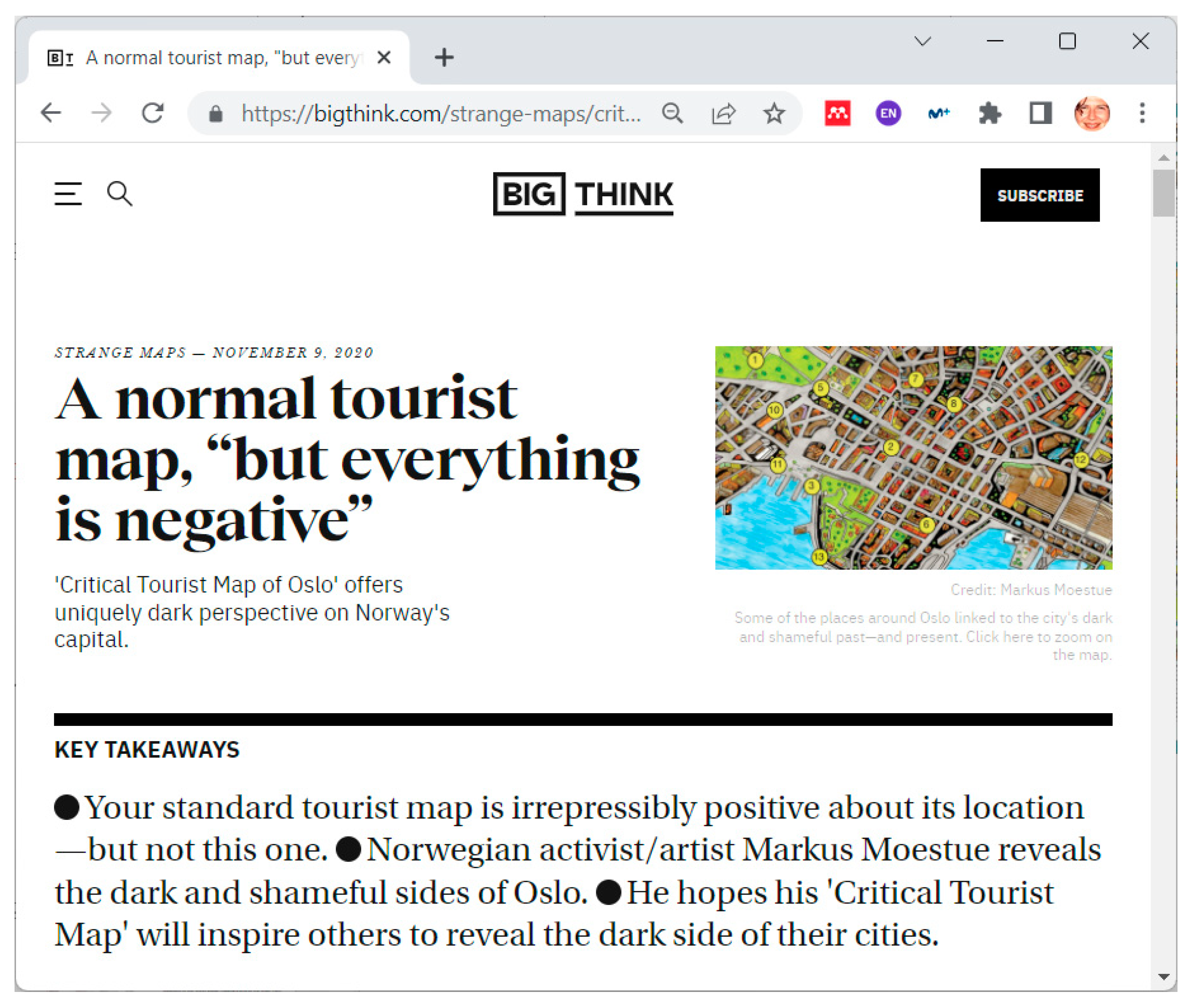
A year after the exhibition of the two first panels of La Manada City, the activist Markus Moestue released his map of Oslo to the media (Figure 7).
That map contravened the standard of tourist maps. It revealed the darkest and most shameful parts of Oslo. Moreover, Moestue hoped his map would inspire others to show the dark side of their cities (Jakobs 2020). Indeed, Moestue confessed: “Why make this map? In most countries, what we are taught about our own nation in school does not correspond much to reality. And Norway is no exception. We are made to believe in myths surrounding our own nation and are given a perfect mirage of excellence and good intentions in our history lessons. Stories of abuse, greed, and war are often swept under the carpet, and it seems that, by some twist of faith, we are born into the best country in the world, and that all other nations are beneath us. Is Norway really the most happy [sic] place, the most environmentally conscious, the most peace-loving, or the most ethical? Hardly! In this map, I aim to correct a few myths, and point to some problematic aspects of Norway and Oslo. And I wish for this map to be a contrast to the mindless commercially motivated map you’ll receive at the tourist information center. The aim is to make this map available to tourists and others on line, but also on printed paper in tourist locations such as hostels or bars in Oslo. Do you own such a place in Oslo? Please get in touch if you want to offer your guests a free non-comercial [sic] tourist map” (Moestue 2021).
Although La Manada City has similarities with Moestue's work (criticism), it shows essential differences. Our map accentuates, together with criticism, an artistic and literary dimension that is not so present in Moestue's case. Oslo's map is essentially denotative and highlights the lie: the emblematic buildings look like one thing, but they are another (remind Greimas and Courtés 1979). The 'honorable' spaces of the city are depicted as symbols of inequality, injustice, aggression against minorities, etc. For example, the monument to the national hero Tordenskiold is commented by emphasizing that he was a colonial-era slaver; or the objectives of the Nobel Peace Centre are questioned by highlighting the falsehood of the myth of Norway as a peace-loving nation after having supported the bombing of Serbia, or the attack on Afghanistan by helping the United States.
Unlike Moestue's map, our research has indeed led to the establishment of thought processes on violence that are highly literary and artistic, both by examining the names painted on the map and by asking what questions they could answer. Firstly, this map makes violence visible in several ways: by asking who says what (who being the subject from which the ways are named and what the ways themselves), from where it is said, how it is shown linguistically at the denotative and connotative level and what relation to reality (autobiographical of the author, local, community or regional, planetary or global) it is put into practice. Secondly, the map shows the effectiveness of the message: surprising the reader with word games and literary devices, insinuating more than explicitly showing, and making the receiver feel more intelligent than when simply reading a street map to orient himself in a city.
4. Last questions: feminism, apotropaic devices, and surrealism
To conclude this manuscript, we pose specific questions.
Regarding feminism: is the street guide a feminist work? Some time ago, we wondered whether feminist writing existed in Spain at the end of the twentieth century (López-Cabrales 2014). The results at the time were contradictory. Spanish women writers were situated between an aversion to being labeled as 'feminists' (understood then as radical politics and even lesbianism) and feeling that, as women, they had accomplished quite a lot. However, facts such as the spread of sexual predators in the style of La Manada have proved to be revulsive, not only for the feminist movement but for the concrete creation of the street guide of La Manada City. La Manada referred to a well-known case of group violence against women committed by a group of men from Seville against a young woman during the San Fermines festivities in Pamplona. They called their WhatsApp group, where they posted their rape videos, La Manada. Eventually, it was found that the crimes committed in Pamplona had also occurred in other parts of Spain. Women’s reactions to this case, from feminist activism to artivism, have been numerous.
As a literary work, the street map of La Manada City is a poetic journey that sinks its feet in encyclopedic eagerness (very masculine) and surrealism (as a way to overcome the experience of harassment). Intersected by the fact of being a woman, of not having been born where the harassment took place, for developing her artistic and professional work in a patriarchal environment, the work of Inma La Inmunda is a unique product that deserves more research (such as the meaning of gold in the artwork, not as a subsidy of power, but as a subversion, a practical alliance with other minorities on the planet who have within their reach shiny discarded objects that, although not composed of this precious metal, bring out a discourse of luxury in poverty, scarcity, and precariousness).
What are the future possibilities of this work in progress since it manifests a dynamic of concealment? We have rescued a work that is not exhibited in its entirety and that deals with such problematic issues for the environment where it was born that it has complicated exhibition possibilities. However, this does not prevent us from recognizing a completely new expression that reworks past issues and denounces and seeks beauty in an environment of violence. Certain correspondences with reality seem to be found on the map, but they are cryptically established as if the author were protecting herself. This is the same protective effect as the apotropaic elements, whose linguistic forms use stylistic devices such as periphrasis or puns to evade the danger from the outside. On the other hand, we suspect that specific names written on the map may hide agents of the gang of harassment, a question that, in some interviews, the author has insinuated with the case of the name Angels (Harassing Angels Chapel). Even on the visual level, there are portraits of possible stalkers that cannot be recognized (the fact of acknowledging them could give rise to a real danger in the artist's life), and other forms of human members that give us clues of a more than uncomfortable reality: this happens in the phallic Stained-Mouth Prick Memorial or those miniature blurred portraits of the Feminists of Patriarchy Park label (Figure 3).
What are the future possibilities of this work in progress since it manifests an outward dynamic?
Each of the spaces on this map may contain the germ of more works (the titles of the streets and other points hint at the possibility of new creations in the manner of an analogical hypertext). We are convinced that La Manada City is a model of maximalist principles applied to painting. The artist has repeatedly demonstrated against the authoritarianism "of Ikea,” of minimalism with nothing to say. And Inma la Inmunda has a lot to tell. Some too many aspects and nuances emerge from the experiences of group violence maintained over time. On the other hand, as we have seen, the map and the street map have an encyclopedic ambition, which is still a work in progress.
The surrealist path appears to be the right one in the inward-outward dynamic of this archive/map/painting. It is not only that Inma la Inmunda's previous work contains surrealist traits, as we have seen. With its rites as a mode of socialization, the city of Seville offers a vision to the foreigner that acquires those effluvia that we are not living something real. When the surrealist poet Oliverio Girondo wrote his poem "Sevillano" (Sevillian), his images could seem surreal to any foreigner. However, any inhabitant of Seville could understand all the elements of its everyday life (López Cabrales 1995).
Author Contributions
Conceptualization, M.M.L.-C. and I. R.-C.; methodology, J.C.-L.; software, J.C.-L; formal analysis, M.M.L.-C., I. R.-C. and J.C.-L.; investigation, M.M.L.-C. and I. R.-C.; resources, I. R.-C.; writing—original draft preparation, M.M.L.-C., J. C.-L., and I. R.-C.; writing—review and editing, I. R.-C.; visualization, I. R.-C.; supervision, M.M.L.-C., and I. R.-C; project administration, I. R.-C; funding acquisition, M.M.L.-C. and I. R.-C. All authors have read and agreed to the published version of the manuscript.
Funding
This research was funded by EU, NextGenerationEU, through Ministerio de Universidades and University of Seville, grant number 19994.

Data Availability Statement
Not applicable.
Acknowledgments
Authors appreciate the wisdom and experience of Mr. Aitor Lanjarin-Encina and the Department of Art and Art History of the Colorado State University, the help and generosity of Mr. Jonathan Carlyon, Chair of the Department of Languages, Literatures and Cultures of the Colorado State University, the open-mindedness and efficacy of Erin Tomkins (International Student and Scholar Services of CSU), and Gretchen Zarle-Lightfoot (assistant to the editor of Confluencia, Revista Hispánica de Cultura y Literatura). Moreover, we would like to highlight the extraordinary assistance of the International Women’s Club of Fort Collins International Center, especially from Sara Hunt. We cannot forget the expertise and kindness of Karen Smith (English teacher at Fort Collins International Center) and our deep love for the outstanding ELS instructor Andrea Heyman. In addition, we thank the careful and generous work of the Front Range Community College staff in Fort Collins.
Conflicts of Interest
The authors declare no conflict of interest.
| 1 | Girondo's poem entitled “Sevillano” shows this reality of rites that may seem surreal if you are not familiar with the city of Seville. "Sevillano"/ In the atrium: a veritable gathering of blind men, even with a badge, a pack of children, barking for a bitch/ The church is refrigerated so that the votive offerings of eyes and arms do not melt ... / Beneath their stiff mantles, virgins raise ruby tears. Some have ponytail hair. Others wear their hearts like a cushion of pins / A cowbell of keys permeates the gloom with a heavy sacristy odor. An ancestral orangutan revives in an old woman when she crosses her forehead./And meanwhile, in front of the high altar, the women's genitals liquefy contemplating a crucifix that bleeds from its sixty-six ribs, and the priest chews a prayer as if it were a "chewing gum.” Translated into English by Cabeza-Lainez. Available in Spanish at: https://docs.google.com/viewer?a=v&pid=sites&srcid=ZGVmYXVsdGRvbWFpbnxiaWJsaW90ZWNhZGlnaXRhbDMyYnxneDoxYjgzYThkMzQ0ZDRiZWQ4
|
References
- Rodríguez-Cunill; et al. Maculadas sin remedio; ICAS (Culture and Art Institute of Seville): Seville, 2019. [Google Scholar]
- Peña Saint Martin, Florencia; López Marroquín, Scherezada. Violencias en las instituciones de educación superior: reflexiones a partir de los trabajos presentados y publicados en tres congresos mexicanos. In Expresiones de violencia en el entorno universitario. Casos, protocolos y estrategias para su erradicación; Castañeda Salgado, M.P., Aguayo Ayala, A., Peña Saint Martin, F., Eds.; Universidad Autónoma Metropolitana: México, 2022. [Google Scholar]
- Rodríguez-Cunill, Inmaculada. La aplastaremos como a una cucaracha: el caso de Inma la Inmunda. In Violencias en la Educación Superior; Evangelista García, A.A., Peña Saint-Martin, F., Mena Farrera, Ramón Abraham, Eds.; 2021a; Available online: https://idus.us.es/handle/11441/129015.
- Rodríguez Muñoz, María Luisa. Nuestra ilustradora: oda a los cuasicristales de Inmaculada Rodríguez-Cunill. Panacea, Revista de Medicina, Lenguaje y Traducción 2019, 50, 120–122. Available online: http://www.tremedica.org/wp-content/uploads/panacea19-50_18_Nuestra_ilustradora_RodriguezMunoz.pdf.
- Pizán, Cristina de; Lemarchand, Marie-José. La ciudad de las damas, 5th ed.; Siruela: Madrid, 2022; p. 1405. [Google Scholar]
- Quevedo, 1627 El mundo por de dentro, en Sueños y discursos. Barcelona. Original de 1627. Available at https://www.cervantesvirtual.com/obra-visor/el-mundo-por-dedentro--0/html/ffc572ee-82b1-11df-acc7- 002185ce6064_17.html.
- Peña Saint Martin, Florencia. Asedio grupal e indignación: un análisis de su relación. In Peña Saint Martin, Florencia and Fernández Marín, Silvia Karla. Mobbing: haciendo visible lo invisible; Ediciones Eón: México, 2017; pp. 71–87. [Google Scholar]
- Greimas, A.J.; Courtés, J. Semiótica. Diccionario Razonado de la Teoría del Lenguaje; Gredos: Madrid, 1979. [Google Scholar]
- Anand, Shaina. 10 Thesis on the Archive. In Autonomous Archiving; Artikişler, Collective, Ed.; dpr-barcelona: Barcelona, 2016; pp. 79–94. Available online: https://monoskop.org/images/c/cd/Artikisler_Collective_ed_Autonomous_Archiving_2016.pdf.
- Casa Grande del Pumarejo. Inma “La Inmunda” en la Casa del Pumarejo. Video material about the public presentation of Inma La Inmunda y los Esquizos, 4th December of 2015 at House-Palace of Pumarejo (Seville), with a versión of “The java of the atomic bombs” by Boris Vian.. 4’:52” Available at : https://pumarejo.org/inma-la-inmunda-en-la-casa-del-pumarejo-2/.
- La Inmunda, Inma. Anno Murillo, Submundo Patriarcal. In El Topo; Farándulas, 2017; Available online: https://eltopo.org/anno-murillo-submundo-patriarcal/.
- Rodríguez-Cunill, Inmaculada. Invisibilización I. Commentary and video recording of the presentation performance for the audio-installation Noise for those who do not want to listen to in the Casa de las Sirenas (Seville). 2017. Available online: http://machacadas.blogspot.com/2017/01/invisibilizacion-i.html?m=1.
- Ceballos Cuadrado, Antonia. Las Maculadas desenmascaran a Murillo. La Poderío. 2018. Available online: https://lapoderio.com/2018/12/11/las-maculadas-desenmascaran-a-murillo/.
- Cunill, Inmaculada Rodriguez. La piedra de Inma la Magnánima. Confluencia, revista hispánica de cultura y literatura 2021, 37, 195–202. [Google Scholar] [CrossRef]
- Cabeza Lainez, José María. La vision y la voz: Arte, ciudad y cultura en Asia Oriental; University of Cordoba: Córdoba, Spain, 2019. [Google Scholar]
- Cabeza-Lainez, Joseph M.; Almodovar-Melendo, Jose M. Daylight, Shape and Cross-Cultural Influences Through the Routes of Discoveries: the case of Baroque Temples. Space and Culture 2018, 21, 375–394. [Google Scholar] [CrossRef]
- Jackobs, Frank. A normal tourist map, “but everything is negative.” ‘Critical Tourist Map of Oslo’ offers a uniquely dark perspective on Norway’s capital. In Big Think; 2020; Available online: https://bigthink.com/strange-maps/critical-tourist-map/.
- Moestue, Markus. Critical tourist map of Oslo. 2021. Available online: https://markusmoestue.no/Criticaltouristmap.html.
- López Cabrales, María del Mar. Nuevas cuentistas españolas frente al feminismo: teoría y producción. Bulletin Hispanique 2014, 166, 439–449. Available online: https://journals.openedition.org/bulletinhispanique/3303.
- López Cabrales, María del Mar. La Sevilla de Oliverio Girondo. Lo eterno dentro de lo moderno. In La modernidad literaria en España e Hispanoamérica: actas del I Simposio Internacional de la Modernidad Literaria, en homenaje a Julio Vélez Noguera; Universidad de Salamanca: Salamanca, 1995; pp. 83–92. [Google Scholar]
Figure 1.
La Manada City, Commemorative map of the last four centuries of Patriarchy, by Inma la Inmunda. 2018-2021. Work in progress in a painting shape. Eight pieces (100x150 cm. each). Horizontal layout. Pill blisters, exoskeletons of stuffed sea animals, pieces of methacrylate, and other objects from recycling. Acrylics, lacs, and oil painting on wood. Source: Inma la Inmunda.
Figure 1.
La Manada City, Commemorative map of the last four centuries of Patriarchy, by Inma la Inmunda. 2018-2021. Work in progress in a painting shape. Eight pieces (100x150 cm. each). Horizontal layout. Pill blisters, exoskeletons of stuffed sea animals, pieces of methacrylate, and other objects from recycling. Acrylics, lacs, and oil painting on wood. Source: Inma la Inmunda.

Figure 2.
La Manada City, Commemorative map of the last four centuries of Patriarchy, by Inma la Inmunda. 2018-2021. Work in progress in a painting shape. Eight pieces (100x150 cm. each). 4:3 disposition in two rows. Pill blisters, exoskeletons of stuffed sea animals, pieces of methacrylate, and others objects from recycling. Acrylics, lacs, and oil painting on wood. Source: Inma la Inmunda.
Figure 2.
La Manada City, Commemorative map of the last four centuries of Patriarchy, by Inma la Inmunda. 2018-2021. Work in progress in a painting shape. Eight pieces (100x150 cm. each). 4:3 disposition in two rows. Pill blisters, exoskeletons of stuffed sea animals, pieces of methacrylate, and others objects from recycling. Acrylics, lacs, and oil painting on wood. Source: Inma la Inmunda.
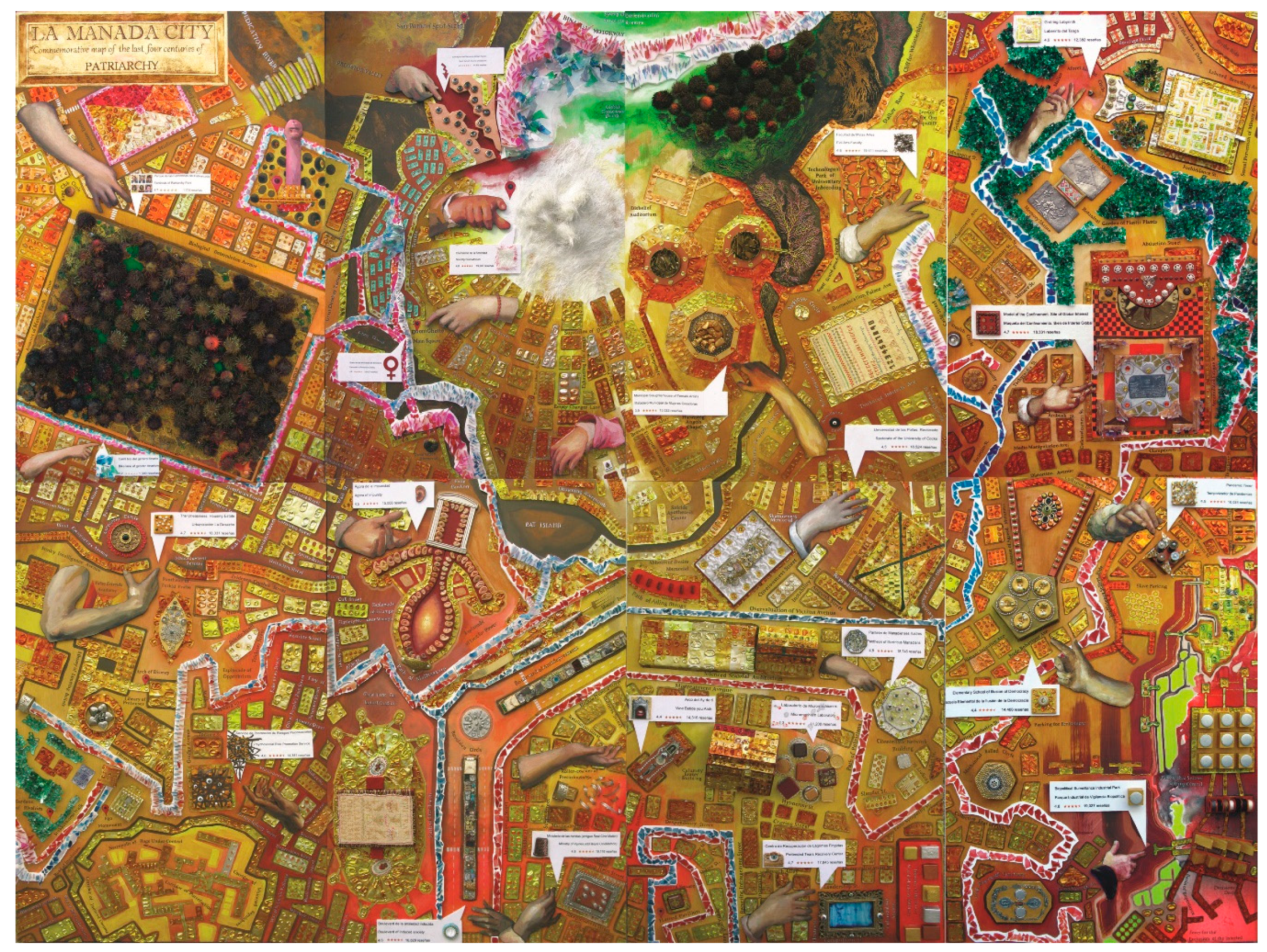
Figure 3.
Detail of signals of Feminists of Patriarchy Park. Source: Inma la Inmunda.
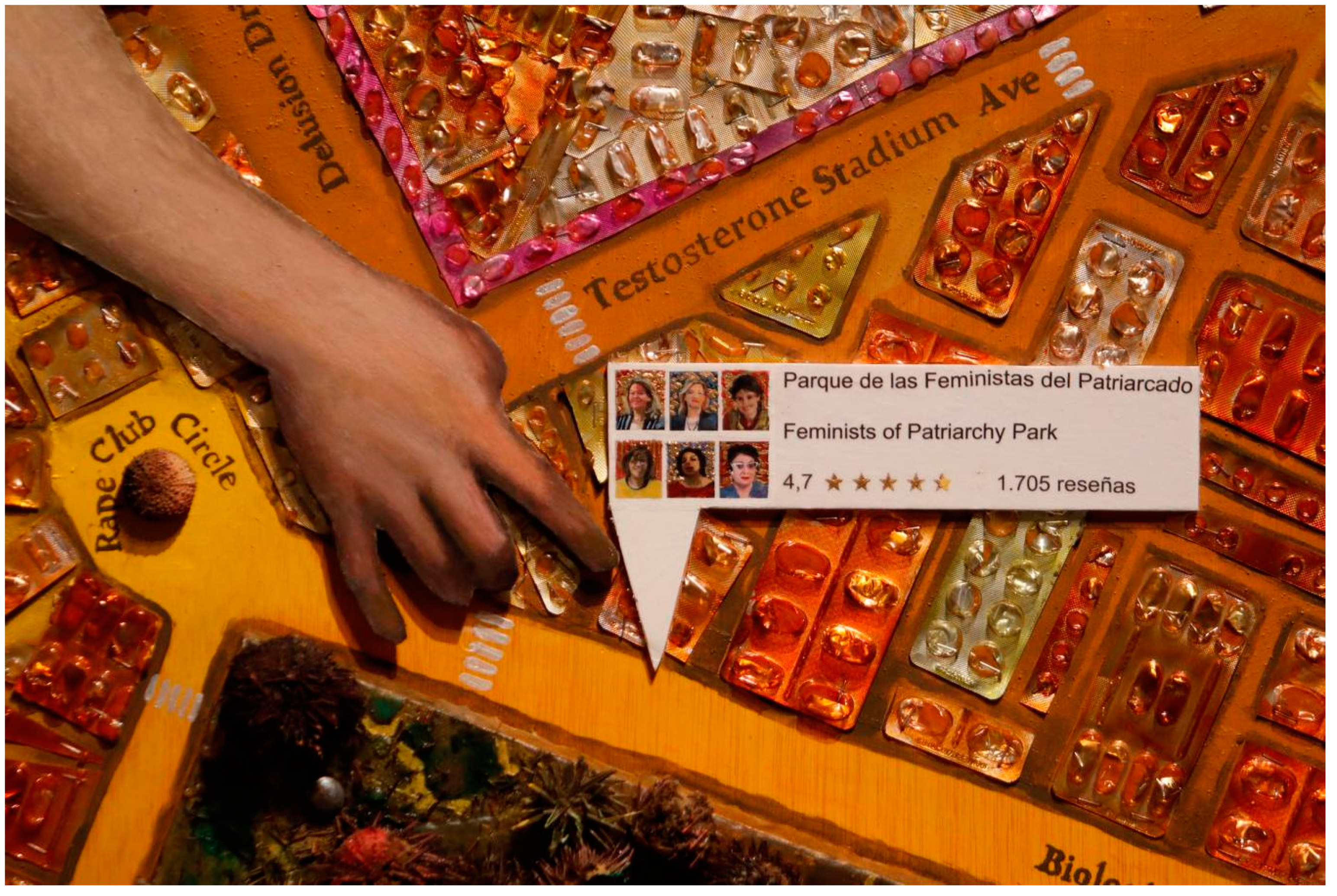
Figure 4.
Details of La Manada City (a) Psychological Risk Promotion Service; (b) Pretended Tears Recovery Center. Source: Inma la Inmunda.
Figure 4.
Details of La Manada City (a) Psychological Risk Promotion Service; (b) Pretended Tears Recovery Center. Source: Inma la Inmunda.
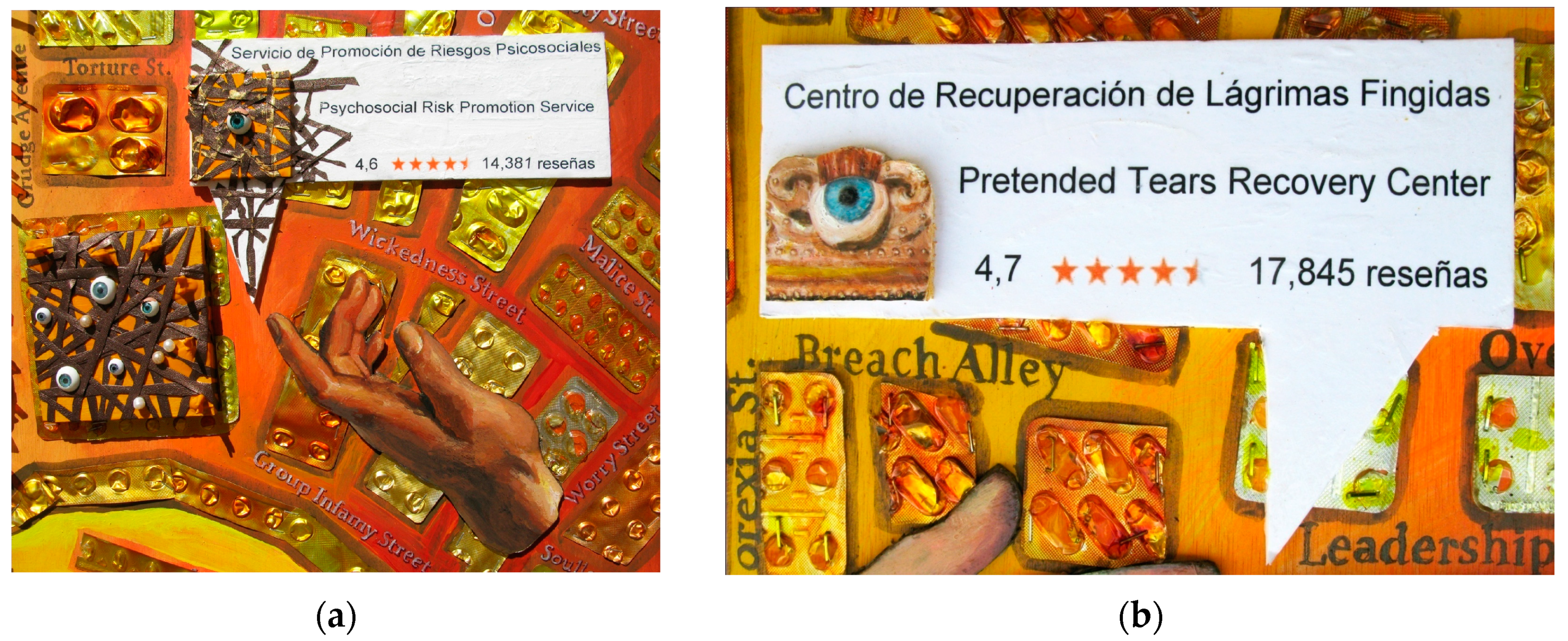
Figure 5.
Details of La Manada City (a) Dystopian Present Street, near the Pandemic Timer; (b) Elementary School of Illusion of Democracy. Source: Inma la Inmunda.
Figure 5.
Details of La Manada City (a) Dystopian Present Street, near the Pandemic Timer; (b) Elementary School of Illusion of Democracy. Source: Inma la Inmunda.
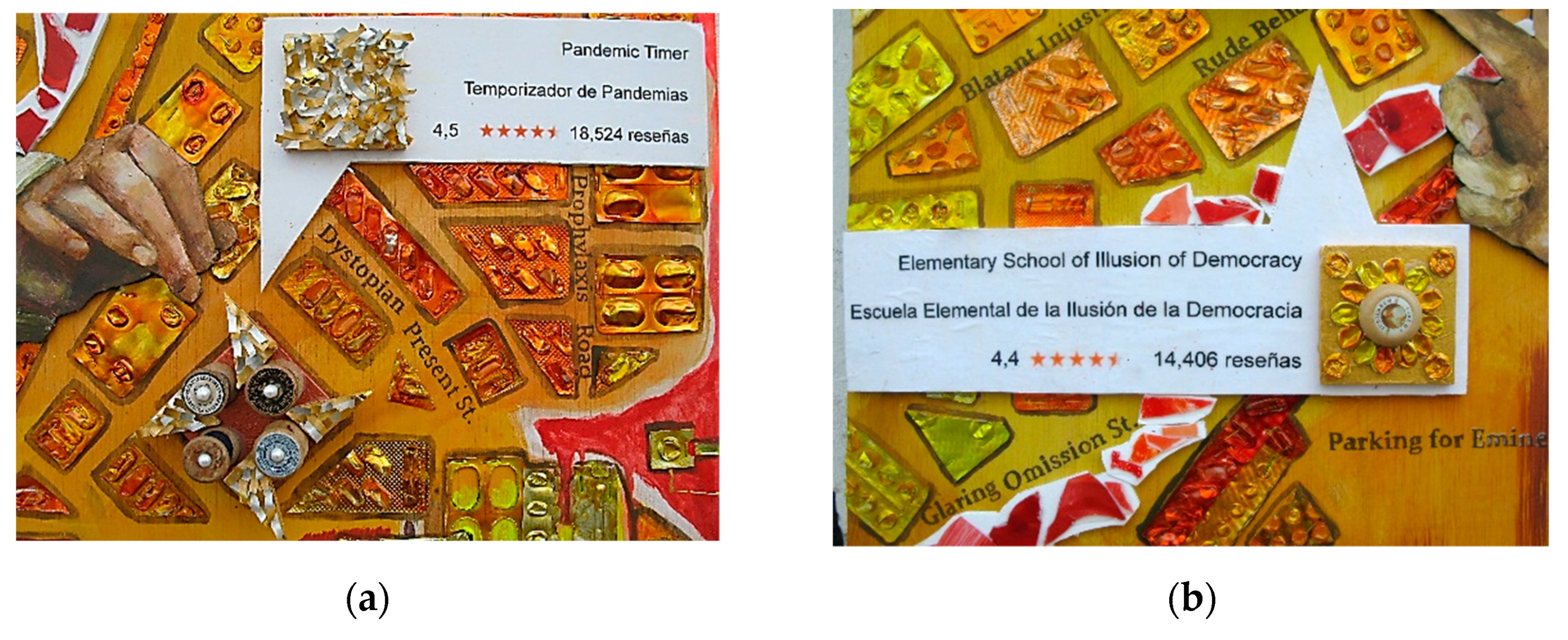
Figure 6.
Logos of Inma la Inmunda (a) Registered trademark. Source: Spanish Patent and Trademark Office M-3683422. Image available at https://www.empresia.es/distintivo/inma-la-inmunda/oepm/m-3683422/; (b) Signature on The Manada City. Source: Inma la Inmunda.
Figure 6.
Logos of Inma la Inmunda (a) Registered trademark. Source: Spanish Patent and Trademark Office M-3683422. Image available at https://www.empresia.es/distintivo/inma-la-inmunda/oepm/m-3683422/; (b) Signature on The Manada City. Source: Inma la Inmunda.
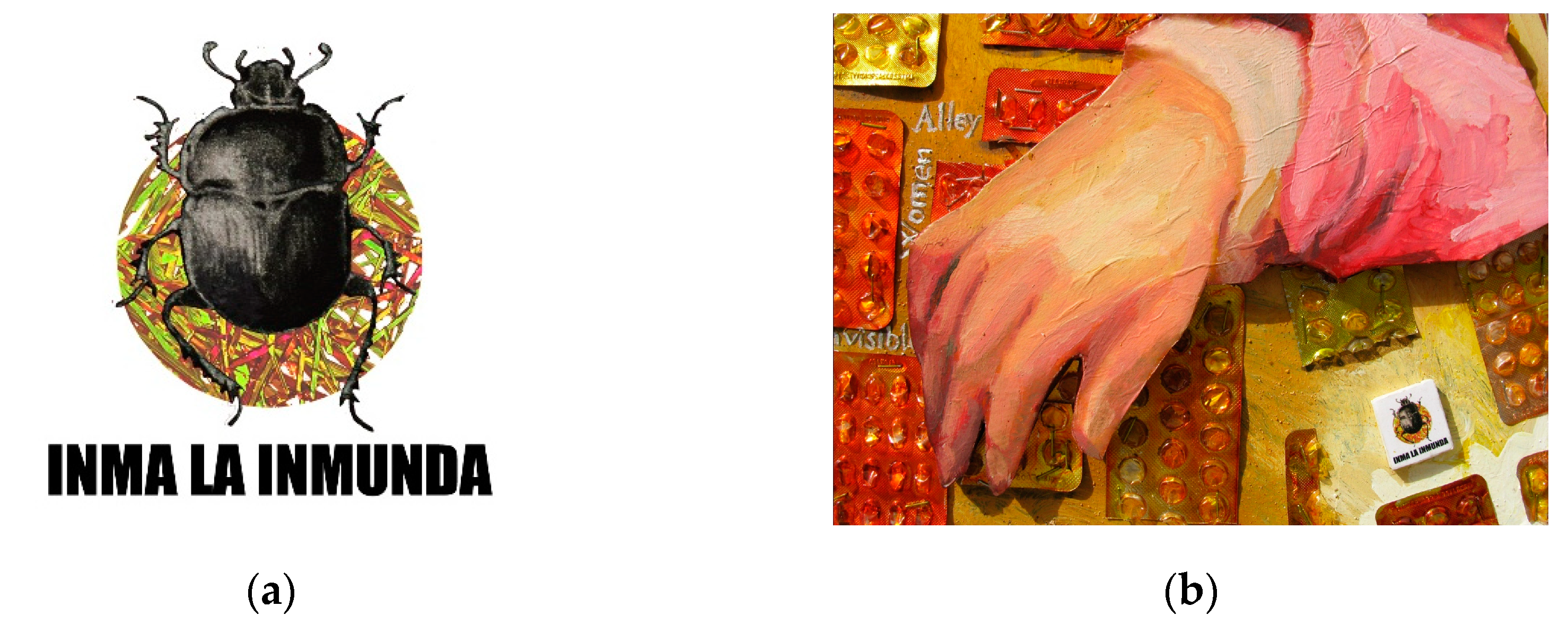
Figure 7.
Piece of news about the critical touristic map of Oslo made by Markus Moestue. Source: https://bigthink.com/strange-maps/critical-tourist-map/
Figure 7.
Piece of news about the critical touristic map of Oslo made by Markus Moestue. Source: https://bigthink.com/strange-maps/critical-tourist-map/
Disclaimer/Publisher’s Note: The statements, opinions and data contained in all publications are solely those of the individual author(s) and contributor(s) and not of MDPI and/or the editor(s). MDPI and/or the editor(s) disclaim responsibility for any injury to people or property resulting from any ideas, methods, instructions or products referred to in the content. |
© 2023 by the authors. Licensee MDPI, Basel, Switzerland. This article is an open access article distributed under the terms and conditions of the Creative Commons Attribution (CC BY) license (http://creativecommons.org/licenses/by/4.0/).
Copyright: This open access article is published under a Creative Commons CC BY 4.0 license, which permit the free download, distribution, and reuse, provided that the author and preprint are cited in any reuse.


