

Submitted:
18 April 2023
Posted:
19 April 2023
You are already at the latest version
Abstract
This study aims to evaluate the determinants that influence the adoption of online databases in the learning process of students at economics universities in Vietnam. A quantitative study with a meta-analysis was conducted by utilizing structural equation modeling (SEM). The sample consisted of 492 students from economics universities located in Vietnam who were surveyed using stratified random sampling. The results indicate that the adoption of online databases in student learning is influenced by six determinants, namely: (i) perceived effectiveness, (ii) perceived ease of use, (iii) technical barriers, (iv) personal usefulness, (v) usage attitudes, and (vi) convenience. Our study has revealed that students' intention to use the online database system is positively influenced by their perceived ease of use and perceived usefulness. These findings could be valuable in shaping policies for enhancing the online database system at economics universities, taking into account the students' characteristics and the institution's needs.
Keywords:
Economics universities
; Learning
; Online database systems
; Students
1. Introduction
Technology has greatly impacted human life,
particularly in the field of education. As a result, the development of online
database systems at universities is rapidly increasing both globally (Azzi-Huck
and Shmis, 2020; Shahzad and Lodhi, 2020) and in Vietnam. The United States, a
leader in education, has over 80% of its universities developing their online
database systems, according to Cyber Universities 2018 statistics. Similarly,
Vietnamese universities have been developing online database systems, such as
the Learning Management System (LMS) and online libraries, to support student
learning.
Policymakers and service system developers from
universities should identify the factors that affect student usage to
effectively develop online databases. While studies evaluating the factors
influencing the use of online database systems are common worldwide, some
notable studies have identified key factors affecting the success of the
learning management system (Jafari and Salem, 2015) and the use of academic online
databases in higher education (Piotrowski et al., 2005). These studies
highlight the importance of understanding the needs of both students and
faculty members to effectively develop online database systems that meet their
requirements. However, in the context of Vietnam, research on the use of
online databases is still limited, as most Vietnamese universities have only
recently begun developing these systems. At economics universities, the online
database system has only been promoted since 2019 due to the Covid pandemic,
and there has not been a study on the factors affecting the effectiveness of
student use. Therefore, conducting systematic research is essential to improve
the online database system in universities.
The remainder of this study is organized as
follows: Section 2 reviews the previous
studies on online database systems, including LMS, e-library, and e-learning. Section 3 describes the methodology used to
collect the data sample. Section 4
presents the results of the analysis and discusses potential solutions.
Finally, Section 5 provides some key
conclusions for practical applications and recommendations.
2. Literature Review
The purpose of identifying the most significant
difficulties of high school students in using online databases and CDROMs,
thereby proposing design elements and instructional strategies to make these
tools more valuable as learning resources and identify the most important
issues related to the use of electronic information resources in schools, used
the Delphi (Neuman, 1995) research method with a panel of 25 librarians from 22
high schools across the United States to produce findings that the main issues
associated with schools' use of online databases and CD-ROMs were the creation
of search keywords, effective search methods, and overcoming mismatches between
individual ideas of how to organize information and how the information is
organized in the contents of the databases.
Groote and Dorsch (2003) conducted an outreach
survey of 188 UIC Peoria faculty, residents, and students to assess the use of
online journals, use of print journals, use of databases, level of computer literacy,
and other characteristics of library users. The conclusion is that users prefer
online resources for printing, and many choose to access these online resources
remotely. The result of the study also shows that the
usability of electronic libraries is a factor promoting the use of users for
this system, the convenience and availability of the entire text seem to play a
role in the selection of online resources for users.
To study the use of academic online databases in
education at the University of West Florida, a survey involving the use of
faculty staff and perspectives towards online databases is
conducted (Piotrowski et al., 2005). Most respondents (n =
46) felt fairly consistent with academic databases via the library at the
university. However, some faculty members argue that databases such as updated
figures and social science citation indicators should be proposed for future
inclusion. (Booker et al., 2012) also carry out research for business students
on the delivery of information literacy instruction (ILI) to the
application of online library resources (OLR) by business students. Research
using web-based surveys, including closed-ended and open-ended questions, was
conducted for 337 business students. The analysis results based on the TAM theoretical
model indicate that the ILI of students is only beneficial in the early stages
of using the library's digital resources. This benefit will be reduced or very
little in the final results of use. At Limkokwing University of Innovative
Technology in Malaysia, a study of the factors influencing the success of LMS
was conducted by (Jafari et al., 2015). The research model was developed by
examining the relationship between student outcomes (perceived usefulness) and
information quality, system quality, and readiness for online learning through
the use of systems and user satisfaction, quantitative data obtained through
questionnaires. After analysis, the data indicated that all relationships from
the independent variable to the dependent variable were significant, including
(A) System quality, (B) Information quality, (D) System use, (E) User
satisfaction (F) User perceived usefulness, except for the relationship between
readiness for e-learning and system use. The most influential variable is the
quality of information about user satisfaction and perceived usefulness, and
the least influential variable is readiness for online learning, system use,
and perceived usefulness. At Bareyo University, a study of the factors
affecting the use of electronic databases by academic staff conducted by (Farouk and Muhammad, 2016) with the purpose of the study is to investigate the level of
use, the enabling factors, and the factors that impede the use of electronic
databases in the university's library. The study uses a descriptive statistical
approach to analyze the data collected and offers factors that facilitate the
use of the database, some of which include: readiness to adapt to change,
availability of computers and ICT skills, internet access, management support
and awareness of the user's initial electronic database. However, the cost of
accessing and using online databases, infrequent power supplies, a lack of
awareness, and too many difficult-to-remember passwords was found to be obstacles
to the use of electronic databases. In another study, (Chen et al., 2019)
launched a database examination study using structural equation modeling and
Rasch modeling to explore the contributing factors of learning and research in
higher education from a psychological assessment perspective. The study used
ODAS modeling and feedback analysis of 300 graduate students in Shanghai,
collected using the stratified random sample technique. The results showed that
graduate students' usefulness and ease of use of the database played an
intermediate role in establishing a connection between self-efficacy and their
intention to use computers and satisfaction with the database for research and
learning. In addition, the results of the analysis show that student satisfaction
is indirectly explained by the usefulness of the database through ease of use
and intention to use.
Regarding the domestic database system, domestic
studies mainly focus on specific types of databases. It is possible to mention
the research on factors affecting the intention to use the E-learning system of
students: the case of Hanoi University of Technology (Le and Dao, 2016). This
research has provided useful suggestions for policymakers and developers of
e-learning systems at the economics universities, such as: towards the core
interests of learners; building friendly systems, and improving technical
barriers. In addition, the factors affecting students' intention to use mobile
applications for education in Vietnam (Cao and Nguyen, 2022)
have contributed three basic meanings to science and practice: the suitability
of the research model based on the TAM model; factors affecting the intention
to use mobile applications for education; as a reference source for related
studies. At the same time, it offers solutions to enhance applications such as
investing in research and design; adding features and experiences; solving
technical barriers, and improving application efficiency. It is impossible not
to mention the research on the factors affecting the
intention to use e-libraries of students at universities
in Hanoi (Vu et al., 2020) based on the TAM model to
conclude: The electronic library provides information and documents on many
different topics, covering a long time; Regular and timely updates will help
students' learning, helping to increase the intention to use electronic
libraries. At the same time, they also recommend promoting communication about
electronic libraries to students; pointing out weaknesses to overcome.
Previous research has primarily focused on specific
database subjects such as LMS, e-library, and e-learning, but there is a lack
of research related to the online database system in general, especially in the
context of economics universities in Vietnam. Therefore, this study aimed to
investigate the determinants that impact the use of the online database system
in the learning of students at six economics universities. The study provides
recommendations to improve the efficiency of the online database system and to
better meet the needs of students in the university.
3. Theoretical Framework and Methodology
3.1. Theoretical Framework
The theory of Reasoned Action (TRA) explains
consumer behavior and determines their behavioral predisposition based on
general feelings of liking or disliking, which lead to behavior, and subjective
norms, which refer to the influence of others on their attitudes (Fishbein and
Ajzen, 1975).
Technology Acceptance Model (TAM) is a theoretical
model used to evaluate the effects on the choice behavior of using
technological devices for individual or collective needs (Davis, 1989).
Theory of Planned Behavior (TPB) is a theory
developed from the TRA, which assumes that a behavior can be predicted or
explained by behavioral tendencies to perform that behavior. Behavioral
tendencies include motivational factors that influence behavior and are defined
as the degree of effort that people put into the behavior (Ajzen, 1991).
3.2. Research methodology
The sample consisted of 492 students from six
economics universities in Vietnam, selected through stratified random sampling.
The data was collected through a questionnaire containing 26 observed
measurement variables for seven proposed groups of factors, including six
independent factors and one dependent factor. The proposed factor groups were
developed based on the research of Jalilvand et al. (2012), and the study used
exploratory factor analysis (EFA), confirmatory factor analysis (CFA), and
structural equation modeling (SEM) for data analysis. The sample size for the
study was n=492. The study focused on analyzing and synthesizing six concepts
and problems related to the use of database systems. These concepts and
problems were selected from various studies, including perceived ease of use
and perceived usefulness (Davis, 1993; Venkatesh et al., 2003; Roca and Gagné,
2008; Park, 2009; Cakir and Solak, 2014; Mohammadi, 2015), perceived
effectiveness (Park, 2009; Park et al., 2012), convenience (Berry et al., 2002;
Gupta and Kim, 2006), attitude to use (Ajzen, 1991; Chou and Hsu, 2016; Tsang
et al., 2004), and technical barriers (Julander and Soderlund, 2003; Le and
Dao, 2015).
Based on the theoretical models of the theory of
Reasoned Action (TRA), Technology Acceptance Model (TAM), and Theory of Planned
Behavior (TPB), and the results of the research by Le and Dao (2015), we
proposed a theoretical model that identified factors affecting the use of
online database systems in the learning of students at economics universities
in Vietnam. The influencing factors were measured by six factors: perceived
effectiveness, perceived ease of use, technical barriers, perceived usefulness,
attitude to use, and convenience.
Perceived effectiveness (PE) was defined as the
personal perception of an individual's ability to use the system effectively.
Individuals believe that their ability to use the system will impact the
expectations and usefulness of the service and promote their intention to use
the system. It was affirmed that perceived effectiveness had a significant
influence on the perceived usefulness and intention to use the E-learning
system of students at Hanoi University of Science and Technology (Le and Dao,
2015).
Hypothesis H1a:
The perceived effectiveness of the online database system has a positive impact on students' intention to use it for learning purposes.
Hypothesis H1b:
Perceived effectiveness positively impacts the perceived usefulness of the online database system.
Perceived ease of use (PEU):
According to research by Le, 2016, perceived ease of use is the perception of
the ability to easily use the service when individuals are exposed to the
service system. The studies of Taylor and Todd (1995);
Venkatesh and Davis (2000); Saroia and Gao (2018) have shown the synergistic effect of perceived ease of use on
perceived usefulness on the indirect intention of use.
Perceived ease of use helps users have a happy attitude, and enjoy using
services and products, thereby improving the intention to use (Pavlou and
Fygenson, 2006).
Hypothesis H2a:
Perceived ease of use positively influences the perceived usefulness of the online database system.
Hypothesis H2b:
Perceived ease of use has a positive impact on the attitude towards using the online database system.
Technical barriers (TB): Based
on the research theory of (Julander and Soderlund, 2003),
technical barriers are the disadvantages in terms of technology and techniques
to access the service system. Technical barriers have a major impact on the
system acceptance process. Therefore, to develop the system effectively,
technological and technical factors must be focused on reducing technical
barriers for users (Le and Dao, 2015).
Hypothesis H3:
Technical barriers negatively affect students' intention to use the online database system for learning purposes.
Perceived usefulness (PU):
Perceived usefulness is the degree to which users feel that using the system
will help them improve their efficiency at work. In addition, the usefulness of
the service is shown by helping customers save time, costs, and access to
diverse services (Davis 1993, Erk and Evans 2016). Studies by Park and Chen
(2007), and Kim et al. (2013) concluded that the greater the perceived
usefulness of users, the greater the influence on the intention to use.
Hypothesis H4:
Perceived usefulness has a positive influence on students’ intention to use the online database system for learning purposes.
Attitude to use (ATU): According
to Ajzen (1991), the intention to use something is
directly influenced by "attitude", "subjective norm" and
"behavioral control perception". Attitude is defined as an
individual's positive or negative emotions when performing a behavior with a
clear purpose (Hsu, 2016). When the individual has a positive attitude toward
an action, the likelihood of performing that action is higher (Tsang, 2004).
Hypothesis H5:
A positive attitude towards using the online database system has a positive impact on students' intention to use it for learning purposes
Convenience (CE): According to
mental computation theory, convenience means consuming less physical and mental
energy to reduce time and effort to increase the benefits of activities. For
services or technology products, convenience is also the ability to access and
use the service system, which the service system provides to users (Berry et
al., 2002). In a study by Gupta and Kim (2006), it was
shown that the convenience of the service also boosts the user’s intention to
use the service system.
Hypothesis H6:
Convenience has a positive influence on students’ intention to use the online database system for learning purposes.
Summarize the theory of previous research works,
combine with the analysis and determination of gaps in research in different
samples. We proposed a research model to study the factors affecting the use of
online database systems in learning among students at economics universities (Figure 1).
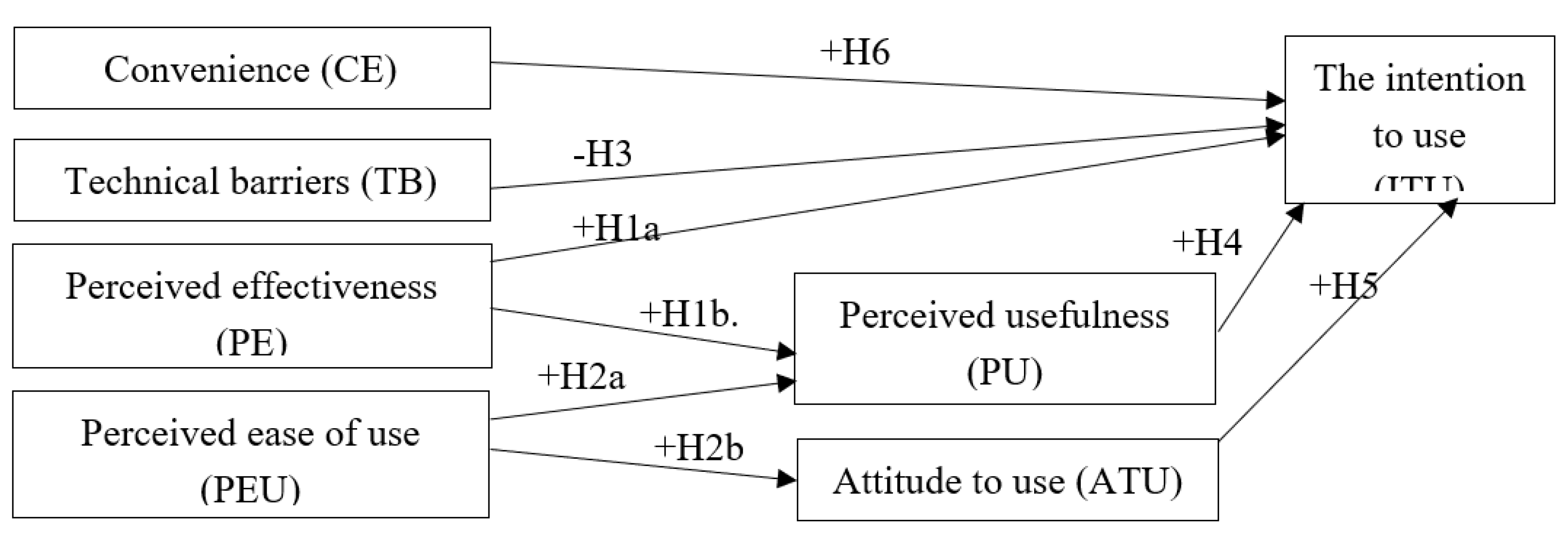
Figure 1.
Proposed research model.
4. Results
4.1. Scale Reliability Evaluation
Out of the 492 surveys collected, inappropriate
responses such as incomplete responses and responses with the same answer for
all observations were excluded. The number of appropriate responses included in
the analysis was 492, which is higher than the minimum sample size of 145
required for this study. The reliability of the scale was assessed using
Cronbach's Alpha coefficient. The results of the Cronbach's Alpha test for
variable groups in the study model show that:
Based on the test results in Tables 1 and 2, all 29 observed variables
showed satisfactory results, indicating that the scale used in the
implementation of EFA is reliable. Therefore, 29 observations are sufficient to
ensure the reliability of the scale.

Table 1.
Cronbach's Alpha Scale Reliability Test Results.
| Items | PEU | PE | TB | PU | ATU | CE | ITU | |
|---|---|---|---|---|---|---|---|---|
| Cronbach's Alpha | 0.851 | 0.763 | 0.805 | 0.802 | 0.785 | 0.837 | 0,866 | Total |
| Number of inspection observations | 05 | 03 | 04 | 04 | 03 | 05 | 05 | 29 |
| The number of observations accepted | 05 | 03 | 04 | 04 | 03 | 05 | 05 | 29 |
| Number of observations removed | 00 | 00 | 00 | 00 | 00 | 00 | 00 | 00 |
Table 2.
Cronbach’s Alpha and Pattern Matrix after extracting unmoderated items.
| Items | Factor | Cronbach’s Alpha | ||||||
|---|---|---|---|---|---|---|---|---|
| 1 | 2 | 3 | 4 | 5 | 6 | 7 | ||
| Perceived ease of use(PEU) | 0.851 | |||||||
| PEU4 | 0.862 | 0.813 | ||||||
| PEU5 | 0.767 | 0.825 | ||||||
| PEU2 | 0.709 | 0.815 | ||||||
| PEU1 | 0.645 | 0.822 | ||||||
| PEU3 | 0.625 | 0.828 | ||||||
| Convenience(CE) | 0.837 | |||||||
| CE2 | 0.786 | 0.795 | ||||||
| CE3 | 0.723 | 0.802 | ||||||
| CE4 | 0.720 | 0.797 | ||||||
| CE1 | 0.676 | 0.809 | ||||||
| CE5 | 0.609 | 0.816 | ||||||
| The intention to use(ITU) | 0.866 | |||||||
| ITU3 | 0.839 | 0.833 | ||||||
| ITU2 | 0.716 | 0.842 | ||||||
| ITU5 | 0.709 | 0.829 | ||||||
| ITU1 | 0.655 | 0.838 | ||||||
| ITU4 | 0.533 | 0.845 | ||||||
| Technical barriers(TB) | 0.805 | |||||||
| TB3 | 0.753 | 0.761 | ||||||
| TB4 | 0.736 | 0.744 | ||||||
| TB1 | 0.672 | 0.753 | ||||||
| TB2 | 0.619 | 0.764 | ||||||
| Perceived usefulness(PU) | 0.802 | |||||||
| PU3 | 0.748 | 0.738 | ||||||
| PU4 | 0.713 | 0.758 | ||||||
| PU1 | 0.695 | 0.759 | ||||||
| PU2 | 0.678 | 0.755 | ||||||
| Perceived effectiveness(PE) | 0.763 | |||||||
| PE2 | 0.732 | 0.664 | ||||||
| PE1 | 0.698 | 0.688 | ||||||
| PE3 | 0.680 | 0.695 | ||||||
| Attitude to use (ATU) | 0.785 | |||||||
| ATU3 | 0.736 | 0.680 | ||||||
| ATU1 | 0.701 | 0.715 | ||||||
| ATU2 | 0.665 | 0.731 | ||||||
| Kaiser-Meyer-Olkin (KMO) Measure of Sampling Adequacy | 0.901 | |||||||
| Sig. (Bartlett’s Test of Sphericity) | 0.000 | |||||||
| Cumulative (%) | 65.100 | |||||||
| The Value of Initial Eigenvalue | 1.101 | |||||||
4.2. Exploratory Factor Analysis (EFA)
By PCA extraction and Promax rotation, EFA test
results of independent variables for KMO and Barlett's test results showed that
KMO = 0.901 > 0.05 and Sig.=0.000 < 0.05, thereby concluding that the
observed variables included in the analysis are correlated with each other and
the appropriate EFA discovery factor analysis used in this study in Table 3.
The results of the factor analysis also show that
the total variance explained is 65,100% > 50%, and the stopping point when
deducting at the 7th factor is 2,722>1 all meet the conditions. Seven
factors were drawn from the analysis of 29 included scales.
Table 3.
Results of EFA exploratory factor analysis for independent variables.
| KMO and Bartlett's Test | ||
|---|---|---|
| Kaiser-Meyer-Olkin Measure of Sampling Adequacy. | 901 | |
| Bartlett's Test of Sphericity | Approx. Chi-Square | 6253,089 |
| df | 406 | |
| Sig. | 0.000 | |
The Rotation Matrix results of the EFA analysis
show that 7 new groups of factors with observed variables with factor load
coefficients greater than 0.3 are satisfactory.
4.3. Confirmatory Factor Analysis (CFA)
Look at the CFA results for the model in Table 4:
First, because Chi-square/df = 1.852 < 2, TLI =
0.942 > 0.90, CFI = 0.949 > 0.90, and RMSEA = 0.042 < 0.08, it can be
said that the model is suitable for the market data.
Table 4.
Model fit results.
| CMIN/DF | CFI | TLI | RMSEA |
|---|---|---|---|
| 1.852 | 949 | 0.942 | 0.042 |
Second, the (normalized) weights are all greater
than 0.5. In which, it ranges from 0.666 to 0.797 and all have P < 0.05, so
the scales reach the convergence value.
Third, because the model is consistent with market
data and the observed variables are not correlated, the scale achieves
unidirectionality based on indicators: AVE > 0.5 and CR > 0.7.
Fourth, the AVE coefficients of the above 7 groups
are all larger than MSV, so the scale achieves differentiation. Thus, the model
is consistent with market data, the concepts of achieving convergent value,
achieving unidirectionality, distinguishing value, and measuring scale
reliability in Table 5.
Table 5.
CR and AVE evaluation table.
| CR | AVE | MSV | MaxR(H) | CE | PEU | TB | ITU | ATU | PU | PE | |
|---|---|---|---|---|---|---|---|---|---|---|---|
| CE | 0.838 | 0.51 | 0.366 | 0.84 | 0.714 | ||||||
| PEU | 0.852 | 0.535 | 0.306 | 0.853 | 0.343*** | 0.732 | |||||
| TB | 0.805 | 0.509 | 0.356 | 0.807 | 0.391*** | 0.372*** | 0.713 | ||||
| ITU | 0.866 | 0.565 | 0.402 | 0.868 | 0.605*** | 0.553*** | 0.597*** | 0.751 | |||
| ATU | 0.786 | 0.551 | 0.362 | 0.792 | 0.559*** | 0.199*** | 0.537*** | 0.602*** | 0.742 | ||
| PU | 0.802 | 0.504 | 0.133 | 0.804 | 0.364*** | 0.269*** | 0.197*** | 0.363*** | 0.169** | 0.71 | |
| PE | 0.764 | 0.519 | 0.402 | 0.766 | 0.313*** | 0.509*** | 0.499*** | 0.634*** | 0.434*** | 0.229*** | 0.72 |
4.4. Structural Equation Modeling Analysis (SEM)
According to the following summary table, in theory for good, the three indicators GFI, TLI, and CFI are all above 0.9. However, it is difficult to achieve all three indicators. According to (Nguyen and Nguyen, 2008), the model with TLI, CFI ≥ 0.9 and CMIN/df ≤ 3, and MRSEA ≤ 0.08 is acceptable. Take this criterion and compare it with the actual acceptable results of the data set by the model.
The SEM model analysis results show that the research model is consistent with market data: Chisquare; CMIN/df = 2.362; GFI = 0.897; TLI = 0.908; CFI = 0.918; RMSEA = 0.053 in Figure 2.
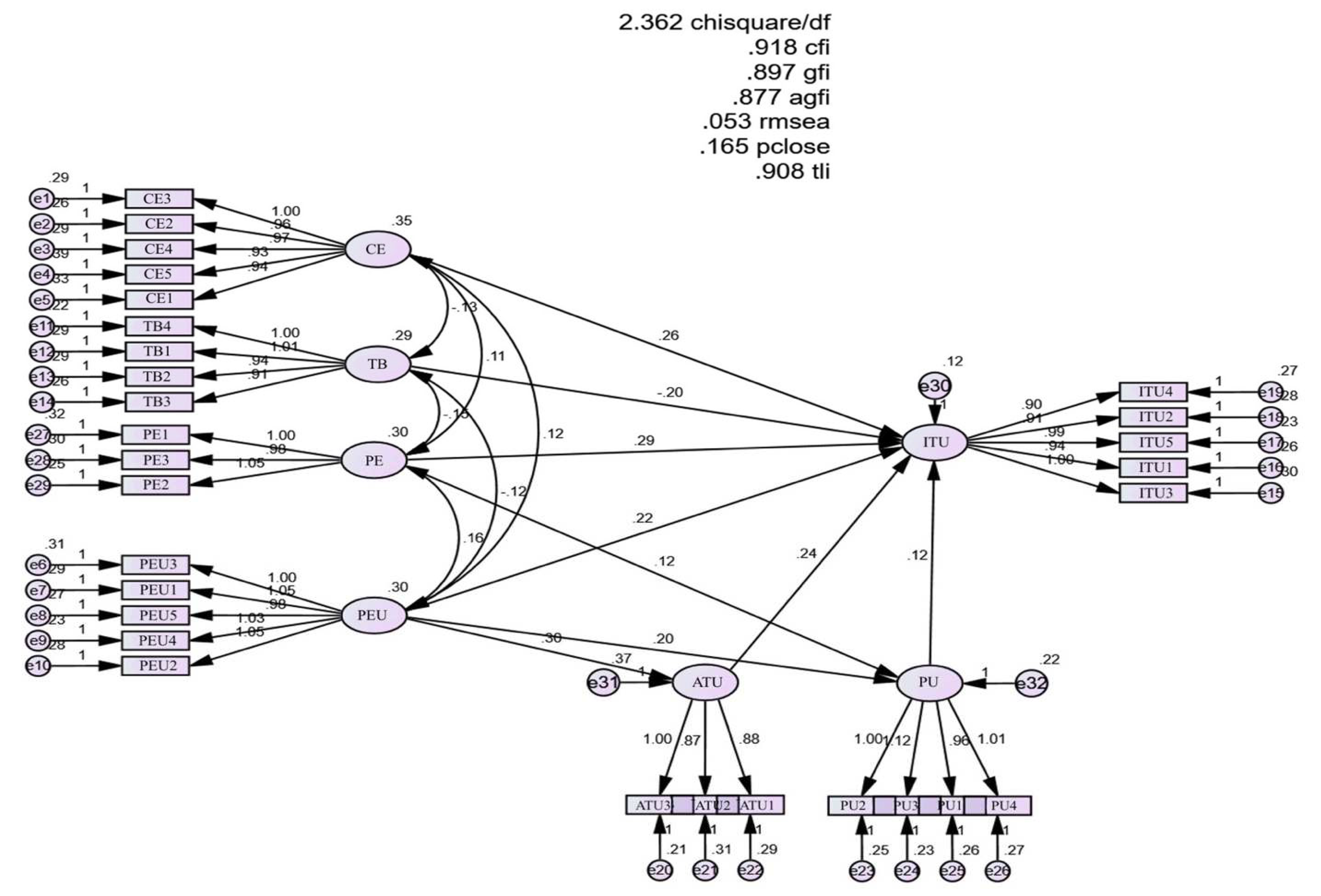
Figure 2.
SEM analysis.
Table 6 shows the results of the hypothesis testing for the relationships between the factors in the proposed model. The p-values for the relationships are all below the 5% significance level. The relationship between PE and PU has a reliability of 90% at the 5% significance level, indicating that PE does not have a significant impact on PU in the same direction. However, at the 10% significance level, PE has a significant positive impact on PU. The study can also observe that at P < 0.05, PE, PEU, CE, ATU, and PU have a positive impact on ITU, while TB has a negative impact on ITU.
Table 6.
Results of SEM model estimation.
| Relationship | Unstandardized | Normalizations | Standard error | p-value | ||
|---|---|---|---|---|---|---|
| ATU | <--- | PEU | 296 | 259 | 0.063 | *** |
| PU | <--- | PEU | 0.196 | .216 | .061 | 0.001 |
| PEU | <--- | PE | 116 | 129 | 0.063 | 0.064 |
| ITU | <--- | PE | 0.293 | 273 | 0.063 | *** |
| ITU | <--- | PEU | 223. | 206 | 0.057 | *** |
| ITU | <--- | TB | 196 | -0.179 | 0.056 | *** |
| ITU | <--- | CE | 257 | .256 | 047 | *** |
| ITU | <--- | ATU | 235 | 249 | 041: | *** |
| ITU | <--- | PU | 123 | 103 | 0.05 | 0.013 |
5. Discussion
The survey data analysis showed that all six factors examined (Convenience, Technical barriers, Perceived effectiveness, Perceived ease of use, Perceived usefulness, and Attitude to use) significantly affected the use of online database systems by students at six economics universities in Vietnam. The factor with the strongest influence was Perceived effectiveness, while Perceived usefulness had a reverse effect.
These findings support the reliability of the Technology Acceptance Model (TAM) in predicting students' intention to use online database systems, specifically the factors of Perceived ease of use and Perceived usefulness. This is consistent with recent studies in online learning systems and e-commerce services (Klopping and Mckinney, 2004; Uroso et al., 2010; Cakir and Solak, 2014; Mohamadi, 2015; Le and Dao, 2016).
Furthermore, our study revealed the significant influence of technical barriers on students' intention to use online database systems. This emphasizes the importance of considering technology-related factors and implementing technological solutions to reduce barriers to users caused by technical issues. To improve the use of online database systems in student learning at economics universities.
Hypothesis H1a:
The perceived effectiveness of the online database system has a positive impact on students’ intention to use it for learning purposes.
Hypothesis H1b:
Perceived effectiveness positively impacts the perceived usefulness of the online database system.
The factor with the strongest influence among the six elements of the model was Perceived effectiveness, accounting for 27.3% of the variance in students' intention to use the online database system. This indicates that students at the university prioritize and expect features that provide value and direct benefits in their use of the system for learning. The desire for efficiency when using technology is likely to continue to grow as technology advances.
Hypothesis H2a:
Perceived ease of use positively influences the perceived usefulness of the online database system.
Hypothesis H2b:
Perceived ease of use has a positive impact on the attitude towards using the online database system.
The results of the study suggest that perceived ease of use has a relatively strong influence on students' use of online database systems in their learning at 6 economics universities, with a percentage of 20.6%. The analysis indicates that students are more likely to adopt and utilize the database system if it has a user-friendly design. With self-study becoming increasingly popular, the need to find relevant documents is also increasing, making it crucial for the database system to be easily accessible and navigable for students.
Hypothesis H3:
Technical barriers negatively affect students' intention to use the online database system for learning purposes.
Through the evaluation according to the intended behavior theory (TPB) of Fishbein and Ajzen (1975), combined with the research results, it was found that the technical barrier strongly influenced, -17.9%, the use of online database system in the learning of students of National Economics University. The barriers are easy to encounter such as incompatibility with equipment, software errors, etc. If this problem is not overcome, students will notice the inconvenience and reduce the use of the online database system in their learning.
Hypothesis H4:
Perceived usefulness has a positive influence on students’ intention to use the online database system for learning purposes.
From the analysis, it was found that the perceived usefulness has a relative impact on the use of the online database system in the learning of students at 6 economics universities, at 10.3%. Since the popularity of the internet in Vietnam, we have more and more opportunities to access information and data, but not all sources of information are useful to users. Therefore, the more valuable the database system is to students, the more students will use the system in the learning process.
Hypothesis H5:
A positive attitude towards using the online database system has a positive impact on students’ intention to use it for learning purposes.
The attitude of using impacts on the use of online database systems in the learning of students at economics universities at a high level of 24.9%. Attitude is also affected by perceived ease of use at 25.9%. The perceived usefulness factor does not affect the use attitude factor. The DATA base system with proximity and convenience in use will be well received by students and have a good attitude and attitude to influence in the same direction as their use.
Hypothesis H6:
Convenience has a positive influence on students' intention to use the online database system for learning purposes.
The research tested the hypothesis and the results showed that the correlation between these two factors is relatively large, with a rate of 25.6%. The convenience of the system will promote the use of students because students always want to access and use the school's system easily.
6. Conclusion and Recommendation
The study suggests implementing the following solutions:
For Economics Universities
Firstly, Vietnamese universities are not real service companies (Nguyen, 2013). Therefore, economics universities need to improve the accessibility of the system to make it more convenient for students to access the system. The school needs to disseminate the general knowledge and benefits of the university's online database system to students by organizing seminars and workshops to guide new students on how to use the system so that students can better understand the system and be able to use all the functions and tools of the system optimally.
Secondly, the perceived effectiveness for students also needs to be improved through the establishment of a system that is compatible with all operating systems in students' devices, especially the need to install more system versions suitable for devices running macOS 11.0 or lower, build tools in the system friendly, regularly add new utilities as well as new features and experiences.
Thirdly, the school needs to improve the usefulness of the system. Students today have a very high demand for finding materials online, so universities should invest in and update a variety of learning materials on the Reader electronic library. In addition, lecturers should also post more soft copies of documents in addition to the main material on the class in the LMS channel so that students can easily receive more sources of information and knowledge.
Fourthly, the online database system needs to be improved through the reduction of technical barriers. The school should invest in and upgrade the hardware of the system to avoid overloading and crashing the system every time there is a large number of students accessing it in a period of time.
Last, the school needs to strictly manage and control the system to promptly prevent hackers from hacking to disrupt the system or hackers posting unhealthy content that affects the school and students.
For the Students
Every student, especially freshmen, needs to actively register and participate in lessons, training seminars, and tutorials using the universities’ online database system, thereby equipping themselves with the knowledge and skills necessary to use the channels of the support system for learning most effectively.
In addition, each student should actively update new versions of the application in the online database system on his/her devices to get a better experience during use for his/her learning. Students should take advantage of these utilities, and arrange and use the channels of the system for learning in a reasonable, effective way, avoiding wasting time.
Furthermore, the students can exchange and share the usage and access to their effective system. Students also regularly contribute comments to economics universities about the inadequacies and limitations of the system in the process of using it for learning so that the universities can promptly fix and repair it to bring the best experience to students.
Author Contributions
Conceptualization — T.M.P.N; Methodology — T.M.P.N; Validation — T.M.P.N; Writing, Review & Editing —T.M.P.N; Visualization – T.M.P.N; Supervision – T.M.P.N.
Funding
This research is funded by National Economics University, Hanoi, Vietnam.
References
- Arfan, S. , Rohail, H.; Adejare, Y. A.; Arsalan, H.; Rab, N. L. Effects of COVID-19 in E-learning on higher education institution students: the group comparison between male and female. Natl. Libr. Med. 2020, 55, 805–826. [Google Scholar] [CrossRef]
- Azzi-Huck, K.; Shmis, T. Managing the impact of COVID-19 on education systems around the world: How countries are preparing, coping, and planning for recovery. WorldBank Blogs 2020.
- Ajzen, I. The Theory of Planned Behavior. Organizational Behavior and Human Decision Processes. 1991, 50, 179–211. [Google Scholar] [CrossRef]
- Berry, L.L.; Seiders, K.; Grewal, D. Understanding Service Convenience. J. Mark. 2002, 66, 1–17. [Google Scholar] [CrossRef]
- Booker, L.D.; Detlor, B.; Serenko, A. Factors affecting the adoption of online library resources by business students. J. Am. Soc. Inf. Sci. Technol. 2012, 63, 2503–2520. [Google Scholar] [CrossRef]
- Cao, M.T.; Nguyen, P.N. Factors Affecting Students in Vietnam's Intention on Using Smartphones for Learning on the Mobile Learning Platforms. J. Educ. Soc. Res. 2022, 12, 113–125. [Google Scholar] [CrossRef]
- Cakır, R.; Solak, E. Attitude of Turkish EFL Learners towards e-Learning through Tam Model. Procedia - Soc. Behav. Sci. 2015, 176, 596–601. [Google Scholar] [CrossRef]
- Chen, H.; Islam, A.Y.M.A.; Gu, X.; Teo, T.; Peng, Z. Technology-enhanced learning and research using databases in higher education: the application of the ODAS model. Educ. Psychol. 2019, 40, 1056–1075. [Google Scholar] [CrossRef]
- Chou, S.-W.; Hsu, C.-S. Understanding online repurchase intention: social exchange theory and shopping habit. Inf. Syst. e-Business Manag. 2015, 14, 19–45. [Google Scholar] [CrossRef]
- Davis, F.D. Perceived usefulness, perceived ease of use and user acceptance of information technology. MIS Q. 1989, 13, 319–339. [Google Scholar] [CrossRef]
- Davis, F.D. User acceptance of information technology: system characteristics, user perceptions and behavioral impacts. Int. J. Man-Machine Stud. 1993, 38, 475–487. [Google Scholar] [CrossRef]
- Farouk, B. L.; Muhammad, Y. Factors affecting the use of electronic-databases by academic staff: A study of Bayero University, Kano, Library. Techno Science Africana Journal. 2016, 13. [Google Scholar]
- Fishbein, M.; Ajzen, I. Belief, Attitude, Intention, and Behavior: An Introduction to Theory and Research. Philos. Rhetor. 1977, 6, 244–245. [Google Scholar]
- Groote, D. S. Measuring use patterns of online journals and databases. Journal of the Medical Library Association. 2003, 91, 231–240. [Google Scholar]
- Gupta, S.; Kim, H.W. The moderating effect of transaction experience on value-driven internet shopping. In Proceeding of European Conference on Information Systems. 2006, 807–818. [Google Scholar]
- Jafari, S. M.; Salem, S. F.; Moaddab, M. S.; Salem, S. O. Learning Management System (LMS) success: An investigation among the university students, 2015 IEEE Conference on e-Learning, e-Management and e-Services (IC3e), Melaka, Malaysia, 2015, 64-69.
- Jalilvand, M.R.; Samiei, N.; Dini, B.; Manzari, P.Y. Examining the structural relationships of electronic word of mouth, destination image, tourist attitude toward destination and travel intention: An integrated approach. J. Destin. Mark. Manag. 2012, 1, 134–143. [Google Scholar] [CrossRef]
- Julander, C. R.; Soderlund, M. Effects of switching barriers on satisfaction repurchase intentions and attitudinal loyalty. SSE/EFI Working Paper Series in Business Administration. 2003, 1-22.
- Kim, C.; Kim, M.K.; Lee, C.; Spector, J.M.; DeMeester, K. Teacher beliefs and technology integration. Teach. Teach. Educ. 2013, 29, 76–85. [Google Scholar] [CrossRef]
- Klopping, I.M.; McKinney, E. Extending the Technology Acceptance Model and the Task-Technology Fit Model to Consumer e- Commerce. Inf. Technol. Learn. Perform. J. 2004, 22, 35–48. [Google Scholar]
- Le, H. H.; Dao, T. K. Factors affecting students' intention to use E-Learning system: A case study of Hanoi University of Science and Technology. Economic and Development Magazine. 2016, 231, 78–86. [Google Scholar]
- Mohammadi, H. Investigating users’ perspectives on e-learning: An integration of TAM and IS success model. Comput. Hum. Behav. 2015, 45, 359–374. [Google Scholar] [CrossRef]
- Neuman, D. High school students' use of databases: Results of a national Delphi study. J. Am. Soc. Inf. Sci. 1995, 46, 284–298. [Google Scholar] [CrossRef]
- Uroso, A. , Soyelu, S. ; Koufie, M. Task technology fit and technology acceptance models applicability to e-tourism. Journal of Economic Development, Management, IT, Finance and Marketing. 2010, 2, 1–32. [Google Scholar]
- Park, S.Y. An Analysis of the Technology Acceptance Model in Understanding University Students' Behavioral Intention to Use E-Learning. Educ. Technol. Soc. 2009, 12, 150–162. [Google Scholar]
- Park, Y.; Chen, J.V. Acceptance and adoption of the innovative use of smartphone. Ind. Manag. Data Syst. 2007, 107, 1349–1365. [Google Scholar] [CrossRef]
- Park, S.Y.; Nam, M.; Cha, S. University students' behavioral intention to use mobile learning: Evaluating the technology acceptance model. Br. J. Educ. Technol. 2011, 43, 592–605. [Google Scholar] [CrossRef]
- Pavlou; Fygenson Understanding and Predicting Electronic Commerce Adoption: An Extension of the Theory of Planned Behavior. MIS Q. 2006, 30, 115. [CrossRef]
- Piotrowski, C.; Perdue, B.; Armstrong, T. Scholarly online database use in higher education: a faculty survey. Gale Academic Onefile. 2005, 125, 443–446. [Google Scholar]
- Roca, J.C.; Gagné, M. Understanding e-learning continuance intention in the workplace: A self-determination theory perspective. Comput. Hum. Behav. 2008, 24, 1585–1604. [Google Scholar] [CrossRef]
- Saroia, A.I.; Gao, S. Investigating university students’ intention to use mobile learning management systems in Sweden. Innov. Educ. Teach. Int. 2019, 56, 569–580. [Google Scholar] [CrossRef]
- Taylor, S.; Todd, P. An integrated model of waste management behavior: A test of household recycling and composting intentions. Environ. Behav. 1995. 27, 603–630. [CrossRef]
- Tsang, M.M.; Ho, S.-C.; Liang, T.-P. Consumer Attitudes Toward Mobile Advertising: An Empirical Study. Int. J. Electron. Commer. 2004, 8, 65–78. [Google Scholar] [CrossRef]
- Venkatesh, V.; Davis, F.D. A Theoretical Extension of the Technology Acceptance Model: Four Longitudinal Field Studies. Manag. Sci. 2000, 46, 186–204. [Google Scholar] [CrossRef]
- Venkatesh, V.; Morris, M.; Davis, G.; Davis, F. User acceptance of information technology: Toward a unified view. MIS Q. 2003, 27, 425–478. [Google Scholar] [CrossRef]
- Vu, K. L.; Van, T. A.; Ta, T. N. Factors affecting the intention to use e-libraries of students at universities in Hanoi. National Economics University, Hanoi, Vietnam. 2020.
Disclaimer/Publisher’s Note: The statements, opinions and data contained in all publications are solely those of the individual author(s) and contributor(s) and not of MDPI and/or the editor(s). MDPI and/or the editor(s) disclaim responsibility for any injury to people or property resulting from any ideas, methods, instructions or products referred to in the content. |
© 2023 by the authors. Licensee MDPI, Basel, Switzerland. This article is an open access article distributed under the terms and conditions of the Creative Commons Attribution (CC BY) license (http://creativecommons.org/licenses/by/4.0/).
Copyright: This open access article is published under a Creative Commons CC BY 4.0 license, which permit the free download, distribution, and reuse, provided that the author and preprint are cited in any reuse.


