

Submitted:
17 April 2023
Posted:
18 April 2023
Read the latest preprint version here
Abstract
The Grassmann variables are used to transform a system with constraints into an unconstraint system. As a result, the Schrödinger equation arises instead of the Wheeler-DeWitt one. Formally, the Schrödinger equation describes a system’s evolution, but a definition of the scalar product is needed to calculate the mean values of the operators. We suggest an explicit formula for the scalar product. The calculation of the mean values is compared with the etalon method, in which a redundant degree of freedom is excluded. Nevertheless, we could note that a complete correspondence with the etalon picture is not found. Apparently, the picture with Grassmann variables requires further search for underlying Hilbert space.
Keywords:
minisuperspace model
; quantum evolution
; ghost variables
; operator mean values
1. Introduction
There is a principal possibility to construct the theory of quantum gravity (QG) from the point view that gravity is a usual physical system with constraints [1,2], and it has to be quantized using the Dirac brackets [3]. The physical question is, which gravity theory type must be quantized? It hardly is the general relativity (GR) because GR suffers from the loss of information (unitarity) in black holes (see, e.g., [4]) and from the vacuum energy problem [5]. It seems possible [6] to repair GR by restricting it to a class of manifolds without black holes [7,8,9,10]. Simultaneously, a possibility of arbitrarily choosing an energy density level appears [6,11], which removes the vacuum energy problem, at least for the massless particles. The resulting theory could be a suitable candidate for quantization. Another mathematical question is how to realize the commutation relations corresponding to the Dirac brackets. By now, there is no constructive way to do that [12].
In the quasi-Heisenberg picture [13,14,15,16], the commutator relations are determined near a small scale factor that simplifies a problem. A more radical method is introducing the Grassmann variables [17,18,19,20], which reduce a system with constraints to that without constraints. However, if one applies the Grassmann variables not only to calculation of the scattering amplitudes, but also to mean values of the operators, a question about the Hilbert space and scalar product arises [21,22].
For simplicity, the question about the scalar product could be considered on a minisuperspace model example. Minisuperspace models are widely used in QG [23,24,25,26] to understand the main features of gravity quantization and represents an example of a simple system with constraints. Without the experimental data for the minisuperspace model, one could not check different approaches to gravity quantization straightforwardly. Fortunately, an etalon quantization method for the minisuperspace model exists, which "could not be wrong." It consists in the explicit exclusion (see Appendix) of the redundant degree of freedom initially to obtain a physical Hamiltonian [27,28].
2. Etalon Picture with the Exclusion of the Redundant Degrees of Freedom
Let us consider action for gravity and a real massless scalar field:
where R is a scalar curvature. By the consideration of the uniform, isotropic and flat universe
where functions a and N depend on only, the action (1) reduces to
where the reduced Planck mass is used. Hamiltonian
determines also the Hamiltonian constraint
due to the equation . Time evolution of an arbitrary quantity A is expressed through the Poisson brackets
which are defined as
The full system of the equations of motion has the form:
Their solutions are
The additional time-dependent gauge fixing condition
can be introduced as the constraint that allows reducing this simple system to a sole degree of freedom. Let us take and as the physical variables, then a and have to be excluded by the constraints. Substituting , and a into (3) results in
where
The most simple and straightforward way to describe a quantum evolution is to formulate the Schrödinger equation
with a physical Hamiltonian (12). In the momentum representation, the operators become
The solution of Eq. (13) is written as
It is possible to calculate the mean values of an arbitrary operator build from and for some particular wave packet in the following way
Since the basic wave functions contain module of k, a singularity may arise at if contains degrees of the differential operator . That may violate hermicity. To avoid this, the wave packet has to be turned to zero at . For instance, it could be taken in the Gaussian form
with the multiplier in the front of exponent.
Let us come to calculation of some mean values taking . The mean value of is
The next quantity is
3. Evolution in the Extended Space
Indeed, the etalon picture cannot be applied in the general case to QG because one cannot resolve the constraints. It is believed that the Grassmann variables allow writing a Lagrangian in the form where there are no constraints at all [19,20,30,31].
The discussion could be started in terms of a continual integral. The transition amplitude from vacuum to vacuum state is written in the form [32]
where is a gauge fixing function (here non-canonical gauge fixing [21] is considered).
The action (3) is invariant relatively the infinitesimal gauge transformations:
where is an infinitesimal function of time. If to take the differential gauge condition , then (21) follows in
and the Faddev-Popov determinant [32] takes the form of . The functional (20) could be rewritten as
where using of the Grassmann variables [32] raises the determinant into an exponent.
Integration over N could be performed explicitly. In a discrete version, where is discretized over the interval , the term with delta functions has the form
i.e., an initial value of has to equal a final value . For instance, one may take , and, then, the Lagrangian from Eq. (25) becomes
The action (27) is a fixed gauge action with no Hamiltonian constraint, but instead, the ghost (Grassmann) variables arise in (27). The expressions for the momentums of the Grassmann variables are
where, as usual, the left derivative over the Grassmann variables is implied. The Lagrangian (27), rewritten in terms of momentum, acquires the form of
Following Vereshkov, Shestakova et al. [19,20] one may consider the Hamiltonian
as describing the quantum evolution of a system.
To quantize the system, the anticommutation relation has to be introduced for the Grassmann variables
In the particular representation , , , , , , the Schrödinger equation reads as
where the operator ordering in the form of the two-dimensional Laplacian has been used. It should be supplemented by the scalar product
where the measure arises due to hermicity requirement [18,33]. This measure is a consequence of a minisuperspace metric if the Hamiltonian is written in the form of with , . Thus, the measure takes the form [33]. Formal solutions of the equation (32) can be written as
where the functions u and v satisfy the equation
with
Then, the scalar product (33) reduces to
Although the constraint formally disappears from the theory, one may think that the space of solutions of the Wheeler-DeWitt equation (WDW) equation still plays a role [22]. Otherwise, the question of correspondence with the classical theory, where the Hamiltonian constraint holds, arises. We would like to relate the space of the functions, satisfying to the Schrödinger equation (32) with the functions satisfying the equation , i.e., the WDW equation. Operator (36) has the Klein-Gordon form. Thus the Klien-Gordon-type scalar product has to be used. According to this hypotheses, let us represent the functions u, v as
where operator , or in the representation (14) and (compare with (15)). The operator (see Appendix in [34]) is a necessary attribute of the scalar product for the Klein-Gordon equation to obtain hermicity. It should be noted that, in fact, the function v does not depend on the time because and commute with . Thus, the time evolution arises only due to function u, or more accurately, due to the presence of the Dirac delta function in ().
Thus scalar product (37) reduces to
The expression for the mean value of an operator has the form:
where u, v are given by (38), () and it is assumed that an operator does not contains ghost variables , , that is expectable for physical operators. The limit in (41) implies that an evolution begins at , when and tends to .
Both Schrödinger and Heisenberg pictures are possible with this scalar product. For the last, the time-dependent operators have the form
while the functions u and v have to be used without multiplier .
4. Mean values of scale factor degrees
The simplest way to test a theory is to compare it with the etalon picture by calculating the mean value of the squared scale factor, which has to be equal according to (18). For its value calculation with (38), (), (41), it is sufficient to expand in (38) and () and perform the calculation according (41). It turns out to be, that the mean value of actually coincides with that given by (18). The next test is the calculation of . The result of calculation is
while the etalon model gives another value (19). An origin of this discrepancy could be better seen in the Heisenberg picture. Evolution equations for the Heisenberg operators follow from the operator commutators with the Hamiltonian (36)
It is possible to guess a solution for this particular case:
where . Actually, calculation of the commutator (44) using (36),(45) gives
which is exactly equals to the derivative of (45) over . Under calculation of the mean value of , third term in (45) does not contribute and the result coincides with that of etalon method. However, under calculation of , the first and third terms in (45) play a role, and discrepancy with the etalon method arises. One could also calculate the mean values of the other degrees of a, which are presented in Table 1. It is interesting to plot these values , that is shown in Figure 1.
5. Discussion and Conclusion
A reasonable expression for the scalar product using the Grassmann variables is suggested. It establishes a relation of a picture with the Grassmann variables to the Klein-Gordon scalar product and allows calculating the mean values of operators in both Schrödinger and Heisenberg pictures, which give the same results. However, it is shown that the mean values of are different for than those calculated in the etalon method, implying explicit exclusion of superfluous degrees of freedom. In principle, the above methods may have different Hilbert spaces. That means the different wave packets have to be taken for these methods to obtain the same set of operator mean values. Here we cannot find the wave packet , which would give the same mean values as the wave packet for the etalon method.
There could also be more profound reasons why there is no correspondence with the etalon method. The well-known phenomenon of Zitterbewegung (see [35] and references therein) is an inevitable feature of the Klein-Gordon equation. It could be possible that an effect of that kind plays a role in the picture with the Grassmann variables producing an additional dispersion compared to the etalon picture. One of the possible ways to correct the picture is to consider that operators of physical quantities act not only in k and space, but also in the extended space of the Grassmann variables , . This hypothesis needs further investigation as well the general issue of the scalar product for the approach with the Grassmann variables.
Appendix A. Resolving constraints in path integrals
The theory of constraint systems considers reducing a system with constraints to the system with excluded redundant degrees of freedom as a proof [17,18] of formalism. Let us consider action of an arbitrary system with n dynamical variables q and m constraints
The constraints have to be supplemented by additional gauge fixing conditions so that the total system of constraints
leads to a second kind system with constraints. It is suggested that the determinant , where the Poisson brackets are defined as
Let us consider a transformation to a new set of coordinates
in the transition functional [17,18,20]
where the delta function appears in a second equality after integration over . Last equality has been proved in [18] by taking functions as new coordinates , where , or in [17], where is associated with momentums , . As it was shown [17,18], the continual integration could be performed explicitly and only continual integration over coordinates remains in the final result in (A7). However, the result (A7) could be deduced generally, in particular, in Section 2 we take as independent variables and exclude using the constraints.
References
- Gitman, D.; Tyutin, I.V. Quantization of Fields with Constraints; Springer: Berlin, Germany, 1990. [Google Scholar]
- Henneaux, M.; Teitelboim, C. Quantization of Gauge Systems; Princeton Univ. Press: Princeton, NJ, USA, 1992. [Google Scholar]
- Dirac, P. Lectures on Quantum Mechanics; Belfer Graduate School of Science, Yeshiva University: NY, 1967. [Google Scholar]
- Giddings, S. Black hole information, unitarity, and nonlocality. Phys. Rev. D 2006, 74. [Google Scholar] [CrossRef]
- Barvinsky, A.O.; Kamenshchik, A.Y.; Vardanyan, T. Comment about the vanishing of the vacuum energy in the Wess–Zumino model. Phys. Lett. B 2018, 782, 55–60. [Google Scholar] [CrossRef]
- Cherkas, S.L.; Kalashnikov, V.L. An approach to the theory of gravity with an arbitrary reference level of energy density. Proc. Natl. Acad. Sci. Belarus, Ser. Phys.-Math. 2019, 55, 83. [Google Scholar] [CrossRef]
- Cherkas, S.L.; Kalashnikov, V.L. Eicheons instead of Black holes. Phys. Scr. 2020, 95, 085009. [Google Scholar] [CrossRef]
- Cherkas, S.L.; Kalashnikov, V.L. Vacuum Polarization Instead of “Dark Matter” in a Galaxy. Universe 2022, 8, 456. [Google Scholar] [CrossRef]
- Cherkas, S.L.; Kalashnikov, V.L. Dark Matter in the Milky Way as the F-Type of Vacuum Polarization. Phys. Sci. Forum 2023, 7, 8. [Google Scholar] [CrossRef]
- Carballo-Rubio, R.; Filippo, F.D.; Liberati, S.; Visser, M. Singularity-free gravitational collapse: From regular black holes to horizonless objects. arXiv 2023, arXiv:2302.00028. [Google Scholar]
- Haridasu, B.S.; Cherkas, S.L.; Kalashnikov, V.L. A reference level of the Universe vacuum energy density and the astrophysical data. Fortschr. Phys. 2020, 68, 2000047. [Google Scholar] [CrossRef]
- Burdík, C̆; Navrátil, O. Dirac formulation of free open string. Univ. J. Phys. Appl. 2007, 4, 487–506. [Google Scholar]
- Cherkas, S.L.; Kalashnikov, V.L. Quantum evolution of the universe in the constrained quasi-Heisenberg picture: From quanta to classics? Grav. Cosmol. 2006, 12, 126–129. [Google Scholar]
- Cherkas, S.L.; Kalashnikov, V.L. An inhomogeneous toy model of the quantum gravity with the explicitly evolvable observables. Gen. Rel. Grav. 2012, 44, 3081–3102. [Google Scholar] [CrossRef]
- Cherkas, S.; Kalashnikov, V. Quantization of the inhomogeneous BianchiI model: quasi-Heisenberg picture. Nonlin. Phenom. Complex Syst. 2013, 18, 1–15. [Google Scholar]
- Cherkas, S.; Kalashnikov, V. Quantum Mechanics Allows Setting Initial Conditions at a Cosmological Singularity: Gowdy Model Example. Theor. Phys. 2017, 2, 124–135. [Google Scholar] [CrossRef]
- Faddeev, L.; Popov, V.N. Covariant quantization of the gravitational field. Sov. Phys. Usp. 1974, 16, 777–789. [Google Scholar] [CrossRef]
- Faddeev, L.; Slavnov, A. Gauge Fields. Introduction to Quantum Theory; Addison-Wesley Publishing: Redwood, CA, USA, 1991. [Google Scholar]
- Savchenko, V.; Shestakova, T.; Vereshkov, G. Quantum geometrodynamics in extended phase space - I. Physical problems of interpretation and mathematical problems of gauge invariance. Grav. Cosmol. 2001, 7, 18–28. [Google Scholar]
- Vereshkov, G.; Marochnik, L. Quantum Gravity in Heisenberg Representation and Self-Consistent Theory of Gravitons in Macroscopic Spacetime. J. Mod. Phys. 2013, 4, 285–297. [Google Scholar] [CrossRef]
- Ruffini, G. Quantization of simple parametrized systems. arXiv 2005, arXiv:gr-qc/0511088.
- Cianfrani, F.; Montani, G. Dirac prescription from BRST symmetry in FRW space-time. Phys. Rev. D 2013, 87, 084025. [Google Scholar] [CrossRef]
- Garay, L.J.; Halliwell, J.J.; Marugán, G.A.M. Path-integral quantum cosmology: A class of exactly soluble scalar-field minisuperspace models with exponential potentials. Phys. Rev. D 1991, 43, 2572–2589. [Google Scholar] [CrossRef]
- Bojowald, M. Quantum cosmology: A review. Rep. Progr. Phys. 2015, 78, 023901. [Google Scholar] [CrossRef]
- Balcerzak, A.; Lisaj, M. Spinor wave function of the Universe in non-minimally coupled varying constants cosmologies. arXiv 2023, arXiv:2303.13302. [Google Scholar] [CrossRef]
- Lehners, J.L. Review of the No-Boundary Wave Function. arXiv 2023, arXiv:2303.08802. [Google Scholar]
- Barvinsky, A.O.; Kamenshchik, A.Y. Selection rules for the Wheeler-DeWitt equation in quantum cosmology. Phys. Rev. D 2014, 89, 043526. [Google Scholar] [CrossRef]
- Cherkas, S.L.; Kalashnikov, V.L. Evidence of time evolution in quantum gravity. Universe 2020, 6, 67. [Google Scholar] [CrossRef]
- Cherkas, S.L.; Kalashnikov, V.L. Illusiveness of the Problem of Time. Nonlin. Phen. Complex Syst. 2021, 24, 192–197. [Google Scholar] [CrossRef]
- Shestakova, T.P.; Simeone, C. The Problem of time and gauge invariance in the quantization of cosmological models. II. Recent developments in the path integral approach. Grav. Cosmol. 2004, 10, 257–268. [Google Scholar]
- Shestakova, T.P. Is the Wheeler-DeWitt equation more fundamental than the Schrödinger equation? Int. J. Mod. Phys. D 2018, 27, 1841004. [Google Scholar] [CrossRef]
- Kaku, M. Introduction to Superstrings; Springer: New York, 2012. [Google Scholar]
- DeWitt, B.S. Dynamical Theory in Curved Spaces. I. A Review of the Classical and Quantum Action Principles. Rev. Mod. Phys. 1957, 29, 377–397. [Google Scholar] [CrossRef]
- Mostafazadeh, A. Quantum mechanics of Klein-Gordon-type fields and quantum cosmology. Ann. Phys. (N.Y.) 2004, 309, 1–48. [Google Scholar] [CrossRef]
- Silenko, A.J. Zitterbewegung of Bosons. Phys. Part. Nucl. Lett. 2020, 17, 116–119. [Google Scholar] [CrossRef]
Figure 1.
n-th root of coefficient in the expression for the mean value of th degree of scale factor over wave packet (17). Red and blue curves correspond to the etalon method and that with the Grassmann variables, respectively.
Figure 1.
n-th root of coefficient in the expression for the mean value of th degree of scale factor over wave packet (17). Red and blue curves correspond to the etalon method and that with the Grassmann variables, respectively.
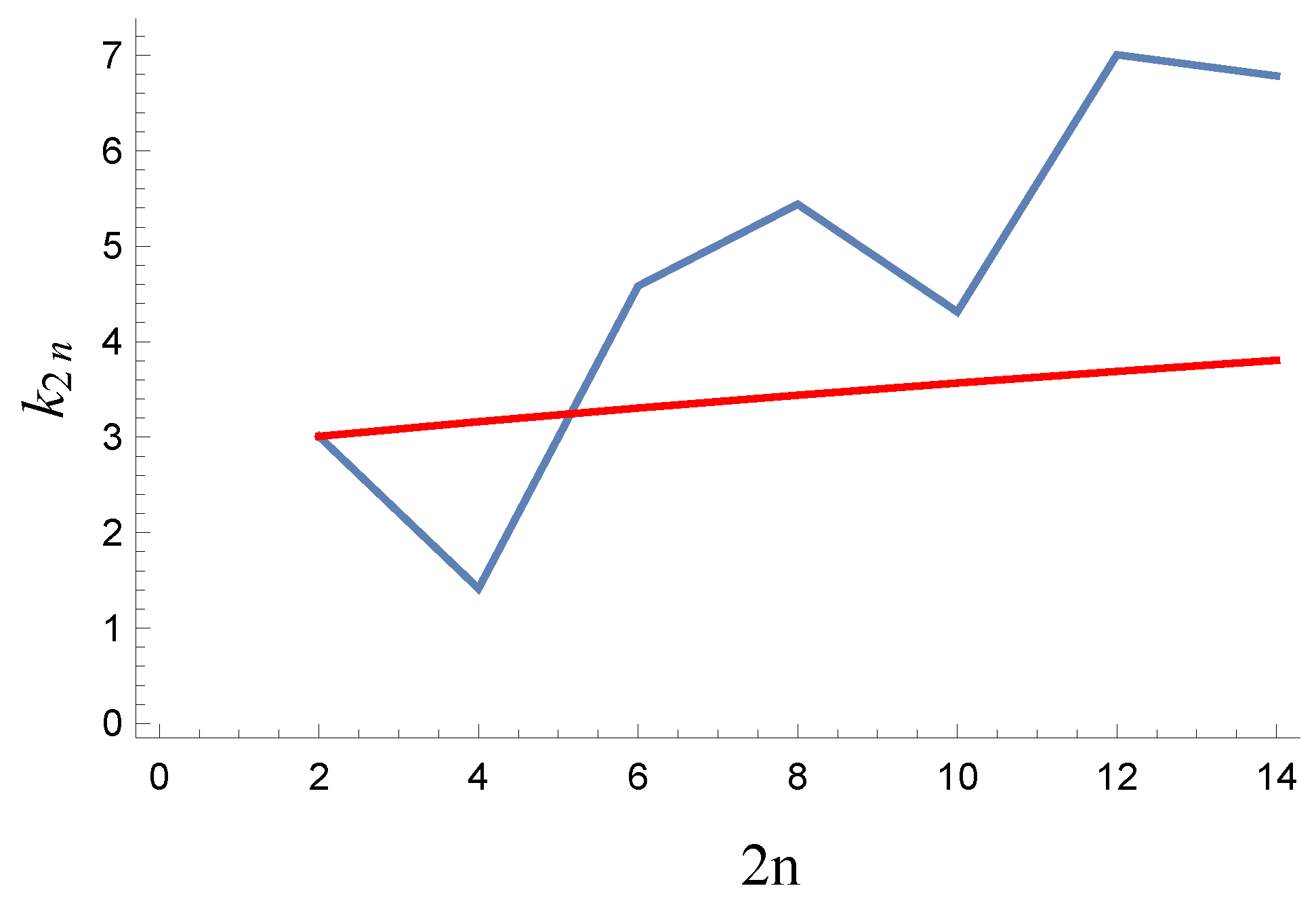

Table 1.
Comparison of the mean values over the wave packet (17).
Table 1.
Comparison of the mean values over the wave packet (17).
| 2 | 4 | 6 | 8 | 10 | 12 | 14 | |
|---|---|---|---|---|---|---|---|
| for the etalon model | |||||||
| for the model with the Grassmann variables |
Disclaimer/Publisher’s Note: The statements, opinions and data contained in all publications are solely those of the individual author(s) and contributor(s) and not of MDPI and/or the editor(s). MDPI and/or the editor(s) disclaim responsibility for any injury to people or property resulting from any ideas, methods, instructions or products referred to in the content. |
© 2023 by the authors. Licensee MDPI, Basel, Switzerland. This article is an open access article distributed under the terms and conditions of the Creative Commons Attribution (CC BY) license (http://creativecommons.org/licenses/by/4.0/).
Copyright: This open access article is published under a Creative Commons CC BY 4.0 license, which permit the free download, distribution, and reuse, provided that the author and preprint are cited in any reuse.


