

Submitted:
03 April 2023
Posted:
04 April 2023
Read the latest preprint version here
Abstract
The concept of Research Integrity and research ethics are linked to the scientific research process and its communication. Presenting the results objectively is essential. It turns out that few scientists use manipulation of results and consequently other types of misconduct such as data Fabrication, Falsification, and Plagiarism (FFP). In this article, we show the definitions of these and different aspects of behavior that should be avoided, which affect principles of research reliability. We present, through a brief literature review, the concept of Research Integrity, FFP, and its relations with Publish or Perish. Editorial disputes are linked to the power that scientists have to remain in the field of research, governed by clear rules to increase their intellectual capital. We discussed that scientists tend to want their papers published in journals with better impact and well-evaluated, seeking prominence in the publishing sector. We have seen that both scientists and journals can have sequelae and problems in the face of the Publish or Perish movement, which can call into question the quality of the editorial process, peer review, and the journal itself.
Keywords:
Research integrity
; Publish or Perish
; Misconduct in Science
; Data fabrication
; Data falsification
; Plagiarism
1. Introduction
The concept of integrity in research can be understood as behaviors, conduct, and principles associated with the honesty and ethics of independent researchers, who are trainers of a generation of new researchers. Such behaviors are at the center of science and are also the basis for organized skepticism, that is, the questioning, critical and impartial character that must exist in all phases of doing science, including the communication phase.
They focus on different aspects of the research process, with the honesty and reliability of the research process. This includes ensuring that research is conducted in a transparent and impartial manner, that data is collected and analyzed accurately, and that research results are reported honestly and without distortion.
Research ethics focuses on the moral principles that should guide research, while research integrity focuses on the specific practices and processes that ensure the reliability and honesty of research. It is concerned with the impact of research on individuals and society, while research integrity is primarily concerned with the reliability of the research itself.
Overall, research ethics and integrity are important to ensure that research is conducted in a responsible manner closely linked to research reliability, being a set of rules for research to be conducted ethically and reliably.
A deviation from these behaviors can constitute misconduct, among which the most frequent are Fabrication, Falsification, and Plagiarism (FFP).
In this article, we present the concept of scientific integrity and its regulations, the most identified and most frequent types of misconduct that directly affect the communication process in scientific journals used by few scientists, but corrupt the credibility of what is published. In the end, the issue of Publish or Perish and its relations with Research Integrity will be discussed.
2. Research integrity: definition, concept, and regulations
The concept of research integrity has been formally outlined by several institutions and organizations worldwide, such as the European Code of Conduct for Research Integrity (ALLEA), the Committee on Assessing Integrity in Research Environments, and the U.S. Office of Research Integrity. Below, the definitions of these institutions are presented, which help to understand the complexity of the concept.
The European Code of Conduct for Research Integrity, research integrity is defined as the responsibility and honesty of researchers to communicate and transmit in a transparent, impartial, and honest way the presentation of research results, objectives, intentions, methods, and interpretations [1]. Everyone should have due ethical care for human beings, animals, environments, or the objects they study, with fairness in giving credit for the work of others and responsibility for training generations of future scientists and scholars under their supervision.
Among the inappropriate behaviors listed in this code, some are understood to be less frequent, such as conflicts of interest, breach of confidentiality, lack of consent in the use of materials, abuse of the use of other research, ghost authorship, simultaneous submission, redundant publication, among others found in the literature. Other conducts are related to dealing with the misconduct themselves, which include: covering up misconduct and proposing reprisals to whistleblowers. The Code also indicates minor contraventions, but which, with the same frequency, harm research and, therefore, must be directly corrected by professors, advisors, and institutions when found.
For the U.S. Committee on Assessing Integrity in Research Environments, Board on Health Sciences Policy, and Division of Earth and Life Studies, of the Institute of Medicine, the concept of integrity in research is essential to maintain scientific excellence and public trust and seeks to preserve it, in the two entities of the research, the scientists and the institutions that work. For a scientist, integrity embodies the individual's commitment, intellectual honesty, and personal responsibility (moral character and experience). For an institution, it is a commitment to create an environment of responsible conduct, with standards of excellence, reliability, and legality, and then to assess whether an environment of high integrity has been created [2].
The U.S. Office of Research Integrity (ORI), in the publication Teaching the Responsible Conduct of Research in Humans (RCRH), defines research integrity as adherence to ethical principles and rules for responsible practice in scientific research. The use of principles and practices as a personal principle united with the intellectual, in a moral aspect and experience in ethical principles, with honesty, reliability, and a series of practices that characterize the conduct of responsible research [3].
Considering other formal sources, such as the prestigious Dictionary of Public Health, published by the Oxford publisher of reference books, the concept of integrity in research is treated as misconduct in science, translated from the English 'scientific misconduct'. The concept includes several varieties of crimes against the truth that are committed by scientists, such as undeclared conflicts of interest, plagiarism or theft of intellectual property, fabrication of data, fraud, and some less common misdemeanors, such as fictitious authorship and publication. multiple of the same information (which is used to inflate an author's list of publications). This attitude generates waste and disorganizes information collections, libraries, and electronic research and retrieval systems, due to the insertion of repetitive material [4].
These definitions and others led the international scientific community, involved and interested in the subject, to elaborate, in 2010, the Singapore Statement on Research Integrity, where the concept of integrity is closely linked to researchers who must assume responsibility for the reliability of their research. This statute presents four principles: (1) honesty, with reliable research, using appropriate methods and conclusions based on critical analysis of evidence, with complete and objective results; (2) responsibility for the conduct of research, researchers must assume the reliability of their research, for their contributions in publications, funding, reports; (3) professional courtesy by sharing data and results openly and promptly, and limiting professional comments; (4) loyalty in working with others on research authorship, creating environments that encourage education and policies on integrity, creating standards for the progress of research integrity [5]. Other Statements were prepared at the World Conference on Research Integrity (WCRI), with guidelines for new challenges, among them Montreal, Hong Kong, and 2022 to Cape Town [6].
It is important to highlight that cases of unethical conduct by scientists became more evident after the 1960s and 1970s, due to greater competition in research seeking public and private funding [7]. In the 1980s, cases of misconduct also began to appear in top universities, such as Harvard and Yale in the USA, and in different areas. An example of great repercussion took place in a laboratory at the prestigious Harvard Medical School and involved a young researcher, John R. Darsee, who was working with his advisor, the excellent cardiologist Eugene Braunwad. The research was part of a major multi-institutional project funded by the NIH and the final results was widely praised. The scandal erupted in 1981 when Darsee was accused of manipulating or inventing data published in more than a dozen articles that he co-authored [7] (p. 8).
Cases of misconduct in science go back centuries, but it was in the 19th and early 20th centuries that there was a large growth in the number of publications in journals and, consequently, an increase in the dissemination and also in identification of fraud. The author states that the search for scientific merit, or prestige, is the main reason for misconduct [7].
A case of misconduct from the 19th century was that of Thompson and Pro which constitutes the first published record of plagiarism, in an indisputable way. This case begins in 1852 when the British Royal College of Surgeons in London announced the Jacksonian Prize, which was awarded to a surgical essay authored by Henry Thompson, a British scientist and also editor of the Lancet magazine. Thompson's essay was published in 1854 and, two years later, in Paris, the French scientist, José Pro presented an essay on the same subject and theme to the Societé de Chirurgie, which was awarded honors. It was later found that 23 of the 26 pages of José Pro's essay were a 'literal translation' of Thompson's award-winning essay [7] (pp. 4-6).
The Lancet magazine and the British scientific community reacted to this case by publishing a three-page article, with the extract of the two articles side-by-side with the image of plagiarism, the plagiarism of the French author, José Pro being undisputed (Figure 1). The magazine showed that a case of plagiarism, without due credit (citation), can cause immeasurable damage, ending the text of the article with the following expression,
We have only now to add, that M. Pro, of the most shameless and extensive plagiarisms which has been brought to light for many years, has paid a great compliment to their real author, and that the Societé de Chirurgie, by conferring their highest distinctions upon the supposed original observer, have quite unwittingly confirmed it.[8](p. 556)
Thompson's case led the various scientific communities at the time to new challenges and questions about the outcome of the paper submission process, from writing a review to publication. Many questions came up about the intellectual property of research and about mechanisms for recognizing authorship and rights over research. They began to identify that other forces intervened in the ownership and creation of surveys.
Several other similar cases, mainly of plagiarism of articles, occurred in the U. S. and Europe. As a consequence of these cases of misconduct in science, which occurred throughout the recent history of science, several bodies were created to regulate, control, and evaluate research and science. Many of these bodies, in addition to assessing conduct that may violate the ethical principles of research, also establish mechanisms and rules to respond to such conduct.
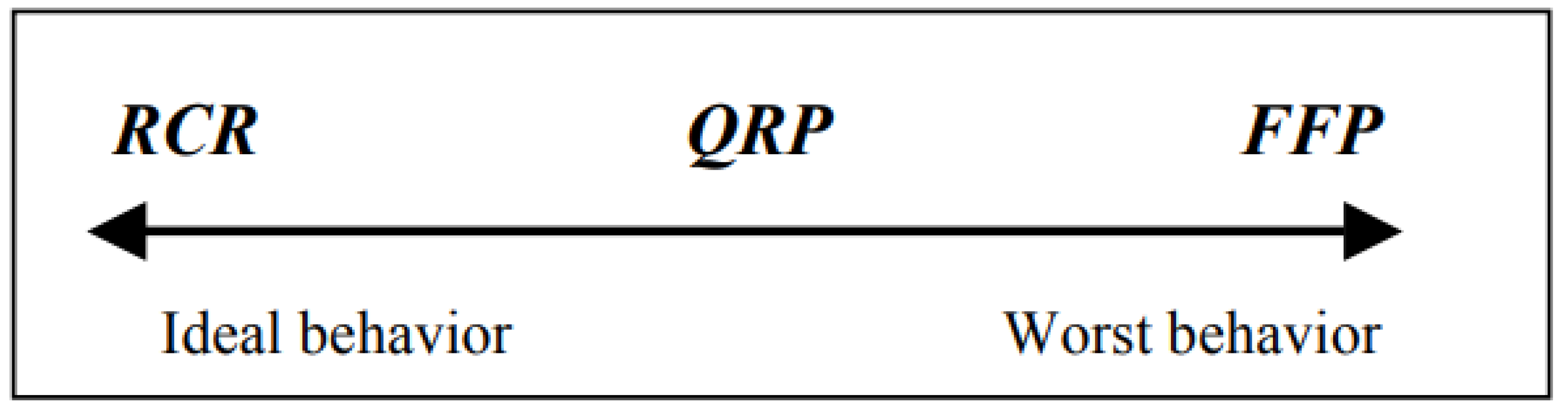
Among the specialists in research integrity, it is worth highlighting the model developed by Nicholas Steneck [9](p. 54) to describe the conduct of researchers shown in Figure 2.
Steneck argues that researchers should practice research responsibly, but that rule may not hold true for some. The author then elaborates a model to explain the patterns of behavior in research, in terms of ethical conduct, ranging from ideal behavior to reprehensible behavior. In this model, behaviors are divided into three categories: responsible conduct (RCR or Responsible Conduct of Research), which represents the ideal standard for individuals and institutions; Questionable Research Practices (QRP or Questionable Research Practices), which include issues of authorship (false, omitted, ghost) and issues of data inaccuracy, caused by honest errors and/or unintentional oversights; and the fabrication, falsification, and plagiarism (FFP) behaviors that characterize misbehavior, which is serious enough to warrant action. The author justifies that research itself can effectively regulate the behavior of individuals [9].
Among the behaviors most often defined as inappropriate or unethical in the process of preparing and writing scientific papers are data fabrication, falsification, and plagiarism.
3. Fabrication, Falsification, and Plagiarism (FFP)
As in other human activities, cases of misconduct in science happen daily and can be justified by several factors, such as competition for resources or the pursuit and maintenance of prestige in the field of research.
Among the cases of misconduct, there is a group that is very often called by the acronym FFP used to refer to the most typical and frequent misconduct, which, sometimes, are also understood as the most serious and of general concern, according to the publication of the ORI [10].
The expression “ffp” stems from the time when U.S. government agencies, such as the Public Health Service (PHS), began discussing regulation in a report on misconduct from late 1988 to 1990. The acronym was used as a synonym for the expression 'research fraud' that was defined in the 1990s, with importance for committee reviews that discussed scientific misconduct. From the year 2000, the acronym was introduced in US federal documents and, thus, started to be adopted. The use of the acronym does not disregard other misconduct but leads to a connotation of serious deviant practices in science, fraud, and other derivative ways to identify dishonest behavior [11].
According to the study in journals in the biomedical area, cases of misconduct and ethical issues found are distributed in the following types: redundant publication at 24%, issues with animal welfare at 16%, authorship disputes 14%, redundant publications 15%, human welfare 8%, data fabrication 8%, plagiarism 7%, conflicts of interest 5%, and other issues 3% [12].
3.1. Defining data fabrication and falsification
Data fabrication is understood as the construction of data, results, records, procedures, reports, and results that were not actually performed. The definition of the term is found in specialized dictionaries and reference works and its location is not found in linguistic dictionaries.
In the Oxford Reference, data fabrication (or 'fabrication of data') appears with the following definition: “The invention or falsification of observations or results of experiments. This is a very serious form of scientific fraud that is a criminal act occasionally perpetrated by overly eager, dishonest, or corrupt scientists.”[13].
In the A Dictionary of Public Health, the definition of the term fabrication is found together with a larger term, Fraud, as "... is fabrication (or invention) of data, or, more often, when the facts are falsified with intent to deceive. There are many ways this can happen, all of them crimes that require exposure and appropriate corrective action”[14].
Among the various international, governmental and educational organizations, aimed at preventing, regulating and punishing episodes considered to be bad scientific practices, the Council of Science Editors (CSE) stands out. It is an organization based in the United States, which defines data fabrication as the invention, recording or communication of data, generating a scientific record that does not accurately reflect the observed truth [15]. The ORI defines manufacturing as “Fabrication is making up data or results and recording or reporting them”[16].
The Handbook of Journal Publishing, published by Cambridge University Press , states that, “Data fabrication occurs when data are invented - either some data, which just tip the results of the research over to being positive and significant, or the wholesale fabrication of all the data in a paper.”. The authors state that this can be one of the most difficult misconducts to discover and detect [17](pp. 361-362).
Among the experts, Malhar M. Kumar stands out, who defines data fabrication as the creation or composition of false research data, without performing any experiment [18]. Another specialist, David B. Resnik, an American researcher in ethics and bioethics at the NIH and NIEHS, fabrication, falsification, or manipulation of data and the lies attributed to this type of practice are a great burden for science, as lead to errors that hinder the process of seeking knowledge through science [19].
Data fabrication and falsification are most frequent in the results section of a job. There are some phrases that when used lead readers to have doubts; phrases such as 'data not presented' or 'observations not published', are considered as an attempt to influence readers with data that could not be appreciated and evaluated externally. Data on the quality of statistical analysis and others such as data summaries, averages, and standard errors can also be associated with this type of misconduct. According to Michael J. Zigmond and Beth A. Fischer, all these acts are classified as misdemeanors, with intent or not, but the result will be the same in inducing readers to believe in their data [20].
Cases of data fabrication reported to the ORI from 1996 to 2004 accounted for 8% of all misconduct reports in a group of biomedical journals [20](p.232). It is possible, however, that this number is underreported, that is, that the fraction of cases with data fabrication is even greater. This is because the ease of access to online content and the policies for publishing research data for editors and readers, which are used in some journals, favor this type of misconduct [12].
It is relevant to consider that the practice of manufacturing data is found throughout the history of science. In the history of Archaeology, for example, there is the case of the 'Piltdown Man', which begins with the discovery of a skull at the beginning of the 20th century in England. These were the fossilized remains of an unknown early species of man, which the discoverers claimed was a new species, 'The Missing Link', the first human. Its discoverer, Charles Dawson (1864-1916), whose name was baptized the discovered skull Eoanthropus dawsoni, was questioned for many years, until in 1953, with the advance of science, it was discovered that it was a fraud. The skull was a combination of a modern man's skull and an orangutan's lower jaw and chimpanzee teeth. The big loss was that the fraud significantly affected early research on human evolution [21].
Frauds have been practiced for several centuries, as examples in Archeology, with disputes between researchers, excavators, traders, and collectors of all kinds of ancient objects, which together with all the possibilities of methodologies that could be used, generated a set of many possibilities of fraud [7].
More recent cases also discuss the need for article authors to reveal more details of the work and provide open access and/or publication of raw data, thus avoiding doubts about the data [22].
Cases of data fabrication have always occurred in science, but they are difficult to identify and when they are made public, they have often already been used as a basis for other studies, causing errors in sequence, in articles, or in new works that use fabricated results.
Regarding the definition of Falsification, it is the manipulation of research materials, equipment, or processes, or the alteration, or omission of data or results in such a way that the research is not faithfully represented in the research records.
According to the Handbook of Journal Publishing, data falsification is a very serious type of misconduct, as it involves manipulating research data to make results more positive and/or more meaningful. It involves making a new hypothesis, even an exaggerated one, seems more likely, including the omission of data that do not support the authors' hypotheses [17].
Among the institutions specializing in research integrity, it is worth highlighting the ORI definition of data falsification, which is presented in several issues related to data manipulation. Thus, the definition of data falsification, in the area of clinical research, is defined as ORI [23].
- replacing the record from one subject to another subject;
- false denunciation by a data coordination center of a certain clinical trials team, which was certified to perform the procedures on research, which had been carried out, when there was not;
- alteration of data and records of visits of subjects' eligibility;
- changing data in patient triage records and/or submitting the same log with changed dates on multiple occasions;
- not updating patient status and representing previous contact data as being current;
- altering test results on certain blood samples to demonstrate that the assay accurately predicts illness or relapse;
- retroact follow-up interviews to fit the time window determined by the study protocol;
- falsification of the time blood samples were taken from humans.
3.2. Defining Plagiarism
Among English language dictionaries, the New Oxford American Dictionary defines 'plagiarism' as “... the practice of taking someone else's work or ideas and passing them off as one's own” [24]. The Longman Dictionary of Contemporary English defines plagiarism in two contexts [uncountable] “when someone uses another person's words, ideas, or work and pretends they are their own”, for example, a magazine accused the professor of plagiarism of his articles. In the [countable] context, it presents as “an idea, phrase, or story that has been copied from another person's work, without stating where it came from”, for example, the statement that there is plagiarism of new software [25].
Among the various international, governmental, and education bodies, aimed at preventing, regulating, and punishing episodes considered to be bad scientific practices, the Committee on Publication Ethics (COPE), from the United Kingdom, considers 'plagiarism' as the use without references of ideas of others already published and also states that the submission of a new identical paper with new authorship in another language is also considered plagiarism [26]. The U.S. office linked to the White House, Office of Science and Technology Policy (OSTP), defines that: “plagiarism ranges from the unreferenced use of others' published ideas… to submission under 'new' authorship of a complete paper, sometimes in a different language”[27]. Another body, the Office of Research Integrity (ORI), thus defines plagiarism:
“... as misappropriation of intellectual property and the substantial unattributed textual copying of another’s work. It does not include authorship or credit disputes. … includes the unauthorized use of ideas or unique methods obtained by a privileged communication, such as grant or manuscript review”[28]
Já em texto publicado em seu portal, o ORI define plágio como: […] taking over the ideas, methods, or written words of another, without acknowledgement and with the intention that they be taken as the work of the deceiver” [29].
For Miguel Roig, professor, researcher, and author of the guide to ethical writing published in ORI, plagiarism is considered to be the most well-known event of scientific misconduct today.
Although the institutions present differences in the delineation of the concept of plagiarism, it is possible to verify that there is a common point: the concept of plagiarism in science is always associated with the use of ideas from others in scientific works without proper citations [29].
Cases of plagiarism have always occurred in science, literature, arts, oral communication, and music, and can be considered a relatively frequent behavior in human life. In science, plagiarism is generally considered a conscious and intentional act to mislead the reader and use the original intellectual source of someone else's ideas without claiming credit. About this, Roig defines that the scientific process often occurs within tight deadlines and with a lot of pressure, leading some authors not to write with clarity or precision. Intentional lapses, even if apparently small, are considered a serious problem, because this conduct goes against the main objective of science, which is the search for truth.
In the 16th and 17th centuries, graphic printing in Europe favored the growth of communication in written form due to the ease of multiplication of printed content. Coincidence or not, along with Gutenberg's reinvention of the printing press, the first known case of plagiarism appears. In the year 1533, the first case of plagiarism was described in a dispute, over the use of an illustration in a treatise on herbs, between two printers from Frankfurt and Strasbourg. The accused of plagiarism argued in his defense that the use of the illustration in another work was a 'benefit to humanity' [30] (p. 39).
A few centuries were then necessary for the first idea to appear to regulate the rights of authors and publishers, which led to the concept of the Copyright Act (also known as The Statute of Anne = Queen Anne), in English legislation, in 1709 [30]. Set for preventing unauthorized copying of books, and preserving individual rights in writings, fine arts and paintings, films, photographs, buildings, data, software, and many others. Purpose and scope of protection. What initially could be 'negative protection' (simple prevention) was replaced by 'positive protection', those with rights to all types of exploitation of work, its reproduction, communication, and distribution, as well as moral rights [31].
In France, after the French Revolution of 1789, with individual rights declared and growing, the Droit d’auteur concept emerged. This concept focused on the moral aspects, on the author's right to originality, due to the intellectual production already having a social discussion and legal, historical, and social construction/denotation. It includes morality, respect for the integrity of the work, and economic rights [32].
4. FFP and Publish or Perish
Faced with the growing number of research and funding limitations, publishing or not publishing can mean the success or ruin of a researcher, since evaluations for granting funding, increasingly, consider the number of articles a central factor in this process. In this context, the concept Publish or Perish, in Portuguese 'Publicar ou Perecer', which according to Rui Alves, is the absolutely 'vital' idea of competing by publishing. The obvious gist is that intellectual work must always have publication as its ultimate goal. With almost obsessive pressure, on those who study or work in a “competition to gain notoriety, secure a good job, and if possible contribute something to the evolution of science, in short, to make a curriculum and advance in the career”. Many questions, however, that there is a risk of overvaluing quantity to the detriment of published content, which can lead to large scientific production, but of poor quality [33]. (p. 277).
It is important to emphasize that the concept publish or perish, according to Eugene Garfield, seems to have its origins in Logan Wilson's book, The Academic Man: a Study in the Sociology of a Profession, published by Oxford University Press in 1942, when he states that "the prevailing pragmatism imposed on academic groups that they must write and publish something and obtain it in situational domains dictate the doctrine” in scientific fields constitutes a kind of “Publish or Perish”[34](p. 11).
This maxim has come to dictate the modus operandi of science and scientists, especially in recent decades, and has also been investigated under different aspects and approaches by various areas interested in understanding how science works, such as sociology. Science as a social activity has been studied by several renowned sociologists, among them Pierre Bourdieu (1930-2002), French sociologist and full professor at the Collège de France. Pierre Bourdieu began his training at the Ecole Normale Supérieure, Faculté des lettres de Paris, taught at the Lycée de Moulins, Faculté des lettres d´Alger, Faculté des lettres de Paris and at the Ecole des Hautes Etudes en Sciences Sociales. In his vast work, Bourdieu studied almost everything in society, from peasants, artists, clerics, bosses, and businessmen, to the various popular classes, related to the countless and diverse disciplines related to the sociology of knowledge, such as ethnology, sociology, philosophy, sociolinguistics, economics, history, among others [35](p. 7).
Bourdieu shows that all cultural and intellectual productions, from philosophy, its history, processes in science, art, and literature, among other possibilities, are objects of analysis with scientific pretensions. It exposes that, in all these fields, there are oppositions and that they are irreducible. When oppositions are entering the field, there is a force between the already defined internalist interpretations on the one hand and externalist interpretations on the other. [35](p. 19)
When it comes to scientists and science, the need for historical and philosophical bases is evident, which become part of the process of perpetuating science and, according to Bourdieu, it is engendering itself, training, accumulating knowledge, and outside any intervention of the social world.
It shows that there are struggles between and within the fields, which are governed by relations of strength and domination, which gives the field a certain social structure. In the scientific field, it is this structure that commands scientific interventions, places for publication, themes and objects to be researched. This structure determines what agents can and cannot do. Called 'objective' battles, social agents are led by the dominant forces of the field, but they are also guided and recognized, as agents of the field, by dispositions or behaviors that have been acquired, what Bourdieu calls habitus. The permanent and durable ways, rules, and ways of acting and being in a field, which agents need to acquire in order to maintain themselves and conquer a place in the field [35](pp. 22-23).
habitus “... is an ancient philosophical notion, originating in the thought of Aristotle and medieval scholasticism ...”, which was reworked by Pierre Bourdieu in the 1960s, to construct a 'generalized economy of practices’ that would be able to integrate into this economy other invariants (such as interest, capital, Market, and rationality) and thus, specifying either the social conditions for the emergence of economic actors and exchange systems or in a concrete way in which these are stabilized and propel or contradict each other [36](p. 64).
Scientific capital is a particular kind of symbolic capital (founded on acts of knowledge and recognition), which can be understood as the 'credit' attributed by peers, competitors or not, in the specific field. It is a type of capital that rests on the recognition of a field actor's competence or authority [35](pp. 25-26).
Based on Bourdieu's thoughts on the scientific field and its ruptures in society, he states that in the scientific field, as well as in society, there are two poles: the dominant ones who have greater scientific capital and occupy the upper hierarchy in the scientific field and who can impose definitions and rules to science related to your interests; the dominated, who hold little or no scientific capital and who occupy the lower hierarchy [37](p. 212).
It is important to emphasize that the search for or the perpetuation of power in the scientific environment is carried out by forces originating, essentially, within the scientific field itself, in a process that, sometimes, scientists use unethical means to manage to penetrate or maintain in the field. Thus, it draws attention to the mechanisms that researchers use to remain in the field at any cost.
The search for power and accumulation of scientific capital, in an environment where the maxim is to publish or perish, may have the consequence of breaking the rules stipulated in the scientific field, pointing out that the growing culture of 'publish or perish' may come into conflict with the objectivity of integrity in research, forcing scientists to produce 'publishable' results at any cost or results with 'positive' frequencies (In this context, Daniele Fanelli, Stanford University scientist in scientific integrity) [38].
5. Conclusions
In the scientific environment, the main means of dissemination is the paper, a manuscript that must be original and unpublished in the field of study and that guarantees the priority of the discovery, since it allows its communication more quickly. In the 20th century, publishing in papers became a maxim and the number of specialized publications increased.
Important to consider that in the quest for priority in discovery, as an aspect that drives scientists to remain in the field, publishing has become, in recent decades, a tacit rule of science and thus constitutes part of the habitus of science. scientific field. Furthermore, publishing, especially in highly visible journals, also represents prestige for scientists, or scientific capital, as described by Bourdieu.
Scientists, to promote their theories, have to constantly assert their power as specialists in the field, which is proportional to their capital. Thus, the more scientific capital, pure or institutional, a scientist has, the more power in the field he will have; power in deciding on the field, maintaining the status quo, that is, maintaining the rules. In this sense, when publishing, in the format of papers and in better dissemination vehicles, which can be reverted to more capital through citations, the scientist seeks greater chances of accumulating scientific capital, which translates into more prestige and power in the field. About prestige, “... it rests almost exclusively on the recognition, little or poorly objectified and institutionalized, of the group of peers or the most consecrated fraction among them (for example, with the 'invisible colleges' of scholars united by relations of mutual esteem” [35](p. 35).
It is a fact that scientists want to have their papers published in better-evaluated journals, as well as seek greater space and recognition in the field. On the other hand, journals also seek the most prominent place in the publishing sector and, for that, they also seek to attract the most renowned scientists with the greatest capital in the field, which can translate into more readers, more visibility, and more resources. However, both scientists and journals, in a way, can come out with sequels in the face of the growing 'Publish or Perish' movement and potential involvement with questionable conduct. The publication of papers with frauds, such as FFP or of another nature, once discovered, can annihilate a researcher's career. As for journals, such a finding puts the quality of the peer review process carried out by them in check and, sometimes, the very maintenance of the journal. The result of this is the increase in the number of papers retracted, which a study of articles retracted in the PubMed database has increased by 10 times since the year 1975 and has had a recent increase in the biomedical literature [39]. The most common cause was fraud or suspected fraud with 43.4% of the articles retracted. The study also identified that highly prestigious journals have a higher proportion of fraud, which consists of the competition between the benefits of publishing in such places, and powerful incentives for fraud.
Funding
This research was funded by UNIVERSIDADE ESTADUAL DE MARINGÁ.
References
- European Science Foundation. The European code of conduct for research integrity. Strasbourg, 2011. Available online: http://www.esf.org/fileadmin/Public_documents/Publications/Code_Conduct_ResearchIntegrity.pdf. (accessed on 20 May 2020).
- Institute Of Medicine (U.S.). National Research Council. Integrity in scientific research: creating an environment that promotes responsible conduct. The National Academies Press: Washington, DC, 2002. Committee on Assessing Integrity in Research Environments, Board on Health Sciences Policy and Division of Earth and Life Studies.
- Korenman, S. G. Teaching the responsible conduct of research in humans (RCRH). University of California: Los Angeles, 2006. Available online: http://ori.hhs.gov/education/products/ucla/default.htm. (accessed on 20 July 2019).
- Fraud. In Last, J. M. A dictionary of public health. Oxford University Press: Oxford, 2007.
- Singapore Statement on Research Integrity. In 2nd World Conference On Research Integrity-WCRI, Singapore, 21-24 July 2010. Available online: < http://www.singaporestatement.org/downloads/singpore%20statement_A4size.pdf >. (accessed on 20 March. 2021).
- Cape Town Statement on Research Integrity. In 7nd World Conference On Research Integrity-WCRI, Cape Town, 21-24 July 2022. Available online: https://www.wcrif.org/guidance/cape-town-statement (accessed on 20 January 2023).
- LaFollette, M. C. Stealing into print: fraud, plagiarism, and misconduct in scientific publishing. University of California Press: Berkeley, 1996.
- The Lancet. Reviews and notices of books. Lancet 1858, 555-557. [CrossRef]
- Steneck, N. H. Fostering integrity in research: definitions, current knowledge, and future directions. Sci. Eng. Ethics 2006, 12, 53-74. [CrossRef]
- Steneck, N. H. ORI introduction to the responsible conduct of research. Revised edition. ORI: Washington, DC, 2007. [CrossRef]
- Goodstein, D. Scientific misconduct. Academe 2002, 88, 28-31. [CrossRef]
- Benos, D. J.; Fabres, J.; Farmer, J. et al. Ethics and scientific publication. Adv. Physiol. Educ. 2005, 29, 59-74. [CrossRef]
- Fabrication of Data. In Oxford Reference. Available online: < http://www.oxfordreference.com/view/10.1093/oi/authority.20110803095807302 (accessed on 1 April 2020).
- Fraud. In: Last, J. M. A dictionary of public health. Oxford University Press: Oxford, 2007.
- CSE. Council of Science Editors. White paper on publication ethics. 2012 update. Available online: http://www.councilscienceeditors.org/resource-library/editorial-policies/white-paper-on-publication-ethics/ (accessed on 20 March 2020).
- ORI - Office Of Research Integrity. United States Department of Health & Human Services. Definition of research misconduct. 2011. Available online: http://ori.hhs.gov/definition-misconduct (accessed on 20 November 2019).
- Morris, S.; Barnas, E.; Lafrenier, D.; Reich, M. The handbook of journal publishing. Cambridge University Press: New York, 2013. [CrossRef]
- Kumar, Malhar N. A review of the types of scientific misconduct in biomedical research. J. Acad. Ethics 2008, 6, 211-228. [CrossRef]
- Resnik, D. B. What is ethics in research & why is it important? National Institute of Environmental Health Sciences: Durham: 2015. Available online: http://www.niehs.nih.gov/research/resources/bioethics/whatis/ (accessed on 20 July 2019).
- Zigmond, Michael J.; Fischer, Beth A. Beyond fabrication and plagiarism: the little murders of every science. Sci. Eng. Ethics 2002, 8, 229-234. [CrossRef]
- Piltdown Man. In Wikipedia. Available online: https://en.wikipedia.org/wiki/Piltdown_Man (accessed on 20 Jan. 2023).
- Yong, E.; Ledford, H.; Van Noorden, R. 3 ways to blow the whistle. Nature 2013, 503, 454-457. [CrossRef]
- ORI - Office of Research Integrity. Handling misconduct: inquiry issues. 2016. Available online: http://ori.hhs.gov/ori-responses-issues (accessed on 20 March 2020).
- Plagiarism. In: New Oxford American Dictionary. Apple: Oxford, 2011.
- Plagiarism. In Longman Dictionary of Contemporary English. Available online: http://www.ldoceonline.com/dictionary/plagiarism (accessed on 20 May 2019).
- COPE. Committee on Publication Ethics. How should editors respond to plagiarism? COPE discussion paper, 26 Apr. 2011. Elizabeth Wager. Available online: http://publicationethics.org/files/COPE_plagiarism_disc%20doc_26%20Apr%2011.pdf (accessed on 30 March 2020).
- OSTP - Office Of Science And Technology Policy. United States Executive Office of the President. Federal Research Misconduct Policy. 6 Dec. 2000. Available online: < https://ori.hhs.gov/federal-research-misconduct-policy (accessed on 20 May 2020).
- ORI - Office Of Research Integrity. ORI policy on plagiarism. 2013. Available online: http://ori.hhs.gov/ori-policy-plagiarism (accessed on 20 November 2017).
- Roig, M. Avoiding plagiarism, self-plagiarism, and other questionable writing practices: a guide to ethical writing. [200-]. Available online: https://ori.hhs.gov/images/ddblock/plagiarism.pdf (accessed on 10 November 2019).
- Gandelman, H. O que é plágio? Rev. ABPI-Assoc. Bras. Propr. Intelect. 2005, 75, 36-43.
- Teilmann-Lock, Stina. The object of copyright: a conceptual history of originals and copies in literature, art and design. Routledge: New York, 2016.
- Droit D’auteur. In Wikipédia. Available online: http://fr.wikipedia.org/wiki/Droit_d'auteur. (accessed on 25 March 2023).
- Alves, Rui. Publish or Perish. Portuguese J. Nephrol Hypertens. 2014, 28, 277-279.
- Garfield, Eugene. What is the primordial reference for the phrase ‘Publish or Perish’. Scientist 1996, 10, 11.
- Champagne, P. Prefácio. In Os usos sociais da ciência: por uma sociologia clínica do campo científico. Bourdieu, P. Editora Unesp: São Paulo, 2004, pp. 7-15.
- Wacquant, Loïc. Esclarecer o habitus. Educ. Ling. 2007, 10, 63-71. [CrossRef]
- Hochman, G. A ciência entre a comunidade e o mercado: leituras de Kuhn, Bourdieu, Latour e Knorr-Cetina. In Filosofia, história e sociologia das ciências I: abordagens contemporâneas. Portocarrero, V., Ed.; Ed. Fiocruz: Rio de Janeiro, 1994, pp. 199-231.
- Fanelli, D. Do pressures to publish increase scientists´ bias? An empirical support from US States Data. Plos One 2010, 5, e10271. [CrossRef]
- Fang, F. C.; Steen, R. G.; Casadevall, A. Misconduct accounts for the majority of retracted scientific publications. Proc. Natl. Acad. Sci. 2012, 109, 17028-17033. [CrossRef]
Figure 1.
Lancet journal (June 5, 1858) page with the indication of plagiarism [8](p. 556).
Figure 1.
Lancet journal (June 5, 1858) page with the indication of plagiarism [8](p. 556).
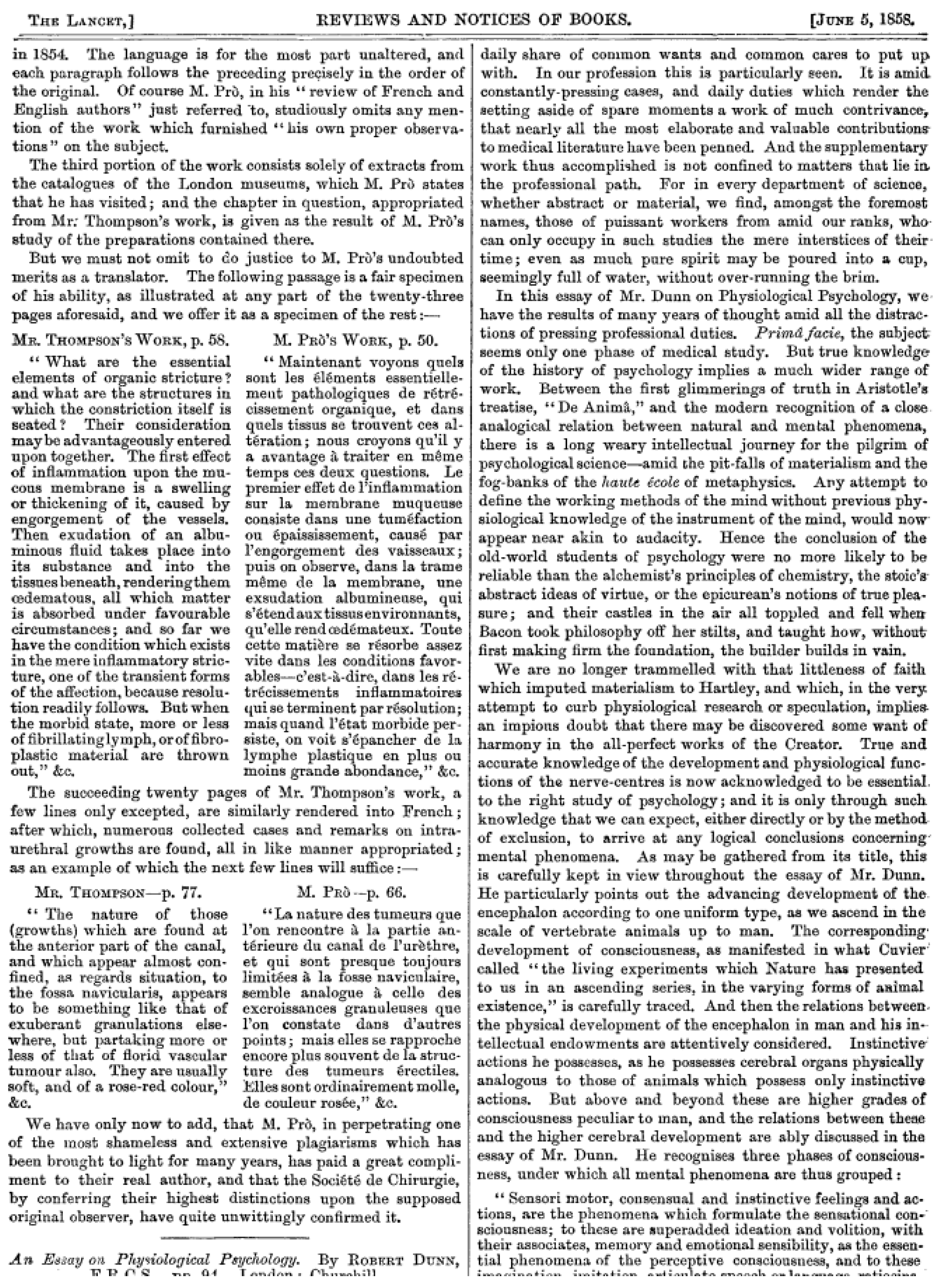
Figure 2.
Current framework for Defining Research Behaviors
Disclaimer/Publisher’s Note: The statements, opinions and data contained in all publications are solely those of the individual author(s) and contributor(s) and not of MDPI and/or the editor(s). MDPI and/or the editor(s) disclaim responsibility for any injury to people or property resulting from any ideas, methods, instructions or products referred to in the content. |
© 2023 by the authors. Licensee MDPI, Basel, Switzerland. This article is an open access article distributed under the terms and conditions of the Creative Commons Attribution (CC BY) license (http://creativecommons.org/licenses/by/4.0/).
Copyright: This open access article is published under a Creative Commons CC BY 4.0 license, which permit the free download, distribution, and reuse, provided that the author and preprint are cited in any reuse.


