
Submitted:
23 September 2023
Posted:
25 September 2023
You are already at the latest version
Abstract
We define a spinor-Minkowski metric for SL(4,C). It is not a trivial generalization of the SL(2,C) metric and it involves the Minkowskian one. We define 4x4 version of the Pauli matrices and eight 4-component associated generalized eigenvectors that can be regarded as undotted covariant spinors. The 4-component spinors can be grouped into four categories. Each category transforms in its own way. The outer products of pairwise combinations of 4-component spinors can be associated with 4-vectors. Including the dotted covariant, undotted and dotted contravariant forms totally we have sixteen pairs of spinors. Eight of them live in the conjugate space which has no countepart in SL(2,C).
Keywords:
Lie Algebra
; Lorentz group
; SL(4
; C)
; particle physics
; polarization optics
; nanoparticle interactions
MSC: 22E43; 22E70; 53B30
1. Introduction
Let be an element of SL(2,C). In an exponential form with parameters and :
is the Pauli vector with . The subscript is introduced in order to distinguish the other forms of L that will be introduced subsequently.
We rewrite and its complex conjugate in the following compact forms:
and denotes complex conjugation. corresponds to the Lorentz transformation with and being the rotation and boost parameters, respectively.
It is well known that a complex version of the Lorentz transformation matrix can be written as a matrix direct product of and [1,2]:
Let us write in basis
is the identity. Explicit definitions of can be found in the Appendix. With the expansion given in Equation (4)
We can write Equation (5) as a matrix product of two matrices by defining new basis
where , .
In order to obtain the familiar real matrix form of the Lorentz transformation it is enough to change the basis [3,4,5]:
where
Now, it is straightforward to show that the real Lorentz transformation matrix can be written as a commutative product of two matrices one being the complex conjugate of the other [6,7,8]:
and are the versions of and matrices. They can be expressed in terms of matrices:
and are versions of Pauli matrices [9]:
By definition, , , is the identity. Similarly, we define basis as . But now we have an important property that .
basis do not form a complete set for matrices, but the set of does 2 . and matrices are traceless Hermitian and they satisfy the following commutation relations:
The Pauli matrices satisfy the first two relations, but the analogy breaks down because and , hence does not commute with if . On the other hand commutes with for all .
From the Equation (12), can be found in terms of the elements of :
where , , , and . Hence, can be written in terms of as
We can write and in terms of and matrices:
Or, simply
Similarly we write and in terms of :
It is straightforward to show that commutes with , but does not commute with , in general. Actually, this property of Z matrices is more general. Let Z and Y be two matrices defined in and bases, respectively, Z and Y commute, because commutes with .
We also define the spinor metric g for SL(4,C) that corresponds to the spinor metric of SL(2,C):
is the mostly minus Minkowski metric3.
preserves the spinor metric g and the Minkowski metric 4:
Since is real, directly entails . In an analogy with , we have the following very useful relation:
In this note it will be shown that there are eight generalized eigenvectors of that can be interpreted as 4-component undotted covariant spinors. They can be grouped pairwise into four categories. Each category transforms in its own way. The outer products of spinor pairs can be associated with 4-vectors. When we include the dotted contravariant forms we get eight spinor pairs.
There is also a conjugate space. The dotted covariant and undotted contravariant spinor pairs live in this space. They double the number of spinor pairs, hence we have totally sixteen pairs. Due to the structural reasons there is no counterpart of this conjugate space in SL(2,C).
In the following sections we will study the first and the second categories in detail, and we will introduce the remaining ones in the subsequent sections.
2. The first and the second pairs and their transformation properties
Let be the representation of the Lorentz group that acts on the 2-component left-chiral spinor :
where
In terms of the components of :
Let us call this transformation scheme .
Let be the dotted version corresponding to the representation of the Lorentz group. . Let be the 2-component right-chiral spinor, , where
transforms as
In terms of the components , Equation (30) is equivalent to the scheme given in Equation (28).
What happens when acts on ? In this case, in terms of the components
Let us call this transformation scheme . We can write in a matrix form:
Let us name this transformation matrix as . Note that, , and Equation (32) is nothing but the transformation of under the action of , which is a type transformation.
Now, let be the representation of SL(4,C) that acts on a pair of 4-component undotted covariant spinors:
where and are the generalized eigenvectors of 5:
Indices in the parentheses are simply labels for 4-component spinors.
We also have another pair of generalized eigenvectors for :
Transformation scheme of and is different from that of and . Under the action of , and transform according to the scheme , but and transform according to the scheme . However, we may think in an alternative way: Suppose that and are different kind of objects with different transformation properties, such that another transformation matrix, , acts on them and under the action of they transform according to the scheme :
By definition :
Or, simply
Although and have different transformation properties than and , they are not completely independent:
where corresponds to a CCW rotation about the axis in SL(4,C) 6. For more about rotations in the spinor space see Secction Section 9.
Now let be the representation. . The first pair of 4-component spinors for this representation is
These are also the generalized eigenvectors of . Under the action of , and transform according to the scheme .
The second pair of the generalized eigenvectors of is defined as
Under the action of , and transform according to the scheme . But, they transform according to the scheme under the action of :
where by definition. We also have the following relations between them:
Note that can be related to only by the SL(4,C) metric g that involves the Minkowski metric. , and its dotted version is defined as 7
The scalar product of 4-component spinors is defined in a similar way as 2-component spinors and they are invariant under the Z transformations.
We write various forms of Z and L matrices in a compact notation to manifest the parallelism between them:
3. Outer products of 4-component spinors
Let us define the outer product which transforms as
This is a type transformation. Determinant of is zero, hence can be associated with a null 4-vector through the substitutions, :
We also define the outer product which transforms as
This is also a type transformation. Determinant of is zero and can be associated with a null 4-vector:
can be obtained from by parity inversion.
We define the outer product of 4-component spinors, , which transform in a similar way as :
For and , transforms according to the scheme . Equation (52) is the main motivation behind the interpretation of as a 4-component spinor for SL(4, C).
transform in a similar way as :
For and , transform according to the scheme .
We also have outer products of 4-component spinors of the other kind. For and , and transform according to the scheme under the action of and :
and are Hermitian and zero determinant matrices and they are the basic elements of the outer product forms. In the next section it will be shown that combinations of these basic elements can be associated with 4-vectors.
4. Quaternion forms and 4-vectors
In general, we can treat and z as variables that do not depend on u and v. Then, we can associate the following matrices and with 4-vectors, which are not necessarily null:
detdet and in general not zero 8 . and transform as
In SL(4,C), in order to have a similar representation, we have to introduce the following two column objects that are pairwise combinations of 4-component spinors:
where , , and .
Let us define an outer product of the form , which is formally a quaternion:
can be written as a sum of two basic forms: . In its present form det and corresponds to a null 4-vector, but we can associate with an arbitrary 4-vector in terms of the variables and z:
and it is the version of :
Similarly, we define :
In terms of the variables and z
and it is the version of :
can be obtained from by parity inversion and they transform as
These are type transformations, hence these forms correspond to 4-vectors.
The outer product is also a quaternion:
In terms of variables and z
In short,
We also write :
and it can be obtained from by parity inversion. and are transformed by and :
These transformations obey the scheme also, hence and can be associated with 4-vectors.
With our compact notation it can be shown that the form of the transformation matrix matches the form of the transformed object. For example, acts on the form , acts on the form , acts on the form , and acts on the form .
5. Two more pairs of spinors
There are four eigenvectors of that constitute a complete orthonormal set of basis:
and correspond to eigenvalue and and correspond to eigenvalue. We obtain eight generalized eigenvectors by combining the basis corresponding to the same eigenvalue. For example, we can obtain the four generalized undotted covariant eigenvectors that we have previously studied as follows:
We can obtain four more generalized eigenvectors of by changing the sign or swapping u and v:
Totally we get eight undotted covariant spinors:
We can group () pairwise:
We already know that transforms with and transforms with . Following the same procedure that we have applied in the previous sections we can show that and transform with and respectively:
where
The corresponding SL(4,C) matrices are
There are also the dotted versions:
We also define eight dotted contravariat spinors () which are also the generalized eigenvectors of :
We group them pairwise:
Each pair of the dotted contravariant spinors transform with the associated dotted Z matrix.
We define four two-column undotted covariant objects (spinor pairs):
And we define the corresponding two-column dotted contravariant spinor pairs
Finally, we construct eight outer products that can be associated with 4-vectors:
Each form transforms in its own way with the matching Z or matrix.
6. Complex conjugated forms
There are also dotted covariant and undotted contravariant 4-component spinors which have no counterparts in SL(2,C): , . They are the generalized eigenvectors of . We group them pairwise to get eight more two-column objects (spinor pairs):
All conjugated pairs live in the conjugate space and their outer products, that can be associated with 4-vectors, also live in the conjugate space:
The space of conjugate quaternions is spanned by and it has no counterpart in SL(2, C). Dotted lower indexed and undotted upper indexed forms transform with and with matrices respectively (), and all transformations obey the scheme .
7. Four types of transformations for SL(2,C)
We can suggest a similar formalism for SL(2,C). Let and be covariant spinors:
and let and be contravariant spinors:
where
This proliferation is necessary for the symmetry in Figure 1.
We have the following transformation properties:
All transformations obey the scheme .
We have the following outer products:
It is worth noting that complex conjugating these forms does not yield anything new. In order to emphasize the difference with 4-component spinor pairs let us define the following sets:
The outer products of the elements of the set generate all forms of X matrices that are based on matrices, . These are the matrices given in Eqations (115)-(118). Similarly, the elements of the set generate all forms of X matrices that are based on matrices, . But, the set is equal to the set 11.
Likewise, we define two sets for 4-component spinor pairs
The outer products of the elements of the set generate all forms of Q matrices that are based on matrices, . These are the matrices given in Eqations (93)-(96). Similarly, the elements of the set generate all forms of Q matrices that are based on matrices, . Now, the set is completely distinct from the set .
8. Conjugate spaces in diagonal basis
It is possible to diagonalize and simultaneously. Actually, in E and basis both and were already diagonal. Hence we can construct a similar 4-component spinor formalism by simply changing bases back to E and :
where
Then we have
These are the definitions that were given in Equation (6). Note that .
The new bases obey the same commutation relations as the old bases. 4-component spinor pairs in the new basis can be obtained by the transformation
New spinor metric for this subspace is
Hence we obtain the following dotted contravariant spinor pairs:
Here we have , , and . These relations are equivalent to the ones that given Equation (111). If this were the whole story we would have to conclude that the new representation is equivalent to SL(2,C), but there is another subspace with its own spinor metric that is based on . The spinor pairs associated with this second subspace can be obtained as :
The spinor metric for this subspace is 12
Hence we obtain the associated contravariant forms as follows: 13
It may be useful to write the bases for the spinor pairs in both representations. Let be the space of 4-component two column spinor pairs. The subspaces and associated with and are spanned by
Here we use the property . On the other hand, The subspaces and associated with E and are spanned by
Note that none of the bases for spinor pairs that given in Eqations (131) and (132) can be written as a linear combination of the others.
In the new basis the transformation matrix that corresponds to takes the form
In short, and preserves the spinor metric
Similarly, corresponds to
In short, and preserves the metric
transforms the associated outer product
transforms the associated outer product
We can also write the Lorentz transformation matrix in terms of by using the relations , , and :
Everything looks nice and simple in the diagonal basis. But now does not transform the simple and familiar form of the contravariant real 4-vector , instead, it acts on the complex 4-vector
Hence the Lorentz transformation of a 4-vector in the diagonal basis reads as follows:
Furthermore, the Minkowski metric in the diagonal representation takes the form
It can be shown that both and preserve .
9. Rotations in spinor space
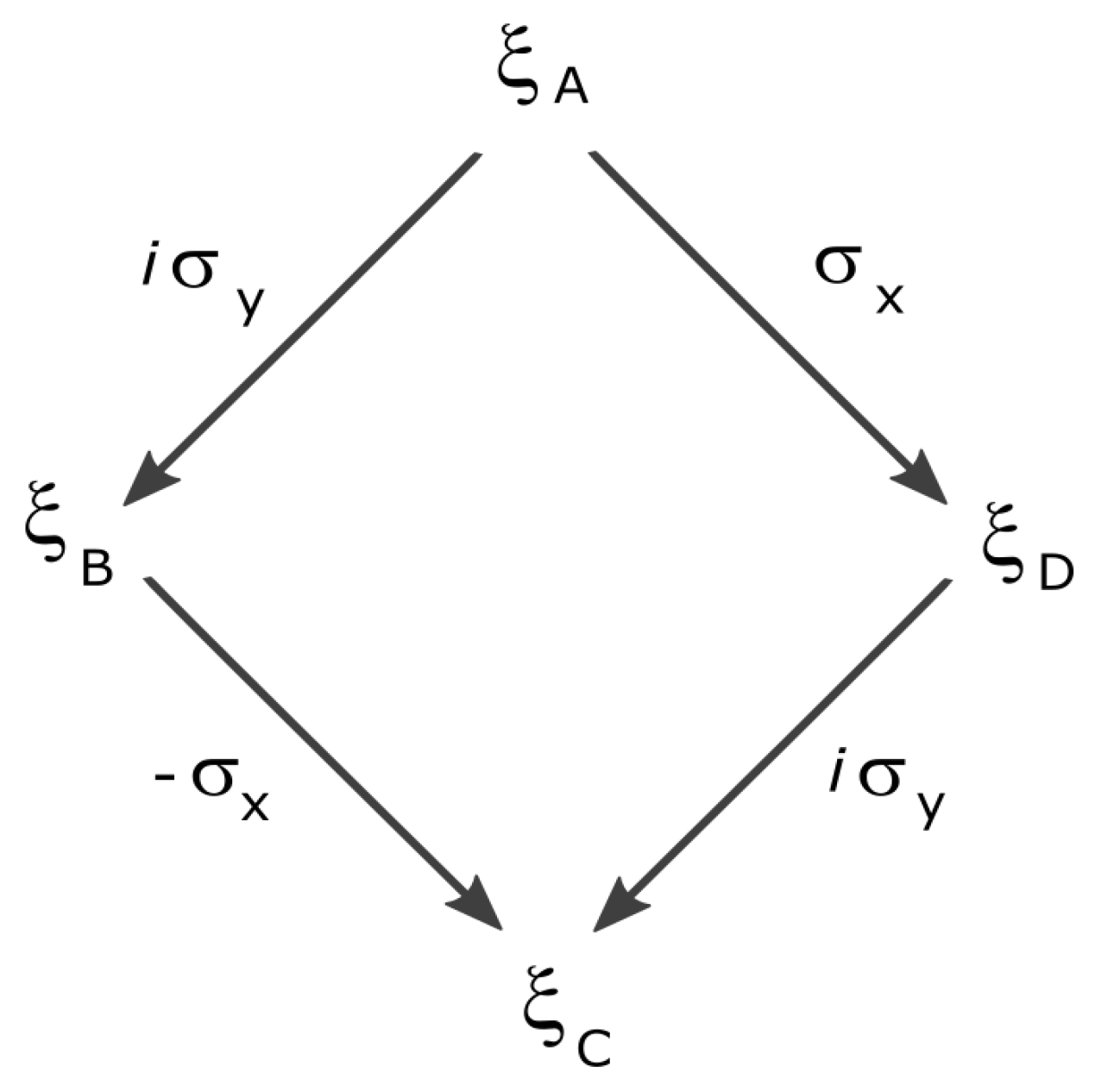
represents a CCW rotation about by an angle . If , . For example, represents a CCW rotation about the x axis. When we apply this rotation on we get , i.e. a rotation about the x axis transforms into apart from a global phase . Some of these transformations are shown in Figure 2. The relations that are not shown can be found by successive application of rotations, such as
Likewise,
Here we used the property that a rotation in the opposite direction is induced by the Hermitian adjoint of the forward one.
In order to visualize the orientations of different types of spinors in the spinor space the flagpole picture may be helpful [23]. Space components of a 4-vector associated with a spinor is given by
For , , , , therefore the orientation of the flagpole associated with can be marked as . On the other hand, For , , , , therefore the orientation of the flagpole associated with is , likewise for , and for , . Hence, in Figure 1, a vector pointing from the origin to the corner of the cube can be used to describe the orientation of the spinor that carries same mark.
Similar rotation schemes apply to the dotted contravariant 2-component spinors as well.
Rotations for 4-component spinor pairs is not much different. Now we have to replace by . Here are some rotations for undotted covariant and dotted contravariant 4-component spinor pairs
The complex conjugated forms are rotated in a slightly different way. Now we have to replace with . For example, for dotted covariant spinor pairs
Similar relations hold for undotted contravariant spinor pairs.
It is also possible to rotate the spinors about an axis perpendicular to their flagpole. For example, when we rotate by about an axis perpendicular to the flagpole of , apart from a global phase, we get . But, the perpendicular axis is not unique and the global phase depends on its choice.
10. State space and inner product of states
When a Z matrix acts on a spinor pair the result is again a spinor pair. We may regard a spinor pair as a two column state vector which fits a certain pattern 14:
where and are two complex parameters. Previously defined pairs that given in Equation (58) and their dotted contravariant versions obey the same pattern 15. Under the action of Z, transforms in such a way that the pattern is preserved
Here Z can be type or D. 16
Now let us consider the inner product of two state vectors
Due to the specific pattern of the states the inner product always results in this form, therefore, for later convenience, we will define the inner product of two states as one half the trace of the matrix and we will simply write:
This definition is equivalent to the inner product of two 2-component spinors with components and .
11. Observables and states
We associate with the components of an observable along the axes and z:
Let be a unit vector: , and let . is the observable for Type-A states. For types and D, , , .
The component of the observable along can be written as
This is the analog of :
In terms of and the eigenstates of are
and states correspond to and eigenvalues respectively and they constitute a complete set of basis, hence
In SL(4,C), the eigenstates of turn out to be the following two column orthogonal state vectors of Type-A that correspond to the eigenvalues and , respectively:
and constitute a complete set of basis for the state space, therefore
In a similar way we can write , and in terms of the orthogonal states vectors associated with them.
According to the definition of the inner product that given in Equation (152), the expectation value of in a state with a flagpole in the direction of a unit vector is
Although, the state vector has four components the state space is only two dimensional 17. It may be convenient to use and as basis states by letting in Equation (158)
In these basis basic spinor pairs can be written as
We can write raising and lowering operators and their effect on the and states:
Similar relations can be written for Type and D states with the associated ladder operators:
12. 8-component Dirac spinor
Let us rewrite Equation (169) with matrices
where
Clifford algebra of is the same as
Let us write in terms of spinor pairs
Then Equation (170) reads
Let us try a plane wave solution
A nontrivial solution exists only if the determinant of the coefficients vanishes
We have a nontrivial solution if .
Equation (176) can be written in a compact form
This is equivalent to Dirac’s formulation. Hence, we expect positive and negative energy solutions for a system which has a two level intrinsic property.
In general, the 8-component spinor pair transforms as
Since the Clifford algebra of and is the same, covariance of the Dirac-like equation that given in Equation (170) can be verified by showing the existence of of a matrix S that satisfies the property [24]
As a special case, it is straightforward to show the existence of such a matrix S in the version of the Weyl basis
In this basis we can write Equation (179) as
Appendix A
Appendix A.1. Various forms of Z and L matrices
Let us begin with the exponential form , where , . Let be the complex angle defined as . Using the property :
where
Or in a compact form
It is easy to show that
and
where complex conjugation is applied only to .
The corresponding is
In terms of the Pauli matrices:
In order to write we first find , where
From the definition :
Or, simply
We write various forms of Z and L matrices in compact forms:
Although, all types of Z and L matrices are in the same form, there is a very important difference between them. Because of the particular property of the Pauli matrices, , but , we have the following relations:
For example,
On the other hand we do not have a similar property with matrices, hence
.
The structural difference between SL(2,C) and SL(4,C) becomes more apparent when we write the matrices in exponential forms. In order to do this we have to define two types of : and .
Due to the properties, and , the relations in Equation (195) hold. But we do not have similar relations with the matrices.
Appendix A.2. The Lorentz matrix
By definition
where
Appendix A.3. Geometric phase with 4-component spinors
When the polarization state of light undergoes a series of operations and returns to its original state, the final state differs in an additional overall phase factor from the original one. It was pointed out by Pancharatnam that the phase difference is not only due to the dynamical phase from the accumulated path lengths but also involves a geometric phase [32]. Berry introduced the corresponding theory for quantum mechanical state vector and re-derived the Pancharatnam’s geometric phase [33,34]. If the cyclic path consists of only great circles, additional dynamical phase will not develop, and the geometric part increases by 19, where is the solid angle that the geodesic path of cyclic operations subtends on the Poincare sphere 20.
The emergence of geometric phase can be demonstrated in SL(2,C) by considering three successive Hermitian operations on a spinor. For example, let , and be three radial unit vectors at points 1, 2 and 3 on the Poincare sphere:
And let , and be the spinors that correspond to these radial unit vectors:
We consider a closed loop projection operations that starts by acting on and finally brings the state back to which may differ from the first one only by a phase angle :
For simplicity and without loss of generality when we choose
This is the geometric phase and it’s magnitude is equal to . The result can be checked by calculating the area subtended by the cyclic path in terms of the angular variables. In this example, the corners of the spherical triangle are defined by the unit vectors, , and , hence, it is convenient to use the following formula in order to calculate the area of the spherical triangle [35]:
As an example let . From Equation (205), and from Equation (207) . Hence, 21.
Similar relations can be derived with Z matrices and 4-component spinor pairs. But, now the type of transformation is important, must act on the pair , ( or D). As an example, this time, we demonstrate the emergence of the geometric phase with unitary operations (rotations) on the 4-component spinor pairs. In order to avoid the dynamical phase we consider trajectories on the great circles. Let us start with at the point :
First we rotate about the y-axis CCW by . A matrix with does this job:
Then we apply a CCW rotation about the z-axis
Finally we rotate the state CCW about the x-axis by :
The final state differs from the initial one by a phase angle , and this is the expected geometric phase for this cyclic unitary operations on the Poincare sphere.
If we work with , or we have to use the associated form of the Z matrix. Similar operations are also possible with dotted and undotted contravariant states by using and matrices respectively.
Appendix A.4. Coherent parallel combination of transformations and interpretation of Z as a state of the transforming medium
Up to now Z matrices were abstract mathematical operators that transform abstract mathematical objects (spinors). In a real experiment the transformation of the physical state of the system is carried out by an apparatus. For example, the polarization state of a beam of light (or a single photon) is modified as it passes through an optical medium.
The overall effect of the interaction of light with a deterministic, i.e., non-depolarizing, medium or optical element can be described by a 2×2 complex matrix J, referred to as the Jones matrix [28]. In order to obtain the Jones matrix boost and rotation parameters of the Lorentz group should be replaced by spectroscopic parameters (diattenuation and retardation) associated with various anisotropy properties of the optical medium 22. Jones matrix J differs from L of SL(2,C) by a complex constant [25], hence it is an element of GL(2,C). This complex overall factor k is due to the isotropic phase retardation ( and isotropic amplitude absorption (): , where . Hence, in polarization optics, . Similarly . Accordingly, . It may be appropriate to define new parameters, [18]:
In order to obtain the optical version of the Z matrix we have to modify Equation (184). After multiplying by k, we replace and in by birefringence and dichroism parameters: and for linear birefringence, for circular birefringence; and for linear dichroism and for circular dichroism 23. For example, the state of the medium that given by is a horizontal linear polarizer, is a linear polarizer at , is a quarter wave plate (vertical fast axis), is a circular retarder (). List of basic optical elements and their states can be found in the Appendix.
There are basically two types of light-medium interaction: serial and parallel 24. In a serial combination Jones matrices act on a 2-component spinor in succession
In a parallel process, an optical recombination takes place during the light-medium interaction. When the light beam simultaneously illuminates different parts of the medium, each part having different optical properties, the light emerging from different parts, in general with different polarizations, may recombine into a single beam. If the medium is composed of several non-depolarizing (deterministic) components, each component with a well defined Jones matrix, then the matrix associated with the coherently combined overall optical system is simply given by a linear combination of the individual matrices of the components [26,27]:
where
Complex coefficients are generally functions of space, time and frequency and they play the role of probability amplitudes of quantum mechanics 25 26. Similar relations can be written in terms of N matrices:
The 4×4 real matrix for transforming the Stokes vector of the light is the Mueller matrix M that is directly connected with the experimental work. If the medium is deterministic, M can be obtained from N matrix as, . As opposed to J and N, M does not contain any information about the overall phase introduced by the material medium. M differs from the Lorentz transformation matrix by a positive real constant 27.
The resultant matrix state N in Equation (217) corresponds to the nondepolarizing Mueller matrix of the coherently combined system. Without loss of generality we may restrict our presentation to a two-term coherent parallel combination, then M can be written in terms of N matrices as follows:
In this expansion, and are the Mueller matrices of the nondepolarizing component systems, whereas, and are the matrices resulting from coherence that cannot be interpreted as Mueller matrices in the usual sense. Although, the combined term turns out to be a real matrix, it is still not a Mueller matrix [18].
It may be more convenient to work with vectors rather than matrices to represent optical media states. The state interpretation of the transformation matrices becomes more clear in the vector representation. The vector state can be defined as the first column of the N matrix [8]:
It is possible to decompose a given vector state with respect to a complete basis set of component systems:
Here, we simply apply the ordinary vector decomposition procedure. The natural basis are
These basis correspond respectively to free space (identity), half-wave plate ( fast axis), half-wave plate ( fast axis) and a circular retarder (). We may use other states as basis if we like. For example, let and correspond to orthonormal vector states of a linear horizontal polarizer and a linear vertical polarizer, then the following expansion of will correspond to a horizontal quarter-wave plate state [18]:
where 28 and
Therefore, at least mathematically, we can consider an ideal quarter-wave plate state as a coherent linear combination of two orthogonal linear polarizer states. In practice, this means that, if it could be possible to combine two orthogonal polarizers coherently with the associated complex coefficients as given in Equation (222), we would obtain an artificial quarter wave plate that effectively responds to the incident light just like a genuine one.
In general, we can use non-orthogonal basis to decompose a given covariance vector . However, decomposition with respect to non-orthogonal basis is more involved: we have to take into account covariant and contravariant types of bases and expansion coefficients. As an example, the covariance vector of an ideal partial polarizer can be decomposed into two non-orthogonal states, one of them being the direct beam state which corresponds to the identity Mueller matrix, and the other component being a horizontal linear polarizer state, with a suitable coefficient.
There are coherent parallel combination experiments that demonstrate the state interpretation of J, N and in light-nanoparticle interactions [18,19,20,21]. In a certain interval of wavelength, a nanorod oriented at an angle in the the x-y plane responds to the incident light propagating along the z axis as a linear polaizer and the associated vector state is
It can be mathematically shown and experimentally observed that two crossed orthogonal identical nanorods respond to the incident light as an identity (free space)[18,19]:
In this expression, for simplicity, we let the Lorentzian polarizabilities of the nanorods equal to one.
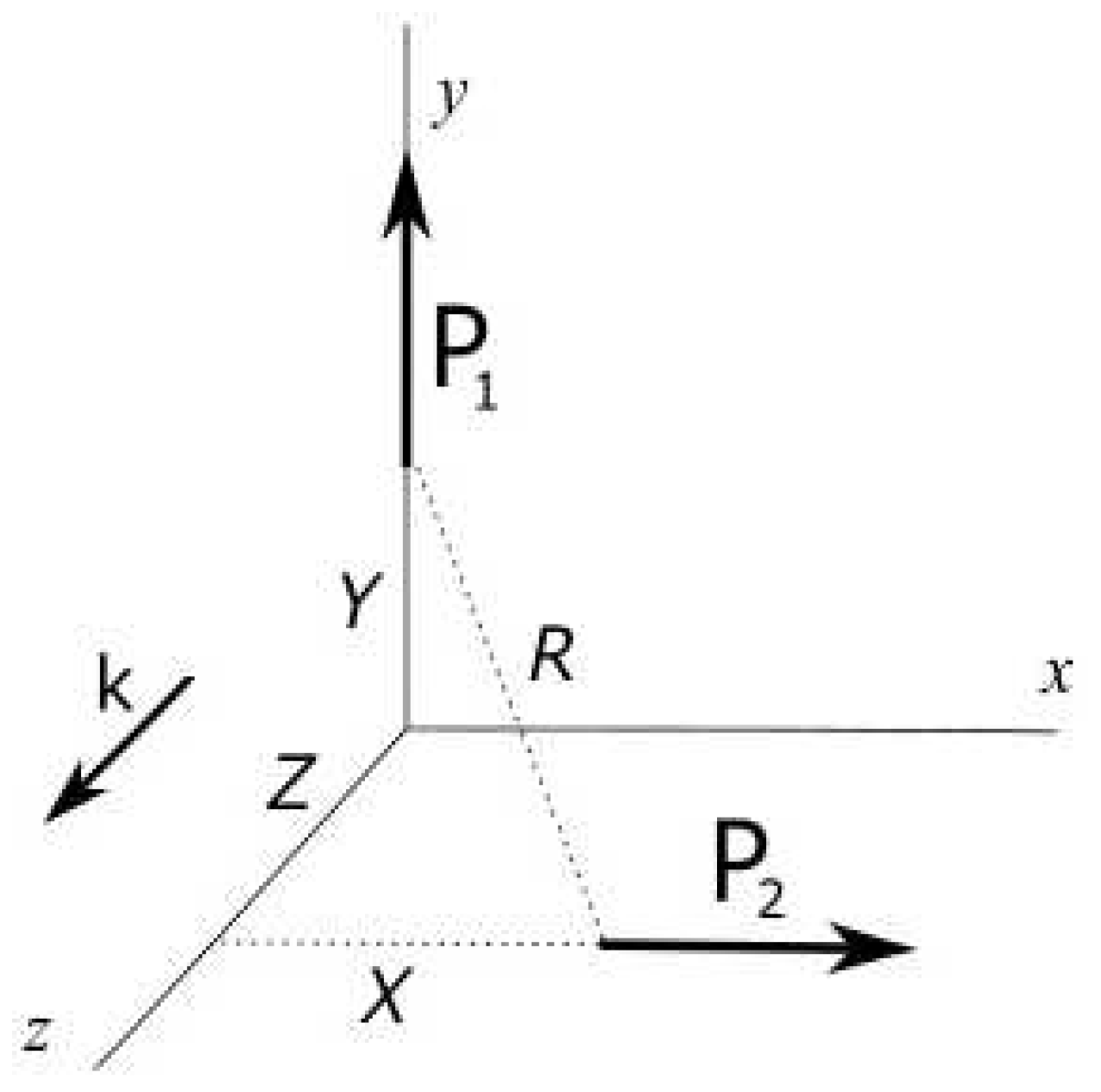
In a three dimensional arrangement, if there is a spacing between the two nanorods as depicted in Figure A1, coherently combined system manifests optical activity along the z axis due to the relative phase and mutual interaction between the nanorods. It is worth noting that, since the nonorod vector states are in the form given in Equation (224), the fourth component that corresponds to the anisotropy, which is related to the optical activity, is always zero, i.e., for non-interacting nanorods no coherent linear combination can result in a vector state with 29. For the system given in Figure A1, the emergence of optical activity can be described as a three term coherent combination of vector states, two of them associated with non-interacting nanorods and the third one being the state due the interaction:
where is the phase difference due to the spacing between the nanorods along the z axis, contains the Lorentzian polarizability and the interaction coefficient, the overall factor , G is a function of the Lorentzian polarizability and the far field factor, is a compound factor involving phase, polarizability and interaction coefficient [21] 30 31.
Figure A1.
Optical activity in a coupled dimer. and are the dipoles associated with the nanorods, Light propagates along .
Figure A1.
Optical activity in a coupled dimer. and are the dipoles associated with the nanorods, Light propagates along .
Appendix A.4.1. Unitary formulation of the rotation of the medium in space
J, N matrices and vector are the states of the transforming medium or the optical element, therefore they are themselves subjected to transformations. Particularly, if the optical element is rotated CCW by an angle about an axis parallel to the direction of propagation of light, the state of the optical element is also rotated:
is unitary matrix, element of SL(4,C):
indicates the direction of propagation of light 32. The corresponding Mueller matrix is rotated as 33
If we choose the direction of the light beam along the z axis
and
Appendix A.5. Table for vector and matrix states of optical elements
This appendix contains a tabulated list of vector states, N matrix states and their corresponding Mueller matrices M .
| Optical element | N | M | |
| Free space | |||
| Half-wave plate (Ideal mirror) | |||
| Half-wave plate 45º fast axis | |||
| Circular retarder | |||
| Horizontal Linear Polarizer | |||
| Vertical Linear Polarizer | |||
| Linear Polarizer at 45º | |||
| Linear Polarizer at 135º | |||
| Circular Polarizer (right handed) | |||
| Circular Polarizer (left handed) |
| Optical element | N | M | |
| QWP horizontal fast axis | |||
| QWP vertical fast axis | |||
| QWP fast axis 135º | |||
| QWP fast axis 45º | |||
| Circular retarder | |||
| Circular retarder |
References
- J. Hladik, "Spinors in Physics," Springer-Verlac, New York (1996).
- Başkal, S. , Kim Young S., Noz, Marilyn E, "Physics of the Lorentz Group," Morgan and Claypool Publishers, CA (2015).
- Sudha and, A.V. Gopala Rao, "Polarization Elements: A Group Theoretical Study". [CrossRef]
- R. Barakat, "Exponential versions of the Jones and Mueller–Jones polarization matrices," J. Opt. Soc. Am. A/Vol. 13, No. 1 (1996). [CrossRef]
- R. M. A. Azzam, "Propagation of partially polarized light through anisotropic media with or without depolarization: A differential 4 × 4 matrix calculus," J. Opt. Soc. Am. 68, 1756 (1978). [CrossRef]
- A. A. Bogush, V. M. Red’kov, "On unique parametrization of the linear group GL(4.C) and its subgroups by using the Dirac matrix algebra basis," arXiv:hep-th/0607054V1 (2006). [CrossRef]
- E. Ovsiyuk, O. Veko, M. Neagu, V. Balan, V. Red’kov, "Some Properties of Parameters of Lorentz Matrices and Transitivity Equations," BSG Proceedings, Vol. 20, 2013, pp. 11-63.
- E. Kuntman, M. A. Kuntman, and O. Arteaga, "Vector and matrix states for Mueller matrices of nondepolarizing optical media," J. Opt. Soc. Am. 2017; 34, 82–86. [CrossRef]
- S.R. Cloude, “Group theory and polarization algebra”, Optik 75, 26-36 (1986).
- D. Han, Y.S. Kim, M. E. Noz, "Stokes parameters as a Minkowskian four-vector,". Phys. Rev E 1997, 56. [CrossRef]
- D. Han, Y. S. Kim, M. E. Noz, "Jones-matrix Formalism as a Representation of the Lorentz Group," J. Opt. Soc. Am. A, 14 (1997). [CrossRef]
- W. R. Hamilton, "On a new species of imaginary quantities connected with the theory of quaternions," Proceedings of the Royal Irish Academy, 2:424–434 (1844).
- Katsusada Morita, "Quaternions, Lorentz Group and the Dirac Theory," Progress of Theoretical Physics, Volume 117, Issue 3 (2007), pp 501-532. [CrossRef]
- Lanlan Liu, Chonging Wu, Chao Shang, Zhengyong Li, Jian Wang, IEEE Photonics Journal ( Volume: 7, Issue: 4, Aug. 2015 ).
- E. Kuntman, M. A. Kuntman, A. Canillas, and O. Arteaga, "Quaternion algebra for Stokes-Mueller formalism," J. Opt. Soc. Am. A 36, 492-497 (2019). [CrossRef]
- E. Kuntman and O. Arteaga, "Decomposition of a depolarizing Mueller matrix into its nondepolarizing components by using symmetry conditions," Appl. Opt. 55 (2016). [CrossRef]
- R. Ossikovski, E. Garcia-Caurel, M, Foldyna and J.J. Gil, "Application of the arbitrary decomposition to finite spot size Mueller matrix measurements," Appl. Opt. 53 (2014). [CrossRef]
- E. Kuntman, M. A. Kuntman, J. Sancho-Parramon and O. Arteaga, "Formalism of optical coherence and polarization based on material media states," Phys. Rev. A 95 (2017). [CrossRef]
- M. A. Kuntman, E. Kuntman, J. Sancho-Parramon and O. Arteaga, "Light scattering by coupled oriented dipoles: Decomposition of the scattering matrix," Phys. Rev B 98 (2018). [CrossRef]
- O. Arteaga, R. Ossikovski, E. Kuntman, M. A. Kuntman, A. Cannilas and E. Garcia-Caurel, "Mueller matrix polarimetry on a Young’s double-slit experiment analog," Optics Letters 45 (2017). [CrossRef]
- M. A. Kuntman, E. Kuntman, O. Arteaga, "Asymmetric scattering and Reciprocity in a Plasmonic Dimer," Symmetry 12 (2020). [CrossRef]
- K. Kim, L. Mandel and E. Wolf, J. Opt.Soc. Am. 1987.
- A. M. Steane, "An introduction to spinors,". arXiv 2013, arXiv:1312.3824v1.
- J. D. Bjorken, S. D. Drell, "Relativistic Quantum Mechanics," McGraw-Hill, NY (1964).
- Sudha and A., V. Gopala Rao, "Polarization Elements-A Group Theoretical Study," arxiv:physics/0007079v1 (2000).
- J. J. Gil, Eur. Phys. J. Appl. Phys. 40, 1 (2007).
- N. G. Parke, J. Math. Phys. 28, 131 (1949).
- R. C. Jones, J. Opt. Soc. Am. 31, 488 (1941).
- D. Goldstein, "Polarized Light, Revised and Expanded," Optical Science and Engineering, 2nd ed. (CRC Boca Raton, FL., 2003).
- J. J. Gil and I. S. Jose, J. Opt. Soc. Am. A 30 (2013).
- J. J. Gil. J. Appl. Remote Sens. 2014, 8.
- S. Pancharatnam, Proc. Indian Acad. Sci 44, 247 (1956).
- M. V. Berry, Proc. R. Soc. Lond. A 392, 84 (1984).
- M. V. Berry, J. Mod. Opt. 34, 1401 (1987).
- J. P. Gutierrez-Vega, "Pancharatnam-Berry phase of optical sysytems," Opt. Lett. 36, 1143-1145 (2011). [CrossRef]
- T. van Dijk, H.F. Schouten, W. Ubachs, T.D. Visser, Optics Express 18 (2010) 10796.
- José Lages, Remo Giust, Jean-Marie Vigoureux, "Geometric phase and Pancharatnam phase induced by light wave polarization," Physica E: Low-dimensional Systems and Nanostructures, Volume 59, 2014, Pages 6-14. [CrossRef]
| 1 | This representation will be studied in detail in Section 8
|
| 2 | The basis set is equivalent to the Dirac basis set, . |
| 3 | We can define the spinor metric for SL(4,C) as or if we like. These metrics also have the same properties as g. |
| 4 | Besides , we will subsequently define other types and that preserve both g and . Dotted versions of all four types of transformations also preserve both g and . All types of and preserve and (). |
| 5 | We may use the generalized eigenvectors of or matrices as well, but, in that case, we have to employ the other forms of the spinor metric. |
| 6 |
corresponds to a CCW rotation about the axis in SL(2,C). |
| 7 | The upper dot on a spinorial object simply means complex conjugation: . But, the upper dot on an element of SL(2,C) or SL(4,C) has a particular meaning. . Similarly, . |
| 8 | These are matrix representations of quaternions, because matrices have the same properties as the Hamilton’s quaternion basis, : , . |
| 9 | In these expressions complex conjugation is not explicit, but , i.e., is based on matrices. |
| 10 | Actually, there is one more way:
|
| 11 | The set is equal to the set due to the relations given in Equation (111), and due to the relations , , , the set is equal to the set . |
| 12 | |
| 13 | We can also obtain 16 independent spinor pairs for the diagonal basis from the eigenvectors of and by applying the procedure described in Section 5
|
| 14 |
is an eigenvector of
|
| 15 | The pairs that obey this pattern are the generalized eigenvectors of . First column corresponds to the eigenvalue and the second column corresponds to the eigenvalue . |
| 16 | Let denote a state vector of any kind and let be its dotted contravariant version. These objects live in the state space and they all fit the pattern that given in Equation (149). All undotted covariant objects transform with and all dotted contravariant objects transform with which are based on . Under these transformations the pattern of the transformed object remains the same. Similar considerations also apply to the conjugated counterparts that live in the conjugate space. The only difference is that, in this case, the sign of the imaginary unit in Equation (149) is flipped and all matrix forms are now based on . |
| 17 | The conjugate space is also two dimensional. Basis for the conjugate space can be obtained by simply changing the sign of the imaginary unit in Equation (161). Comjugate basis cannot be expressed as linear combinations of and basis. |
| 18 | There does not exists a fourth matrix that anticommutes with matrices. |
| 19 | Sign depends on the sense of the cyclic path. |
| 20 | Geometric phase can also be defined and calculated for an open loop operations on the Poincare sphere. |
| 21 | Negative sign is due to the CCW cyclic path. |
| 22 | In polarization optics, convention is usual. |
| 23 | Birefringence parameters correspond to rotations and dichroism parameters correspond to boosts. |
| 24 | We may think of more complicated combinations involving many branches with serial, parallel or mixed operations. |
| 25 | |
| 26 | When we interpret as the state of the component system (medium), the linear combination given in Eqations (215) may look like a superposition of states, but the elements in the sum are not representing different states of the same system, they are the states corresponding to different systems. |
| 27 |
. Only the isotropic amplitude absorption survives in . |
| 28 | In this simple example, and the state space is two dimensional, hence we can truncate the third and fourth components of the vector states. |
| 29 | This is also true for crossed orthogonal nanorods. |
| 30 | Lorentzian polarizability and the interaction coefficient are functions of the wavelength of the incident light, hence the phenomenon of plasmonic hybridization occurs at wavelengths that make the denominator of g zero. |
| 31 | Optical activity can be observed even in a planar geometry in sideways scattering directions [21]. |
| 32 | The vector state is rotated as . |
| 33 |
, because any complex conjugate form commutes with any Hermitian adjoint form ( commutes with for all ), hence . |
Figure 1.
Reflections and inversions. space is not shown.
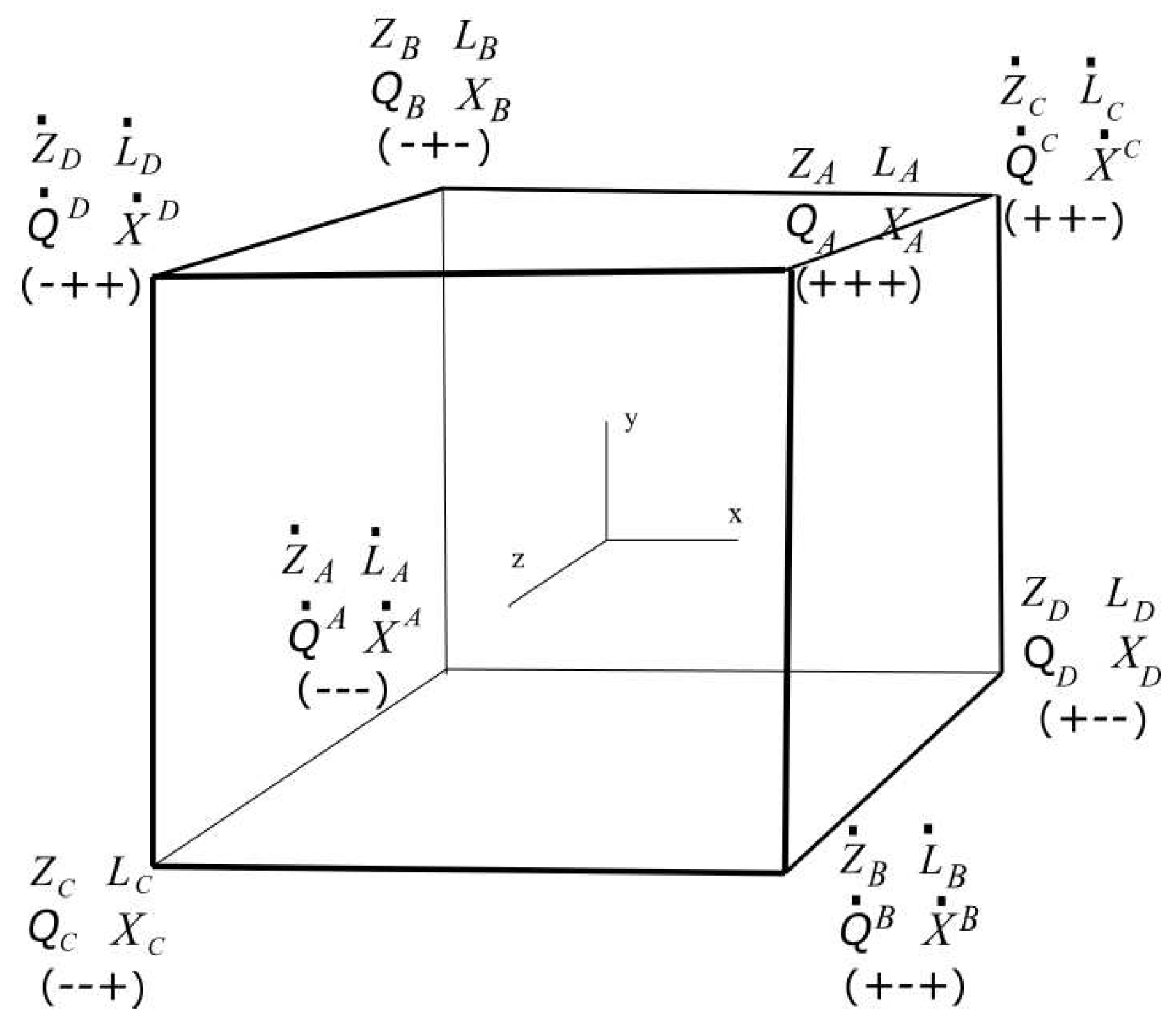
Figure 2.
rotations of spinors
Disclaimer/Publisher’s Note: The statements, opinions and data contained in all publications are solely those of the individual author(s) and contributor(s) and not of MDPI and/or the editor(s). MDPI and/or the editor(s) disclaim responsibility for any injury to people or property resulting from any ideas, methods, instructions or products referred to in the content. |
© 2023 by the authors. Licensee MDPI, Basel, Switzerland. This article is an open access article distributed under the terms and conditions of the Creative Commons Attribution (CC BY) license (http://creativecommons.org/licenses/by/4.0/).
Copyright: This open access article is published under a Creative Commons CC BY 4.0 license, which permit the free download, distribution, and reuse, provided that the author and preprint are cited in any reuse.


