

Submitted:
28 March 2023
Posted:
29 March 2023
Read the latest preprint version here
Abstract
The following system of equations {x_1 \cdot x_1=x_2, x_2 \cdot x_2=x_3, 2^{2^{x_1}}=x_3, x_4 \cdot x_5=x_2, x_6 \cdot x_7=x_2} has exactly one solution in ({\mathbb N}\{0,1})^7, namely (2,4,16,2,2,2,2). Hypothesis 1 states that if a system of equations S \subseteq {x_i \cdot x_j=x_k: i,j,k \in {1,...,7}} \cup {2^{2^{x_j}}=x_k: j,k \in {1,...,7}} has at most five equations and at most finitely many solutions in ({\mathbb N}\{0,1})^7, then each such solution (x_1,...,x_7) satisfies x_1,...,x_7 \leq 16. Hypothesis 1 implies that there are infinitely many composite numbers of the form 2^{2^{n}}+1. Hypotheses 2 and 3 are of similar kind. Hypothesis 2 implies that if the equation x!+1=y^2 has at most finitely many solutions in positive integers x and y, then each such solution (x,y) belongs to the set {(4,5),(5,11),(7,71)}. Hypothesis 3 implies that if the equation x(x+1)=y! has at most finitely many solutions in positive integers x and y, then each such solution (x,y) belongs to the set {(1,2),(2,3)}.
Keywords:
Brocard's problem
; Brocard-Ramanujan equation x!+1=y^2
; composite Fermat numbers
; composite numbers of the form 2^(2^n)+1
; Erd\"os' equation x(x+1)=y!
MSC: 11D61; 11D85
1. Composite numbers of the form
Let denote the following system of equations:
The following subsystem of 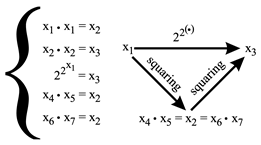
has exactly one solution in , namely .
Hypothesis 1.
If a system of equations has at most five equations and at most finitely many solutions in , then each such solution satisfies .
Lemma 1.([7], p. 109). For every non-negative integers x and y, if and only if .
Theorem 1.
Hypothesis 1 implies that is composite for infinitely many integers greater than 1.
Proof.
Assume, on the contrary, that Hypothesis 1 holds and is composite for at most finitely many integers greater than 1. Then, the equation
has at most finitely many solutions in . By Lemma 1, in positive integers greater than 1, the following subsystem of 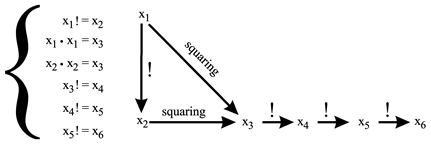 has at most finitely many solutions in and expresses that
Since , we get a contradiction. □
has at most finitely many solutions in and expresses that
Since , we get a contradiction. □
has at most finitely many solutions in and expresses that
Most mathematicians believe that is composite for every integer , see [2], p. 23.
Open Problem 1.
([3], p. 159). Are there infinitely many composite numbers of the form ?
Primes of the form are called Fermat primes, as Fermat conjectured that every integer of the form is prime, see [3], p. 1. Fermat remarked that , , , , and are all prime, see [3], p. 1.
Open Problem 2.
([3], p. 158). Are there infinitely many prime numbers of the form ?
2. The Brocard-Ramanujan equation
Let denote the following system of equations:
The following subsystem of 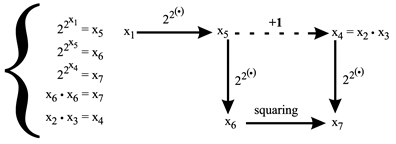 has exactly two solutions in positive integers, namely and .
has exactly two solutions in positive integers, namely and .
Hypothesis 2.
If a system of equations has at most finitely many solutions in positive integers , then each such solution satisfies .
Lemma 2.
For every positive integers x and y, if and only if
Theorem 2.
Hypothesis 2 implies that if the equation has at most finitely many solutions in positive integers and , then each such solution belongs to the set .
Proof.
The following system of equations
is a subsystem of . By Lemma 2, in positive integers, the system expresses that or
is a subsystem of . By Lemma 2, in positive integers, the system expresses that or
If the equation has at most finitely many solutions in positive integers and , then has at most finitely many solutions in positive integers and Hypothesis 2 implies that every tuple of positive integers that solves satisfies . Hence, . If , then is a square only for . □
It is conjectured that is a square only for , see [10], p. 297. A weak form of Szpiro’s conjecture implies that the equation has only finitely many solutions in positive integers, see [6].
3. Erdös’ equation
Let denote the following system of equations:
The following subsystem of 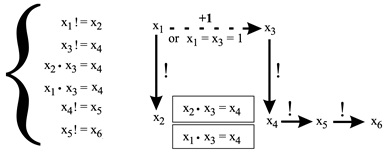 has exactly three solutions in positive integers, namely , , and .
has exactly three solutions in positive integers, namely , , and .
Hypothesis 3.
If a system of equations has at most finitely many solutions in positive integers , then each such solution ) satisfies .
Theorem 3.
Hypothesis 3 implies that if the equation has at most finitely many solutions in positive integers and , then each such solution belongs to the set .
Proof.
The following system of equations 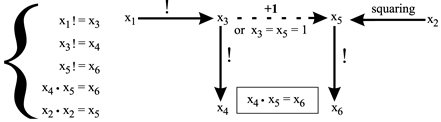 is a subsystem of . By Lemma 2, in positive integers, the system expresses that or
is a subsystem of . By Lemma 2, in positive integers, the system expresses that or
If the equation has at most finitely many solutions in positive integers and , then has at most finitely many solutions in positive integers and Hypothesis 3 implies that every tuple of positive integers that solves satisfies . Hence, . If , then is a product of two consecutive positive integers only for because the following MuPAD program
- for x2 from 1 to 720 do
- x1:=round(sqrt(x2!+(1/4))-(1/2)):
- if x1∗(x1+1)=x2! then print(x2) end_if:
- end_for:
returns 2 and 3. □
The question of solving the equation was posed by P. Erdös, see [1]. F. Luca proved that the conjecture implies that the equation has only finitely many solutions in positive integers, see [4].
4. There is no hope for a hypothesis that is similar to Hypothesis 2 or 3 and holds for an arbitrary number of variables
Let , , and let for every integer . Let denote the system of equations . For an integer , let denote the following system of equations:

For every positive integer n, the system has exactly two solutions in positive integers , namely and . For a positive integer n, let denote the following statement: if a system of equations
has at most finitely many solutions in positive integers , then each such solution satisfies . The statements are discussed in [8,9].
Theorem 4.
Every factorial Diophantine equation can be algorithmically transformed into an equivalent system of equations of the forms and . It means that this system of equations satisfies a modified version of Lemma 4 in [7].
Proof.
It follows from Lemmas 2–4 in [7] and Lemma 2. □
The statement is dubious. By Theorem 4, this statement implies that there is an algorithm which takes as input a factorial Diophantine equation and returns an integer which is greater than the solutions in positive integers, if these solutions form a finite set. This conclusion is strange because properties of factorial Diophantine equations are similar to properties of exponential Diophantine equations and a computable upper bound on non-negative integer solutions does not exist for exponential Diophantine equations with a finite number of solutions, see [5].
References
- D. Berend and J. E. Harmse, On polynomial-factorial Diophantine equations, Trans. Amer. Math. Soc. 358 (2006), no. 4, 1741–1779.
- J.-M. De Koninck and F. Luca, Analytic number theory: Exploring the anatomy of integers, American Mathematical Society, Providence, RI, 2012.
- M. Křížek, F. Luca, L. Somer, 17 lectures on Fermat numbers: from number theory to geometry, Springer, New York, 2001.
- F. Luca, The Diophantine equation P(x)=n! and a result of M. Overholt, Glas. Mat. Ser. III 37 (57) (2002), no. 2, 269–273.
- Yu. Matiyasevich, Existence of noneffectivizable estimates in the theory of exponential Diophantine equations, J. Sov. Math. vol. 8, no. 3, 1977, 299–311. 3. [CrossRef]
- M. Overholt, The Diophantine equation n!+1=m2, Bull. London Math. Soc. 25 (1993), no. 2, 104. no. 2.
- A. Tyszka, A hypothetical upper bound on the heights of the solutions of a Diophantine equation with a finite number of solutions, Open Comput. Sci. 8 (2018), no. 1, 109–114. [CrossRef]
- A. Tyszka, Statements and open problems on decidable sets X⊆N that contain informal notions and refer to the current knowledge on X, http://arxiv.org/abs/1506.08655, to appear in Creative Mathematics and Informatics 32 (2023), no. 2.
- A. Tyszka, Statements and open problems on decidable sets X⊆N that refer to the current knowledge on X, Journal of Applied Computer Science & Mathematics 16 (2022), no. 2. [CrossRef]
- E. W. Weisstein, CRC Concise Encyclopedia of Mathematics, 2nd ed., Chapman & Hall/CRC, Boca Raton, FL, 2002.
Disclaimer/Publisher’s Note: The statements, opinions and data contained in all publications are solely those of the individual author(s) and contributor(s) and not of MDPI and/or the editor(s). MDPI and/or the editor(s) disclaim responsibility for any injury to people or property resulting from any ideas, methods, instructions or products referred to in the content. |
© 2023 by the authors. Licensee MDPI, Basel, Switzerland. This article is an open access article distributed under the terms and conditions of the Creative Commons Attribution (CC BY) license (http://creativecommons.org/licenses/by/4.0/).
Copyright: This open access article is published under a Creative Commons CC BY 4.0 license, which permit the free download, distribution, and reuse, provided that the author and preprint are cited in any reuse.