

Submitted:
22 March 2023
Posted:
23 March 2023
You are already at the latest version
Abstract
Livability is one of the paramount characteristics of the current era that architects striving to achieve. This situation becomes even more important on commercial streets, whose functional diversity and constant movement of people require special action. In Erbil, commercial streets suffer from neglect in terms of adopting places for livability. Although it has huge potential to form an attractive and entertaining environment other than shopping. Some countries have developed standards for the design of commercial streets. The basic requirements are the same, but details usually vary according to the diverse needs of people. The research aims to identify a comprehensive framework (A Checklist) for placemaking to form the basis for measuring livability in one of the vital streets in Erbil city. This Framework is considered the basis for assessing and designing at the same time, supporting designers to achieve two main pillars: develop existing streets and suggest basic principles for future street design. This article adopts a practical framework, a questionnaire, a field survey, and observation as research methods. The research concluded that altogether placemaking dimensions are essential in activating livability, and a sort of balance between the main dimensions appeared. The more applied strategies, the higher the street livability.
Keywords:
Placemaking
; Livability
; Models
; Practical Framework
1. Introduction
Streets are the main component of urban form and the city in general. An absence of understanding of people's needs and urban design has led to the creation of dead streets that are not lively and do not encourage interaction,[1]. Streets are places where children play, housewives and old people spend their lives. it’s the outside of the house and a significant part of our urban environment, [2]. Both Allan and Appleyard turned slightly back toward the importance of the street in city design and how its regarded as the city’s lungs, [3]. Streets are multi-use places of social interaction, diverse activities, economical, walkable places, playing for children, and many other activities that take place in this space, [4] . The character of a city is well-defined by its streets and public places. These places create the city's image, from squares and roads to neighborhood parks and playgrounds. Streets connect places, and people, enabling commerce, social interaction, and movement. Streets contribute to defining cities' cultural, social, economic, and political functions, [5]. The goal of generating cities is to attract the largest possible number of people to walk within its streets, bringing more life and adding a richness of experiences, especially when fast traffic turns into a slow one, [6]. PPS (The Project of Public Spaces), presented a model for evaluating public places in general, including streets, it works as a tool that helps people assess any place. The model includes four dimensions; accessibility; easy clear movements, people involved in activities; the space being comfortable and having a good image; and, it is a sociable place: where people meet each other, [7]. PPS is the end of a modernization of a large number of factors and dimensions that constitute vital places. Its beginnings date back to the 1960s when Jane Jacobs mentioned that the key to the city is through its efficient and lively streets. At the same time, people enjoy observing the streets and the entertainment it contains. The principle is to focus on the street's physical characteristics as; form, the pavement's width, height, buildings' edges, variety of activities, and greenery, [8].
This article will discuss and develops the dimensions presented by placemaking, and theories of place presented by researchers, urban theorists, and designers, to identify the essential dimensions that effects improving the quality of the place and raising its livability. It proposes a new theoretical and practical framework to assess the livability of commercial streets. This article aims to lay the foundations for comprehensive and integrated placemaking strategies to assess the commercial street in terms of its livability. As well as aims to adopt the practical framework as a means to check the level of street implementation of these strategies, in addition to being a basis for the design of the commercial street in the future. To select a research sample (commercial street), a pilot study was conducted to find out people's opinions about the best commercial streets in Erbil city, and the most livable one from their point of view. The quick questionnaire was associated with social, local, and physical dimensions.
The article is divided into the following steps: first, presents the models and dimensions identified by theorists, researchers, and (PPS), and has been applied to several case studies. The second step characterizes the added dimensions and factors that enrich the new model. The third step is; determining theorists’ opinions regarding essential dimensions to raise the place value, encourage belonging to the place, and increase human interaction. As a result of the aforementioned three parts, an integrated and accurate (Framework) was extracted for assessing placemaking. The proposed theoretical framework was applied to the selected research sample to assess the percentage of street application of the placemaking strategy. The final part presents a case study discussion, results, conclusions, and recommendations.
2. Materials and Methods
2.1. Dimension Extraction
This part displays models adopted by the placemaking concept to identify the influential and frequent dimensions. Several researchers deliberately developed these models or modified them according to the research problem, need, and context they worked with. PPS presented four main dimensions recognized by; uses and activities, comfort and images, access and linkages, and sociability. The following Figures display the models presented by architects, researchers, or development organizations. After comparing these models, they were regrouped according to the types of dimensions introduced by PPS. To determine the basic dimensions on which the theoretical Framework was erected, the research applied the following steps:
2.1.1. First Step (Models Review)
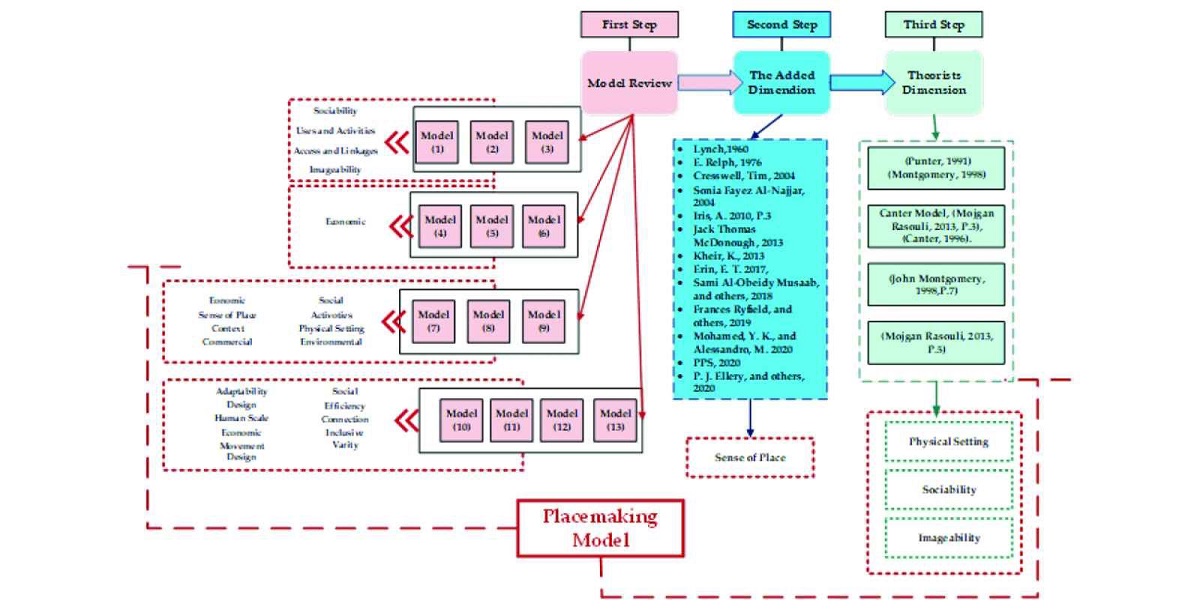
- Thirteen models adopted by researchers, architectural theorists, and urban designers were reviewed to evaluate placemaking within a commercial street. The most frequent dimensions were: Sociability, Accessibility, Uses and Activities, Comfort, and Imageability.
- The dimensions were regrouped into four groups based on the common dimensions among the models. As well as the derivation of the new dimension between them
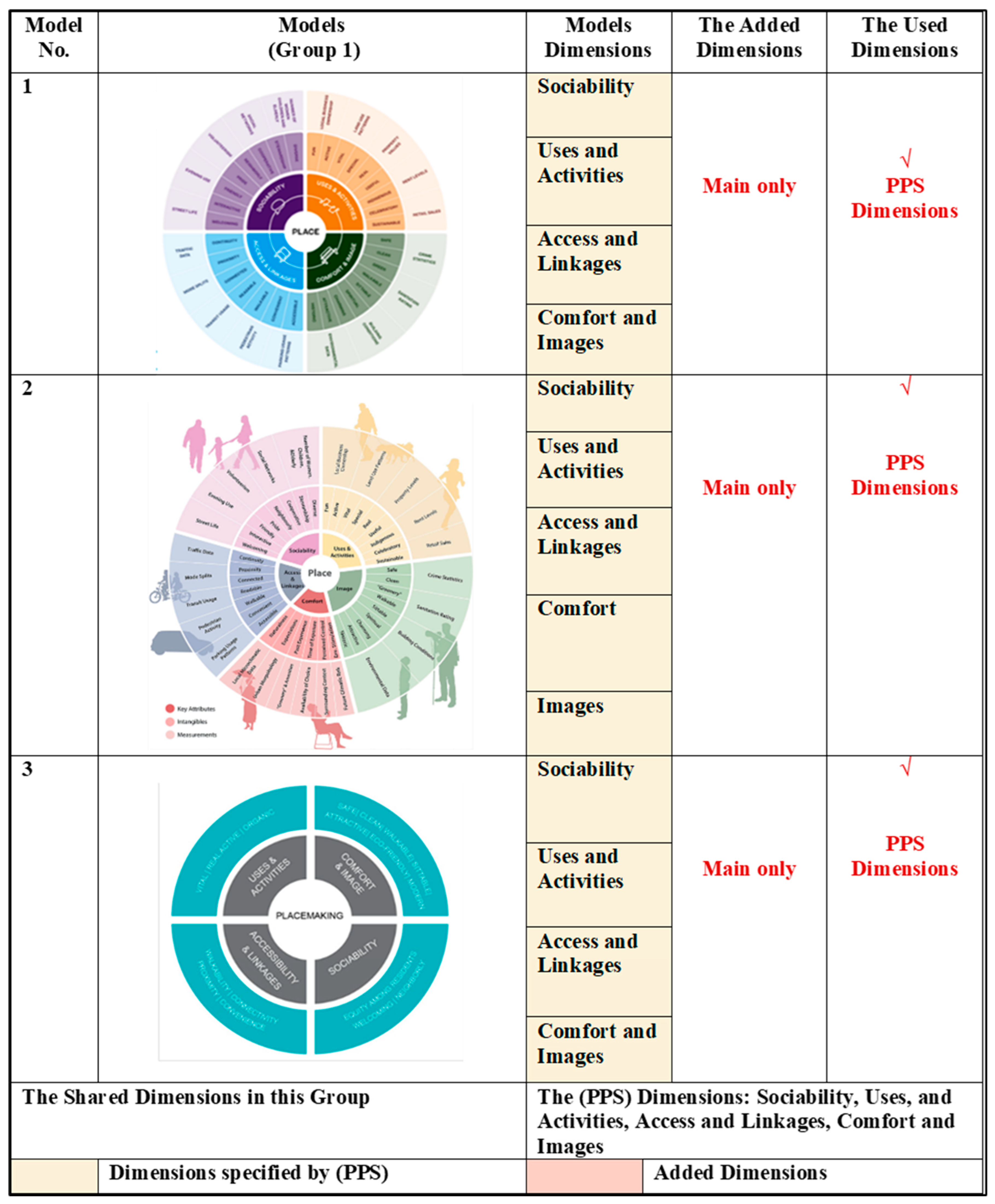
- First group with three models out of thirteen, all four dimensions were adopted for evaluating and redeveloping streets, this group relied on the dimensions of (PPS), which become the basis for their research and practical assessment. Figure 1, Appendix A1. [7], [9], [10]
- The second group with three models shared the same basic dimensions. Other dimensions were added according to the context of the research sample, site analysis, and conservation since the selected site was within a conservation area. Both climatic and economic were added to the considerations of the selected samples, Appendix A2, [11], [12], [13].
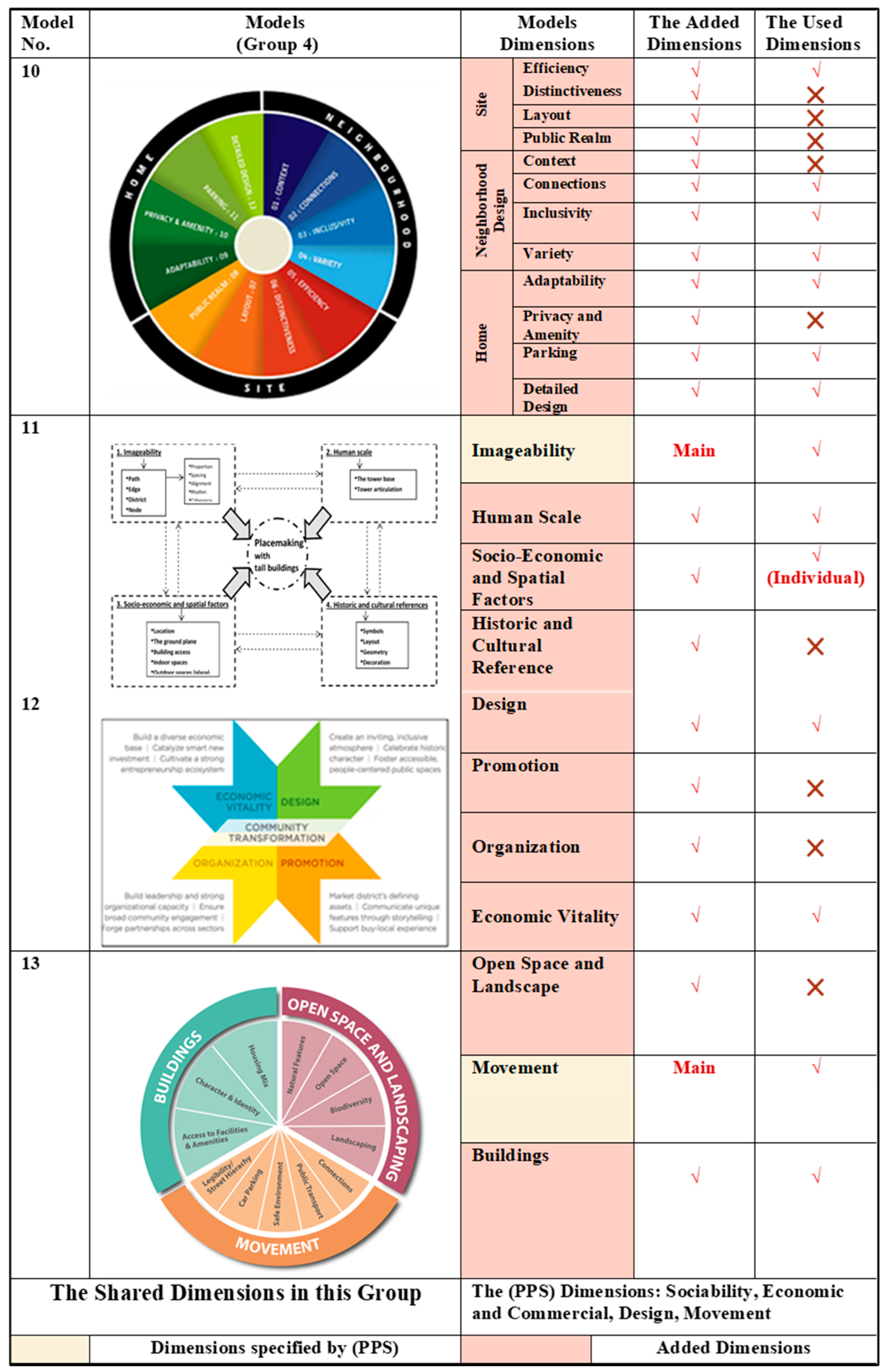
- Dimensions such as design, environmental, urban context, historical, spatial, human scale, climatic, and sense of place were mentioned individually and according to the research need and problem in this group. The researchers praised the importance of these dimensions, considered one of the basic pillars of placemaking that was not used previously. Appendix A4. [17], [18], [19], [20]. (The compared dimensions table in Appendix part A).
- By comparing the dimensions of the aforementioned models presented by the researchers, an extrapolation was made to determine the most important and repeated factors to use within the model and the Framework, both (Theoretical and Practical).
- The least frequent dimensions in the previous studies were also included in the theoretical framework. A comprehensive evaluation list for placemaking was extracted, to evaluate livability in the commercial street, Figure 2.
2.1.2. Second Step (The Added Dimension)
This part deals with adding an influential dimension to the placemaking framework, which did not appear explicitly in the previous models. Despite this, it has been widely mentioned by many researchers who have praised its effectiveness in placemaking.
2.1.2.1. Sense of Place
P. J. Ellery presented a model where individuals embody its core, all sensory information assembled from the place, perceptions they form based on their relations with a place, and connections they create between the individual and the place. No matter how positive or negative these perceptions are, they will form a certain association with the place. This is called a sense of place and has great benefits, including improving social communication and strengthening the relationships of individuals. He presented a Placemaking model that depends on the connection between place and people. This is considered an essential part of placemaking mechanics,[14]. PPS declares that space and place as terms they often used reciprocally, and consist of different meanings depending on the setting in which they operate. Placemaking explains that place creation exceeds the physical dimension and involves other aspects, such as sociability, mixed uses, accessibility, interaction, and comfort. This produces bonds between people and places to create a sense of place, [7]. Cresswell regarded a sense of place as a way of knowing more about places, it is more cognitive than existential, and it is the spatial connection that people have to place. The availability of spatial sufficiency associated with the needs of people and the appointed time generates a meaning of the place. [21]. Lynch identified that the psychology of the place is connected to a mental map people use as a guide in urban places, using their senses to express whether the place is safe, comfortable, vital, or threatening, [22]. Iris presents several theorists' perspectives on a sense of place and how a sense of belonging is formed through buildings with historical character. Placemaking can be achieved on a variety of scales, from the balcony of a house to the city streets where all people meet, [23]. Many aspects of placemaking rely on inviting people to suggest activities. Giving input to the development of places, as they become more familiar with needs and activities a sense of place will generate. To influence social structures, it seeks for a practical application to link the relationship between people and place. communication between place and people in a specific space will generate as a result of the sensory understanding of community participation. It appears when people understand and accept the place they use, [24]. Ralph describes a sense of place as the possession and creation of place, developing a system of meaningful places, giving shape to our experiences, [25]. The creation of place comes as a result of the synthesis of spatial experiences, scenes, stories, feelings, and ideas. It is intricately linked to history, cultural identity, and social relations, to be an essential component of an event, [26]. Experience is one of the essential factors in a sense of place, [27]. It involves psychological, cognitive, emotional processes, and physical activities, and can be defined in three parts; identifying or recognizing a place, feelings about or evaluating a place, and behaviors and interactions that occur in a place, [28]. Depending on what was mentioned, sense of place is an integral part of the place and one of its necessary specifications demonstrates the strength of human attachment, then the place is successful in terms of interaction and vitality.
2.1.2.2. Sense of Place and Placemaking
Sense of place usually developed from common relations, activities, interactions in small places, and receiving and sharing information. Such small actions like setting or standing and talking, over time, develop a place’s character and are regarded as essential motivations for developing people’s sense of place. Theoretical research holds that traditional environments provide a better sense of place and evoke deep-rooted cultural meanings. Placemaking stems from dissatisfaction with the design that is not depending on place within contemporary urban, [18]. Placemaking endorses a substantial sense of belonging and sense of place. The changing public place is the result of the imagination and interactions between people. It is essential for place comfort, safety, and security to create a unique identity for the place, [29]. Placemaking gradually started focusing on the cultural developments in urban places, as it greatly impacts the creation of a sense of place that evokes the city character, [30]. Creating a sense of place is likewise related to the number of activities and events included within the space. These activities provide opportunities for conversations and social gatherings, as is evident in the “Power of Ten”, which includes the availability of a good number of activities that suit all ages in the city. These are some strategies that have been followed to attract a higher density of people within the premise of providing vital entertainment venues. Places often succeed when people have a range of reasons (more than ten activities). These might contain a place to sit, playgrounds, any kind of art, music, food, history to experience, and people to meet, as well, some of these activities will be unique to that place, reflecting the culture of the surrounding community,[31]. Another important component of placemaking is the availability of retail, these offer a wide variety and choices to people within the urban space. It has economic, social, and local dimensions, not to mention the density it will achieve in this place. [30]. Another important element in the city that constitutes an essential part of its structure is the streets, which include many activities and functions that give them a sense of place. Therefore, all physical features in the street, such as buildings, their elements, and landscape design significantly contribute to making the street legible and accessible providing safety, and a comfortable environment for people.[27]. According to the mentioned above, a question will arise; Why is a sense of place an effective factor in placemaking? Sense of place is linked with three basic components; it has a strong connection with the knowledgeable aspect of the place. It is related to being an applied practical reference formed through place attachment and place identity. Finally, is related to the psychological aspect and its effects on the users. Accordingly, it is related to three components of placemaking dimensions that were proposed before, they are; sociability, imageability, and activities. At this stage, an initial model was formed to be a base for modifying the model (the framework). Figure 3 and Figure 4.
2.1.3. Third Step (Theorists Dimensions)
The final step is defining the model upon which to base the placemaking Framework. Several theorists' opinions on place and placemaking were reviewed in their identification of the dimensions and basic factors related to generating lively places. Despite the great disparity in theorists' attitudes towards place theory, most of them praised the importance of physical setting, imageability, activities, and diversity to activate the place, and the connection between humans and place. These dimensions are regarded as one of the basics of placemaking theory that conveys many benefits to both environment and society. Jane Jacob aroused attention to life in the street as a social place, instead of being a street for cars only. She was the first to explore place quality regarding activities producing value in a built environment, [8].
Christopher Alexander quote “Streets should be for staying in, and not just for moving through, the way they are today”. Alexander is one of the theorists who presented ideas and theories that impressed the design of cities and streets in all their details. Among these, is the wholeness concept, which adopts the idea of integrating space with all needs to reach a vital and usable place for people. In “New Concept in Complex Theory”, he interpreted wholeness as the basis for spatial configurations, and a key to many events and phenomena representing aspects of system behavior. In his book “A pattern of language”, he pointed out the importance of adopting people's concepts when designing the city and the street. This idea will revive the livability aspect, since people's needs are basic within the public space, and adopting these images represents the essence of creating beautiful places, [32], [33]. Most of the beautiful places in the world weren't made by architects, but by people themselves, [7]. He also talked about the process of locating any shop within the street, which must take into account several basic points, including the need and filling the functional void, and the existence of activities, [32]. Three basic ideas that are the essence of placemaking are advanced by Christopher: wholeness, adopting people's ideas and needs when designing, and dealing with the smallest details that are related to daily needs.
Gehl argued that successful urban places are mostly based on street life and the different ways that activities are distributed and occur in the street, [34], (1989). One of the essential fundamentals of placemaking is, changing space to place, as Cresswell explained, space turns into place when the person adds his touches and changes to it (a man who makes the place meaningful), this will make the place belongs to him. He mentioned that place memory and spatial recognition impact place theories as well. For him, location, locality, and sense of place are the main components of place, [21]. In turn, Gehl drew architects’ and planners’ attention to the importance of the spaces between buildings and their impact on creating a livable environment, through connecting physical settings and activities in the street, [35]. Punter suggests a model for enhancing a sense of place which is discussed by Montgomery. He regarded a sense of place as an essential factor in activating placemaking meaning from human experience effects on spatial correlation. Punter reinterpreted the models presented by both Relph, (1976) and Canter (1977). The model was about connecting activities, physical settings, and means to enhance the use of places, see Figure 5. [36], cited from (Punter, 1991).
Canter, introduced an identification process for the place, his theory revolves around three main pillars, a place for him a realm of; activities, physical attributes, and conceptions,[37], [38], Canter’s theory owns a practical dimension in addition to theoretical, as it hits the core of design decisions. To lay the foundation for place theory, Canter explained the importance of integrating two realms; the various design aspects presented by designers, and the results of the environment and behavioral research. Accordingly, a framework appears based on place experience integrating; social, individual, and cultural aspects. On the other hand, different behavioral and environmental research models work as independent theories alongside the models of place theories. Hypothetically, these aspects assume the importance of analyzing place studies as meaning with building perception reveals similar components of spatial experience. The theory integrates personal, social, and cultural, using the place as a neutral technical term in a physical and social experience of place. See Figure 6, [39]. Montgomery put forward two models for discussion, the first is for Canter, where the model-centered place, came as a result of (perception, idea, cognition, and physical attributes) asserting a person's perception and experience in knowing the place. He also discussed the components of place for Punter, focusing on the importance of a sense of place in activating placemaking, and how ideas and meaning derived from human experience with place affect the spatial association. Montgomery stressed the importance of these three principles in highlighting the quality of a good location. [36]. He believes these principles greatly impact deriving the characteristics of placemaking and creating successful urban places. Instead of being a place only, the main axis has become a sense of place, and all of the activities, physical settings, and meaning are acquired from the place. He combines what is appropriate from the two models to form the basis of placemaking to best determine the work of qualitative specifications, see Figure 7.
Mojgan reviewed most of the previous models and emphasized that the model he presents enhances the quality of place, and how design contributes to a sense of place. By considering the importance of these components, it is easy to adapt this theory to placemaking principles. See Figure 8. [38]. Seamon said “To be is to be in a place", which means that human is essentially implanted where any understanding of their life is truly related to the quality of the place anywhere life occurs, [40]. He introduced a tried component to constitute place theory; the environment and geographical basis of the place, the people of the place, and the togetherness of the place. He combined these motive elements in a three-arrowed model, [41]. Seamon regarded the place as a phenomenon connecting humans and their activity, presenting a complete image of a place. Originally place is a phenomenon due to its close connection to human and their activities. To explain the three components, Seamon identified six place processes that connect each other to present a complete image of the place, Figure 9. Figure 10, shows research steps for extracting dimensions and adopting the new Framework.
2.2. Placemaking Model
According to the previous review of place theory and theorists, the research identified the following points:
- Dimensions have been compared to identify the more influential ones in place and placemaking.
- By reviewing the models and according to previous studies that developed or applied the models, all of them indicated the importance of the four dimensions within the strategies of place; Sociability, Access and linkages, Uses and Activities, and Comfort and Images, [7], [9], [10], [11], [12], [13], [14], [15], [16], [17], [18], [19], [20]. As for the theorists of the place, Punter, Canter, Montgomery, Mojgan, and Seamon, [36], [38], [39], [40], [41], agreed on the presence of three basic dimensions that have an impact on raising the quality of the place, which are the social aspect, the physical setting, and the meaning or sense of the place, and by comparing the practical and theoretical sides of both models and the theorists, the model was restructured to suit the local commercial street.
- According to the previous literature, the aforementioned (Theoretical Framework) was reconfigured into a (Practical Framework) consisting of three main pillars. Consequently, the organization of these three dimensions has been reduced and restructured as shown in Table 1.
- The research decided to identify three basic dimensions: Physical Setting, Sociability, and Imageability. Each dimension is subdivided into another secondary dimension, factors, secondary factors, and possible values, Figure 11.
- The research adopted these dimensions and factors to place the foundation of the Practical Framework. The placemaking framework has been identified, constituting the appropriate approach for assessing P.M. strategies in commercial streets.
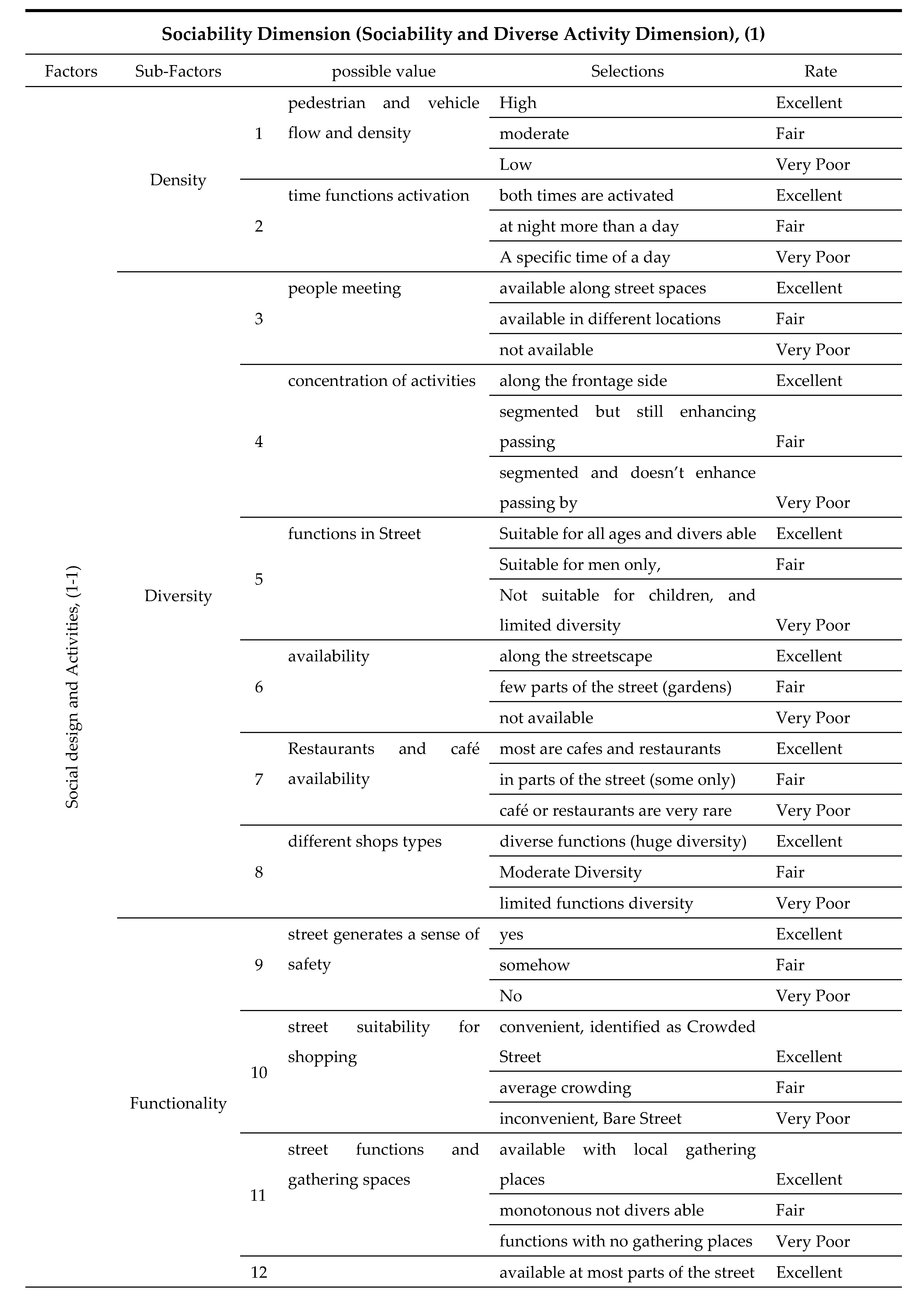
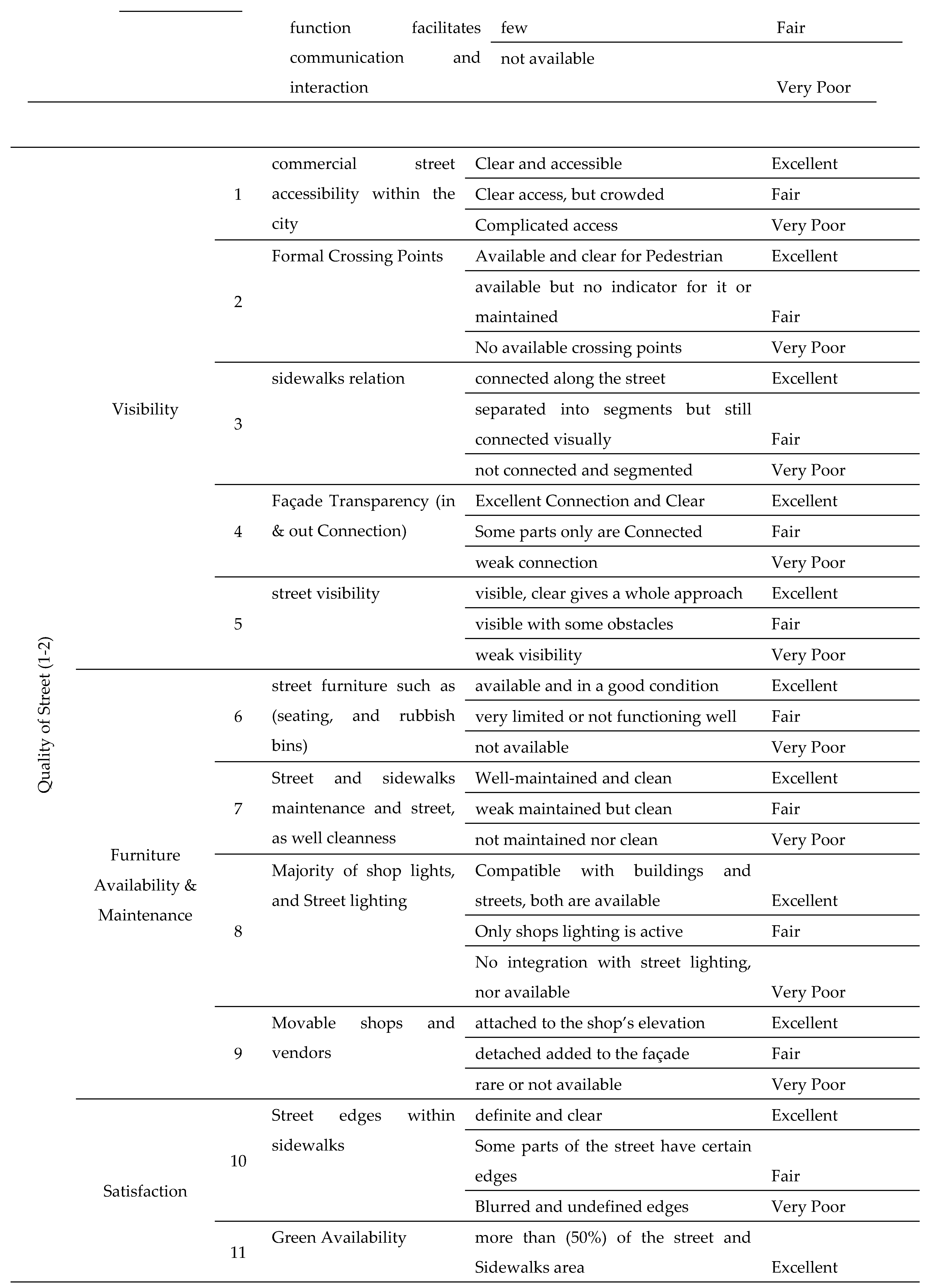
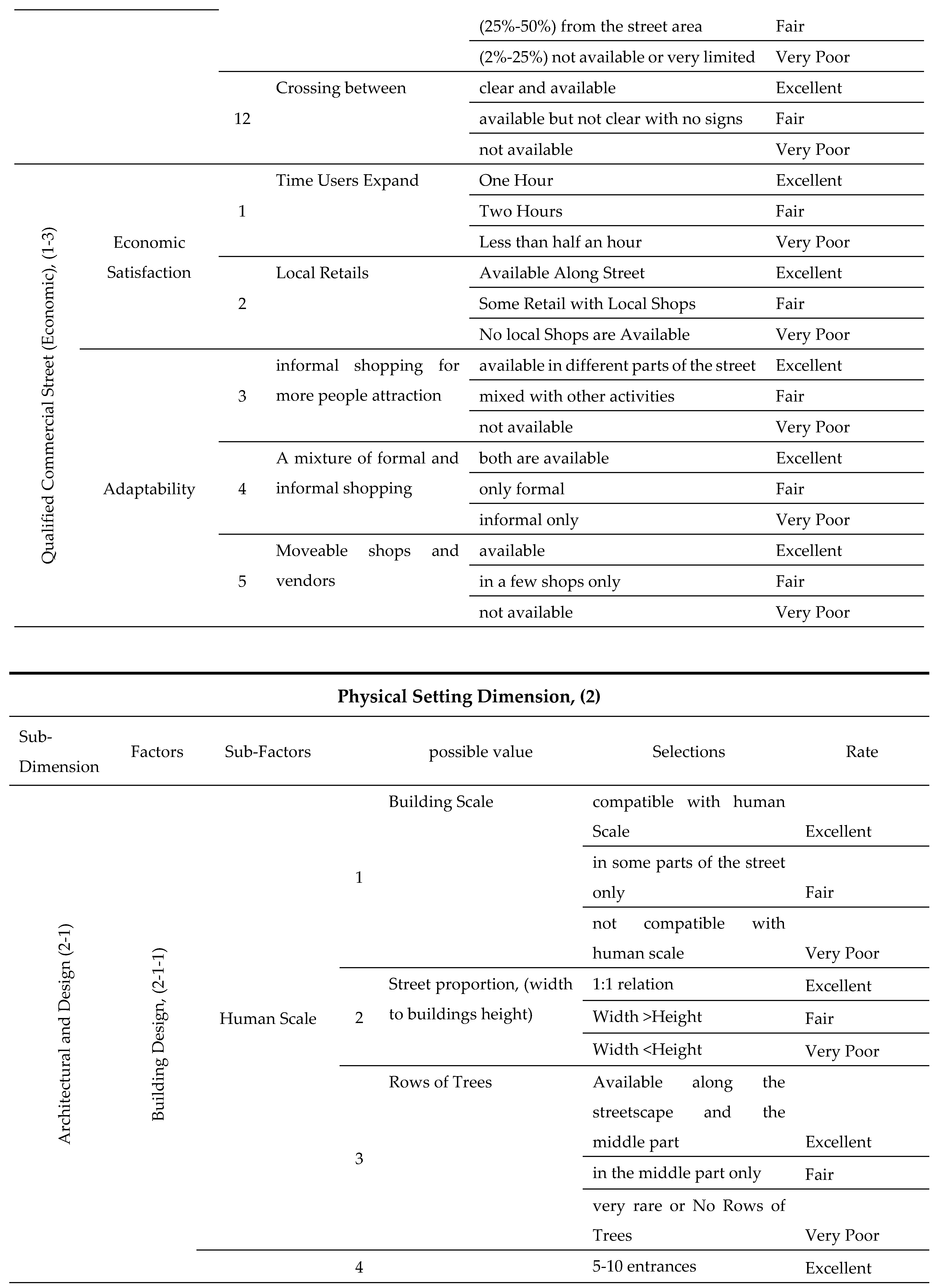
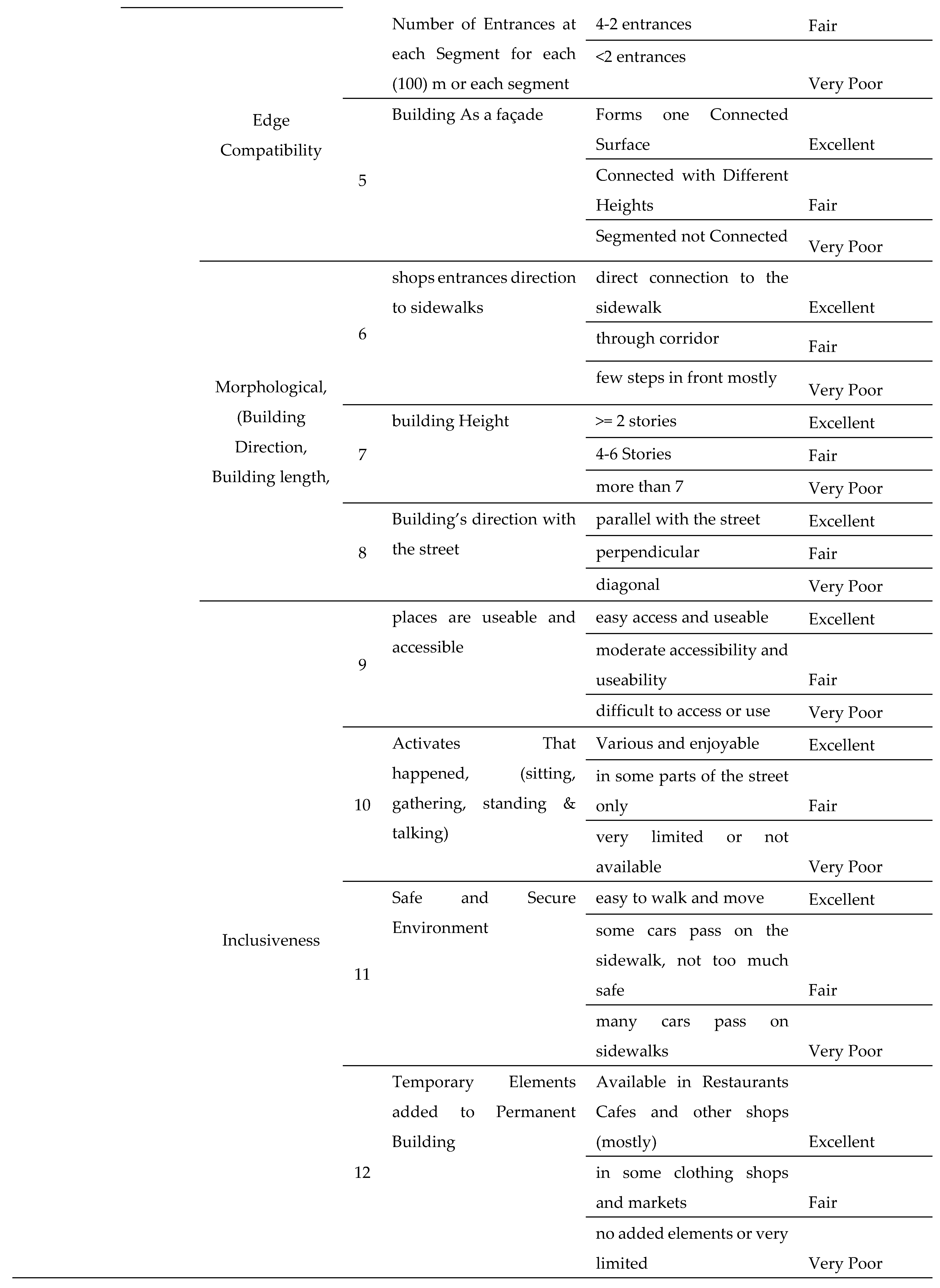
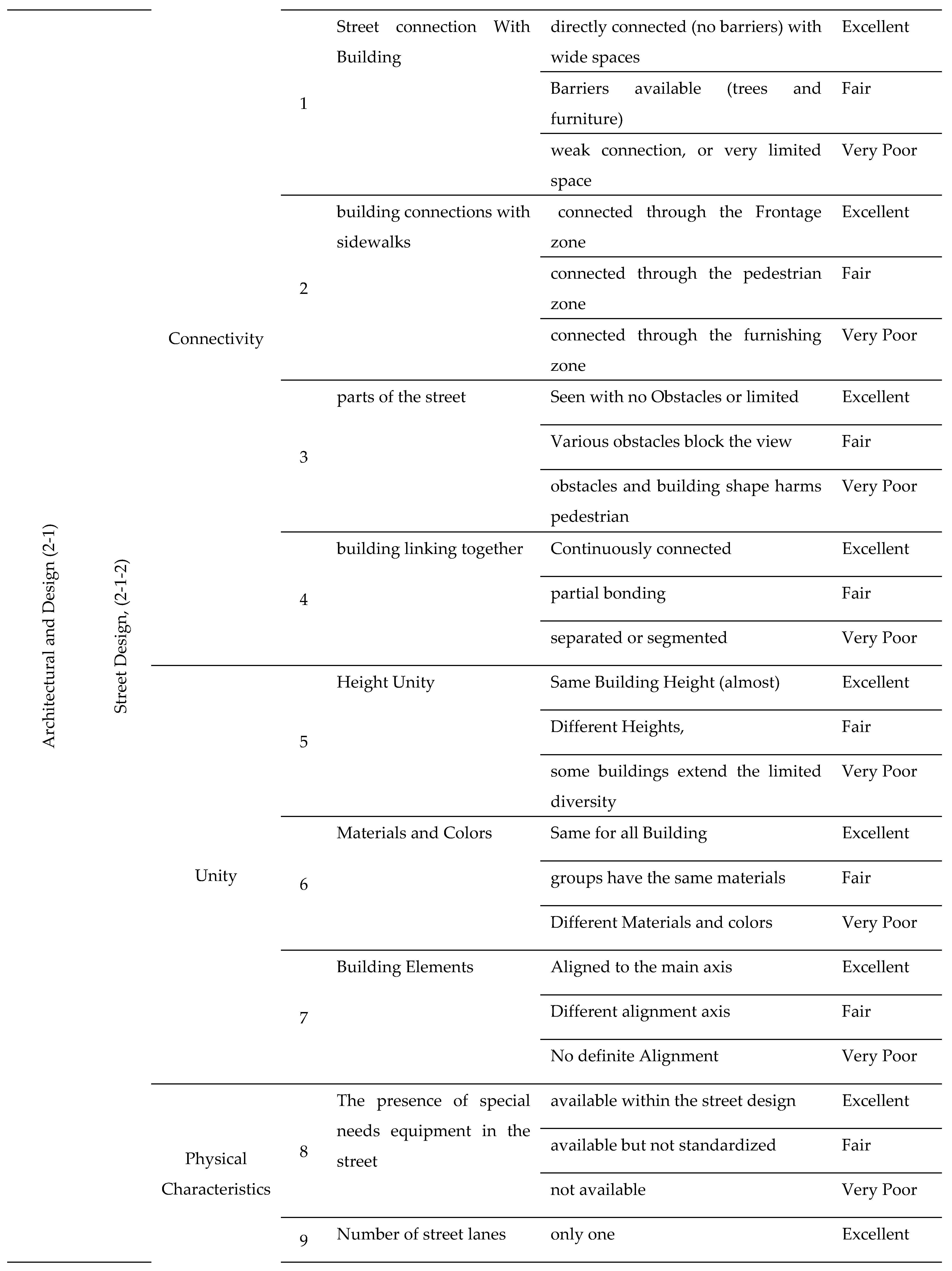
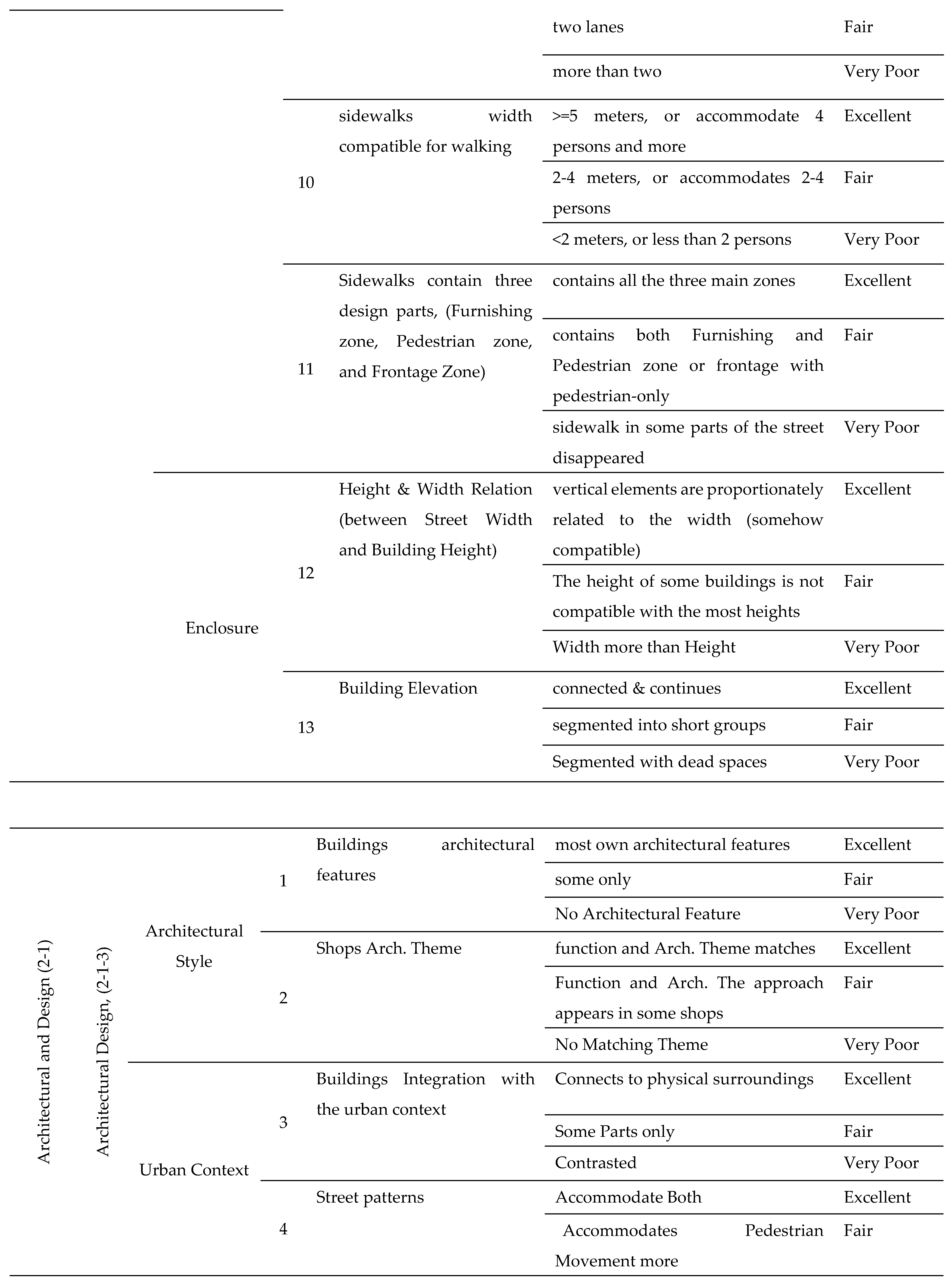
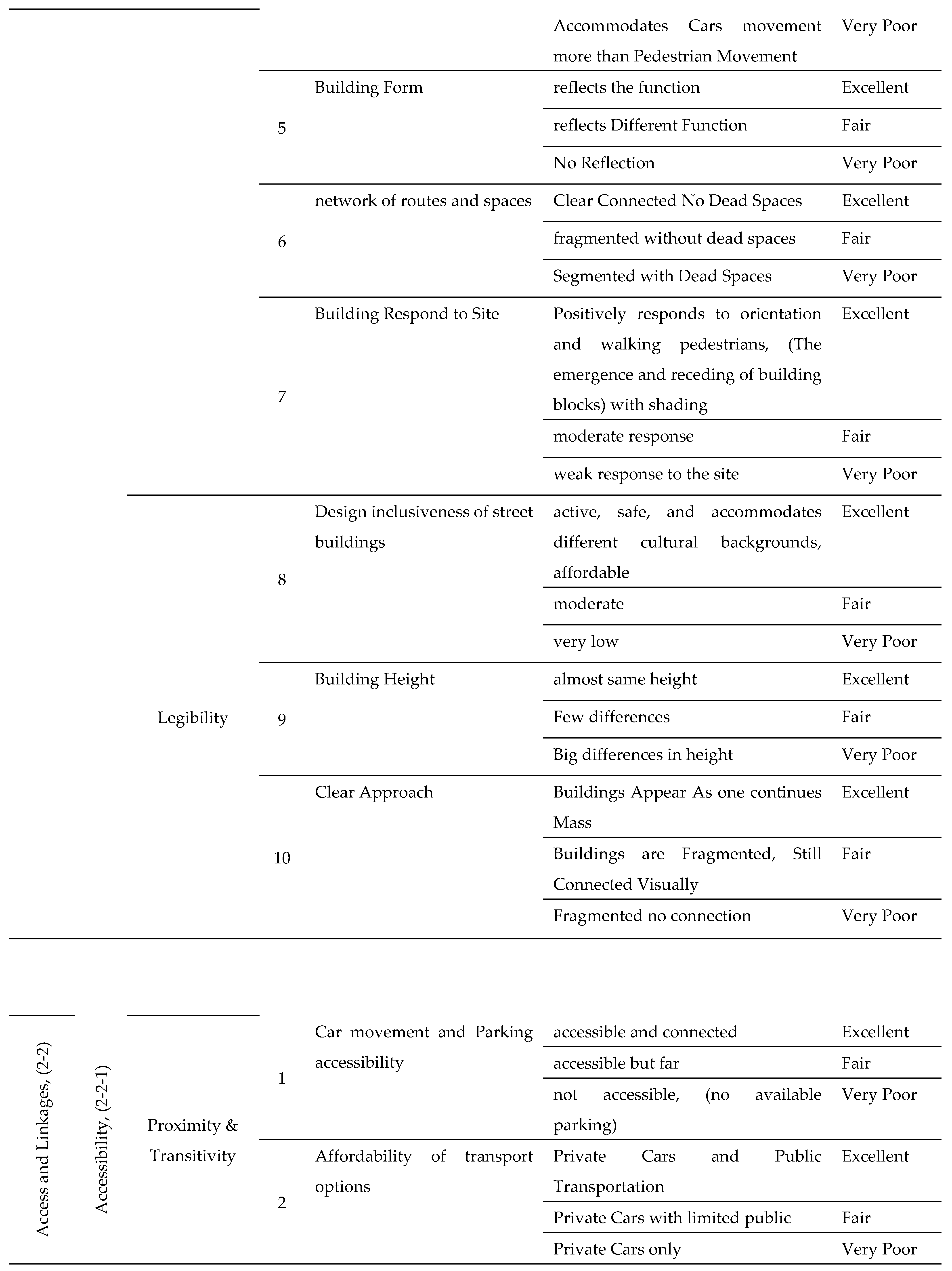
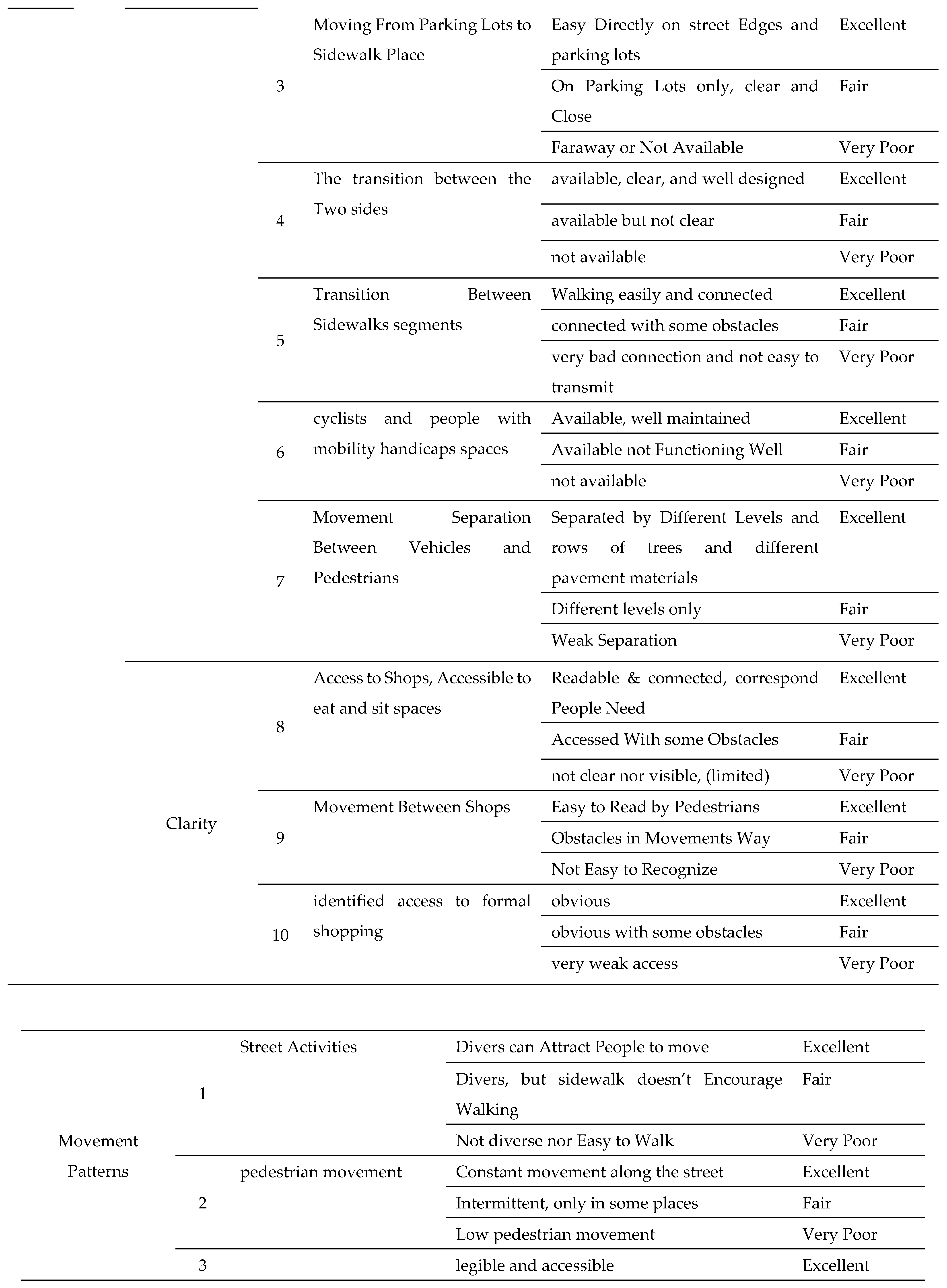
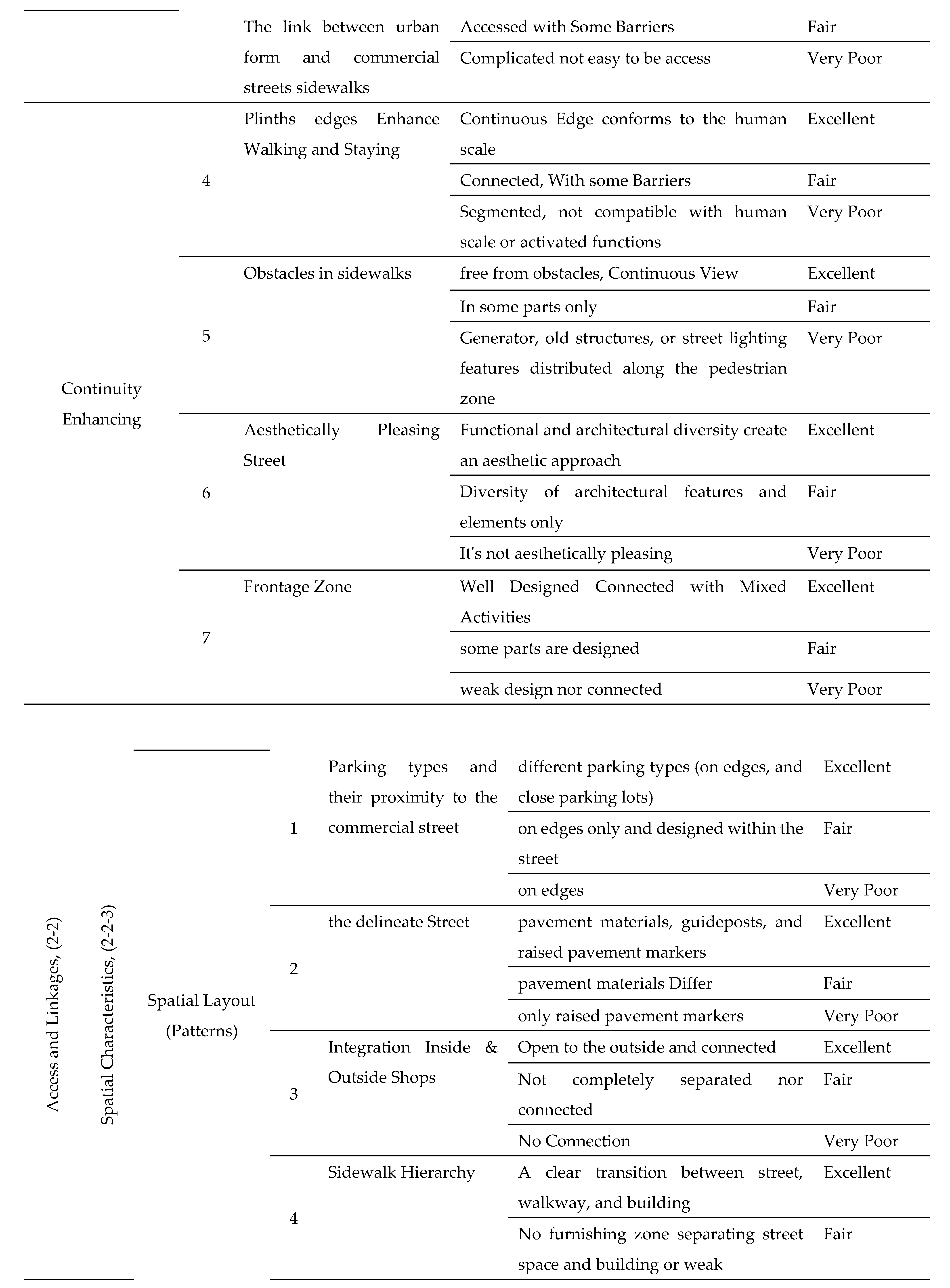
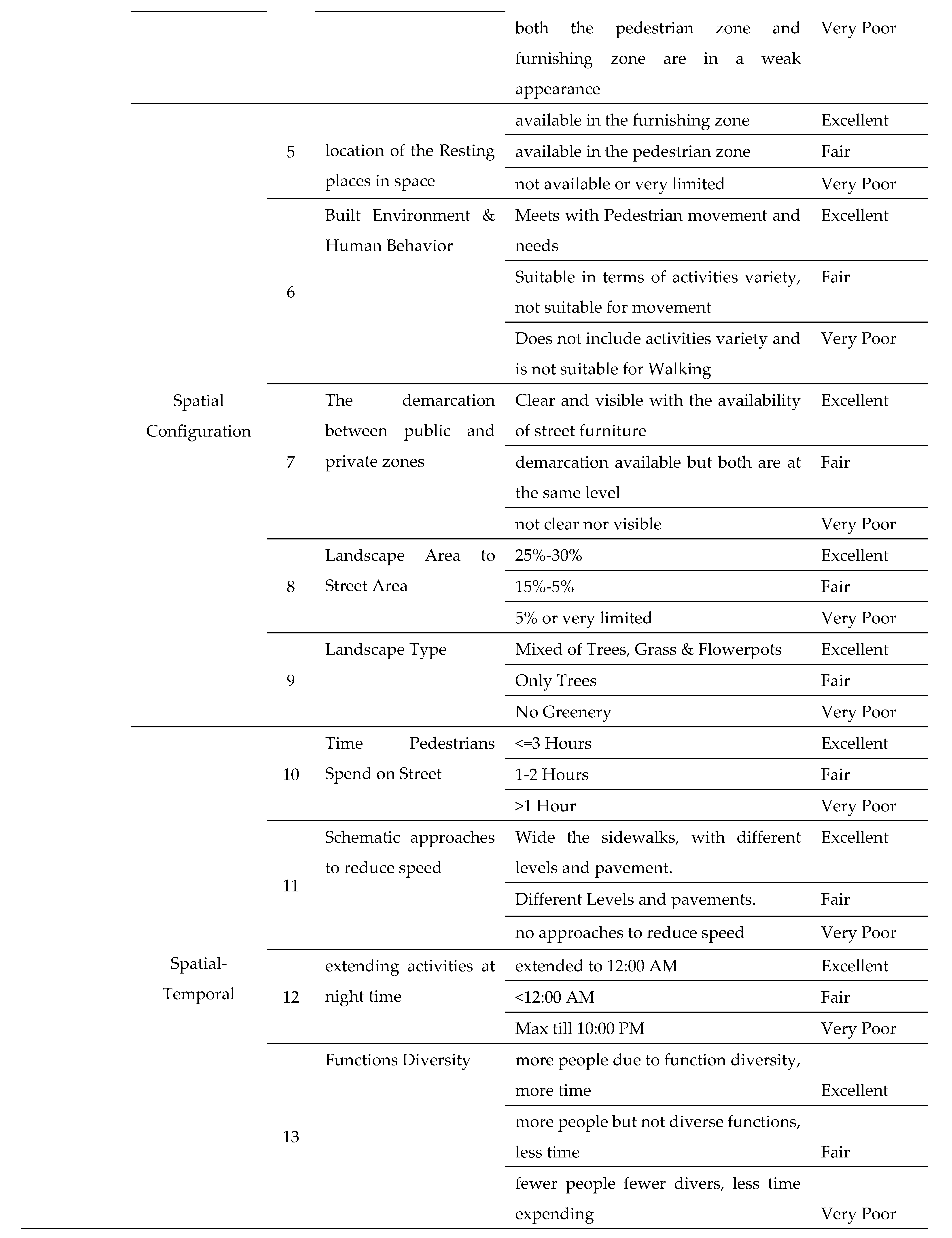
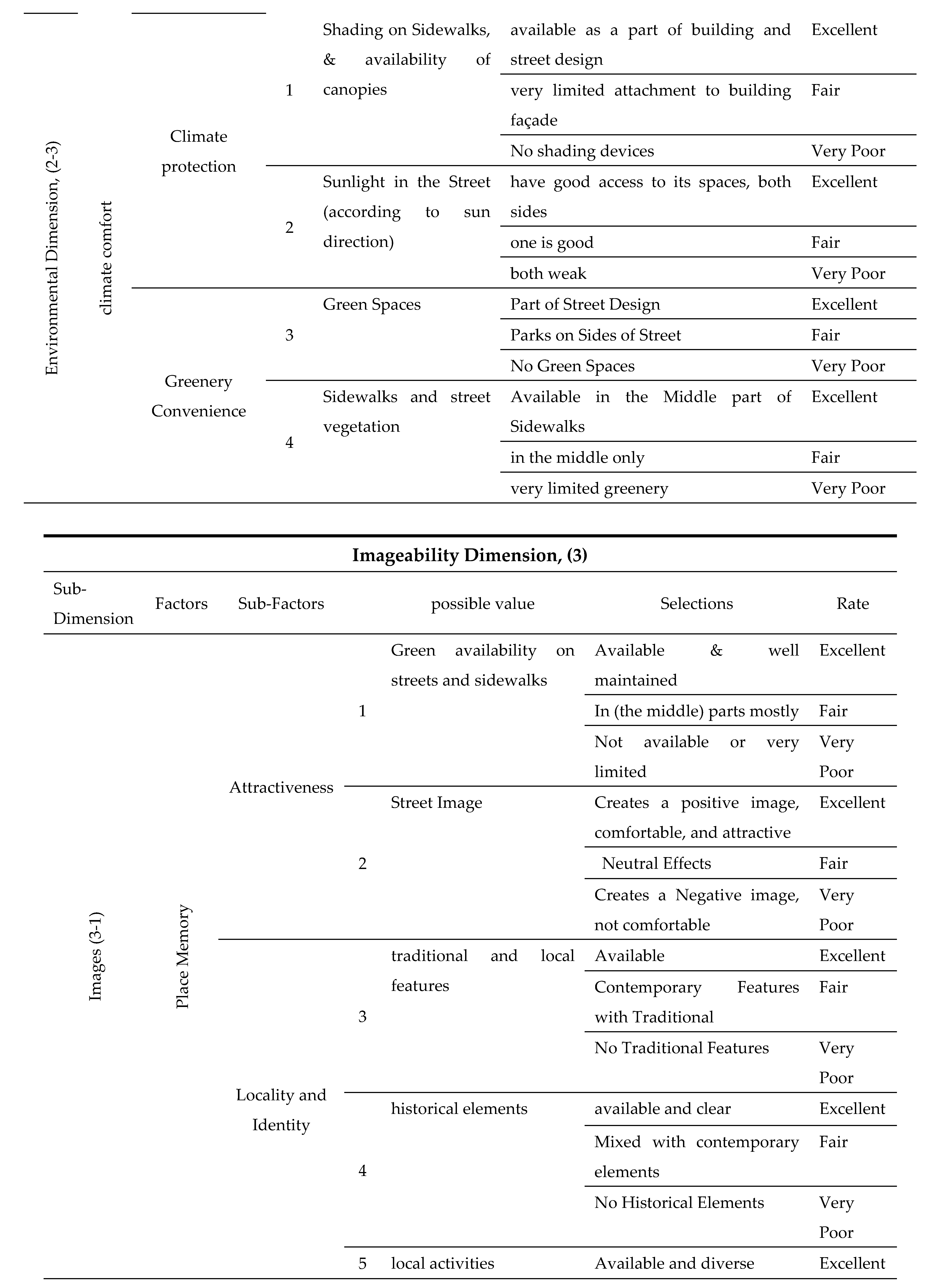
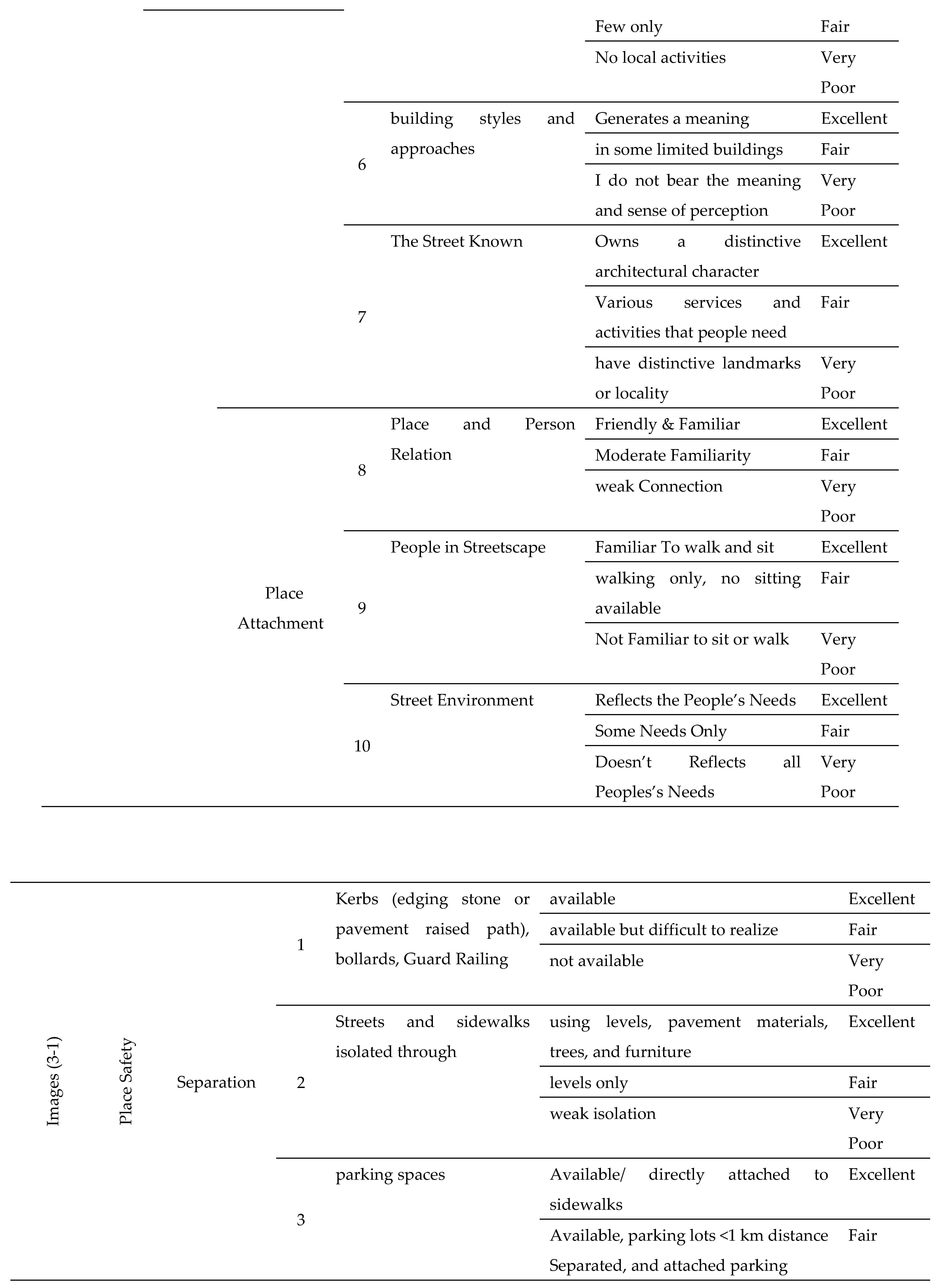
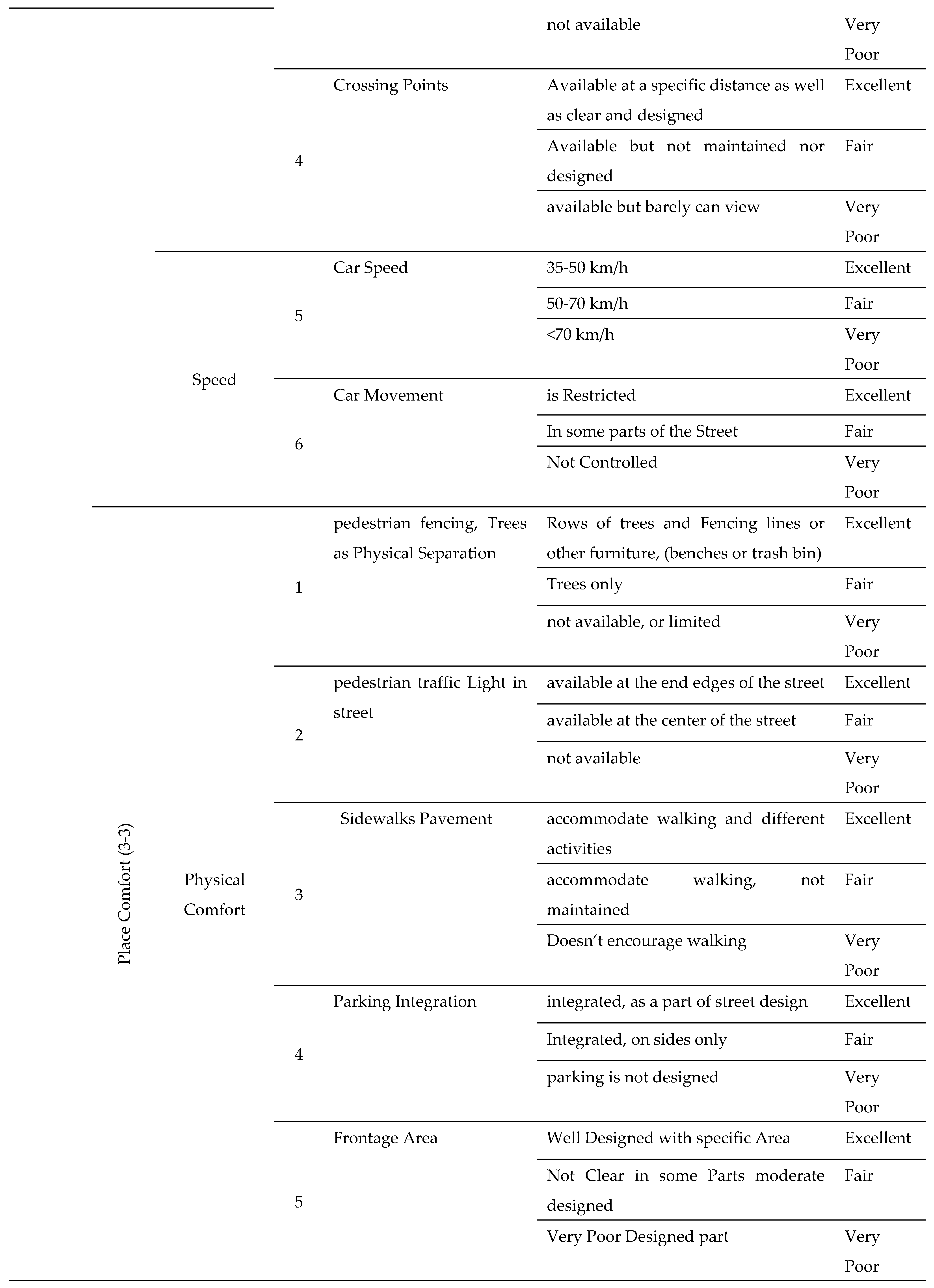
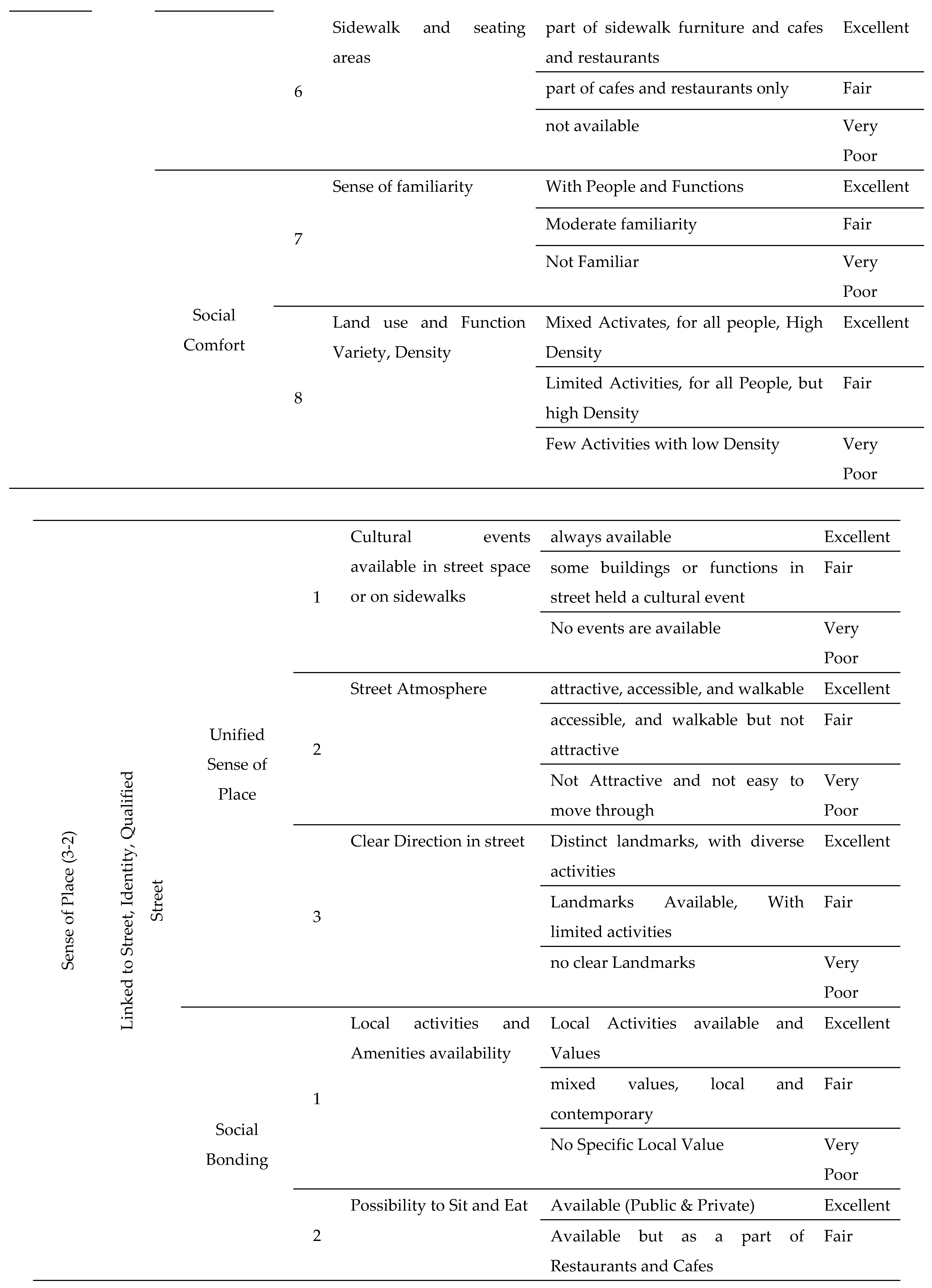
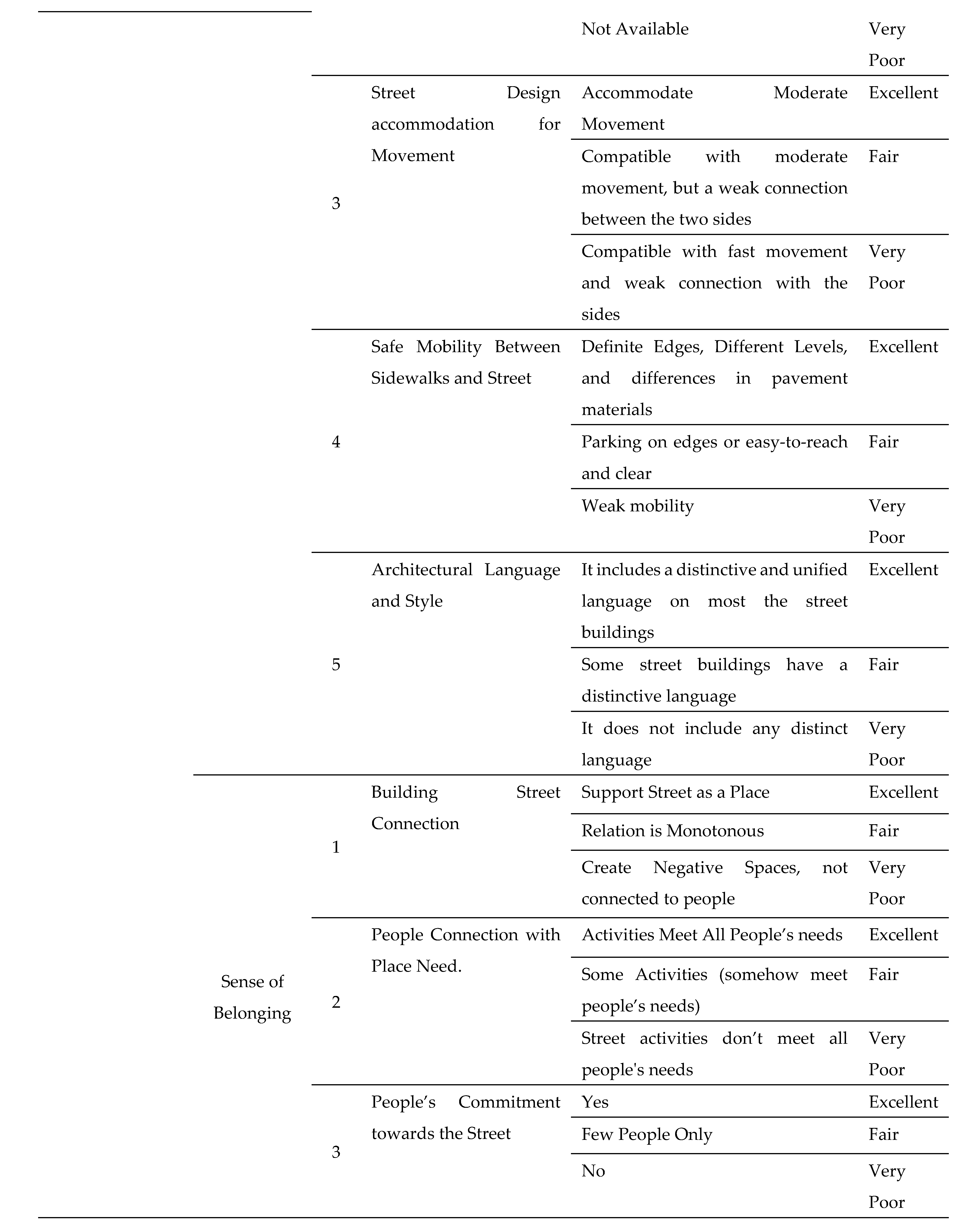
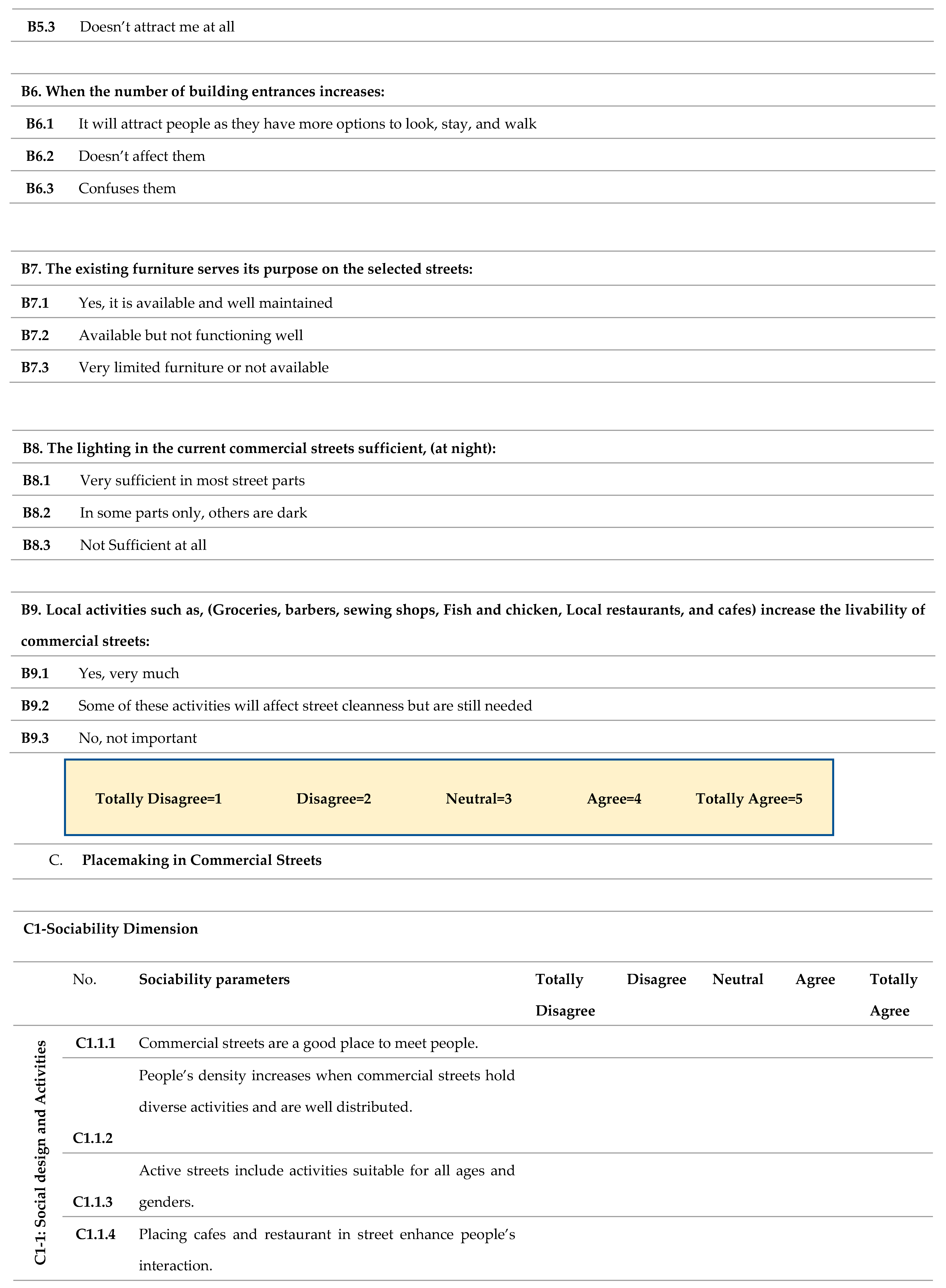
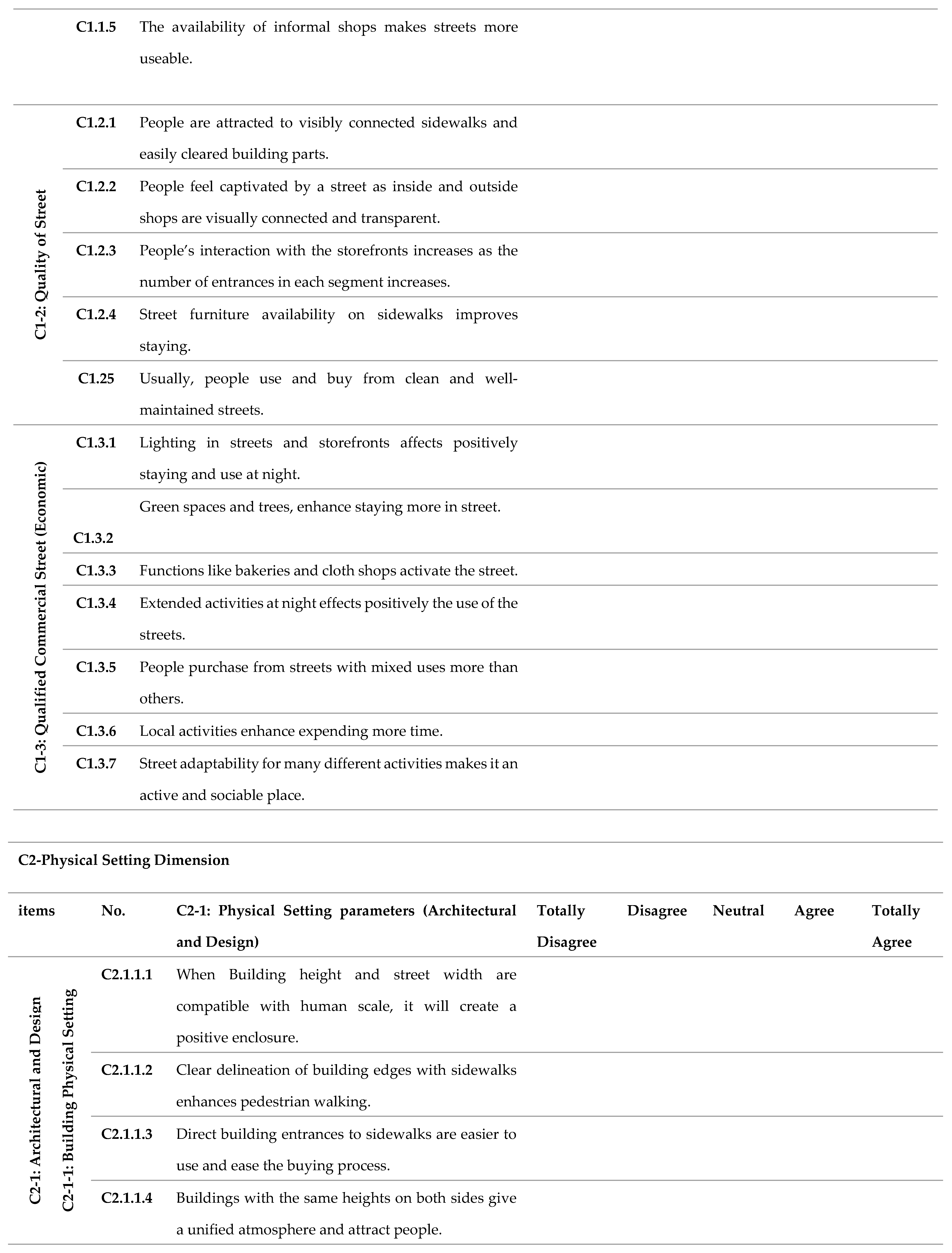
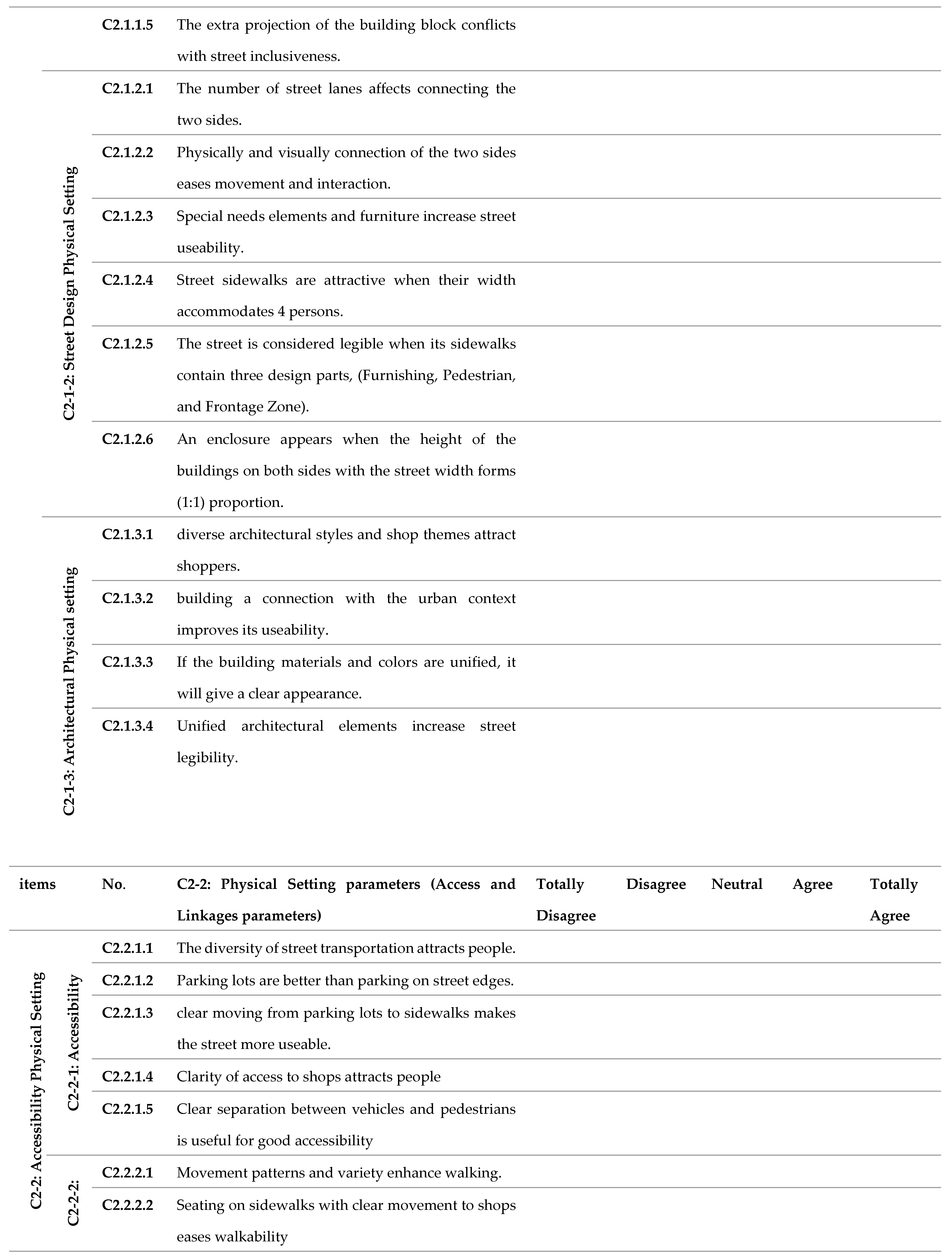
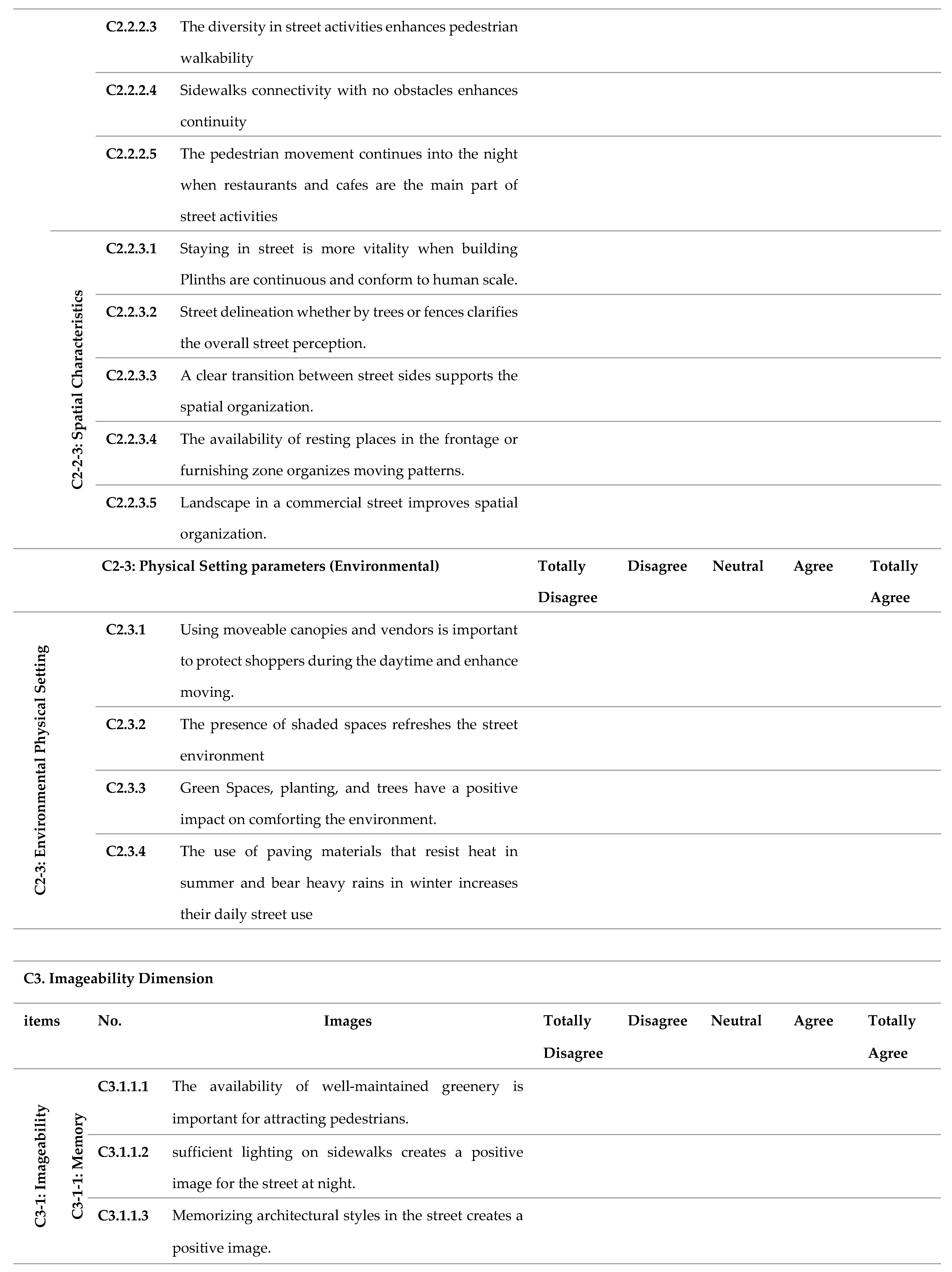
- The practical framework consists of 5 sequences, starting with dimensions, sub-dimension, factors, sub-factors, and possible values which have detailed selections regarding every single factor that appeared as a descriptive approach to identify the best or worse phenomena in the street, example for the Practical Framework Table 2. For more details, the whole (practical Framework) is available in appendix part B.
Example for the suggested Framework.
- Three basic dimensions identified within the model and the Framework, are as follows:
2.2.1. Sociability Dimension
Streets with neither people nor everyday life experience no effective or attractive atmosphere. The social dimension identifies the people’s responses to any street based on the density of people in a place generates by the street design, [42]. This dimension concerns social life in the street. places are not physical features and spaces only, it contains social values as well, [43]. Carmona, believes that understanding the relationship between people and place, is an essential element in urban design, [44]. Placemaking is essentially a human experience. The principle of inspiration is to reinvent the physical and social environment that people share. The way people gather and form a safe, comfortable, and social environment as a result of purposeful, systematic design and planning, will not be a social environment only but will enhance the place features, [12]. External places include many social activities and events, usually formed as a result of planning, and Place design in addition to comfort and safety. Correspondingly feelings and attachments to place will form, the social activity in itself is a catalyst for relationships, and is linked to the human senses, [35]. Places that contribute to the formation of a community foundation and relationships between its members, provide continuity from past to present, meet many daily needs, and contribute to defining the community identity. Such a place has a positive influence on daily life and encourages interaction, [45]. Diversity is one of the important notions related to urban vitality, including primary uses and activities that people need in their daily life. A Combinations of mixed activities are the key to generating diversity and people density, creating successful urban places, leads to social interactions, [38].
The social dimension includes a group of factors whose importance is seen in supporting people's expected interactions as a result of creating interaction in the street. This dimension includes density, diversity, functionality, visibility, furniture availability and maintenance, economic satisfaction, and adaptability. These factors are interrelated to create spatial interaction between people.
2.2.2. Physical Setting Dimension
Lynch believes that any physical form has an impact on people's activities, the city expresses both physical characteristics and social units. the city has a size, plan, and pattern that serve as vital features to create its physical form. people who live in the city will shape their characteristics, and be shaped by them, the perceived value is based on how people perceive value and determine what it means, [22]. The place is defined by a mental image arrangement, behavior, and physical setting. A model with a mental image has an implicit temporal dimension where experience is reflected in affective and cognitive responses to current physical settings. This image is articulated to the physical settings and activities inside these settings, [46]. It is incorrect to separate the social aspect and the physical setting, as the physical features including landscape design, sidewalks, furniture, etc., enrich the place's characteristics and provide comfort for users, so creating a lively image encourages use, diversity, and the formation of social relations. [47]. The improvement of street livability has a close connection with the physical elements, planning, and architectural design of both sidewalks and streets, and buildings. Among these physical details is controlling the vehicle’s movement and the separation from pedestrians, and how street furniture plays a vital role in creating a spatial presence,[43]. Physical characteristics are the dominant factors that can influence a person’s sense of place, [48]. It affects many factors and increases the functioning of other visual dimensions, the sense of place, and social aspects as well. Walkability for example is greatly affected by the physical features of a place and bears a meaningful relationship with the conditions of the built environment, [49]. One of the placemaking elements is to enliven the streets by providing visual interest and encouraging people to walk. Accordingly, the edges of the streets must be lined to be supported by functional diversity and activities. This affects guiding people and enhances continuity,[4]. Characteristics of outdoor activities are mainly affected by planning and physical settings. Adding a specific color or material or a certain type of plant or exposing sidewalks and providing seating areas, all of which create patterns of activities and generate a positive atmosphere [46]. The physical dimension is divided into three secondary sub-dimensions and factors that increase the performance of the place. The presence of physical components affects positively the provision of suitable architectural forms in a commercial street, as well as creates attractive street design. This dimension included the following factors: Human Scale, Edge Compatibility, Morphological, (Building direction, Building length, Inclusiveness, Connectivity, Unity, Physical Characteristics, Enclosure, Architectural Style, urban context, Legibility, Proximity & Transitivity, Clarity, Movement Patterns, Continuity, Spatial Layout (Patterns), Spatial Configuration, Spatial-temporal, climate protection, and Greenery convenience.
2.2.3. Imageability Dimension
Lynch and Relph pointed out the importance of images, place experience, and physical setting in identifying place identity. Images form in human minds when they first used the place, presenting meaningful forms that strengthen the bonds between place and humans. Lynch presented five elements that assist in creating a mental map to forming wayfinding for people. Imageability and legibility are essential factors in placemaking according to Lynch’s approach. He defined ‘imageability’ as the quality of a physical feature that gives the individual a strong intense image, the paths, the usual network, or potential lines of movement through the urban context, [22], [25]. Seamon emphasizes the importance of phenomenology in creating placemaking. The place is a phenomenon that connects with humans and their activities. This presents a whole image of place phenomenology forming the basic step in envisioning placemaking. [40]. Most current design guidelines use constant, communal, generic terms to describe urban design and placemaking requirements. Following such guidelines lead to reliable place, and can lead to consistency in placemaking. In turn are regarded as essential for perceptual qualities, such as imageability and visual enclosure, [48]. Imageability is the quality of the space that makes the place recognizable, memorable, and distinguishable. It is associated with specific physical elements and creates a unique place. Imageability is the result of other urban design characteristics such as human scale, permeability, connectivity, and enclosure. When the spatial structure of a space is understandable, with an opportunity to define a coherent pattern for it, then a place will be readable, [38]. Community images and identity are often formed through historical existence, as placemaking seeks to create unique and vital destinations by highlighting historical existence and features, [24]. Placemaking may be enhanced by Kevin Lynch’s theory of imageability, it helps to create places with a clear regard for the built environment making it easier to understand and navigate cities, [50]. As a result, the research identified a group of factors within imageability that have an impact on activating the imageability dimension. The factors included are as follows: Memory (Attractiveness, Locality, Identity, Place Attachment), Safety (Separation, Speed), Comfort (Physical Comfort and Social Comfort), and Qualified Street (Unified Sense of Place, Social Bonding, and Sense of Belonging, Figure 12.
2.3. Placemaking Framework
The research presented an extensive study for theoretical references on the concept of place theory and placemaking. A comprehensive knowledge base was reached for the placemaking strategies, with steps and an accurate description for each paragraph, which depended on the dimensions previously identified.
Each dimension includes factors supposed to improve its performance within its relationship with the other dimensions in the model. This Framework included a group of possible values that explain the; design, social, imageability, and physical aspects. The result of each set of indicators is associated with one of the factors, and the latter leads to one of the three dimensions. For the Framework to be accurate in assessment, a three-level Likert scale was adopted to describe each possible value. Through the application of the list, the
placemaking activating steps are evaluated, as it is assumed that the more the placemaking steps are applied, the higher the livability of the commercial street.
2.4. Study Method
2.4.1. Selecting the Street
Selecting the research sample was initially determined after a systematic approach that relied on what was stated in previous studies, and according to the city context and streets.
- The first stage is to identify several streets to which the specifications for commercial streets apply.
- The research decided to select the connector streets between the circles of Erbil city, as it was categorized by a set of characteristics that qualified it to be crowded and diverse commercial streets.
- The width of the selected streets is between (20-50) m, and the lengths ranged from (600-2000) m.
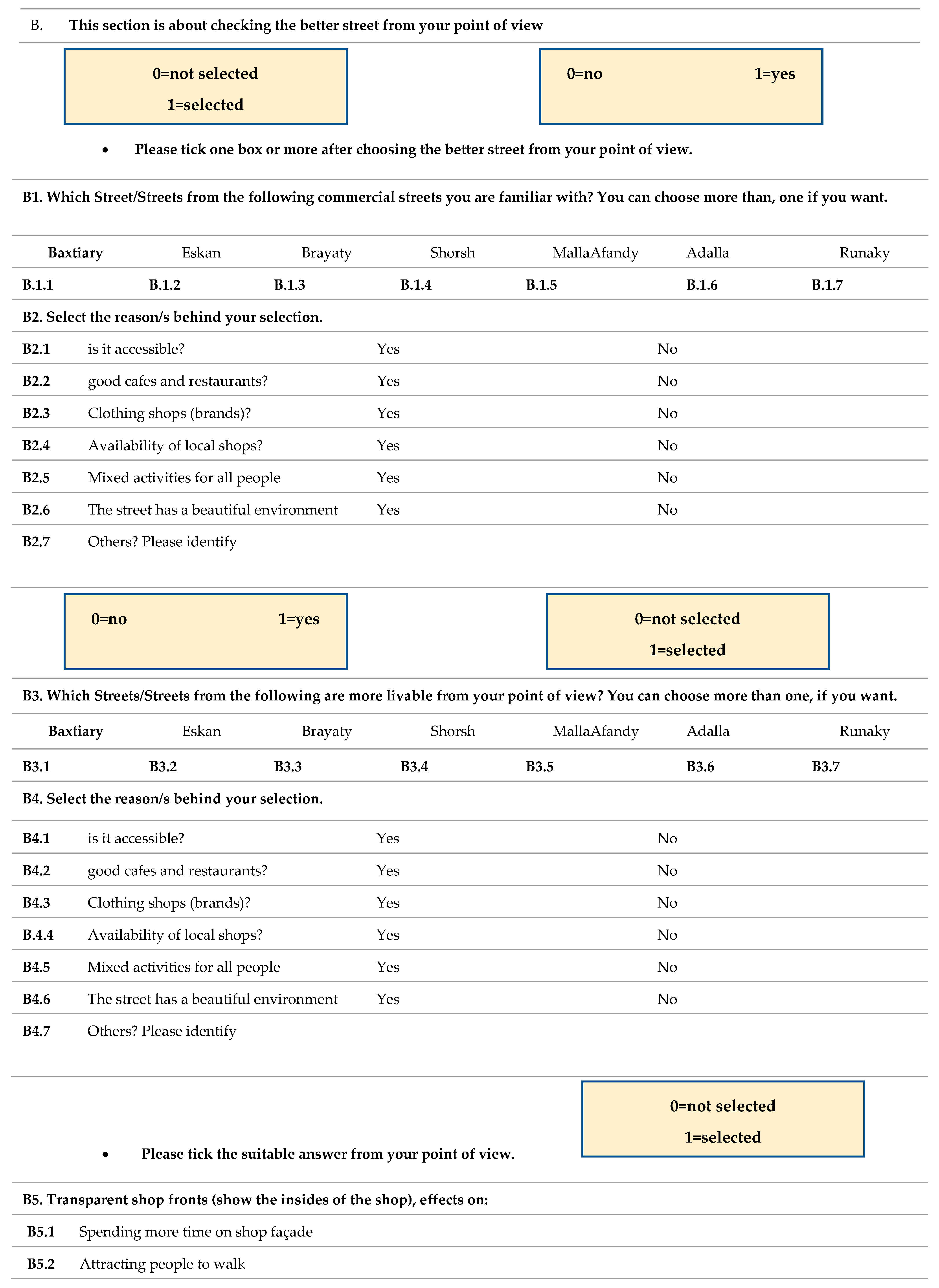
- A quick pilot study was conducted in which people were asked about their opinion of the most lively and livable street, Figure 13. Among the seven commercial streets, Eskan with the higher rate (35%) has been selected as the research sample.
- People identified the reason for choosing this street as being multi-functional and diverse, with attraction points, in addition to being a street that contains two parking spaces. Figure 14.
- Eskan Street was adopted as a research sample to apply a placemaking Framework, and assess livability.
2.5. Case Study
Erbil Governorate is located in the northern part of Iraq within the Kurdistan Region. It is characterized by dry semi-continental weather, in summer is hot and dry, whereas in winter is cold and wet. Erbil is regarded as the commercial and administrative center in the Region, and one of the oldest continuously inhabited cities in the world, [51]. Eskan one of the neighborhoods in Erbil city, it is about (14) minutes away from the city center. One of the famous and important streets in Erbil city passes through it. Eskan Street is located to the south of the historic Erbil Citadel, about a kilometer away. It is considered one of the most popular and lively streets in the neighborhood, in addition to that it is considered one of the most important commercial areas, and regarded as the first market in Erbil city, contains several restaurants, cafes, shops, gardens, and street vendors. It includes a wide range of necessary recreational facilities that make it a comprehensive and integrated area, [52].
2.6. Street Description
- Eskan Street is one of the crowded streets frequented by many Erbil residents as well as tourists, the street connects two vital streets in Erbil city, the (30) Street, and the (60) Street, Figure 15.
- The street is distinguished by its many activities and the variety of restaurants and cafes, most of which are local dishes.
- It also includes other activities such as hotels and motels, markets, mobile shops, car accessories, and clothes shops, in addition to tailors and barber shops. At the end of the street, towards the city center to (30) street, there is a large mall with many shops and various activities. Figure 16.
- The street includes several cafes, which are considered a good entertaining place for many young people.
- It contains a large garden that occupies the left side of the street, with an area of approximately (6,592) m2 as a cafeteria.
- The length of the street is approximately (670) meters with an area of (12,226) square meters and a width of (20) meters.
- The street contains many carts and booths selling local foods and juices, varying according to the seasons of the year.
2.7. Methods
Methods adopted by the research include the Practical Framework. A questionnaire directed to architects and urban designers. The research identified the positive and negative points through observation and survey.
2.7.1. Field Survey
- The research depended on several ways to collect data, the first of which is the field survey, it was divided into three main parts, the physical part including; urban, design, architectural details, and factors related to both street and sidewalks, furniture, street vegetation, and diverse activities. The social aspect and the imageability aspect.
- The field survey included three basic times: 9:00 a.m., 1:00 p.m., and 9:00 p.m. Information was entered into the survey table to determine diversity, social difference, and people density to which activities according to the times between day and night.
- The field survey was carried out during two seasons (summer and winter).
- In Summer, the survey began on (15 June to 15 July) and three times per day, from (9:00 am-1:00 pm, from 2:00 pm-5 pm, and then from 6:00 to 9:00, to midnight.
- For the period between (9:00 a.m.-1:00 p.m.), most of the activities that operate during this period are supermarkets, mobile, and construction shops, and the most effective ones are restaurants and cafeterias that serve breakfast for people going to work. Since the location of the street has a close connection with Erbil city center, where most of the businesses take a place, people use these restaurants for breakfast before going to work. Then density gradually reduces for an hour (but never decreases).
- Density and overcrowding increase again and for the period between (12:00 p.m.-2:00 p.m.) due to the lunch period.
- The fact that the street offers local and popular dishes and their prices are affordable in addition to the location of the street within the city, was among the reasons for the density.
- In summer, for the period between (2:00 p.m. -6:00 p.m.) people’s motion decreases due to the intense heat, and the density gradually returns from (6:30 p.m.-12:00 a.m.). On holidays (Friday and Saturday) People stay up until 2:00 am.
- The survey times included these periods to determine the people density and most used activities.
- Some construction shops and mobile services end at (6:00 p.m.). Continuing to work are sweet shops, markets, and defiantly restaurants and cafeterias.
- In summer, the garden operates from 6:00 p.m.-12:00 a.m. It is rarely used during the day due to the heat. The garden returns to work after daytime hours at night.
- The survey was repeated to identify the most important changes and activities that flourish in winter.
- The survey was for a month as well, and it lasted from (15-December-15-January), and for three times: (9:00 a.m., 1:00 p.m., and 4:00 p.m.).
- Juice shops have changed to shops serving tea, coffee, and traditional sweets.
- The use of the garden changed from hours after (6:00 pm) to daytime hours from (12:00 p.m.- 5:00 pm at sunset).
- In winter, activities did not continue till midnight, most of them ended at 8:00 and 9:00 p.m.
- In general, the use of the street in the summer lasted longer hours than the day, but the movement usually increases in summer after (6:00 p.m.), since the temperature decreases and it facilitates the movement of people in extremely hot weather.
- On the other hand, after (6:00 p.m.) in winter, the movement of people decreased, so it was noticed that some shop owners put temporary structures made of nylon material, with a fireplace on wood and gas within the space of the street in order to create a comfortable atmosphere for use by people.
2.7.2. Observation
Observation is conducted to identify the following points:
- The movement of people and the density were monitored and on which activities the density of people was higher.
- The most frequently used activities and the ages and genders of the people who mostly use the street.
- Formal and informal activities, as in Erbil culture people like eating and drinking local foods, booths, and carts present affordable local food.
- Pedestrian movement, ease of walking, accessibility, sidewalk width, suitability for movement, and the number of people within sidewalk space.
- Transfer between the two sides and the appropriate physical features and elements that facilitate the transition.
- Amenities and furniture and their availability within street space and sidewalks.
3. Results & Discussion
3.1. Field and Observation Results
Several positive and negative points were identified. Focusing on activating the positive points will raise the performance and use of the street by people. Determining the negative points will represent the solutions that must be added to the street to raise its vitality, livability, and continuous use by people. The results were reviewed based on the basic divisions of the research dimensions.
3.1.1. Activities and land use in Street, (Sociability)
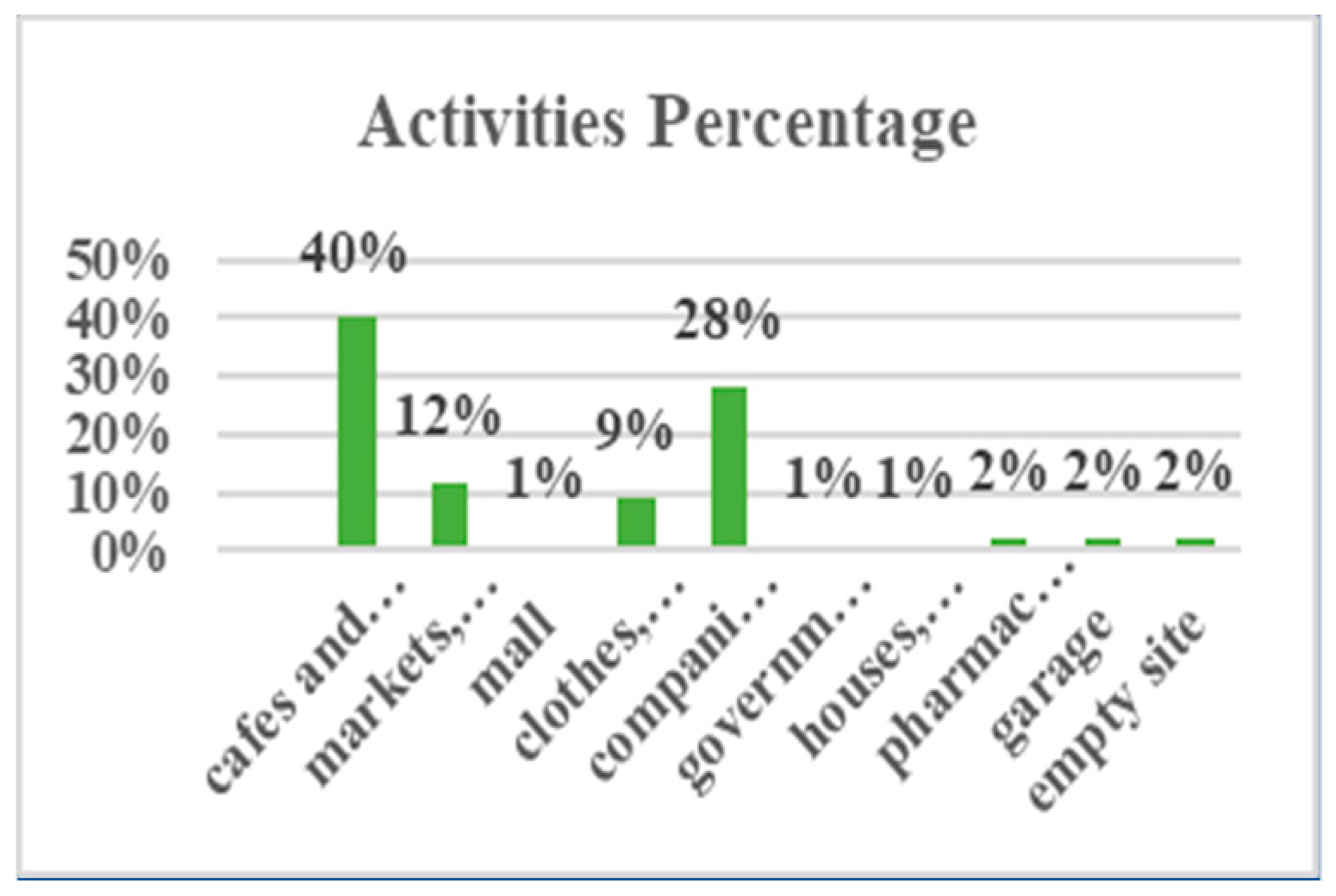
- Types of uses and functions have been identified in the street on both sides, the street has a variety of uses, but the largest percentage was for restaurants and cafes, followed by construction companies, real estate, car accessories, clothing stores, and tailors in the third rank. Figure 17, Figure 18.
Figure 17.
Activities Type in Street
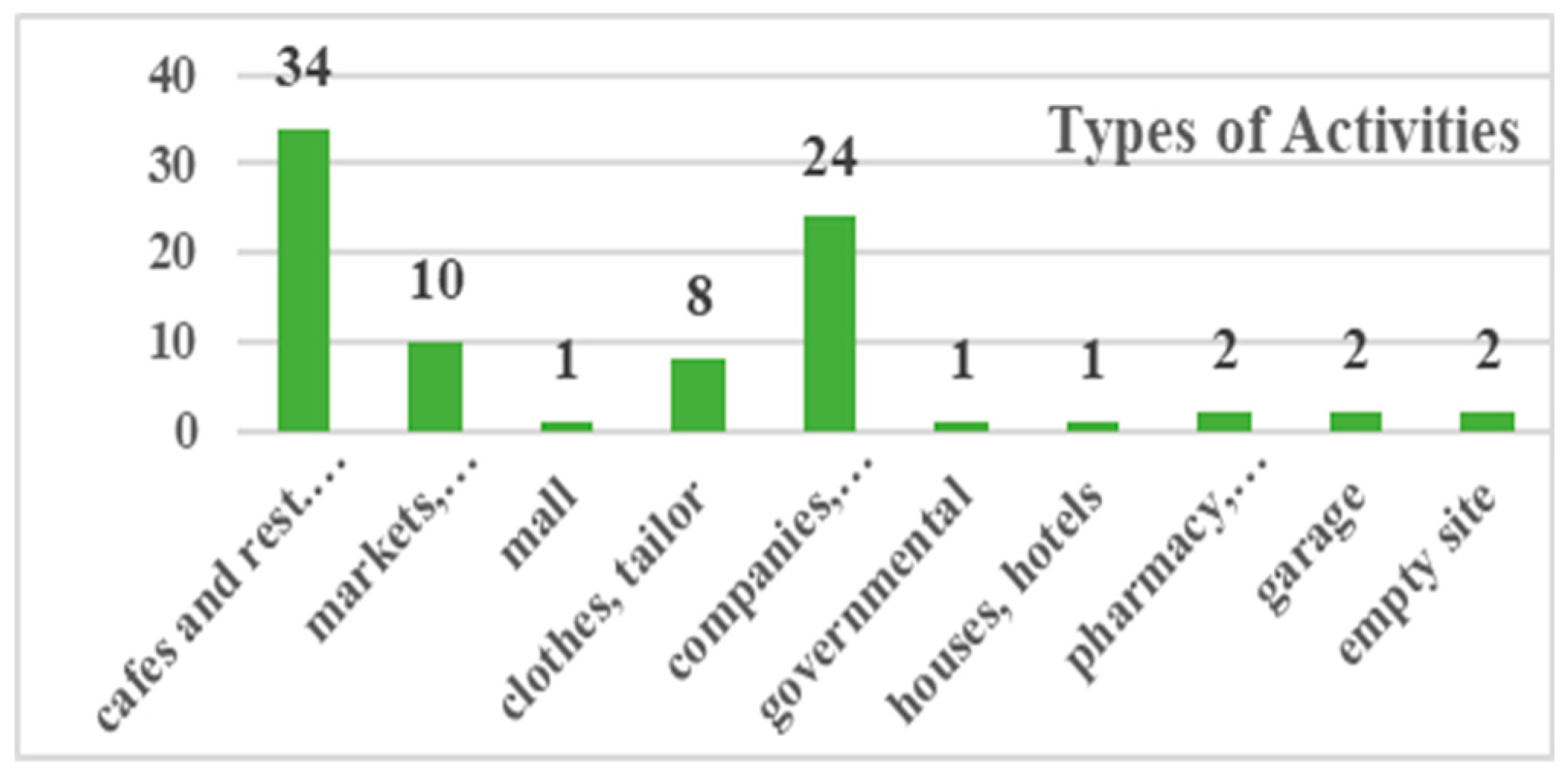
Figure 18.
Activities Percentage
- Activities were mostly restaurants and cafeterias, the food served in the restaurants varied greatly between local and fast food, and this affects attracting many people, mainly men.
- The street contains many other shops that meet people's daily needs.
- A large mall from the (30) street side occupied with many shops, services, and clothes frequented by people from all parts of the city. Figure 19.
- The number of restaurants and cafeterias had a great impact on attracting people, especially young people. In some important events such as the (world cup), which was held in December 2022, the street is closed and cars are prevented from passing in, to provide a suitable environment for people to move safely and to exploit the street and accept the largest number of people since the sidewalks cannot bear a large number of people, Figure 20.
- One of the attraction points for people is the presence of food and juice carts and booths, with a variety of meals change what serves between the seasons from juices and cold drinks in summer, and hot local foods and drinks in the winter such as (tea, baklava, hummus, broad bean, and turnip). Many people buy these foods or stop by to eat with friends, creating a social gathering, and the feeling of vitality is very evident. Figure 21 and Figure 22.
Figure 19.
The Mall
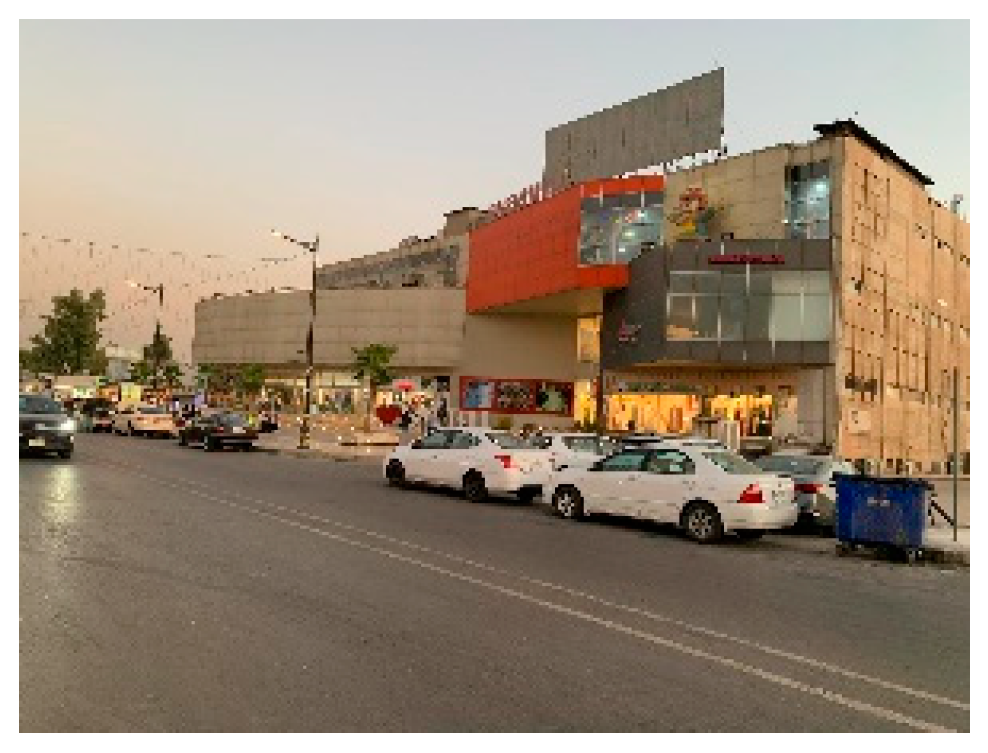
Figure 20.
Restaurants and Cafes
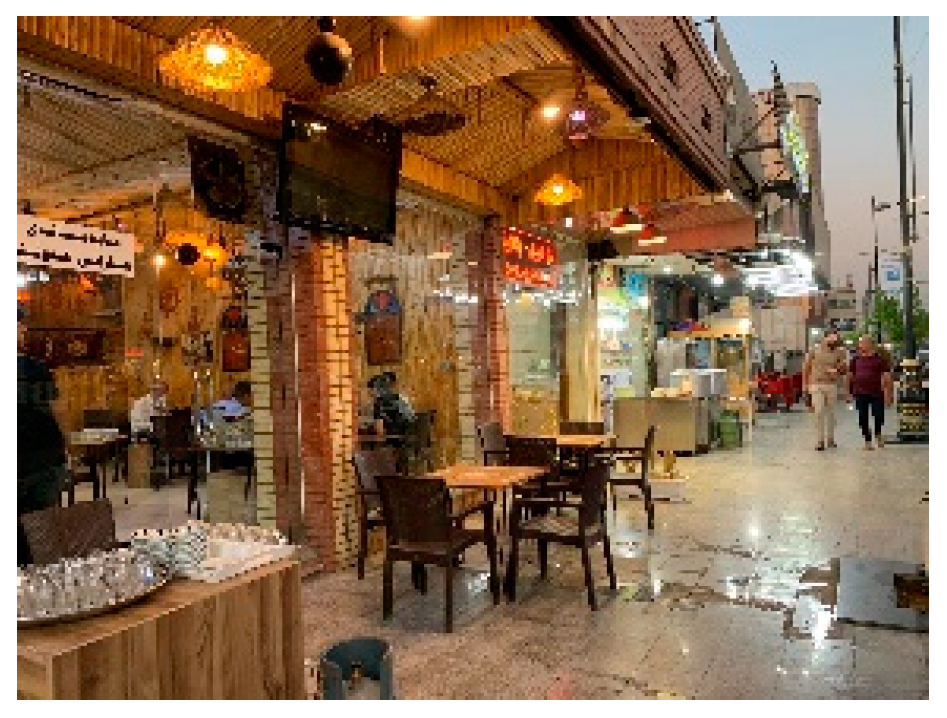
Figure 21.
Local Food
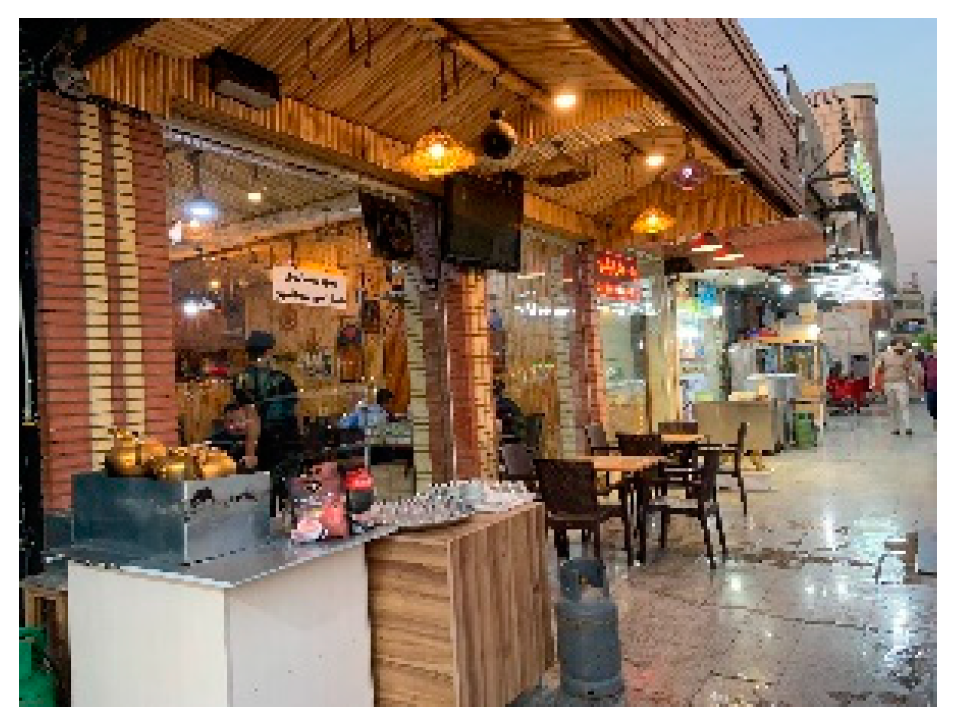
Figure 22.
Food Booths
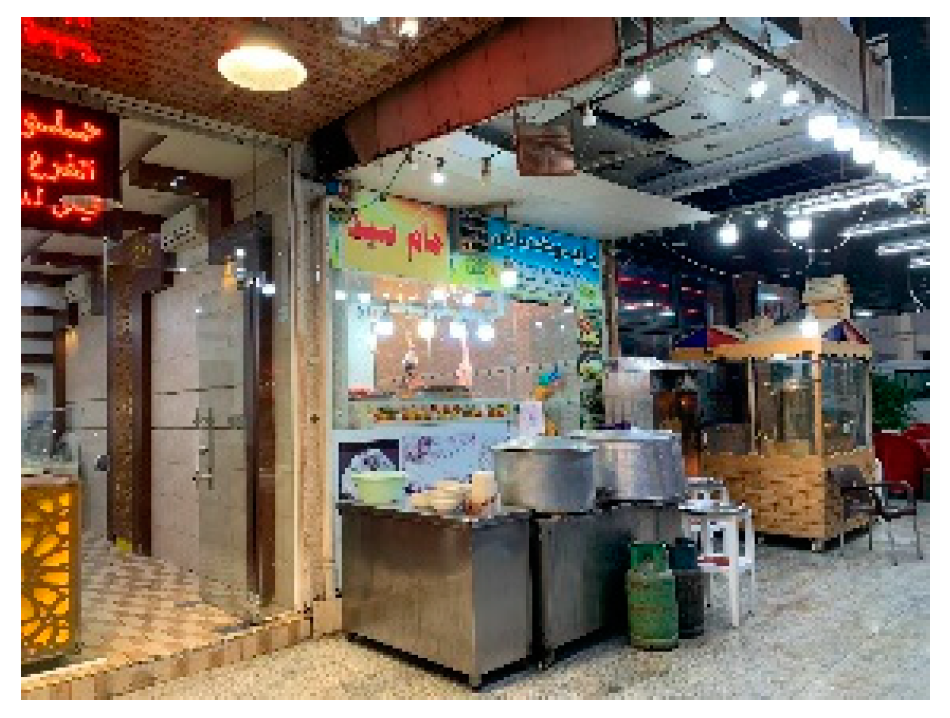
- The street is crowded all day, except in the early morning hours, at night the traffic is highest, and the speed of the car does not exceed (30) km per hour, this will provide some protection for pedestrians when transitioning between two sides of the street.
- Among the things that negatively affect the continuity of people’s walkability are the presence of activities that interrupt the shop’s continuity or that may not work after (4 p.m.), and empty sites.
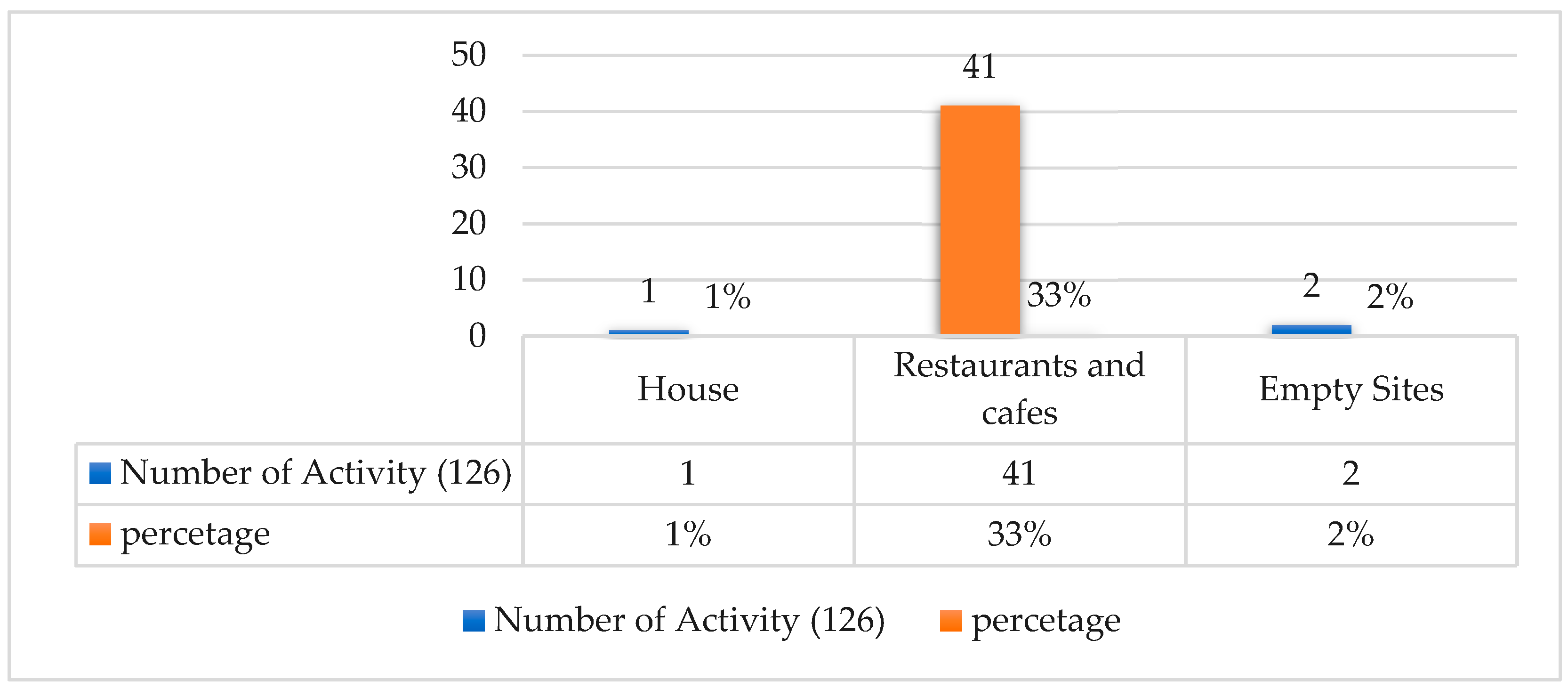
- One of the positive points, Eskan Street was almost devoid of houses and empty or unbuilt sites. This encouraged the continuity of commercial facades and thus strengthened the spatial connection, Figure 23. The presence of houses causes the creation of intermittent and dead commercial facades, which affects the facade continuity and people's walkability.
Figure 23.
Houses and Empty Sites percentage to Restaurants and Cafes on the Street.
- Building plinths are continuous with diverse activities, and have excellent lighting at night, with a suitable pedestrian area accommodating four people, Figure 24. Plinths are a very important part of buildings, the ground floor, and the city at eye level. A building may be unpleasant, but with a lively plinth, the experience can be positive. The other way around is possible as well as the building can be very beautiful, but if the ground floor is a dead wall, the experience on the street level is hardly positive, [5] (p.18).
- Most of the visitors and users of the street were men. About fifty men walking or buying in the street there were approximately two women. This is one of the negative points of the commercial street.
3.1.2. Physical Setting
- The street sidewalks were distinguished by several positive points that encourage walking, including the width that occupies four people, approximately (5) meters width, and in some parts of it especially in front of the mall, reaches (10) meters.
- Good tiling quality with unified material, most are continued without interruptions (almost the same level), and continuous sidewalk encourages walkability.
- Minimum width of the sidewalk in commercial streets within the central area is (4.8) m, [53] (p.3).
- Sidewalk design includes three design components: frontage zone, pedestrian zone, and furnishing zone. Figure 25.
- The height of the sidewalks was appropriate in a way that prevents any overtaking by cars on the sidewalks or cutting off pedestrian traffic.
- Despite the lack of canopies that protect pedestrians, most of the buildings had setbacks on the ground floor to allow forming a cover for pedestrians from the sun while walking, Figure 26.
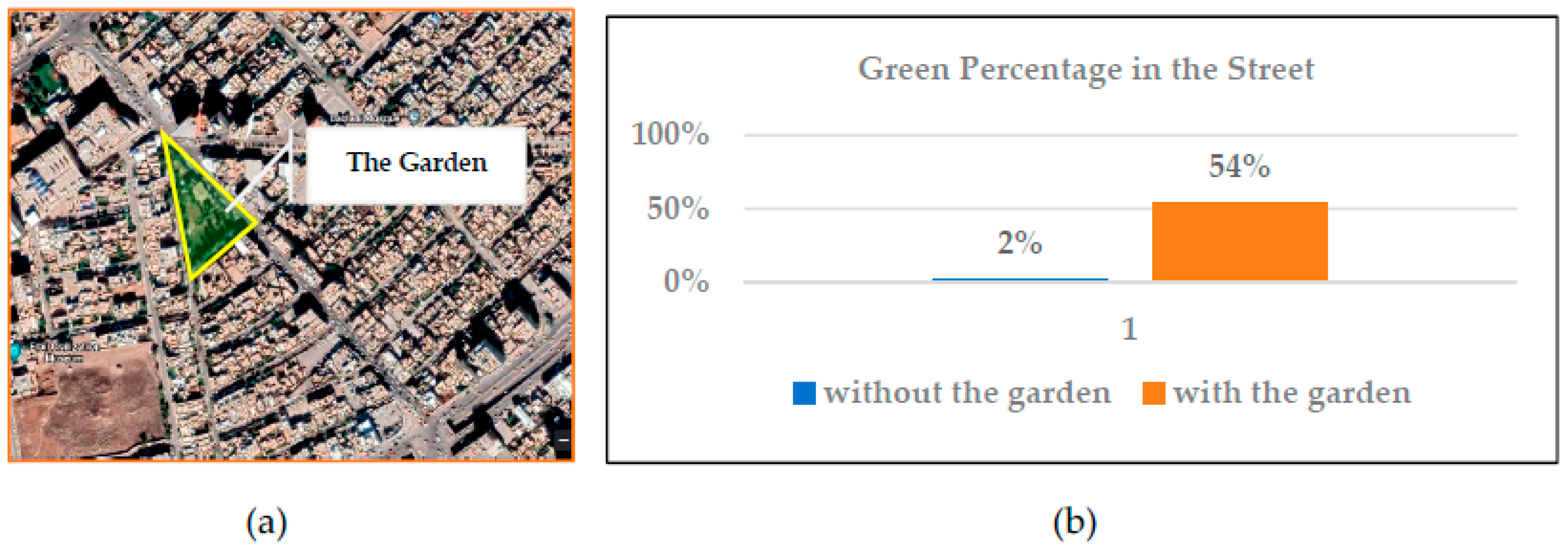
- The percentage of vegetation cover was limited as well as the number of trees, except for the afforestation on the right side of the street, due to the presence of a garden that covers approximately (6,592) m2, which works as a café and sitting area, Figure 27.
Figure 25.
Three Parts Available on Streets Sidewalks.
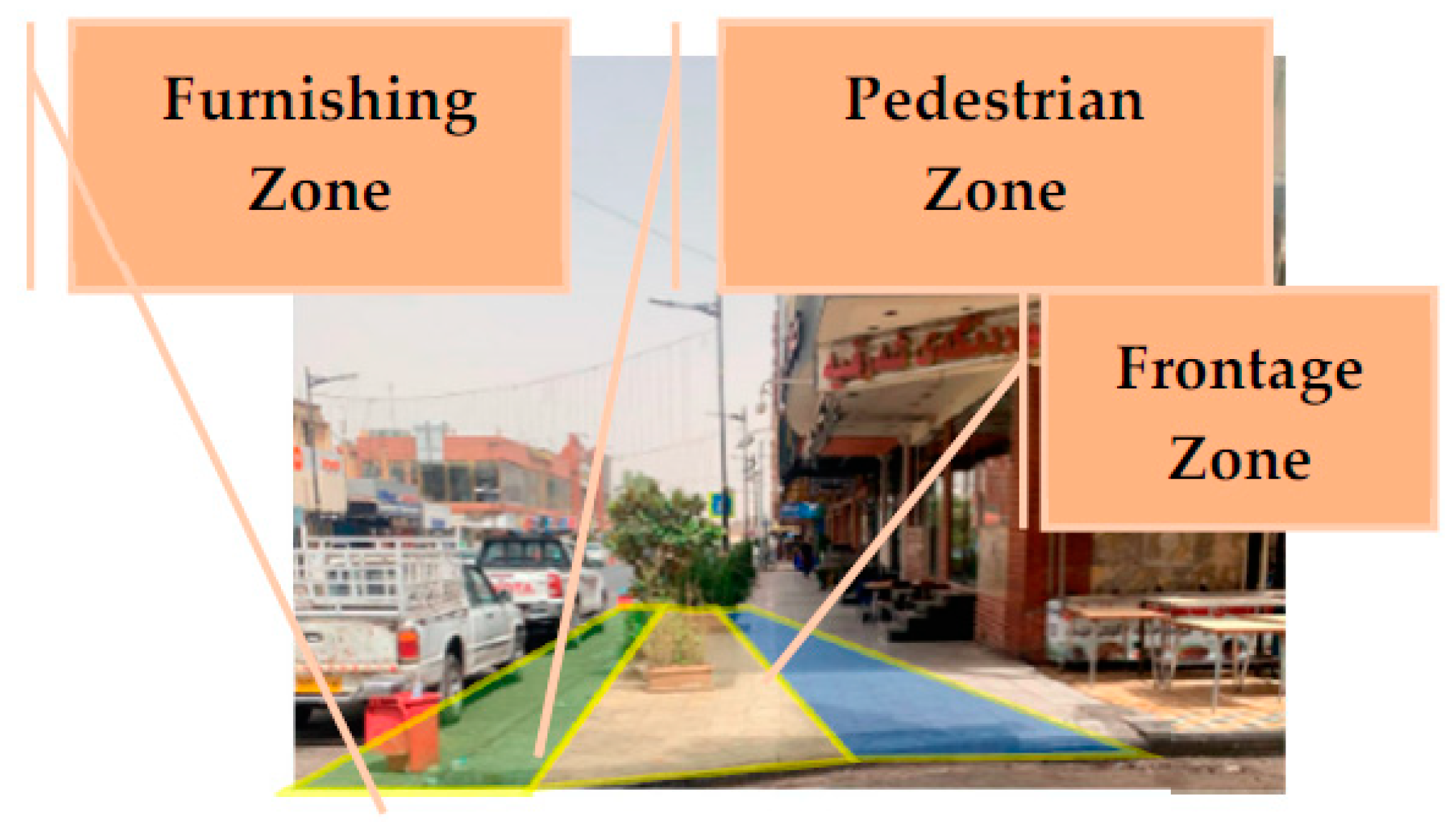
Figure 26.
Pedestrian Protection Slab.
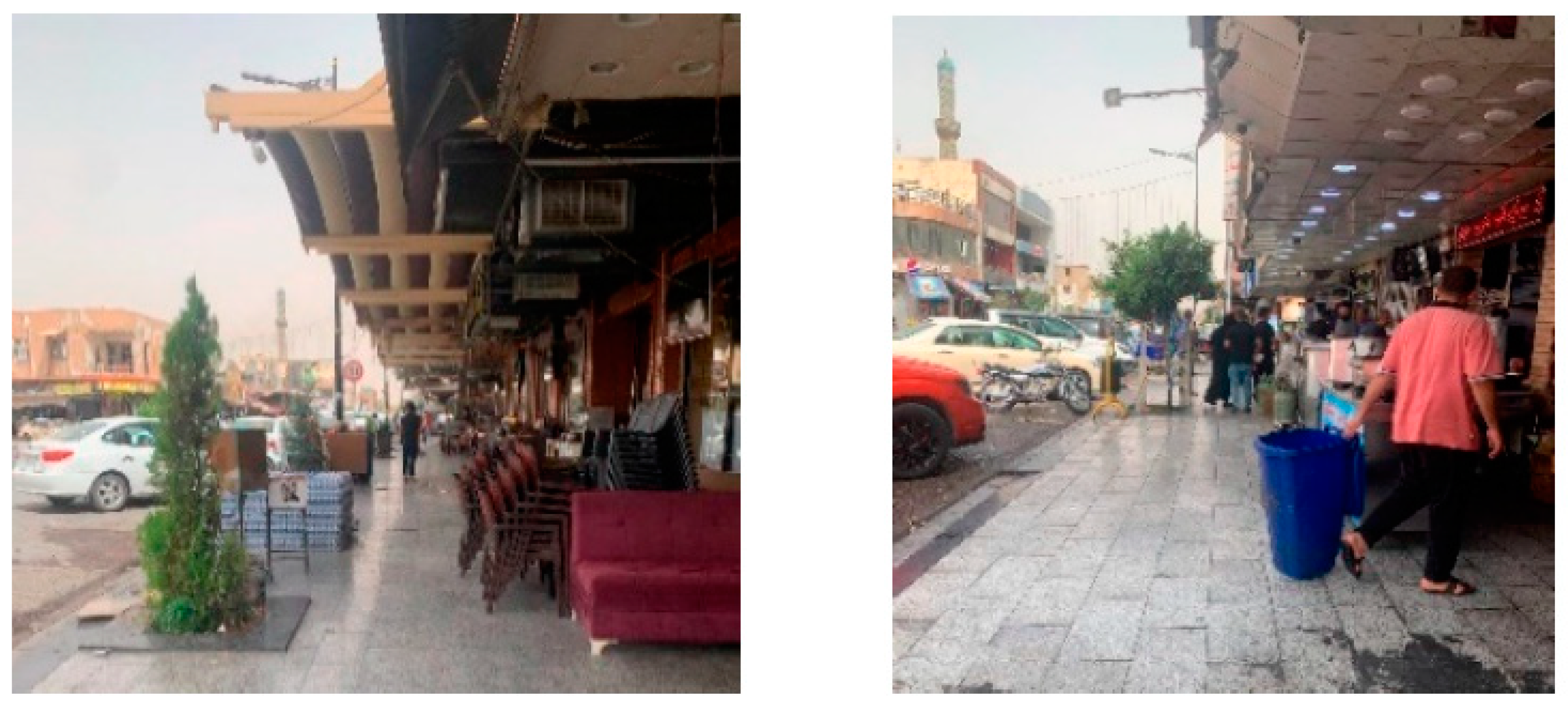
Figure 27.
Garden and Green Cover Percentage in the Street
- Number of trees is very limited; most are not maintained. The approximate number of trees in the whole street is (40) only, Figure 28. The garden is occupied by many trees, Figure 29. It is important to give more attention to trees as they protect pedestrians from the sun, soften the weather, and give an aesthetic and attractive image to the commercial street.
Figure 28.
Trees Situation in Street (Very Limited).
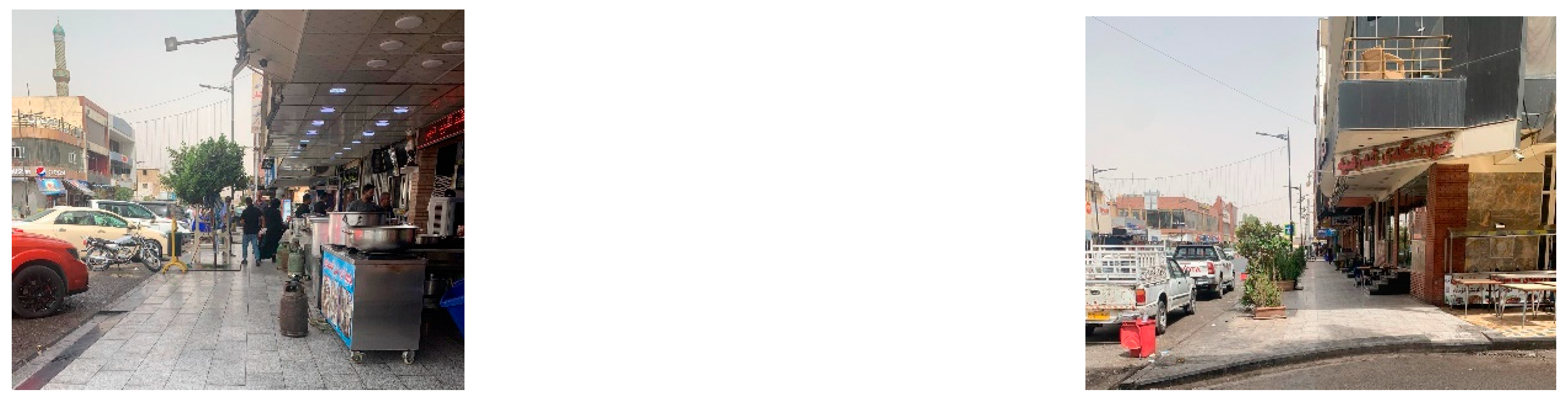
Figure 29.
Trees Mostly in the Garden.
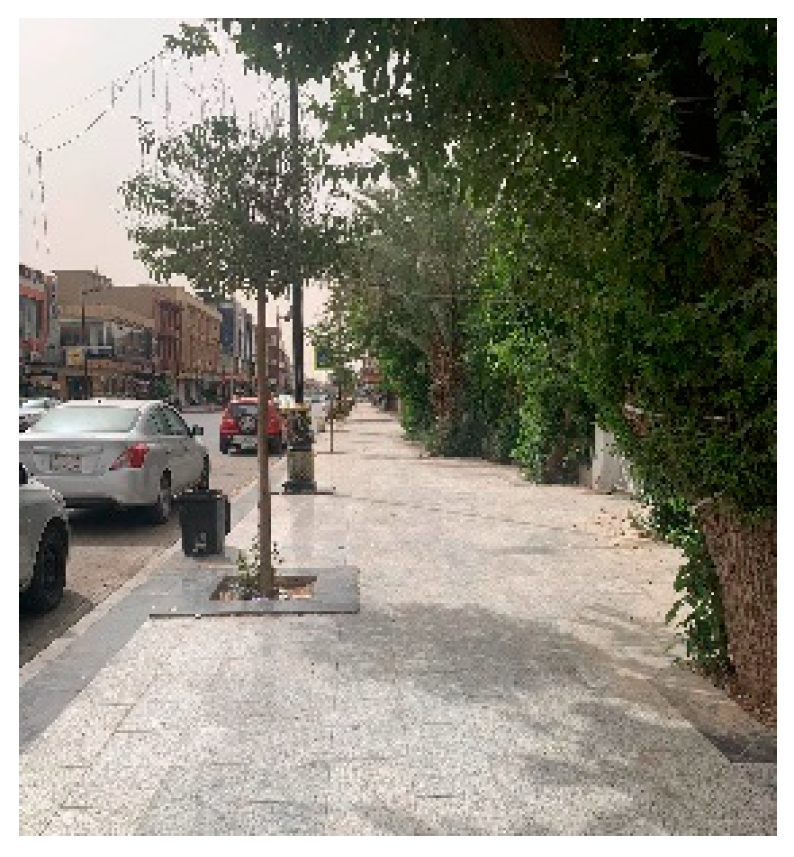
- The general line of the building’s facades and within the perspective of the street was somewhat proportional and uniform in height. Most of the buildings were two floors high, except for a few buildings that exceeded three, and one of the buildings reached (8) floors. Figure 30.
3.1.3. Imageability
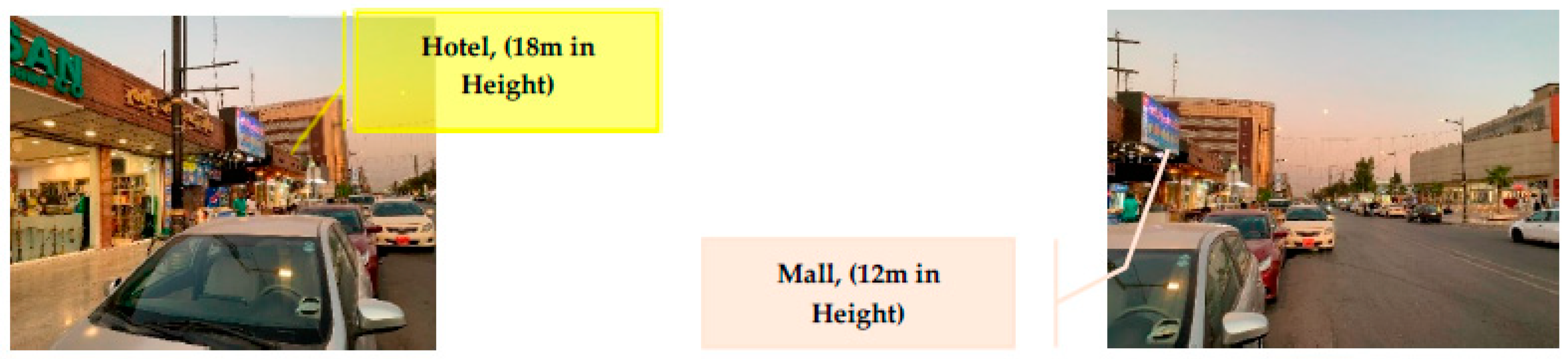
- Among the important things that define the street and distinguish it from others are points of attraction and the well-known buildings in it. Better to define a street with buildings, either of a different height or functions or even an architectural style. Two buildings were the identification for Eskan street in general, both were from the (30m) street side, Figure 31.
Figure 31.
Important Buildings in street.
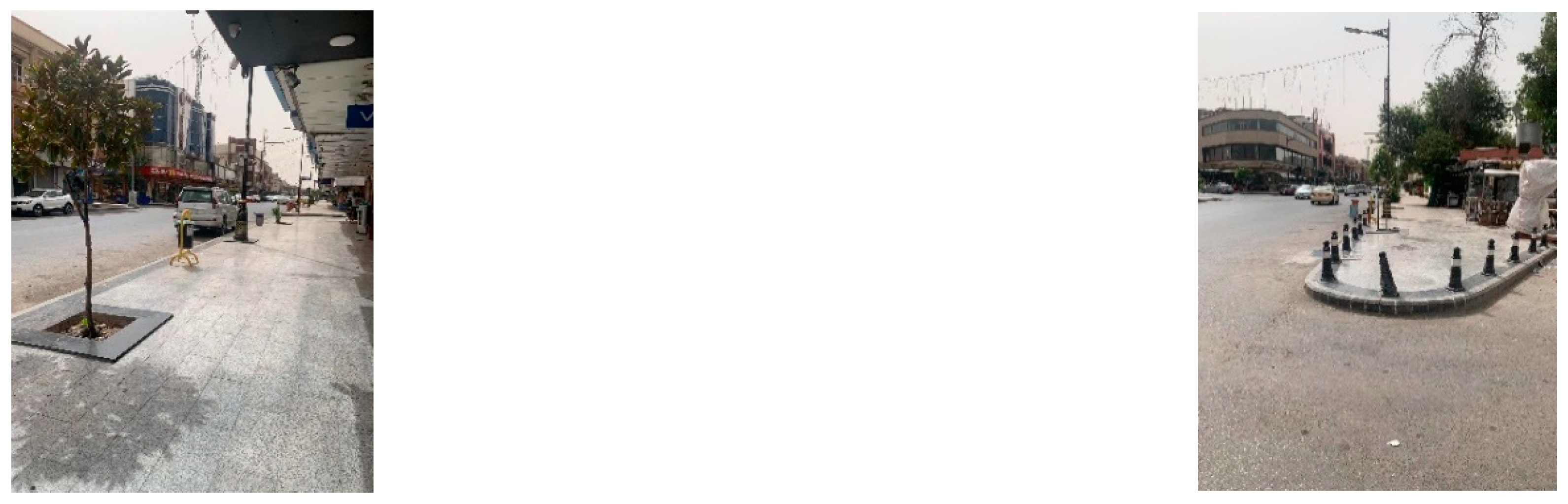
- Short poles were observed in some parts, serving as an edge demarcating sidewalk from the street and car overtaking. These columns are very important in terms of providing safety.
- Within the Furnishing zone, there were electricity poles, trees, billboards, and trash bins. These elements define the edge, preventing cars from overtaking, and forming a clear visual axis for the street and the sidewalks on both sides, Figure 32.
Figure 32.
Sidewalk Furniture.
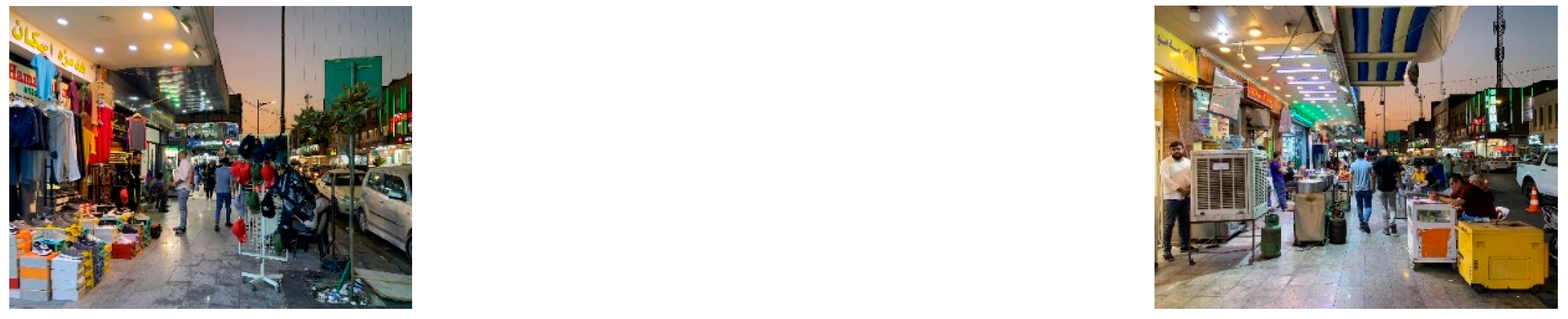
- Although sidewalks were suitable for the movement of people, the shop owners took advantage of them to display their goods, sell food and juices, or put chairs that belongs to the restaurant.
- Some buildings and restaurants took advantage of the frontage zone to add structural elements such as some levels and a few steps for entry. These elements were considered an obstacle to the movement of people, and in some places, people were forced to go down to the street to continue their movement and expose themselves to confrontation with cars, Figure 33.
Figure 33.
Overtaking on sidewalks by shop owners.
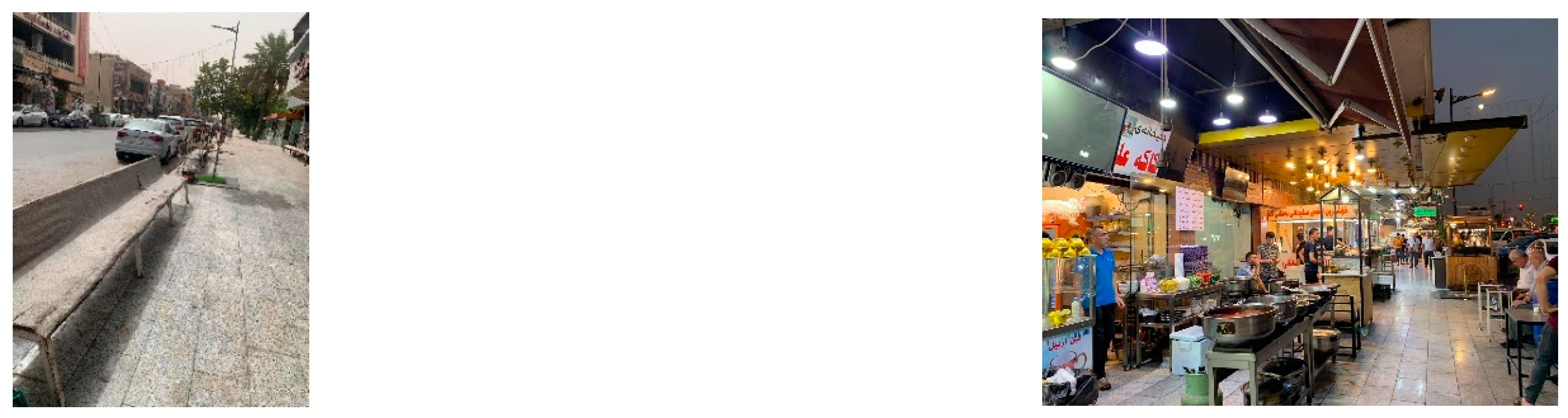
- One of the positive and negative points at the same time is the availability of sitting places on some parts of sidewalks, but they belong to the private property of restaurants and cafe owners, and passers-by cannot use them. The street is devoid of public seating. Furniture and its availability on the sidewalks and the street provide comfort for pedestrians, Figure 34.
Figure 34.
Seating on sidewalks.
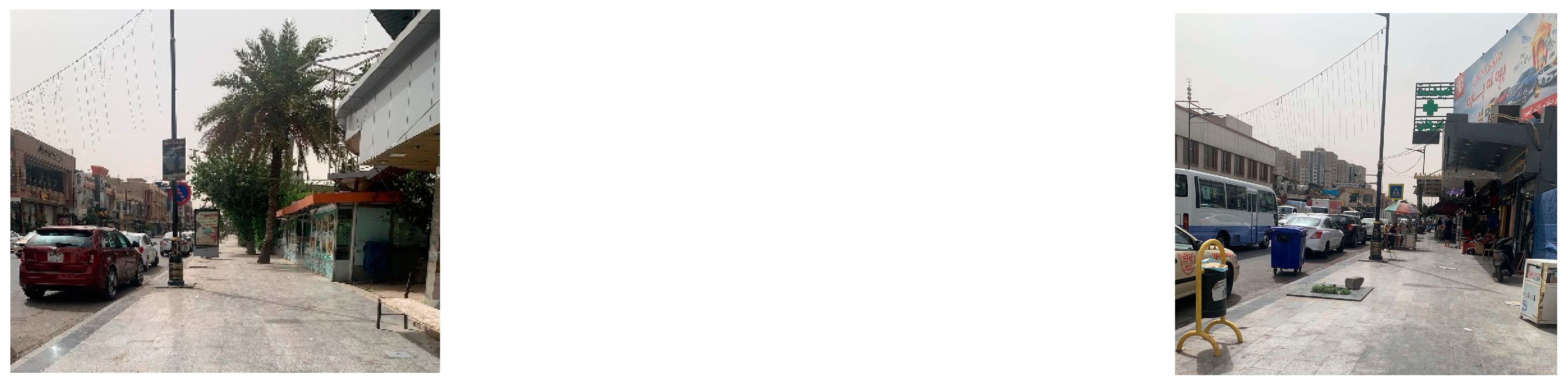
- Although trees are limited, they provide shade and enrich the visual aesthetics of this part of the street. The differences are clear between parts with trees and parts without, Figure 35.
Figure 35.
Trees on sidewalks (very limited).
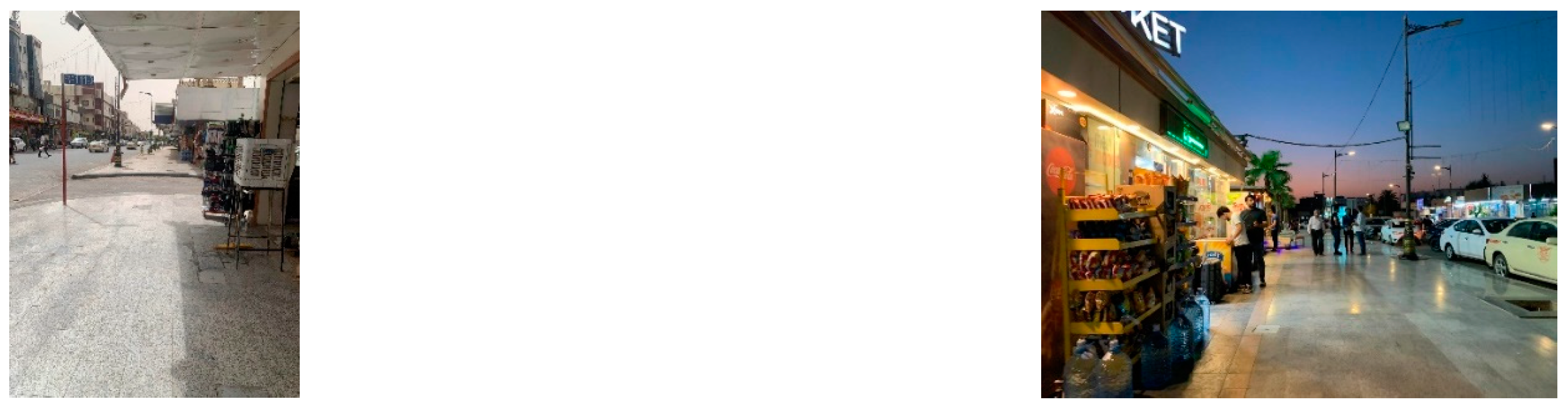
- One of the pedestrian attractions on the commercial street is the transparency of shop fronts. The problem is that most of the shops on Eskan street are restaurants and cafeterias, and some others are various shops. Many restaurants relied on using sidewalks as sitting places, while shop owners used sidewalks to display their goods. The interface has almost disappeared except for a few of them.
- For other shops the fronts were completely transparent, showing what is inside, this raised the visual connection between pedestrians and shops. at night This sensory connection and visual transparency increased due to lighting. Figure 36.
Figure 36.
Façade tranceperancy in shops.

- Sidewalks show a clear visual connection, uniform tiling materials, and limited obstacles within the pedestrian zone. This visual connection had an impact on many levels, including giving a unified character to sidewalks, encouraging walking, feeling comfortable when moving, and presenting a beautiful street image, Figure 37.
Figure 37.
Sidewalks continuity.
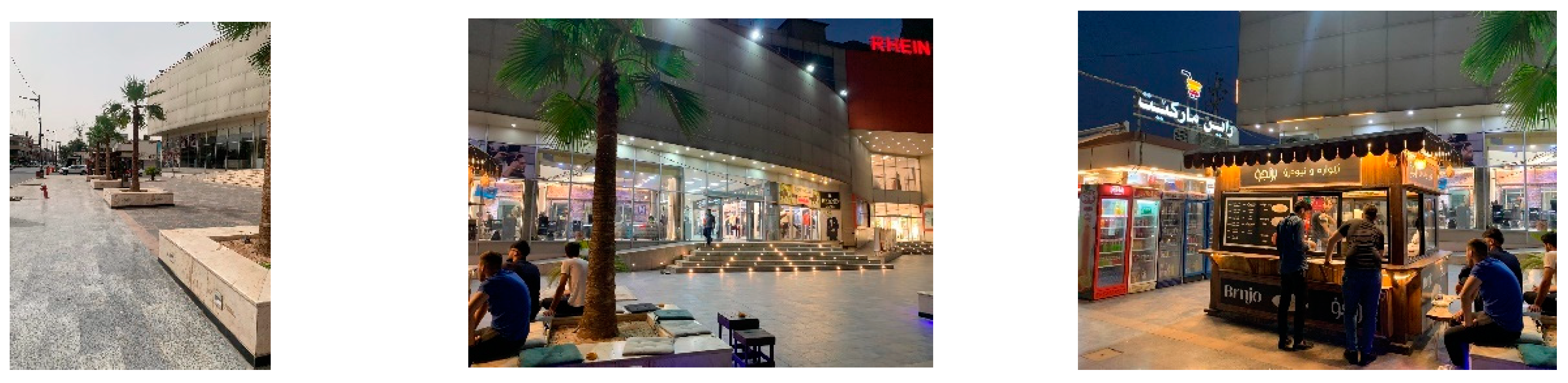
- Some uses of street furniture and Tree planting boxes positively attracted people to sit and enjoy with friends and created an interactive atmosphere, especially since the space in front of the mall was spacious and could hold many activities, Figure 38.
Figure 38.
Furniture creates an attractive point for people to gather.
- One of the points that negatively affect the aesthetic image of the street is the weakness of cleaning and maintenance for the street, its furniture, and lighting. Cleanliness is very important in attracting people and the constant desire to return and use it. In general, there is interest in cleanliness, but not at high levels, Figure 39.
Figure 39.
Sidewalk Maintenance.
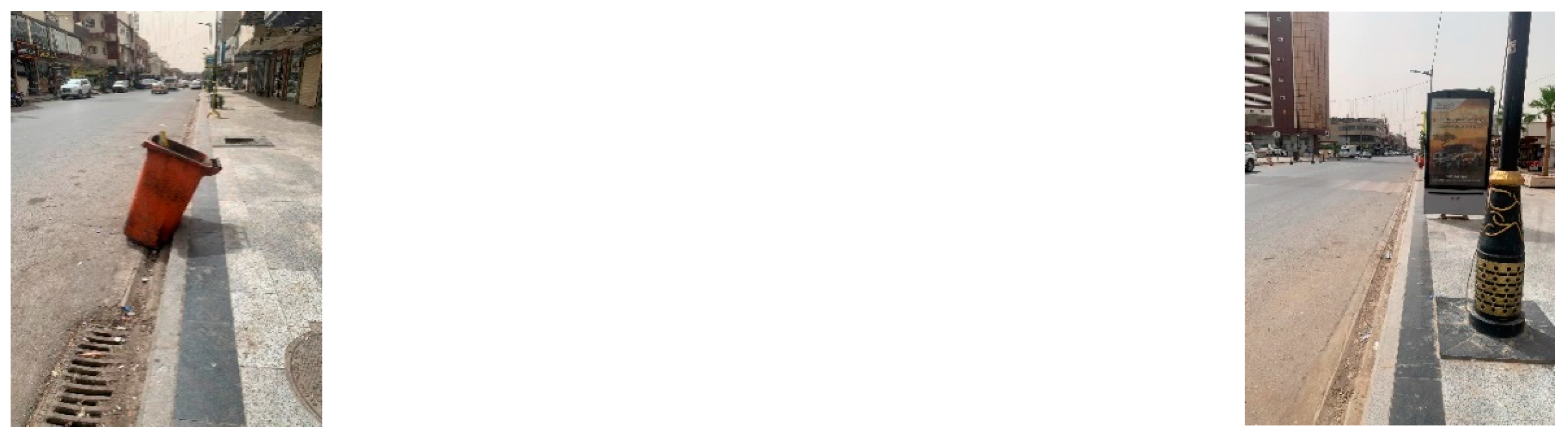
- The street did not include standardization in architectural styles, elements, and forms designs were individual and did not follow general frameworks. One of the positive points is that some restaurant owners use traditional materials such as bricks, which add a local character to the facades. Figure 40.
3.2. Practical Framework and Questianeer Results
A questionnaire was applied and directed to architects and urban designers to find out the important placemaking strategies to achieve livability. The purpose is to find some local dimensions suitable for the environment of Erbil city and its commercial streets by evaluating the livability of Eskan Street. The results of each of the Framework and the questionnaire were analyzed by the SPSS statistical program, and the results were as follows:
3.2.1. Practical Framework Results
The research explained the mechanism of the Framework through which it attempts to reach the most accurate steps and strategies for generating placemaking. Commercial streets include many activities usually associated with city streets, and meet people's needs. the basic dimensions were disassembled into secondary ones and then into factors and sub-factors, then through the concept of possible value linked with each factor, Eskan street is assessed, which is classified as a placemaking strategy. The data was analyzed to identify the outcomes that resulted from the Framework.
3.2.1.1. Sociability Results
The social dimension includes three basic factors, which in turn included a group of secondary factors. The first factor is social design and Activities, which included the following secondary factors (Density, Diversity, Functionality), and its result was (2.50), the second is the Quality of the Street, including (Visibility, Furniture Availability & Maintenance, and satisfaction) appeared in a lower rate (2.25). The highest rate was for the Economic factor, which included, (Economic Satisfaction and Adaptability), with a ratio of (2.60).
From the foregoing, the economic factor is the most influential among this group followed by social design and activities in the second place, while the quality of the street was the least significant, Figure 41.
From the results of the secondary factors, it turns out that functionality was the most important among the others, in terms of functional diversity and ease of movement within the various activities. In second place is adaptability, the ability of the street to adapt to people’s needs, whether by changing the seating places or the type of formal services and informal in particular. Figure 42.
3.2.1.2. Physical Setting Results
The physical setting revolves around several secondary dimensions, namely the Architectural and Design Dimension, Access and Linkages Dimensions, and Environmental Dimension, and then to sub-divisions; (Building Design Street Design, Architectural Design, Accessibility, Walkability, Spatial Characteristics, Climate Comfort), which in turn is associated with several factors and secondary factors: (Human Scale, Edge Compatibility, Morphological, (Building direction, Building length), Inclusiveness, Connectivity, Unity, Physical Characteristics, Enclosure, Architectural Style, urban context, Legibility, Proximity & Transitivity, Clarity, Movement Patterns, Continuity, Spatial Layout (Patterns), Spatial Configuration, Spatial-Temporal, climate protection, and Greenery convenience). Figure 43 shows that the most influential factors among the group were walkability with a rate of (3.00), and street design in addition to spatial characteristics with a rate of (2.62). The most influential secondary factors were each of the inclusiveness: in terms of ease of movement and use of street places and accessibility. Unity is the most appreciated, as the unification of the height and the coordination of the width of the sidewalks and their continuity are among the specifications that appeared clearly in the street space. The same applies to legibility, connectivity of blocks and buildings facades, continuity of the sidewalks, and diversity of uses.
As for the secondary factors, the highest within the group was for each (inclusiveness, unity, legibility, movement patterns, and continuity with the rate (3.00), was the most valued among the group. followed in order of importance; connectivity, spatial layout, and the spatial temporal factors with a rate of (2.75). The lowest percentage factors were the architectural style (1.00), as people in such streets search for comfort, safety, diversity, and local food more than attractive building, attractive activities are more valued than other aspects, Figure 44.
3.2.1.3. Imageability Results
The Imageability dimension included two secondary dimensions, which are images and sense of place. The main factors included: (Memory, Safety, Comfort, and Qualified Street). The latter included secondary factors: (Attractiveness, Locality, and identity, Place Attachment, Separation, Speed, Physical Comfort, Social Comfort, Unified Sense of Place, Social Bonding, and Sense of Belonging). In Figure 45, it is clear that (qualified Street) is the highest among the group in terms of holding a cultural event in the street, the attractiveness of the whole atmosphere, and the type of activities people desire as an entertainment function. The second in ranking is for safety, as too many points helped raise the quality of the place. It is the limited width of the street that did not exceed (20 m), in addition to the consistency between the width and height of the street and the buildings.
Consistency and proportionality relation between street width and building height will encourage the slow movement of cars, in turn, encourage the safe movement of pedestrians. This will increase comfort in the street, [32].
From the comparison of the secondary factors, it was noted that three of the group dominated: place attachment, unified sense of place, and sense of belonging, with a ratio (2.67). while in the second level each of, separation, speed, and social comfort with the rate (2.50). other secondary factors varied between (2.40-2.33), Figure 46. The importance of these secondary factors appears as they explain the human connection to the street and the desire to walk and use the various activities that meet people's needs. In addition, the street meets many cultural events. People support the continuity of social diversity in the street and have some kind of commitment to its spaces.
3.2.2. Questionnaire Results
Building the questionnaire list was based on the following points:
- The questionnaire was directed to architects and urban designers as the research aims to reach systematic strategies and detailed steps for placemaking.
- (100) lists were distributed to architects, only (62) were received, (and 7) contained inconsistent answers (where the researchers added six pairs of verification questions if the answers were different for more than three pairs, the questionnaire will be canceled).
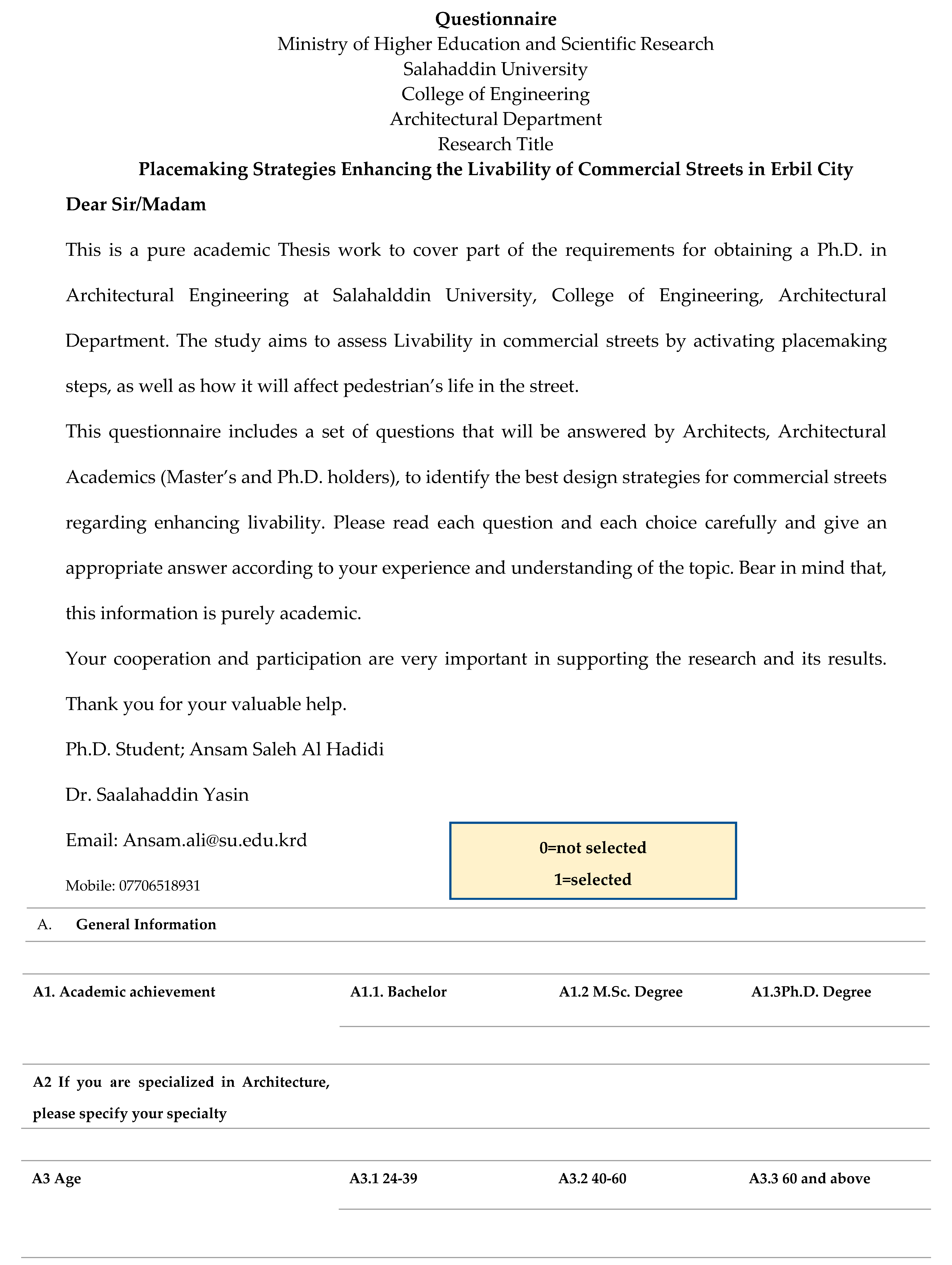
- The Questionnaire consisted of two main parts. The first presents a group of general questions about age and architectural specialization, as well as their opinion on a comparison between seven commercial streets.
- The second part included two main aspects of the research, the placemaking (which included questions regarding the three basic pillars identified by the research, physical setting, sociability, and imageability), as well as questions related to livability, Appendix (C), shows the Questionnaire list.
- The questionnaire list was created in the same way as the basic components of the checklist (the practical framework), and with the same approach, as well as the outputs of the field survey, in sequence, conforming to the dimensions and basic factors.
- The research took this format to easily compare both approaches. By comparing the averages of the results of the questionnaire regarding main and secondary dimensions, and factors, the most influencing dimensions are comfort and safety, along with the economic factor, accessibility, and walkability. Figure 47, Each of the physical dimensions of the street in terms of sidewalks width and the availability of furniture, activities, and their diversity, and the formation of a beautiful image, were among the most influential that came in second place. These are regarded as the most important steps in activating livability.
- Among the important things that the research noticed, which appeared more clearly in the pilot study, people were asked about the reason for choosing this commercial street, and the reasons as mentioned previously in this research, land use diversity, variety of restaurants, and plenty of cafeterias, being a comfortable street as the car movement is limited, in addition to the existence of a mall on the street which contains many activities, services, and various shops, in addition to entertainment services for children.
- Females’ participant showed their desire to roam the street which is not totally possible to use by women at all times, as it is considered a (male street) more than a female one (although there is no objection to using the female gender), since the quality of food in restaurants and cafeterias and the gathering of young people, especially in soccer watch periods.
- Therefore, this point must be taken into consideration when aiming to develop the street, as most women want to use the street. It is noted that there are a large number of women users of the mall more than men and at different times.
The comparison between the two methods was made on two levels:
- The first is to compare the secondary dimensions to find out the differences between the two sides and the importance according to the different points of view.
- The second was at the level of comparison of the three basic dimensions.
In general, the two methods showed consistency and convergence in results, as shown in Table 5.
- And by comparing the averages and despite the close consistency between the results, it is clear that the physical aspect was the highest among the group in both methods, with (3.99) and (4.07) for the questionnaire and the practical framework, followed by the imageability aspect by (3.97) and (3.85).
- And the last dimension in the ranking is for the sociability dimension of (3.81) and (3.50).

Table 5.
Comparing the mean average of both (questionnaire and checklist).
| Sub-Dimensions | Mean-questionnaire. | Dimensions | Dimensions Percentage | Mean-Checklist | Dimensions | Dimensions Percentage |
|---|---|---|---|---|---|---|
| Social design and Activities | 3.81 | Sociability | 3.81 | 3.50 | Sociability | 3.68 |
| Quality of Street | 3.61 | 3.40 | ||||
| Economic | 4.01 | 4.14 | ||||
| Building Design | 3.77 | Physical Setting | 3.99 | 4.50 | Physical Setting | 4.07 |
| Street Design | 3.92 | 3.80 | ||||
| Architectural Design | 3.80 | 3.70 | ||||
| Accessibility | 4.17 | 3.70 | ||||
| Walkability | 4.08 | 4.50 | ||||
| Spatial Characteristics | 3.85 | 3.88 | ||||
| Environmental | 4.38 | 4.40 | ||||
| Memory | 3.97 | Imageability | 3.97 | 3.80 | Imageability | 3.85 |
| Safety | 4.02 | 3.80 | ||||
| Comfort | 4.01 | 3.90 | ||||
| Sense of Place | 3.89 | 3.90 |
Figure 48.
The main dimensions for the questionnaire.
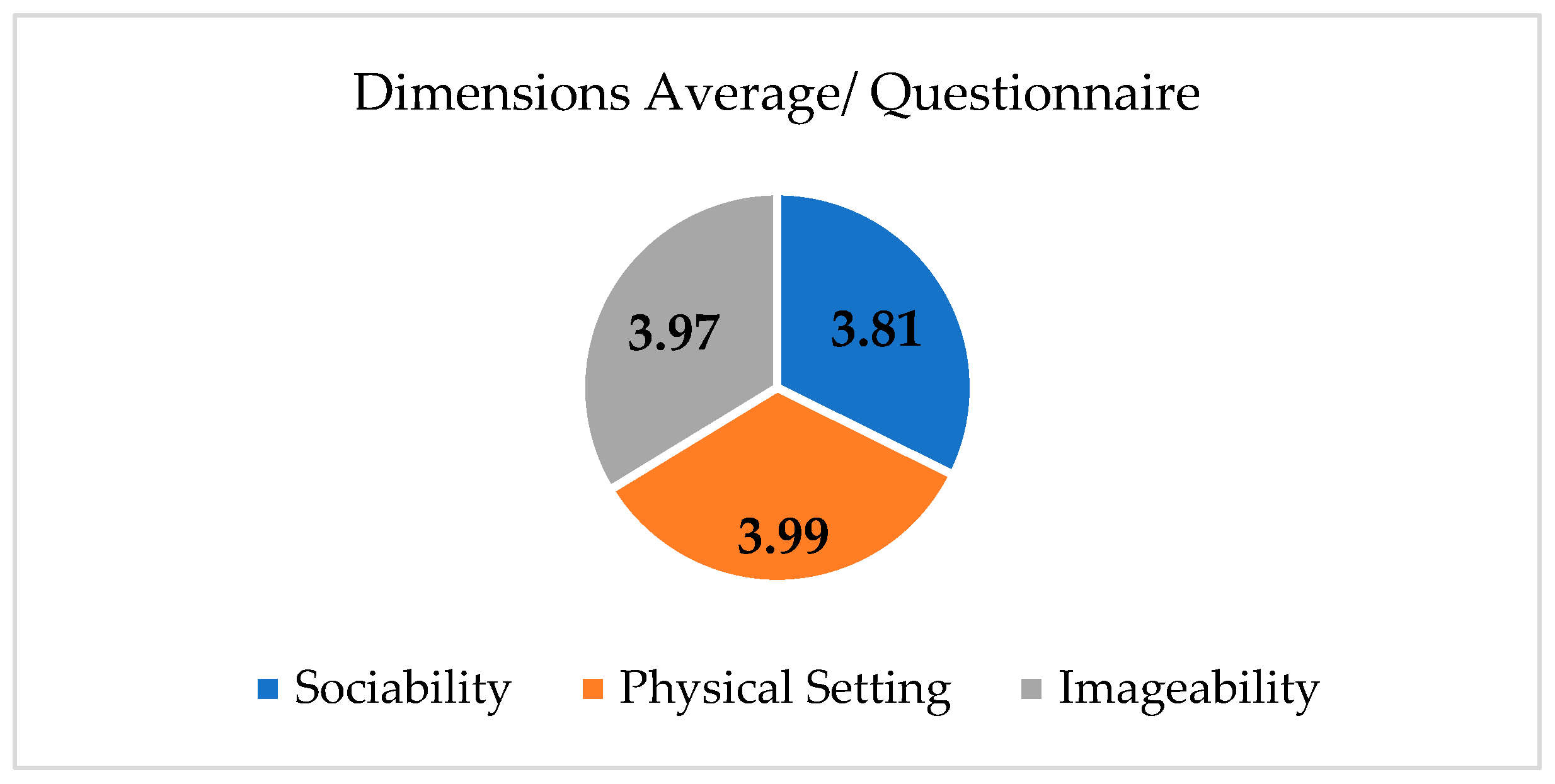
Figure 49.
The main dimensions of the questionnaire
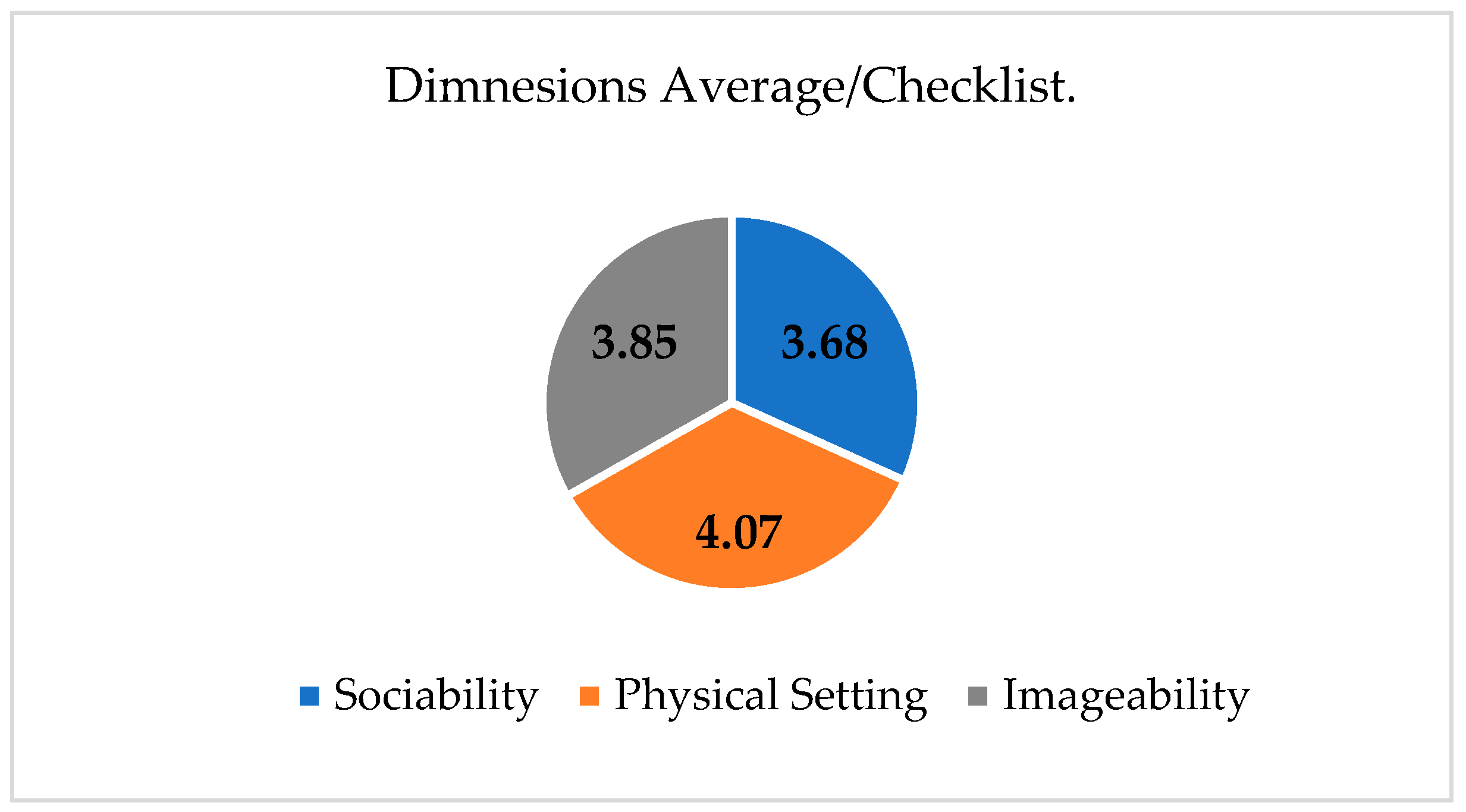
As a comparison between the averages of both methods questionnaires and the practical Framework, it can be noted that the results are consistent regarding the secondary dimensions and factors, indicating the importance of the mentioned factors in activating placemaking. By comparing the secondary dimensions of each of the questionnaires and the practical framework, a kind of consistency was found between the dimensions in both methods. In the questionnaire results each of environment, accessibility, walkability, safety, comfort, and economic, were the highest rates among the group. As for the practical framework (checklist), building design, walkability, environment, and economics were the highest rates. And in comparison, both methods praised the importance of economic, walkability, and environmental, which they regarded as the basic aspects of placemaking strategies, having a significant impact on raising street livability.
Safety and comfort, along with a sense of place, are also important dimensions that came in second place in terms of importance (although not much difference), both methods acclaimed the importance of its actual presence within the street space due to its great role in supporting livability, Figure 50. In general, each dimension, whether it appears at a high or medium rate, has a significant impact on the performance of placemaking strategies. And the more accurate the application, the more visible the symbiosis.
The Practical Framework was evaluated with three stages (excellent, fair, and poor) to stand on the level of Eskan street in its application of the placemaking strategy. By comparing the results, it is noticed that the street applied strategies percentage with excellent results (58.6%). The average percentage with fair results (27.8%), and for the very poor (13.5%). This displays that the street includes some specifications that are in line with what is required for placemaking in terms of inclusiveness in the steps. The street commits many details, design features, and spatial dimensions that are commensurate with the human scale, all of which encourage people to use and return to the street many times. Figure 51. Figure 52 shows the methods and results.
3.3. Discussion and Conclusion
The process of placemaking steps must be followed by municipalities, architects, and urban designers in cooperation with people as well. It is an inclusive and participatory process, each dimension or factor whether main or secondary has an impact on activating placemaking strategies. By comparing the averages of the dimensions, it is noted that the three dimensions are essential in supporting livability.
The most important dimension in the group is the (physical setting). Among its secondary dimensions with the highest ratio are; (Street Design, Architectural Design, Accessibility, Walkability, Spatial Characteristics, and Environmental). Imageability dimension in the second stage. The higher secondary dimensions are for each safety and comfort. People praised the importance of safety in the street and preventing cars from overtaking sidewalks. Ease of transition between the two sides in addition to comfort when using the street. The last dimension is sociability.
The research presented a theoretical inductive study for several literary references that dealt with the idea of eliciting livability through placemaking strategies. An expanded comprehensive list was extracted to evaluate commercial streets in terms of the level of their placemaking application, down to the most accurate factors with a direct impact on each step. From the Framework, it is possible to determine the shortage in the commercial street and which of P.M. steps are weak or not available, to work on activating and developing the weak steps.
By comparing the applied models and theorists' opinions regarding the place and its theories, it was found that the place is a phenomenon of space. The basic dimensions of the place were clear and defined by both sides, as many contributions and studies were made that suggest frameworks for the development of the place. Few of these studies are directed towards the development of the commercial street into a livable place, not just a shopping road. Several researchers have discussed an individual and specific aspect of livability effects, without specifying the details of its assessment through possible values. Others did not link placemaking strategies as essential steps to structure livability. Although the previous studies built the basis of the theoretical and practical framework for this research, from which the three basic dimensions were formed. However, the intellectual and evaluative depth of this foundation was in the secondary dimensions and factors that were reconfigured within the practical framework to form a comprehensive checklist, and one of the first studies that assess all design details of the commercial street and the percentage of its application of placemaking strategies. Thus, this study has filled the gap in the field of assessing and developing commercial streets as livable places.
The list was applied to one of the vital commercial streets in Erbil (Eskan Street), and application percentages were determined according to placemaking strategies and which dimension had the strongest impact on the group. The final results showed consistency and balance between the three dimensions. This is what most theorists referred to when they mentioned that making a place is comprehensive.
Appendix A
Appendix: A1.
First Group Models
Appendix: A2.
Second Group Models
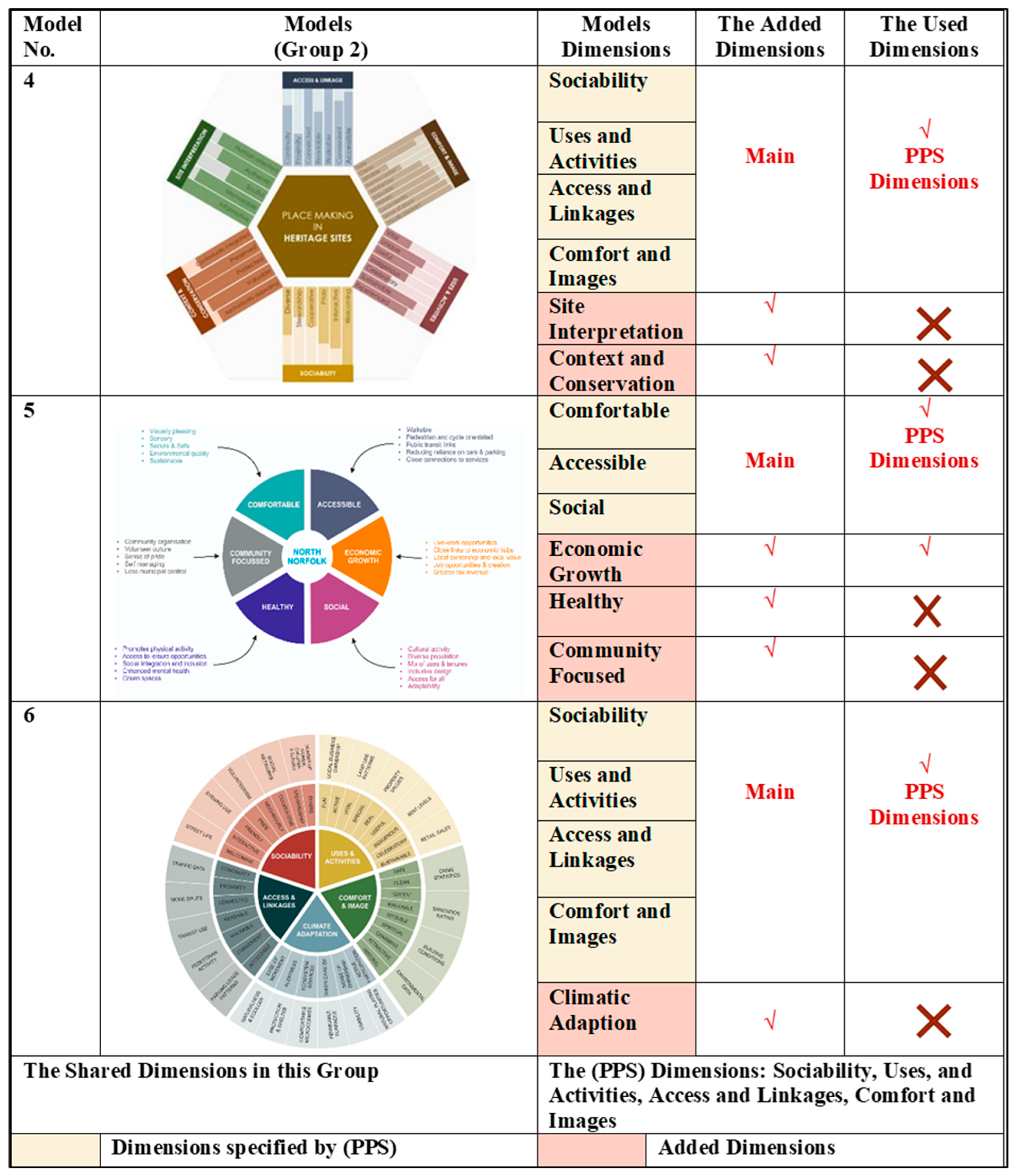
Appendix: A3.
Third Group Models
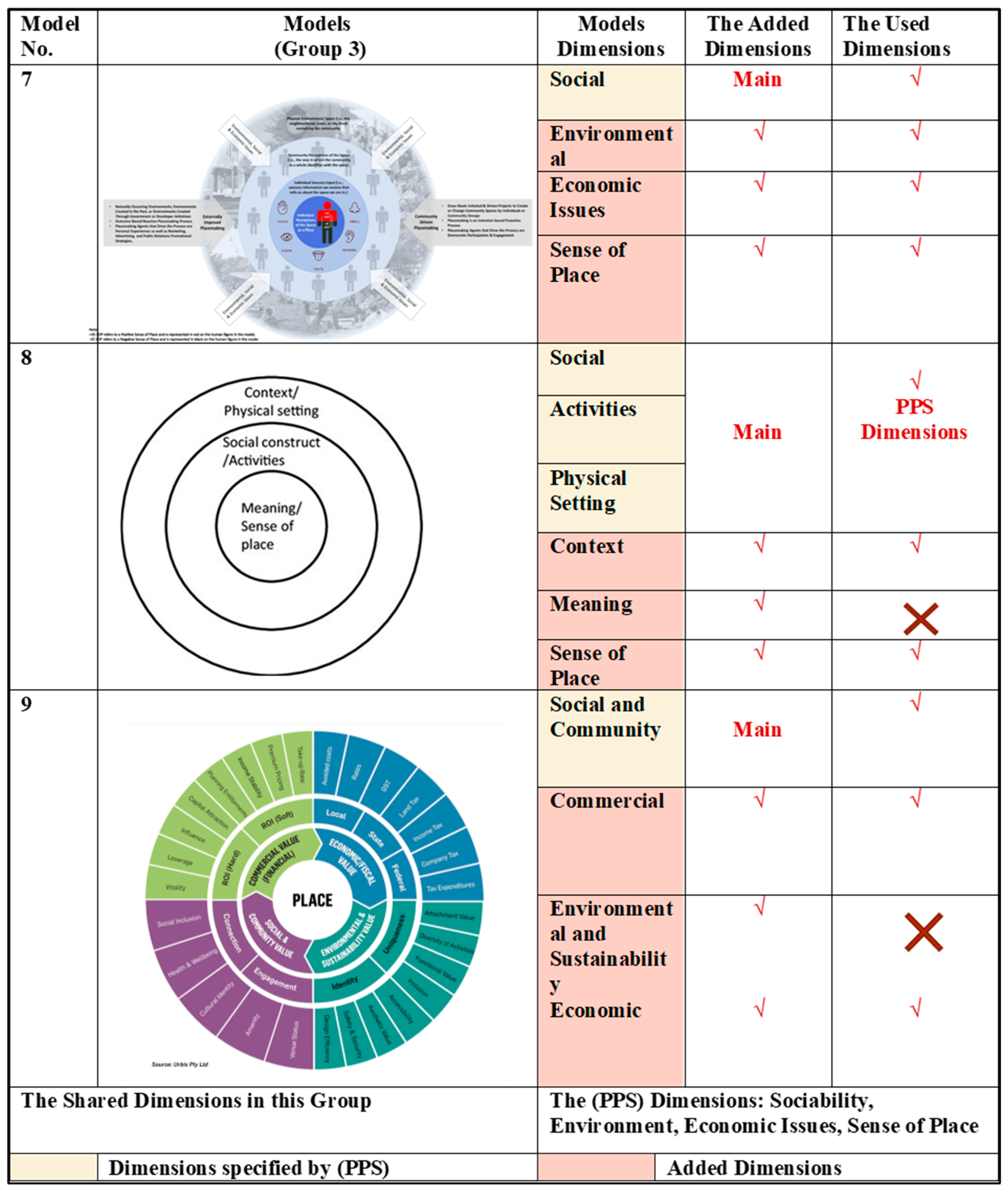
Appendix: A4.
Fourth Group Models
Placemaking Models Review, (P.M. Groups). Source: Author
Appendix B
Appendix B1.
The Placemaking Practical Framework (Checklist). Source Author
|
Appendix C
Appendix C: The Questionnaire List. Source: Author
      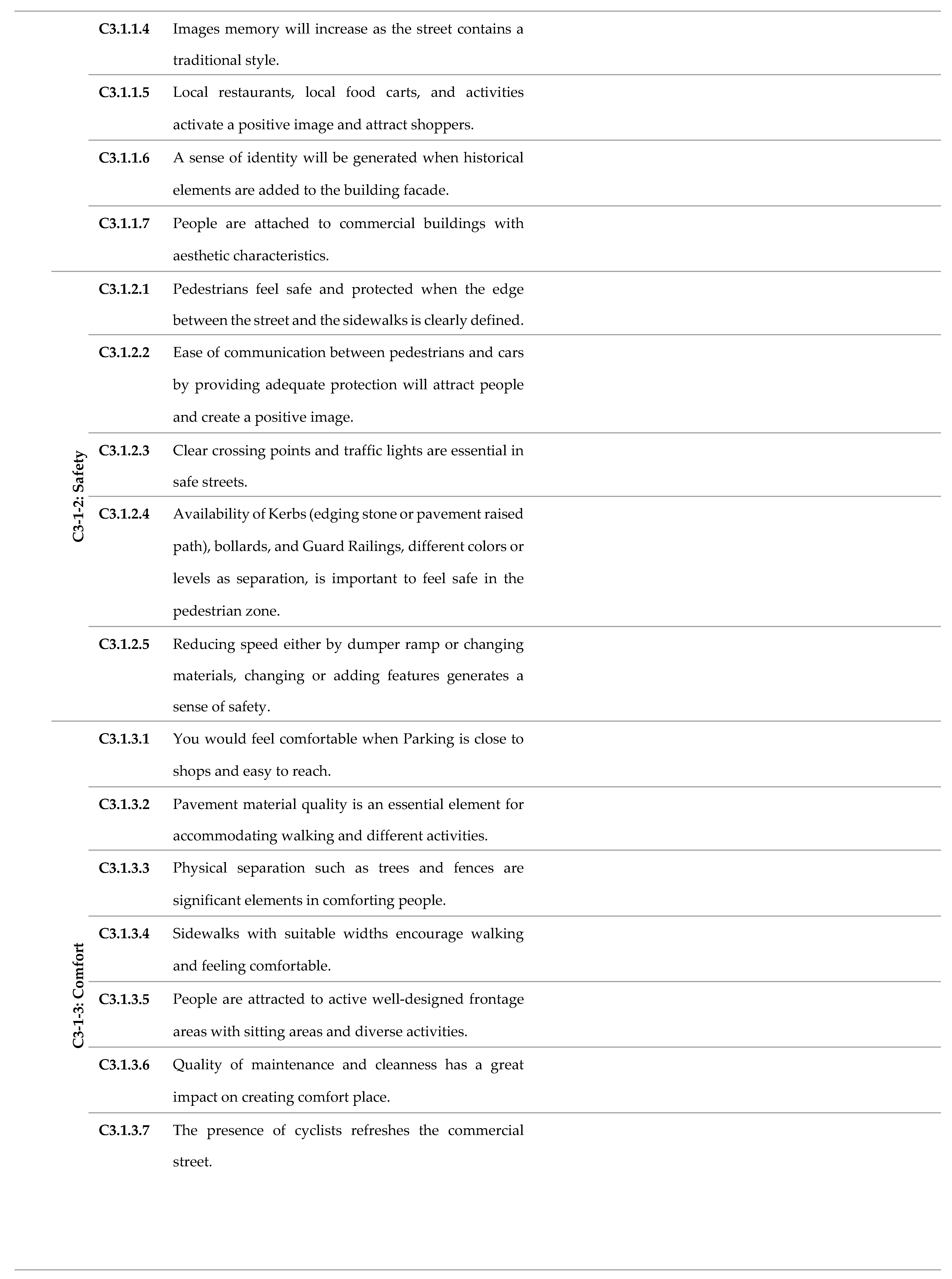 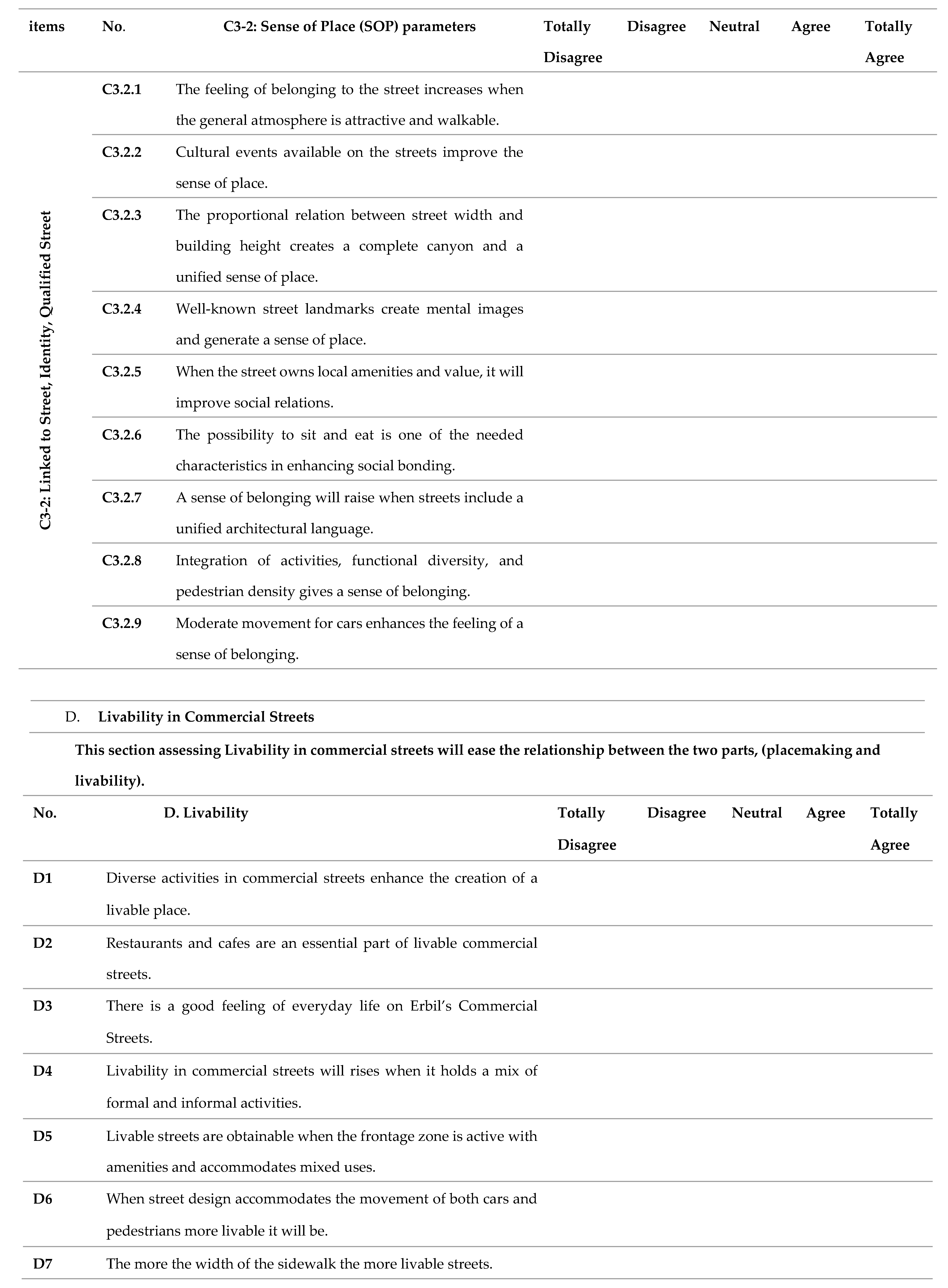 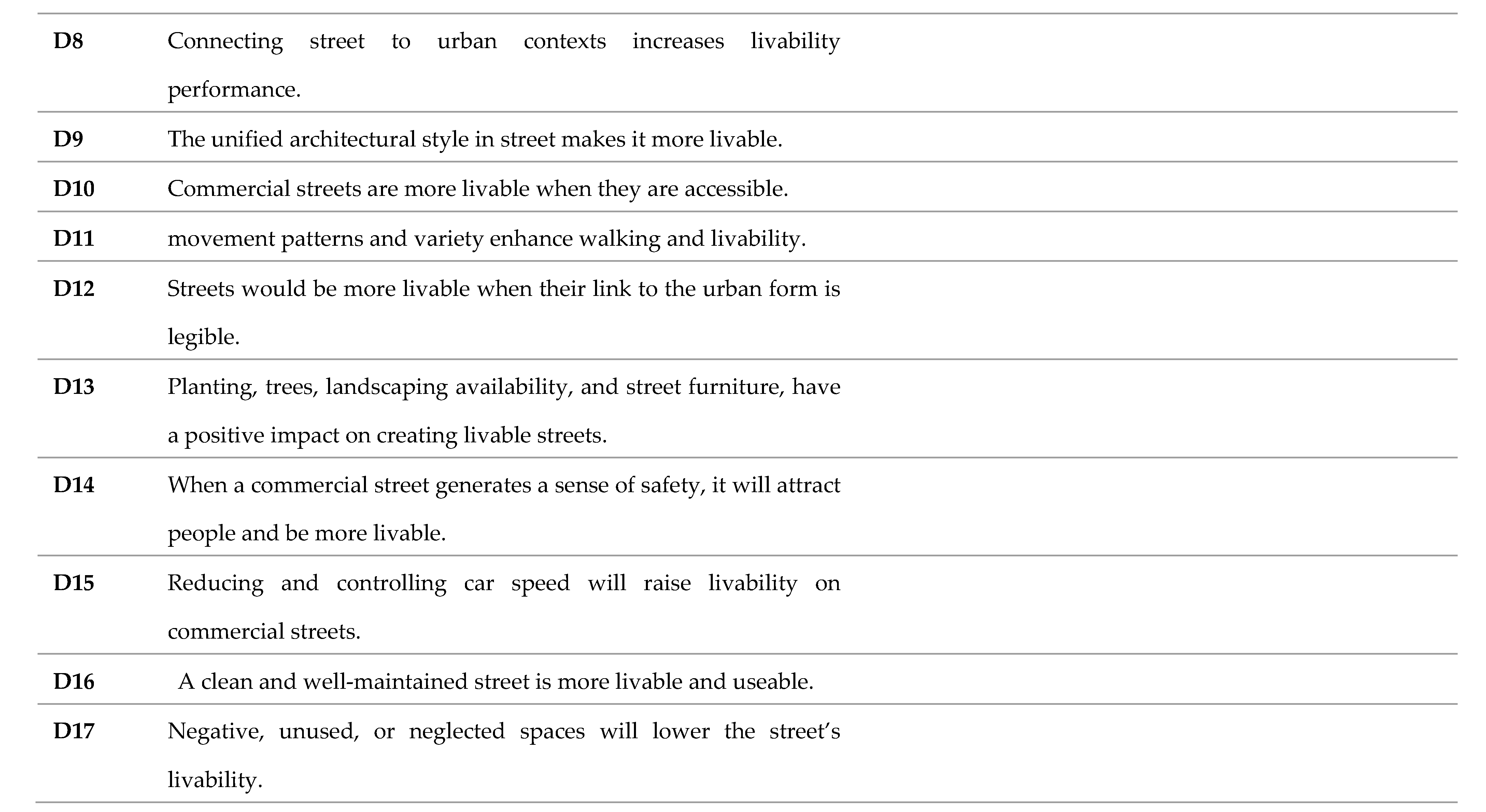
|
References
- N. A. Rahman, S. Shamsuddin, and I. Ghani, “What Makes People Use the Street?: Towards a Liveable Urban Environment in Kuala Lumpur City Centre,” Procedia Soc Behav Sci, vol. 170, 2015. [CrossRef]
- D. Appleyard, “Livable streets: protected neighborhoods,” Ekistics, vol. 45, no. 273, pp. 412–417, Dec. 2016, Accessed: Feb. 21, 2023. [Online]. Available: http://www.jstor.orgURL:http://www.jstor.org/stable/.
- A. Jacobs and D. Appleyard, “Toward an urban design manifesto,” Journal of the American Planning Association, vol. 53, no. 1, pp. 112–120, 1987. [CrossRef]
- K. Marthya, R. Furlan, L. Ellath, M. Esmat, and R. Al-Matwi, “Place-making of transit towns in Qatar: The case of qatar national museum-souq waqif corridor,” Designs (Basel), vol. 5, no. 1, pp. 1–17, Mar. 2021. [CrossRef]
- Joan Clos, The city at eye level: lessons for street plinths. 2016. Accessed: Feb. 08, 2023. [Online]. Available: https://thecityateyelevel.com/app/uploads/2018/06/eBook_The.City_.at_.Eye_.Level_English.pdf.
- J. Gehl, Cities for People. Washington, ISLAND PRES, 2010. Accessed: Feb. 08, 2023. [Online]. Available: https://umranica.wikido.xyz/repo/7/75/Cities_For_People_-_Jan_Gehl.pdf.
- Fred Kent, “Project of Public Spaces (PPS),” https://www.pps.org/category/placemaking, 2020. INQUIRIES@PPS.ORG OR 212.620.5660.
- J. Jacobs, The DEATH and LIFE of GREAT AMERICAN CITIES, 1st Vintage Books. New York: Urban renewal-—United States.3. Urban policy—United States I. TitleHT167.J33 1992, 1961. Accessed: Feb. 08, 2023. [Online]. Available: https://www.buurtwijs.nl/sites/default/files/buurtwijs/bestanden/jane_jacobs_the_death_and_life_of_great_american.pdf.
- non-profit foundation, “Placemaking Week Europe,” Sep. 27, 2022. https://placemaking-europe.eu/ (accessed Feb. 07, 2023).
- Rita Nohra and Chirine Salha, “Placemaking: Putting life and soul into neighborhood spaces,” Hospitality news Middle East, Jul. 02, 2018. https://www.hospitalitynewsmag.com/placemaking-putting-life-and-soul-into-neighborhood-spaces/ (accessed Feb. 07, 2023).
- A. M. R. M. Mohamed, S. Samarghandi, H. Samir, and M. F. M. Mohammed, “The role of placemaking approach in revitalising AL-ULA heritage site: Linkage and access as key factors,” International Journal of Sustainable Development and Planning, vol. 15, no. 6, pp. 921–926, Sep. 2020. [CrossRef]
- North Norfolk District Council., “https://designguide.north-norfolk.gov.uk/getting-started/the-value-of-placemaking/,” www.north-norfolk.gov.uk, 2023. https://designguide.north-norfolk.gov.uk/getting-started/the-value-of-placemaking/ (accessed Feb. 08, 2023).
- A. Santos Nouri and J. P. Costa, “Placemaking and climate change adaptation: new qualitative and quantitative considerations for the ‘Place Diagram,’” J Urban, vol. 10, no. 3, pp. 356–382, Jul. 2017. [CrossRef]
- P. J. Ellery, J. Ellery, and M. Borkowsky, “Toward a Theoretical Understanding of Placemaking,” International Journal of Community Well-Being, vol. 4, no. 1, pp. 55–76, Mar. 2021. [CrossRef]
- E. Ghavampour and B. Vale, “Revisiting the ‘model of place’: A comparative study of placemaking and sustainability,” Urban Plan, vol. 4, no. 2 Public Space in the New Urban Agenda: Research into Implementation, pp. 196–206, 2019. [CrossRef]
- Jack Backen, “THE VALUE OF PLACEMAKING,” The City at Eye Level Asia, Nov. 04, 2020. https://thecityateyelevel.com/stories/the-value-of-placemaking/ (accessed Feb. 07, 2023).
- P. and U. D. Tribal and A. and U. D. O’ Mahony Pike, “Urban Design Manual A best practice guide A companion document to the Guidelines for Planning Authorities on Sustainable Residential Development in Urban Areas,” Ireland and across Europe, May 2009. Accessed: Feb. 07, 2023. [Online]. Available: https://www.opr.ie/wp-content/uploads/2019/08/1999-Urban-Design-Manual-1.pdf.
- K. Al-Kodmany, “High-Rise Buildings Placemaking in the High-Rise City: Architectural and Urban Design Analyses,” International Journal of High-Rise, vol. 2, no. 2, pp. 153–169, 2013, [Online]. Available: www.ctbuh-korea.org/ijhrb/index.php.
- National Associations of Realtors, “Placemaking: Big Impacts, Small Towns,” Jan. 13, 2020. https://www.nar.realtor/blogs/spaces-to-places/placemaking-big-impacts-small-towns (accessed Feb. 21, 2023).
- Aras an Chontae, “URBAN CENTRES & PLACEMAKING 7,” Mullingar, Mount Street. Accessed: Feb. 08, 2023. [Online]. Available: https://consult.westmeathcoco.ie/en/consultation/draft-westmeath-county-development-plan-2021-2027/chapter/07-urban-centres-and-place-making.
- Tim Cresswell, “Place: A Short Introduction,” 13th ed., Swanston Street, Carlton, Victoria 3053, Australia: Blackwell Publishing, 2004. Accessed: Feb. 08, 2023. [Online]. Available: https://docplayer.net/87556924-Place-a-short-introduction-tim-cresswell-ij-blackwell-l-publishing.html.
- Kevin Lynch, THE IMAGE OF THE CITY, 20th ed. London: The M.I.T. Press, 1961.
- I. Aravot, “Back to phenomenological placemaking,” J Urban Des (Abingdon), vol. 7, no. 2, pp. 201–212, Jun. 2002. [CrossRef]
- E. E. Toolis, “Theorizing Critical Placemaking as a Tool for Reclaiming Public Space,” Am J Community Psychol, vol. 59, no. 1–2, pp. 184–199, Mar. 2016. [CrossRef]
- D. Seamon and J. Sowers, “Place and placelessness (1976): Edward Relph,” in Key Texts in Human Geography, SAGE Publications Inc., 2008, pp. 43–52. [CrossRef]
- F. Ryfield, D. Cabana, J. Brannigan, and T. Crowe, “Conceptualizing ‘sense of place’ in cultural ecosystem services: A framework for interdisciplinary research,” Ecosyst Serv, vol. 36, Apr. 2019. [CrossRef]
- S. Shamsuddin and M. S. Al-Obeidy, “Evaluating Diversity of Commercial Streets by the Approach of Sense of Place,” Adv Environ Biol, vol. 9, no. 4, pp. 193–196, 2015, [Online]. Available: http://www.aensiweb.com/AEB/.
- S. Fayez, A.-N. Supervisor, D. Kamel, and O. Mahadin, “TOWARDS A COMPREHENSIVE APPROACH TO DEFINING SENSE OF PLACE AND CHARACTER ‘THE STREET AND THE CITY OF AMMAN,’” 2004. [CrossRef]
- M. Y. Khemri, A. Melis, and S. Caputo, “Sustaining the Liveliness of Public Spaces in El Houma through Placemaking,” The Journal of Public Space, no. Vol. 5 n. 1, pp. 129–152, Jan. 2020. [CrossRef]
- J. T. Mcdonough, “PLACE-MAKING: A STUDY OF EMERGING PROFESSIONALS’ PREFERENCES OF PLACE-MAKING ATTRIBUTES,” 2013. Accessed: Feb. 09, 2023. [Online]. Available: https://d.lib.msu.edu/etd/2768.
- N. 10276 U. PO Box 1073 New York, “The Power of 10+, How Cities Transform Through Placemaking,” 2020. https://www.pps.org/article/the-power-of-10 (accessed Feb. 21, 2023).
- Christopher Alexander, A PATTERN LANGUAGE. NEW YORK: OXFORD UNIVERSITY PRESS, 1977.
- Christopher Alexander, NEW CONCEPTS IN COMPLEXITY THEORY. 2003. Accessed: Mar. 12, 2023. [Online]. Available: http://www.katarxis3.com/SCIENTIFIC%20INTRODUCTION.pdf.
- J. Gehl, “A Changing Street Life in a Changing Society,” Places, vol. 6, no. 1, 1989, Accessed: Feb. 09, 2023. [Online]. Available: http://escholarship.org/uc/item/46r328ks.
- J. Gehl, LIFE BETWEEN BUILDINGS. Washington, DC: ISLAND PRESS, 2011. Accessed: Feb. 22, 2023. [Online]. Available: https://kupdf.net/download/jan-gehl-life-between-buildingspdf_59d293dd08bbc53f7868720b_pdf.
- J. Montgomery, “Making a city: urbanity, vitality and urban design,” J Urban Des (Abingdon), vol. 3, no. 1, pp. 93–116, 1998. [CrossRef]
- D. v. Canter, “The psychology of place,” Architectural Press, 1977, p. 198. Accessed: Feb. 22, 2023. [Online]. Available: https://www.researchgate.net/publication/232600712_The_Psychology_of_Place.
- M. Rasouli, “Analysis of Activity Patterns and Design Features Relationships in Urban Public Spaces Using Direct Field Observations, Activity Maps and GIS Analysis Mel Lastman Square in Toronto as a Case Study,” University of Waterloo, Waterloo, Ontario, Canada, 2013. Accessed: Feb. 09, 2023. [Online]. Available: https://uwspace.uwaterloo.ca/bitstream/handle/10012/7383/Rasouli_Mojgan.pdf;sequence=1.
- D. V. Canter, “The Facets of Place,” Dartmouth, 1996, p. 330. Accessed: Feb. 22, 2023. [Online]. Available: https://www.researchgate.net/publication/247875806_The_Facets_of_Place.
- David Seamon, “Awakening to the World as Phenomenon. The value of phenomenology for a pedagogy of place and place making,” 2020.
- David Seamon, Life Takes Place, Phenomenology, Life worlds, and place Making, 1st ed. New York: Taylor & Francis, 2018. [CrossRef]
- H. Abusaada and A. Elshater, “Effect of people on placemaking and affective atmospheres in city streets,” Ain Shams Engineering Journal, vol. 12, no. 3, pp. 3389–3403, Sep. 2021. [CrossRef]
- N. M. Ghazi and Z. R. Abaas, “Toward liveable commercial streets: A case study of Al-Karada inner street in Baghdad,” Heliyon, vol. 5, no. 5, May 2019. [CrossRef]
- M. Carmona, “Contemporary public space: Critique and classification, part one: Critique,” J Urban Des (Abingdon), vol. 15, no. 1, pp. 123–148, Feb. 2010. [CrossRef]
- V. Mehta, “Lively streets: Determining environmental characteristics to support social behavior,” J Plan Educ Res, vol. 27, no. 2, pp. 165–187, 2007. [CrossRef]
- M. Del Aguila, E. Ghavampour, and B. Vale, “Theory of place in public space,” Urban Plan, vol. 4, no. 2 Public Space in the New Urban Agenda Research into Implementation, pp. 249–259, 2019. [CrossRef]
- D. F. Harb, “EXAMINING THE VIBRANCY OF URBAN COMMERCIAL STREETS IN DOHA,” Master of Arts in Urban Planning and Design, QATAR UNIVERSITY COLLEGE OF ENGINEERING, 2016. doi: http://hdl.handle.net/10576/5118.
- M. Hu and R. Chen, “A Framework for Understanding Sense of Place in an Urban Design Context,” Urban Science, vol. 2, no. 2, p. 34, Apr. 2018. [CrossRef]
- M. Marzbani, J. Awad, and M. Rezaei, “The Sense of Place: Components and Walkability. Old and New Developments in Dubai, UAE,” The Journal of Public Space, vol. 5, no. Vol. 5 n. 1, pp. 21–36, Jan. 2020. [CrossRef]
- K. Al-Kodmany, “Planning guidelines for enhancing placemaking with tall buildings,” Archnet-IJAR, vol. 12, no. 2, pp. 5–23, 2018. [CrossRef]
- Erbil Governorate, “Erbil Governorate Profile,” 2015. Accessed: Feb. 10, 2023. [Online]. Available: http://www.jauiraq.org/documents/380/GP-Erbil%202013.pdf.
- Erbil Governorate, “Eskan neighborhood guide in Erbil, Iraq,” دليل المناطق, السوق المفتوح. https://guide.opensooq.com/%d8%a7%d9%84%d8%b9%d8%b1%d8%a7%d9%82/%d8%a3%d8%b1%d8%a8%d9%8a%d9%84/%d8%af%d9%84%d9%8a%d9%84-%d8%ad%d9%8a-%d8%a7%d9%84%d8%a5%d8%b3%d9%83%d8%a7%d9%86-%d9%81%d9%8a-%d8%a3%d8%b1%d8%a8%d9%8a%d9%84-%d8%a7%d9%84%d8%b9%d8%b1%d8%a7%d9%82/ (accessed Feb. 22, 2023).
- W. Salih Mohammed and S. M. Al-Jawari, “Spatial Organization of Commercial Streets and Its Impact on the Urban Scene-A Case Study of Al-Jawahiri Street in Al-Najaf, Iraq the divan of Al-Najaf Al-Ashraf Governorate, the Construction Commission, the Resident Engineer Department for Kufa Projects,” International Journal of Engineering Research & Technology (IJERT), vol. Vol. 10 Issue 02, Feb. 2021, [Online]. Available: www.ijert.org.
Figure 1.
The PPS Placemaking Model with Four Main Dimensions
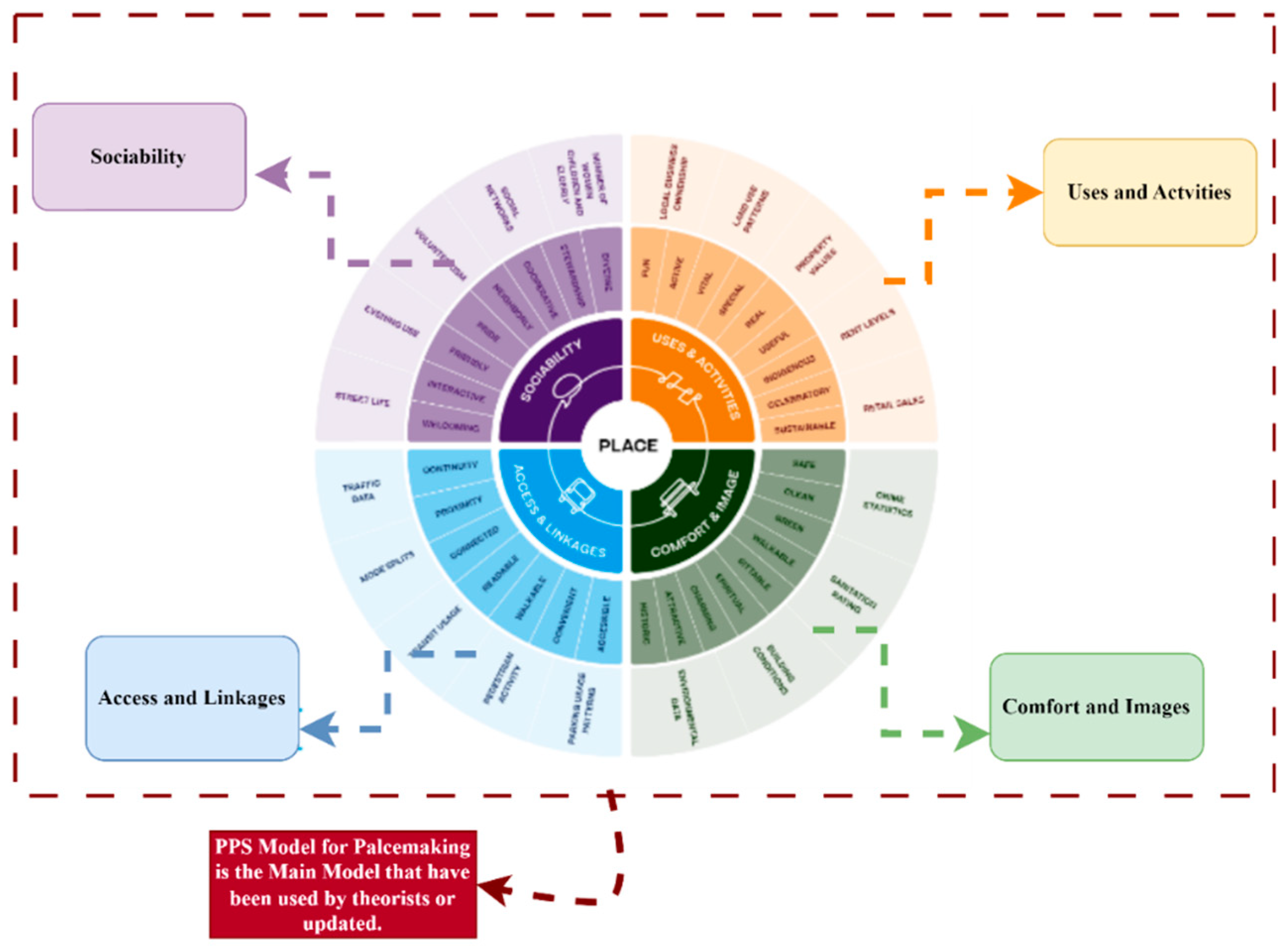
Figure 2.
Dimensional extrapolation, Source: Author
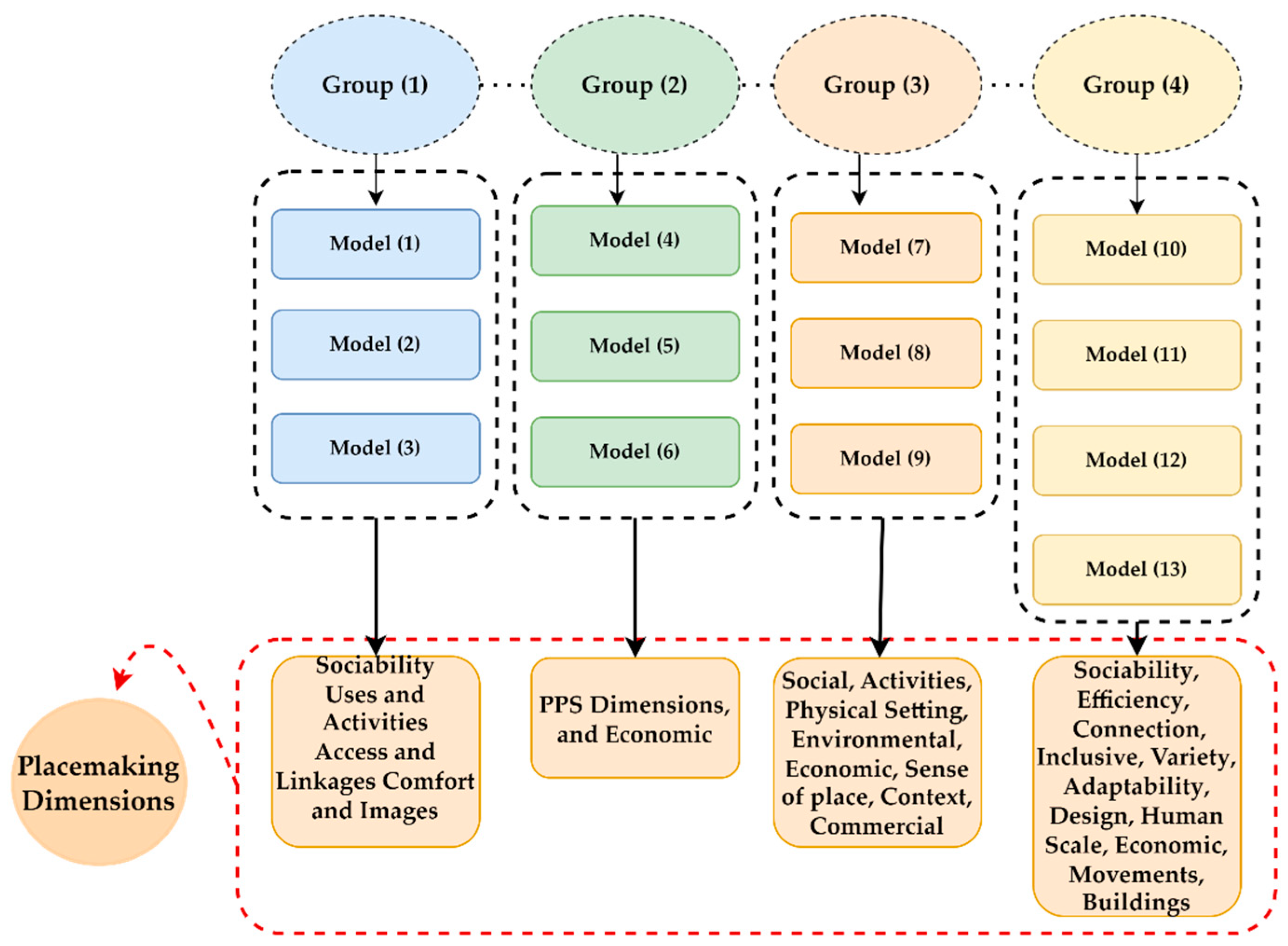
Figure 3.
Placemaking Dimension, Source: [7]
Figure 3.
Placemaking Dimension, Source: [7]
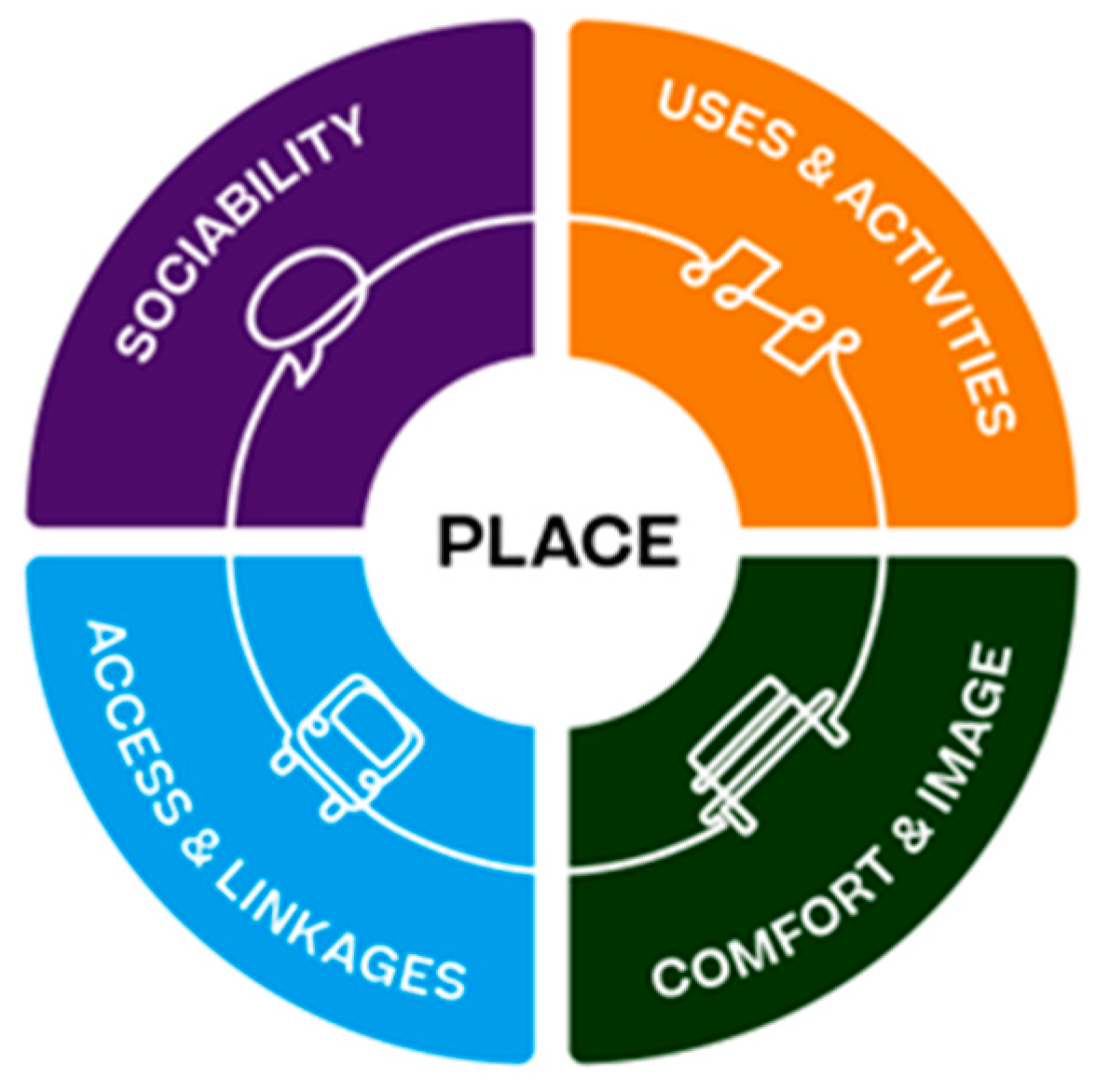
Figure 4.
Source: author.
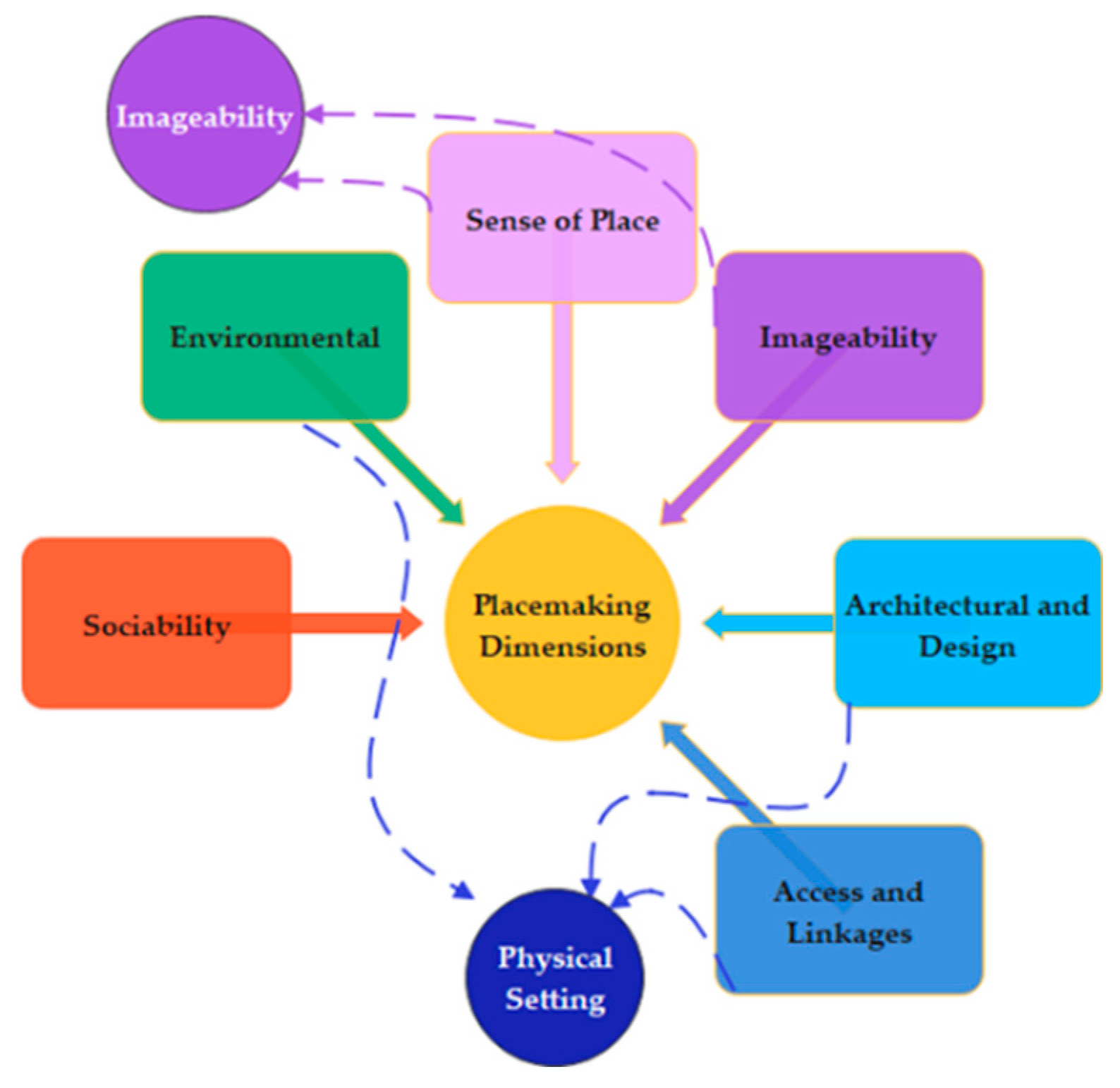
Figure 5.
Component of sense of place.
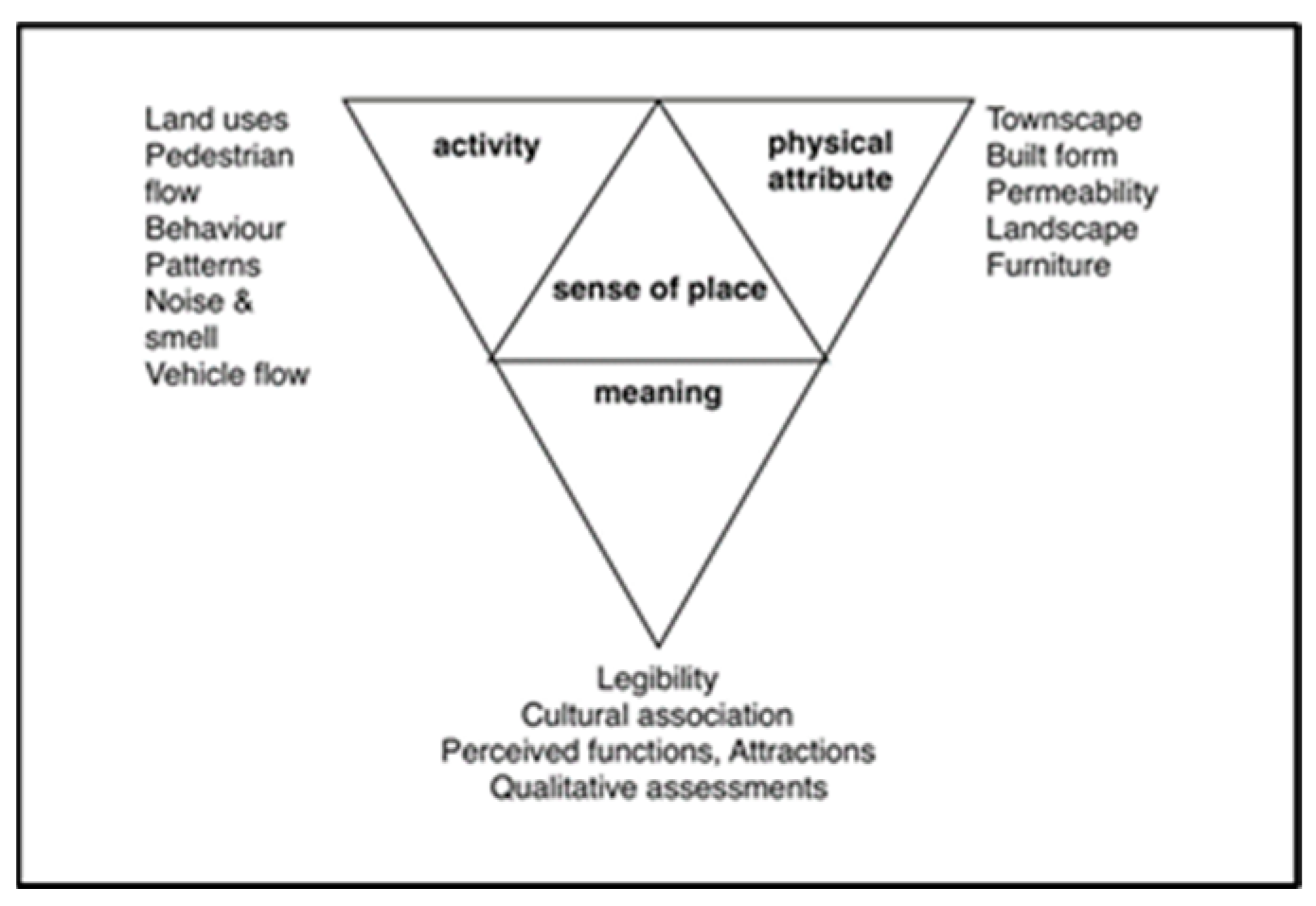
Figure 6.
Canter model, place components.
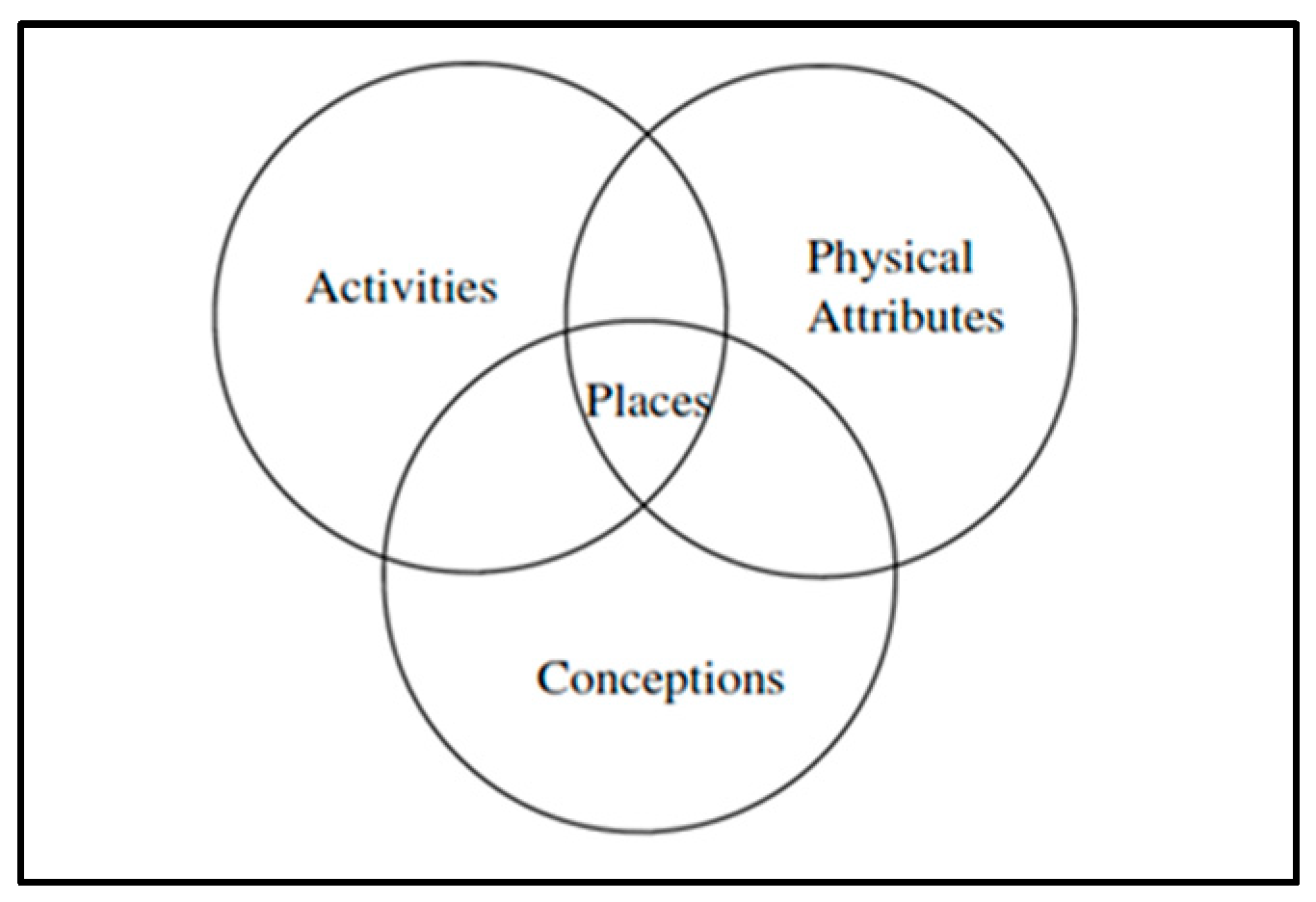
Figure 7.
The Updated Place Component by Montgomery.
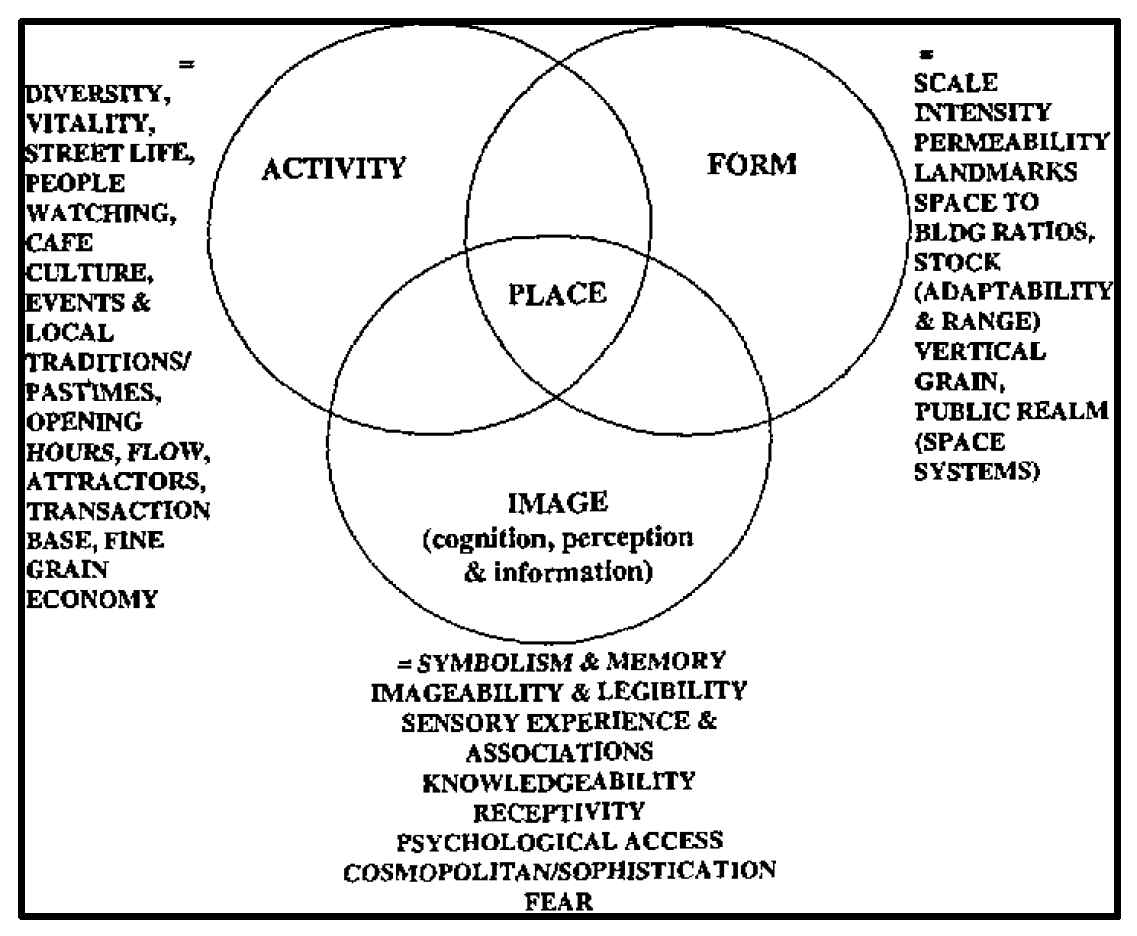
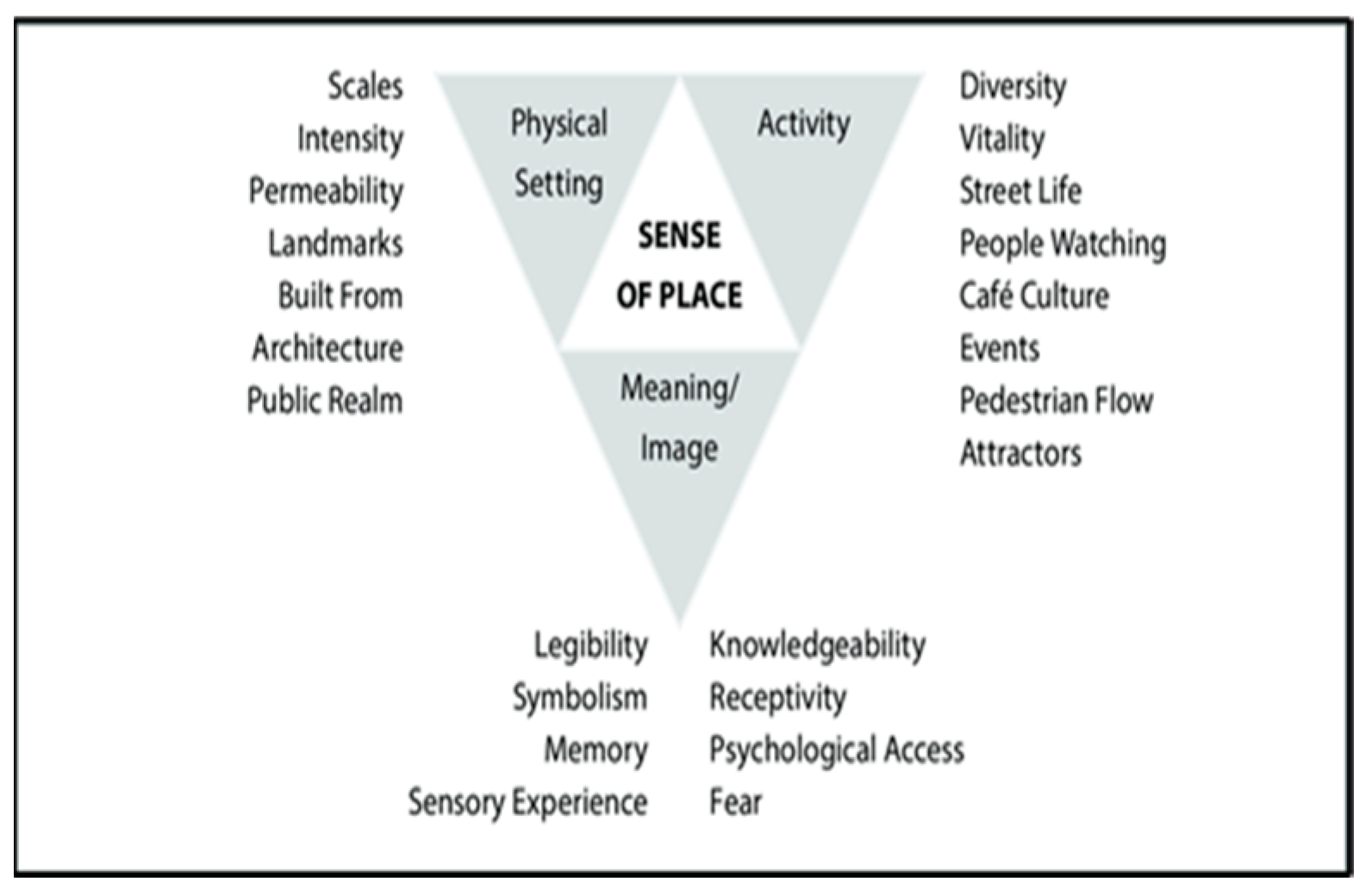
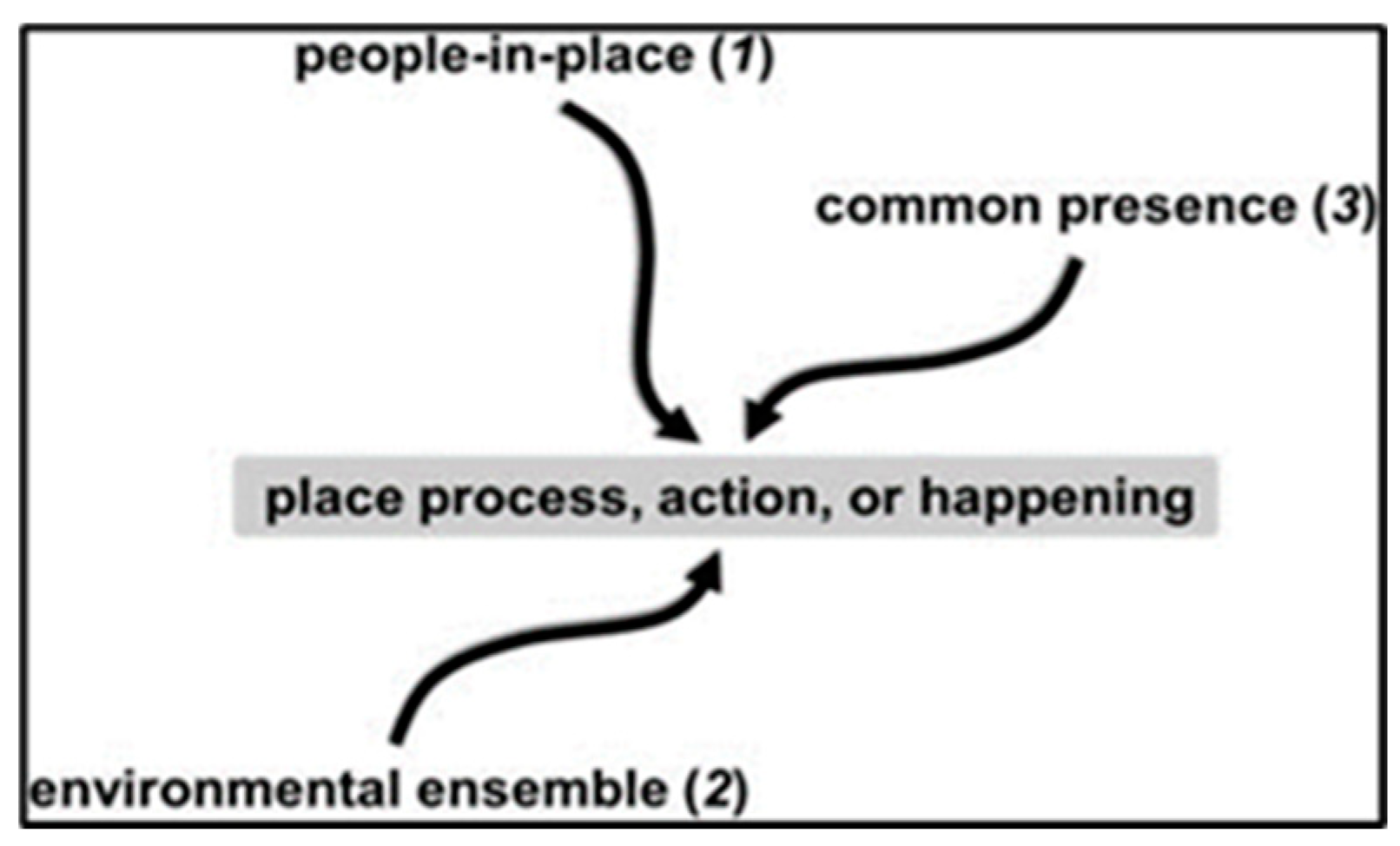
Figure 10.
The Research Steps for extracting dimensions and adopting the new Framework. Source: Author
Figure 10.
The Research Steps for extracting dimensions and adopting the new Framework. Source: Author
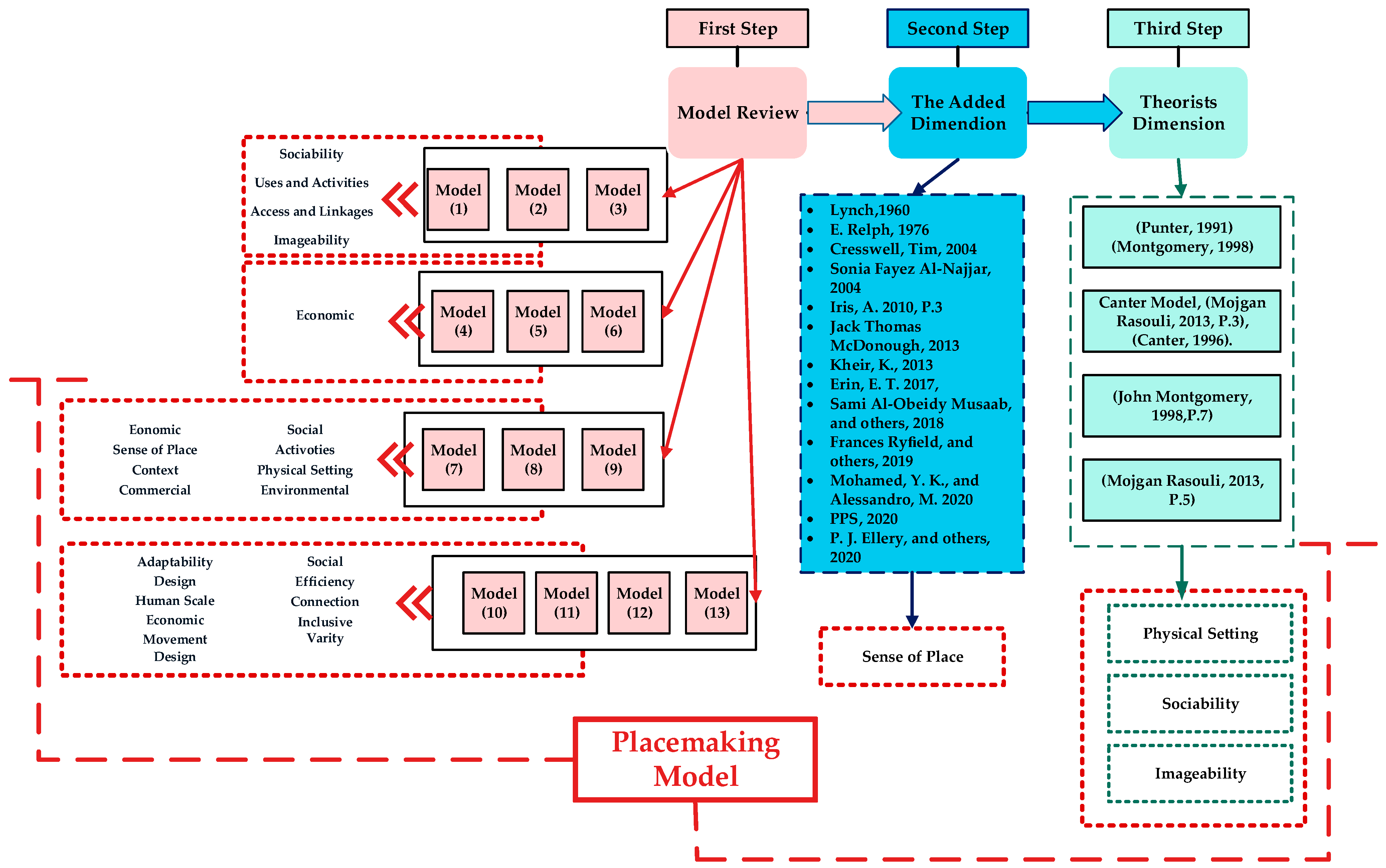
Figure 11.
The Placemaking Model (Theoretical Framework), Source: Author
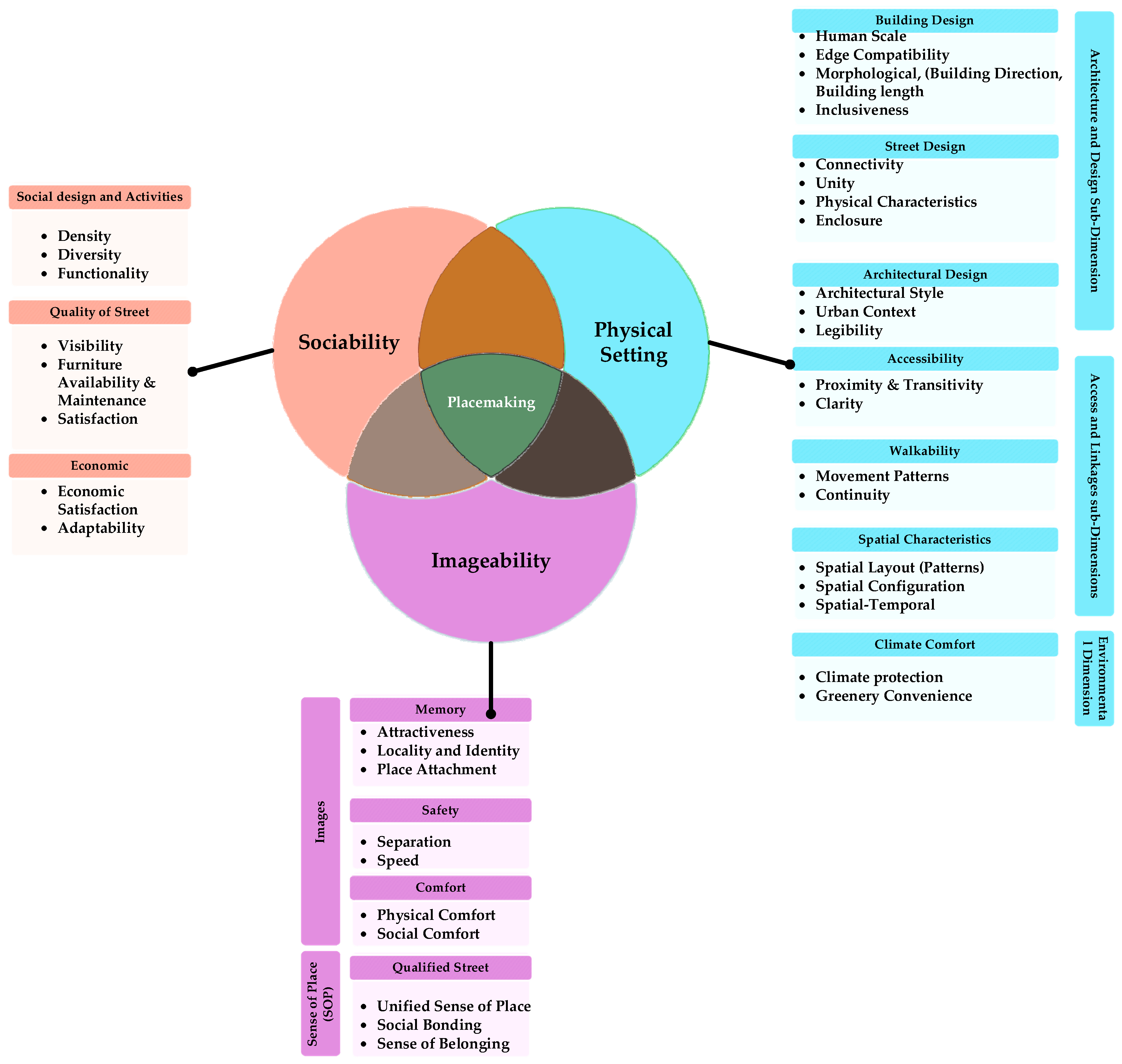
Figure 12.
The three Main Dimensions
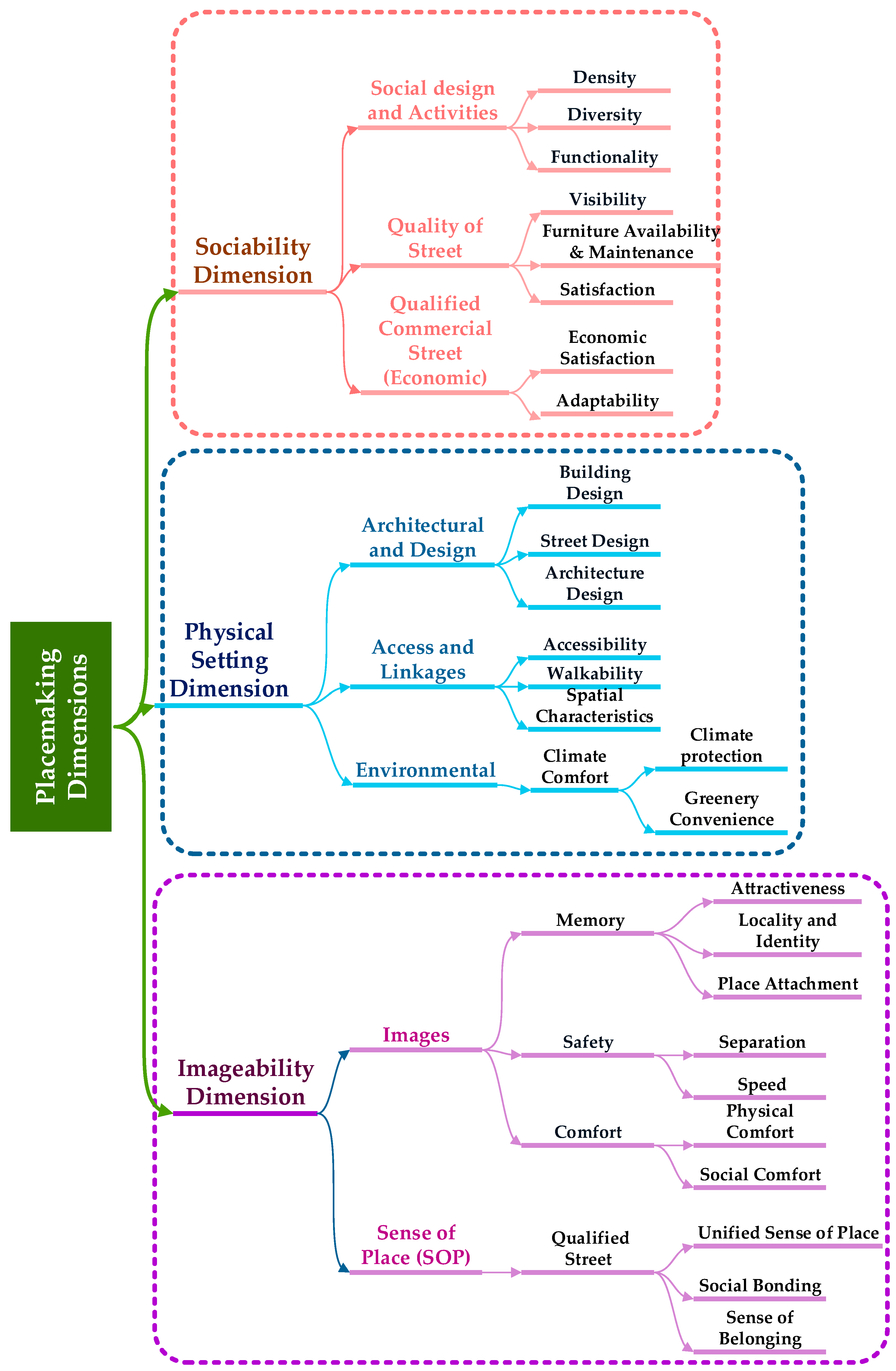
Figure 13.
Comparing the Streets
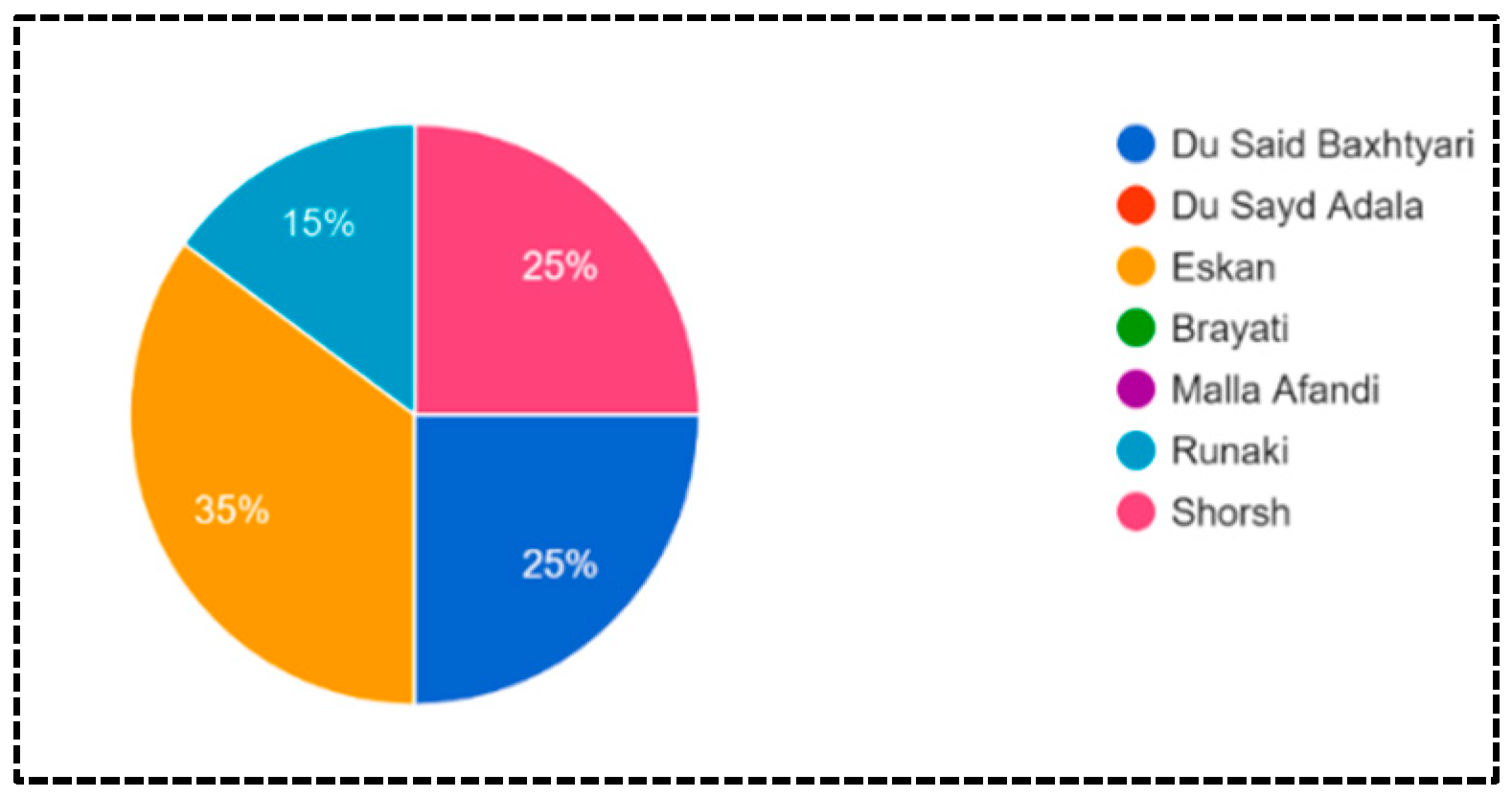
Figure 14.
Reasons for Selecting Eskan Street
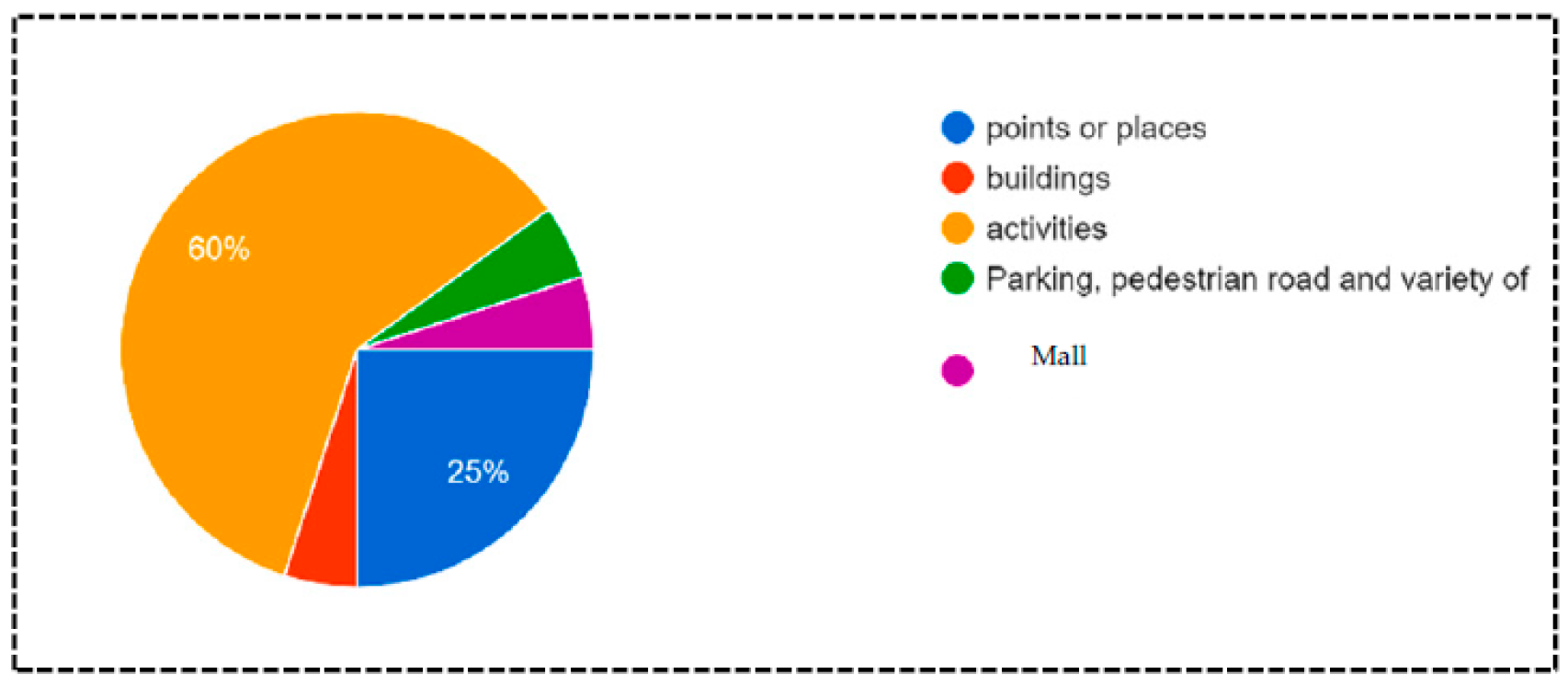
Figure 15.
The Main Land use in Eskan Street
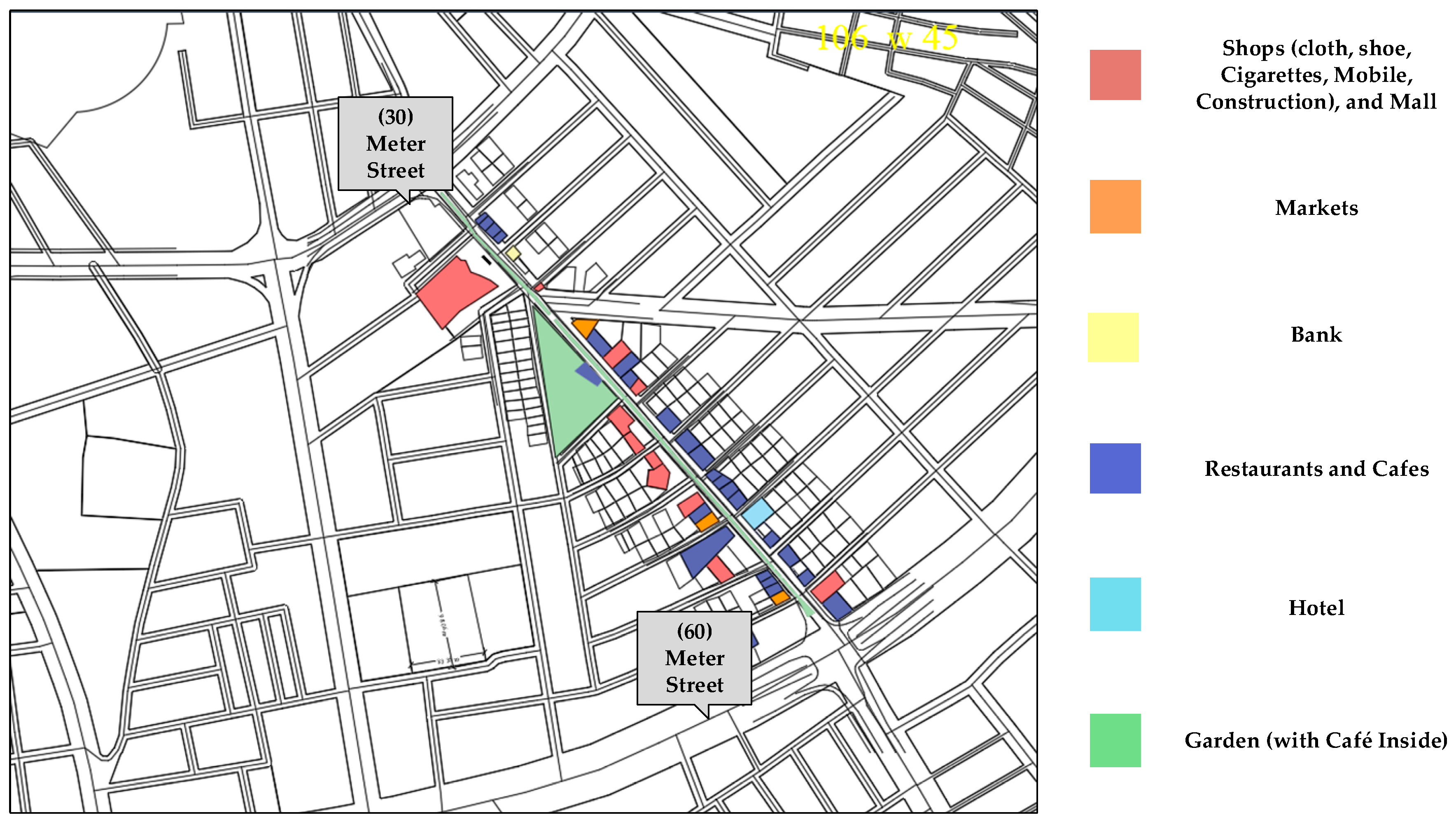
Figure 16.
Important Activities in Eskan street
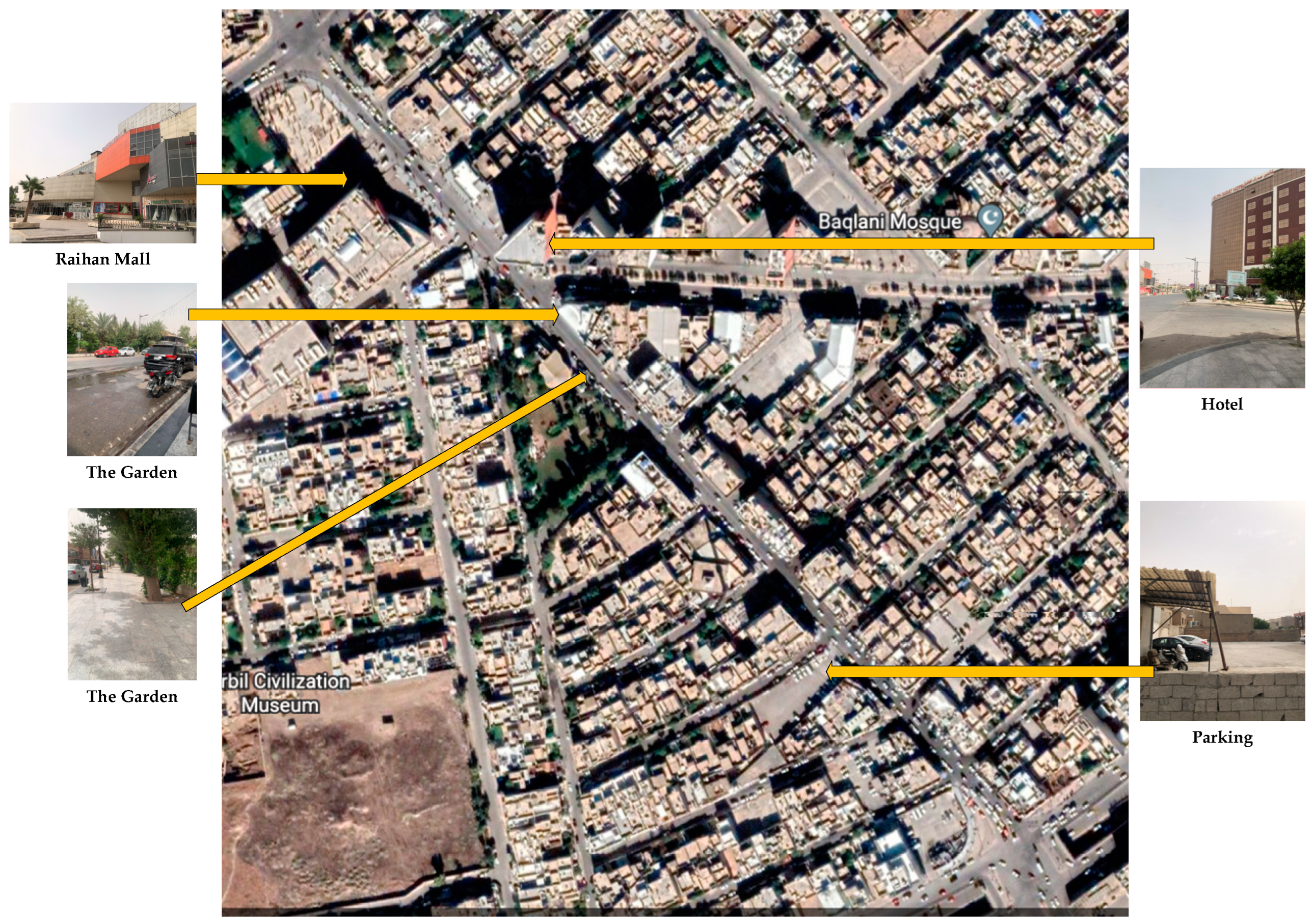
Figure 24.
The Continuous Plinths (elevations at the Ground Level).
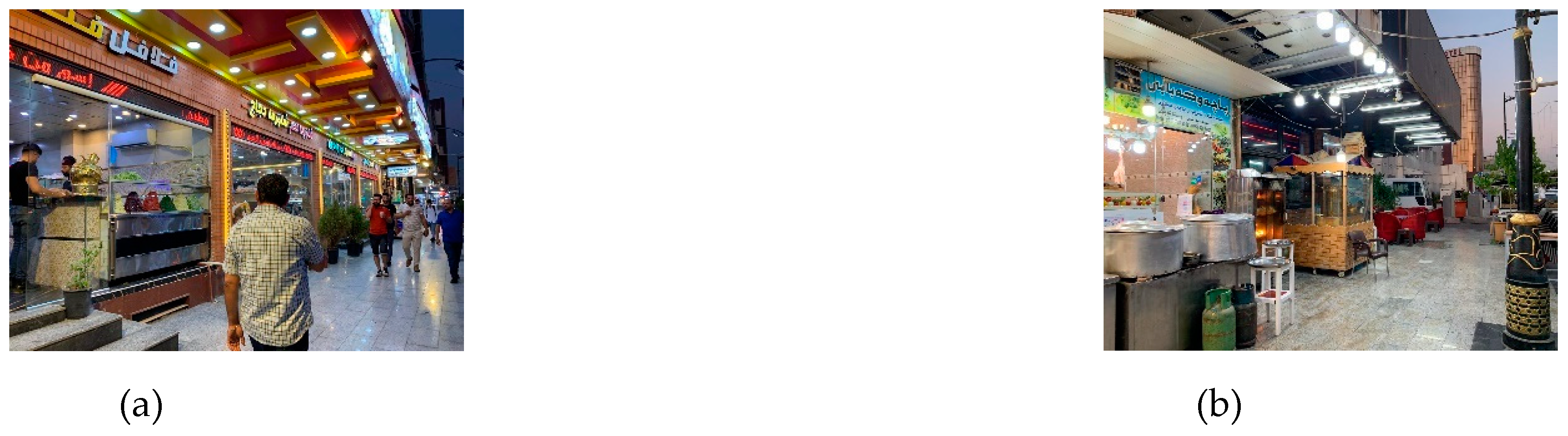
Figure 30.
Building Height on the Street (Mostly Two Floors).
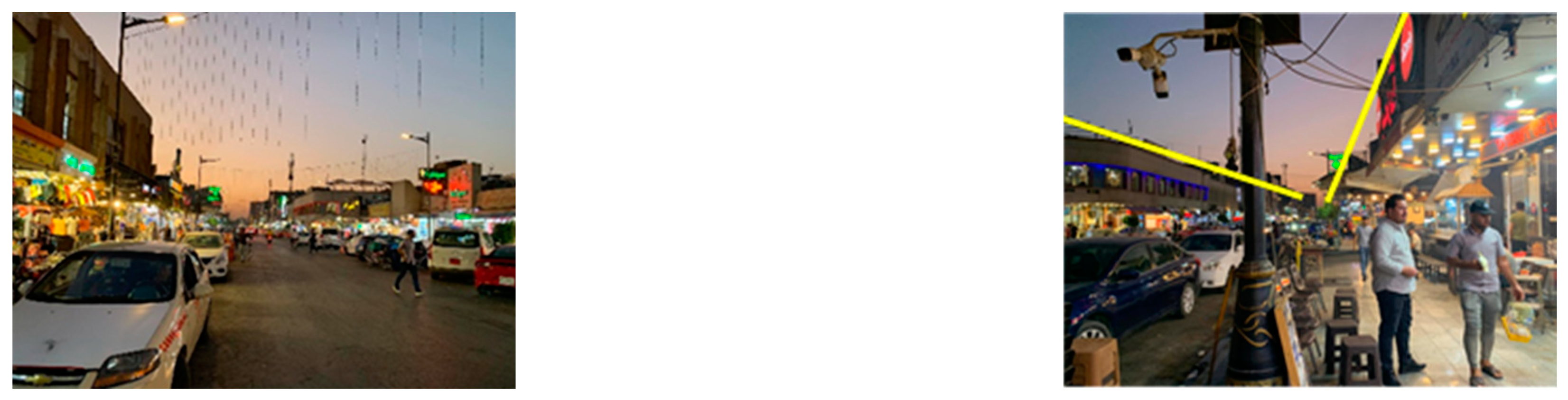
Figure 40.
Architectural styles, elements in the street
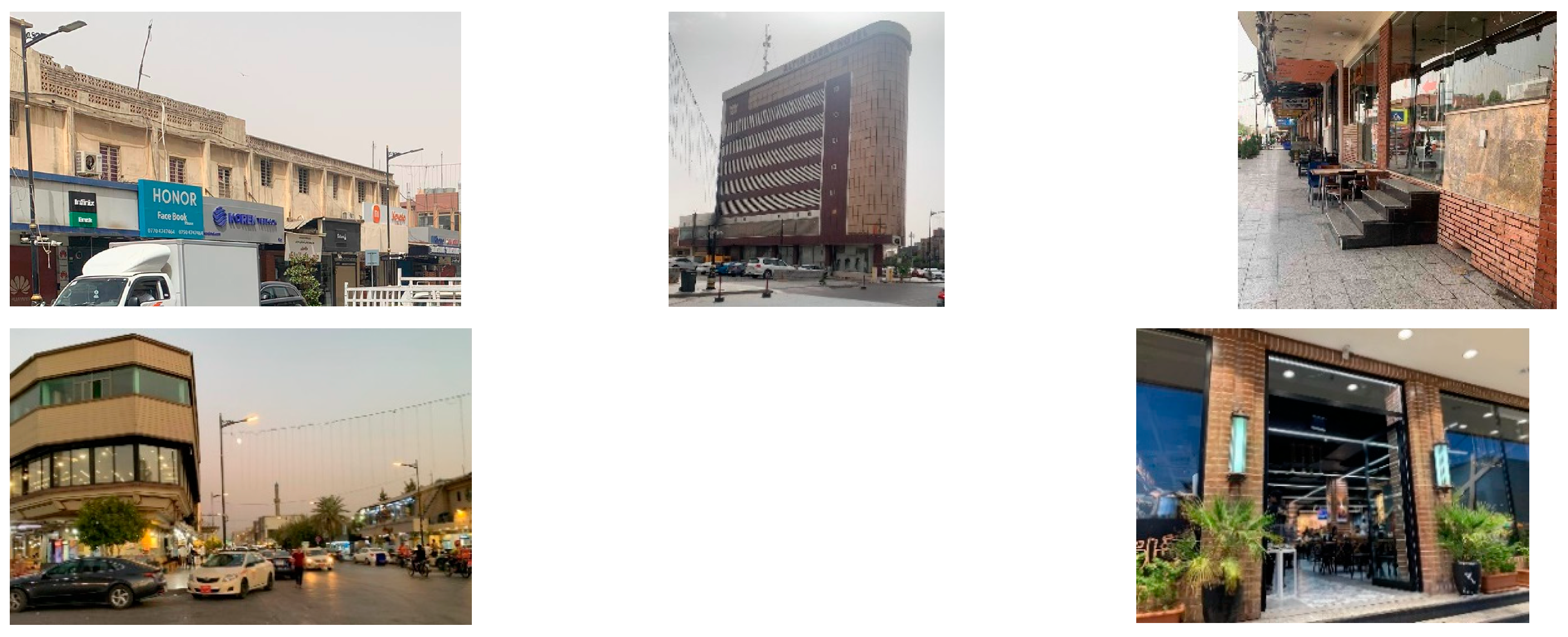
Figure 41.
Sociability Dimensions
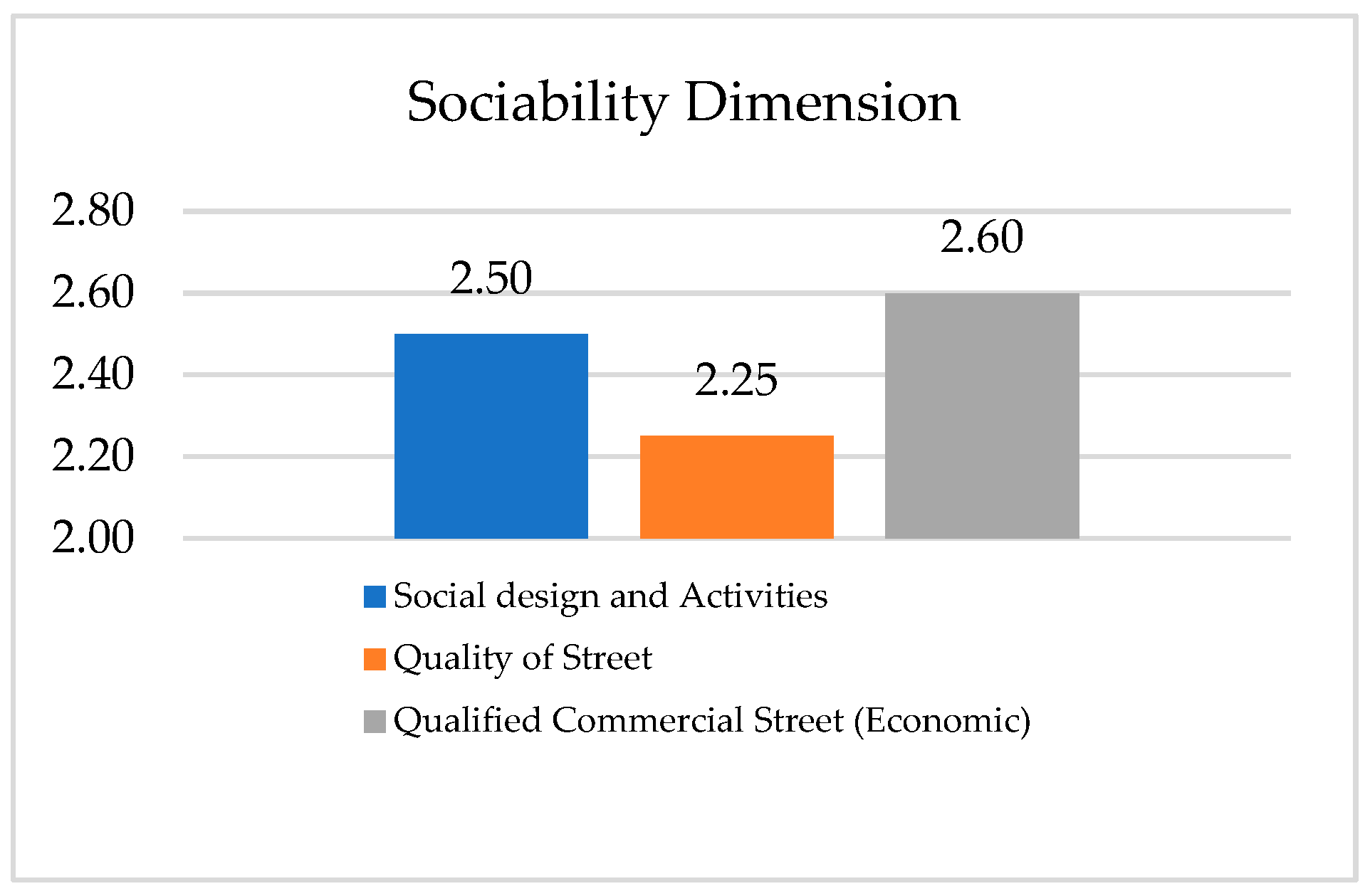
Figure 42.
Sociability Sub-Factors
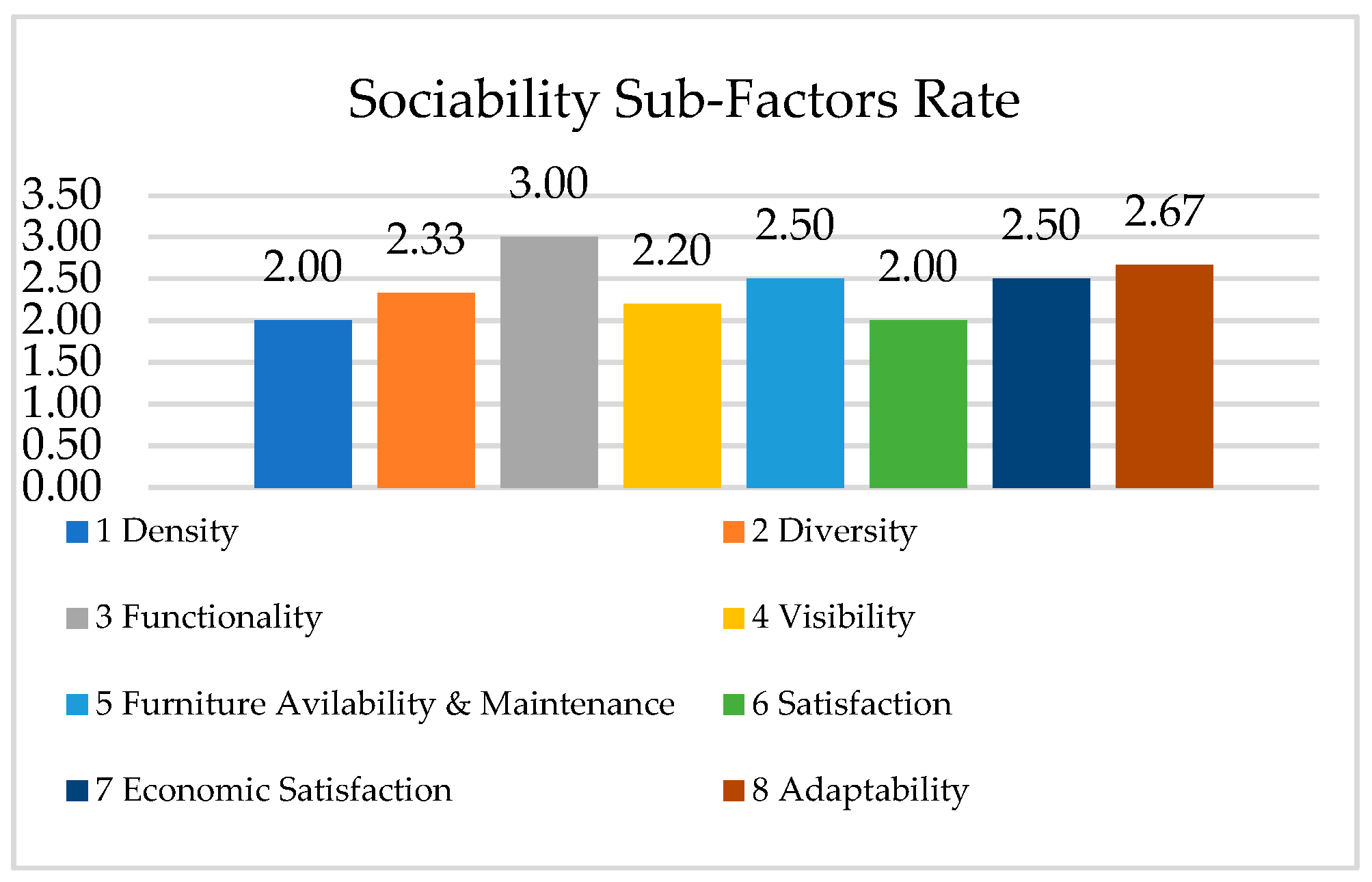
Figure 43.
Physical setting dimensions results
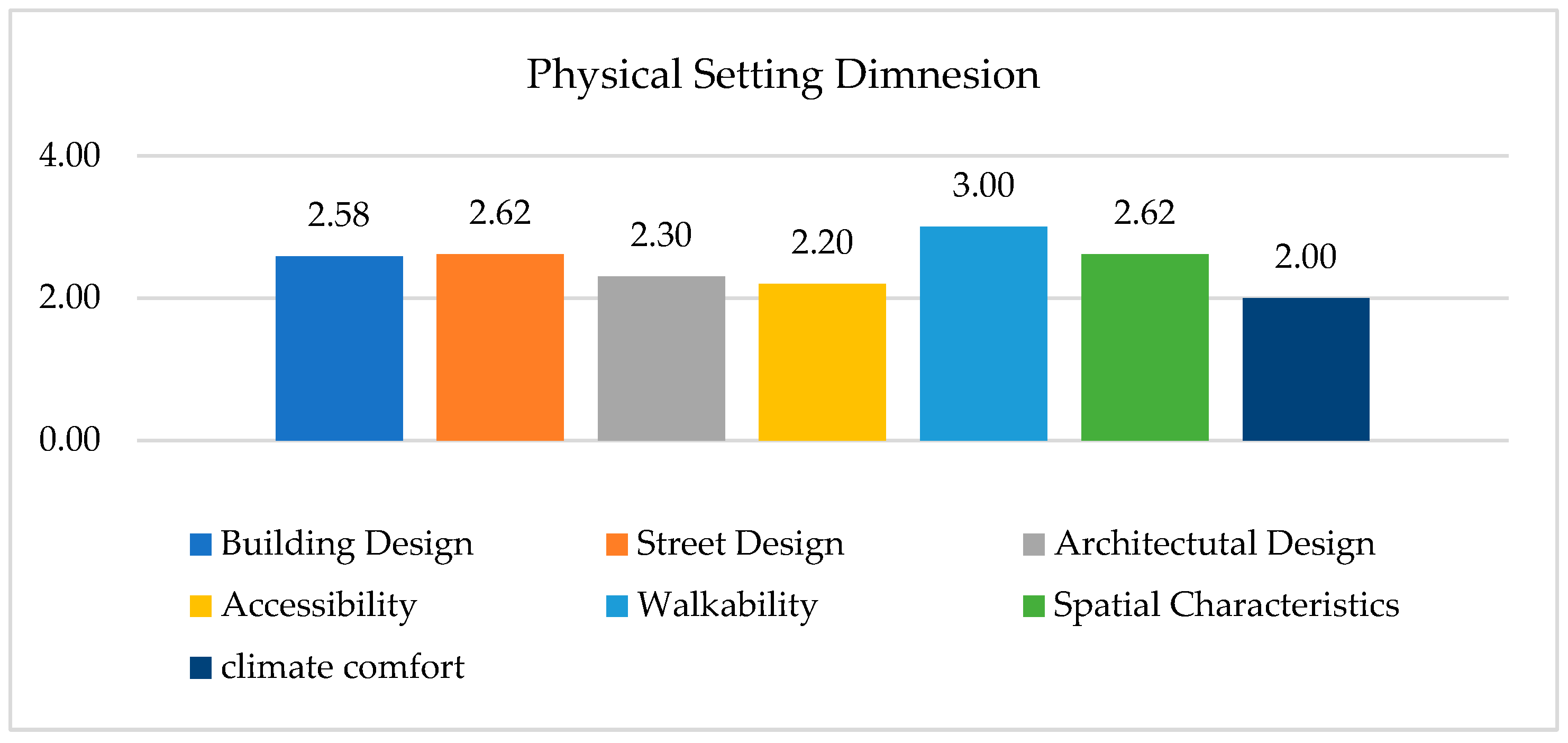
Figure 44.
Physical setting sub-factors results
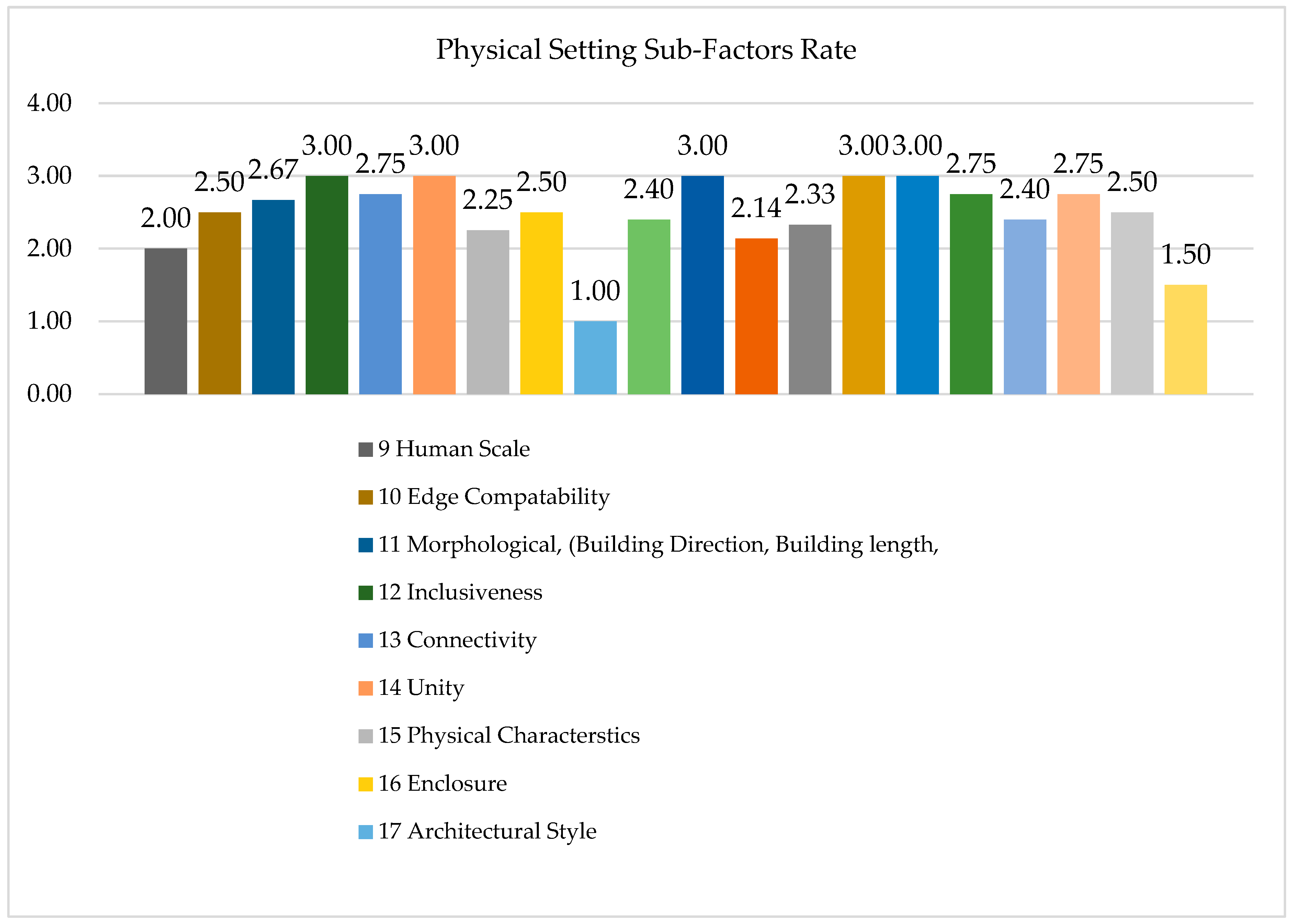
Figure 45.
Imageability Dimensions Rate
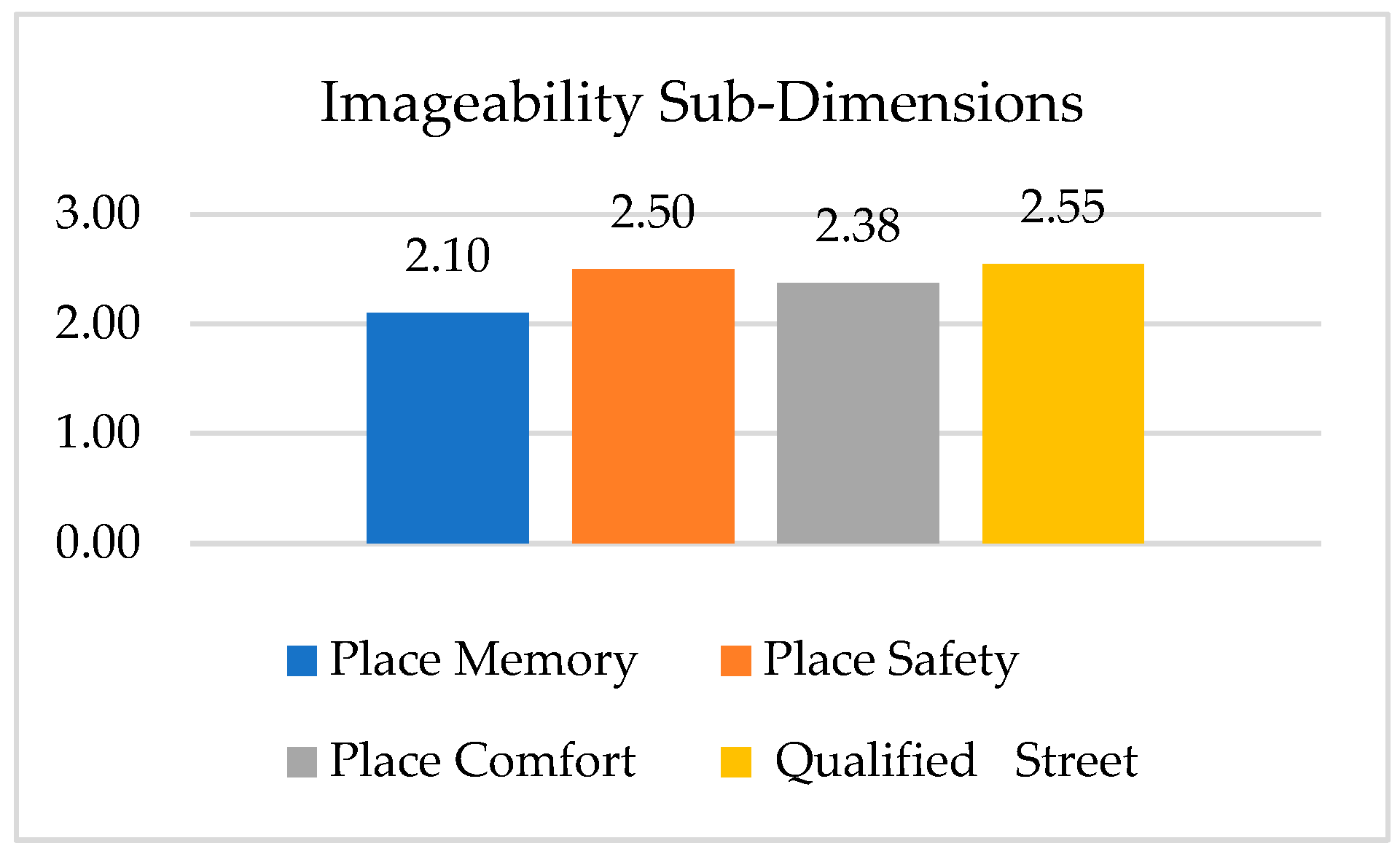
Figure 46.
Imageability Sub-Factors Rate.
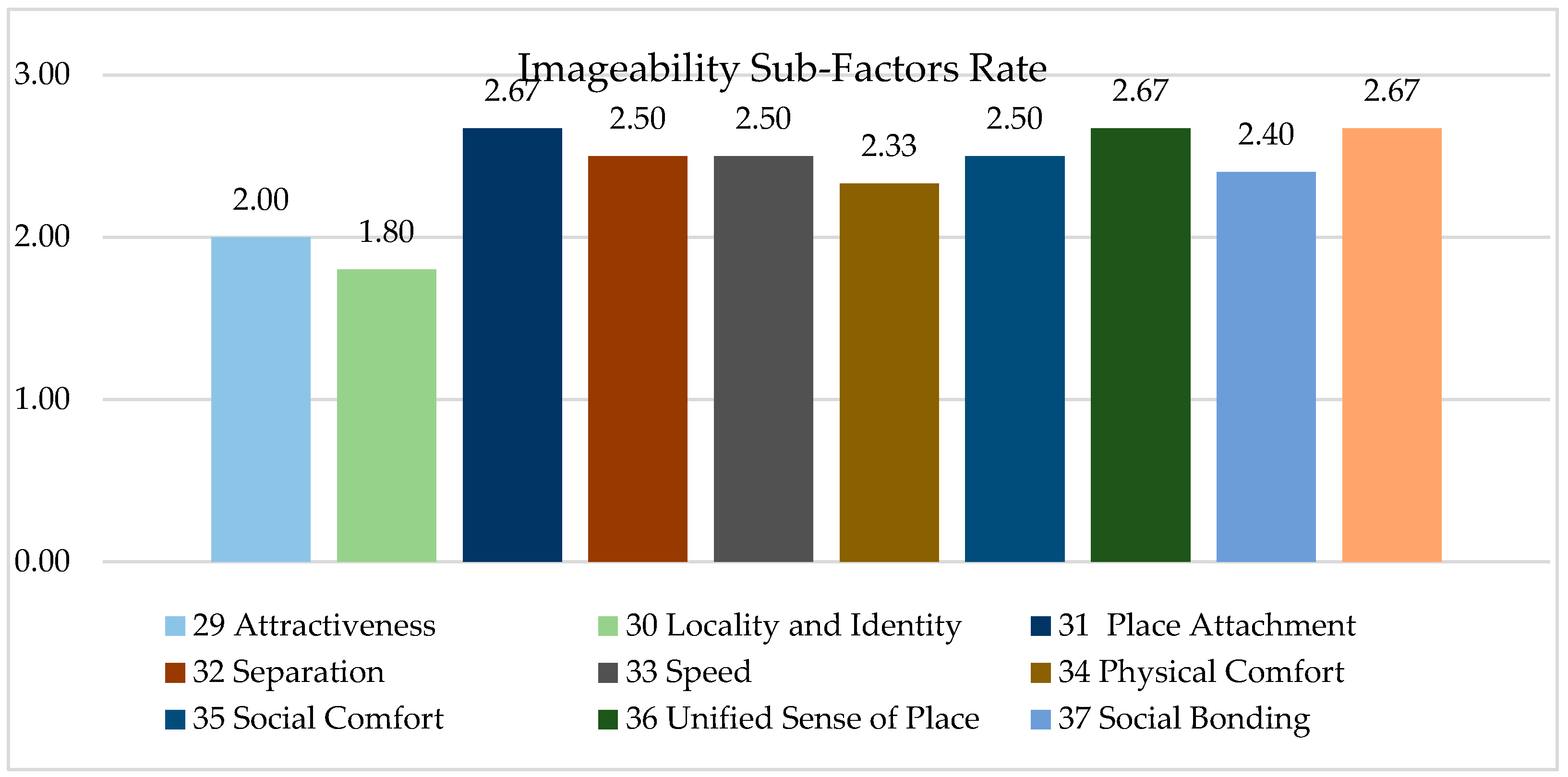
Figure 47.
Sub-Dimensions Average (Mean) For the Questionnaire.
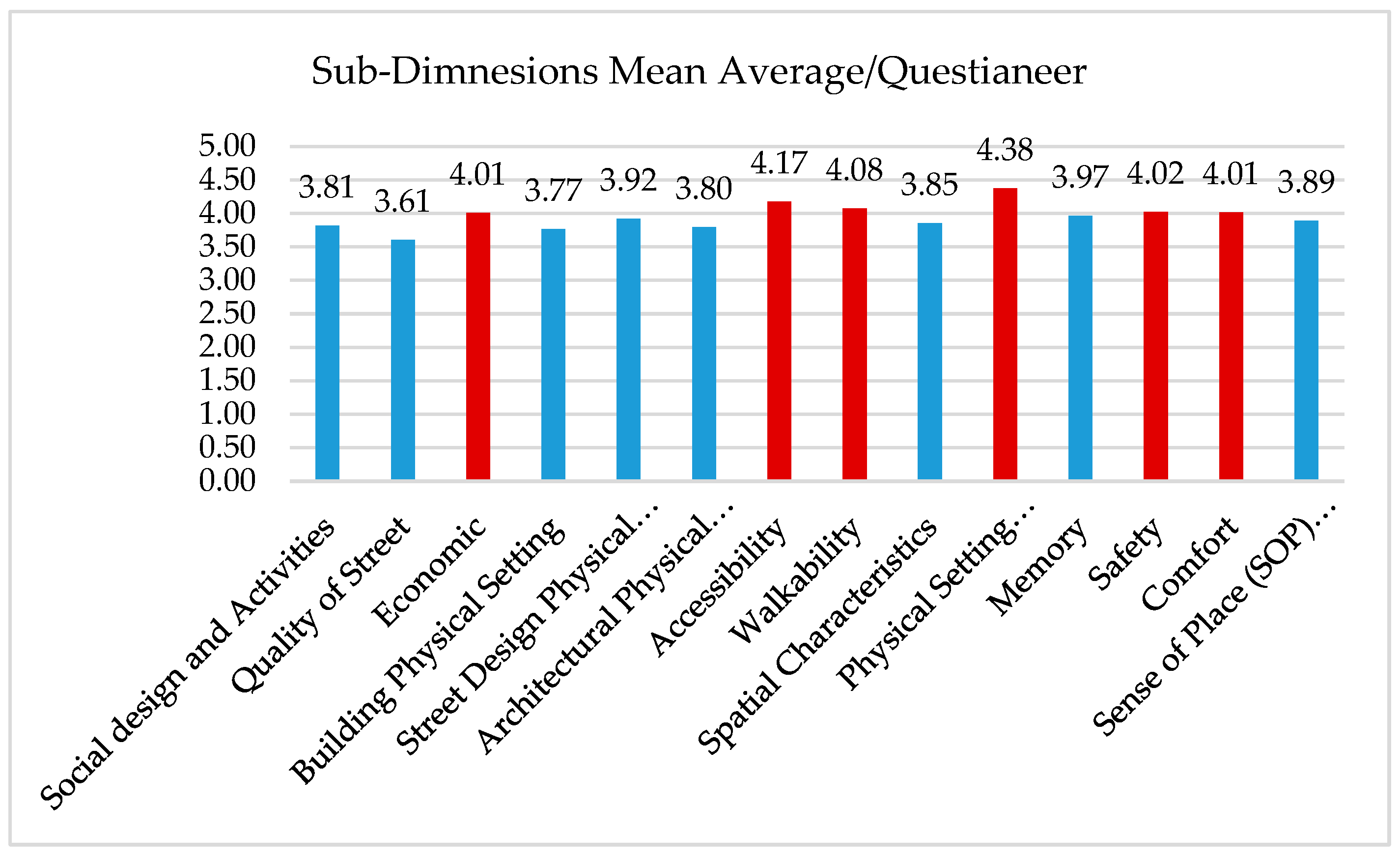
Figure 50.
Sub-Dimensions Comparative
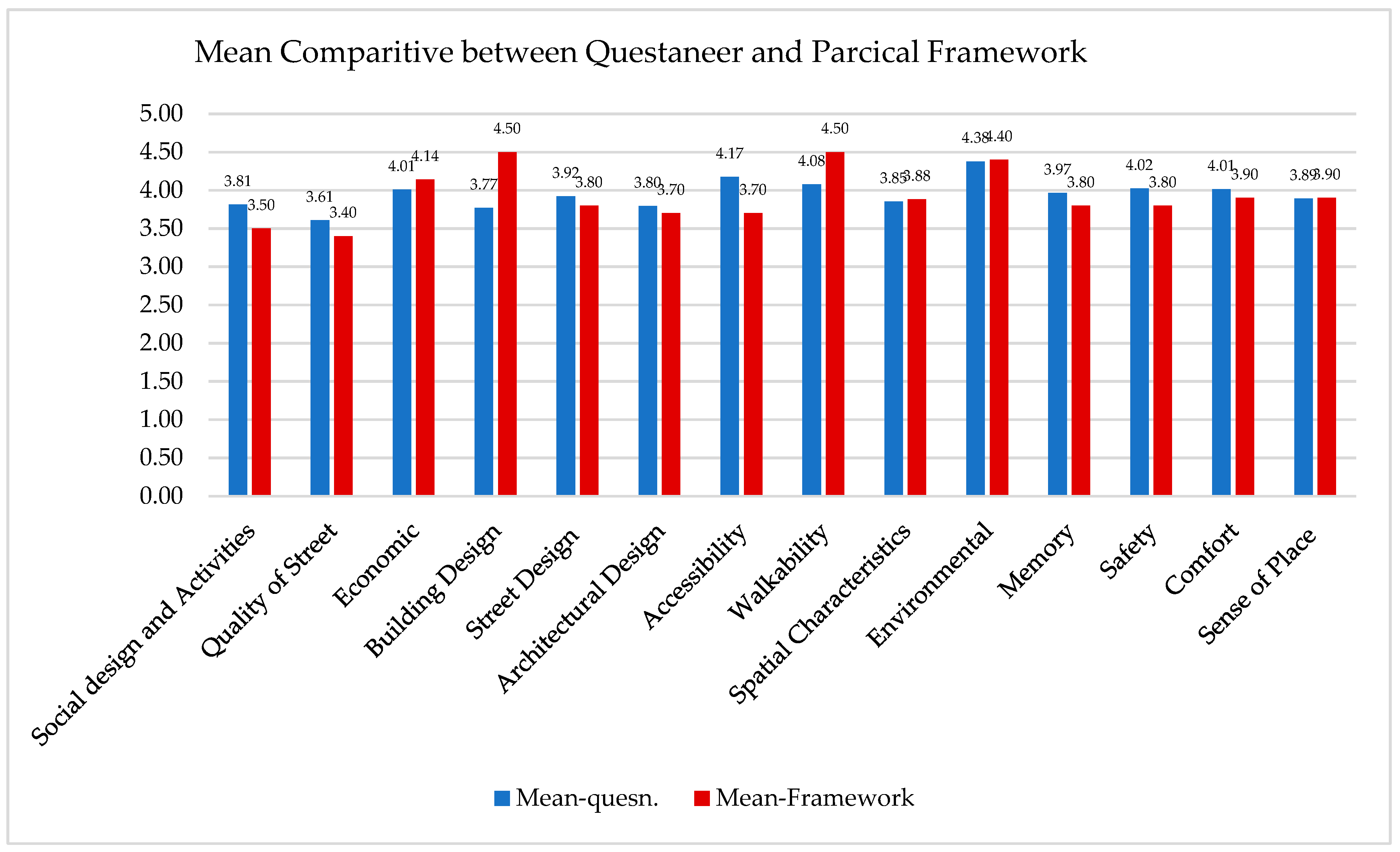
Figure 51.
Placemaking Strategies Applied Percentages in Eskan Street
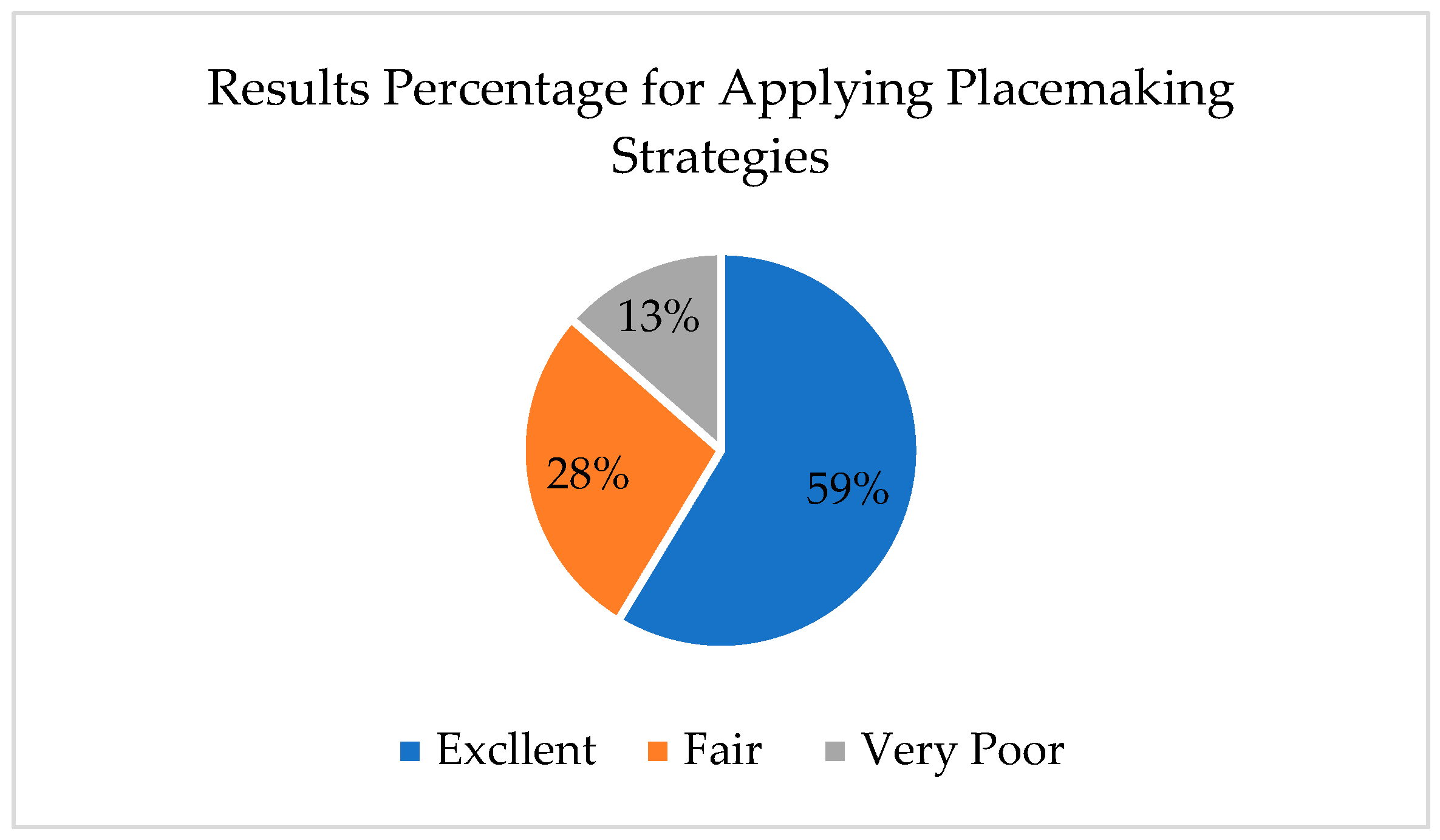
Figure 52.
Methods adopted and results.
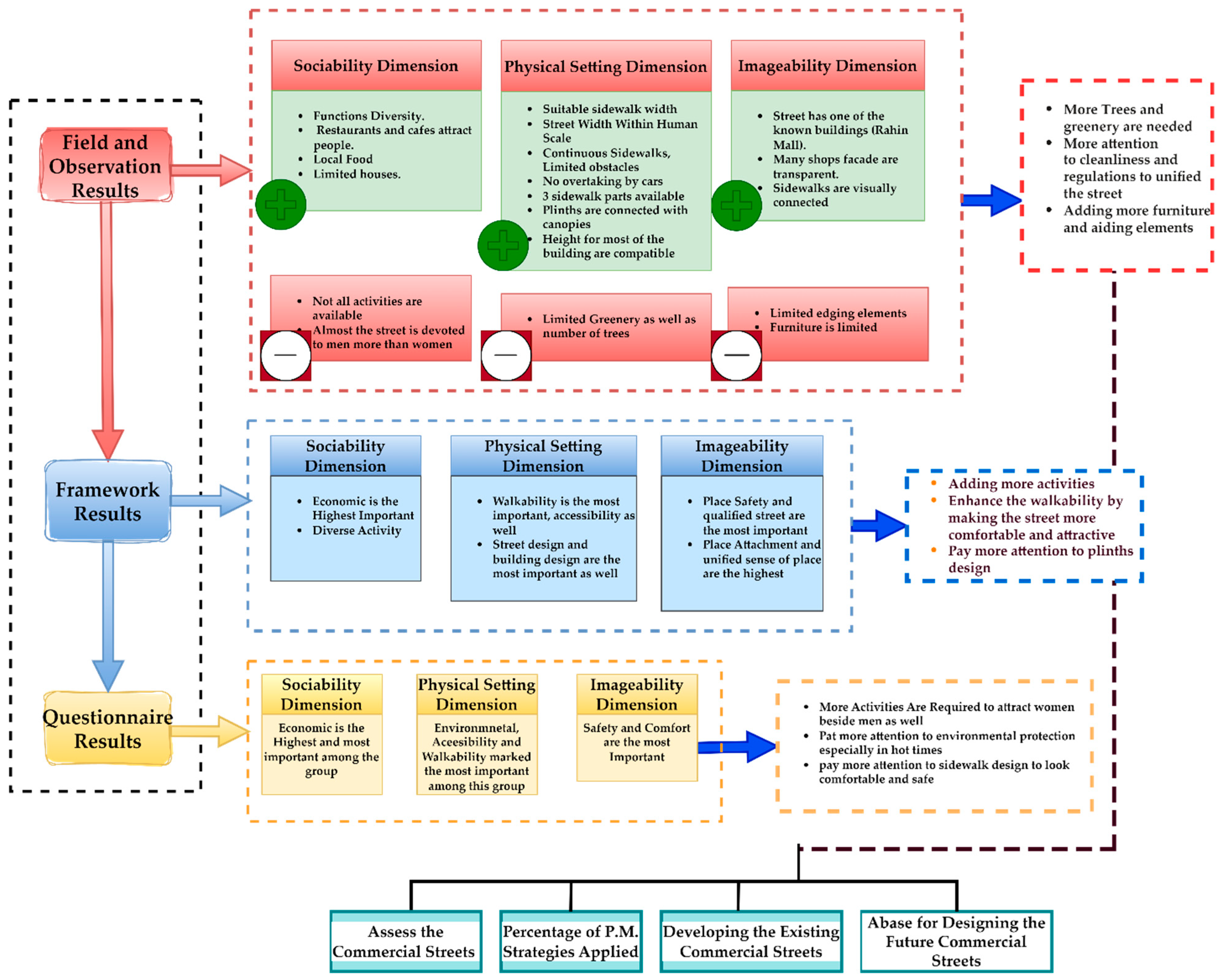
Table 1.
Theoretical Framework, (Dimensions, Factors, and Possible values). Source: Author.
| No. | Dimensions | Factors | Sub-Factors | |
|---|---|---|---|---|
| 1 | Sociability And Diverse Activity Dimension | Social design and Activities | Density | |
| Diversity | ||||
| Functionality | ||||
| Quality of Street | Visibility | |||
| Furniture Availability & Maintenance | ||||
| Satisfaction | ||||
| Economic | Economic Satisfaction | |||
| Adaptability | ||||
| 2 | Physical Setting Dimension | Architectural and Design Sub-Dimension | Building Design | Human Scale |
| Edge Compatibility | ||||
| Morphological, (Building Direction, Building length, | ||||
| Inclusiveness | ||||
| Street Design | Connectivity | |||
| Unity | ||||
| Physical Characteristics | ||||
| Enclosure | ||||
| Architectural Design | Architectural Style | |||
| Urban Context | ||||
| Legibility | ||||
| Access and Linkages Sub-Dimensions | Accessibility | Proximity & Transitivity | ||
| Clarity | ||||
| Walkability | Movement Patterns | |||
| Continuity | ||||
| Spatial Characteristics | Spatial Layout (Patterns) | |||
| Spatial Configuration | ||||
| Spatial-Temporal | ||||
| Environmental Dimension | Sub-Climate Comfort | Climate protection | ||
| Greenery Convenience | ||||
| 3 | Imageability Dimension | Images | Memory | Attractiveness |
| Locality and Identity | ||||
| Place Attachment | ||||
| Safety | Separation | |||
| Speed | ||||
| Comfort | Physical Comfort | |||
| Social Comfort | ||||
| Sense of Place (SOP) | Qualified Street |
Unified Sense of Place | ||
| Social Bonding | ||||
| Sense of Belonging | ||||
Table 2.
Placemaking Framework (Practical Framework) Source: Author
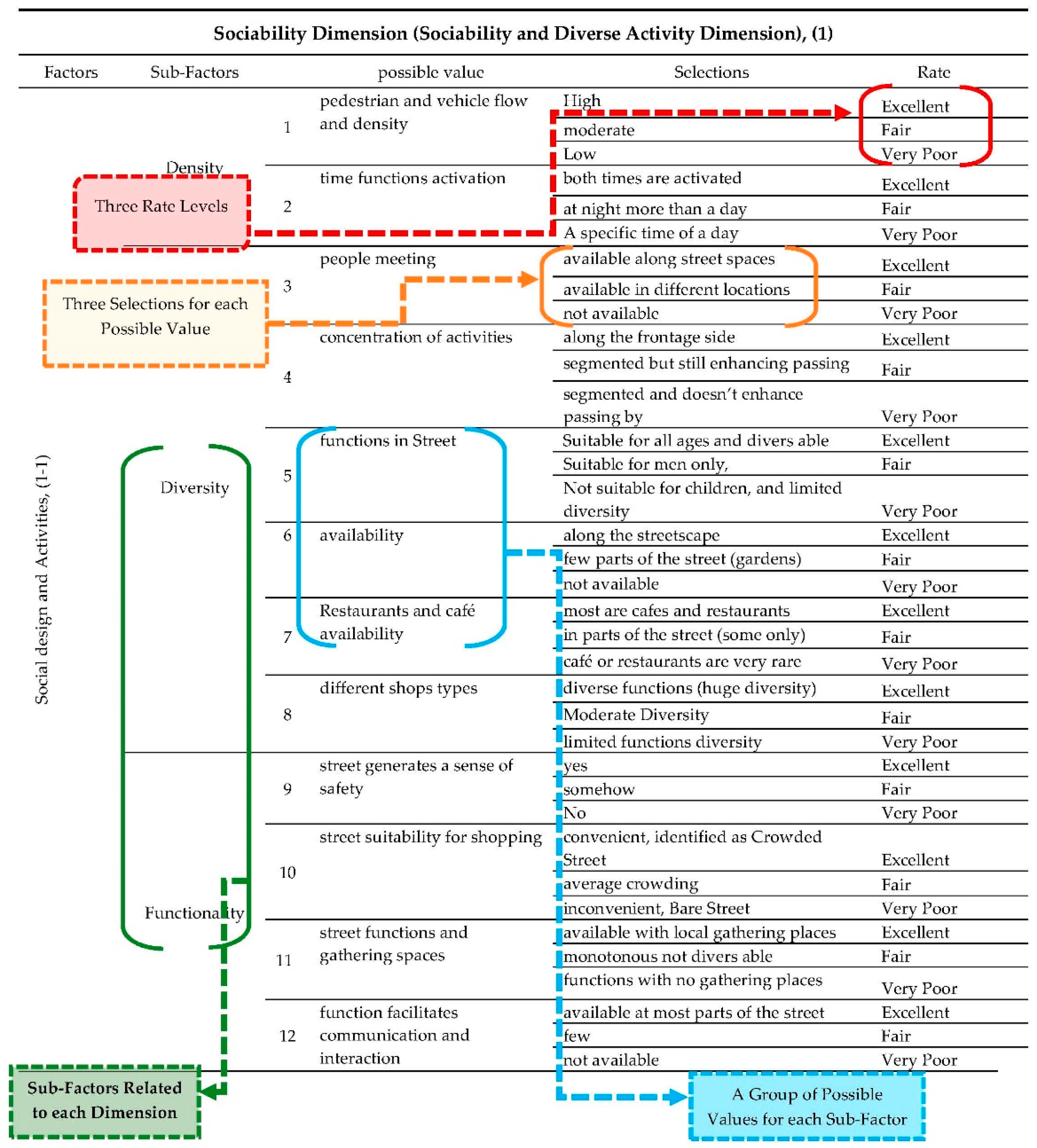 |
Table 3.
Selection List, (Criteria of Selecting Case Study) Source: Author.
| No. | selection items | Sub-Numbers | Characteristics |
|---|---|---|---|
| 1 | location | 1.1 | The selected streets between (Street 30m) and (Street 120m) ring roads. |
| 1.2 | (Street 60 or 100) are not included, while the internal streets link the main traffic circles in Erbil city, connecting two important streets or (the connector roads between circle roads). | ||
| 1.3 | The street falls within the framework of commercial streets that have developed over the years. | ||
| 1.4 | people identified this street as a commercial street. | ||
| 2 | social characteristics | 2.1 | A clear density of pedestrians on the sidewalks of these streets. |
| 2.2 | Functional diversity in activities and services is clear. | ||
| 2.3 | Provides some activities of economic attraction. | ||
| 2.4 | Providing the daily needs of people. | ||
| 2.5 | Each selected sample must have a sidewalk at least allows the passage of 2 people. | ||
| 2.6 | The commercial street includes some activities that provide places to sit and rest. | ||
| 3 | commercial approach | 3.1 | The ground floor is dedicated to commercial activities. |
| 3.2 | should be mixed-use activities, (diversity). | ||
| 3.3 | The possibility of shopping in the street. | ||
| 3.4 | The streets include a mixture of formal and informal shops | ||
| 4 | Architectural feature | 4.1 | some important buildings available within street spaces |
| 4.2 | The presence of common spaces within the commercial street space | ||
| 4.3 | At least one or two types of street furniture are present in the selected samples | ||
| 4.4 | Street height and width are convenient or (in acceptable proportion) | ||
| 5 | street type | 5.1 | The street should be either the type of shared street or integrated activities |
| 5.2 | Being a Minor Streets type where this size will provide spatial enclosure within the three dimensions | ||
| 5.3 | Specified within the commercial street from the municipality | ||
| 5.4 | Collector street, between two main rings in Erbil city | ||
| 6 | sizes & dimensions (physical Attributes) | 6.1 | street length is between (600-2000) m |
| 6.2 | The sidewalk’s dimensions are similar. | ||
| 6.3 | The height of the buildings on both sides is no more than 10 floors | ||
| 6.4 | There are designated places for pedestrians to cross between both sides of the street | ||
| 6.5 | The width of the street is between (20-50) meters, and there are at least two lanes on each side, back and forth |
Table 4.
The sequence of selecting the Case Study
| Erbil Sectors | No. of Connector Roads | Road Connector width (30-60 m) | Length (500-2000) | Connectors specified as a Commercial | Changed from Commercial to Another function | Changed to Commercial | Street Name | No Colleges or Universities | Functions Compatible with Research need | |
|---|---|---|---|---|---|---|---|---|---|---|
| Sector-2 | 15 | 12 | 4 | 7 | 0 | 0 | 7 | Eskan | 0 | 1 |
| Sector-3 | 4 | 4 | 4 | 4 | 0 | 0 | 4 | Shorsh | 0 | 1 |
| Sector-4 | 6 | 5 | 5 | 2 | 0 | 1 | 3 | Bryati | 0 | 1 |
| Sector-5 | 4 | 4 | 4 | 3 | 0 | 1 | 4 | Malla Afandi | 0 | 1 |
| Sector-6 | 3 | 3 | 3 | 0 | 0 | 1 | 1 | Runaki | 2 | 1 |
| Sector-7 | 4 | 4 | 3 | 1 | 0 | 2 | 3 | Adalla | 1 | 1 |
| Sector-8 | 3 | 3 | 2 | 1 | 0 | 0 | 0 | Nawroze | 0 | 0 |
| Sector-9 | 4 | 4 | 4 | 2 | 1 | 1 | 3 | Baxhtyari | 0 | 1 |
| Sector-10 | 2 | 2 | 2 | 1 | 0 | 1 | 2 | Ainkawa | 0 | 0 |
| Total Street Number | 45 | 41 | 31 | 21 | 1 | 7 | 27 | 3 | 7 | |
Disclaimer/Publisher’s Note: The statements, opinions and data contained in all publications are solely those of the individual author(s) and contributor(s) and not of MDPI and/or the editor(s). MDPI and/or the editor(s) disclaim responsibility for any injury to people or property resulting from any ideas, methods, instructions or products referred to in the content. |
© 2023 by the authors. Licensee MDPI, Basel, Switzerland. This article is an open access article distributed under the terms and conditions of the Creative Commons Attribution (CC BY) license (http://creativecommons.org/licenses/by/4.0/).
Copyright: This open access article is published under a Creative Commons CC BY 4.0 license, which permit the free download, distribution, and reuse, provided that the author and preprint are cited in any reuse.


