
Submitted:
16 March 2023
Posted:
20 March 2023
Read the latest preprint version here
Preprints on COVID-19 and SARS-CoV-2
Abstract
In the wake of the Covid-19 crisis, a need has arisen to prevent and treat two related conditions, Covid vaccine injury and long Covid, both of which have a significant vascular component. Therefore, the management of these conditions require the development of strategies to prevent or dissolve blood clots and restore circulatory health. This review summarizes the evidence on strategies that can be applied to treat both long and vaccine injuries based on similar mechanisms of action.
Keywords:
Long Covid
; Covid-19 vaccine
; thrombosis
; clots
; inflammation
; therapeutics
1. Introduction
According to available data, by September 30, 2022, 68% of the world’s population had received at least one dose of the Covid-19 vaccine, and 12.74 billion doses had been administered [1]. The vaccines most commonly administered were Comirnaty (Pfizer/BioNTech), Covishield (Astrazeneca), CoronaVac (Sinovac), Spikevax (Moderna), Jcovden (Johnson & Johnson) [2]. Of these, approximately 30% of the doses produced by January 22, 2022 were in the form of a novel vaccine with a synthetic N1-methyl-pseudoiridinylated mRNA encapsulated in a lipid nanoparticle (LNP) [3].
LNPs are a new technology that was not used in vaccine delivery until the emergency use authorization (EUA) of the Pfizer/BioNTech BNT162b2 and Moderna mRNA-1273 Covid vaccines [4]. This was also unprecedented in the approval process being the fastest for any vaccine [5], leaving many concerns over long-term safety [6], which was difficult to evaluate due to the unblinding of the initial clinical trials [7].
Whilst the delivery technology of LNPs have previously been used to deliver small molecules, it has only recently been used to deliver RNA. LNPs are advantageous for targeting brain tissue, as they can cross the blood-brain barrier (BBB) [8,9]. The first drug used and LNP to deliver RNA was a small interfering RNA (siRNA)-based drug, known as Onpattro (Alnylam Pharmaceuticals) first approved in 2018 for the treatment of polyneuropathies [10].
Given both the novelty of the technology and the paucity of data on which approval was based (which was also subject to data integrity issues [11]), long-term effects cannot be definitively ruled out, especially because many of the foundational claims on which approval was based have been contested by recent experiments [12,13,14]. For example, in contrast to claims that the injection stayed at the injection site [15], and that spike protein would only be expressed for a short period of time (based on the lability of non-pseudoiridynlated RNA [16]), the contents and products of the Covid vaccines have been found in the blood stream of most vaccinees studied within hours to days [12].
The first claim was based on intramuscular administration [15], and the second claim was based on the lability of RNA [17], with a typical RNA half-life of minutes [18]; however, biodistribution studies have found significant expression of spikes in other tissues and organs [12], and researchers have found both vaccine mRNA and spike protein (which is encoded by the vaccine sequence) two months post-administration [14], and even up to four months post-vaccination [13]. One preprint study of people with SARS-CoV-2 negative post-vaccination Long COVID-like symptoms showed spike protein persistence on average 105 days post vaccination [19]. Long COVID patients (post SARS-CoV-2 infection) show spike protein persistence up to 15 months [20]. Another study showed spike protein persistence in the gut of long Covid patients, but not in the bloodstream.
Spike proteins can be packaged in exosomes [13], possibly resulting in inflammation and immune activation [21,22] in organs and tissues distant from the injection site [13]. Extracellular vesicles are capable of crossing the blood brain barrier [23], and LNPs as well as exosomes will exchange more readily in small diameter vessels with low flow rates (i.e., capillaries and small vessels) [24]. Importantly, the spike protein seems to additionally impact blood-brain barrier permeability [25,26]. These results challenge the initial mechanistic foundation on which the presumption of safety is contingent.
Compared with other vaccines, Covid-19 vaccines have a much higher adverse event rate [27]. Histopathological findings and autopsies of those dying post-vaccination support the causative role of the vaccine in deaths [28], most commonly from vascular-related events. Pharmacovigilance programs in several countries have observed a safety signal for myocarditis in the Covid-19 vaccinated population [29,30,31]. A US survey found that 19% of myocarditis cases had not recovered at 90 days after onset [32]. In addition, screening of BNT162b2 vaccine recipients among boys aged 13-18 in a Thai study revealed that 2.3% of the boys had at least one elevated cardiac biomarker or positive lab assessment, and 29% had at least one cardiac manifestation, such as tachycardia, palpitation to myopericarditis [33]. Given this information, and given the ubiquitous use of COVID-19 vaccines, it is possible that widespread subclinical damage exists in the COVID-19 vaccinated population.
Structurally, the spike protein, particularly the receptor-binding domain (RBD) of the S1 subunit, has attracted much attention, as it is the most prominent aspect of the viral capsid [34] (which consists of spike (S) and nucleocapsid (N)) glycoproteins. Cell entry is mediated by the binding of Spike RBD to the Angiotensin Converting Enzyme II (ACE2) [35]. Therefore, by preventing this binding through allosteric inhibition, it is possible to prevent the entry of SARS-CoV-2 virions into the cell and subsequent infection [36].
A strategy to inhibit S1 RBD binding to ACE2 has been employed in the development of SARS-CoV-2 vaccines [37]. mRNA vaccines exclusively encode spike proteins, and mono-antigenic targeting can create opportunities for immune escape by variants [38], given that the mRNA vaccines do not halt transmission [39]. Positive selection pressure is observed on residues of the spike protein because of widespread vaccination, although these cannot be definitively related causally [40,41].
1.1. Mechanisms of Harm
As mentioned previously, while it was expected that the LNP-encapsulated synthetic mRNAs would remain at the injection site and rapidly degrade, there is substantial evidence that they enter the bloodstream [42], deposit in other tissues [43], and even in the breast milk of lactating mothers [44]. The S1 subunit of the spike protein can damage the endothelial lining of blood vessels[45,46,47]. Vaccine particles in the bloodstream can cause a significant inflammatory response in blood vessels [48].
Several hypotheses for the mechanisms of long Covid-19 exist, including immune dysregulation, auto-immunity, endothelial dysfunction, activation of coagulation and latent viral persistence [49,50], though this review focuses on the elements common to both Covid-19 infection and vaccine injury. Cardiovascular complications, particularly microthrombus formation, feature both in the etiologies of long Covid-19 [51,52] as well as Covid-19 vaccine injury [53].
The SARS-CoV-2 (infection or vaccine produced) spike protein can bind to the ACE2 receptor on platelets, leading to their activation [54], and can cause fibrinogen-resistant blood clots [55]. Spike protein fragments can also be amyloidogenic on their own [56]. Several reports demonstrate elevated troponin levels in cardiac symptoms following the covid vaccine [57].
Ontologically, both infection and vaccination express the spike protein, though some subtle differences exist between the vaccine-generated and the infection-generated spike protein. Importantly, the spike protein encoded by vaccines is static and does not undergo evolution, whereas the spike protein produced by infection evolves as the virus evolves [58,59]. There is one exception to this, and that is when the vaccine is updated, as it is in the bivalent boosters of Pfizer and Moderna, which express the spike protein of both the B.1.1.529 (omicron) BA.5 sublineage and the ancestral WA1/2020 strain [60]. The other important distinction between vaccine spike and infection spike is the stabilized prefusion state in the vaccine spike, which results in an increased ACE2 binding affinity compared to spike proteins generated via SARS-CoV-2 infection [61]. The difference in the circulating (in the population) SARS-CoV-2 spike protein to the spike protein (either vaccine or infection generated) of one’s initial immune imprinting has important implications for immune escape [59,62] and immune mediated damage [63]. Immune escape is demonstrated in population studies showing waning vaccine efficacy [64].
In 2021 a Comprehensive investigations revealed consistent pathophysiological alterations after vaccination with COVID-19 vaccines, including alterations of immune cell gene expression [65].
1.2. Therapeutic Mechanisms
There are several non-specific means of counteracting the effects of long-covid and post-Covid vaccine injury. These include nutritional support for general immune regulation and for overall health [66], as well as more specific, spike protein -specific therapeutics.
Non-specific therapeutic moieties include nutritional optimization, as diet-related pathologies including obesity [67] and type 2 diabetes [68] were associated with worse outcomes from Covid-19 infection. Additionally, high blood glucose facilitates several steps of the viral lifecycle and infection progression [69], motivating the reduction of sugar and refined carbohydrate intake, which are associated with increases in blood sugar. Furthermore, adoption of a whole foods, plant-based diet is associated with decreased oxidative stress and inflammation [70] and better cardiovascular conditions. These positive impacts are attributed to their nutrient profile consisting of antioxidants, vitamins, minerals, and phytochemicals containing phenolic compounds that can exert antioxidant, anti-inflammatory, and other beneficial effects [71,72].
The microbiota plays a fundamental role in the induction, training and function of the host’s immune system and thus shapes the responses to its challenges [73]. Gut microbiome composition was significantly altered in patients with COVID-19 compared with non-COVID-19 individuals, irrespective of whether patients had received medication [74]. The researchers said patients with severe illness exhibit high blood plasma levels of inflammatory cytokines and inflammatory markers — and that given altered gut microbiota composition in SARS-CoV-2 infected subjects, there is substantial involvement of the GI tract during infection. These results suggest that gut microbiota composition is associated with the magnitude of immune response to COVID-19 and subsequent tissue damage and thus could play a role in regulating disease severity. The scientists also found that because a small subset of patients showed gut microbiota dysbiosis, or imbalance, even 30 days after recovery, this could be a potential explanation for why some symptoms persist in long COVID [75].
Given the intricate influence of gut microbiota (GM) on host immune effectors and subsequent inflammatory profile, GM composition and function might contribute to explaining the individual resilience/fragility with respect to COVID-19 and/or the response to therapeutics (Vaccines) which deserves further research [76]. Microbial diversity can be improved by consuming many prebiotics and probiotics, such as sauerkraut and kimchi.
The design and discovery of spike protein inhibitors have followed a typical drug repurposing process. Given the structural similarity of the SARS-CoV-2 spike protein to other coronaviruses [77,78], compounds that work for these could potentially be repurposed for SARS-CoV-2 spike inhibition.
Typically, once a prospective compound for repurposing has been identified, it is tested using a ligand-binding assay (LBA) [79]. These assays can provide information on binding affinity and kinetics, as well as binding stoichiometries and even cooperative effects [79].
The next level of verification may be an in vitro assay for viral inhibition in cell culture, where cells are infected with a virus and viral levels or titre (concentration) are measured by counting viral plaques [80] or measuring viral nucleic acid (NA) levels [81]. Control cells are compared with treated cells. Though the approach has limitations, in not considering the whole-body dynamics of a virus [82], it can serve as a useful starting point.
In vivo studies are a further level of verification, which show the impact of the intervention in an animal model. Beyond in vivo studies, there are clinical studies, which are typically of two design types: observational and randomized control trials (RCTs)[83].
Little to no guidance has been provided by health authorities on how to manage spike protein related disease, leaving it up to independent scientists and doctors to develop. On Covid-19 Vaccine induced Thrombotic Thrombocytopenia Syndrome (TTS), a 2021 review made suggestions on management, including intravenous immunoglobulin, anticoagulants and plasma exchange in severe cases [84]. These compounds are nutritional supplements and natural products, with some repurposed pharmaceuticals (Table 1 and Table 2).
This list points to the available evidence on each therapy and advances them for further investigation. The following therapeutics work through different mechanisms, but we largely focus on those proteins that bind directly with the spike protein for improved clearance. Here, we summarize studies with different levels of evidence for their respective efficacies, from in silico predictions, which can be based on binding predictions or systems biological associations, to those showing activity in an in vitro or cell-free assay, in vivo studies, and any clinical or epidemiological evidence.
1.3. Therapeutics
Given the many uncertainties around the duration of spike protein production and the variables determining production, adopting a preventive approach seems sensible, provided the proposed interventions are safe. It remains unknown whether full recovery from Covid-19 Vaccine Injury is possible, however, we suggest targeting several different processes to reduce symptoms associated with both vaccine injury and long Covid. These include:
0) Establishing a healthy microbiome
1) Inhibiting spike protein cleavage and binding (Stopping ongoing damage)
2) Clearing spike protein from the body (Clearing the damaging agents)
3) Healing the damage caused by spike protein (Restoring homeostasis and boosting the immune system)
These categories are not clearly separate, as compounds binding to the spike can both inactivate it by preventing its binding to ACE2 as well as aid in its clearance. There are many biological pathways through which a given effect can occur. To inhibit the harmful effects of spike protein, it is possible to target furin cleavage, either by directly binding to the furin cleavage site itself [85,86,87] or by interfering with the serine protease reaction [88,89,90], to block the interaction by binding to ACE2 [91], downregulating ACE2 expression [92], inhibiting the transition to the active conformation of S protein [93], or binding the RBD of spike protein and allosterically inhibiting interaction with ACE2 [94] (Figure 1). Clearing of spike proteins can also be accomplished by increasing autophagy, which clears proteins and recycles their amino acids [95].
1.3.1. Establishing a Healthy Microbiome
A wholefood plant based diet may improve outcomes in Covid-19 [96,97,98]. The state of the microbiome is in essential criteria for progression of acute covid infection, long covid and post vaccine syndrome [99,100,101,102].
Microbiome diversity and richness can be improved through a diet rich in prebiotic fiber and probiotics, particularly fermented foods, which can subsequently lower inflammation [103].
1.3.2. Preventing Spike Protein Damage
1.3.2. A. Compounds Inhibiting Spike Protein Cleavage
The furin cleavage site on SARS-CoV-2 has been suggested as a reason for its increased infectivity relative to SARS-CoV [104], which had a higher fatality rate but was much less infectious [105]. Cleavage of the full length spike protein into S1 and S2 subunits is essential for SARS-CoV-2 entry into human lung cells [88,106,107,108]. The full length spike is present in both SARS-CoV-2 infection as well as vaccination, and is the only protein common to SARS-CoV-2 infection and vaccination (it is the only protein present in vaccination) [109].
Vaccine-produced spike has an important difference to SARS-CoV-2 spike, the inclusion of two proline mutations to stabilize the pre-fusion state of the spike protein Pfizer’s BNT162b2 [110], Moderna’s mRNA-1273 [111], Johnson & Johnson’s Ad26.COV2.S [112] and NovaVax’s NVAX-CoV2373 [113]. This was first discovered in the context of MERS [114]. Other vaccines apparently encode the full-length, wild-type spike protein, including AstraZeneca’s ChAdOx1 [115] and SinoVac’s CoronaVac [116].
These dual proline mutations featuring in the mRNA vaccines stabilize the pre-fusion state, though some cleavage still occurs [114,117,118], and interestingly, the mutations produce an unknown cleavage product of 40kDa, where typical cleavage products for the Wild-type spike protein are 80kDa [118] . As such, targeting the cleavage of spike protein is likely to make a difference in long Covid, as well as vaccine injury from the vaccines encoding the full-length wild-type spike protein (AstraZeneca, SinoVac and others), though may have less of an impact in vaccines encoding the pre-fusion-stabilized spike protein (Pfizer, Moderna, Johnson & Johnson, NovaVax and others).
1.3.2. B. Compounds Inhibiting Spike Protein Binding
One of the most direct therapeutic mechanisms is to seek compounds which disrupt the ACE2/Spike interface, either through binding ACE2 or spike in isolation, or disrupting the interface itself. This problem is a steric and conformational problem, for which computational prediction using structural models is highly amenable. A great many computational studies of Spike protein and ACE2 binding compounds have been performed, and some of these hits have further been developed through LBAs, in vitro studies, in vivo studies in animal models, and lastly clinical trials with human subjects. Few of the compounds reach the final stage, though several with this mechanism of action have been investigated. Most promisingly were Ivermectin and quercetin, as computational prediction showed these bind to spike. If spike is bound in the receptor binding domain (RBD), the interaction with ACE2 receptors, by which spike protein exerts its inflammatory effect, is also inhibited.
Similarly, compounds which bind to the ACE2 receptor can also antagonistically compete with spike protein for a limited number of receptor sites. For example, the diabetes medication metformin has been identified as a potential long covid therapeutic agent due to this mechanism of action. Decreasing the level of spike actively binding to ACE2 has therapeutic implications.
1.3.3. Clearing Spike Protein
So far, we have discussed ways to inhibit the impacts of the spike protein on the host’s system. Importantly, to get beyond this, it is necessary to clear out the spike protein. This can be accomplished through upregulation of the protein degradative pathways in the body through upregulation of autophagy. Autophagy can be upregulated by fasting [122] and calorie restriction [123], especially if protein is reduced [124]. Autophagy in many instances does not require the complete cessation of food intake. Sharply decreasing protein intake can upregulate autophagy pathways [125], and this can be accomplished while still eating, which makes this more approachable as a protocol.
Spermidine, a polyanion compound found in high concentrations in wheat germ [126], can potently stimulate autophagy [127]. Other factors which influence autophagy are acute heat exposure, as one would experience in a sauna [128,129], flavonoid consumption [130], phenolic compounds [131,132], and coffee [133]. Resveratrol can also induce fasting, as it acts as a protein restriction mimetic [134], and metformin, a diabetes medication, can influence autophagy signalling [135]. Surpisingly, cold exposure, in addition to heat exposure, also increases autophagy [136,137]. Hyperbaric oxygen [138] and ozone therapy [139] may also stimulate autophagy.
1.3.4. Healing the Damage
After the damage process has been attenuated, it is necessary to heal the damage that has occurred. The healing stage requires normalizing the immune response, reducing lingering inflammation (such as by targeting interleukin 6 [140]), and addressing any acute damage in affected tissues, particularly cardiovascular damage [51,52,53]. Damage reduction may also mean reducing the level of blood clotting if clotting is present and repairing any organ damage, if relevant.The stage of healing requires normalizing the immune response, reducing lingering inflammation (such as by targeting interleukin 6 [140]), and addressing any acute damage in whatever affected tissues, which for our purposes includes blood. Micro-clots are a possible etiological factor in Long covid [141,142,143] as well as Covid vaccine injury [144]. Damage reduction may also mean reducing the level of blood clotting if clotting is present, and repairing any organ damage, if relevant. Sufferers of long Covid have been found to have a higher inflammatory response to the initial covid infection than those who recover completely from Covid-19 [145], so anti-inflammatory and immunomodulatory medications have been identified as potential long Covid and therapeutics.
Anti-coagulant medication, such as aspirin, can be useful in alleviating the cardiovascular complications of Covid-19 [146,147], as they have a long history of use in improving blood flow and reducing coagulopathies [148,149,150].
Another useful compound for breaking up blood clots is nattokinase, which is a fibrinolytic found in fermented soybeans (bacterial species Bacillus subtilis var. natto) [151,152]. Experiments have demonstrated that it potently degrades spike protein [153,154], which is an added benefit in addition to its fibrinolytic and anti-coagulant properties [155].
2. Methods
A search for Clinical Trials for the condition “Long Covid OR Long Covid-19” in ClinicalTrials. gov revealed 317 studies. A search for clinical trials on vaccine adverse events revealed that one study used rutin and glycoside-rich mulberry juice to reduce adverse events to C19 injection [156]. Other studies, while not specifically treating the immune response, administer therapy alongside vaccination to observe changes in response. These include spermidine [157], probiotics [158], a yeast-based supplement rich in selenium and zinc [159], plant stanol esters [160], mushrooms [161], deltoid muscle exercises (for site pain) [162], osteopathic manipulative treatment [163,164], metformin [165], iron [166], ergoferon [167], ketogenic diet [168] and immunosuppressants [169,170].A search for Clinical Trials for the condition “Long Covid OR Long Covid-19” on the website ClinicalTrials.gov reveals 317 studies. A search for clinical trials on vaccine adverse events reveals one study using rutin and glycoside rich mulberry juice to reduce adverse events to C19 injection [156]. Other studies, while not specifically treating immune response, administer a therapy alongside vaccination to observe changes in response. These include spermidine [157], probiotics [158], a yeast based supplement rich in selenium and zinc [159], plant stanol esters [160], mushrooms [161], deltoid muscle exercises (for site pain) [162], osteopathic manipulative treatment [163,164], metformin [165], iron [166], ergoferon [167], a ketogenic diet [168] and immunosuppressants [169,170].
It is a difficult task to assess the evidentiary basis for each type of intervention, as few meta-analyses have been carried out. For example, a search in the Cochrane Collaboration Library for “Post Acute Covid-19” yields one relevant review on remedying olfactory dysfunction, finding limited evidence for the usefulness of proposed therapies [171]. Furthermore, 46 relevant completed studies for the search term “Long Covid” exist on ClinicalTrials.gov (Jan. 8, 2023)
As few systematic reviews exist, we aim to summarize the evidentiary basis of the known interventions currently in clinical trials for the treatment of long covid are shown in Table S1.
Other interventions currently under clinical trials for the treatment of long covid are below in Table S1
3. Results
In Table 1, we grouped the therapeutics by mechanism and stage (as per our above definitions) and included information on their origins. Our categorization for sources is based on the classification of natural products (NP) or pharmaceutical drugs (PD). For natural products, we included the most common source organism(s) based on its scientific name for consistency.
The pharmaceutical compounds with plausible applicability for the treatment of long Covid, and post-injection syndrome are listed in Table 1.

Table 1.
Pharmaceutical compounds with plausible mechanisms of action against spike protein-relatedpathologies.
Table 1.
Pharmaceutical compounds with plausible mechanisms of action against spike protein-relatedpathologies.
| Compound | Mechanism | Reference | Clinical Trials | Results |
|---|---|---|---|---|
| Ivermectin | Multiple Binding of spike protein |
[172,173,174,175,176] | ||
| Corticosteroids | Reducing inflammatory response | [177,178] | NCT05350774 |
Proxy: Significant decrease in breathlessness [179] |
| Antihistamines | Reduced inflammation | [180,181,182] | ||
| Aspirin | Anti-coagulant | [183] | ||
| Low Dose Nalterxone (LDN) | Immunomodulatory | [184,185] | NCT05430152 NCT04604704 |
Significant improvement [185] |
| Colchicine | Reduces inflammation | [186,187,188] | Reduced myocmardial infarction, stroke and cardiovascular death (non Covid-19 or vaccine related) [189] | |
| Metformin | Several | [190] | NCT04510194 | 42% relative decrease in long-covid incidence after treatment of initial C19 infection [191] |
Clinical trials are conducted for a long period unless otherwise stated. Clinical trials are for long Covid unless otherwise stated. *Vaccine immune response. † Adverse reactions to vaccination adverse reaction.
Table 2.
Natural compounds and supplements with plausible mechanism of action against spike protein related pathologies.
Table 2.
Natural compounds and supplements with plausible mechanism of action against spike protein related pathologies.
| Compound | Mechanism | Reference | Clinical Trials | Evidence Summary |
|---|---|---|---|---|
| Vitamin D | Immunomodulatory | [192,193,194] | NCT05356936 | Proxy (C19 severity) [195] |
| Vitamin C | Immune support, antioxidant | [177,178] | NCT05150782 | Reduction in fatigue (not long-covid related) [196] improved oxygenation, decrease in inflammatory markers and a faster recovery were observed in initial covid-19 infection (proxy measure for long-covid) [197] Improvement in general fatigue symptioms when combined with l-arginine [198] Significant improvement [199] |
| Vitamin K2 | Immunomodulatory | [180,181,182] | NCT05356936 | Proxy evidence (severity of covid infection) [200] |
| N-Acetyl Cysteine (NAC) | Antioxidant, anti-inflammatory, cellular metabolism, Blocks S-ACE2 interface (IS [201]) |
[202,203,204,205,206] | NCT05371288 NCT05152849 |
Proxy evidence (severity of covid infection) |
| Glutathione | Antioxidant, anti-inflammatory, cellular metabolism | [207,208,209] | NCT05371288 | Proxy (severity of covid infection) [209,210] |
| Melatonin | Antioxidant, anti-inflammatory, cellular metabolism | [186,187,211,212] | Proxy (higher rate of recovery, lower risk of intensive care unit admission) [213] | |
| Quercetin | Anti-inflammatory Blocks spike-ACE2 interaction [214,215] |
[214,216,217,218] | Proxy (faster time to negative PCR test when combined with Vitamin D and curcumin) [219] | |
| Emodin | Blocks spike-ACE2 interaction [220] | [220] | ||
| Black cumin seed extract (nigella sativa) |
Anti-inflammatory | [221,222,223] | ||
| Resveratrol | Anti-inflammaotry, anti-thrombotic | [224,225,226] | Proxy (lower rates of hospitalization) [227] | |
| Curcumin | Inhibits spike-ACE2 interaction, Inhibits virus encapsulation [228], Binds SC2 proteins (IS) [229] |
[228,230,231,232] | NCT05150782 | Proxy (lowers inflammatory cytokines) [232,233] |
| Magnesium | Multifactorial, nutritional support | [234,235] | Proxy (low magnesium-calcium ratio associated with higher C19 mortality [236], low magnesium associated with higher risk of infection [237]) | |
| Zinc | [238,239,240] | NCT04798677* | Proxy (possibe better acute C19 outcomes [241], other meta-analysis did not confirm efficacy [242]) | |
| Nattokinase | Anti-coagulant, Degrades spike (IV) [154] |
[153,154] | Proxy: Degrades spike protein in vitro [154] | |
| Fish Oil | Anti-coagulant | [243,244,245] | NCT05121766 | Proxy (lowered hospital admission and mortality [243]) |
| Luteolin | Decreases inflammation [246] | [246,247,248] | NCT05311852 | Faster recovery of olfactory dysfunction when combined with Ultramicronized Palmitoylethanolamide and olfactory training [249] |
| St. John’s Wort | Decrease inflammation [250] | [250,251] | ||
| Fisetin | Senolytic [252] Binds SARS-CoV-2 main protease (IS) [253] Binds spike protein (IS) [254] |
[252,254,255] | ||
| Frankincense | Binds to Furin | [256] |
NCT05150782 |
Positive impact [257] |
| Apigenin | Binds SARS-CoV-2 spike (IS [215]), antioxidant [258] | [259,260] | ||
| Nutmeg | Anti-coagulant | [261] | ||
| Sage | Inhibits replication (IV) [262] |
[262,263] | ||
| Rutin | Binds spike [264] | [265] | NCT05387252† | |
| Limonene | Anti-inflammatory | [266] | Antiviral in in vitro assays as whole bark product [267] | |
| Algae | Immunomodulatory [268] | [269,270,271] | NCT05524532 NCT04777981 |
|
| Dandelion leaf extract | Blocks S1-ACE2 interaction (IS+ IVT [272] | [272] [272] | Proxy (reduction of sore throat in combination with other extracts [273] | |
| Cinnamon | Immunomodulatory [274,275] | [276,277] | ||
| Milk thistle extract (Silymarin) | Antioxidant, anti-inflammatory [278] Endothelial protective (IVO [279]) Blocks Spike [279] |
[279] | Evidence for mechanism, but not treatment as of Oct.2022 [278] | |
| Andrographis | Binds ACE2 (IVT), reduction in viral load (IVT) [280] | [281,282,283,284,285,286,287] | Proxy (no decrease in C19 severity [288] | |
| prunella vulgaris | Blocks Spike [186,289] | [290] | ||
| Licorice | Immunomodulatory, anti-inflammatory [291] | [292,293,294,295,296] | Proxy (inhibits virus in vitro [296]) | |
| Cardamom | Anti-inflammatory (IVO [297] | [297] | Proxy (lowers inflammatory markers) [297] | |
| Cloves | Antithrombotic, anti-inflammatory [298], Blocks S1-ACE2 interaction (IS, CFA) [299], stimulates autophagy [300] |
[298] | Prevents post-Covid cognitive impairment [301] | |
| Ginger | [302,303] | Proxy. Reduced hospitalization period in SC2 infection [304] | ||
| Garlic | Immunomodulatory [305] | [305,306,307] | Proxy (faster recovery from C19) [308] | |
| Thyme | Antioxidant, nutrient rich, anti-inflammatory [309] | [310] | Positive impact [257] | |
| Propolis | ACE2 signalling pathways (IS [311],IVT,IVO) [312,313] Immunomodulation [314] |
[312,315,316] | Meta-analysis reveals propolis and honey could probably improve clinical Covid-19 symptoms and decrease viral clearance time [311] |
4. Discussion
The recovery of large cohorts of the population from both long- and post-vaccination syndrome requires the use of non-invasive, integrative therapies that can be scaled and administered in a decentralized fashion. It is important to disseminate this knowledge to the lay public so that they can mitigate their individual risks and those of their loved ones. While it is difficult to enumerate the true scale of post-vaccination or post-covid clotting disorders, there has been an appreciable rise in cardiac incidents [29], strokes (inter-cerebral hemorrhages [317]), and non-covid excess mortality [318,319]. A significant increase in total mortality due to a vaccine is not unprecedented, as the DTP vaccine administered in Guineau-Bissau in the 1980s increased child mortality by four times compared to unvaccinated mortality [320]. The recovery of large swathes of the population from both long covid and post-vaccination syndrome requires the use of non-invasive, integrative therapies which can be scaled and administered in a decentralized fashion. It is important to disseminate this knowledge to the lay public, so they can mitigate their individual risk and those of their loved ones. While it is difficult to enumerate the true scale of post-vaccination or post-covid clotting disorders , there has been an appreciable rise in both cardiac incidents [29], strokes (inter-cerebral hemorrhages [317]) as well as non-covid excess mortality [318,319].
While the magnitude of the impact of both long covid and post-vaccination syndromes is unclear, it is important to prepare for the potential consequences by having information ready for dissemination, as well as to perform research on promising therapeutics to relieve the damage caused by spike protein. The therapies discussed in this review have a varying evidentiary basis and may serve as starting points for the development of therapies to relieve spike protein related pathologies in the coming years.
Supplementary Materials
The following supporting information can be downloaded at the website of this paper posted on Preprints.org, Table S1: Overview of Clinical Trials for Long-covid and Covid-19 vaccine injury.
Author Contributions
Conceptualization, M.T.J.H.; methodology, M.T.J.H.; investigation, M.T.J.H., C.P. and T.L.; writing—original draft preparation, M.T.J.H.; writing—review and editing, M.T.J.H., C.P. and T.L.; supervision and project administration, M.T.J.H.; funding acquisition, T.L. All authors have read and agreed to the published version of the manuscript.
Acknowledgments
The author would like to acknowledge the contributions of Francesca Havens, Dana F. Flavin and AJ.
Conflicts of Interest
M.T.J.H., C.P. and T.L. are members of the World Counciol for Health, a community interest company for advancing holistic health.
References
- Ritchie, H.; Mathieu, E.; Rodés-Guirao, L.; Appel, C.; Giattino, C.; Ortiz-Ospina, E.; Hasell, J.; Macdonald, B.; Beltekian, D.; Roser, M. Coronavirus Pandemic (COVID-19). Our World in Data 2020. [Google Scholar]
- Staff, G. COVID 19 Vaccine production to January 31st 2022Global Commission for Post-Pandemic Policy. Available online: https://globalcommissionforpostpandemicpolicy.org/covid-19-vaccine-production-to-january-31st-2022/ (accessed on 2022).
- Halma, M.; Rose, J.; Jenks, A.; Lawrie, T. The Novelty of mRNA Vaccines and Potential Harms: A Scoping Review. 2023. [Google Scholar] [CrossRef]
- ARCHIVE: Conditions of Authorisation for COVID-19 Vaccine Pfizer/BioNTech (Regulation 174). Available online: https://www.gov.uk/government/publications/regulatory-approval-of-pfizer-biontech-vaccine-for-covid-19/conditions-of-authorisation-for-pfizerbiontech-covid-19-vaccine.
- Ball, P. The lightning-fast quest for COVID vaccines — and what it means for other diseases. Nature 2020, 589, 16–18. [Google Scholar] [CrossRef] [PubMed]
- Anand, P.; Stahel, V.P. Review the safety of Covid-19 mRNA vaccines: a review. Patient Saf Surg 2021, 15, 20. [Google Scholar] [CrossRef] [PubMed]
- Doshi, P. Covid-19 vaccines: In the rush for regulatory approval, do we need more data? BMJ 2021, 373, n1244. [Google Scholar] [CrossRef] [PubMed]
- Bondì, M.L.; Di Gesù, R.; Craparo, E.F. Chapter twelve - Lipid Nanoparticles for Drug Targeting to the Brain. In Methods in Enzymology; Düzgüneş, N., Ed.; Academic Press, 2012; Volume 508, pp. 229–251. [Google Scholar] [CrossRef]
- Pottoo, F.H.; Sharma, S.; Javed, M.N.; Barkat, M.A.; Harshita; Alam, M.S.; Naim, M.J.; Alam, O.; Ansari, M.A.; Barreto, G.E.; et al. Lipid-based nanoformulations in the treatment of neurological disorders. Drug Metab Rev 2020, 52, 185–204. [Google Scholar] [CrossRef] [PubMed]
- Akinc, A.; Maier, M.A.; Manoharan, M.; Fitzgerald, K.; Jayaraman, M.; Barros, S.; Ansell, S.; Du, X.; Hope, M.J.; Madden, T.D.; et al. The Onpattro story and the clinical translation of nanomedicines containing nucleic acid-based drugs. Nat. Nanotechnol. 2019, 14, 1084–1087. [Google Scholar] [CrossRef] [PubMed]
- Thacker, P.D. Covid-19: Researcher blows the whistle on data integrity issues in Pfizer’s vaccine trial. BMJ 2021, 375. [Google Scholar] [CrossRef] [PubMed]
- Ogata, A.F.; Cheng, C.-A.; Desjardins, M.; Senussi, Y.; Sherman, A.C.; Powell, M.; Novack, L.; Von, S.; Li, X.; Baden, L.R.; et al. Circulating Severe Acute Respiratory Syndrome Coronavirus 2 (SARS-CoV-2) Vaccine Antigen Detected in the Plasma of mRNA-1273 Vaccine Recipients. Clinical Infectious Diseases 2022, 74, 715–718. [Google Scholar] [CrossRef] [PubMed]
- Bansal, S.; Perincheri, S.; Fleming, T.; Poulson, C.; Tiffany, B.; Bremner, R.M.; Mohanakumar, T. Cutting Edge: Circulating Exosomes with COVID Spike Protein Are Induced by BNT162b2 (Pfizer–BioNTech) Vaccination prior to Development of Antibodies: A Novel Mechanism for Immune Activation by mRNA Vaccines. The Journal of Immunology 2021, 207, 2405–2410. [Google Scholar] [CrossRef]
- Röltgen, K.; Nielsen, S.C.A.; Silva, O.; Younes, S.F.; Zaslavsky, M.; Costales, C.; Yang, F.; Wirz, O.F.; Solis, D.; Hoh, R.A.; et al. Immune imprinting, breadth of variant recognition, and germinal center response in human SARS-CoV-2 infection and vaccination. Cell 2022, 185, 1025–1040.e14. [Google Scholar] [CrossRef] [PubMed]
- Spike Protein Behavior. Available online: https://www.science.org/content/blog-post/spike-protein-behavior (accessed on 2022).
- Schlake, T.; Thess, A.; Fotin-Mleczek, M.; Kallen, K.-J. Developing mRNA-vaccine technologies. RNA Biol 2012, 9, 1319–1330. [Google Scholar] [CrossRef] [PubMed]
- Shyu, A.-B.; Wilkinson, M.F.; van Hoof, A. Messenger RNA regulation: to translate or to degrade. EMBO J 2008, 27, 471–481. [Google Scholar] [CrossRef]
- Baudrimont, A.; Voegeli, S.; Viloria, E.C.; Stritt, F.; Lenon, M.; Wada, T.; Jaquet, V.; Becskei, A. Multiplexed gene control reveals rapid mRNA turnover. Science Advances 2017, 3, e1700006. [Google Scholar] [CrossRef]
- Patterson, B.; Francisco, E.; Yogendra, R.; Long, E.; Pise, A.; Beaty, C.; Osgood, E.; Bream, J.; Kreimer, M.; Heide, R.V.; et al. SARS-CoV-2 S1 Protein Persistence in SARS-CoV-2 Negative Post-Vaccination Individuals with Long COVID/ PASC-Like Symptom 2022. [CrossRef]
- Patterson, B.K.; Francisco, E.B.; Yogendra, R.; Long, E.; Pise, A.; Rodrigues, H.; Hall, E.; Herrera, M.; Parikh, P.; Guevara-Coto, J.; et al. Persistence of SARS CoV-2 S1 Protein in CD16+ Monocytes in Post-Acute Sequelae of COVID-19 (PASC) up to 15 Months Post-Infection. Frontiers in Immunology 2022, 12. [Google Scholar] [CrossRef] [PubMed]
- Khan, S.; Shafiei, M.S.; Longoria, C.; Schoggins, J.W.; Savani, R.C.; Zaki, H. SARS-CoV-2 spike protein induces inflammation via TLR2-dependent activation of the NF-κB pathway. Elife 2021, 10, e68563. [Google Scholar] [CrossRef] [PubMed]
- Robles, J.P.; Zamora, M.; Adan-Castro, E.; Siqueiros-Marquez, L.; Martinez de la Escalera, G.; Clapp, C. The spike protein of SARS-CoV-2 induces endothelial inflammation through integrin α5β1 and NF-κB signaling. J Biol Chem 2022, 298, 101695. [Google Scholar] [CrossRef] [PubMed]
- Banks, W.A.; Sharma, P.; Bullock, K.M.; Hansen, K.M.; Ludwig, N.; Whiteside, T.L. Transport of Extracellular Vesicles across the Blood-Brain Barrier: Brain Pharmacokinetics and Effects of Inflammation. Int J Mol Sci 2020, 21, 4407. [Google Scholar] [CrossRef]
- Chen, Y.Y.; Syed, A.M.; MacMillan, P.; Rocheleau, J.V.; Chan, W.C.W. Flow Rate Affects Nanoparticle Uptake into Endothelial Cells. Adv Mater 2020, 32, e1906274. [Google Scholar] [CrossRef]
- Buzhdygan, T.P.; DeOre, B.J.; Baldwin-Leclair, A.; Bullock, T.A.; McGary, H.M.; Khan, J.A.; Razmpour, R.; Hale, J.F.; Galie, P.A.; Potula, R.; et al. The SARS-CoV-2 spike protein alters barrier function in 2D static and 3D microfluidic in-vitro models of the human blood-brain barrier. Neurobiol Dis 2020, 146, 105131. [Google Scholar] [CrossRef]
- Asandei, A.; Mereuta, L.; Schiopu, I.; Park, J.; Seo, C.H.; Park, Y.; Luchian, T. Non-Receptor-Mediated Lipid Membrane Permeabilization by the SARS-CoV-2 Spike Protein S1 Subunit. ACS Appl Mater Interfaces 2020, 12, 55649–55658. [Google Scholar] [CrossRef] [PubMed]
- Malhotra, A. Curing the pandemic of misinformation on COVID-19 mRNA vaccines through real evidence-based medicine - Part 1. Journal of Insulin Resistance 2022, 5, 8. [Google Scholar] [CrossRef]
- Gill, J.R.; Tashjian, R.; Duncanson, E. Autopsy Histopathologic Cardiac Findings in 2 Adolescents Following the Second COVID-19 Vaccine Dose. Archives of Pathology & Laboratory Medicine 2022, 146, 925–929. [Google Scholar] [CrossRef]
- Diaz, G.A.; Parsons, G.T.; Gering, S.K.; Meier, A.R.; Hutchinson, I.V.; Robicsek, A. Myocarditis and Pericarditis After Vaccination for COVID-19. JAMA 2021. [Google Scholar] [CrossRef] [PubMed]
- Karlstad, Ø.; Hovi, P.; Husby, A.; Härkänen, T.; Selmer, R.M.; Pihlström, N.; Hansen, J.V.; Nohynek, H.; Gunnes, N.; Sundström, A.; et al. SARS-CoV-2 Vaccination and Myocarditis in a Nordic Cohort Study of 23 Million Residents. JAMA Cardiology 2022, 7, 600–612. [Google Scholar] [CrossRef] [PubMed]
- Patone, M.; Mei, X.W.; Handunnetthi, L.; Dixon, S.; Zaccardi, F.; Shankar-Hari, M.; Watkinson, P.; Khunti, K.; Harnden, A.; Coupland, C.A.C.; et al. Risks of myocarditis, pericarditis, and cardiac arrhythmias associated with COVID-19 vaccination or SARS-CoV-2 infection. Nat Med 2022, 28, 410–422. [Google Scholar] [CrossRef] [PubMed]
- Kracalik, I.; Oster, M.E.; Broder, K.R.; Cortese, M.M.; Glover, M.; Shields, K.; Creech, C.B.; Romanson, B.; Novosad, S.; Soslow, J.; et al. Outcomes at least 90 days since onset of myocarditis after mRNA COVID-19 vaccination in adolescents and young adults in the USA: a follow-up surveillance study. The Lancet Child & Adolescent Health, 2022. [Google Scholar] [CrossRef]
- Mansanguan, S.; Charunwatthana, P.; Piyaphanee, W.; Dechkhajorn, W.; Poolcharoen, A.; Mansanguan, C. Cardiovascular Manifestation of the BNT162b2 mRNA COVID-19 Vaccine in Adolescents. Tropical Medicine and Infectious Disease 2022, 7, 196. [Google Scholar] [CrossRef] [PubMed]
- Tai, W.; He, L.; Zhang, X.; Pu, J.; Voronin, D.; Jiang, S.; Zhou, Y.; Du, L. Characterization of the receptor-binding domain (RBD) of 2019 novel coronavirus: implication for development of RBD protein as a viral attachment inhibitor and vaccine. Cell Mol Immunol 2020, 17, 613–620. [Google Scholar] [CrossRef]
- Jackson, C.B.; Farzan, M.; Chen, B.; Choe, H. Mechanisms of SARS-CoV-2 entry into cells. Nat Rev Mol Cell Biol 2022, 23, 3–20. [Google Scholar] [CrossRef] [PubMed]
- Shin, Y.-H.; Jeong, K.; Lee, J.; Lee, H.J.; Yim, J.; Kim, J.; Kim, S.; Park, S.B. Inhibition of ACE2-Spike Interaction by an ACE2 Binder Suppresses SARS-CoV-2 Entry. Angew Chem Int Ed Engl 2022, 61, e202115695. [Google Scholar] [CrossRef]
- Martínez-Flores, D.; Zepeda-Cervantes, J.; Cruz-Reséndiz, A.; Aguirre-Sampieri, S.; Sampieri, A.; Vaca, L. SARS-CoV-2 Vaccines Based on the Spike Glycoprotein and Implications of New Viral Variants. Front Immunol 2021, 12, 701501. [Google Scholar] [CrossRef] [PubMed]
- Read, A.F.; Baigent, S.J.; Powers, C.; Kgosana, L.B.; Blackwell, L.; Smith, L.P.; Kennedy, D.A.; Walkden-Brown, S.W.; Nair, V.K. Imperfect Vaccination Can Enhance the Transmission of Highly Virulent Pathogens. PLOS Biology 2015, 13, e1002198. [Google Scholar] [CrossRef] [PubMed]
- Lyngse, F.P.; Kirkeby, C.T.; Denwood, M.; Christiansen, L.E.; Mølbak, K.; Møller, C.H.; Skov, R.L.; Krause, T.G.; Rasmussen, M.; Sieber, R.N.; et al. Household transmission of SARS-CoV-2 Omicron variant of concern subvariants BA.1 and BA.2 in Denmark. Nat Commun 2022, 13, 5760. [Google Scholar] [CrossRef] [PubMed]
- López-Cortés, G.I.; Palacios-Pérez, M.; Zamudio, G.S.; Veledíaz, H.F.; Ortega, E.; José, M.V. Neutral evolution test of the spike protein of SARS-CoV-2 and its implications in the binding to ACE2. Sci Rep 2021, 11, 18847. [Google Scholar] [CrossRef] [PubMed]
- Gupta, D.; Sharma, P.; Singh, M.; Kumar, M.; Ethayathulla, A.S.; Kaur, P. Structural and functional insights into the spike protein mutations of emerging SARS-CoV-2 variants. Cell Mol Life Sci 2021, 78, 7967–7989. [Google Scholar] [CrossRef]
- Fertig, T.E.; Chitoiu, L.; Marta, D.S.; Ionescu, V.-S.; Cismasiu, V.B.; Radu, E.; Angheluta, G.; Dobre, M.; Serbanescu, A.; Hinescu, M.E.; et al. Vaccine mRNA Can Be Detected in Blood at 15 Days Post-Vaccination. Biomedicines 2022, 10, 1538. [Google Scholar] [CrossRef] [PubMed]
- Bahl, K.; Senn, J.J.; Yuzhakov, O.; Bulychev, A.; Brito, L.A.; Hassett, K.J.; Laska, M.E.; Smith, M.; Almarsson, Ö.; Thompson, J.; et al. Preclinical and Clinical Demonstration of Immunogenicity by mRNA Vaccines against H10N8 and H7N9 Influenza Viruses. Molecular Therapy 2017, 25, 1316–1327. [Google Scholar] [CrossRef]
- Hanna, N.; Heffes-Doon, A.; Lin, X.; Manzano De Mejia, C.; Botros, B.; Gurzenda, E.; Nayak, A. Detection of Messenger RNA COVID-19 Vaccines in Human Breast Milk. JAMA Pediatrics 2022. [Google Scholar] [CrossRef] [PubMed]
- Nuovo, G.J.; Magro, C.; Shaffer, T.; Awad, H.; Suster, D.; Mikhail, S.; He, B.; Michaille, J.-J.; Liechty, B.; Tili, E. Endothelial cell damage is the central part of COVID-19 and a mouse model induced by injection of the S1 subunit of the spike protein. Annals of Diagnostic Pathology 2021, 51, 151682. [Google Scholar] [CrossRef]
- Raghavan, S.; Kenchappa, D.B.; Leo, M.D. SARS-CoV-2 Spike Protein Induces Degradation of Junctional Proteins That Maintain Endothelial Barrier Integrity. Front Cardiovasc Med 2021, 8, 687783. [Google Scholar] [CrossRef]
- Lei, Y.; Zhang, J.; Schiavon, C.R.; He, M.; Chen, L.; Shen, H.; Zhang, Y.; Yin, Q.; Cho, Y.; Andrade, L.; et al. SARS-CoV-2 Spike Protein Impairs Endothelial Function via Downregulation of ACE 2. Circulation Research 2021, 128, 1323–1326. [Google Scholar] [CrossRef]
- Serviente, C.; Matias, A.; Erol, M.E.; Calderone, M.; Layec, G. The Influence of Covid-19-Based mRNA Vaccines on Measures of Conduit Artery and Microvascular Endothelial Function. The FASEB Journal 2022, 36. [Google Scholar] [CrossRef]
- Castanares-Zapatero, D.; Chalon, P.; Kohn, L.; Dauvrin, M.; Detollenaere, J.; Maertens de Noordhout, C.; Primus-de Jong, C.; Cleemput, I.; Van den Heede, K. Pathophysiology and mechanism of long COVID: a comprehensive review. Ann Med 2022, 54, 1473–1487. [Google Scholar] [CrossRef]
- Crook, H.; Raza, S.; Nowell, J.; Young, M.; Edison, P. Long covid-mechanisms, risk factors, and management. BMJ 2021, 374, n1648. [Google Scholar] [CrossRef]
- Xie, Y.; Xu, E.; Bowe, B.; Al-Aly, Z. Long-term cardiovascular outcomes of COVID-19. Nat Med 2022, 28, 583–590. [Google Scholar] [CrossRef]
- Raman, B.; Bluemke, D.A.; Lüscher, T.F.; Neubauer, S. Long COVID: post-acute sequelae of COVID-19 with a cardiovascular focus. European Heart Journal 2022, 43, 1157–1172. [Google Scholar] [CrossRef]
- Yonker, L.M.; Swank, Z.; Bartsch, Y.C.; Burns, M.D.; Kane, A.; Boribong, B.P.; Davis, J.P.; Loiselle, M.; Novak, T.; Senussi, Y.; et al. Circulating Spike Protein Detected in Post–COVID-19 mRNA Vaccine Myocarditis. Circulation 0. [CrossRef]
- Zhang, S.; Liu, Y.; Wang, X.; Yang, L.; Li, H.; Wang, Y.; Liu, M.; Zhao, X.; Xie, Y.; Yang, Y.; et al. SARS-CoV-2 binds platelet ACE2 to enhance thrombosis in COVID-19. J Hematol Oncol 2020, 120–120. [Google Scholar] [CrossRef]
- Grobbelaar, L.M.; Venter, C.; Vlok, M.; Ngoepe, M.; Laubscher, G.J.; Lourens, P.J.; Steenkamp, J.; Kell, D.B.; Pretorius, E. SARS-CoV-2 spike protein S1 induces fibrin(ogen) resistant to fibrinolysis: implications for microclot formation in COVID-19. Bioscience Reports 2021, 41, BSR20210611. [Google Scholar] [CrossRef]
- Nyström, S.; Hammarström, P. Amyloidogenesis of SARS-CoV-2 Spike Protein. J Am Chem Soc 2022, 144, 8945–8950. [Google Scholar] [CrossRef]
- Montgomery, J.; Ryan, M.; Engler, R.; Hoffman, D.; McClenathan, B.; Collins, L.; Loran, D.; Hrncir, D.; Herring, K.; Platzer, M.; et al. Myocarditis Following Immunization With mRNA COVID-19 Vaccines in Members of the US Military. JAMA Cardiology 2021, 6, 1202–1206. [Google Scholar] [CrossRef]
- Chakraborty, C.; Bhattacharya, M.; Sharma, A.R. Present variants of concern and variants of interest of severe acute respiratory syndrome coronavirus 2: Their significant mutations in S-glycoprotein, infectivity, re-infectivity, immune escape and vaccines activity. Reviews in Medical Virology 2022, 32, e2270. [Google Scholar] [CrossRef]
- Harvey, W.T.; Carabelli, A.M.; Jackson, B.; Gupta, R.K.; Thomson, E.C.; Harrison, E.M.; Ludden, C.; Reeve, R.; Rambaut, A.; Peacock, S.J.; et al. SARS-CoV-2 variants, spike mutations and immune escape. Nat Rev Microbiol 2021, 19, 409–424. [Google Scholar] [CrossRef]
- Collier, A.Y.; Miller, J.; Hachmann, N.P.; McMahan, K.; Liu, J.; Bondzie, E.A.; Gallup, L.; Rowe, M.; Schonberg, E.; Thai, S.; et al. Immunogenicity of BA.5 Bivalent mRNA Vaccine Boosters. N Engl J Med 2023. [Google Scholar] [CrossRef]
- Tian, J.-H.; Patel, N.; Haupt, R.; Zhou, H.; Weston, S.; Hammond, H.; Logue, J.; Portnoff, A.D.; Norton, J.; Guebre-Xabier, M.; et al. SARS-CoV-2 spike glycoprotein vaccine candidate NVX-CoV2373 immunogenicity in baboons and protection in mice. Nat Commun 2021, 12, 372. [Google Scholar] [CrossRef]
- Chakraborty, C.; Sharma, A.R.; Bhattacharya, M.; Lee, S.-S. A Detailed Overview of Immune Escape, Antibody Escape, Partial Vaccine Escape of SARS-CoV-2 and Their Emerging Variants With Escape Mutations. Front Immunol 2022, 13, 801522. [Google Scholar] [CrossRef]
- Wan, Y.; Shang, J.; Sun, S.; Tai, W.; Chen, J.; Geng, Q.; He, L.; Chen, Y.; Wu, J.; Shi, Z.; et al. Molecular Mechanism for Antibody-Dependent Enhancement of Coronavirus Entry. J Virol 2020, 94, e02015-19. [Google Scholar] [CrossRef]
- Regev-Yochay, G.; Gonen, T.; Gilboa, M.; Mandelboim, M.; Indenbaum, V.; Amit, S.; Meltzer, L.; Asraf, K.; Cohen, C.; Fluss, R.; et al. Efficacy of a Fourth Dose of Covid-19 mRNA Vaccine against Omicron. N Engl J Med 2022, 386, 1377–1380. [Google Scholar] [CrossRef]
- Liu, J.; Wang, J.; Xu, J.; Xia, H.; Wang, Y.; Zhang, C.; Chen, W.; Zhang, H.; Liu, Q.; Zhu, R.; et al. Comprehensive investigations revealed consistent pathophysiological alterations after vaccination with COVID-19 vaccines. Cell Discov 2021, 7, 1–15. [Google Scholar] [CrossRef]
- Iddir, M.; Brito, A.; Dingeo, G.; Fernandez Del Campo, S.S.; Samouda, H.; La Frano, M.R.; Bohn, T. Strengthening the Immune System and Reducing Inflammation and Oxidative Stress through Diet and Nutrition: Considerations during the COVID-19 Crisis. Nutrients 2020, 12, 1562. [Google Scholar] [CrossRef]
- Nakeshbandi, M.; Maini, R.; Daniel, P.; Rosengarten, S.; Parmar, P.; Wilson, C.; Kim, J.M.; Oommen, A.; Mecklenburg, M.; Salvani, J.; et al. The impact of obesity on COVID-19 complications: a retrospective cohort study. Int J Obes 2020, 44, 1832–1837. [Google Scholar] [CrossRef]
- Apicella, M.; Campopiano, M.C.; Mantuano, M.; Mazoni, L.; Coppelli, A.; Del Prato, S. COVID-19 in people with diabetes: understanding the reasons for worse outcomes. The Lancet Diabetes & Endocrinology 2020, 8, 782–792. [Google Scholar] [CrossRef]
- E, L.; C, L.; C, F.; E, O.; Js, C.; F, C.; Mf, S.; C, M.; M, B.; E, D.; et al. A Machine-Generated View of the Role of Blood Glucose Levels in the Severity of COVID-19. Frontiers in public health 2021, 9. [Google Scholar] [CrossRef]
- Em, H.; Lm, S.; A, M.; S, B.; J, S.; Ja, R.; Cp, H.; Ar, S. Fruit and vegetable consumption and its relation to markers of inflammation and oxidative stress in adolescents. Journal of the American Dietetic Association 2009, 109. [Google Scholar] [CrossRef]
- Yc, C.; Jm, S.; Wl, H.; Yc, H. Polyphenols and Oxidative Stress in Atherosclerosis-Related Ischemic Heart Disease and Stroke. Oxidative medicine and cellular longevity 2017, 2017. [Google Scholar] [CrossRef]
- A, S.; G, S. Protective Role of Polyphenols against Vascular Inflammation, Aging and Cardiovascular Disease. Nutrients 2018, 11. [Google Scholar] [CrossRef]
- Y, B.; Tw, H. Role of the microbiota in immunity and inflammation. Cell 2014, 157. [Google Scholar] [CrossRef]
- Yeoh, Y.K.; Zuo, T.; Lui, G.C.-Y.; Zhang, F.; Liu, Q.; Li, A.Y.; Chung, A.C.; Cheung, C.P.; Tso, E.Y.; Fung, K.S.; et al. Gut microbiota composition reflects disease severity and dysfunctional immune responses in patients with COVID-19. Gut 2021, 70, 698–706. [Google Scholar] [CrossRef]
- T, Z.; Q, L.; F, Z.; Gc, L.; Ey, T.; Yk, Y.; Z, C.; Ss, B.; Fk, C.; Pk, C.; et al. Depicting SARS-CoV-2 faecal viral activity in association with gut microbiota composition in patients with COVID-19. Gut 2021, 70. [Google Scholar] [CrossRef]
- Ferreira, C.; Viana, S.D.; Reis, F. Gut Microbiota Dysbiosis–Immune Hyperresponse–Inflammation Triad in Coronavirus Disease 2019 (COVID-19): Impact of Pharmacological and Nutraceutical Approaches. Microorganisms 2020, 8, 1514. [Google Scholar] [CrossRef] [PubMed]
- Wang, C.; van Haperen, R.; Gutiérrez-Álvarez, J.; Li, W.; Okba, N.M.A.; Albulescu, I.; Widjaja, I.; van Dieren, B.; Fernandez-Delgado, R.; Sola, I.; et al. A conserved immunogenic and vulnerable site on the coronavirus spike protein delineated by cross-reactive monoclonal antibodies. Nat Commun 2021, 12, 1715. [Google Scholar] [CrossRef] [PubMed]
- Li, F. Structure, Function, and Evolution of Coronavirus Spike Proteins. Annu Rev Virol 2016, 3, 237–261. [Google Scholar] [CrossRef] [PubMed]
- Pollard, T.D. A Guide to Simple and Informative Binding Assays. Mol Biol Cell 2010, 21, 4061–4067. [Google Scholar] [CrossRef] [PubMed]
- Baer, A.; Kehn-Hall, K. Viral Concentration Determination Through Plaque Assays: Using Traditional and Novel Overlay Systems. J Vis Exp 2014, 52065. [Google Scholar] [CrossRef]
- Puren, A.; Gerlach, J.L.; Weigl, B.H.; Kelso, D.M.; Domingo, G.J. Laboratory operations, specimen processing, and handling for viral load testing and surveillance. J Infect Dis 2010, 201 Suppl 1, S27–36. [Google Scholar] [CrossRef]
- Gillette, J.R. Problems in Correlating InVitro and InVivo Studies of Drug Metabolism. In Pharmacokinetics: A Modern View; Benet, L.Z., Levy, G., Ferraiolo, B.L., Eds.; Springer: Boston, MA, USA, 1984; pp. 235–252. ISBN 978-1-4613-2799-8. [Google Scholar] [CrossRef]
- Faraoni, D.; Schaefer, S.T. Randomized controlled trials vs. observational studies: why not just live together? BMC Anesthesiol 2016, 16, 102. [Google Scholar] [CrossRef]
- Islam, A.; Bashir, M.S.; Joyce, K.; Rashid, H.; Laher, I.; Elshazly, S. An Update on COVID-19 Vaccine Induced Thrombotic Thrombocytopenia Syndrome and Some Management Recommendations. Molecules 2021, 26, 5004. [Google Scholar] [CrossRef]
- Thomas, G.; Couture, F.; Kwiatkowska, A. The Path to Therapeutic Furin Inhibitors: From Yeast Pheromones to SARS-CoV-2. International Journal of Molecular Sciences 2022, 23, 3435. [Google Scholar] [CrossRef] [PubMed]
- Cheng, Y.-W.; Chao, T.-L.; Li, C.-L.; Chiu, M.-F.; Kao, H.-C.; Wang, S.-H.; Pang, Y.-H.; Lin, C.-H.; Tsai, Y.-M.; Lee, W.-H.; et al. Furin Inhibitors Block SARS-CoV-2 Spike Protein Cleavage to Suppress Virus Production and Cytopathic Effects. Cell Reports 2020, 33, 108254. [Google Scholar] [CrossRef]
- Wu, C.; Zheng, M.; Yang, Y.; Gu, X.; Yang, K.; Li, M.; Liu, Y.; Zhang, Q.; Zhang, P.; Wang, Y.; et al. Furin: A Potential Therapeutic Target for COVID-19. iScience 2020, 23, 101642. [Google Scholar] [CrossRef]
- Mykytyn, A.Z.; Breugem, T.I.; Riesebosch, S.; Schipper, D.; van den Doel, P.B.; Rottier, R.J.; Lamers, M.M.; Haagmans, B.L. SARS-CoV-2 entry into human airway organoids is serine protease-mediated and facilitated by the multibasic cleavage site. eLife 2021, 10, e64508. [Google Scholar] [CrossRef] [PubMed]
- Rosendal, E.; Mihai, I.S.; Becker, M.; Das, D.; Frängsmyr, L.; Persson, B.D.; Rankin, G.D.; Gröning, R.; Trygg, J.; Forsell, M.; et al. Serine Protease Inhibitors Restrict Host Susceptibility to SARS-CoV-2 Infections. mBio 2022, 13, e0089222. [Google Scholar] [CrossRef]
- Shulla, A.; Heald-Sargent, T.; Subramanya, G.; Zhao, J.; Perlman, S.; Gallagher, T. A transmembrane serine protease is linked to the severe acute respiratory syndrome coronavirus receptor and activates virus entry. J Virol 2011, 85, 873–882. [Google Scholar] [CrossRef] [PubMed]
- Lu, J.; Hou, Y.; Ge, S.; Wang, X.; Wang, J.; Hu, T.; Lv, Y.; He, H.; Wang, C. Screened antipsychotic drugs inhibit SARS-CoV-2 binding with ACE2 in vitro. Life Sci 2021, 266, 118889. [Google Scholar] [CrossRef] [PubMed]
- Su, S.; Chen, J.; Wang, Y.; Wong, L.M.; Zhu, Z.; Jiang, G.; Liu, P. Lenalidomide downregulates ACE2 protein abundance to alleviate infection by SARS-CoV-2 spike protein conditioned pseudoviruses. Sig Transduct Target Ther 2021, 6, 1–4. [Google Scholar] [CrossRef]
- Ramadan, A.A.; Mayilsamy, K.; McGill, A.R.; Ghosh, A.; Giulianotti, M.A.; Donow, H.M.; Mohapatra, S.S.; Mohapatra, S.; Chandran, B.; Deschenes, R.J.; et al. Inhibition of SARS-CoV-2 spike protein palmitoylation reduces virus infectivity. 2021. [Google Scholar] [CrossRef]
- Rajpoot, S.; Ohishi, T.; Kumar, A.; Pan, Q.; Banerjee, S.; Zhang, K.Y.J.; Baig, M.S. A Novel Therapeutic Peptide Blocks SARS-CoV-2 Spike Protein Binding with Host Cell ACE2 Receptor. Drugs R D 2021, 21, 273–283. [Google Scholar] [CrossRef] [PubMed]
- Kruse, K.B.; Brodsky, J.L.; McCracken, A.A. Autophagy: an ER protein quality control process. Autophagy 2006, 2, 135–137. [Google Scholar] [CrossRef]
- S, H.; K, H. Modifiable Host Factors for the Prevention and Treatment of COVID-19: Diet and Lifestyle/Diet and Lifestyle Factors in the Prevention of COVID-19. Nutrients 2022, 14. [Google Scholar] [CrossRef]
- Losso, J.N.; Losso, M.N.; Toc, M.; Inungu, J.N.; Finley, J.W. The Young Age and Plant-Based Diet Hypothesis for Low SARS-CoV-2 Infection and COVID-19 Pandemic in Sub-Saharan Africa. Plant Foods Hum Nutr 2021, 76, 270–280. [Google Scholar] [CrossRef]
- Brown, R.B. Low dietary sodium potentially mediates COVID-19 prevention associated with whole-food plant-based diets. Br J Nutr 2022, 1–6. [Google Scholar] [CrossRef]
- De, R.; Dutta, S. Role of the Microbiome in the Pathogenesis of COVID-19. Front Cell Infect Microbiol 2022, 12, 736397. [Google Scholar] [CrossRef]
- Ramakrishnan, R.K.; Kashour, T.; Hamid, Q.; Halwani, R.; Tleyjeh, I.M. Unraveling the Mystery Surrounding Post-Acute Sequelae of COVID-19. Front Immunol 2021, 12, 686029. [Google Scholar] [CrossRef]
- Haran, J.P.; Bradley, E.; Zeamer, A.L.; Cincotta, L.; Salive, M.-C.; Dutta, P.; Mutaawe, S.; Anya, O.; Meza-Segura, M.; Moormann, A.M.; et al. Inflammation-type dysbiosis of the oral microbiome associates with the duration of COVID-19 symptoms and long COVID. JCI Insight 2021, 6, e152346. [Google Scholar] [CrossRef] [PubMed]
- Proal, A.D.; VanElzakker, M.B. Long COVID or Post-acute Sequelae of COVID-19 (PASC): An Overview of Biological Factors That May Contribute to Persistent Symptoms. Front Microbiol 2021, 12, 698169. [Google Scholar] [CrossRef] [PubMed]
- Wastyk, H.C.; Fragiadakis, G.K.; Perelman, D.; Dahan, D.; Merrill, B.D.; Yu, F.B.; Topf, M.; Gonzalez, C.G.; Treuren, W.V.; Han, S.; et al. Gut-microbiota-targeted diets modulate human immune status. Cell 2021, 184, 4137–4153.e14. [Google Scholar] [CrossRef] [PubMed]
- Rossi, G.A.; Sacco, O.; Mancino, E.; Cristiani, L.; Midulla, F. Differences and similarities between SARS-CoV and SARS-CoV-2: spike receptor-binding domain recognition and host cell infection with support of cellular serine proteases. Infection 2020, 48, 665–669. [Google Scholar] [CrossRef]
- Petersen, E.; Koopmans, M.; Go, U.; Hamer, D.H.; Petrosillo, N.; Castelli, F.; Storgaard, M.; Khalili, S.A.; Simonsen, L. Comparing SARS-CoV-2 with SARS-CoV and influenza pandemics. The Lancet Infectious Diseases 2020, 20, e238–e244. [Google Scholar] [CrossRef]
- Hoffmann, M.; Kleine-Weber, H.; Pöhlmann, S. A Multibasic Cleavage Site in the Spike Protein of SARS-CoV-2 Is Essential for Infection of Human Lung Cells. Mol Cell 2020, 78, 779–784.e5. [Google Scholar] [CrossRef]
- Coutard, B.; Valle, C.; de Lamballerie, X.; Canard, B.; Seidah, N.G.; Decroly, E. The spike glycoprotein of the new coronavirus 2019-nCoV contains a furin-like cleavage site absent in CoV of the same clade. Antiviral Res 2020, 176, 104742. [Google Scholar] [CrossRef]
- Hoffmann, M.; Kleine-Weber, H.; Schroeder, S.; Krüger, N.; Herrler, T.; Erichsen, S.; Schiergens, T.S.; Herrler, G.; Wu, N.-H.; Nitsche, A.; et al. SARS-CoV-2 Cell Entry Depends on ACE2 and TMPRSS2 and Is Blocked by a Clinically Proven Protease Inhibitor. Cell 2020, 181, 271–280.e8. [Google Scholar] [CrossRef] [PubMed]
- Hansen, T.; Titze, U.; Kulamadayil-Heidenreich, N.S.A.; Glombitza, S.; Tebbe, J.J.; Röcken, C.; Schulz, B.; Weise, M.; Wilkens, L. First case of postmortem study in a patient vaccinated against SARS-CoV-2. Int J Infect Dis 2021, 107, 172–175. [Google Scholar] [CrossRef] [PubMed]
- Polack, F.P.; Thomas, S.J.; Kitchin, N.; Absalon, J.; Gurtman, A.; Lockhart, S.; Perez, J.L.; Pérez Marc, G.; Moreira, E.D.; Zerbini, C.; et al. Safety and Efficacy of the BNT162b2 mRNA Covid-19 Vaccine. New England Journal of Medicine 2020, 383, 2603–2615. [Google Scholar] [CrossRef] [PubMed]
- Corbett, K.S.; Flynn, B.; Foulds, K.E.; Francica, J.R.; Boyoglu-Barnum, S.; Werner, A.P.; Flach, B.; O’Connell, S.; Bock, K.W.; Minai, M.; et al. Evaluation of the mRNA-1273 Vaccine against SARS-CoV-2 in Nonhuman Primates. N Engl J Med 2020, 383, 1544–1555. [Google Scholar] [CrossRef] [PubMed]
- Bos, R.; Rutten, L.; van der Lubbe, J.E.M.; Bakkers, M.J.G.; Hardenberg, G.; Wegmann, F.; Zuijdgeest, D.; de Wilde, A.H.; Koornneef, A.; Verwilligen, A.; et al. Ad26 vector-based COVID-19 vaccine encoding a prefusion-stabilized SARS-CoV-2 Spike immunogen induces potent humoral and cellular immune responses. npj Vaccines 2020, 5, 1–11. [Google Scholar] [CrossRef] [PubMed]
- Bangaru, S.; Ozorowski, G.; Turner, H.L.; Antanasijevic, A.; Huang, D.; Wang, X.; Torres, J.L.; Diedrich, J.K.; Tian, J.-H.; Portnoff, A.D.; et al. Structural analysis of full-length SARS-CoV-2 spike protein from an advanced vaccine candidate. Science 2020, 370, 1089–1094. [Google Scholar] [CrossRef]
- Pallesen, J.; Wang, N.; Corbett, K.S.; Wrapp, D.; Kirchdoerfer, R.N.; Turner, H.L.; Cottrell, C.A.; Becker, M.M.; Wang, L.; Shi, W.; et al. Immunogenicity and structures of a rationally designed prefusion MERS-CoV spike antigen. Proc. Natl. Acad. Sci. U.S.A. 2017, 114. [Google Scholar] [CrossRef]
- Watanabe, Y.; Mendonça, L.; Allen, E.R.; Howe, A.; Lee, M.; Allen, J.D.; Chawla, H.; Pulido, D.; Donnellan, F.; Davies, H.; et al. Native-like SARS-CoV-2 Spike Glycoprotein Expressed by ChAdOx1 nCoV-19/AZD1222 Vaccine. ACS Cent. Sci. 2021, 7, 594–602. [Google Scholar] [CrossRef]
- Gao, Q.; Bao, L.; Mao, H.; Wang, L.; Xu, K.; Yang, M.; Li, Y.; Zhu, L.; Wang, N.; Lv, Z.; et al. Development of an inactivated vaccine candidate for SARS-CoV-2. Science 2020, 369, 77–81. [Google Scholar] [CrossRef]
- Lu, M.; Chamblee, M.; Zhang, Y.; Ye, C.; Dravid, P.; Park, J.-G.; Mahesh, K.; Trivedi, S.; Murthy, S.; Sharma, H.; et al. SARS-CoV-2 prefusion spike protein stabilized by six rather than two prolines is more potent for inducing antibodies that neutralize viral variants of concern. Proceedings of the National Academy of Sciences 2022, 119, e2110105119. [Google Scholar] [CrossRef]
- Amanat, F.; Strohmeier, S.; Rathnasinghe, R.; Schotsaert, M.; Coughlan, L.; García-Sastre, A.; Krammer, F. Introduction of Two Prolines and Removal of the Polybasic Cleavage Site Lead to Higher Efficacy of a Recombinant Spike-Based SARS-CoV-2 Vaccine in the Mouse Model. mBio 2021, 12, e02648-20. [Google Scholar] [CrossRef] [PubMed]
- Murza, A.; Dion, S.P.; Boudreault, P.-L.; Désilets, A.; Leduc, R.; Marsault, É. Inhibitors of type II transmembrane serine proteases in the treatment of diseases of the respiratory tract - A review of patent literature. Expert Opin Ther Pat 2020, 30, 807–824. [Google Scholar] [CrossRef] [PubMed]
- Rahman, N.; Basharat, Z.; Yousuf, M.; Castaldo, G.; Rastrelli, L.; Khan, H. Virtual Screening of Natural Products against Type II Transmembrane Serine Protease (TMPRSS2), the Priming Agent of Coronavirus 2 (SARS-CoV-2). Molecules 2020, 25, 2271. [Google Scholar] [CrossRef] [PubMed]
- Azouz, N.P.; Klingler, A.M.; Callahan, V.; Akhrymuk, I.V.; Elez, K.; Raich, L.; Henry, B.M.; Benoit, J.L.; Benoit, S.W.; Noé, F.; et al. Alpha 1 Antitrypsin is an Inhibitor of the SARS-CoV-2-Priming Protease TMPRSS2. Pathog Immun 2021, 6, 55–74. [Google Scholar] [CrossRef] [PubMed]
- Longo, V.D.; Mattson, M.P. Fasting: Molecular Mechanisms and Clinical Applications. Cell Metab 2014, 19, 181–192. [Google Scholar] [CrossRef] [PubMed]
- Bagherniya, M.; Butler, A.E.; Barreto, G.E.; Sahebkar, A. The effect of fasting or calorie restriction on autophagy induction: A review of the literature. Ageing Research Reviews 2018, 47, 183–197. [Google Scholar] [CrossRef] [PubMed]
- Brandhorst, S.; Longo, V.D. Protein Quantity and Source, Fasting-Mimicking Diets, and Longevity. Advances in Nutrition 2019, 10, S340–S350. [Google Scholar] [CrossRef] [PubMed]
- Shuvayeva, G.; Bobak, Y.; Igumentseva, N.; Titone, R.; Morani, F.; Stasyk, O.; Isidoro, C. Single amino acid arginine deprivation triggers prosurvival autophagic response in ovarian carcinoma SKOV3. Biomed Res Int 2014, 2014, 505041. [Google Scholar] [CrossRef]
- Nishimura, K.; Shiina, R.; Kashiwagi, K.; Igarashi, K. Decrease in Polyamines with Aging and Their Ingestion from Food and Drink. The Journal of Biochemistry 2006, 139, 81–90. [Google Scholar] [CrossRef]
- Eisenberg, T.; Knauer, H.; Schauer, A.; Büttner, S.; Ruckenstuhl, C.; Carmona-Gutierrez, D.; Ring, J.; Schroeder, S.; Magnes, C.; Antonacci, L.; et al. Induction of autophagy by spermidine promotes longevity. Nat Cell Biol 2009, 11, 1305–1314. [Google Scholar] [CrossRef]
- Summers, C.M.; Valentine, R.J. Acute Heat Exposure Alters Autophagy Signaling in C2C12 Myotubes. Frontiers in Physiology 2020, 10. [Google Scholar] [CrossRef] [PubMed]
- McCormick, J.J.; Dokladny, K.; Moseley, P.L.; Kenny, G.P. Autophagy and heat: a potential role for heat therapy to improve autophagic function in health and disease. Journal of Applied Physiology 2021, 130, 1–9. [Google Scholar] [CrossRef]
- D’Arcy, M.S. A review of biologically active flavonoids as inducers of autophagy and apoptosis in neoplastic cells and as cytoprotective agents in non-neoplastic cells. Cell Biology International 2022, 46, 1179–1195. [Google Scholar] [CrossRef] [PubMed]
- Hasima, N.; Ozpolat, B. Regulation of autophagy by polyphenolic compounds as a potential therapeutic strategy for cancer. Cell Death Dis 2014, 5, e1509. [Google Scholar] [CrossRef]
- Lin, S.-R.; Fu, Y.-S.; Tsai, M.-J.; Cheng, H.; Weng, C.-F. Natural Compounds from Herbs that can Potentially Execute as Autophagy Inducers for Cancer Therapy. Int J Mol Sci 2017, 18, 1412. [Google Scholar] [CrossRef] [PubMed]
- Pietrocola, F.; Malik, S.A.; Mariño, G.; Vacchelli, E.; Senovilla, L.; Chaba, K.; Niso-Santano, M.; Maiuri, M.C.; Madeo, F.; Kroemer, G. Coffee induces autophagy in vivo. Cell Cycle 2014, 13, 1987–1994. [Google Scholar] [CrossRef] [PubMed]
- Ferraresi, A.; Titone, R.; Follo, C.; Castiglioni, A.; Chiorino, G.; Dhanasekaran, D.N.; Isidoro, C. The protein restriction mimetic Resveratrol is an autophagy inducer stronger than amino acid starvation in ovarian cancer cells. Molecular Carcinogenesis 2017, 56, 2681–2691. [Google Scholar] [CrossRef]
- Lu, G.; Wu, Z.; Shang, J.; Xie, Z.; Chen, C.; zhang, C. The effects of metformin on autophagy. Biomedicine & Pharmacotherapy 2021, 137, 111286. [Google Scholar] [CrossRef]
- Guo, J.; Nie, J.; Chen, Z.; Wang, X.; Hu, H.; Xu, J.; Lu, J.; Ma, L.; Ji, H.; Yuan, J.; et al. Cold exposure-induced endoplasmic reticulum stress regulates autophagy through the SIRT2/FoxO1 signaling pathway. Journal of Cellular Physiology 2022, 237, 3960–3970. [Google Scholar] [CrossRef]
- Yau, W.W.; Wong, K.A.; Zhou, J.; Thimmukonda, N.K.; Wu, Y.; Bay, B.-H.; Singh, B.K.; Yen, P.M. Chronic cold exposure induces autophagy to promote fatty acid oxidation, mitochondrial turnover, and thermogenesis in brown adipose tissue. iScience 2021, 24, 102434. [Google Scholar] [CrossRef]
- Wang, Y.-C.; Zhang, S.; Du, T.-Y.; Wang, B.; Sun, X.-Q. Hyperbaric oxygen preconditioning reduces ischemia–reperfusion injury by stimulating autophagy in neurocyte. Brain Research 2010, 1323, 149–151. [Google Scholar] [CrossRef] [PubMed]
- Sun, P.; Xu, W.; Zhao, X.; Zhang, C.; Lin, X.; Gong, M.; Fu, Z. Ozone induces autophagy by activating PPARγ/mTOR in rat chondrocytes treated with IL-1β. Journal of Orthopaedic Surgery and Research 2022, 17, 351. [Google Scholar] [CrossRef]
- Mojtabavi, H.; Saghazadeh, A.; Rezaei, N. Interleukin-6 and severe COVID-19: a systematic review and meta-analysis. Eur Cytokine Netw 2020, 31, 44–49. [Google Scholar] [CrossRef]
- Kell, D.B.; Laubscher, G.J.; Pretorius, E. A central role for amyloid fibrin microclots in long COVID/PASC: origins and therapeutic implications. Biochem J 2022, 479, 537–559. [Google Scholar] [CrossRef]
- Pretorius, E.; Vlok, M.; Venter, C.; Bezuidenhout, J.A.; Laubscher, G.J.; Steenkamp, J.; Kell, D.B. Persistent clotting protein pathology in Long COVID/Post-Acute Sequelae of COVID-19 (PASC) is accompanied by increased levels of antiplasmin. Cardiovascular Diabetology 2021, 20, 172. [Google Scholar] [CrossRef]
- Pretorius, E.; Venter, C.; Laubscher, G.J.; Kotze, M.J.; Oladejo, S.O.; Watson, L.R.; Rajaratnam, K.; Watson, B.W.; Kell, D.B. Prevalence of symptoms, comorbidities, fibrin amyloid microclots and platelet pathology in individuals with Long COVID/Post-Acute Sequelae of COVID-19 (PASC). Cardiovasc Diabetol 2022, 21, 148. [Google Scholar] [CrossRef] [PubMed]
- Chang, J.C.; Hawley, H.B. Vaccine-Associated Thrombocytopenia and Thrombosis: Venous Endotheliopathy Leading to Venous Combined Micro-Macrothrombosis. Medicina 2021, 57, 1163. [Google Scholar] [CrossRef] [PubMed]
- Mainous, A.G.; Rooks, B.J.; Orlando, F.A. The Impact of Initial COVID-19 Episode Inflammation Among Adults on Mortality Within 12 Months Post-hospital Discharge. Frontiers in Medicine 2022, 9. [Google Scholar] [CrossRef] [PubMed]
- Aydınyılmaz, F.; Aksakal, E.; Pamukcu, H.E.; Aydemir, S.; Doğan, R.; Saraç, İ.; Aydın, S.Ş.; Kalkan, K.; Gülcü, O.; Tanboğa, İ.H. Significance of MPV, RDW and PDW with the Severity and Mortality of COVID-19 and Effects of Acetylsalicylic Acid Use. Clin Appl Thromb Hemost 2021, 27, 10760296211048808. [Google Scholar] [CrossRef]
- Bianconi, V.; Violi, F.; Fallarino, F.; Pignatelli, P.; Sahebkar, A.; Pirro, M. Is Acetylsalicylic Acid a Safe and Potentially Useful Choice for Adult Patients with COVID-19? Drugs 2020, 80, 1383–1396. [Google Scholar] [CrossRef]
- Clissold, S.P. Aspirin and Related Derivatives of Salicylic Acid. Drugs 1986, 32, 8–26. [Google Scholar] [CrossRef] [PubMed]
- Storstein, O.; Nitter-Hauge, S.; Enge, I. Thromboembolic Complications in Coronary Angiography: Prevention with Acetyl-Salicylic Acid. Acta Radiologica. Diagnosis 1977, 18, 555–560. [Google Scholar] [CrossRef]
- Østerud, B.; Brox, J.H. The clotting time of whole blood in plastic tubes: The influence of exercise, prostacyclin and acetylsalicylic acid. Thrombosis Research 1983, 29, 425–435. [Google Scholar] [CrossRef] [PubMed]
- Fujita, M.; Nomura, K.; Hong, K.; Ito, Y.; Asada, A.; Nishimuro, S. Purification and Characterization of a Strong Fibrinolytic Enzyme (Nattokinase) in the Vegetable Cheese Natto, a Popular Soybean Fermented Food in Japan. Biochemical and Biophysical Research Communications 1993, 197, 1340–1347. [Google Scholar] [CrossRef] [PubMed]
- Hsu, R.-L.; Lee, K.-T.; Wang, J.-H.; Lee, L.Y.-L.; Chen, R.P.-Y. Amyloid-Degrading Ability of Nattokinase from Bacillus subtilis Natto. J. Agric. Food Chem. 2009, 57, 503–508. [Google Scholar] [CrossRef] [PubMed]
- Oba, M.; Rongduo, W.; Saito, A.; Okabayashi, T.; Yokota, T.; Yasuoka, J.; Sato, Y.; Nishifuji, K.; Wake, H.; Nibu, Y.; et al. Natto extract, a Japanese fermented soybean food, directly inhibits viral infections including SARS-CoV-2 in vitro. Biochemical and Biophysical Research Communications 2021, 570, 21–25. [Google Scholar] [CrossRef] [PubMed]
- Tanikawa, T.; Kiba, Y.; Yu, J.; Hsu, K.; Chen, S.; Ishii, A.; Yokogawa, T.; Suzuki, R.; Inoue, Y.; Kitamura, M. Degradative Effect of Nattokinase on Spike Protein of SARS-CoV-2. Molecules 2022, 27, 5405. [Google Scholar] [CrossRef] [PubMed]
- Kurosawa, Y.; Nirengi, S.; Homma, T.; Esaki, K.; Ohta, M.; Clark, J.F.; Hamaoka, T. A single-dose of oral nattokinase potentiates thrombolysis and anti-coagulation profiles. Sci Rep 2015, 5, 11601. [Google Scholar] [CrossRef] [PubMed]
- Loh, E.-W. Dose-response Study a Glucoside- and Rutinoside-rich Crude Material in Relieving Side Effects of COVID-19 Vaccines. Available online: https://clinicaltrials.gov/ct2/show/NCT05387252 (accessed on 2022).
- University of Oxford. Characterisation of the Effects of Spermidine, a Nutrition Supplement, on the Immune Memory Response to Coronavirus Vaccine in Older People. Available online: https://clinicaltrials.gov/ct2/show/NCT05421546 (accessed on 2022).
- Université de Sherbrooke. Modulation of Immune Responses to COVID-19 Vaccination by an Intervention on the Gut Microbiota: a Randomized Controlled Trial. Available online: https://clinicaltrials.gov/ct2/show/NCT05195151 (accessed on 2022).
- AB Biotek. Efficacy and Tolerability of a Nutritional Supplementation With ABBC-1, a Symbiotic Combination of Beta-glucans and Selenium and Zinc Enriched Probiotics, in Volunteers Receiving the Influenza or the Covid-19 Vaccines. Available online: https://clinicaltrials.gov/ct2/show/NCT04798677 (accessed on 2022).
- Maastricht University Medical Center. The Effect of Plant Stanol Ester Consumption on the Vaccination Response to a COVID-19 Vaccine. Available online: https://clinicaltrials.gov/ct2/show/NCT04844346 (accessed on 2022).
- Saxe, G. Multicenter Double-Blind, Placebo-Controlled RCT of Fomitopsis Officinalis/Trametes Versicolor for COVID-19. Available online: https://clinicaltrials.gov/ct2/show/NCT04951336 (accessed on 2022).
- Engındenız, Z. Evaluation of Deltoid Muscle Exercises on Injection Site and Arm Pain After Pfizer - BioNTech (BNT162b2) COVID - 19 Vaccination, A Randomized Controlled Study. Available online: https://clinicaltrials.gov/ct2/show/NCT05157230 (accessed on 2022).
- Sanchez, J. Augmentation of Immune Response to COVID-19 mRNA Vaccination Through Osteopathic Manipulative Treatment Including Lymphatic Pumps. Available online: https://clinicaltrials.gov/ct2/show/NCT04928456 (accessed on 2022).
- Rowan University. Lymphatic Osteopathic Manipulative Medicine to Enhance COVID-19 Vaccination Efficacy. Available online: https://clinicaltrials.gov/ct2/show/NCT05069636 (accessed on 2022).
- Bartley, J. Vaccination Efficacy With Metformin in Older Adults: A Pilot Study. Available online: https://clinicaltrials.gov/ct2/show/NCT03996538 (accessed on 2020).
- Karanja, P. S. Iron and Vaccine-preventable Viral Disease. Available online: https://clinicaltrials.gov/ct2/show/NCT04915820 (accessed on 2021).
- Materia Medica Holding. Multicenter, Double-blind, Placebo-controlled, Randomized, Parallel-group Clinical Trial to Evaluate the Efficacy and Safety of Ergoferon as Non-specific COVID-19 Prevention During Vaccination Against SARS-CoV-2. Available online: https://clinicaltrials.gov/ct2/show/NCT05069649 (accessed on 2022).
- Gnessi, L. COVID-19 Vaccination in Subjects With Obesity: Impact of Metabolic Health and the Role of a Ketogenic Diet. Available online: https://clinicaltrials.gov/ct2/show/NCT05163743 (accessed on 2021).
- Wang, A. X. Impact of Immunosuppression Adjustment on the Immune Response to SARS-CoV-2 mRNA Vaccination in Kidney Transplant Recipients (ADIVKT). Available online: https://clinicaltrials.gov/ct2/show/NCT05060991 (accessed on 2022).
- University Hospital Inselspital, Berne. Registry Study for COVID19 Vaccination Efficacy in Patients With a Treatment History of Rituximab. Available online: https://clinicaltrials.gov/ct2/show/NCT04877496 (accessed on 2021).
- Webster, K.E.; O’Byrne, L.; MacKeith, S.; Philpott, C.; Hopkins, C.; Burton, M.J. Interventions for the prevention of persistent post-COVID-19 olfactory dysfunction. Cochrane Database of Systematic Reviews 2021. [Google Scholar] [CrossRef]
- Behera, P.; Patro, B.K.; Singh, A.K.; Chandanshive, P.D.; S R, R.; Pradhan, S.K.; Pentapati, S.S.K.; Batmanabane, G.; Mohapatra, P.R.; Padhy, B.M.; et al. Role of ivermectin in the prevention of SARS-CoV-2 infection among healthcare workers in India: A matched case-control study. PLoS One 2021, 16, e0247163. [Google Scholar] [CrossRef]
- Zaidi, A.K.; Dehgani-Mobaraki, P. The mechanisms of action of ivermectin against SARS-CoV-2—an extensive review. J Antibiot (Tokyo) 2022, 75, 60–71. [Google Scholar] [CrossRef] [PubMed]
- Caly, L.; Druce, J.D.; Catton, M.G.; Jans, D.A.; Wagstaff, K.M. The FDA-approved drug ivermectin inhibits the replication of SARS-CoV-2 in vitro. Antiviral Res 2020, 178, 104787. [Google Scholar] [CrossRef] [PubMed]
- Bryant, A.; Lawrie, T.A.; Dowswell, T.; Fordham, E.J.; Mitchell, S.; Hill, S.R.; Tham, T.C. Ivermectin for Prevention and Treatment of COVID-19 Infection: A Systematic Review, Meta-analysis, and Trial Sequential Analysis to Inform Clinical Guidelines. Am J Ther 2021, 28, e434–e460. [Google Scholar] [CrossRef] [PubMed]
- Kory, P.; Meduri, G.U.; Varon, J.; Iglesias, J.; Marik, P.E. Review of the Emerging Evidence Demonstrating the Efficacy of Ivermectin in the Prophylaxis and Treatment of COVID-19. Am J Ther 2021, 28, e299–e318. [Google Scholar] [CrossRef] [PubMed]
- Griesel, M.; Wagner, C.; Mikolajewska, A.; Stegemann, M.; Fichtner, F.; Metzendorf, M.-I.; Nair, A.A.; Daniel, J.; Fischer, A.-L.; Skoetz, N. Inhaled corticosteroids for the treatment of COVID-19. Cochrane Database Syst Rev 2022, 3, CD015125. [Google Scholar] [CrossRef] [PubMed]
- van Paassen, J.; Vos, J.S.; Hoekstra, E.M.; Neumann, K.M.I.; Boot, P.C.; Arbous, S.M. Corticosteroid use in COVID-19 patients: a systematic review and meta-analysis on clinical outcomes. Crit Care 2020, 24, 696. [Google Scholar] [CrossRef]
- Goel, N.; Goyal, N.; Nagaraja, R.; Kumar, R. Systemic corticosteroids for management of ‘long-COVID’: an evaluation after 3 months of treatment. Monaldi Archives for Chest Disease 2022, 92. [Google Scholar] [CrossRef] [PubMed]
- Morán Blanco, J.I.; Alvarenga Bonilla, J.A.; Homma, S.; Suzuki, K.; Fremont-Smith, P.; Villar Gómez de las Heras, K. Antihistamines and azithromycin as a treatment for COVID-19 on primary health care – A retrospective observational study in elderly patients. Pulm Pharmacol Ther 2021, 67, 101989. [Google Scholar] [CrossRef]
- Pinto, M.D.; Lambert, N.; Downs, C.A.; Abrahim, H.; Hughes, T.D.; Rahmani, A.M.; Burton, C.W.; Chakraborty, R. Antihistamines for Postacute Sequelae of SARS-CoV-2 Infection. The Journal for Nurse Practitioners 2022, 18, 335–338. [Google Scholar] [CrossRef]
- Reznikov, L.R.; Norris, M.H.; Vashisht, R.; Bluhm, A.P.; Li, D.; Liao, Y.-S.J.; Brown, A.; Butte, A.J.; Ostrov, D.A. Identification of antiviral antihistamines for COVID-19 repurposing. Biochemical and Biophysical Research Communications 2021, 538, 173–179. [Google Scholar] [CrossRef]
- Tantry, U.S.; Bliden, K.P.; Gurbel, P.A. Further evidence for the use of aspirin in COVID-19. Int J Cardiol 2022, 346, 107–108. [Google Scholar] [CrossRef] [PubMed]
- Choubey, A.; Dehury, B.; Kumar, S.; Medhi, B.; Mondal, P. Naltrexone a potential therapeutic candidate for COVID-19. J Biomol Struct Dyn 2022, 40, 963–970. [Google Scholar] [CrossRef] [PubMed]
- O’Kelly, B.; Vidal, L.; McHugh, T.; Woo, J.; Avramovic, G.; Lambert, J.S. Safety and efficacy of low dose naltrexone in a long covid cohort; an interventional pre-post study. Brain Behav Immun Health 2022, 24, 100485. [Google Scholar] [CrossRef]
- Karatza, E.; Ismailos, G.; Karalis, V. Colchicine for the treatment of COVID-19 patients: efficacy, safety, and model informed dosage regimens. Xenobiotica 2021, 51, 643–656. [Google Scholar] [CrossRef] [PubMed]
- Chiu, L.; Lo, C.-H.; Shen, M.; Chiu, N.; Aggarwal, R.; Lee, J.; Choi, Y.-G.; Lam, H.; Prsic, E.H.; Chow, R.; et al. Colchicine use in patients with COVID-19: A systematic review and meta-analysis. PLoS One 2021, 16, e0261358. [Google Scholar] [CrossRef] [PubMed]
- Rabbani, A.B.; Parikh, R.V.; Rafique, A.M. Colchicine for the Treatment of Myocardial Injury in Patients With Coronavirus Disease 2019 (COVID-19)—An Old Drug With New Life? JAMA Network Open 2020, 3, e2013556. [Google Scholar] [CrossRef] [PubMed]
- Fiolet, A.T.L.; Opstal, T.S.J.; Mosterd, A.; Eikelboom, J.W.; Jolly, S.S.; Keech, A.C.; Kelly, P.; Tong, D.C.; Layland, J.; Nidorf, S.M.; et al. Efficacy and safety of low-dose colchicine in patients with coronary disease: a systematic review and meta-analysis of randomized trials. European Heart Journal 2021, 42, 2765–2775. [Google Scholar] [CrossRef] [PubMed]
- Ibrahim, S.; Lowe, J.R.; Bramante, C.T.; Shah, S.; Klatt, N.R.; Sherwood, N.; Aronne, L.; Puskarich, M.; Tamariz, L.; Palacio, A.; et al. Metformin and Covid-19: Focused Review of Mechanisms and Current Literature Suggesting Benefit. Front Endocrinol (Lausanne) 2021, 12, 587801. [Google Scholar] [CrossRef] [PubMed]
- Bramante, C.T.; Buse, J.B.; Liebovitz, D.M.; Nicklas, J.L.; Puskarich, M.A.; Cohen, K.; Belani, H.; Anderson, B.; Huling, J.D.; Tignanelli, C.J.; et al. Outpatient treatment of Covid-19 with metformin, ivermectin, and fluvoxamine and the development of Long Covid over 10-month follow-up. medRxiv 2022. [Google Scholar] [CrossRef]
- Prodromos, C.; Rumschlag, T. Hydroxychloroquine is effective, and consistently so when provided early, for COVID-19: a systematic review. New Microbes New Infect 2020, 38, 100776. [Google Scholar] [CrossRef]
- Tsanovska, H.; Simova, I.; Genov, V.; Kundurzhiev, T.; Krasnaliev, J.; Kornovski, V.; Dimitrov, N.; Vekov, T. Hydroxychloroquine (HCQ) Treatment for Hospitalized Patients with COVID- 19. Infect Disord Drug Targets 2022, 22, 66–73. [Google Scholar] [CrossRef] [PubMed]
- Barrea, L.; Verde, L.; Grant, W.B.; Frias-Toral, E.; Sarno, G.; Vetrani, C.; Ceriani, F.; Garcia-Velasquez, E.; Contreras-Briceño, J.; Savastano, S.; et al. Vitamin D: A Role Also in Long COVID-19? Nutrients 2022, 14, 1625. [Google Scholar] [CrossRef] [PubMed]
- Gönen, M.S.; Alaylıoğlu, M.; Durcan, E.; Özdemir, Y.; Şahin, S.; Konukoğlu, D.; Nohut, O.K.; Ürkmez, S.; Küçükece, B.; Balkan, İ.İ.; et al. Rapid and Effective Vitamin D Supplementation May Present Better Clinical Outcomes in COVID-19 (SARS-CoV-2) Patients by Altering Serum INOS1, IL1B, IFNg, Cathelicidin-LL37, and ICAM1. Nutrients 2021, 13, 4047. [Google Scholar] [CrossRef]
- Vollbracht, C.; Kraft, K. Feasibility of Vitamin C in the Treatment of Post Viral Fatigue with Focus on Long COVID, Based on a Systematic Review of IV Vitamin C on Fatigue. Nutrients 2021, 13, 1154. [Google Scholar] [CrossRef] [PubMed]
- Vollbracht, C.; Kraft, K. Oxidative Stress and Hyper-Inflammation as Major Drivers of Severe COVID-19 and Long COVID: Implications for the Benefit of High-Dose Intravenous Vitamin C. Front Pharmacol 2022, 13, 899198. [Google Scholar] [CrossRef]
- Tosato, M.; Calvani, R.; Picca, A.; Ciciarello, F.; Galluzzo, V.; Coelho-Júnior, H.J.; Di Giorgio, A.; Di Mario, C.; Gervasoni, J.; Gremese, E.; et al. Effects of l-Arginine Plus Vitamin C Supplementation on Physical Performance, Endothelial Function, and Persistent Fatigue in Adults with Long COVID: A Single-Blind Randomized Controlled Trial. Nutrients 2022, 14, 4984. [Google Scholar] [CrossRef] [PubMed]
- Izzo, R.; Trimarco, V.; Mone, P.; Aloè, T.; Capra Marzani, M.; Diana, A.; Fazio, G.; Mallardo, M.; Maniscalco, M.; Marazzi, G.; et al. Combining L-Arginine with vitamin C improves long-COVID symptoms: The LINCOLN Survey. Pharmacol Res 2022, 183, 106360. [Google Scholar] [CrossRef] [PubMed]
- Mangge, H.; Prueller, F.; Dawczynski, C.; Curcic, P.; Sloup, Z.; Holter, M.; Herrmann, M.; Meinitzer, A. Dramatic Decrease of Vitamin K2 Subtype Menaquinone-7 in COVID-19 Patients. Antioxidants (Basel) 2022, 11, 1235. [Google Scholar] [CrossRef]
- Debnath, U.; Dewaker, V.; Prabhakar, Y.S.; Bhattacharyya, P.; Mandal, A. Conformational Perturbation of SARS-CoV-2 Spike Protein Using N-Acetyl Cysteine, a Molecular Scissor: A Probable Strategy to Combat COVID-19. 2021. [Google Scholar] [CrossRef]
- Shi, Z.; Puyo, C.A. N-Acetylcysteine to Combat COVID-19: An Evidence Review. Ther Clin Risk Manag 2020, 16, 1047–1055. [Google Scholar] [CrossRef]
- Poe, F.L.; Corn, J. N-Acetylcysteine: A potential therapeutic agent for SARS-CoV-2. Med Hypotheses 2020, 143, 109862. [Google Scholar] [CrossRef]
- Wong, K.K.; Lee, S.W.H.; Kua, K.P. N-Acetylcysteine as Adjuvant Therapy for COVID-19 – A Perspective on the Current State of the Evidence. J Inflamm Res 2021, 14, 2993–3013. [Google Scholar] [CrossRef]
- Sengupta, P.; Dutta, S. N-acetyl cysteine as a potential regulator of SARS-CoV-2-induced male reproductive disruptions. Middle East Fertil Soc J 2022, 27, 14. [Google Scholar] [CrossRef]
- Debnath, U.; Mitra, A.; Dewaker, V.; Prabhakar, Y.S.; Tadala, R.; Krishnan, K.; Wagh, P.; Velusamy, U.; Subramani, C.; Agarwal, S.; et al. N-acetyl cysteine: A tool to perturb SARS-CoV-2 spike protein conformation. 2021. [CrossRef]
- Amin, A.N. The Role of Glutathione Deficiency and MSIDS Variables in Long COVID-19. Available online: https://clinicaltrials.gov/ct2/show/NCT05371288 (accessed on 2022).
- Guloyan, V.; Oganesian, B.; Baghdasaryan, N.; Yeh, C.; Singh, M.; Guilford, F.; Ting, Y.-S.; Venketaraman, V. Glutathione Supplementation as an Adjunctive Therapy in COVID-19. Antioxidants (Basel) 2020, 9, E914. [Google Scholar] [CrossRef] [PubMed]
- Polonikov, A. Endogenous Deficiency of Glutathione as the Most Likely Cause of Serious Manifestations and Death in COVID-19 Patients. ACS Infect Dis 2020, 6, 1558–1562. [Google Scholar] [CrossRef] [PubMed]
- Silvagno, F.; Vernone, A.; Pescarmona, G.P. The Role of Glutathione in Protecting against the Severe Inflammatory Response Triggered by COVID-19. Antioxidants (Basel) 2020, 9, 624. [Google Scholar] [CrossRef]
- Jarrott, B.; Head, R.; Pringle, K.G.; Lumbers, E.R.; Martin, J.H. “LONG COVID”-A hypothesis for understanding the biological basis and pharmacological treatment strategy. Pharmacol Res Perspect 2022, 10, e00911. [Google Scholar] [CrossRef]
- Cardinali, D.P.; Brown, G.M.; Pandi-Perumal, S.R. Possible Application of Melatonin in Long COVID. Biomolecules 2022, 12, 1646. [Google Scholar] [CrossRef] [PubMed]
- Lan, S.-H.; Lee, H.-Z.; Chao, C.-M.; Chang, S.-P.; Lu, L.-C.; Lai, C.-C. Efficacy of melatonin in the treatment of patients with COVID-19: A systematic review and meta-analysis of randomized controlled trials. Journal of Medical Virology 2022, 94, 2102–2107. [Google Scholar] [CrossRef]
- Derosa, G.; Maffioli, P.; D’Angelo, A.; Di Pierro, F. A role for quercetin in coronavirus disease 2019 (COVID-19). Phytother Res 2021, 35, 1230–1236. [Google Scholar] [CrossRef]
- Tuli, H.; Sood, S.; Pundir, A.; Choudhary, D.; Dhama, K.; Kaur, G.; Seth, P.; Vashishth, A.; Kumar, P. Molecular Docking studies of Apigenin, Kaempferol, and Quercetin as potential target against spike receptor protein of SARS COV. Journal of Experimental Biology and Agricultural Sciences 2022, 10, 144–149. [Google Scholar] [CrossRef]
- ÖNAL, H.; ARSLAN, B.; ÜÇÜNCÜ ERGUN, N.; TOPUZ, Ş.; YILMAZ SEMERCİ, S.; KURNAZ, M.E.; MOLU, Y.M.; BOZKURT, M.A.; SÜNER, N.; KOCATAŞ, A. Treatment of COVID-19 patients with quercetin: a prospective, single center, randomized, controlled trial. Turk J Biol 2021, 45, 518–529. [Google Scholar] [CrossRef] [PubMed]
- Pan, B.; Fang, S.; Zhang, J.; Pan, Y.; Liu, H.; Wang, Y.; Li, M.; Liu, L. Chinese herbal compounds against SARS-CoV-2: Puerarin and quercetin impair the binding of viral S-protein to ACE2 receptor. Comput Struct Biotechnol J 2020, 18, 3518–3527. [Google Scholar] [CrossRef] [PubMed]
- Manjunath, S.H.; Thimmulappa, R.K. Antiviral, immunomodulatory, and anticoagulant effects of quercetin and its derivatives: Potential role in prevention and management of COVID-19. Journal of Pharmaceutical Analysis 2022, 12, 29–34. [Google Scholar] [CrossRef]
- Khan, A.; Iqtadar, S.; Mumtaz, S.U.; Heinrich, M.; Pascual-Figal, D.A.; Livingstone, S.; Abaidullah, S. Oral Co-Supplementation of Curcumin, Quercetin, and Vitamin D3 as an Adjuvant Therapy for Mild to Moderate Symptoms of COVID-19—Results From a Pilot Open-Label, Randomized Controlled Trial. Front Pharmacol 2022, 13, 898062. [Google Scholar] [CrossRef] [PubMed]
- Ho, T.-Y.; Wu, S.-L.; Chen, J.-C.; Li, C.-C.; Hsiang, C.-Y. Emodin blocks the SARS coronavirus spike protein and angiotensin-converting enzyme 2 interaction. Antiviral Res 2007, 74, 92–101. [Google Scholar] [CrossRef] [PubMed]
- Maideen, N.M.P. Prophetic Medicine-Nigella Sativa (Black cumin seeds) - Potential herb for COVID-19? J Pharmacopuncture 2020, 23, 62–70. [Google Scholar] [CrossRef]
- Rahman, M.T. Potential benefits of combination of Nigella sativa and Zn supplements to treat COVID-19. J Herb Med 2020, 23, 100382. [Google Scholar] [CrossRef] [PubMed]
- Banerjee, A.; Kanwar, M.; Das Mohapatra, P.K.; Saso, L.; Nicoletti, M.; Maiti, S. Nigellidine (Nigella sativa, black-cumin seed) docking to SARS CoV-2 nsp3 and host inflammatory proteins may inhibit viral replication/transcription and FAS-TNF death signal via TNFR 1/2 blocking. Nat Prod Res 2021, 1–6. [Google Scholar] [CrossRef]
- Giordo, R.; Zinellu, A.; Eid, A.H.; Pintus, G. Therapeutic Potential of Resveratrol in COVID-19-Associated Hemostatic Disorders. Molecules 2021, 26, 856. [Google Scholar] [CrossRef]
- Pasquereau, S.; Nehme, Z.; Haidar Ahmad, S.; Daouad, F.; Van Assche, J.; Wallet, C.; Schwartz, C.; Rohr, O.; Morot-Bizot, S.; Herbein, G. Resveratrol Inhibits HCoV-229E and SARS-CoV-2 Coronavirus Replication In Vitro. Viruses 2021, 13, 354. [Google Scholar] [CrossRef]
- Ramdani, L.H.; Bachari, K. Potential therapeutic effects of Resveratrol against SARS-CoV-2. Acta Virol 2020, 64, 276–280. [Google Scholar] [CrossRef]
- McCreary, M.R.; Schnell, P.M.; Rhoda, D.A. Randomized double-blind placebo-controlled proof-of-concept trial of resveratrol for outpatient treatment of mild coronavirus disease (COVID-19). Sci Rep 2022, 12, 10978. [Google Scholar] [CrossRef]
- Zahedipour, F.; Hosseini, S.A.; Sathyapalan, T.; Majeed, M.; Jamialahmadi, T.; Al-Rasadi, K.; Banach, M.; Sahebkar, A. Potential effects of curcumin in the treatment of COVID-19 infection. Phytother Res 2020, 34, 2911–2920. [Google Scholar] [CrossRef]
- Suravajhala, R.; Parashar, A.; Malik, B.; Nagaraj, A.V.; Padmanaban, G.; Kishor, P.K.; Polavarapu, R.; Suravajhala, P. Comparative Docking Studies on Curcumin with COVID-19 Proteins 2020. [CrossRef]
- Jena, A.B.; Kanungo, N.; Nayak, V.; Chainy, G.B.N.; Dandapat, J. Catechin and curcumin interact with S protein of SARS-CoV2 and ACE2 of human cell membrane: insights from computational studies. Sci Rep 2021, 11, 2043. [Google Scholar] [CrossRef]
- Rattis, B.A.C.; Ramos, S.G.; Celes, M.R.N. Curcumin as a Potential Treatment for COVID-19. Frontiers in Pharmacology 2021, 12. [Google Scholar] [CrossRef]
- Vahedian-Azimi, A.; Abbasifard, M.; Rahimi-Bashar, F.; Guest, P.C.; Majeed, M.; Mohammadi, A.; Banach, M.; Jamialahmadi, T.; Sahebkar, A. Effectiveness of Curcumin on Outcomes of Hospitalized COVID-19 Patients: A Systematic Review of Clinical Trials. Nutrients 2022, 14, 256. [Google Scholar] [CrossRef]
- Abdelazeem, B.; Awad, A.K.; Elbadawy, M.A.; Manasrah, N.; Malik, B.; Yousaf, A.; Alqasem, S.; Banour, S.; Abdelmohsen, S.M. The effects of curcumin as dietary supplement for patients with COVID-19: A systematic review of randomized clinical trials. Drug Discoveries & Therapeutics 2022, 16, 14–22. [Google Scholar] [CrossRef]
- Iotti, S.; Wolf, F.; Mazur, A.; Maier, J.A. The COVID-19 pandemic: is there a role for magnesium? Hypotheses and perspectives. Magnes Res 2020, 33, 21–27. [Google Scholar] [CrossRef]
- Tang, C.-F.; Ding, H.; Jiao, R.-Q.; Wu, X.-X.; Kong, L.-D. Possibility of magnesium supplementation for supportive treatment in patients with COVID-19. Eur J Pharmacol 2020, 886, 173546. [Google Scholar] [CrossRef]
- Guerrero-Romero, F.; Mercado, M.; Rodriguez-Moran, M.; Ramírez-Renteria, C.; Martínez-Aguilar, G.; Marrero-Rodríguez, D.; Ferreira-Hermosillo, A.; Simental-Mendía, L.E.; Remba-Shapiro, I.; Gamboa-Gómez, C.I.; et al. Magnesium-to-Calcium Ratio and Mortality from COVID-19. Nutrients 2022, 14, 1686. [Google Scholar] [CrossRef] [PubMed]
- Tian, J.; Tang, L.; Liu, X.; Li, Y.; Chen, J.; Huang, W.; Liu, M. Populations in Low-Magnesium Areas Were Associated with Higher Risk of Infection in COVID-19’s Early Transmission: A Nationwide Retrospective Cohort Study in the United States. Nutrients 2022, 14, 909. [Google Scholar] [CrossRef]
- Tabatabaeizadeh, S.-A. Zinc supplementation and COVID-19 mortality: a meta-analysis. Eur J Med Res 2022, 27, 70. [Google Scholar] [CrossRef]
- Pal, A.; Squitti, R.; Picozza, M.; Pawar, A.; Rongioletti, M.; Dutta, A.K.; Sahoo, S.; Goswami, K.; Sharma, P.; Prasad, R. Zinc and COVID-19: Basis of Current Clinical Trials. Biol Trace Elem Res 2021, 199, 2882–2892. [Google Scholar] [CrossRef]
- Prasad, A.S.; Malysa, A.; Bepler, G.; Fribley, A.; Bao, B. The Mechanisms of Zinc Action as a Potent Anti-Viral Agent: The Clinical Therapeutic Implication in COVID-19. Antioxidants 2022, 11, 1862. [Google Scholar] [CrossRef]
- Pedrosa, L.F.C.; Barros, A.N.A.B.; Leite-Lais, L. Nutritional risk of vitamin D, vitamin C, zinc, and selenium deficiency on risk and clinical outcomes of COVID-19: A narrative review. Clinical Nutrition ESPEN 2022, 47, 9–27. [Google Scholar] [CrossRef]
- Balboni, E.; Zagnoli, F.; Filippini, T.; Fairweather-Tait, S.J.; Vinceti, M. Zinc and selenium supplementation in COVID-19 prevention and treatment: a systematic review of the experimental studies. Journal of Trace Elements in Medicine and Biology 2022, 71, 126956. [Google Scholar] [CrossRef] [PubMed]
- Ma, Y.; Zhang, L.; Zeng, R.; Luo, D.; Jiang, R.; Wu, H.; Zhuo, Z.; Yang, Q.; Li, J.; Leung, F.W.; et al. Associations of habitual fish oil use with risk of SARS-CoV-2 infection and COVID-19-related outcomes in UK: national population based cohort study 2022. 2022. [Google Scholar] [CrossRef]
- Merritt, R.J.; Bhardwaj, V.; Jami, M.M. Fish oil and COVID-19 thromboses. J Vasc Surg Venous Lymphat Disord 2020, 8, 1120. [Google Scholar] [CrossRef]
- Torrinhas, R.S.; Calder, P.C.; Lemos, G.O.; Waitzberg, D.L. Parenteral fish oil: An adjuvant pharmacotherapy for coronavirus disease 2019? Nutrition 2021, 81, 110900. [Google Scholar] [CrossRef]
- Theoharides, T.C.; Cholevas, C.; Polyzoidis, K.; Politis, A. Long-COVID syndrome-associated brain fog and chemofog: Luteolin to the rescue. Biofactors 2021, 47, 232–241. [Google Scholar] [CrossRef] [PubMed]
- Shadrack, D.M.; Deogratias, G.; Kiruri, L.W.; Onoka, I.; Vianney, J.-M.; Swai, H.; Nyandoro, S.S. Luteolin: a blocker of SARS-CoV-2 cell entry based on relaxed complex scheme, molecular dynamics simulation, and metadynamics. J Mol Model 2021, 27, 221. [Google Scholar] [CrossRef] [PubMed]
- Theoharides, T.C. COVID-19, pulmonary mast cells, cytokine storms, and beneficial actions of luteolin. Biofactors 2020, 46, 306–308. [Google Scholar] [CrossRef] [PubMed]
- Di Stadio, A.; D’Ascanio, L.; Vaira, L.A.; Cantone, E.; De Luca, P.; Cingolani, C.; Motta, G.; De Riu, G.; Vitelli, F.; Spriano, G.; et al. Ultramicronized Palmitoylethanolamide and Luteolin Supplement Combined with Olfactory Training to Treat Post-COVID-19 Olfactory Impairment: A Multi-Center Double-Blinded Randomized Placebo- Controlled Clinical Trial. Current Neuropharmacology 2022, 20, 2001–2012. [Google Scholar] [CrossRef]
- Masiello, P.; Novelli, M.; Beffy, P.; Menegazzi, M. Can Hypericum perforatum (SJW) prevent cytokine storm in COVID-19 patients? Phytother Res 2020, 34, 1471–1473. [Google Scholar] [CrossRef]
- Mohamed, F.F.; Anhlan, D.; Schöfbänker, M.; Schreiber, A.; Classen, N.; Hensel, A.; Hempel, G.; Scholz, W.; Kühn, J.; Hrincius, E.R.; et al. Hypericum perforatum and Its Ingredients Hypericin and Pseudohypericin Demonstrate an Antiviral Activity against SARS-CoV-2. Pharmaceuticals 2022, 15, 530. [Google Scholar] [CrossRef]
- Verdoorn, B.P.; Evans, T.K.; Hanson, G.J.; Zhu, Y.; Langhi Prata, L.G.P.; Pignolo, R.J.; Atkinson, E.J.; Wissler-Gerdes, E.O.; Kuchel, G.A.; Mannick, J.B.; et al. Fisetin for COVID-19 in skilled nursing facilities: Senolytic trials in the COVID era. J Am Geriatr Soc 2021, 69, 3023–3033. [Google Scholar] [CrossRef] [PubMed]
- Oladele, J.O.; Oyeleke, O.M.; Oladele, O.T.; Olowookere, B.D.; Oso, B.J.; Oladiji, A.T. Kolaviron (Kolaflavanone), apigenin, fisetin as potential Coronavirus inhibitors: In silico investigatio. 2020. [Google Scholar] [CrossRef]
- Pandey, P.; Rane, J.S.; Chatterjee, A.; Kumar, A.; Khan, R.; Prakash, A.; Ray, S. Targeting SARS-CoV-2 spike protein of COVID-19 with naturally occurring phytochemicals: an in silico study for drug development. J Biomol Struct Dyn 1–11. [CrossRef]
- Willyard, C. How anti-ageing drugs could boost COVID vaccines in older people. Nature 2020, 586, 352–354. [Google Scholar] [CrossRef]
- Dey, D.; Dey, N.; Ghosh, S.; Chandrasekaran, N.; Mukherjee, A.; Thomas, J. Potential combination therapy using twenty phytochemicals from twenty plants to prevent SARS- CoV-2 infection: An in silico Approach. Virusdisease 2021, 32, 108–116. [Google Scholar] [CrossRef]
- Hawkins, J.; Hires, C.; Keenan, L.; Dunne, E. Aromatherapy blend of thyme, orange, clove bud, and frankincense boosts energy levels in post-COVID-19 female patients: A randomized, double-blinded, placebo controlled clinical trial. Complementary Therapies in Medicine 2022, 67, 102823. [Google Scholar] [CrossRef]
- Fajri, M. The potential of Moringa oleifera as immune booster against COVID 19. IOP Conf. Ser.: Earth Environ. Sci. 2021, 807, 022008. [Google Scholar] [CrossRef]
- Bachar, S.C.; Mazumder, K.; Bachar, R.; Aktar, A.; Al Mahtab, M. A Review of Medicinal Plants with Antiviral Activity Available in Bangladesh and Mechanistic Insight Into Their Bioactive Metabolites on SARS-CoV-2, HIV and HBV. Front Pharmacol 2021, 12, 732891. [Google Scholar] [CrossRef]
- Chaves, O.A.; Lima, C.R.; Fintelman-Rodrigues, N.; Sacramento, C.Q.; de Freitas, C.S.; Vazquez, L.; Temerozo, J.R.; Rocha, M.E.N.; Dias, S.S.G.; Carels, N.; et al. Agathisflavone, a natural biflavonoid that inhibits SARS-CoV-2 replication by targeting its proteases. International Journal of Biological Macromolecules 2022, 222, 1015–1026. [Google Scholar] [CrossRef] [PubMed]
- Janssens, J.; Laekeman, G.M.; Pieters, L.A.; Totte, J.; Herman, A.G.; Vlietinck, A.J. Nutmeg oil: identification and quantitation of its most active constituents as inhibitors of platelet aggregation. J Ethnopharmacol 1990, 29, 179–188. [Google Scholar] [CrossRef]
- Le-Trilling, V.T.K.; Mennerich, D.; Schuler, C.; Sakson, R.; Lill, J.K.; Kasarla, S.S.; Kopczynski, D.; Loroch, S.; Flores-Martinez, Y.; Katschinski, B.; et al. Identification of herbal teas and their compounds eliciting antiviral activity against SARS-CoV-2 in vitro. BMC Biology 2022, 20, 264. [Google Scholar] [CrossRef] [PubMed]
- Le-Trilling, V.T.K.; Mennerich, D.; Schuler, C.; Sakson, R.; Lill, J.K.; Kopczynski, D.; Loroch, S.; Flores-Martinez, Y.; Katschinski, B.; Wohlgemuth, K.; et al. Universally available herbal teas based on sage and perilla elicit potent antiviral activity against SARS-CoV-2 variants of concern by HMOX-1 upregulation in human cells 2022, 2020. 11.18.38 8710. [CrossRef]
- Omoboyowa, D.A.; A, B.T.; Chukwudozie, O.; Nweze, V.; Saibu, O.; Abdulahi, A. SARS-COV-2 Spike Glycoprotein as Inhibitory Target for Insilico Screening of Natural Compound. 2021. [Google Scholar] [CrossRef]
- Kumari, A.; Rajput, V.S.; Nagpal, P.; Kukrety, H.; Grover, S.; Grover, A. Dual inhibition of SARS-CoV-2 spike and main protease through a repurposed drug, rutin. J Biomol Struct Dyn 2022, 40, 4987–4999. [Google Scholar] [CrossRef]
- Nagoor Meeran, M.F.; Seenipandi, A.; Javed, H.; Sharma, C.; Hashiesh, H.M.; Goyal, S.N.; Jha, N.K.; Ojha, S. Can limonene be a possible candidate for evaluation as an agent or adjuvant against infection, immunity, and inflammation in COVID-19? Heliyon 2021, 7, e05703. [Google Scholar] [CrossRef]
- Mohamed, M.E.; Tawfeek, N.; Elbaramawi, S.S.; Fikry, E. Agathis robusta Bark Essential Oil Effectiveness against COVID-19: Chemical Composition, In Silico and In Vitro Approaches. Plants 2022, 11, 663. [Google Scholar] [CrossRef] [PubMed]
- Ziyaei, K.; Ataie, Z.; Mokhtari, M.; Adrah, K.; Daneshmehr, M.A. An insight to the therapeutic potential of algae-derived sulfated polysaccharides and polyunsaturated fatty acids: Focusing on the COVID-19. International Journal of Biological Macromolecules 2022, 209, 244–257. [Google Scholar] [CrossRef]
- Sami, N.; Ahmad, R.; Fatma, T. Exploring algae and cyanobacteria as a promising natural source of antiviral drug against SARS-CoV-2. Biomed J 2021, 44, 54–62. [Google Scholar] [CrossRef]
- Tzachor, A.; Rozen, O.; Khatib, S.; Jensen, S.; Avni, D. Photosynthetically Controlled Spirulina, but Not Solar Spirulina, Inhibits TNF-α Secretion: Potential Implications for COVID-19-Related Cytokine Storm Therapy. Mar Biotechnol 2021, 23, 149–155. [Google Scholar] [CrossRef]
- Kumar, A.; Singh, R.P.; Kumar, I.; Yadav, P.; Singh, S.K.; Kaushalendra; Singh, P.K.; Gupta, R.K.; Singh, S.M.; Kesawat, M.S.; et al. Algal Metabolites Can Be an Immune Booster against COVID-19 Pandemic. Antioxidants (Basel) 2022, 11, 452. [Google Scholar] [CrossRef]
- Tran, H.T.T.; Gigl, M.; Le, N.P.K.; Dawid, C.; Lamy, E. In Vitro Effect of Taraxacum officinale Leaf Aqueous Extract on the Interaction between ACE2 Cell Surface Receptor and SARS-CoV-2 Spike Protein D614 and Four Mutants. Pharmaceuticals (Basel) 2021, 14, 1055. [Google Scholar] [CrossRef]
- Vavilova, V.P.; Петрoвна, В.В.; Vavilov, A.M.; Михайлoвич, В.А.; Tsarkova, S.A.; Анатoльевна, Ц.С.; Nesterova, O.L.; Леoнидoвна, Н.О.; Kulyabina, A.A.; Андреевна, К.А.; et al. One of the possibilities of optimizing the therapy of a new coronavirus infection in children with the inclusion of an extract from marshmallow root, chamomile flowers, horsetail grass, walnut leaves, yarrow grass, oak bark and dandelion grass: prospective open comparative cohort study. Pediatrics. Consilium Medicum 2022, 322–330. [Google Scholar] [CrossRef]
- Lucas, K.; Ackermann, M.; Leifke, A.L.; Li, W.W.; Pöschl, U.; Fröhlich-Nowoisky, J. Ceylon cinnamon and its major compound Cinnamaldehyde can limit overshooting inflammatory signaling and angiogenesis in vitro: implications for COVID-19 treatment. 2021. [Google Scholar] [CrossRef]
- Lucas, K.; Fröhlich-Nowoisky, J.; Oppitz, N.; Ackermann, M. Cinnamon and Hop Extracts as Potential Immunomodulators for Severe COVID-19 Cases. Frontiers in Plant Science 2021, 12. [Google Scholar] [CrossRef]
- Zareie, A.; Soleimani, D.; Askari, G.; Jamialahmadi, T.; Guest, P.C.; Bagherniya, M.; Sahebkar, A. Cinnamon: A Promising Natural Product Against COVID-19. Adv Exp Med Biol 2021, 1327, 191–195. [Google Scholar] [CrossRef] [PubMed]
- Yakhchali, M.; Taghipour, Z.; Mirabzadeh Ardakani, M.; Alizadeh Vaghasloo, M.; Vazirian, M.; Sadrai, S. Cinnamon and its possible impact on COVID-19: The viewpoint of traditional and conventional medicine. Biomed Pharmacother 2021, 143, 112221. [Google Scholar] [CrossRef] [PubMed]
- Musazadeh, V.; Karimi, A.; bagheri, N.; Jafarzadeh, J.; Sanaie, S.; Vajdi, M.; Karimi, M.; Niazkar, H.R. The favorable impacts of silibinin polyphenols as adjunctive therapy in reducing the complications of COVID-19: A review of research evidence and underlying mechanisms. Biomedicine & Pharmacotherapy 2022, 154, 113593. [Google Scholar] [CrossRef]
- Speciale, A.; Muscarà, C.; Molonia, M.S.; Cimino, F.; Saija, A.; Giofrè, S.V. Silibinin as potential tool against SARS-Cov-2: In silico spike receptor-binding domain and main protease molecular docking analysis, and in vitro endothelial protective effects. Phytother Res 2021, 35, 4616–4625. [Google Scholar] [CrossRef] [PubMed]
- Intharuksa, A.; Arunotayanun, W.; Yooin, W.; Sirisa-ard, P. A Comprehensive Review of Andrographis paniculata (Burm. f.) Nees and Its Constituents as Potential Lead Compounds for COVID-19 Drug Discovery. Molecules 2022, 27, 4479. [Google Scholar] [CrossRef] [PubMed]
- Sa-Ngiamsuntorn, K.; Suksatu, A.; Pewkliang, Y.; Thongsri, P.; Kanjanasirirat, P.; Manopwisedjaroen, S.; Charoensutthivarakul, S.; Wongtrakoongate, P.; Pitiporn, S.; Chaopreecha, J.; et al. Anti-SARS-CoV-2 Activity of Andrographis paniculata Extract and Its Major Component Andrographolide in Human Lung Epithelial Cells and Cytotoxicity Evaluation in Major Organ Cell Representatives. J Nat Prod 2021, 84, 1261–1270. [Google Scholar] [CrossRef] [PubMed]
- Banerjee, S.; Kar, A.; Mukherjee, P.K.; Haldar, P.K.; Sharma, N.; Katiyar, C.K. Immunoprotective potential of Ayurvedic herb Kalmegh (Andrographis paniculata) against respiratory viral infections - LC-MS/MS and network pharmacology analysis. Phytochem Anal 2021, 32, 629–639. [Google Scholar] [CrossRef] [PubMed]
- Wanaratna, K.; Leethong, P.; Inchai, N.; Chueawiang, W.; Sriraksa, P.; Tabmee, A.; Sirinavin, S. Efficacy and safety of Andrographis paniculata extract in patients with mild COVID-19: A randomized controlled tria. 2021. [Google Scholar] [CrossRef]
- Sukardiman; Ervina, M.; Fadhil Pratama, M.R.; Poerwono, H.; Siswodihardjo, S. The coronavirus disease 2019 main protease inhibitor from Andrographis paniculata (Burm. f) Ness. J Adv Pharm Technol Res 2020, 11, 157–162. [Google Scholar] [CrossRef]
- Murugan, N.A.; Pandian, C.J.; Jeyakanthan, J. Computational investigation on Andrographis paniculata phytochemicals to evaluate their potency against SARS-CoV-2 in comparison to known antiviral compounds in drug trials. J Biomol Struct Dyn 2021, 39, 4415–4426. [Google Scholar] [CrossRef]
- Vijayakumar, M.; Janani, B.; Kannappan, P.; Renganathan, S.; Al-Ghamdi, S.; Alsaidan, M.; Abdelaziz, M.A.; Peer Mohideen, A.; Shahid, M.; Ramesh, T. In silico identification of potential inhibitors against main protease of SARS-CoV-2 6LU7 from Andrographis panniculata via molecular docking, binding energy calculations and molecular dynamics simulation studies. Saudi J Biol Sci 2022, 29, 18–29. [Google Scholar] [CrossRef]
- Banerjee, A.; Czinn, S.J.; Reiter, R.J.; Blanchard, T.G. Crosstalk between endoplasmic reticulum stress and anti-viral activities: A novel therapeutic target for COVID-19. Life Sci 2020, 255, 117842. [Google Scholar] [CrossRef] [PubMed]
- Tanwettiyanont, J.; Piriyachananusorn, N.; Sangsoi, L.; Boonsong, B.; Sunpapoa, C.; Tanamatayarat, P.; Na-Ek, N.; Kanchanasurakit, S. Use of Andrographis paniculata (Burm.f.) Wall. ex Nees and risk of pneumonia in hospitalised patients with mild coronavirus disease 2019: A retrospective cohort study. Frontiers in Medicine 2022, 9. [Google Scholar] [CrossRef] [PubMed]
- Ao, Z.; Chan, M.; Ouyang, M.J.; Abiola, O.T.; Mahmoudi, M.; Kobasa, D.; Yao, X. Prunella vulgaris Extract Blocks SARS- Coronavirus 2 Virus Spike Protein D614 and G614 Variants Mediated Receptor Binding and Virus Entry 2020. [CrossRef]
- Ao, Z.; Chan, M.; Ouyang, M.J.; Olukitibi, T.A.; Mahmoudi, M.; Kobasa, D.; Yao, X. Identification and evaluation of the inhibitory effect of Prunella vulgaris extract on SARS-coronavirus 2 virus entry. PLOS ONE 2021, 16, e0251649. [Google Scholar] [CrossRef]
- Gomaa, A.A.; Abdel-Wadood, Y.A. The potential of glycyrrhizin and licorice extract in combating COVID-19 and associated conditions. Phytomedicine Plus 2021, 1, 100043. [Google Scholar] [CrossRef] [PubMed]
- van de Sand, L.; Bormann, M.; Alt, M.; Schipper, L.; Heilingloh, C.S.; Steinmann, E.; Todt, D.; Dittmer, U.; Elsner, C.; Witzke, O.; et al. Glycyrrhizin Effectively Inhibits SARS-CoV-2 Replication by Inhibiting the Viral Main Protease. Viruses 2021, 13, 609. [Google Scholar] [CrossRef]
- Diomede, L.; Beeg, M.; Gamba, A.; Fumagalli, O.; Gobbi, M.; Salmona, M. Can Antiviral Activity of Licorice Help Fight COVID-19 Infection? Biomolecules 2021, 11, 855. [Google Scholar] [CrossRef]
- Gomaa, A. Evaluation of The Potential Therapeutic Effects of Licorice and Boswellia Serrata Gum in Egyptian Patients With COVID-19 as a Complementary Medicine; clinicaltrials.gov. 2022. [Google Scholar]
- Ng, S.L.; Khaw, K.-Y.; Ong, Y.S.; Goh, H.P.; Kifli, N.; Teh, S.P.; Ming, L.C.; Kotra, V.; Goh, B.H. Licorice: A Potential Herb in Overcoming SARS-CoV-2 Infections. J Evid Based Integr Med 2021, 26, 2515690X21996662. [Google Scholar] [CrossRef]
- Yi, Y.; Li, J.; Lai, X.; Zhang, M.; Kuang, Y.; Bao, Y.-O.; Yu, R.; Hong, W.; Muturi, E.; Xue, H.; et al. Natural triterpenoids from licorice potently inhibit SARS-CoV-2 infection. J Adv Res 2021, 36, 201–210. [Google Scholar] [CrossRef]
- Shakeeb, N.; Varkey, P.; Hynse, A.; Mandlecha, A. Anti-inflammatory response of cardamom extract and prediction of therapeutic window in COVID-19 patients by assessing inflammatory markers using RT-PCR. Inflammopharmacology 2022, 30, 883–894. [Google Scholar] [CrossRef]
- Vicidomini, C.; Roviello, V.; Roviello, G.N. Molecular Basis of the Therapeutical Potential of Clove (Syzygium aromaticum L.) and Clues to Its Anti-COVID-19 Utility. Molecules 2021, 26, 1880. [Google Scholar] [CrossRef]
- Paidi, R.K.; Jana, M.; Raha, S.; McKay, M.; Sheinin, M.; Mishra, R.K.; Pahan, K. Eugenol, a Component of Holy Basil (Tulsi) and Common Spice Clove, Inhibits the Interaction Between SARS-CoV-2 Spike S1 and ACE2 to Induce Therapeutic Responses. J Neuroimmune Pharmacol 2021, 16, 743–755. [Google Scholar] [CrossRef] [PubMed]
- Truzzi, F.; Whittaker, A.; D’Amen, E.; Tibaldi, C.; Abate, A.; Valerii, M.C.; Spisni, E.; Dinelli, G. Wheat Germ Spermidine and Clove Eugenol in Combination Stimulate Autophagy In Vitro Showing Potential in Supporting the Immune System against Viral Infections. Molecules 2022, 27, 3425. [Google Scholar] [CrossRef]
- Gomaa, A.A.; Abdel-Wadood, Y.A.; Gomaa, M.A. Glycyrrhizin and boswellic acids, the golden nutraceuticals: multitargeting for treatment of mild–moderate COVID-19 and prevention of post-COVID cognitive impairment. Inflammopharmacol 2022, 30, 1977–1992. [Google Scholar] [CrossRef]
- The role of ginger plants against COVID-19. 2022.
- RECENT DEVELOPMENT IN THE FORMULATIONS OF GINGER FOR THERAPEUTIC APPLICATIONS AND AN OVERVIEW TOWARDS THE ACTION ON SARS-COV-2 | INTERNATIONAL JOURNAL OF PHARMACEUTICAL SCIENCES AND RESEARCH. Available online: https://ijpsr.com/bft-article/recent-development-in-the-formulations-of-ginger-for-therapeutic-applications-and-an-overview-towards-the-action-on-sars-cov-2/ (accessed on 2021).
- Li, Y.; Yang, D.; Gao, X.; Ju, M.; Fang, H.; Yan, Z.; Qu, H.; Zhang, Y.; Xie, L.; Weng, H.; et al. Ginger supplement significantly reduced length of hospital stay in individuals with COVID-19. Nutrition & Metabolism 2022, 19, 84. [Google Scholar] [CrossRef]
- Khubber, S.; Hashemifesharaki, R.; Mohammadi, M.; Gharibzahedi, S.M.T. Garlic (Allium sativum L.): a potential unique therapeutic food rich in organosulfur and flavonoid compounds to fight with COVID-19. Nutr J 2020, 19, 124. [Google Scholar] [CrossRef] [PubMed]
- Donma, M.M.; Donma, O. The effects of allium sativum on immunity within the scope of COVID-19 infection. Med Hypotheses 2020, 144, 109934. [Google Scholar] [CrossRef] [PubMed]
- Thuy, B.T.P.; My, T.T.A.; Hai, N.T.T.; Hieu, L.T.; Hoa, T.T.; Thi Phuong Loan, H.; Triet, N.T.; Anh, T.T.V.; Quy, P.T.; Tat, P.V.; et al. Investigation into SARS-CoV-2 Resistance of Compounds in Garlic Essential Oil. ACS Omega 2020, 5, 8312–8320. [Google Scholar] [CrossRef]
- Wang, Y.; Wu, Y.; Fu, P.; Zhou, H.; Guo, X.; Zhu, C.; Tu, Y.; Wang, J.; Li, H.; Chen, Z. Effect of garlic essential oil in 97 patients hospitalized with covid-19: A multi-center experience. Pakistan journal of pharmaceutical sciences 2022, 35, 1077–1082. [Google Scholar] [CrossRef]
- Hammoudi Halat, D.; Krayem, M.; Khaled, S.; Younes, S. A Focused Insight into Thyme: Biological, Chemical, and Therapeutic Properties of an Indigenous Mediterranean Herb. Nutrients 2022, 14, 2104. [Google Scholar] [CrossRef]
- Kulkarni, S.A.; Nagarajan, S.K.; Ramesh, V.; Palaniyandi, V.; Selvam, S.P.; Madhavan, T. Computational evaluation of major components from plant essential oils as potent inhibitors of SARS-CoV-2 spike protein. J Mol Struct 2020, 1221, 128823. [Google Scholar] [CrossRef] [PubMed]
- Dilokthornsakul, W.; Kosiyaporn, R.; Wuttipongwaragon, R.; Dilokthornsakul, P. Potential effects of propolis and honey in COVID-19 prevention and treatment: A systematic review of in silico and clinical studies. J Integr Med 2022, 20, 114–125. [Google Scholar] [CrossRef]
- Berretta, A.A.; Silveira, M.A.D.; Cóndor Capcha, J.M.; De Jong, D. Propolis and its potential against SARS-CoV-2 infection mechanisms and COVID-19 disease: Running title: Propolis against SARS-CoV-2 infection and COVID-19. Biomed Pharmacother 2020, 131, 110622. [Google Scholar] [CrossRef] [PubMed]
- Ali, A.M.; Kunugi, H. Propolis, Bee Honey, and Their Components Protect against Coronavirus Disease 2019 (COVID-19): A Review of In Silico, In Vitro, and Clinical Studies. Molecules 2021, 26, 1232. [Google Scholar] [CrossRef] [PubMed]
- Ripari, N.; Sartori, A.A.; da Silva Honorio, M.; Conte, F.L.; Tasca, K.I.; Santiago, K.B.; Sforcin, J.M. Propolis antiviral and immunomodulatory activity: a review and perspectives for COVID-19 treatment. J Pharm Pharmacol 2021, 73, 281–299. [Google Scholar] [CrossRef] [PubMed]
- Fiorini, A.C.; Scorza, C.A.; de Almeida, A.-C.G.; Fonseca, M.C.M.; Finsterer, J.; Fonseca, F.L.A.; Scorza, F.A. Antiviral activity of Brazilian Green Propolis extract against SARS-CoV-2 (Severe Acute Respiratory Syndrome - Coronavirus 2) infection: case report and review. Clinics (Sao Paulo) 2021, 76, e2357. [Google Scholar] [CrossRef]
- Bachevski, D.; Damevska, K.; Simeonovski, V.; Dimova, M. Back to the basics: Propolis and COVID-19. Dermatol Ther 2020, 33, e13780. [Google Scholar] [CrossRef] [PubMed]
- Bako, A.T.; Pan, A.; Potter, T.; Tannous, J.; Johnson, C.; Baig, E.; Meeks, J.; Woo, D.; Vahidy, F.S. Contemporary Trends in the Nationwide Incidence of Primary Intracerebral Hemorrhage. Stroke 2022, 53, e70–e74. [Google Scholar] [CrossRef] [PubMed]
- König, S.; Hohenstein, S.; Leiner, J.; Hindricks, G.; Meier-Hellmann, A.; Kuhlen, R.; Bollmann, A. National mortality data for Germany before and throughout the pandemic: There is an excess mortality exceeding COVID-19-attributed fatalities. Journal of Infection 2022, 84, 834–872. [Google Scholar] [CrossRef]
- Government of Canada, S.C. Provisional deaths and excess mortality in Canada dashboard. Available online: https://www150.statcan.gc.ca/n1/pub/71-607-x/71-607-x2021028-eng.htm (accessed on 2021).
- Aaby, P.; Jensen, H.; Gomes, J.; Fernandes, M.; Lisse, I.M. The introduction of diphtheria-tetanus-pertussis vaccine and child mortality in rural Guinea-Bissau: an observational study. Int J Epidemiol 2004, 33, 374–380. [Google Scholar] [CrossRef]
Figure 1.
Methods for inhibition of spike protein induced pathogenesis.
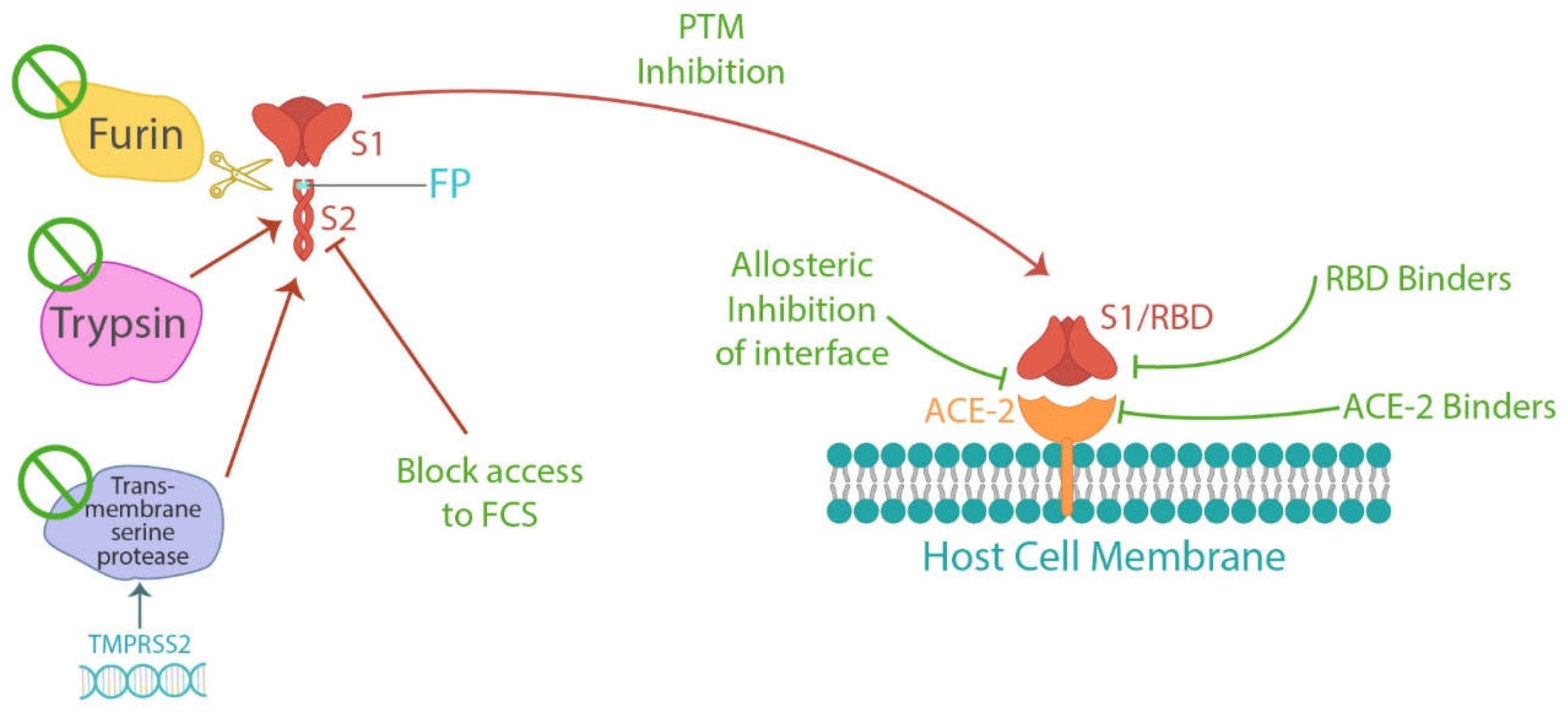
Disclaimer/Publisher’s Note: The statements, opinions and data contained in all publications are solely those of the individual author(s) and contributor(s) and not of MDPI and/or the editor(s). MDPI and/or the editor(s) disclaim responsibility for any injury to people or property resulting from any ideas, methods, instructions or products referred to in the content. |
© 2023 by the authors. Licensee MDPI, Basel, Switzerland. This article is an open access article distributed under the terms and conditions of the Creative Commons Attribution (CC BY) license (http://creativecommons.org/licenses/by/4.0/).
Copyright: This open access article is published under a Creative Commons CC BY 4.0 license, which permit the free download, distribution, and reuse, provided that the author and preprint are cited in any reuse.