

Submitted:
10 March 2023
Posted:
13 March 2023
You are already at the latest version
Abstract
Cancer is one of the leading causes of death, and latest predictions indicate that cancer- related deaths will increase over the next few decades. Despite significant advances in conventional therapies, treatments remain far from ideal due to limitations such as lack of selectivity, non-specific distribution, and multidrug resistance. Current research is focusing on the development of several strategies to improve the efficiency of chemotherapeutic agents and, as a result, overcome the conventional therapies challenges. In this regard, combined therapy with natural compounds and other therapeutic agents, such as chemotherapeutics or nucleic acids, has recently emerged as a new strategy for tackling the drawbacks of conventional therapies. Taking this strategy into consideration, the co-delivery of the above-mentioned agents in lipid-based nanocarriers provide some advantages by improving the potential of the therapeutic agents carried. This review encompassed different strategies associated with combined therapy, at the same time highlighting the most recent advances and outstanding advantages of lipid-based nanocarriers for achieving a promising combination therapy that may overcome cancer treatment challenges.
Keywords:
cancer
; conventional therapy
; combined therapy
; lipid-based nanocarriers
; natural compounds
1. Introduction
According to the World Health Organization (WHO), cancer is a serious public health problem around the world, being the leading cause of mortality and causing more than 6 million deaths yearly [1,2]. While the cancer mortality rate has declined in recent years, WHO estimates 13.1 million cancer-related deaths by 2030 [3,4]. Despite extensive development of cytotoxic agents, current therapy approaches for cancer are still ineffective [5]. There are two major treatment options available: surgical procedures or non-surgical therapy regimens [5]. The surgical intervention is limited by the tumor's size as well as the stage of metastasis in the tissues and organs from the site of origin. Non-surgical treatment options primarily include chemotherapy and radiotherapy, or a combination of these approaches [6,7]. Even though chemotherapeutic agents have evidenced efficacy in killing cancer cells by interfering with the process of cell division [5], they still face a number of challenges, including low bioavailability and lack of selectivity. Consequently, non-specific body distribution of chemotherapy is a key factor for cancer patient mortality, followed by chemo-resistance of cancer cells, which is another significant barrier that must be overcome in order to provide effective cancer treatment [2,3,7,8,9].
Several strategies have been employed to improve the performance of chemotherapeutic agents and, as a result, overcome the above-mentioned challenges. Among these strategies are chemical modification, the development of new chemotherapeutic agents that are not detected by multidrug resistance (MDR) efflux pumps, and the combination of cytotoxic agent with a chemosensitizer. Moreover, nanocarriers have been proposed to surpass some of the chemotherapy challenges. In this regard, nanocarriers for drug delivery are designed to reach specific organs and act selectively on the target site, providing advantages over conventional chemotherapeutics [1,7,10]. Some of the nanocarriers’ benefits include increased permeability through cell membranes and improved protection of the drugs against physical and chemical degradation. Furthermore, nanocarriers improves the therapeutic potential by optimizing drugs properties like stability, solubility, and bioavailability [1,11].
A common strategy for cancer therapy based on the association of multiple chemotherapeutic agents has been implemented as the standard first-line treatment of various malignancies to improve clinical outcome [2]. This approach has confirmed a great potential, particularly to solve the issue of MDR in cancer cells [12,13] and so, to improve anticancer efficacy [14,15,16]. Nonetheless, the administration of multiple drugs is frequently challenging, as different pharmacological agents have distinct pharmacokinetic profiles, resulting in an uncoordinated uptake by the tumor cell, affecting the expected synergistic effect [17,18]. Since nanocarriers can deliver multiple pharmacological agents to the same tumor cell in a single vehicle, the administration of combined drugs utilizing nanocarriers offers the most recent and efficient therapy for several cancers. The “same time at same place” strategy is appealing since it may increase therapeutic efficacy while minimizing damage to healthy cells through pharmacological synergism, overcoming MDR, and reducing the effective doses [2,19]. Additionally, due to the importance of minimizing harmful side effects to healthy cells, pharmaceutical market has been more receptive to lipid-based nanocarriers as they are classified by FDA as generally recognized as safe (GRAS). Lipid-based nanocarriers are also regarded as safe because they are biodegradable and will not accumulate in the body [20].
There is currently a growing interest in the use of natural products in cancer prevention and therapy. Natural compounds and their derivatives have been clinically researched for their capacity to reverse, inhibit and prevent cancer progression [21]. Due to their proven efficacy in a wide range of malignant tumors with minimal side effects and toxicity, some authors demonstrated that these agents may be a promising option for combination therapy [22].
For their prospective therapeutic applications, nucleic acids like plasmid DNA (pDNA), small interfering RNA (siRNA), and micro-RNA (miRNA) have been developed into potent tools. Since nucleic acids are able, among other effects, to modulate the expression of genes responsible for MDR, associating chemotherapeutics with nucleic acids has been suggested as an appropriate strategy to increase cancer therapy effect [23,24,25,26]. The combination of natural compounds and nucleic acids is a less well-known strategy that has the potential to be very effective as a therapeutic modality that acts by different mechanisms. This combination can lead to a synergistic improvement of the therapeutic effect, a sensitization of the cancer cells to the anticancer activity of the natural compound, and a synergic effect against MDR that restores the anticancer effect.
This review provides an overview of lipid-based nanosystems used to carry a combination of natural compounds either with chemotherapeutic drugs or with nucleic acids, due to the advantages of this co-delivery: synergistic/additive/potentiation effect, cancer cells sensitization, overcoming MDR and reduction of side effects. Given their promising features, there is an increasing number of reviews exploring the use of natural compounds in cancer treatment [e.g., [27,28,29,30,31,32], but to our knowledge there is none exploring the association of natural compounds and nucleic acids or focusing on the use of lyotropic liquid crystalline nanoassemblies (LLCNs) that have recently emerged as a promising class of advanced delivery systems, failing to provide a complete, updated overview of the numerous studies currently available in the literature.
2. Natural Compounds: Advantages of Combination Therapy in Cancer
Conventional therapy has evident benefits in cancer treatment; however, despite the continuous emergence of new anticancer agents, the majority of chemotherapy-based treatment continues to remain ineffective due to an array of factors, which include chemotherapy-induced toxicity and adverse reactions, insufficient target specificity, and, most importantly, drug resistance during cancer progression [9]. In this regard, combination therapy has recently become an emerging strategy for tackling the drawbacks of chemotherapy. Simultaneous delivery of two or more therapeutic agents (chemotherapeutic drugs, natural compounds, nucleic acids) can modify different signaling pathways in cancer cells, providing synergistic response, improving targeting selectivity, optimizing therapeutic effect, and overcoming MDR [2,17,33]. Thus, taking benefit of the minimal side effects promoted by natural compounds, there is a tendency to follow the potential strategy of combination therapy [9].
2.1. Overcoming Multidrug Resistance
MDR is a mechanism that emerges after cells’ exposure to chemotherapeutic agents and refers to the capacity of cancer cells to become resistant to the agents’ effect and can result in the development of malignant cell metastases [34,35]. The cellular mechanisms of MDR can be divided into two general classes: (i) those that block the delivery of chemotherapeutic agents to their target sites, and include the abnormal vasculature which results in low oral chemotherapeutic absorption, early renal clearance, poor bioavailability and lower tumor site accumulation; or (ii) those that emerge in cancer cells primarily as a result of genetic and epigenetic alterations and directly affect the efficacy of chemotherapeutic agents, and include apoptosis deregulation, increased repair of drug-induced DNA damage, and, enhanced efflux of chemotherapeutic agents [34,35].
Although a wide range of different factors can contribute to MDR, drug efflux changes are considered the major cause of classical MDR [36]. Drug efflux is enhanced by the overexpression of human ATP-binding cassette (ABC) membrane transporters. These transporters are accountable of removing chemotherapeutic agents from cancer cells. Among the ABC transporters, multidrug resistance proteins (MRP), specifically P-glycoprotein (P-gp) is an ATP-dependent drug efflux pump also referred as multidrug resistance protein 1 (MRP1). P-gp, the best-studied drug efflux pump, is a significant contributor to chemotherapy failure [36,37]. Furthermore, it has been reported that resistant cells have significantly greater levels of P-gp, and their overexpression is linked to a poor prognosis in a variety of cancers [38].
P-gp mediated MDR affects several classes of chemotherapeutic agents, like anthracyclines (e.g., daunorubicin and doxorubicin (DOX)), taxanes (e.g., paclitaxel (PTX) and docetaxel (DTX)), epipodophyllotoxins (e.g., etoposide) and camptothecins (e.g., topotecan and methotrexate (MTX)). As a result, strategies to reverse P-gp-mediated MDR have been extensively researched since the early 1980s, and three generations of P-gp inhibitors are currently classified [34,35,39]. Despite promising in vitro results, there is not, unfortunately, a irrefutable efficacy proof of the currently available inhibitors, since various clinical trials have been performed to evaluate their anticancer effect, but no significant improvements have been found [21,34]. The development of an ideal inhibitor is then commonly associated with the difficulty of finding compounds with high potency, specificity and with low intrinsic toxicity. Furthermore, it is difficult to achieve specificity of the inhibitors to the ABC transporters, as well as interactions between chemotherapeutic agents and inhibitors [21].
Consequently, in order to overcome such limitations, researchers have shifted their attention to novel approaches for MDR prevention in cancer. In this regard, natural compounds have emerged as an appealing solution, primarily due to their chemosensitizing capacity [40], as referred. Chemosensitizers are small molecules that can increase the sensitivity of cancer cells to chemotherapeutic agents, and those that act as ABC membrane transporter inhibitors are particularly effective. A main example are inhibitors obtained from natural sources, also known as fourth-generation inhibitors, which can interact with ATP binding sites or act directly at MRP binding sites. Natural inhibitors have the potential to be considerably more successful since they offer the most diverse and innovative chemical scaffolds [21]. Moreover, natural compounds with anticancer properties are widely available, as evidenced by the Naturally Occurring Plant-based Anti-Cancer Compound-Activity-Target Database (NPACT) [41]. The main natural compounds evaluated as chemosensitizing agents are highlighted in Figure 1.
Despite, a wide range of natural compounds, such as terpenoids, alkaloids, steroids, and saponins (Figure 1), have recently been employed to overcome MDR [40,41], phenolic derivatives and flavonoids have been the most cited and studied. According to in vitro biochemical and pharmacological studies, the majority of flavonoids could modulate ABC transporters by competitively binding to the substrate-binding sites and, as a result, delaying cellular efflux [21]. From these chemical families of natural compounds, resveratrol (RSV), curcumin (CUR), and epigallocatechin-3-gallate (EGCG) are the most promising as they can also directly interact with MDR genes [41]. For example, CUR, a polyphenol found in plants of genus Curcuma, modulates cancer signalling pathways, primarily by inhibiting the nuclear factor kappa B (NF-kB) pathway, as shown in Figure 2. In more detail, CUR modifies signalling pathways of the apoptosis process, by interfering with: X-linked inhibitor of apoptosis protein (XIAP), cell proliferation (Cyclin D1, ciclo-oxigenase-2 (COX-2), C-myc), cellular inhibitor of apoptosis protein-1 (CIAP-1), cell metastasis (C-X-C chemokine receptor type 4 (CXCR4), ICAM-I), cell invasion (matrix metallopeptidase 9 (MMP-9)) and angiogenesis (vascular endothelial growth factor (VEGF)) [41]. This natural compound also displays P-gp inhibitory activity by downregulating the phosphoinositide 3-kinases (PI3K)/protein kinase B (Akt) [42].
2.2. Synergistic, Additive and Potentiation Effects
The combination of therapeutic agents can result in the following complementary effects [33,43]: (i) synergistic, when the final effect is greater than the sum of individual agents’ effects, resulting in cooperative targeting activity regulation but each agent targets different sites; (ii) additive, that promotes greater or equal effect to the sum of individual agents’ effect; however, both agents act on the same target or pathway; and, (iii) potentiation, in which one agent can enhance the effect of the other or minimize its side effects by regulating pharmacokinetics and/or pharmacodynamics. Furthermore, when both agents in a combination therapy act on the same pathway or target, an undesirable antagonist effect may occur (i.e., when the resultant therapeutic effect is less than the sum of effects of each agent delivered).
2.3. Reducing the Side Effects
Combination therapy may also avoid the toxic side effects that normally affect healthy cells. This could happen if one of the co-delivered agents is antagonistic to the other in terms of cytotoxicity. For example, antioxidant supplementation during anticancer treatment may decrease adverse reactions, primarily due to the prevention of Reactive Oxygen Species (ROS)-mediated injury, without compromising anticancer activity [41].
2.4. Decreasing the Effective Chemotherapy Dose
One significant drawback of chemotherapy is the high dose of cytotoxic drugs required to achieve a therapeutic effect, which causes serious side effects. In this context, combination therapy appears to be a promising alternative, since the combination of a natural compound and chemotherapeutic drug may promote an increase of the cytotoxic effect (due to previously described synergistic, additive or potentiation effects), improve chemotherapeutic performance, and reduce the effective dose required to achieve the necessary therapeutic outcomes [41].
3. Lipid-based Nanocarriers for the Co-delivery of Natural Compounds and other Therapeutic agents
Classic combination therapy (i.e., simultaneous administration of the therapeutic agents in their free form) can be challenging due to several drawbacks, including the presence of highly organized physical, physiological and enzymatic barriers, which make targeting cancer cells with minimal side effects particularly difficult. Furthermore, the varying physiochemical and pharmacodynamic properties of different agents can limit their successful co-delivery [44]. Thus, as previously stated, nanocarriers are an advantageous option for overcoming these challenges, since they are designed to reach specific organs and act selectively on the target site [1,7,10]. In this regard, several nanocarriers have been widely explored for the delivery of anti-cancer drugs [5]. Lipid-based nanocarriers present some attractive features such as: non-toxic degradation products, biodegradable matrix, low toxicity, high capacity to incorporate lipophilic and/or hydrophilic compounds, and ability to achieve controlled release of encapsulated therapeutic agent [45,46].
3.1. Co-delivery of natural compounds and chemotherapeutics
Table 1 provides several examples of lipid-based nanocarriers co-encapsulating a chemotherapeutic agent and a natural compound for cancer treatment.
Co-delivery of natural compounds acting as chemosensitizers and chemotherapeutic agents with different or comparable mechanisms of action has been identified as the most promising strategy for overcoming undesirable toxicity and other side effects while improving therapeutic effect [5]. However, this co-delivery is also being investigated as a strategy to treat drug-resistant cancers, because of its ability to interfere with a number of signalling pathways in cancer cells [74]. In this regard, the co-encapsulation of different chemotherapeutic agents, particularly doxorubicin (DOX), paclitaxel (PTX) and 5-fluorouracil (5-FU), with diverse natural compounds using different lipid-based nanocarriers has been reported (Table 1).
DOX, a potent anthracycline, exhibits a broad-spectrum of anticancer activity [57,75]. In brief, DOX’s anticancer mechanism involves two primary possible pathways: (i) producing ROS that cause DNA damage [76,77] and (ii) intercalating into DNA strands and inhibiting topoisomerase II [78,79]. Despite its high efficacy in cancer treatment, DOX’s clinical application is hampered by severe side effects, the majority of which are caused by non-selective DOX-induced apoptosis in tissues and organs [80,81,82], as well as the development of MDR during chemotherapy [83,84]. One co-delivery approach focuses on the combination of DOX with natural compounds, such as CUR [9,51,52], palmitoyl ascorbate (PA) [55] and oleanolic acid (OA) [54], using different lipid-based nanocarriers in order to obtain a synergistic effect. For example, Barui et al. [51] and Tefas et al. [9] developed liposomes co-encapsulating CUR and DOX, and demonstrated their synergism in inhibiting the proliferation, invasion and migration of tumor cells [9,40]. Zhao et al. [52] studied the cell proliferation inhibition effect of lipid nanoparticles co-loaded with DOX and CUR. The results confirmed the synergistic effect on apoptosis, proliferation, and angiogenesis of hepatocellular carcinoma (HCC), by the increase of Caspase-3 and Bax/Bcl-2 ratio and the decrease of C-myc and VEGF. In addition to CUR, the co-encapsulation of DOX with PA, a lipophilic derivative of ascorbic acid, in liposomes caused an anticancer synergistic effect [55]. Furthermore, the addition of PA not only improved DOX’s anticancer effects [77], but it also demonstrated that this natural compound can mitigate the tissue toxicity of DOX resulting from oxidation [55], as previously described by Shimpo et al. [85]. Sarfraz et al. [54] explored the effect of a liposomal formulation that co-encapsulated DOX and OA, a natural pentacyclic triterpenoid, in a HepG2 mouse model of HCC. This combination had an anticancer synergistic effect, as well as, an antagonistic oxidative effect at the cardiomyocytes level, which reduced DOX cardiotoxicity [54]. Overcoming MDR with flavonoids, like quercetin (QUER) and baicalein (BCL) is the most widely discussed strategy for increasing anticancer effect in several drug-resistant cell lines [50,86,87]. As an example of this strategy, Liu et al. [50] developed Hyaluronic Acid (HA)-decorated nanostructured lipid carriers (NLCs) to co-deliver DOX and BCL, and reported a synergistic cytotoxic effect in DOX-resistant MCF-7 breast cancer cells. DOX-QUER co-loaded in a lipid-based nanocarrier was also developed as a promising approach for active targeting with the goal of increasing cellular uptake and toxicity against cancer cells [37,88] . Zhang et al. [37] confirmed that QUER can avoid the MDR effect and that BIO enhances P-gp inhibition synergistically resulting in improved antitumor activity. Furthermore, to overcome MDR, the use of DOX combined with other natural compounds, such as docosahexaenoic acid (DHA) [53], α-Tocopherol succinate (TS) [57] and Brucea javanica oil (BJO) [58], has been reported in the literature. Mussi et al. [53] proposed NLCs co-loaded with DOX and DHA that increased cytotoxicity activity and penetration of DOX, inferring a bypassing of P-gp bomb efflux. The potential of solid lipid nanoparticles (SLNs) co-loaded with DOX and TS – a vitamin E analogue - to overcome MDR and to increase DOX cytotoxicity have been confirmed by two independent studies [57,89]. Li et al. [58] developed lyotropic liquid crystalline nanoassemblies (LLCNs) co-loaded with DOX and BJO in human breast carcinoma cell lines (MCF-7) that have shown an improved anti-tumor effect [58].
PTX is an antimicrotubule chemotherapeutic agent widely used in cancer treatment [66,70]. In cancer cells, PTX induces apoptosis and, as a mitotic inhibitor of cell replication, interferes with microtubule breakdown, which leads to cell cycle arrest [68]. Nevertheless, due to the development of MDR, the potential application of PTX in several cancers is severely limited [42,90]. PTX is a substrate for MDR1 (i.e. for P-gp channel) [91], an thus the primary strategy for reversing MDR using combined therapy is the co-delivery of PTX with potential P-gp modulators. Several studies were developed in order to reverse MDR, using different natural compounds, such as Borneol (BOR) [54], CUR [55,56], Cyclosporine A (CycA) [57] and parthenolide (PTN) [70]. Abouzeid et al. [55] and Ganta et al. [56] demonstrated a synergistic effect in MDR cells of CUR and PTX co-loaded in PEG-PE/vitamin E micelles [55] and nanoemulsions [56]. Indeed, CUR enhanced PTX cytotoxicity by down-regulation of NF-kB and Akt pathways [55,56] (Figure 2). Tang et al. [65] studied lipid-albumin nanoassemblies (LANs) co-loaded with BOR and PTX to achieve greater cellular uptake and improved anti-tumor efficacy. BOR/PTX LANs significantly increased cytotoxicity and drug accumulation in cancer cells, corroborating its potential to enhance the efficacy of chemotherapy. Sarisozen et al. [68] developed actively targeted PEG-PE-based micelles co-encapsulating PTX and CycA, a first-generation P-gp inhibitor, to reverse PTX resistance in P-gp expressing cells. The authors concluded that the formulation showed a significant increase in cytotoxicity specifically in drug-resistant cells [68]. Gill et al. [70] studied PTX and PTN co-loaded in micelles that significantly improved anticancer activity against PTX-resistant cell lines. Moreover, the anti-proliferative and pro-apoptotic activity of RSV against MDR tumor cells has been reported [92]. Meng et al. [2] demonstrated that co-encapsulating RSV and PTX in PEGylated liposomes had the potential to reverse PTX-resistance of MCF-7/Adr tumors and improve the efficacy of RSV and PTX, implying their promising use in the treatment of drug-resistant malignancies. The BCL oxidative stress inducing potential was also considered by Meng et al. [64], who proposed co-loading PTX and BCL in nanoemulsions to enhance antitumor effect and suppress MDR in breast cancer. The antioxidant activity of PA has also improved PTX anticancer activity when they were co-encapsulated in liposomes [69].
5-Fluorouracil (5-FU), an antimetabolite, is commonly used to treat colorectal, breast, head, and neck cancers. The anticancer effect of 5-FU is due to the inhibition of thymidylate synthase and the incorporation of its metabolites into DNA and RNA, thereby inhibiting their production [93]. Previous research has shown that RSV synergistically promotes 5-FU-mediated cancer cell apoptosis [47,48]. Mohan et al. [48] investigated the influence of RSV and 5-FU co-loaded in PEGylated liposomes on head and neck squamous cancer cell line, reporting differential combination effects on genes’ expression that results cancer cell apoptosis. Furthermore, Cosco et al. [47] evaluated the efficacy of ultradeformable liposomes co-loaded with both agents against squamous cell carcinoma-related lesions. The authors reported that liposomes improved RSV and 5-FU permeation into deeper skin strata, where antioxidant and antiproliferative effects of RSV are essential [47].
3.2. Co-delivery of natural compounds and nucleic acids
Currently, the efforts to overcome the drawbacks of traditional cancer treatment are mostly focused on strategies that can block the efflux pump effects generated by long-term pharmacological therapy [94]. The combination of natural compounds with nucleic acids is another promising option for a co-delivery system [17]. Furthermore, this is a desirable method for cancer treatment able to overcome MDR and generate synergistic apoptotic effects while reducing toxicity and other side effects [95]. Given their multifunctionality and ability to encapsulate drugs, nanocarriers are the most widely used drug delivery systems [96]. However, many of these delivery systems suffer from non-degradability, complexity and insufficient biological activity [97]. Lipid-based nanocarriers developed for the co-delivery of nucleic acids and natural compounds (Table 2) are promising due to their low toxicity, biocompatibility and ease of scaling up [98].
Co-delivery of natural compounds and pDNA [100], siRNA [99,101], or miRNA [104], has been reported and the expression of specific genes can be restored, upregulated, downregulated, or even silenced depending on the type of nucleic acid used [107].
pDNA are small DNA molecules that can carry a gene that will be transcribed into a specific protein of interest, thus improve or restore its function and consequently, different cellular pathways [108]. For example, Xu et al. [100] studied the potential of lipoplexes (i.e., nucleic acids condensed by liposomes) for the co-delivery of p53 pDNA and RSV. The developed formulations were able to up-regulate p53, and the combination of two therapeutic agents demonstrated an anticancer synergistic effect by cell growth inhibition [100].
In comparison to pDNA, miRNA and siRNA act via RNA interference mechanisms.
miRNA can direct and regulate the expression of multiple genes encoding proteins involved in different cellular pathways, both at the transcriptional and translational levels [109]. Thus, Abtahi et al. [104] studied nioplexes (i.e., nucleic acids condensed by niosomes) for co-delivery of CUR and miR-34a, one of the p53 network members. The results showed that combining miR-34a and CUR enabled a synergistic effect, allowing for a reduction of the NF-kB expression (Figure 2) and a consequent increase in p53 expression [104].
siRNA has been widely used to selectively down-regulate abnormal protein expression in tumor cells, which is a promising strategy for preventing disease progression [99,103]. The combination of siRNA with different natural compounds, such as gambogenic acid (GNA) [99], CUR [101,102,103,104,105] and gedunin (GED) [106], using lipid-based nanosystems has also been reported. GNA, isolated from Gamboge, is considered a potential anticancer compound as it regulates the expression of cyclin D1 and cyclo-oxygenase (COX)-2 [110,111,112]. Yu et al. [99] studied lipoplexes for co-delivery of VEGF-siRNA and GNA to improve anti-cancer efficiency in HepG2 cells. According to this study, VEGF-siRNA seem to mediate VEGF silencing, and the combination with GNA enhanced cell sensitivity and promoted apoptosis [99]. GED, a tetranortriterpenoid isolated from Indian neem tree, is a Hsp90 inhibitor that demonstrated anti-proliferative effects in several cancers [113,114]. Rana et al. [106] developed lipoplexes for co-delivery of GED and P-gp siRNA, to enhance the inhibition of breast cancer stem cells proliferation by modulating P-gp and Cyclin D1 as well as apoptotic related genes [106]. CUR has received considerable attention in cancer treatment as the bioactive compound most co-loaded with siRNA. Anup et al. [101,102] developed lipoplexes co-loaded with CUR and STAT3 siRNA. The authors demonstrated that the lipoplexes administrated iontophoretically showed similar efficiency in inhibiting tumor progression and STAT3 protein suppression as intratumorally administration. The authors also reported a synergistic effect of CUR and STAT3 siRNA in cancer cell inhibition [101,102]. Muddineti et al. [103] studied micelleplexes (i.e., nucleic acids condensed by micelles) for co-delivery of CUR and siRNA in a time-dependent manner via clathrin-dependent endocytosis mechanism [103]. Jia et al. [105] developed CUR and siCCAT1 co-delivered in lipopolyplexes (i.e., nucleic acids condensed by liposomes containing polymers) for colorectal cancer therapy. The results confirmed the ability of the lipopolyplexes to perform endosomal/lysosomal escape efficiently due to the proton sponge effect of the polymer component. Furthermore, the co-delivery of CUR and siCCAT1 could effectively silence CCAT1 and achieve a synergistic effect, thereby enhancing B-cell limphoma-2 mediated apoptosis in human colon cancer cells [105].
4. Conclusions
Conventional cancer therapies are still unable to achieve the desired outcomes due to current limitations related with inefficiency and selectivity. As a result, the development of novel therapeutic strategies to overcome these limitations has become critical. Combination therapy has been extensively explored in this context, since co-delivery of natural compounds and chemotherapeutic agents or nucleic acids can achieve stronger anticancer effect through synergistic/additive/potentiation mechanisms, or by improving selectivity, and overcoming MDR either by inhibition of ABC membrane transporters or interaction with MDR genes.
However, while this strategy provides new therapeutic results, it also introduces several new challenges, such as the need to clearly identify the mechanism behind the enhanced anticancer activity by comparing the co-delivery effect with co-administration effect. It is also required to better define the concentration-dependent effect of natural compounds, as well as to evaluate the improvement of their pharmacokinetic parameters when delivered by lipid-based nanocarriers. Moreover, despite lipid-based nanocarriers are considered biocompatible, the safety of the loaded cargo has also to be addressed, namely by long-term toxicity assessment and by studying the immunogenicity issues that may arise from the nucleic acid conjugation. Furthermore, as far as we know, no clinical trials with nanocarriers co-delivering natural compounds and other therapeutic agents have been conducted, which may be due to these challenges as well as the costs of designing and developing such complex formulations.
Despite the critical points that remain unresolved, the co-delivery strategy of natural compounds and chemotherapeutic agents/nucleic acids is undeniably very promising, and we believe that this approach will fulfill the translation of lipid-based nanocarriers into clinical applications.
Author Contributions
Conceptualization C.M.L., M.L., F.A.; writing—original draft preparation, P.V.T., E.F., T.B.S.; writing—review and editing, P.V.T., C.M.L., M.L., F.A..; visualization, M.L., P.V.T.; supervision, C.M.L., M.L., F.A.; funding acquisition, M.L., F.A. All authors have read and agreed to the published version of the manuscript.
Funding
This work was supported by the Portuguese Foundation for Science and Technology (FCT) in the framework of the Strategic Funding UIDB/04650/2020 (CF-UM-UP) and UIDB/04046/2020 and UIDP/04046/2020 (BioISI).
Data Availability Statement
Data sharing is not applicable to this article as no new data were created or analyzed in this study.
Conflicts of Interest
The authors declare no conflict of interest.
References
- Sanchez-Moreno, P.; Ortega-Vinuesa, J.L.; Peula-Garcia, J.M.; Marchal, J.A.; Boulaiz, H. Smart Drug-Delivery Systems for Cancer Nanotherapy. Curr Drug Targets 2018, 19, 339-359. [CrossRef]
- Meng, J.; Guo, F.; Xu, H.; Liang, W.; Wang, C.; Yang, X.D. Combination Therapy using Co-encapsulated Resveratrol and Paclitaxel in Liposomes for Drug Resistance Reversal in Breast Cancer Cells in vivo. Sci Rep 2016, 6, 22390. [CrossRef]
- Mozafari, M.R.; Pardakhty, A.; Azarmi, S.; Jazayeri, J.A.; Nokhodchi, A.; Omri, A. Role of nanocarrier systems in cancer nanotherapy. J Liposome Res 2009, 19, 310-321. [CrossRef]
- Boyle, P.; Levin, B. World cancer report 2008; IARC Press, International Agency for Research on Cancer: 2008.
- Qi, S.S.; Sun, J.H.; Yu, H.H.; Yu, S.Q. Co-delivery nanoparticles of anti-cancer drugs for improving chemotherapy efficacy. Drug Deliv 2017, 24, 1909-1926. [CrossRef]
- Leng, F.; Liu, F.; Yang, Y.; Wu, Y.; Tian, W. Strategies on Nanodiagnostics and Nanotherapies of the Three Common Cancers. Nanomaterials (Basel) 2018, 8, 202. [CrossRef]
- Senapati, S.; Mahanta, A.K.; Kumar, S.; Maiti, P. Controlled drug delivery vehicles for cancer treatment and their performance. Signal Transduction and Targeted Therapy 2018, 3, 7. [CrossRef]
- Hofmann, M.; Guschel, M.; Bernd, A.; Bereiter-Hahn, J.; Kaufmann, R.; Tandi, C.; Wiig, H.; Kippenberger, S. Lowering of tumor interstitial fluid pressure reduces tumor cell proliferation in a xenograft tumor model. Neoplasia 2006, 8, 89-95. [CrossRef]
- Tefas, L.R.; Sylvester, B.; Tomuta, I.; Sesarman, A.; Licarete, E.; Banciu, M.; Porfire, A. Development of antiproliferative long-circulating liposomes co-encapsulating doxorubicin and curcumin, through the use of a quality-by-design approach. Drug Des Devel Ther 2017, 11, 1605-1621. [CrossRef]
- Cho, K.; Wang, X.; Nie, S.; Chen, Z.G.; Shin, D.M. Therapeutic nanoparticles for drug delivery in cancer. Clin Cancer Res 2008, 14, 1310-1316. [CrossRef]
- Jain, T.K.; Morales, M.A.; Sahoo, S.K.; Leslie-Pelecky, D.L.; Labhasetwar, V. Iron oxide nanoparticles for sustained delivery of anticancer agents. Mol Pharm 2005, 2, 194-205. [CrossRef]
- Gottesman, M.M. Mechanisms of Cancer Drug Resistance. Annual Review of Medicine 2002, 53, 615-627. [CrossRef]
- Noguchi, K.; Katayama, K.; Mitsuhashi, J.; Sugimoto, Y. Functions of the breast cancer resistance protein (BCRP/ABCG2) in chemotherapy. Adv Drug Deliv Rev 2009, 61, 26-33. [CrossRef]
- Al-Lazikani, B.; Banerji, U.; Workman, P. Combinatorial drug therapy for cancer in the post-genomic era. Nat Biotechnol 2012, 30, 679-692. [CrossRef]
- Bahadur, K.C.R.; Xu, P. Multicompartment intracellular self-expanding nanogel for targeted delivery of drug cocktail. Adv Mater 2012, 24, 6479-6483. [CrossRef]
- DeVita, V.T., Jr.; Young, R.C.; Canellos, G.P. Combination versus single agent chemotherapy: a review of the basis for selection of drug treatment of cancer. Cancer 1975, 35, 98-110. [CrossRef]
- Hu, C.M.; Zhang, L. Nanoparticle-based combination therapy toward overcoming drug resistance in cancer. Biochem Pharmacol 2012, 83, 1104-1111. [CrossRef]
- Ma, J.; Waxman, D.J. Combination of antiangiogenesis with chemotherapy for more effective cancer treatment. Mol Cancer Ther 2008, 7, 3670-3684. [CrossRef]
- Li, H.; Li, M.; Chen, C.; Fan, A.; Kong, D.; Wang, Z.; Zhao, Y. On-demand combinational delivery of curcumin and doxorubicin via a pH-labile micellar nanocarrier. Int J Pharm 2015, 495, 572-578. [CrossRef]
- Qi, J.; Zhuang, J.; Lu, Y.; Dong, X.; Zhao, W.; Wu, W. In vivo fate of lipid-based nanoparticles. Drug Discov Today 2017, 22, 166-172. [CrossRef]
- Wu, C.-P.; Ohnuma, S.; Ambudkar, S.V. Discovering natural product modulators to overcome multidrug resistance in cancer chemotherapy. Curr Pharm Biotechnol 2011, 12, 609-620. [CrossRef]
- Kallifatidis, G.; Hoy, J.J.; Lokeshwar, B.L. Bioactive natural products for chemoprevention and treatment of castration-resistant prostate cancer. Semin Cancer Biol 2016, 40-41, 160-169. [CrossRef]
- Kapse-Mistry, S.; Govender, T.; Srivastava, R.; Yergeri, M. Nanodrug delivery in reversing multidrug resistance in cancer cells. Front Pharmacol 2014, 5, 159-159. [CrossRef]
- Creixell, M.; Peppas, N.A. Co-delivery of siRNA and therapeutic agents using nanocarriers to overcome cancer resistance. Nano Today 2012, 7, 367-379. [CrossRef]
- Meng, H.; Mai, W.X.; Zhang, H.; Xue, M.; Xia, T.; Lin, S.; Wang, X.; Zhao, Y.; Ji, Z.; Zink, J.I.; et al. Codelivery of an optimal drug/siRNA combination using mesoporous silica nanoparticles to overcome drug resistance in breast cancer in vitro and in vivo. ACS Nano 2013, 7, 994-1005. [CrossRef]
- Amani, A.; Alizadeh, M.R.; Yaghoubi, H.; Nohtani, M. Novel multi-targeted nanoparticles for targeted co-delivery of nucleic acid and chemotherapeutic agents to breast cancer tissues. Materials Science and Engineering: C 2021, 118, 111494. [CrossRef]
- Ali Abdalla, Y.O.; Subramaniam, B.; Nyamathulla, S.; Shamsuddin, N.; Arshad, N.M.; Mun, K.S.; Awang, K.; Nagoor, N.H. Natural Products for Cancer Therapy: A Review of Their Mechanism of Actions and Toxicity in the Past Decade. Journal of Tropical Medicine 2022, 2022, 5794350. [CrossRef]
- Lin, S.-R.; Chang, C.-H.; Hsu, C.-F.; Tsai, M.-J.; Cheng, H.; Leong, M.K.; Sung, P.-J.; Chen, J.-C.; Weng, C.-F. Natural compounds as potential adjuvants to cancer therapy: Preclinical evidence. British Journal of Pharmacology 2020, 177, 1409-1423. [CrossRef]
- Hashem, S.; Ali, T.A.; Akhtar, S.; Nisar, S.; Sageena, G.; Ali, S.; Al-Mannai, S.; Therachiyil, L.; Mir, R.; Elfaki, I.; et al. Targeting cancer signaling pathways by natural products: Exploring promising anti-cancer agents. Biomedicine & Pharmacotherapy 2022, 150, 113054. [CrossRef]
- Cho, Y.; Park, M.N.; Noh, S.; Kang, S.Y.; Kim, B. Review of Natural Compounds for the Management and Prevention of Lymphoma. Processes 2020, 8, 1164.
- Sauter, E.R. Cancer prevention and treatment using combination therapy with natural compounds. Expert Review of Clinical Pharmacology 2020, 13, 265-285. [CrossRef]
- Gao, Q.; Feng, J.; Liu, W.; Wen, C.; Wu, Y.; Liao, Q.; Zou, L.; Sui, X.; Xie, T.; Zhang, J.; et al. Opportunities and challenges for co-delivery nanomedicines based on combination of phytochemicals with chemotherapeutic drugs in cancer treatment. Advanced Drug Delivery Reviews 2022, 188, 114445. [CrossRef]
- Hu, Q.; Sun, W.; Wang, C.; Gu, Z. Recent advances of cocktail chemotherapy by combination drug delivery systems. Adv Drug Deliv Rev 2016, 98, 19-34. [CrossRef]
- Wang, J.; Seebacher, N.; Shi, H.; Kan, Q.; Duan, Z. Novel strategies to prevent the development of multidrug resistance (MDR) in cancer. Oncotarget 2017, 8, 84559-84571. [CrossRef]
- Gottesman, M.M.; Fojo, T.; Bates, S.E. Multidrug resistance in cancer: role of ATP-dependent transporters. Nat Rev Cancer 2002, 2, 48-58. [CrossRef]
- Liu, K.; Chen, W.; Yang, T.; Wen, B.; Ding, D.; Keidar, M.; Tang, J.; Zhang, W. Paclitaxel and quercetin nanoparticles co-loaded in microspheres to prolong retention time for pulmonary drug delivery. Int J Nanomedicine 2017, 12, 8239-8255. [CrossRef]
- Zhang, J.; Luo, Y.; Zhao, X.; Li, X.; Li, K.; Chen, D.; Qiao, M.; Hu, H.; Zhao, X. Co-delivery of doxorubicin and the traditional Chinese medicine quercetin using biotin–PEG2000–DSPE modified liposomes for the treatment of multidrug resistant breast cancer. RSC Advances 2016, 6, 113173-113184. [CrossRef]
- Israel, B.B.; Tilghman, S.L.; Parker-Lemieux, K.; Payton-Stewart, F. Phytochemicals: Current strategies for treating breast cancer. Oncol Lett 2018, 15, 7471-7478. [CrossRef]
- Gameiro, M.; Silva, R.; Rocha-Pereira, C.; Carmo, H.; Carvalho, F.; Bastos, M.L.; Remião, F. Cellular Models and In Vitro Assays for the Screening of modulators of P-gp, MRP1 and BCRP. Molecules 2017, 22. [CrossRef]
- Aung, T.N.; Qu, Z.; Kortschak, R.D.; Adelson, D.L. Understanding the Effectiveness of Natural Compound Mixtures in Cancer through Their Molecular Mode of Action. Int J Mol Sci 2017, 18. [CrossRef]
- de Oliveira Júnior, R.G.; Christiane Adrielly, A.F.; da Silva Almeida, J.R.G.; Grougnet, R.; Thiéry, V.; Picot, L. Sensitization of tumor cells to chemotherapy by natural products: A systematic review of preclinical data and molecular mechanisms. Fitoterapia 2018, 129, 383-400. [CrossRef]
- Baek, J.S.; Cho, C.W. A multifunctional lipid nanoparticle for co-delivery of paclitaxel and curcumin for targeted delivery and enhanced cytotoxicity in multidrug resistant breast cancer cells. Oncotarget 2017, 8, 30369-30382. [CrossRef]
- Jia, J.; Zhu, F.; Ma, X.; Cao, Z.; Cao, Z.W.; Li, Y.; Li, Y.X.; Chen, Y.Z. Mechanisms of drug combinations: interaction and network perspectives. Nat Rev Drug Discov 2009, 8, 111-128. [CrossRef]
- Xu, M.; Li, G.; Zhang, H.; Chen, X.; Li, Y.; Yao, Q.; Xie, M. Sequential delivery of dual drugs with nanostructured lipid carriers for improving synergistic tumor treatment effect. Drug Deliv 2020, 27, 983-995. [CrossRef]
- Pardeike, J.; Hommoss, A.; Müller, R.H. Lipid nanoparticles (SLN, NLC) in cosmetic and pharmaceutical dermal products. Int J Pharm 2009, 366, 170-184. [CrossRef]
- Rahman, H.S.; Rasedee, A.; How, C.W.; Abdul, A.B.; Zeenathul, N.A.; Othman, H.H.; Saeed, M.I.; Yeap, S.K. Zerumbone-loaded nanostructured lipid carriers: preparation, characterization, and antileukemic effect. Int J Nanomedicine 2013, 8, 2769-2781. [CrossRef]
- Cosco, D.; Paolino, D.; Maiuolo, J.; Marzio, L.D.; Carafa, M.; Ventura, C.A.; Fresta, M. Ultradeformable liposomes as multidrug carrier of resveratrol and 5-fluorouracil for their topical delivery. Int J Pharm 2015, 489, 1-10. [CrossRef]
- Mohan, A.; Narayanan, S.; Sethuraman, S.; Krishnan, U.M. Novel resveratrol and 5-fluorouracil coencapsulated in PEGylated nanoliposomes improve chemotherapeutic efficacy of combination against head and neck squamous cell carcinoma. Biomed Res Int 2014, 2014, 424239. [CrossRef]
- Pawar, H.; Surapaneni, S.K.; Tikoo, K.; Singh, C.; Burman, R.; Gill, M.S.; Suresh, S. Folic acid functionalized long-circulating co-encapsulated docetaxel and curcumin solid lipid nanoparticles: In vitro evaluation, pharmacokinetic and biodistribution in rats. Drug Deliv 2016, 23, 1453-1468. [CrossRef]
- Liu, Q.; Li, J.; Pu, G.; Zhang, F.; Liu, H.; Zhang, Y. Co-delivery of baicalein and doxorubicin by hyaluronic acid decorated nanostructured lipid carriers for breast cancer therapy. Drug Deliv 2016, 23, 1364-1368. [CrossRef]
- Barui, S.; Saha, S.; Mondal, G.; Haseena, S.; Chaudhuri, A. Simultaneous delivery of doxorubicin and curcumin encapsulated in liposomes of pegylated RGDK-lipopeptide to tumor vasculature. Biomaterials 2014, 35, 1643-1656. [CrossRef]
- Zhao, X.; Chen, Q.; Li, Y.; Tang, H.; Liu, W.; Yang, X. Doxorubicin and curcumin co-delivery by lipid nanoparticles for enhanced treatment of diethylnitrosamine-induced hepatocellular carcinoma in mice. Eur J Pharm Biopharm 2015, 93, 27-36. [CrossRef]
- Mussi, S.V.; Sawant, R.; Perche, F.; Oliveira, M.C.; Azevedo, R.B.; Ferreira, L.A.; Torchilin, V.P. Novel nanostructured lipid carrier co-loaded with doxorubicin and docosahexaenoic acid demonstrates enhanced in vitro activity and overcomes drug resistance in MCF-7/Adr cells. Pharm Res 2014, 31, 1882-1892. [CrossRef]
- Sarfraz, M.; Afzal, A.; Raza, S.M.; Bashir, S.; Madni, A.; Khan, M.W.; Ma, X.; Xiang, G. Liposomal co-delivered oleanolic acid attenuates doxorubicin-induced multi-organ toxicity in hepatocellular carcinoma. Oncotarget 2017, 8, 47136-47153. [CrossRef]
- Yang, Y.; Lu, X.; Liu, Q.; Dai, Y.; Zhu, X.; Wen, Y.; Xu, J.; Lu, Y.; Zhao, D.; Chen, X.; et al. Palmitoyl ascorbate and doxorubicin co-encapsulated liposome for synergistic anticancer therapy. Eur J Pharm Sci 2017, 105, 219-229. [CrossRef]
- Minaei, A.; Sabzichi, M.; Ramezani, F.; Hamishehkar, H.; Samadi, N. Co-delivery with nano-quercetin enhances doxorubicin-mediated cytotoxicity against MCF-7 cells. Mol Biol Rep 2016, 43, 99-105. [CrossRef]
- Oliveira, M.S.; Aryasomayajula, B.; Pattni, B.; Mussi, S.V.; Ferreira, L.A.M.; Torchilin, V.P. Solid lipid nanoparticles co-loaded with doxorubicin and alpha-tocopherol succinate are effective against drug-resistant cancer cells in monolayer and 3-D spheroid cancer cell models. Int J Pharm 2016, 512, 292-300. [CrossRef]
- Li, Y.; Angelova, A.; Hu, F.; Garamus, V.M.; Peng, C.; Li, N.; Liu, J.; Liu, D.; Zou, A. pH Responsiveness of Hexosomes and Cubosomes for Combined Delivery of Brucea javanica Oil and Doxorubicin. Langmuir 2019, 35, 14532-14542. [CrossRef]
- Jiang, H.; Geng, D.; Liu, H.; Li, Z.; Cao, J. Co-delivery of etoposide and curcumin by lipid nanoparticulate drug delivery system for the treatment of gastric tumors. Drug Delivery 2016, 23, 3665-3673. [CrossRef]
- Shukla, P.; Mathur, V.; Kumar, A.; Khedgikar, V.; Teja, V.B.; Chaudhary, D.; Kushwaha, P.; Bora, H.K.; Konwar, R.; Trivedi, R.; et al. Nanoemulsion based concomitant delivery of curcumin and etoposide: impact on cross talk between prostate cancer cells and osteoblast during metastasis. J Biomed Nanotechnol 2014, 10, 3381-3391. [CrossRef]
- Lu, Z.; Su, J.; Li, Z.; Zhan, Y.; Ye, D. Hyaluronic acid-coated, prodrug-based nanostructured lipid carriers for enhanced pancreatic cancer therapy. Drug Dev Ind Pharm 2017, 43, 160-170. [CrossRef]
- Soe, Z.C.; Thapa, R.K.; Ou, W.; Gautam, M.; Nguyen, H.T.; Jin, S.G.; Ku, S.K.; Oh, K.T.; Choi, H.G.; Yong, C.S.; et al. Folate receptor-mediated celastrol and irinotecan combination delivery using liposomes for effective chemotherapy. Colloids Surf B Biointerfaces 2018, 170, 718-728. [CrossRef]
- Jain, A.; Sharma, G.; Kushwah, V.; Garg, N.K.; Kesharwani, P.; Ghoshal, G.; Singh, B.; Shivhare, U.S.; Jain, S.; Katare, O.P. Methotrexate and beta-carotene loaded-lipid polymer hybrid nanoparticles: a preclinical study for breast cancer. Nanomedicine (Lond) 2017, 12, 1851-1872. [CrossRef]
- Meng, L.; Xia, X.; Yang, Y.; Ye, J.; Dong, W.; Ma, P.; Jin, Y.; Liu, Y. Co-encapsulation of paclitaxel and baicalein in nanoemulsions to overcome multidrug resistance via oxidative stress augmentation and P-glycoprotein inhibition. Int J Pharm 2016, 513, 8-16. [CrossRef]
- Tang, B.; Fang, G.; Gao, Y.; Liu, Y.; Liu, J.; Zou, M.; Wang, L.; Cheng, G. Lipid-albumin nanoassemblies co-loaded with borneol and paclitaxel for intracellular drug delivery to C6 glioma cells with P-gp inhibition and its tumor targeting. Asian Journal of Pharmaceutical Sciences 2015, 10, 363-371. [CrossRef]
- Abouzeid, A.H.; Patel, N.R.; Torchilin, V.P. Polyethylene glycol-phosphatidylethanolamine (PEG-PE)/vitamin E micelles for co-delivery of paclitaxel and curcumin to overcome multi-drug resistance in ovarian cancer. Int J Pharm 2014, 464, 178-184. [CrossRef]
- Ganta, S.; Amiji, M. Coadministration of Paclitaxel and curcumin in nanoemulsion formulations to overcome multidrug resistance in tumor cells. Mol Pharm 2009, 6, 928-939. [CrossRef]
- Sarisozen, C.; Vural, I.; Levchenko, T.; Hincal, A.A.; Torchilin, V.P. PEG-PE-based micelles co-loaded with paclitaxel and cyclosporine A or loaded with paclitaxel and targeted by anticancer antibody overcome drug resistance in cancer cells. Drug Deliv 2012, 19, 169-176. [CrossRef]
- Sawant, R.R.; Vaze, O.S.; Rockwell, K.; Torchilin, V.P. Palmitoyl ascorbate-modified liposomes as nanoparticle platform for ascorbate-mediated cytotoxicity and paclitaxel co-delivery. Eur J Pharm Biopharm 2010, 75, 321-326. [CrossRef]
- Gill, K.K.; Kaddoumi, A.; Nazzal, S. Mixed micelles of PEG(2000)-DSPE and vitamin-E TPGS for concurrent delivery of paclitaxel and parthenolide: enhanced chemosenstization and antitumor efficacy against non-small cell lung cancer (NSCLC) cell lines. European journal of pharmaceutical sciences : official journal of the European Federation for Pharmaceutical Sciences 2012, 46 1-2, 64-71.
- Kabary, D.M.; Helmy, M.W.; Elkhodairy, K.A.; Fang, J.Y.; Elzoghby, A.O. Hyaluronate/lactoferrin layer-by-layer-coated lipid nanocarriers for targeted co-delivery of rapamycin and berberine to lung carcinoma. Colloids Surf B Biointerfaces 2018, 169, 183-194. [CrossRef]
- Webb, M.S.; Johnstone, S.; Morris, T.J.; Kennedy, A.; Gallagher, R.; Harasym, N.; Harasym, T.; Shew, C.R.; Tardi, P.; Dragowska, W.H.; et al. In vitro and in vivo characterization of a combination chemotherapy formulation consisting of vinorelbine and phosphatidylserine. Eur J Pharm Biopharm 2007, 65, 289-299. [CrossRef]
- Abdelaziz, H.M.; Elzoghby, A.O.; Helmy, M.W.; Samaha, M.W.; Fang, J.Y.; Freag, M.S. Liquid crystalline assembly for potential combinatorial chemo-herbal drug delivery to lung cancer cells. Int J Nanomedicine 2019, 14, 499-517. [CrossRef]
- Lúcio, M.; Lopes, C.M.; Oliveira, M.E.C.R. Functional Lipid Nanosystems in Cancer; CRC Press: 2021.
- Mohan, P.; Rapoport, N. Doxorubicin as a molecular nanotheranostic agent: effect of doxorubicin encapsulation in micelles or nanoemulsions on the ultrasound-mediated intracellular delivery and nuclear trafficking. Mol Pharm 2010, 7, 1959-1973. [CrossRef]
- Sriraman, S.K.; Salzano, G.; Sarisozen, C.; Torchilin, V. Anti-cancer activity of doxorubicin-loaded liposomes co-modified with transferrin and folic acid. Eur J Pharm Biopharm 2016, 105, 40-49. [CrossRef]
- Štěrba, M.; Popelová, O.; Vávrová, A.; Jirkovský, E.; Kovaříková, P.; Geršl, V.; Šimůnek, T. Oxidative Stress, Redox Signaling, and Metal Chelation in Anthracycline Cardiotoxicity and Pharmacological Cardioprotection. Antioxid Redox Signal 2012, 18, 899-929. [CrossRef]
- Nitiss, J.L. Targeting DNA topoisomerase II in cancer chemotherapy. Nat Rev Cancer 2009, 9, 338. [CrossRef]
- Sun, J.; Song, Y.; Lu, M.; Lin, X.; Liu, Y.; Zhou, S.; Su, Y.; Deng, Y. Evaluation of the antitumor effect of dexamethasone palmitate and doxorubicin co-loaded liposomes modified with a sialic acid-octadecylamine conjugate. Eur J Pharm Sci 2016, 93, 177-183. [CrossRef]
- Elbialy, N.S.; Mady, M.M. Ehrlich tumor inhibition using doxorubicin containing liposomes. Saudi Pharm J 2015, 23, 182-187. [CrossRef]
- Misra, R.; Sahoo, S.K. Intracellular trafficking of nuclear localization signal conjugated nanoparticles for cancer therapy. Eur J Pharm Sci 2010, 39, 152-163. [CrossRef]
- Qiu, L.; Qiao, M.; Chen, Q.; Tian, C.; Long, M.; Wang, M.; Li, Z.; Hu, W.; Li, G.; Cheng, L.; et al. Enhanced effect of pH-sensitive mixed copolymer micelles for overcoming multidrug resistance of doxorubicin. Biomaterials 2014, 35, 9877-9887. [CrossRef]
- Chakravarty, G.; Mathur, A.; Mallade, P.; Gerlach, S.; Willis, J.; Datta, A.; Srivastav, S.; Abdel-Mageed, A.B.; Mondal, D. Nelfinavir targets multiple drug resistance mechanisms to increase the efficacy of doxorubicin in MCF-7/Dox breast cancer cells. Biochimie 2016, 124, 53-64. [CrossRef]
- Wu, Y.; Zhang, Y.; Zhang, W.; Sun, C.; Wu, J.; Tang, J. Reversing of multidrug resistance breast cancer by co-delivery of P-gp siRNA and doxorubicin via folic acid-modified core-shell nanomicelles. Colloids Surf B Biointerfaces 2016, 138, 60-69. [CrossRef]
- Shimpo, K.; Nagatsu, T.; Yamada, K.; Sato, T.; Niimi, H.; Shamoto, M.; Takeuchi, T.; Umezawa, H.; Fujita, K. Ascorbic acid and adriamycin toxicity. Am J Clin Nutr 1991, 54, 1298s-1301s. [CrossRef]
- Borska, S.; Chmielewska, M.; Wysocka, T.; Drag-Zalesinska, M.; Zabel, M.; Dziegiel, P. In vitro effect of quercetin on human gastric carcinoma: targeting cancer cells death and MDR. Food Chem Toxicol 2012, 50, 3375-3383. [CrossRef]
- Kim, M.K.; Park, K.S.; Choo, H.; Chong, Y. Quercetin-POM (pivaloxymethyl) conjugates: Modulatory activity for P-glycoprotein-based multidrug resistance. Phytomedicine 2015, 22, 778-785. [CrossRef]
- Kim, J.H.; Li, Y.; Kim, M.S.; Kang, S.W.; Jeong, J.H.; Lee, D.S. Synthesis and evaluation of biotin-conjugated pH-responsive polymeric micelles as drug carriers. Int J Pharm 2012, 427, 435-442. [CrossRef]
- Oliveira, M.S.; Mussi, S.V.; Gomes, D.A.; Yoshida, M.I.; Frezard, F.; Carregal, V.M.; Ferreira, L.A.M. α-Tocopherol succinate improves encapsulation and anticancer activity of doxorubicin loaded in solid lipid nanoparticles. Colloids Surf B Biointerfaces 2016, 140, 246-253. [CrossRef]
- Gao, M.; Xu, Y.; Qiu, L. Enhanced combination therapy effect on paclitaxel-resistant carcinoma by chloroquine co-delivery via liposomes. Int J Nanomedicine 2015, 10, 6615-6632. [CrossRef]
- Jang, S.H.; Wientjes, M.G.; Au, J.L. Kinetics of P-glycoprotein-mediated efflux of paclitaxel. J Pharmacol Exp Ther 2001, 298, 1236-1242.
- Quan, F.; Pan, C.; Ma, Q.; Zhang, S.; Yan, L. Reversal effect of resveratrol on multidrug resistance in KBv200 cell line. Biomed Pharmacother 2008, 62, 622-629. [CrossRef]
- Longley, D.B.; Harkin, D.P.; Johnston, P.G. 5-fluorouracil: mechanisms of action and clinical strategies. Nat Rev Cancer 2003, 3, 330-338. [CrossRef]
- Yang, Z.; Gao, D.; Cao, Z.; Zhang, C.; Cheng, D.; Liu, J.; Shuai, X. Drug and gene co-delivery systems for cancer treatment. Biomaterials Science 2015, 3, 1035-1049. [CrossRef]
- Saraswathy, M.; Gong, S. Recent developments in the co-delivery of siRNA and small molecule anticancer drugs for cancer treatment. Materials Today 2014, 17, 298-306. [CrossRef]
- Mitchell, M.J.; Billingsley, M.M.; Haley, R.M.; Wechsler, M.E.; Peppas, N.A.; Langer, R. Engineering precision nanoparticles for drug delivery. Nature Reviews Drug Discovery 2021, 20, 101-124. [CrossRef]
- Fenton, O.S.; Olafson, K.N.; Pillai, P.S.; Mitchell, M.J.; Langer, R. Advances in Biomaterials for Drug Delivery. Advanced Materials 2018, 30, 1705328. [CrossRef]
- Jogdeo, C.M.; Panja, S.; Kanvinde, S.; Kapoor, E.; Siddhanta, K.; Oupický, D. Advances in Lipid-Based Codelivery Systems for Cancer and Inflammatory Diseases. Advanced Healthcare Materials n/a, 2202400. [CrossRef]
- Yu, Q.; Zhang, B.; Zhou, Y.; Ge, Q.; Chang, J.; Chen, Y.; Zhang, K.; Peng, D.; Chen, W. Co-delivery of gambogenic acid and VEGF-siRNA with anionic liposome and polyethylenimine complexes to HepG2 cells. J Liposome Res 2019, 29, 322-331. [CrossRef]
- Xu, X.; Liu, A.; Bai, Y.; Li, Y.; Zhang, C.; Cui, S.; Piao, Y.; Zhang, S. Co-delivery of resveratrol and p53 gene via peptide cationic liposomal nanocarrier for the synergistic treatment of cervical cancer and breast cancer cells. Journal of Drug Delivery Science and Technology 2019, 51, 746-753. [CrossRef]
- Jose, A.; Labala, S.; Venuganti, V.V.K. Co-delivery of curcumin and STAT3 siRNA using deformable cationic liposomes to treat skin cancer. Journal of Drug Targeting 2017, 25, 330-341. [CrossRef]
- Jose, A.; Labala, S.; Ninave, K.M.; Gade, S.K.; Venuganti, V.V.K. Effective Skin Cancer Treatment by Topical Co-delivery of Curcumin and STAT3 siRNA Using Cationic Liposomes. AAPS PharmSciTech 2018, 19, 166-175. [CrossRef]
- Muddineti, O.S.; Shah, A.; Rompicharla, S.V.K.; Ghosh, B.; Biswas, S. Cholesterol-grafted chitosan micelles as a nanocarrier system for drug-siRNA co-delivery to the lung cancer cells. International Journal of Biological Macromolecules 2018, 118, 857-863. [CrossRef]
- Abtahi, N.A.; Naghib, S.M.; Ghalekohneh, S.J.; Mohammadpour, Z.; Nazari, H.; Mosavi, S.M.; Gheibihayat, S.M.; Haghiralsadat, F.; Reza, J.Z.; Doulabi, B.Z. Multifunctional stimuli-responsive niosomal nanoparticles for co-delivery and co-administration of gene and bioactive compound: In vitro and in vivo studies. Chemical Engineering Journal 2022, 429, 132090. [CrossRef]
- Jia, F.; Li, Y.; Deng, X.; Wang, X.; Cui, X.; Lu, J.; Pan, Z.; Wu, Y. Self-assembled fluorescent hybrid nanoparticles-mediated collaborative lncRNA CCAT1 silencing and curcumin delivery for synchronous colorectal cancer theranostics. Journal of Nanobiotechnology 2021, 19, 238. [CrossRef]
- Rana, M.S.; Ediriweera, M.K.; Rajagopalan, U.; Karunaratne, D.N.; Tennekoon, K.H.; Samarakoon, S.R. A new liposomal nanocarrier for co-delivery of gedunin and p-glycoprotein siRNA to target breast cancer stem cells. Natural Product Research 2022, 36, 6389-6392. [CrossRef]
- Hientz, K.; Mohr, A.; Bhakta-Guha, D.; Efferth, T. The role of p53 in cancer drug resistance and targeted chemotherapy. Oncotarget 2017, 8, 8921-8946. [CrossRef]
- Eftekhari, R.B.; Maghsoudnia, N.; Samimi, S.; Zamzami, A.; Dorkoosh, F.A. Co-Delivery Nanosystems for Cancer Treatment: A Review. Pharmaceutical Nanotechnology 2019, 7, 90-112. [CrossRef]
- Oliveto, S.; Mancino, M.; Manfrini, N.; Biffo, S. Role of microRNAs in translation regulation and cancer. World J Biol Chem 2017, 8, 45-56. [CrossRef]
- Yu, X.J.; Han, Q.B.; Wen, Z.S.; Ma, L.; Gao, J.; Zhou, G.B. Gambogenic acid induces G1 arrest via GSK3β-dependent cyclin D1 degradation and triggers autophagy in lung cancer cells. Cancer Lett 2012, 322, 185-194. [CrossRef]
- Su, J.; Cheng, H.; Zhang, D.; Wang, M.; Xie, C.; Hu, Y.; Chang, H.C.; Li, Q. Synergistic effects of 5-fluorouracil and gambogenic acid on A549 cells: activation of cell death caused by apoptotic and necroptotic mechanisms via the ROS-mitochondria pathway. Biol Pharm Bull 2014, 37, 1259-1268. [CrossRef]
- Tang, X.; Sun, J.; Ge, T.; Zhang, K.; Gui, Q.; Zhang, S.; Chen, W. PEGylated liposomes as delivery systems for Gambogenic acid: Characterization and in vitro/in vivo evaluation. Colloids and Surfaces B: Biointerfaces 2018, 172, 26-36. [CrossRef]
- Patwardhan, C.A.; Fauq, A.; Peterson, L.B.; Miller, C.; Blagg, B.S.J.; Chadli, A. Gedunin inactivates the co-chaperone p23 protein causing cancer cell death by apoptosis. J Biol Chem 2013, 288, 7313-7325. [CrossRef]
- Nwokwu, C.D.U.; Samarakoon, S.R.; Karunaratne, D.N.; Katuvawila, N.P.; Pamunuwa, G.K.; Ediriweera, M.K.; Tennekoon, K.H. Induction of apoptosis in response to improved gedunin by liposomal nano-encapsulation in human non-small-cell lung cancer (NCI-H292) cell line. Tropical Journal of Pharmaceutical Research 2017, 16, 2079-2087.
Figure 1.
Main natural compounds considered chemosensitizing agents, according to their chemical family [41].
Figure 1.
Main natural compounds considered chemosensitizing agents, according to their chemical family [41].
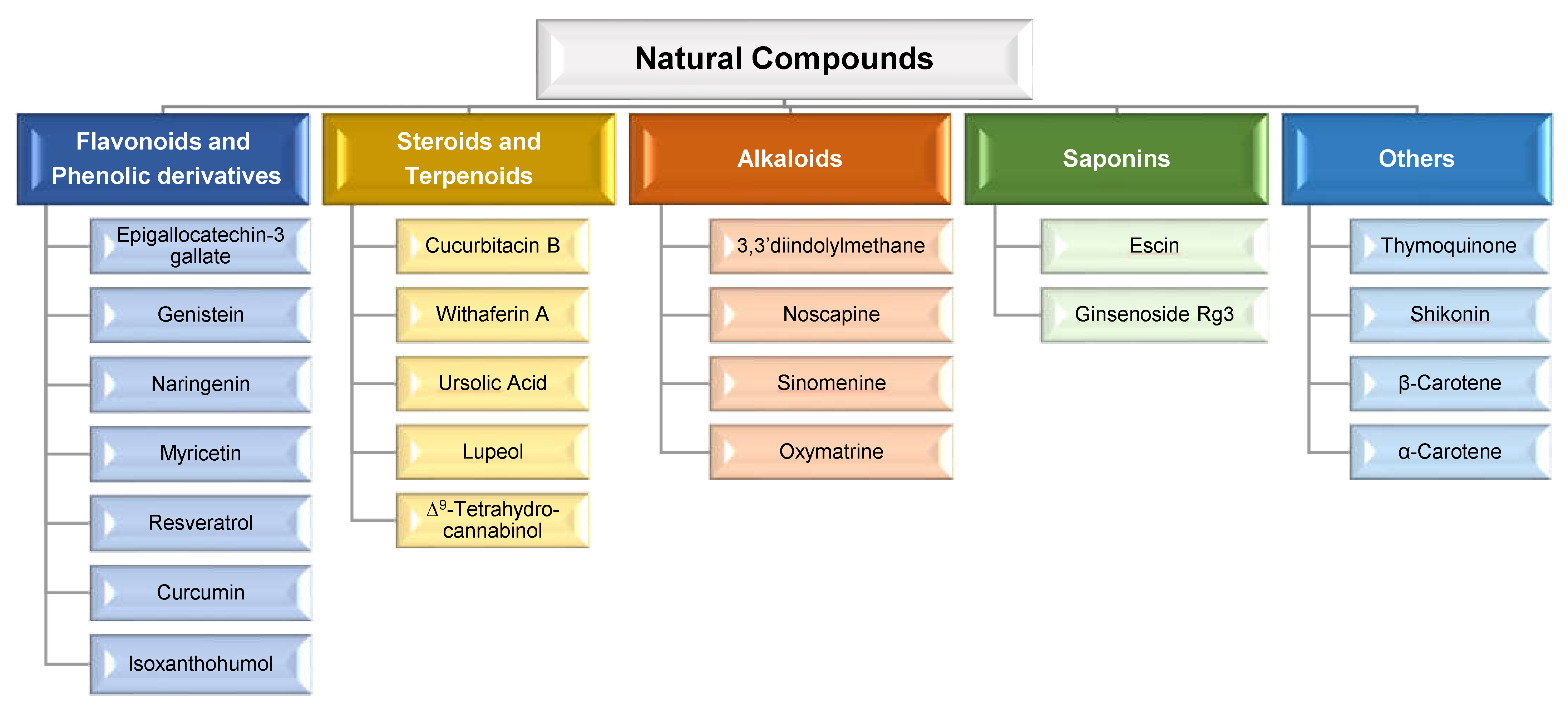
Figure 2.
Potential targets associated with Curcumin anticancer activity. This natural compound induces a negative reduction of its target genes by inhibiting NF-kβ signaling. Bcl-2 - B-cell limphoma-2; COX-2 - ciclo-oxigenase-2; IL-6 - interleukin 6; IL-10 - interleukin 10; IL-18 - interleukin 18; MMP9 - matrix metallopeptidase 9; NF-kβ - nuclear factor kappa B; VEGF - vascular endothelial growth factor; XIAP - X-linked inhibitor of apoptosis protein.
Figure 2.
Potential targets associated with Curcumin anticancer activity. This natural compound induces a negative reduction of its target genes by inhibiting NF-kβ signaling. Bcl-2 - B-cell limphoma-2; COX-2 - ciclo-oxigenase-2; IL-6 - interleukin 6; IL-10 - interleukin 10; IL-18 - interleukin 18; MMP9 - matrix metallopeptidase 9; NF-kβ - nuclear factor kappa B; VEGF - vascular endothelial growth factor; XIAP - X-linked inhibitor of apoptosis protein.
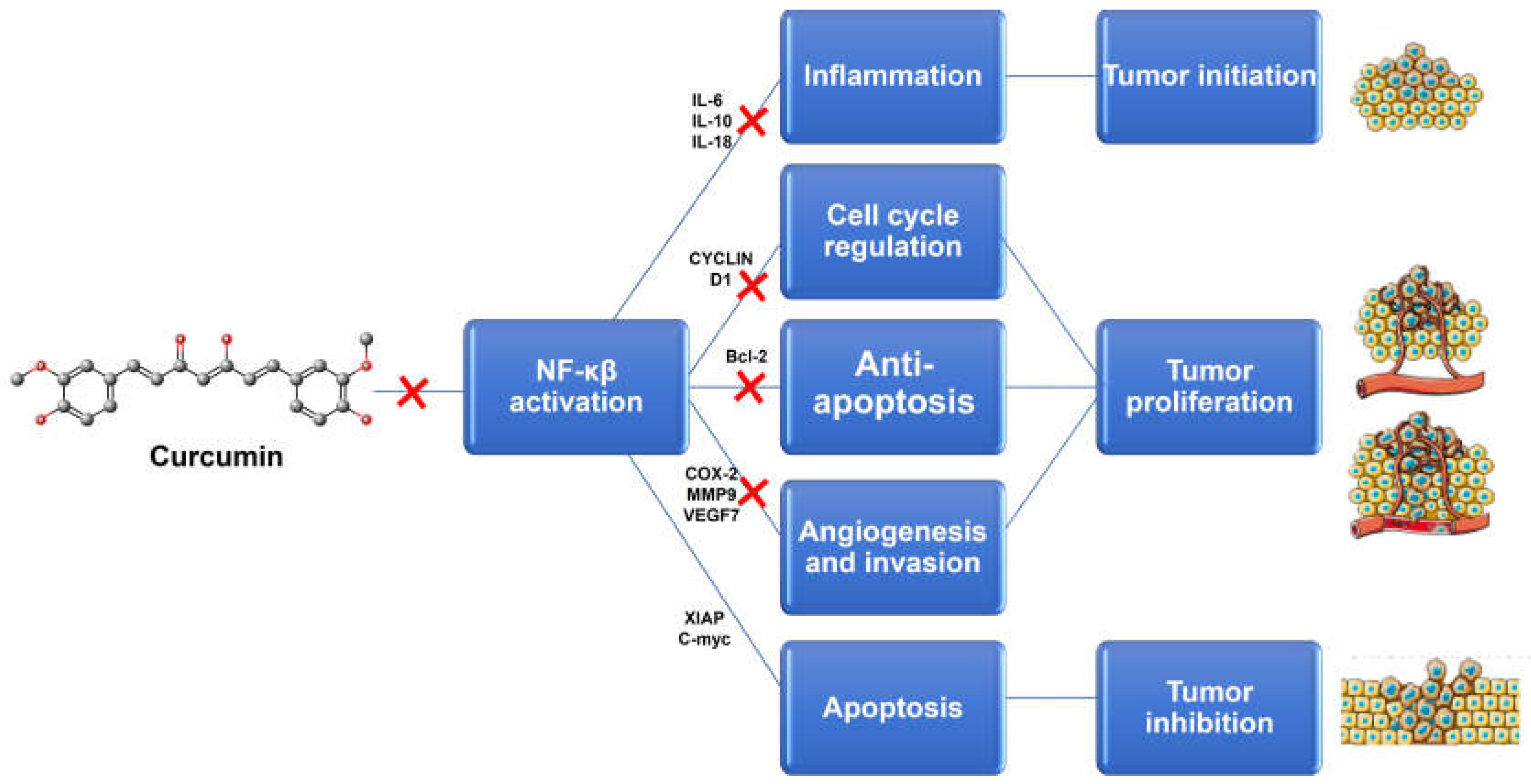

Table 1.
Examples of lipid-based nanocarriers co-encapsulating a chemotherapeutic agent and a natural compound for cancer treatment.
Table 1.
Examples of lipid-based nanocarriers co-encapsulating a chemotherapeutic agent and a natural compound for cancer treatment.
| Chemotherapeutic agent | Natural compound |
Lipid-based nanocarrier | Composition | Strategy | Ref. |
|---|---|---|---|---|---|
| 5-FU | RSV | Ultradeformable liposomes |
PL90G:SC | Synergistic effect | [47] |
| PEGylated liposomes | EPC:DSPE-PEG2000 | Synergistic effect | [48] | ||
| DTX | CUR | SLNs | Compritol® 888 ATO, GMS, Poloxamer 188Functionalization: Folic acid | Synergistic effect | [49] |
| DOX | BCL | NLCs | SA, SPC, Precirol® ATO5, Cremophor® ELP, DDAB | Synergistic effect | [50] |
| CUR | Liposomes | PEG-RGDK-lipopeptide | Synergistic effect | [51] | |
| Oil-in-water emulsion | Precirol® ATO 5, LabrafacTM lipophile WL 1349, Lipoid S75, Cremophor® RH 40, Glycerin | Synergistic effect | [52] | ||
| Liposomes | DPPC:DSPE:CHOL:PEG2000 | Synergistic effect | [9] | ||
| DHA | NLCs | Tween® 80, Oleic acid, Triethanolamine, Compritol® 888 ATO, EDTA | Overcome MDR | [53] | |
| OA | Liposomes | HSPC:CHOL:DSPE:PEG2000 | Synergistic effect | [54] | |
| PA | Liposomes | PC:CHOL | Synergistic effect | [55] | |
| QUER | Liposomes | BIO:DSPE:PEG2000 | Overcome MDR | [37] | |
| Phytosomes | Lecithin | Synergistic effect | [56] | ||
| TS | SLNs | Compritol® 888 ATO, TPGS, Triethanolamine | Synergistic effect | [57] | |
| BJO | LLCNs | GMO:P407 Hexagonal phase inducer: Oleic acid |
Overcome MDR | [58] | |
| ETP | CUR | NLCs | GMS, SPC, Oleic acid, DDAB | Decreasing the effective chemotherapy dose | [59] |
| Nanoemulsion | SPC, Tween® 80 | Additive effect | [60] | ||
| GEM | BCL | NLCs | SPC, Precirol® ATO-5, Olive oil, Tween® 80, DDAB | Synergistic effect | [61] |
| ITC | CTL | Liposomes | DPPC:CHOL:DSPE-PEG2000-FA | Synergistic effect | [62] |
| MTX | BCN | Lipid-polymer hybrid nanoparticle |
DSPE-PEG2000:SA:Gelucire® 50/13:PLA | Synergistic effect | [63] |
| PTX | BCL | Nanoemulsion | MCT, Soybean oil, Soybean lecithin, Kolliphor® P188, Glycerol |
Overcome MDR | [64] |
| BOR | Lipid-albumin nanoassemblies |
Egg yolk lecithin PL 100 M:BSA | Potentiation effect | [65] | |
| CUR | SLNs | GMS; TPGS, Tween® 80 Functionalization: Conjugated stearic acid and folate |
Overcome MDR | [42] | |
| Micelles | PEG2000-DSPE/Vit E | Synergistic effect | [66] | ||
| Nanoemulsion | Flaxseed oil, Egg lecithin | Overcome MDR | [67] | ||
| CycA | Micelles | PEG2000-PE | Overcome MDR | [68] | |
| PA | Liposomes | EPC:CHOL | Potentiation effect | [69] | |
| PTN | Micelles | PEG2000-DSPE/Vit E | Synergistic effect | [70] | |
| RSV | Liposomes | PC:DSPE-PEG2000 | Synergistic effect | [2] | |
| RAP | BER | Layer by layer lipid nanoparticles |
GMS, Tween® 80 | Synergistic effect | [71] |
| VNB | Phosphatidylserine | Liposomes | SM:CHOL:DPPS:PEG2000-DSPE | Synergistic effect | [72] |
| PMX | RSV | LLCNs | GMO:P407 Ion-pairing: CTAB |
Reducing side effects | [73] |
Table abbreviations: 5-FU - 5-Fluorouracil; BCL - Baicalein; BCN - β-carotene; BER - Berberine; BIO - Biotin; BJO - Brucea javanica oil; BOR - Borneol; BSA - Bovine serum albumin; CHOL - Cholesterol; CTAB - Cetyl trimethyl ammonium bromide; CTL - Celastrol; CUR - Curcumin; CycA - Cyclosporine A; DDAB - Dimethyl dioctadecyl ammonium bromide; DHA - Docosahexaenoic acid; DOX - Doxorubicin; DPPC - Dipalmitoylphosphocholine; DPPS - Dipalmitoylphosphatidylserine; DSPE - Distearoylphosphatidylethanolamine; DTX - Docetaxel; EDTA - Ethylenediaminetetraacetic acid; EPC - Egg phosphatidylcholine; ETP - Etoposide; FA - Folic acid; GEM - Gemcitabine; GMO - Glyceryl monooleate (or monoolein); GMS - Glyceryl monostearate; HSPC - Dehydrogenated soya phosphatidylcholine; ITC - Irinotecan; LLCNs - Lyotropic liquid crystalline nanoassemblies; MCT - Medium chain triglycerides; MDR - Multidrug resistance; MTX - Methotrexate; NLC - Nanostructured lipid carrier; OA - Oleanolic acid; P407 - Poloxamer 407 (or Pluronic® F-127 or Lutrol® F127); PA - Palmitoyl ascorbate; PC - Phosphatidylcholine; PE - Phosphatidylethanolamine; PEG - Polyethylene glycol; PL90G - Phospholipon® 90G; PLA - Polylactic acid; PMX – Pemetrexed; PTN - Parthenolide; PTX - Paclitaxel; QUER - Quercetin; RAP - Rapamycin; RSV - Resveratrol; SA - Stearic acid; SC - Sodium cholate; SLN - Solid lipid nanoparticles; SM - Sphingomyelin; SPC - Soybean phosphatidylcholine; TPGS - α-Tocopherol polyethylene glycol-1000 succinate; TS - α-Tocopherol succinate; Vit E - Vitamin E; VNB - Vinorelbine.
Table 2.
Examples of lipid-based nanocarriers co-encapsulating a nucleic acid and a natural compound for cancer treatment.
Table 2.
Examples of lipid-based nanocarriers co-encapsulating a nucleic acid and a natural compound for cancer treatment.
| Nanocarrier | Composition | Nucleic acid | Natural compound | Physical-chemical characterization | Cancer cell lines | Remarks | Ref. | ||
|---|---|---|---|---|---|---|---|---|---|
| Size (nm) and PDI | ζ-potential (mV) | EE (%) and DL (%) | |||||||
| Lipoplexes | CHEMS, CHOL, PE, PEI |
VEGF siRNA | GNA | Size: 200 PDI: < 0.3 |
-30 | EE: 81.8±2.04% | HepG2 cells | Downregulation of VEGF expression. GNA loaded Lipoplexes have stronger pro-apoptotic effects. |
[99] |
| Lipoplexes | CD014, DOPE | p53 pDNA | RSV | Size: 65.9 to 220.7 | +81.4 to +109.8 | EE: >90% | MCF-7 and HeLa cells | RSV and p53 pDNA showed synergistic effect on cells growth inhibition. | [100] |
| Lipoplexes | DOTAP, DOPE, Sodium cholate, C6 ceramide |
STAT3 siRNA | CUR | Size: 157.0±11.0 PDI: 0.46±0.003 |
+70.5±7.0 | EE: 87.5±4.0% (10:1 lipid:CUR ratio) | A431 cells | Downregulation of STAT3 expression. CUR and STAT3 siRNA demonstrated synergistic effect in cancer cell inhibition. |
[101] |
| Lipoplexes | DOTAP, DOPE, Sodium cholate, C6 ceramide | STAT3 siRNA | CUR | Size: 192.6±9.0 PDI: 0.326±0.004 |
+56.4 ± 8.0 | EE: 86.8±6.0% | B16F10 cells | CUR and STAT3 siRNA had a synergistic effect on cancer cell inhibition. The lipoplexes enabled a non-invasive topical iontophoretic application. |
[102] |
| Micelleplexes | Chitosan, Cholesterol chloroformate | siRNA | CUR | Size: 165±2.6 PDI: 0.16±0.02 |
+24.8±2.2 | - | A549 cells | CUR and siRNA were delivered in time dependent manner via clathrin dependent endocytosis mechanism. | [103] |
| Nioplexes | CHOL, Tween 80, Tween 60, DOTAP | miR-34a | CUR | Size: 60±0.05 PDI: 0.15±0.74 |
+27±0.30 | EE: 100% | A270cp-1, PC3, MCF-7 cells |
Co-delivery induced higher cytotoxicity than co-administration. | [104] |
| Lipopolyplexes | DSPE-mPEG, PEI-PDLLA | CCAT1 siRNA | CUR | Size: 151 | +12.37 to -10.48 (depending on CNP:siCCAT1 ratios) | EE: 85.85±3.37% DL: 14.36±1.28% |
HT-29 cells | Co-delivery of CUR and siCCAT1 increases HT-29 cell sensitivity to anti-cancer efficiency of CUR and the silencing effect of CCAT1. | [105] |
| Lipoplexes | Stearylamine, CHOL, Phosphatidylcholine | P-gp siRNA | GED | Size: 236.01 ±44.80 PDI: 0.35±0.15 |
+41.30 ±4.48 | - | MDA-MB 231 cells | Lipoplexes were able to inhibit cell proliferation. Downregulation of P-gp, Cyclin D1, p53, Bax, and Survivin expression. |
[106] |
Table abbreviations: A270cp-1 - Human ovarian cancer cells; A431 - Human skin carcinoma cells; A549 - Human lung adenocarcinoma cells; B16F10 - Murine melanoma cells; CCAT1 - Colon cancer-associated transcript-1; CD014 - Peptide-cationic lipid; CHEMS - Cholesteryl hemisuccinate; CHOL - Cholesterol; CUR - Curcumin; D.L. - Drug loading; DOPE - Dioleoylphosphatidylethanolamine; DOTAP - 1,2-dioleoyl-3-trimethylammonium propane; DSPE-mPEG - 1,2-distearoyl-snglycero-3-phosphoethanolamine-N-[methoxy(polyethylene glycol); E.E. - Entrapment efficiency; GNA - Gambogenic acid; GED – Gedunin; HeLA - Cervical carcinoma cells; HepG2 - Human hepatoma cells; HT-29 - Human colon carcinoma cells; MCF-7 - Human breast adenocarcinoma (ER-positive) cells; MDA-MB 231 - Human breast adenocarcinoma cells with low monocarboxylic acid transporter expression; miR-34a - microRNA-34a; PC3 - Human prostate cancer cells; PDLLA - poly (d, l-lactide); pDNA - Plasmid DNA; PE - Phosphatidyl ethanolamine; PEI - Polyethyleneimine; P-gp - P-glycoprotein ;RSV - Resveratrol; siRNA - Small interfering RNA; STAT3 - Signal transducer and activator of transcription 3; VEGF - Vascular endothelial growth factor.
Disclaimer/Publisher’s Note: The statements, opinions and data contained in all publications are solely those of the individual author(s) and contributor(s) and not of MDPI and/or the editor(s). MDPI and/or the editor(s) disclaim responsibility for any injury to people or property resulting from any ideas, methods, instructions or products referred to in the content. |
© 2023 by the authors. Licensee MDPI, Basel, Switzerland. This article is an open access article distributed under the terms and conditions of the Creative Commons Attribution (CC BY) license (http://creativecommons.org/licenses/by/4.0/).
Copyright: This open access article is published under a Creative Commons CC BY 4.0 license, which permit the free download, distribution, and reuse, provided that the author and preprint are cited in any reuse.


