

Submitted:
21 February 2023
Posted:
27 February 2023
You are already at the latest version
Abstract
Extensive use of petrochemical plastic packaging leads to the greenhouse gas emission and con-tamination to soil and oceans, posing major threats to the ecosystem. The packaging needs, hence, are shifting to bioplastics with natural biodegradability. Lignocellulose, the biomass from forest and agriculture, can produce cellulose nanofibrils (CNF), a biodegradable material with ac-ceptable functional properties, that can make packaging among other products. CNF extracted from lignocellulosic wastes can lower the packaging carbon footprint and the production cost. Most of these low value feedstocks go to alternative applications, that make their use in CNF packaging competitive. To transfer the waste materials from current practices to the packaging production, it is imperative to assess their sustainability, encompassing environmental and eco-nomic impacts along with the feedstock physical and chemical properties. A consolidated over-view of these criteria is absent in the literature. This study performs an iterative literature review and presents thirteen attributes, delineating sustainability of lignocellulosic wastes for commer-cial CNF packaging production. These criteria data are gathered for the UK waste streams, and transformed into a quantitative matrix, evaluating the waste feedstock sustainability for CNF packaging production. The presented approach can be adopted to decision scenarios in bioplas-tics packaging conversion and waste management.
Keywords:
biodegradable packaging
; lignocellulose
; cellulose nanofibrils
; feedstock selection
; sustainability assessment
; waste management
1. Introduction
Plastics, the fossil-derived polymers, with strength, flexibility and durability, have wide range of applications, including packaging [1]. Packaging holds the largest global plastic market, presenting 36% of the overall demand in 2021 [2]. Most of the plastic packaging are single use and often end up in incineration or landfilling, causing major global greenhouse gas (GHG) emissions [1,3]. According to OECD [4], plastic life cycle globally accounts for 1.8 Gt CO2-equivalent emissions in 2019, which is projected to grow to 4.3 Gt by 2060. When proper disposal does not take place, plastics often enter the terrestrial and marine environments, negatively impacting the ecosystems for thousands of years, due to being non-biodegradable [5,6].
These prevalent environmental impacts have led to the shift of packaging consumption towards bioplastics, derived from biological precursors (e.g. starch, cellulose, alginate, gelatin, collagen, proteins, chitosan, pectin) with natural biodegradability [3,7,8]. The global bioplastics production capacity standing at 2.42 mtonnes in 2021 is projected to grow to 7.59 mtonnes in 2026 [9]. Starch-blends derived from food crops (e.g. maize, sugarcane) dominate the commercial market of bioplastic feedstocks [10,11], though present a number of problems. Consumption of food crop feedstocks threatens food security, increasing both the market demand and price [12]. This also increases the use of land and fertiliser with associated GHG emissions, negating the sought environmental benefits of bioplastics [13,14]. Moreover, material characteristics e.g. poor mechanical and barrier properties of starch-based bioplastics make them an inferior alternative to the petrochemical counterparts [15,16].
Whereas, lignocellulose (LC), the biomass composites of cellulose, hemicellulose and lignin, deriving from forest and agriculture, does not compete with food and are abundant in nature [17]. Some potential LC sources include: wood (softwood, hardwood), seed (cotton), bast (flax, hemp), leaf (sisal, brassica), stalk (wheat, barley), grass/weed (miscanthus, arabidopsis, bamboo) [18]. The cellulose fibres in LC are composed of microfibrils of 10-50 nm diameter, that in turn comprises elementary fibrils with a diameter of 3-5 nm, each of which consists of around 30-100 cellulose polymer chains (see Figure 1) [19]. Biosynthesis of LC can produce native nanocellulose materials: weblike cellulose nano fibril (CNF) and rodlike cellulose nanocrystal (CNC) [17]. CNF gels, with larger surface area, possess better film formation capability than CNC, and are therefore recommended for packaging applications [8,20].
Numerous studies discuss the use of CNF packaging films for: food, health care and various consumer goods [8,16,21]. These films are not only biodegradable and recyclable, but also demonstrate functionalities better or comparable to that of petrochemical polymers and other LC derivatives e.g. regular paper [22,23]. CNF films demonstrate high mechanical strength, optical transmittance, thermal stability and gas (e.g. oxygen, air) barrier property [24,25]. They also show better water vapor barrier property than paper, though that remains somewhat lower compared to petrochemical plastics (e.g. polyolefins) [23]. This limits their application for packaging products with high moisture content (e.g. horticulture, fish, meat) and/or being stored at high relative humidity. However, this shortcoming could be overcome by various processes: incorporation of inorganic fillers (i.e. silver), chemical modification (i.e. plasma polymerization), and adsorption of other film matrix materials (e.g. chitosan) [26,27].
CNF packaging films are produced mainly in four generic steps (See Figure 2): (1) size reduction e.g. chopping or grinding of LCs; (2) chemical/biological pre-treatment for removal of non-cellulosic compounds (e.g. lignin, hemicellulose) or modifying properties; (3) mechanical disintegration of cellulose; (4) film preparation [17,28]. The CNF films can be either recycled or converted into compost, returning organic matter to the soil [29,30]. Ease of preparation, competitive properties and circular end-of-life treatments spur commercial interests in CNF packaging production [26,29]. Large scale production ought to fulfil a major proportion of the global demand for flexible packaging that stands at 33.5 million metric tons in 2022 [31,32].
Economic and environmental consequences are major obstacles for large scale biodegradable packaging production [33,34]. Production of dedicated LC feedstock (i.e. purposefully cultivated for bioplastics) can lead to the land use changes as well as enhanced agricultural activities and fertilizer uses, causing massive environmental burden [12,35,36]. Moreover, feedstock price, a major contributor to the LC processing cost, is higher for the dedicated biomass [34]. These present a need to identify more sustainable feedstock options for commercial CNF packaging production, providing environmental neutrality while maintaining the economic benefits [23].
Compared to dedicated LC, the use of lignocellulosic wastes i.e. the leftover and eliminated substances of primary processes and applications, lowers the feedstock price and removes the need for land use changes, while producing CNF with similar properties [37,38] (Piemonte & Gironi, 2011; Jonoobi et al., 2014). These wastes— comprising primary residues from forestry (e.g. bark, branches, stump) and agriculture (straw) as well as secondary wastes from municipality, businesses and industries (e.g. waste paper, saw dust, and waste food)— are collectively known as lignocellulosic waste and residue (LCW&R) (See Figure 3) [22,39] (Panoutsou & Singh, 2016; Rajinipriya et al., 2018). CNF can also be extracted from algae, bacteria and some animals (e.g. tunicates), however this study focuses on the readily available, carbon neutral and low cost feedstock alternative LCW&R [7,23,26].
Many of the LCW&R options either have alternative uses, e.g. straw use in power generation, compost media, animal bedding, or they go through different end-of-life treatments e.g. incineration and landfilling of paper wastes [40,41]. Diversion of these materials from current uses and treatments to CNF packaging production requires an evaluation of their economic viability and emission mitigation efficacy [33,34,40]. In addition, it is also imperative to assess the feedstock technical characteristics i.e. physical and chemical attributes that largely influence the properties and processing requirements for CNF based packaging [42,43,44].
Existing studies in the literature discuss the impact of various feedstock criteria on CNF films properties, processing requirements and overall LC-based supply chains [20,24,42,45,46,47]. Shanmugam et al. [23] and Ang et al. [29] investigate how the mechanical property, barrier and recycling performance of CNF differ for the processed (i.e. dried) and virgin (i.e. never dried) LC. Impact of cell wall structure and composition (e.g. lignin, hemicellulose) of LC on the CNF properties and process energy consumption are also examined by many authors [19,46,48,49,50]. Existing studies also relate the CNF production yield to the raw material carbohydrate composition [49,51]. Whereas, for industrial LC processing, several studies [20,34,52,53] indicate the influence of feedstock physical properties (e.g. bulk density, durability) and price on the overall production cost. The impact of biomass supply chains on environment, soil and biodiversity are also widely analysed [35,40,54,55]. However, a study consolidating all the above criteria, defining sustainability of LC wastes for large scale CNF production, is still absent in the literature.
This study aims to coalesce the sustainability criteria, incorporating technical, economic, and environmental aspects of LCW&R for large scale CNF packaging production. To this end, we adopt iterative literature review and expert interviews, and identify thirteen relevant attributes. To demonstrate the use of this criteria pool, we collect the data on LCW&R streams in the UK and analyse how they perform across the given criteria. This helps in better understanding of their sustainability potential to be used for CNF packaging. The approach could be applied to various scenarios to support sustainable feedstock selection for bioplastics packaging and waste management decisions.
2. Materials and Methods
An iterative review of relevant academic and grey literature (e.g. reports, briefs and websites) followed by experts’ interviews are conducted to identify the technical, economic and environmental criteria, defining sustainability of LCW&R for the CNF packaging production. Total thirteen criteria are identified, categorising as: positive/beneficial, whose higher values are desired; and negative/non-beneficial to be as low as possible. Availability (C1), physical composition (C2), cellulose content (C3), hemicellulose content (C4) and bulk density (C5) form the positive criteria, whereas the negative criteria comprise lignin content (C6), ash content (C7), cell wall thickness (C8), price of feedstock (C9), seasonal variability (C10), particle size (C11), environmental emission (C12), and soil and biodiversity impact (C13). These criteria are discussed in section 3.
To demonstrate waste feedstock sustainability evaluation based on these criteria, data for the current LCW&R streams (See Table 1, Table 2, Table 3) are collated for the UK. While most of these criteria are objective and measurable that include C1, C3, C4, C5, C6, C7, C8, C9 and C11, others i.e. C2, C10, C12, C13 are subjective. The quantitative values of the objective attributes are gathered from the existing sources while subjective criteria values are approximated using categorial scales shown in Table 4. The positive (C1-C5) and negative (C6-C13) criteria values are compiled in Table 5a and Table 5b respectively and are then transformed into a coherent quantitative matrix (see Table 6), assessing sustainability of different waste streams for CNF films production. The criteria analysis for the UK waste streams are discussed below:
2.1. LCW&R Streams in the UK
In this paper the LCW&R streams refer to the flows of specific LC wastes to various end applications or treatments [56]. To indicate an LCW&R stream, we use the name of the waste material and their existing end use/treatment with a graphical rightward arrow (→) in between, demonstrating the conversion direction (See Table 1, Table 2, Table 3). Including end uses and treatments within the feedstock options, helps to consider their differing environmental impacts as a criterion for feedstock selection. For example, diversion to CNF packaging from two waste streams— ‘Wheat straw→Animal bedding’ and ‘Wheat straw→Heat & power’— ought to result in different emission mitigation due to different end uses at present, though both comprise the same material (i.e. wheat straw). Total 28 LCW&R streams are considered in this study and are denoted with alphanumeric code F1-F28 for the ease of the readers. The LCW&R streams in the UK under primary and secondary categories are discussed below:
2.1.1. Primary Agriculture Residues
The primary agriculture residues comprise crop stem, leaves, dead shoot and chaff, though for simplification we use the term “straw” to generically denote the residues remaining after extracting grains. Straw is the second largest food supply chain wastes and cost of collection is relatively high [54]. In the UK, the major produced crops are: wheat, barley, oat and oilseed rape [40]. Residues from these crops have many alternative uses that compete and influence the uncertainty of their availability and price [57]. Even when they are not collected for specific applications, they house small insects and return nutrients to the soil [41].
Wheat straw, being less palatable, contributes a small fraction to ‘animal feed’ while the main uses are detected for: ‘animal bedding’, ‘heat and power’, and ‘mushroom and carrot production’ [40,54,57]. Barley and oat straws, being highly nutritious, are mostly used in ‘animal feed’ with a small portion going to ‘animal bedding’, owing to higher price [54]. Oilseed rape straws are brittle and not ideal for ‘animal bedding’ but are increasingly being used for bioenergy i.e. ‘heat and power’. A proportion of all crop residues are left or chopped and ploughed back into the land, broadly considered here as ‘soil incorporation’. Combining the four crop types with alternative uses, total 13 LCW&R streams are identified for the UK primary agriculture residues as shown in Table 1.

Table 1.
LCW&R streams for primary agriculture residues.
| Wheat straw | Barley straw | Oat straw | Oilseed rape straw | |
| Animal bedding | Wheat straw→ Animal bedding (F1) | Barley straw→ Animal bedding (F6) | Oat straw→ Animal bedding (F9) | — |
| Animal feed | Wheat straw→ Animal feed (F2) | Barley straw→ Animal feed (F7) | Oat straw→ Animal feed (F10) | — |
| Heat & power | Wheat straw→ Heat & power (F3) | — | — | Oilseed rape straw→Heat & power (F12) |
| Mushroom and carrot production | Wheat straw→ Mushroom and carrot production (F4) | — | — | — |
| Soil incorporation | Wheat straw→ Soil incorporation (F5) | Barley straw→ Soil incorporation (F8) | Oat straw→ Soil incorporation (F11) | Oilseed rape straw→Soil incorporation (F13) |
2.1.2. Primary Forest Residues
Forest residues are the mix of tree remains i.e. bark, tops, branches, distorted wood, and in some cases stumps that are left after harvesting [40]. This biomass is expensive to collect and transport [41]. Moreover, extensive collection can cause soil erosion and risks to biodiversity [58].
Forest residues derive from two types of wood: hardwood that comes from broadleaved trees, such as oak, ash and beech; and softwood produced by coniferous trees, e.g. pine, fir, spruce and larch. Considering two material types (conifers, broadleaves) with two end applications (uncollected, heat and power), total 4 LCW&R streams are identified for the UK primary forest residues as shown in Table 2.
Table 2.
LCW&R streams for primary forest residues.
| Conifers leftover | Broadleaves leftover | |
| Uncollected | Conifer leftover→ Uncollected (F14) | Broadleave leftover→ Uncollected (F16) |
| Heat & power | Conifer leftover→Heat & power (F15) | Broadleave leftover→Heat & power (F17) |
Table 3.
LCW&R streams for secondary municipal and industrial wastes.
| Paper and cardboard waste | Wood waste | Organic waste | |
| Incineration with/out recovery | Paper and cardboard waste→ Incineration with/out recovery (F18) | Wood waste→ Incineration with/out recovery (F21) | Organic waste→Incineration with/out recovery (F25) |
| Recycling & reuse | Paper and cardboard waste→Recycling & reuse (F19) | Wood waste→Recycling & reuse (F22) | — |
| Backfilling | — | Wood waste→Backfilling (F23) | Organic waste→Backfilling (F26) |
| Landfilling | Paper and cardboard waste→Landfilling (F20) | Wood waste→Landfilling (F24) | Organic waste→Landfilling (F27) |
| Composting and anaerobic digestion | — | — | Organic waste→Composting and anaerobic digestion (F28) |
2.1.3. Secondary Municipal and Industrial Waste
The secondary LCW&R derive from the lignocellulosic municipal and industrial wastes. Three material groups presenting this waste category are: paper and cardboard, wood and organic. Unlike the primary residues of homogenous material, secondary LC wastes mostly comprise processed and mixed material. Paper and cardboard waste includes paper and card packaging from businesses and households as well as sludges and rejects from pulp and paper industries [59]. Whereas, wooden packaging, saw dust, bark, chips and cuttings from industries make up the wood waste. The key components of organic waste come from green and food wastes [59].
The waste treatment routes are identified from the 2018 UK national statistics [60]. The major paper and cardboard wastes go to ‘recycling and reuse’ which is followed by ‘incineration with/out recovery’ and ‘landfilling’. Wood wastes also follow the same treatment routes though ‘backfilling’ is performed to some extent. A major portion of the organic wastes go to organic recycling, i.e. ‘composting and anaerobic digestion’. The LCW&R streams for secondary municipal and industrial wastes are presented in Table 3.
2.2. LCW&R Streams Criteria Data Compilation
The positive and negative criteria data for the current LCW&R streams in the UK (Table 1,2 and 3) are gathered in Table 5a and 5b respectively. The data collection approach used for objective and subjective data are discussed below:
2.2.1. Objective Criteria Data
The quantitative values of objective criteria are gathered from the existing literature except for availability (C1) that is estimated based on both the literature and recent statistics as follows:
Availability of primary agriculture residues: The data on the UK straw availability are not reported, though the crop production data is publicly available [61]. To estimate the current amount of dry crop residue in the UK, 2021 data on crop areas, yields, moisture content and harvest indices (i.e. the proportion of total dry crop biomass harvested as grain) are used [61,62,63,64]. The proportions of various straws’ applications are then determined based on public datasets and existing literature [40,54,65,66].
Availability of primary forest residues: Forest residues are not part of the UK national statistics. This study estimates the current dry wood residue biomass for the year 2021 from known forestry statistics [67,68] with the assumptions of harvest site area, wood density, moisture content and the ratio of harvest residues [40,41]. 50% of the forest residues are considered “uncollected” to comply with the sustainable and good management practices e.g., ensuring soil cover or adding organic fertilizers [41]. The only application identified for rest of the biomass (collected) is the production of “heat and power” through domestic and industrial combustion [41].
Availability of secondary municipal and industrial waste: To devise the secondary LCW&R streams, generation and treatments of non-hazardous municipal and industrial LC- based wastes in the UK are considered. The latest dataset reporting this information derives from 2018 UK waste statistics [60]. No moisture content is assumed for paper and wood waste, though 82.5% moisture is considered for organic waste [69]. Waste statistics on later year are not used for being incomplete, and not reflecting the standard waste management practices due to Covid-19.
2.2.2. Subjective Criteria Data
Subjective criteria values in Table 5a and 5b are defined by various terms based upon the literature and authors’ perception. The four subjective criteria considered in this study are discussed below:
Physical composition: Four subjective ratings are used to define physical composition (C2) (See Table 4 and 5a). The terms ‘Raw and homogenous’ is used for all the primary residues from forest and agriculture. The other three ratings are used for the secondary waste streams: ‘raw and mixed’ for organic; ‘processed and mixed’ for paper; and an intermediate category between these two ‘raw & mixed to processed & mixed’ for wood wastes which comprises both processed and unprocessed materials.
Seasonal variability: Seasonal variability (C10), comprising three ratings (high, medium and low) defines three levels of uncertainty associated with the potential availability of the biomass (See Table 4 and 5b).
Environmental emission: To gauge the change in environmental emission (C12) for feedstock diversion from current practices to CNF packaging, we use EU Waste Hierarchy, i.e. an order of preference for waste management based on their environmental impact [70]. In this hierarchy, bioplastics production falls in the third step i.e. reuse, recycling and composting [70]. The waste currently flowing to the treatments below the third step i.e. energy recovery (i.e. combustion, incineration) and disposal (incineration, landfilling) are considered ‘decrease’ emission when diverted to bioplastics (i.e. CNF) production. The current practices that are likely to involve less processes and chemical use (e.g. feed and bedding material production) are considered ‘increase’ emissions when moved to CNF production [71]. All types of soil incorporation and composting are considered ‘unchanged’ emission as the CNF end-of-life treatment can take the same route (See Table 4 and 5b).
Soil and biodiversity impact: Soil and biodiversity impact (C13) only applies to the primary biomass extracted from nature. The primary residue, going to the soil, are considered ‘yes’ (i.e. having an impact on soil and biodiversity) for C13 when moved to CNF films production. Rest of the material streams are considered ‘no’ for C13 (See Table 4 and 5b).
2.3. LCW&R Performance Matrix
Simple calculations are performed to devise the LCW&R performance matrix (See Table 6). All quantitative criteria values are converted to discrete numbers by taking the average if they are expressed in range. The subjective attributes presented via qualitative data are approximated in discrete quantitative values using the categorial scales shown in Table 4. The data are then normalised to dimensionless indicators in a coherent scale of 0 to 1, using a technique described in the literature [72,73]. The values are presented via data bars in green and red colours for positive and negative criteria respectively in Table 6.
Table 4.
Scales used for quantitative estimation of subjective criteria.
| Subjective rating | Quantitative rating |
| Physical composition | |
| Raw & homogenous | 4 |
| Raw & mixed | 3 |
| Raw & mixed to processed & mixed | 2 |
| Processed & mixed | 1 |
| Seasonal variability | |
| High | 3 |
| Medium | 2 |
| Low | 1 |
| Environmental emission | |
| Increase | 1 |
| Decrease or unchanged | 0 |
| Soil and biodiversity impact | |
| Yes | 1 |
| No | 0 |
3. Results
This section presents thirteen criteria of LCW&R — comprising technical, economic and environmental aspects— that collectively determine the feedstock sustainability for CNF packaging production. The criteria values are collated for the 28 LC-waste streams in the UK, as shown with the units of measurements in Table 5a and 5B. This is converted into a quantitative matrix in Table 6, mapping sustainability performance of the waste streams along the criteria between 0 to 1.
3.1. Sustainability Criteria
The criteria, evaluating the sustainability of using LCW&R from their current practices to the CNF packaging production, are discussed below:
3.1.1. Availability (C1)
Feedstock availability refers to the maximum amount of LCW&R at hand for the CNF packaging production [34,40,74,75]. Knowing the material quantity flowing to various applications/ processes at a given time helps to identify which LCW&R stream diversion can achieve economies of scale in the packaging production. Lack of consideration of the availability criteria may cause overstretch or underutilization of the waste material [76]. In the UK (Table 5a), F19 i.e. paper and cardboard waste flowing to the recycling operations, presents the overall highest availability, though, wheat straws from livestock bedding (F1) enables the maximum feedstock accessibility if primary residues are concerned.
3.1.2. Physical Composition (C2)
This criterion indicates whether an LC stream comprises raw, processed, homogenous or mixed materials, determining its requirements for handling or processing operations and the resulting bioplastics quality [77]. Refined biomass is different by chemical composition and processing history than their raw counterpart, therefore results in CNF films differing by properties, processability or performance [28,29,46]. For example, recycled pulp i.e. once dried, contrasting to virgin pulp i.e. never-dried, produces CNF films with reduced tensile strength and swelling capacity, thereby reducing recyclability [28,48,78]. Whereas mixed wastes e.g. food and garden waste in MSW, possessing heterogenous composition, may cause high costs, requiring more flexible and complex processing in the biorefineries, compared to their homogeneous fractions deriving from forest and agriculture [79,80,81]. In the UK (Table 5a), the primary waste streams (F1-F15) are likely to produce packaging films with better strength and recyclability, albeit using less processing compared to the processed and mixed wastes from flows F16-F28. Use of processed or refined biomass might be restricted in specific cases—such as, for food packaging, regulatory requirement does not allow the use of processed material due to containing harmful chemicals [82].
3.1.3. Cellulose (C3)
Cellulose is the main structural polysaccharide of LC cell walls, that consists of the linear chain of β (1→4) linked d-glucose units. CNF is partially degraded cellulose with diameter in nano level [17,83,84]. Therefore, the higher the cellulose content in a waste material, the greater the biomass-to-CNF yield. Cellulose has high degree of polymerisation (DP), and high DP results in better tensile strength for the CNF sheets [85,86,87]. As is seen from Table 5a for the UK, wood residue streams (F14-F17), possessing more cellulose than non-wood residues (F1-F13), ought to result in better yield and film strength.
3.1.4. Hemicellulose (C4)
Hemicellulose, the second major component of the cell wall, surrounds the cellulose microfibril bundles [83]. Hemicelluloses are branched polysaccharides, containing β-(1→4)-linked backbones of glucose, mannose, or xylose in equatorial configuration [88]. The carboxyl groups in hemicellulose, by the means of electrostatic repulsion, facilitate fibre delamination, reducing fibrillation energy and increasing biomass-to-CNF yield [49]. Also, entrenching around cellulose microfibrils with hydrogen bonds, hemicellulose seals the fibril gap and hinders fibril aggregation upon drying, resulting in enhanced film recyclability and cost-effective transportation [19,29,49,50]. Presence of hemicellulose also enhances film properties e.g. strength and transparency [24,50,89]. Therefore, wood residue and waste from LC streams (F14-F17 and F21-24) in Table 5a (UK scenerio), due to higher hemicellulose, should provide better CNF strength and more production yield than their derivatives, i.e. paper and cardboard in F18-F20.
3.1.5. Bulk Density (C5)
Feedstock delivery cost accounts for 30-35% of the overall costs of an LC supply chain [90]. For cost-effective supply chain, bulk density, i.e. the amount of biomass fitting inside a cubic foot of space, plays a major role [91]. In essence, the greater the bulk density of a biomass, the less space it requires for transportation, handling and storage. Higher density materials require fewer vehicles, as more weight can be placed on each vehicle, reducing the cost of transportation. As is seen from Table 5a for the UK, supply chain cost for agricultural residues derived from F1-F13 is expected to be high, owing to their relatively lower bulk density.
3.1.6. Lignin (C6)
Lignin, a heterogeneous and irregular cross-linked polymer of phenyl propane, binds to cellulose microfibrils in the biomass cell wall [83,92]. With the complex structure, lignin causes biomass recalcitrance to chemical degradation, and restricts CNF extraction [22,83]. Therefore, biomass pre-treatment is performed to remove lignin. Success of the pre-treatment relies on maximum delignification with minimum cellulose loss. Hence, lower lignin composition indicates— faster biomass delignification, lesser cellulose loss and lower temperature and chemical use— thereby providing reduced processing cost and energy [20,34]. Therefore, to reduce cost and energy at delignification, paper and organic waste in F18-F20 and F25-F28 (Table 5b), with lower lignin content, are preferred for the UK.
3.1.7. Ash (C7)
Ash refers to the biomass inorganic constituents, e.g. salts of nitrogen, potassium, magnesium, phosphorus, calcium, sulphur, zinc and silicon. Ash rises as biomass storage period increases, hence higher ash indicates less durable biomass [93]. Increased ash reduces biomass delignification efficacy, and leads to the wear of mechanical components e.g. centrifugal pump heads and homogenisation valves [86,94]. During large scale CNF production, major costs and environmental impact derive from handling, transportation and disposal of residual ash [85,95]. To illustrate, lower ash fraction of wood residue and waste (F14-F17 and F21-24) shown in Table 5b, is an indication of reduced cost and environmental impact for wood-based packaging supply chain in the UK.
3.1.8. Particle Size (C8)
Biomass particle size affects its processability and input consumption during the CNF production process [87]. Smaller biomass particle size provides increased specific surface area (surface area of per unit mass) that reduces processing time, and chemical and energy consumption [96]. Decrease in particle size also increases biomass bulk density, reducing the cost of handling and transportation [81,97]. Therefore, size reduction is recommended before transporting LC to the processing sites [98,99]. In Table 5b for the UK context, we consider biomass as bulk solid except for paper and cardboard waste, and particle size data are collected from the literature. All agricultural residues (F1-F13) regarded as the finest particles (chopped in 2.42-4.22 mm), ought to consume the least processing time and inputs for the CNF packaging production.
3.1.9. Cell Wall Thickness (C9)
High cell wall thickness increases biomass recalcitrance and delays mechanical disintegration, increasing energy consumption [28,49]. Studies [28,46] report that softwood, with relatively lower cell wall thickness, requires less mechanical treatment than hardwood to produce the equivalent fibrillation level. This observation also applies to non-wood plant; for example, sunflower with thinner cell wall takes less fibrillation time compared to alfa i.e. Stipa tenacissima [49]. As is seen from Table 5b, waste paper and cardboard (F18-F20) are considered having no rigid cell wall, thereby consuming less mechanical energy in CNF packaging production compared to their precursor, i.e. wood (F14-F17 and F21-24) with stiff cell wall.
3.1.10. Price (C10)
Feedstock price is an important and sensitive cost component in the biomass production [34]. High feedstock price acts as a barrier against large-scale development [55]. Price of biomass consists of the costs of labour, energy and machineries that can vary based on location, season and demand [54,66,90]. In the UK, municipal and industrial wastes (F18-F28) come at almost zero price, making them more cost effective compared to primary forestry and agricultural residues i.e. F1-F17 (Table 5b).
3.1.11. Seasonal Variability (C11)
A major fraction of biomass supply chain cost originates from storage operation, characterized by seasonal variability of the biomass supply [100]. For example, in the UK, the year-round supply of primary forestry residue is possible with small storage operations [40]. However, supply of agricultural residues is highly prone to seasonal uncertainty as straw is collected in a narrow window [40]. The LC composition of municipal food and garden waste is also influenced by the seasonal variation, leading to the requirements for specific storage condition [101]. Aligning with these notions, the seasonal variability of wood residues and wastes (F14-F17 and F21-24) is regarded as ‘low’, while high seasonal variability is considered for agricultural residues (F1-F13) and so forth (Table 5b).
3.1.12. Environmental Emission (C12)
This criterion indicates whether the relocation of LCW&R use to the CNF packaging production would increase, decrease or have no impact on the emission. To understand the emission change, EU Waste Hierarchy is used as described in section 2.2 [70]. Thus, in Table 5b, diversion of wastes from F3, F15, F17, F18, F20-21, F24-25 and F27 to bioplastics production will ‘decrease’ emission, whereas, F1-2, F4, F6, F7, F9, F10 ought to result in emission increase. Rest of the material, that are left or used in soil, are considered to result in no emission change. For enhanced understanding of the relative emissions, consequential life cycle assessment (LCA) can be adopted [35].
3.1.13. Soil and Biodiversity Impact (C13)
Harvesting primary residues can have significant impact on soil and biodiversity. These residues are considered as important habitat for microorganisms, fungi, insects, and birds [58,102]. Excessive extraction of forest and agricultural biomass can reduce: soil productivity, moisture retention and aeration [103,104]. To comply with the sustainable harvesting guidelines, limited extraction is performed in many countries, however these rules do not constraint the secondary waste use [40,58]. The residue portions that are left or intended for land incorporation (F5, F8, F11, F13, F14, F16 in Table 5b for the UK) will have an impact on soil and biodiversity if collected to produce CNF packaging. However, the waste streams already collected for various applications do not cause these impacts.
3.2. LCW&R Performance Matrix
Table 5a and 5b are combined and converted into a performance matrix in Table 6, evaluating how each LCW&R stream performs across the proposed criteria for the UK context. The normalised scores are shown via green and red data bars for the beneficial and nonbeneficial criteria respectively.
Paper and cardboard wastes for recycling (F19) provides the highest feedstock availability (C1), with no increased emission (C12), and soil and biodiversity impact (C13), though may result in lack of film properties due to low hemicellulose (C4) and lagging in physical composition (C2). Among the waste streams with higher C2 level, i.e. raw and homogenous, wheat straw from livestock bedding (F1) tops in availability (C1), though will increase emission (C12) when moved to the CNF packaging production. The yield and mechanical properties are expected to be the highest for wood residues and wastes (F14-17 and F21-24) owing to their maximum cellulose (C3) and hemicellulose (C4) compositions, yet they will consume more energy in CNF processing due to the highest lignin content (C6) and cell wall thickness (C8). Among these wood streams, extraction of the uncollected residues (F14, F16) may increase soil and biodiversity impact (C13). The secondary waste streams treated in incineration and landfilling (F18, F21, F25, F27), come at almost negligible feedstock price (C9) and do not increase emission (C12) or soil and biodiversity impact (C13); nevertheless they may increase the processing cost, being characterised with processed and mixed material (C2).
Table 5a.
Positive criteria (C1-C5) values for LCW&R streams in the UK.
| Criteria | C1. Availability (dry tonnes) | C2. Physical composition (Subjective) |
C3. Cellulose (wt%) |
C4. Hemicellulose (wt%) |
C5. Bulk density (kg/m3) | |
|---|---|---|---|---|---|---|
| LCW&R | ||||||
| F1. Wheat straw→Animal bedding | 3073851.20 | Raw & homogenous | 33-40 [40] | 20-25 [40] | 36.22-39.74 [81] |
|
| F2. Wheat straw→Animal feed | 81534.52 | Raw & homogenous | 33-40 [40] | 20-25 [40] | 36.22-39.74 [81] |
|
| F3. Wheat straw→Heat & power | 364008.70 | Raw & homogenous | 33-40 [40] | 20-25 [40] | 36.22-39.74 [81] |
|
| F4. Wheat straw→Mashroom and carrot production | 278933.87 | Raw & homogenous | 33-40 [40] | 20-25 [40] | 36.22-39.74 [81] |
|
| F5. Wheat straw→Soil incorporation | 314048.90 | Raw & homogenous | 33-40 [40] | 20-25 [40] | 36.22-39.74 [81] |
|
| F6. Barley straw→Animal bedding | 433491.83 | Raw & homogenous | 31-45 [40] | 27-38 [40] |
33.89-38.61 [81] |
|
| F7. Barley straw→Animal feed | 542612.20 | Raw & homogenous | 31-45 [40] | 27-38 [40] |
33.89-38.61 [81] | |
| F8. Barley straw→Soil incorporation | 149533.75 | Raw & homogenous | 31-45 [40] | 27-38 [40] | 33.89-38.61 [81] |
|
| F9. Oat straw→Animal bedding | 61739.75 | Raw & homogenous | 31-48 [40] | 23-38 [40] |
38.61-41.69 [81] | |
| F10. Oat straw→Animal feed | 227798.37 | Raw & homogenous | 31-48 [40] | 23-38 [40] |
38.61-41.69 [81] | |
| F11. Oat straw→Soil incorporation | 6052.35 | Raw & homogenous | 31-48 [40] | 23-38 [40] | 38.61-41.69 [81] | |
| F12. Oilseed rape straw→Heat & power | 133469.86 | Raw & homogenous | 35-40 [40] | 27-31 [40] | 47.46-49.7 [81] | |
| F13. Oilseed rape straw→Soil incorporation | 106883.32 | Raw & homogenous | 35-40 [40] | 27-31 [40] | 47.46-49.7 [81] | |
| F14. Conifer leftover→Uncollected | 1156979 | Raw & homogenous | 35-45 [40] | 25-30 [40] | 128-267 [105] | |
| F15. Conifer leftover→Heat & power | 1156979 | Raw & homogenous | 35-45 [40] | 25-30 [40] | 128-267 [105] | |
| F16. Broadleave leftover→ Uncollected | 22231 | Raw & homogenous | 40-50 [40] | 25-35 [40] | 128-267 [105] | |
| F17. Broadleave leftover→Heat & power | 22231 | Raw & homogenous | 40-50 [40] | 25-35 [40] | 128-267 [105] | |
| F18. Paper and cardboard waste→Incineration with/out recovery | 3811.08 | Processed & mixed | 40-50 [107,108] | 0-35 [107,108] | 112 [109,110] | |
| F19. Paper and cardboard waste→Recycling & reuse | 3936954.05 | Processed & mixed | 40-50 [107,108] | 0-35 [107,108] | 112 [109,110] |
|
| F20. Paper and cardboard waste→Landfilling | 5062.33 | Processed & mixed | 40-50 [107,108] | 0-35 [107,108] | 112 [109,110] |
|
| F21. Wood waste→Incineration with/out recovery | 2536972.89 | Raw & homogeneous to processed & mixed | 40-50 [40] | 25-35 [40] | 128-267 [105] | |
| F22. Wood waste→Recycling & reuse | 2600381.03 | Raw & homogeneous to processed & mixed | 40-50 [40] | 25-35 [40] | 128-267 [105] | |
| F23. Wood waste→Backfilling | 88781.00 | Raw & homogeneous to processed & mixed | 40-50 [40] | 25-35 [40] | 128-267 [105] | |
| F24. Wood waste→Landfilling | 22185.97 | Raw & mixed to processed & mixed | 40-50 [40] | 25-35 [40] | 128-267 [105] | |
| F25. Organic waste→Incineration with/out recovery | 13246.16 | Raw & mixed | 25.7-55.4 [40,106] |
7.2-43 [40,106] | 200-300 [111] | |
| F26. Organic waste→Backfilling | 2058 | Raw & mixed | 25.7-55.4 [40,106] |
7.2-43 [40,106] | 200-300 [111] | |
| F27. Organic waste→Landfilling | 14452.29 | Raw & mixed | 25.7-55.4 [40,106] |
7.2-43 [40,106] | 200-300 [111] | |
| F28. Organic waste→Composting and anaerobic digestion | 682814.19 | Raw & mixed | 25.7-55.4 [40,106] |
7.2-43 [40,106] | 200-300 [111] | |
Table 5b.
Negative criteria (C6-C13) values for LCW&R streams in the UK.
| Criteria | C6. Lignin (wt%) | C7. Ash (wt%) |
C8. Cell wall thickness (µm) |
C9. Price of feedstock (£/tonne) | C10. Seasonal variability (Subjective) |
C11. Particle size (mm) | C12. Environmental emission (Subjective) |
C13. Soil and biodiversity impact(Subjective) | |
| LCW&R | |||||||||
| F1. Wheat straw→Animal bedding | 15-21 [40] | 3-10 [40] | 3.96 [112] | 39-105 [113] | High | 4.22 (chopped) [81] | Increase | No | |
| F2. Wheat straw→Animal feed | 15-21 [40] | 3-10 [40] | 3.96 [112] | 39-105 [113] |
High | 4.22 (chopped) [81] | Increase | No | |
| F3. Wheat straw→Heat & power | 15-21 [40] | 3-10 [40] | 3.96 [112] | 39-105 [113] |
High | 4.22 (chopped) [81] | Decrease | No | |
| F4. Wheat straw→Mashroom and carrot production | 15-21 [40] | 3-10 [40] |
3.96 [112] |
39-105 [113] |
High | 4.22 (chopped) [81] | Increase | No | |
| F5. Wheat straw→Soil incorporation | 15-21 [40] | 3-10 [40] | 3.96 [112] |
39-105 [113] |
High | 4.22 (chopped) [81] | Unchanged | Yes | |
| F6. Barley straw→Animal bedding | 14-19 [40] | 2-7 [40] |
up to 2 [114] |
45-108 [113] |
High | 3.37 (chopped) [81] | Increase | No | |
| F7. Barley straw→Animal feed | 14-19 [40] | 2-7 [40] |
up to 2 [114] |
45-108 [113] |
High | 3.37 (chopped) [81] | Increase | No | |
| F8. Barley straw→Soil incorporation | 14-19 [40] | 2-7 [40] |
Up to 2 [114] |
45-108 [113] |
High | 3.37 (chopped) [81] | Unchanged | Yes | |
| F9. Oat straw→Animal bedding | 16-19 [40] | 2-7 [40] |
2-3.96 [115] |
50-170 [113] |
High | 4.15 (chopped) [81] | Increase | No | |
| F10. Oat straw→Animal feed | 16-19 [40] | 2-7 [40] |
2-3.96 [115] |
50-170 [113] |
High | 4.15 (chopped) [81] | Increase | No | |
| F11. Oat straw→Soil incorporation | 16-19 [40] | 2-7 [40] |
2-3.96 [115] |
50-170 [113] |
High | 4.15 (chopped) [81] | Unchanged | Yes | |
| F12. Oilseed rape straw→Heat & power | 18-23 [40] | 3-8 [40] |
4.91 [116] |
41-80 [113] |
High | 2.42 (chopped) [81] | Decrease | No | |
| F13. Oilseed rape straw→Soil incorporation | 18-23 [40] | 3-8 [40] | 4.91[116] | 41-80 [113] |
High | 2.42 (chopped) [81] | Unchanged | Yes | |
| F14. Conifer leftover→Uncollected | 25-35 [40] | 1-3 [40] | 2-8 [117] |
35-60 [55] | Low | 0-63 (chipped) [105] | Unchanged | Yes | |
| F15. Conifer leftover→Heat & power | 20-25 [40] |
1-3 [40] |
2-8 [117] |
35-60 [55] |
Low | 0-63 (chipped) [105] |
Decrease | No | |
| F16. Broadleave leftover→ Uncollected | 20-25 [40] |
1-3 [40] |
1-11 [118] |
35-60 [55] |
Low | 0-63 (chipped) [105] |
Unchanged | Yes | |
| F17. Broadleave leftover→Heat & power | 0-30 [107,108] |
1-3 [40] |
1-11 [118] |
35-60 [55] |
Low | 0-63 (chipped) [105] |
Decrease | No | |
| F18. Paper and cardboard waste→Incineration with/out recovery | 0-30 [107,108] |
0-35 [119,120] |
Not applicable | Negligible [40] | Low | 100-300 (baled) [109] | Decrease | No | |
| F19. Paper and cardboard waste→Recycling & reuse | 0-30 [107,108] |
0-35 [119,120] |
Not applicable | Negligible [40] | Low | 100-300 (baled) [109] | Unchanged | No | |
| F20. Paper and cardboard waste→Landfilling | 0-30 [107,108] |
0-35 [119,120] |
Not applicable | Negligible [40] | Low | 100-300 (baled) [109] | Decrease | No | |
| F21. Wood waste→Incineration with/out recovery | 20-35 [40] | 1.0-3.0 [40] | 1-11 [117,118] |
Negligible [40] | Low | 0-63 (chipped) [105] |
Decrease | No | |
| F22. Wood waste→Recycling & reuse | 20-35 [40] | 1.0-3.0 [40] | 1-11 [117,118] |
Negligible [40] | Low | 0-63 (chipped) [105] |
Unchanged | No | |
| F23. Wood waste→Backfilling | 20-35 [40] | 1.0-3.0 (Used same as forest residues) [40] | 1-11 [117,118] |
Negligible [40] | Low | 0-63 (chipped) [105] |
Unchanged | No | |
| F24. Wood waste→Landfilling | 3-35 [40] | 1.0-3.0 (Used same as forest residues) [40] | 1-11 [117,118] |
Negligible [40] | Low | 0-63 (chipped) (Gruduls et al., 2013) [105] |
Decrease | No | |
| F25. Organic waste→Incineration with/out recovery | 3-35 [40] | 2.5-20 [121,122] |
0.1-11 [123] |
Negligible [40] | Medium to High | 10-40 (shredded) [111] | Decrease | No | |
| F26. Organic waste→Backfilling | 25-35 [40] |
2.5-20 [121,122] |
0.1-11 [123] |
Negligible [40] | Medium to High | 10-40 (shredded) [111] | Unchanged | No | |
| F27. Organic waste→Landfilling | 3-35 [40] | 2.5-20 [121,122] |
0.1-11 [123] |
Negligible [40] | Medium to High | 10-40 (shredded) [111] | Decrease | No | |
| F28. Organic waste→Composting and anaerobic digestion | 3-35 [40] | 2.5-20 [121,122] |
0.1-11 [123] |
Negligible [40] | Medium to High | 10-40 (shredded) [111] | Unchanged | No | |
Table 6.
Performance matrix for the UK LCW&R streams. (+ve) and (-ve) are used to indicate positive and negative criteria respectively.
Table 6.
Performance matrix for the UK LCW&R streams. (+ve) and (-ve) are used to indicate positive and negative criteria respectively.
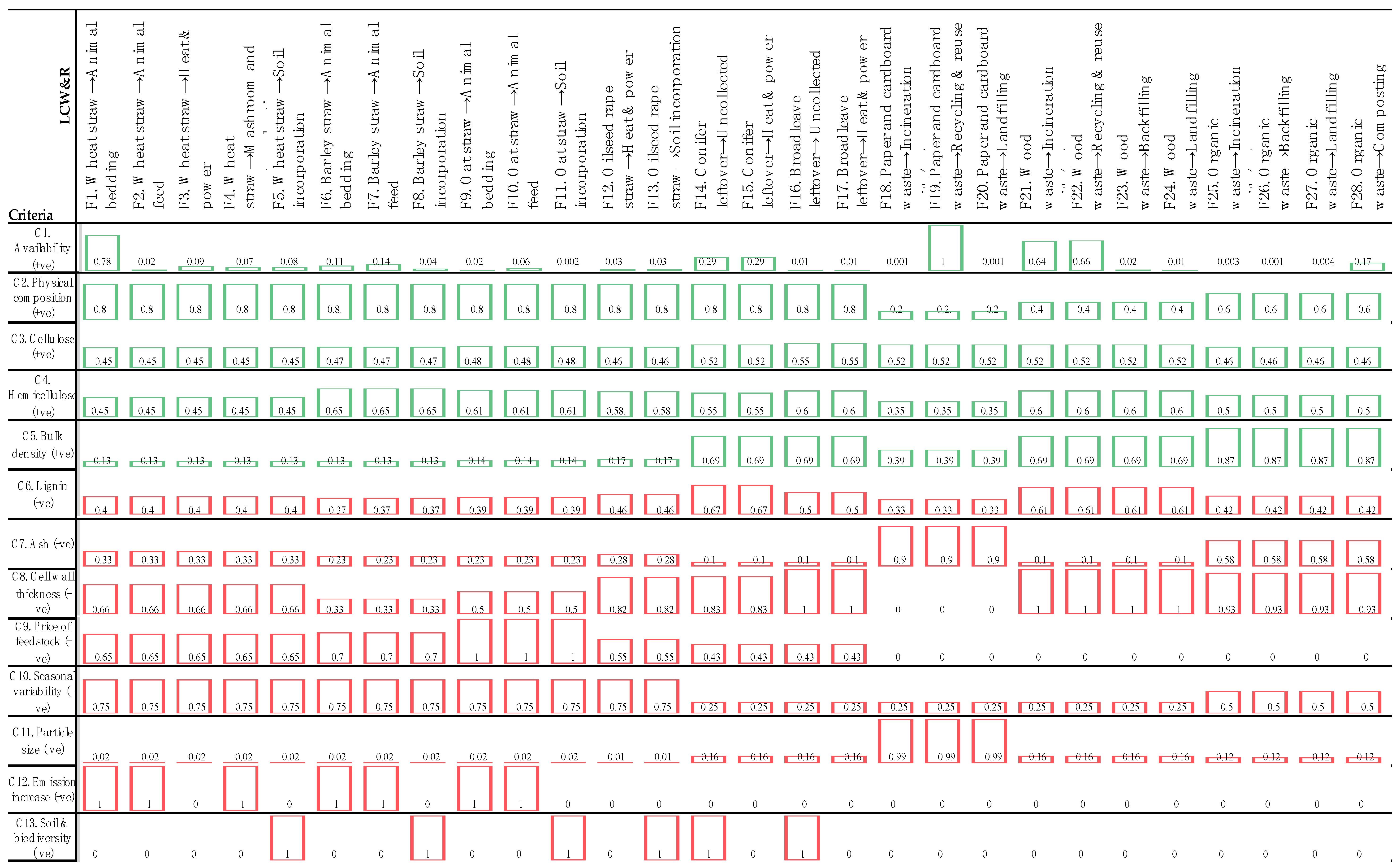
4. Discussion
Sustainability assessment of LCW&R for CNF packaging production is a complex problem, requiring combinatorial consideration of technical, economic and environmental aspects [33,34,43]. These characteristics are mentioned disjointly across the literature [20,24,46,47], though a consolidated overview is absent. This study uses an iterative literature review and experts’ interviews, and identifies 13 criteria, pertaining to LC waste sustainability for CNF packaging production. The criteria list includes: availability, physical composition, cellulose content, hemicellulose content, bulk density, lignin content, ash content, cell wall thickness, price of feedstock, seasonal variability, particle size, environmental emission, and soil and biodiversity impact. These criteria data are collected for the LCW&R streams in the UK (Table 5a and 5b), and are combined into a coherent matrix, assessing their performance (Table 6). The study helps to uncover the sustainability potential of LCW&R for CNF packaging production, encompassing technical properties as well as environmental and economic criteria.
Feedstock attributes, influencing the properties and performance of the CNF packaging films, make up the technical criteria. They include—physical composition, cellulose and hemicellulose contents— that determine strength, transparency, and recyclability of the packaging films. Most of the feedstock characteristics, inter alia, availability, physical composition, bulk density, lignin and price, are found to have influence on the economic aspects of the CNF packaging production, e.g. production yield, processing and supply chain costs, wear of machineries and raw material storage. Whereas environmental dimensions— such as energy consumption, waste management, emission and soil or biodiversity impacts— are correlated to certain feedstock criteria, e.g. bulk density, lignin, ash, particle size, emission, and soil and biodiversity impact and so on. Most of the sustainability assessment criteria are found to influence more than one aspects (technical, economic, environmental) of the CNF packaging production (see Figure 4).
Consideration of technical, economic and environmental factors under the sustainability umbrella presents a more comprehensive approach to feedstock sustainability assessment compared to the existing literature [24,35,53]. Although existing studies present combined synopsis of feedstock criteria for other LC-derivatives, e.g. biofuel and paper, review of bioplastics feedstock criteria is a new contribution [40,85,86]. Moreover, the criteria list presented in the paper can be used to assess the existing waste material streams/flows instead of just the material itself, taking into account the environmental impact for replacing their current practices [33].
The LCW&R streams in the UK have been analysed based on the identified criteria and presented through a performance matrix (Table 5a, 5b, 6). Paper and cardboard wastes intended for recycling (F19) provides the highest feedstock availability, though may result in lack of film mechanical properties. The highest mechanical properties can derive from wood residues and wastes (F14-17 and F21-24), yet high process energy consumption will be a barrier. Moreover, the extraction of uncollected residues (F14, F16) may cause soil and biodiversity impact, though more fractions could be obtained from designated locations [58]. Diversion of secondary waste streams from incineration and landfilling (F18, F21, F25, F27), will reduce feedstock cost, environmental emission and soil and biodiversity impacts; although processing costs may increase due to the presence of heterogenous material. The analysis technique used in this paper can be adopted in wide range of scenarios, requiring LC waste material diversion from existing uses to the production of CNF products including packaging.
The study explores the basic criteria for assessing sustainability of LC wastes in CNF packaging production. The results of this study will be considered in our forthcoming research on bioplastics feedstock decision analytics. Future research opportunity exists for consolidating empirical results to examine or enhance the proposed criteria. Further criteria distinctions can be considered based on: location, climatic conditions, plant species, crop cultivation, fibre location in plant, fibre age and presence of non-structural components (i.e. extractives). Moreover, the chemical pre-treatments and mechanical fibrillations used, influence the properties of resulting CNF films, and thus can be integrated with feedstock criteria analysis to identify the overall sustainable routes for commercial CNF packaging production [42].
5. Conclusions
This study presents criteria for assessing sustainability of LCW&R, incorporating technical, economic, and environmental aspects, for large scale CNF packaging production. Thirteen relevant attributes are identified through an iterative literature review and expert interviews. Further, we gather the criteria data for the UK waste streams and convert them into a performance matrix, measuring the feedstock sustainability. The research will help to identify low-cost feedstock and design biorefineries and supply chains for the CNF packaging, replacing the petrochemical plastics. The study can also help in waste management decisions by identifying the waste material streams for which bioplastics packaging production and environmental emission reduction is complimentary rather than conflicting. This will support the inclusion of bioplastic processing in the national waste management plan, facilitating circular bioeconomy.
Author Contributions
Conceptualization, S.I. and J.M.C.; methodology, S.I.; software, S.I.; validation, S.I.; formal analysis, S.I.; investigation, S.I.; data curation, S.I..; writing—original draft preparation, S.I.; writing—review and editing, S.I. and J.M.C.; visualization, S.I.; supervision, J.M.C.; project administration, S.I. and J.M.C.; funding acquisition, J.M.C. All authors have read and agreed to the published version of the manuscript.
Funding
This research was funded by Natural Environment Research Council (NERC), reference no: G106559.
Conflicts of Interest
The authors declare no conflict of interest.
References
- Assessment of Agricultural Plastics and their Sustainability-A Call for Action. (Accessed 7 January 2022). Available online: https://www.fao.org/3/cb7856en/cb7856en.pdf.
- Plastic Market Size, Share & Trends Report, 2022 - 2030. (Accessed 12 December 2022). Available online: https://www.grandviewresearch.com/industry-analysis/global-plastics-market.
- Plastics in the Bioeconomy (Issue 2). (Accessed 26 January 2022). Available online: https://cdn.ricardo.com/ee/media/downloads/ed12430-bb-net-report-final-issue-2.pdf.
- Plastic leakage and greenhouse gas emissions are increasing. (Accessed 26 January 2022). Available online: https://www.oecd.org/environment/plastics/increased-plastic-leakage-and-greenhouse-gas-emissions.htm.
- Barboza, L.G.A.; Cózar, A.; Gimenez, B.C.G.; Barros, T.L.; Kershaw, P.J.; Guilhermino, L. Macroplastics Pollution in the Marine Environment. In World Seas: An Environmental Evaluation Volume III: Ecological Issues and Environmental Impacts, 2nd ed.; Sheppard, C., Ed.; Academic press: Massachusetts, United States, 2019; Volume 3, pp. 305–328. [Google Scholar] [CrossRef]
- Peng, L.; Fu, D.; Qi, H.; Lan, C.Q.; Yu, H.; Ge, C. Micro- and nano-plastics in marine environment: Source, distribution and threats — A review. Science of The Total Environment 2020, 698, 134254. [Google Scholar] [CrossRef] [PubMed]
- Zhao, X.; Wang, Y.; Chen, X.; Yu, X.; Li, W.; Zhang, S.; Meng, X.; Zhao, Z., M.; Dong, T.; Anderson, A.; Aiyedun, A.; Li, Y.; Webb, E.; Wu, Z.; Kunc, V.; Ragauskas, A.; Ozcan, S.; Zhu, H. Sustainable bioplastics derived from renewable natural resources for food packaging. Matter 2023, 6, 97–127. [Google Scholar] [CrossRef]
- Lavrič, G.; Oberlintner, A.; Filipova, I.; Novak, U.; Likozar, B.; Vrabič-Brodnjak, U. Functional nanocellulose, alginate and chitosan nanocomposites designed as active film packaging materials. Polymers 2021, 13, 2523. [Google Scholar] [CrossRef] [PubMed]
- Bioplastics market data. (Accessed 26 January 2022). Available online: https://www.european-bioplastics.org/market/.
- Brizga, J.; Hubacek, K.; Feng, K. The unintended side effects of bioplastics: Carbon, land, and water footprints. One Earth 2020, 3, 45–53. [Google Scholar] [CrossRef]
- Raj, T.; Chandrasekhar, K.; Naresh Kumar, A.; Kim, S.H. Lignocellulosic biomass as renewable feedstock for biodegradable and recyclable plastics production: A sustainable approach. Renewable and Sustainable Energy Reviews 2022, 158, 112130. [Google Scholar] [CrossRef]
- The nexus of biofuels, climate change, and human health. (Accessed 20 February 2022). [CrossRef]
- Bishop, G.; Styles, D.; Lens, P.N.L. Environmental performance of bioplastic packaging on fresh food produce: A consequential life cycle assessment. Journal of Cleaner Production 2021, 317. [Google Scholar] [CrossRef]
- Garrido, F.J.O.; Piston, F.; Gomez, L.D.; Mcqueen-Mason, S.J. Biomass recalcitrance in barley, wheat and triticale straw: Correlation of biomass quality with classic agronomical traits. PLoS ONE 2018, 13, e0205880–e0205880. [Google Scholar] [CrossRef] [PubMed]
- Abe, M.M.; Martins, J.R.; Sanvezzo, P.B.; Macedo, J.V.; Branciforti, M.C.; Halley, P.; Botaro, V.R.; Brienzo, M. Advantages and disadvantages of bioplastics production from starch and lignocellulosic components. Polymers 2021, 13. [Google Scholar] [CrossRef] [PubMed]
- Davis, G.; Song, J.H. Biodegradable packaging based on raw materials from crops and their impact on waste management. Industrial Crops and Products 2006, 23, 147–161. [Google Scholar] [CrossRef]
- Rojas, J.; Bedoya, M.; Ciro, Y. Current trends in the production of cellulose nanoparticles and nanocomposites for biomedical applications. In Cellulose - Fundamental Aspects and Current Trends; Poletto, M., Ed.; IntechOpen: London, United Kingdom, 2015. [Google Scholar] [CrossRef]
- Petroudy, S.D. Physical and mechanical properties of natural fibers. In Advanced High Strength Natural Fibre Composites in Construction; Fan, M., Fu, F., Eds.; Woodhead Publishing: Cambridge, United Kingdom, 2017; pp. 59–83. [Google Scholar] [CrossRef]
- Arola, S.; Malho, J.M.; Laaksonen, P.; Lille, M.; Linder, M.B. The role of hemicellulose in nano fibrillated cellulose networks. Soft Matter 2013, 9, 1319–1326. [Google Scholar] [CrossRef]
- Lavoine, N.; Desloges, I.; Dufresne, A.; Bras, J. Microfibrillated cellulose - Its barrier properties and applications in cellulosic materials: A review. Carbohydrate Polymers 2012, 90, 735–764. [Google Scholar] [CrossRef] [PubMed]
- Khalil, H.P.S.; Davoudpour, Y.; Saurabh, C.K.; Hossain, M.S.; Adnan, A.S.; Dungani, R.; Paridah, M.T.; Sarker, M., Z.; Fazita, M., R.; Syakir, M.I.; Haafiz, M.K.M. A review on nanocellulosic fibres as new material for sustainable packaging: Process and applications. Renewable and Sustainable Energy Reviews 2016, 64, 823–836. [Google Scholar] [CrossRef]
- Rajinipriya, M.; Nagalakshmaiah, M.; Robert, M.; Elkoun, S. Importance of agricultural and industrial waste in the field of nanocellulose and recent industrial developments of wood based nanocellulose: a review. ACS Publications 2018, 6, 2807–2828. [Google Scholar] [CrossRef]
- Shanmugam, K.; Doosthosseini, H.; Varanasi, S.; Garnier, G.; Batchelor, W. Nanocellulose films as air and water vapour barriers: A recyclable and biodegradable alternative to polyolefin packaging. Sustainable Materials and Technologies 2019, 22, e00115. [Google Scholar] [CrossRef]
- Kontturi, K.S.; Lee, K.Y.; Jones, M.P.; Sampson, W.W.; Bismarck, A.; Kontturi, E. Influence of biological origin on the tensile properties of cellulose nanopapers. Cellulose 2021, 28, 6619–6628. [Google Scholar] [CrossRef]
- Azeredo, H.M.C.; Rosa, M.F.; Mattoso, L.H.C. Nanocellulose in bio-based food packaging applications. Industrial Crops and Products 2017, 97, 664–671. [Google Scholar] [CrossRef]
- Kalia, S.; Boufi, S.; Celli, A.; Kango, S. Nanofibrillated cellulose: Surface modification and potential applications. Colloid and Polymer Science 2014, 292, 5–31. [Google Scholar] [CrossRef]
- Gómez, H., C.; Serpa, A.; Velásquez-Cock, J.; Gañán, P.; Castro, C.; Vélez, L.; Zuluaga, R. Vegetable nanocellulose in food science: A review. Food Hydrocolloids 2016, 57, 178–186. [Google Scholar] [CrossRef]
- Nechyporchuk, O.; Belgacem, M.N.; Bras, J. Production of cellulose nanofibrils: A review of recent advances. Industrial Crops and Products 2016, 93, 2–25. [Google Scholar] [CrossRef]
- Ang, S.; Ghosh, D.; Haritos, V.; Batchelor, W. Recycling cellulose nanofibers from wood pulps provides drainage improvements for high strength sheets in papermaking. Journal of Cleaner Production 2021, 312. [Google Scholar] [CrossRef]
- Vikman, M.; Vartiainen, J.; Tsitko, I.; Korhonen, P. Biodegradability and Compostability of Nanofibrillar Cellulose-Based Products. Journal of Polymers and the Environment 2015, 23, 206–215. [Google Scholar] [CrossRef]
- Statista. Flexible packaging global production volume 2017-2022. Available online: https://www.statista.com/statistics/719097/production-volume-of-the-global-flexible-packaging-industry/.
- Stark, N.M. . Opportunities for Cellulose Nanomaterials in Packaging Films: A Review and Future Trends. Journal of Renewable Materials 2016, 4, 313. [Google Scholar] [CrossRef]
- Bishop, G.; Styles, D.; Lens, P.N.L. Land-use change and valorisation of feedstock side-streams determine the climate mitigation potential of bioplastics. Resources, Conservation and Recycling 2022, 180. [Google Scholar] [CrossRef]
- Bussemaker, M.J.; Day, K.; Drage, G.; Cecelja, F. Supply chain optimisation for an ultrasound-organosolv lignocellulosic biorefinery: impact of technology choices. Waste and Biomass Valorization 2017, 8, 2247–2261. [Google Scholar] [CrossRef] [PubMed]
- Tonini, D.; Hamelin, L.; Astrup, T.F. Environmental implications of the use of agro-industrial residues for biorefineries: application of a deterministic model for indirect land-use changes. GCB Bioenergy 2016, 8, 690–706. [Google Scholar] [CrossRef]
- Badgujar, K.C.; Bhanage, B.M. Dedicated and waste feedstocks for biorefinery: An approach to develop a sustainable society. In Waste Biorefinery: Potential and Perspectives; Bhaskar, T., Pandey, A., Mohan, S.V., Lee, D.J., Khanal, S.K., Eds.; Elsevier: Amsterdam, Netherlands, 2018; pp. 3–38. [Google Scholar] [CrossRef]
- Piemonte, V.; Gironi, F. Land-use change emissions: How green are the bioplastics? Environmental Progress & Sustainable Energy 2011, 30, 685–691. [Google Scholar] [CrossRef]
- Jonoobi, M.; Mathew, A.P.; Oksman, K. Natural resources and residues for production of bionanomaterials. In Handbook of Green Materials: 1 Bionanomaterials: separation processes, characterization and properties; Oksman, K., Mathew, A.P., Bismarck, A., Rojas, O., Sain, M., Eds.; World Scientific: Singapore, 2014. [Google Scholar] [CrossRef]
- United Kingdom Roadmap for lignocellulosic biomass and relevant policies for a bio-based economy in 2030. (Accessed 4 January 2022). Available online: https://www.s2biom.eu/images/Publications/WP8_Country_Outlook/Final_Roadmaps_March/S2Biom-UNITED-KINGDOM-biomass-potential-and-policies.pdf.
- Lignocellulosic feedstock in the, UK. Available online:. (Accessed 4 January 2022). Available online: https://www.nnfcc.co.uk/files/mydocs/LBNet%20Lignocellulosic%20feedstockin%20the%20UK_Nov%202014.pdf.
- Availability of cellulosic residues and wastes in the eu - international council on clean transportation. (Accessed 16 July 2022). Available online: https://www.theicct.org/publications/availability-cellulosic-residues-and-wastes-eu.
- Balea, A.; Fuente, E.; Tarrés, Q.; Pèlach, M.À.; Mutjé, P.; Delgado-Aguilar, M.; Blanco, A.; Negro, C. Influence of pretreatment and mechanical nanofibrillation energy on properties of nanofibers from Aspen cellulose. Cellulose 2021, 28, 9187–9206. [Google Scholar] [CrossRef]
- Bosworth, S.C. Perennial grass biomass production and utilization. In Bioenergy: Biomass to Biofuels and Waste to Energy; Dahiya, A., Ed.; Academic press: Massachusetts, United States, 2020; pp. 89–105. [Google Scholar] [CrossRef]
- Malucelli, L.C.; Lacerda, L.G.; Dziedzic, M.; da Silva Carvalho Filho, M.A. Preparation, properties and future perspectives of nanocrystals from agro-industrial residues: a review of recent research. Reviews in Environmental Science and Biotechnology 2017, 16, 131–145. [Google Scholar] [CrossRef]
- Bian, H. ; Yang, Y.; Tu, P.; Bian, H.; Yang, Y.; Tu, P.; Chen, J.Y. Value-added utilization of wheat straw: from cellulose and cellulose nanofiber to all-cellulose nanocomposite film. Membranes 2022, 12, 475. [Google Scholar] [CrossRef]
- Stelte, W.; Sanadi, A.R. Preparation and characterization of cellulose nanofibers from two commercial hardwood and softwood pulps. Industrial and Engineering Chemistry Research 2009, 48, 11211–11219. [Google Scholar] [CrossRef]
- Woiciechowski, A.L.; José, C.; Neto, D.; Porto De Souza Vandenberghe, L.; De Carvalho Neto, P.; Novak Sydney, A.C.; Letti, A.J.; Karp, S.G.; Alberto, L.; Torres, Z.; Soccol, C.R. Lignocellulosic biomass: Acid and alkaline pretreatments and their effects on biomass recalcitrance-Conventional processing and recent advances. Bioresource technology 2020, 304, 122848. [Google Scholar] [CrossRef] [PubMed]
- Blanco, A.; Monte, M.C.; Campano, C.; Balea, A.; Merayo, N.; Negro, C. Nanocellulose for Industrial Use: Cellulose Nanofibers (CNF), Cellulose Nanocrystals (CNC), and Bacterial Cellulose (BC). In Handbook of Nanomaterials for Industrial Applications; Hussain, C.M., Ed.; Elsevier: Amsterdam, Netherlands, 2018; pp. 74–126. [Google Scholar] [CrossRef]
- Chaker, A.; Alila, S.; Mutjé, P.; Vilar, M.R.; Boufi, S. Key role of the hemicellulose content and the cell morphology on the nanofibrillation effectiveness of cellulose pulps. Cellulose 2013, 20, 2863–2875. [Google Scholar] [CrossRef]
- Iwamoto, S.; Abe, K.; Yano, H. The effect of hemicelluloses on wood pulp nano fibrillation and nanofiber network characteristics. Biomacromolecules 2008, 9, 1022–1026. [Google Scholar] [CrossRef] [PubMed]
- Khalil, H.P.S.; Adnan, A.S.; Yahya, E.B.; Olaiya, N.G.; Safrida, S.; Hossain, M.S.; Balakrishnan, V.; Gopakumar, D.A.; Abdullah, C.K.; Oyekanmi, A.A.; Pasquini, D. A review on plant cellulose nanofibre-based aerogels for biomedical applications. Polymers 2020, 12, 1759. Available online: https://www.mdpi.com/790598. [CrossRef]
- Pre-treatments to enhance the enzymatic saccharification of lignocellulose: technological and economic aspects. (Accessed 14 May 2022). Available online: https://www.bbnet-nibb.co.uk/resource/pre-treatments-to-enhance-the-enzymatic-saccharification-of-lignocellulose-technological-and-economic-aspects/.
- van Dyken, S.; Bakken, B.H.; Skjelbred, H.I. Linear mixed-integer models for biomass supply chains with transport, storage and processing. Energy 2010, 35, 1338–1350. [Google Scholar] [CrossRef]
- Agrocycle factsheet: Straw production and value chains. (Accessed 4 June 2022). Available online: https://www.nnfcc.co.uk/files/mydocs/Straw%20factsheet.pdf.
- Use of sustainably sourced residue and waste streams for advanced biofuel production in the European Union: rural economic impacts and potential for job creation. Available online: https://www.nnfcc.co.uk/files/mydocs/14_2_18%20%20ECF%20Advanced%20Biofuels_NNFCC%20published%20v2.pdf(Accessed 23 March 2022). Understanding waste streams: Treatment of specific waste. Available online: https://www.europarl.europa.eu/EPRS/EPRSBriefing- 564398-Understanding-waste-streams-FINAL.pdf(Accessed 2 February 2022). Straw prices soar, piling pressure on northern European livestock farmers. Available online: https://www.euractiv.com/section/ agriculture-food/news/straw-prices-soar-piling-pressure-on-northern-europe-livestock-farmers/(Accessed 15 April 2022).
- Titus, B.D.; Brown, K.; Helmisaari, H.S.; Vanguelova, E.; Stupak, I.; Evans, A.; Clarke, N.; Guidi, C.; Bruckman, V.J.; Varnagiryte-Kabasinskiene, I.; Armolaitis, K.; de Vries, W.; Hirai, K.; Kaarakka, L.; Hogg, K.; Reece, P. Sustainable forest biomass: a review of current residue harvesting guidelines. Energy, Sustainability and Society 2021, 11, 1–32. [Google Scholar] [CrossRef]
- Guidance on classification of waste according to EWC-Stat categories- Supplement to the Manual for the Implementation of the Regulation (EC) No 2150/2002 on Waste Statistics. (Accessed 25 March 2022). Available online: https://ec.europa.eu/eurostat/documents/342366/351806/Guidance-on-EWCStat-categories-2010.pdf/0e7cd3fc-c05c-47a7-818f-1c2421e55604.
- UK statistics on waste - GOV.UK. Office for National Statistics. (Accessed September 1, 2022). Available online: https://www.gov.uk/government/statistics/uk-waste-data.
- Agriculture in the United Kingdom data sets. (Accessed September 3, 2022). Available online: https://www.gov.uk/government/statistical-data-sets/agriculture-in-the-united-kingdom.
- The main components of yield in wheat. (Accessed December 17, 2022). Available online: https://ahdb.org.uk/knowledge-library/the-main-components-of-yield-in-wheat.
- The main components of yield in barley. (Accessed December 17, 2022). Available online: https://ahdb.org.uk/knowledge-library/the-main-components-of-yield-in-barley.
- Oat growth guide: An output from optimising growth to maximise yield and quality. (December 17, 2022). Available online: https://www.hutton.ac.uk/sites/default/files/files/publications/Oat-Growth-Guide.pdf.
- Plant biomass: miscanthus, short rotation coppice and straw. (Accessed August 7, 2022). Available online: https://www.gov.uk/government/statistics/area-of-crops-grown-for-bioenergy-in-england-and-the-uk-2008-2020/section-2-plant-biomass-miscanthus-short-rotation-coppice-and-straw.
- Straw and Forage Study. (Accessed August 5, 2022). Available online: https://www.gov.scot/binaries/content/documents/govscot/publications/factsheet/2018/04/straw-and-forage-study-sruc-research-report/documents/straw-forage-study-sruc-report-2017-2018-pdf/straw-forage-study-sruc-report-2017-2018-pdf/govscot%3Adocument/Straw%2Band%2Bforage%2Bstudy%2B-%2BSRUC%2Breport%2B2017-2018.pdf.
- 25-year forecast of softwood timber availability. (Accessed January 30, 2022). Available online: https://www.forestresearch.gov.uk/publications/25-year-forecast-of-softwood-timber-availability/.
- Forestry Statistics 2018 - Forest Research. (Accessed January 30, 2022). Available online: https://www.forestresearch.gov.uk/tools-and-resources/statistics/forestry-statistics/forestry-statistics-2021/.
- Compost Moisture content. (November 20, 2022). Available online: http://www.carryoncomposting.com/416920216.
- Arena, U.; di Gregorio, F. A waste management planning based on substance flow analysis. Resources, Conservation and Recycling 2014, 85, 54–66. [Google Scholar] [CrossRef]
- Owen, E.; Jayasuriyat, C.N. Use of crop residues as animal feeds in developing countries. Research and development in agriculture 1989, 6, 129–138. [Google Scholar]
- Islam, S.; Ponnambalam, S.G.; Lam, H.L. A novel framework for analysing the green value of food supply chain based on life cycle assessment. Clean Technologies and Environmental Policy 2017, 19, 93–103. [Google Scholar] [CrossRef]
- Olinto, A.C. , & Islam, S. Optimal aggregate sustainability assessment of total and selected factors of industrial processes. Clean Technologies and Environmental Policy 2017, 19, 1791–1797. [Google Scholar]
- Hughes, S.R.; Qureshi, N. Biomass for biorefining: resources, allocation, utilization, and policies. In Biorefineries: Integrated Biochemical Processes for Liquid Biofuels; Qureshi, N., Hodge, D.B., Vertès, A.A., Eds.; Elsevier: Amsterdam, Netherlands, 2014; pp. 37–58. [Google Scholar] [CrossRef]
- Bhatia, S.K.; Otari, S.V.; Jeon, J.M.; Gurav, R.; Choi, Y.K.; Bhatia, R.K.; Pugazhendhi, A.; Kumar, V.; Rajesh Banu, J.; Yoon, J.J.; Choi, K.Y.; Yang, Y.H. Biowaste-to-bioplastic (polyhydroxyalkanoates): Conversion technologies, strategies, challenges, and perspective. Bioresource Technology 2021, 326, 124733. [Google Scholar] [CrossRef] [PubMed]
- Is Resource Availability Slowing you Down ? Available online:. (Accessed February 5, 2022). Available online: https://www.google.com/search?q=Is+Resource+Availability+Slowing+you+Down%3F&rlz=1C1GCEU_enGB842GB842&oq=Is+Resource+Availability+Slowing+you+Down%3F&aqs=chrome..69i57j69i60.1250j0j4&sourceid=chrome&ie=UTF-8.
- Abdel-Shafy, H.I.; Mansour, M.S.M. Solid waste issue: Sources, composition, disposal, recycling, and valorization. Egyptian Journal of Petroleum 2018, 27, 1275–1290. [Google Scholar] [CrossRef]
- The Effect of Age and Recycling on Paper Quality. (Accessed February 5, 2022). Available online: https://scholarworks.wmich.edu/cgi/viewcontent.cgi?article=5957&context=masters_theses.
- Awoyale, A.A.; Lokhat, D.; Okete, P. Investigation of the effects of pretreatment on the elemental composition of ash derived from selected Nigerian lignocellulosic biomass. Scientific Reports 2021, 11, 21313. [Google Scholar] [CrossRef] [PubMed]
- Di Pretoro, A.; Montastruc, L.; Manenti, F.; Joulia, X. Flexibility assessment of a biorefinery distillation train: Optimal design under uncertain conditions. Computers and Chemical Engineering 2020, 138. [Google Scholar] [CrossRef]
- Tumuluru, J.S.; Tabil, L.G.; Song, Y.; Iroba, K.L.; Meda, V. Grinding energy and physical properties of chopped and hammer-milled barley, wheat, oat, and canola straws. Biomass and Bioenergy 2014, 60, 58–67. [Google Scholar] [CrossRef]
- Food contact materials authorisation guidance. (Accessed December 15, 2022). Available online: https://www.food.gov.uk/business-guidance/regulated-products/food-contact-materials-guidance.
- Abdel-Hamid, A.M.; Solbiati, J.O.; Cann, I.K.O. Insights into lignin degradation and its potential industrial applications. Advances in Applied Microbiology 2013, 82, 1–28. [Google Scholar] [CrossRef] [PubMed]
- Klemm, D.; Heublein, B.; Fink, H.P.; Bohn, A.; Klemm, D.; Fink, H.-P. Cellulose: fascinating biopolymer and sustainable raw material. Wiley Online Library 2005, 44, 3358–3393. [Google Scholar] [CrossRef]
- Abara Mangasha, L. Review on Effect of Some Selected Wood Properties on Pulp and Paper Properties. Journal of Forestry and Environment 2019, 1, 16–22. [Google Scholar]
- Anupam, K.; Lal, P.S.; Bist, V.; Sharma, A.K.; Swaroop, V. Raw material selection for pulping and papermaking using TOPSIS multiple criteria decision-making design. Environmental Progress & Sustainable Energy 2014, 33, 1034–1041. [Google Scholar] [CrossRef]
- Zhang, Q.; Zhang, P.; Pei, Z.J.; Wang, D. Relationships between cellulosic biomass particle size and enzymatic hydrolysis sugar yield: Analysis of inconsistent reports in the literature. Renewable Energy 2013, 60, 127–136. [Google Scholar] [CrossRef]
- Scheller, H.V.; Ulvskov, P. Hemicelluloses. Annual Review of Plant Biology 2010, 61, 263–289. [Google Scholar] [CrossRef] [PubMed]
- Tenhunen, T.M.; Peresin, M.S.; Penttilä, P.A.; Pere, J.; Serimaa, R.; Tammelin, T. Significance of xylan on the stability and water interactions of cellulosic nanofibrils. Reactive and Functional Polymers 2014, 85, 157–166. [Google Scholar] [CrossRef]
- Kumar, A.; Sokhansanj, S.; Flynn, P.C. Development of a multicriteria assessment model for ranking biomass feedstock collection and transportation systems. Applied Biochemistry and Biotechnology 2006, 129, 71–87. [Google Scholar] [CrossRef] [PubMed]
- Bulk Density Impacts on the Supply Chain. (Accessed December 15, 2022). Available online: https://generainc.com/bulk-density-impacts-on-the-supply-chain/.
- Sannigrahi, P.; Pu, Y.; Ragauskas, A. Cellulosic biorefineries-unleashing lignin opportunities. Current opinion in environmental sustainability 2010, 2, 383–393. [Google Scholar] [CrossRef]
- Ogden, C.A.; Ileleji, K.E.; Johnson, K.D. Fuel property changes of switchgrass during one-year of outdoor storage. Biomass and Bioenergy 2019, 120, 359–366. [Google Scholar] [CrossRef]
- Pennells, J.; Godwin, I.D.; Amiralian, N.; Martin, D.J. Trends in the production of cellulose nanofibers from non-wood sources. Cellulose 2020, 27, 575–593. [Google Scholar] [CrossRef]
- James, A.K.; Thring, R.W.; Helle, S.; Ghuman, H.S. Ash Management Review—Applications of Biomass Bottom Ash. Energies 2012, 5, 3856–3873. [Google Scholar] [CrossRef]
- Gharpuray, M.M.; Lee, Y.H.; Fan, L.T. Structural modification of lignocellulosics by pretreatments to enhance enzymatic hydrolysis. Biotechnology and Bioengineering 1983, 25, 157–172. [Google Scholar] [CrossRef] [PubMed]
- Cheng, Z.; Leal, J.H.; Hartford, C.E.; Carson, J.W.; Donohoe, B.S.; Craig, D.A.; Xia, Y.; Daniel, R.C.; Ajayi, O.O.; Semelsberger, T.A. Flow behavior characterization of biomass Feedstocks. Powder Technology 2021, 387, 156–180. [Google Scholar] [CrossRef]
- Richard Hess, J.; Wright, C.T.; Kenney, K.L. Cellulosic biomass feedstocks and logistics for ethanol production. Biofuels, Bioproducts and Biorefining 2007, 1, 181–190. [Google Scholar] [CrossRef]
- Uniform-Format Solid Feedstock Supply System: A Commodity-Scale Design to Produce an Infrastructure-Compatible Bulk Solid from Lignocellulosic Biomass-Executive Summary. (Accessed April 3, 2022). Available online: https://inldigitallibrary.inl.gov/sites/sti/sti/4408280.pdf.
- Rentizelas, A.A.; Tolis, A.J.; Tatsiopoulos, I.P. Logistics issues of biomass: The storage problem and the multi-biomass supply chain. Renewable and Sustainable Energy Reviews 2009, 13, 887–894. [Google Scholar] [CrossRef]
- Denafas, G.; Ruzgas, T.; Martuzevičius, D.; Shmarin, S.; Hoffmann, M.; Mykhaylenko, V.; Ogorodnik, S.; Romanov, M.; Neguliaeva, E.; Chusov, A.; Turkadze, T.; Bochoidze, I.; Ludwig, C. Seasonal variation of municipal solid waste generation and composition in four East European cities. Resources, Conservation and Recycling 2014, 89, 22–30. [Google Scholar] [CrossRef]
- United Kingdom: Roadmap for lignocellulosic biomass and relevant policies for a bio-based economy in 2030. (Accessed October 20, 2022). Available online: https://www.s2biom.eu/images/Publications/WP8_Country_Outlook/Final_Roadmaps_March/S2Biom-UNITED-KINGDOM-biomass-potential-and-policies.pdf.
- Residue management consideration for this fall. (Accessed October 20, 2022). Available online: https://crops.extension.iastate.edu/blog/mahdi-al-kaisi/residue-management-consideration-fall.
- Stump Harvesting: Interim Guidance on Site Selection and Good Practice (Issue April). (Accessed October 22, 2022). Available online: https://cdn.forestresearch.gov.uk/2022/02/fc_stump_harvesting_guidance_april09.pdf.
- Gruduls, K.; Bardule, A.; Zalitis, T.; Lazdiņš, A. Characteristics of wood chips from loging residues and quality influencing factors. Research for rural development 2013, 2, 49–54. [Google Scholar]
- White, J.K. The application of LDAT to the HPM2 challenge. Proceedings of Institution of Civil Engineers: Waste and Resource Management 2008, 161, 137–146. [Google Scholar] [CrossRef]
- Byadgi, S.A.; Kalburgi, P.B. Production of bioethanol from waste newspaper. Procedia Environmental Sciences 2016, 35, 555–562. [Google Scholar] [CrossRef]
- Xu, H.; Huang, L.; Xu, M.; Qi, M.; Yi, T.; Mo, Q.; Zhao, H.; Huang, C.; Wang, S.; Liu, Y. Preparation and Properties of Cellulose-Based Films Regenerated from Waste Corrugated Cardboards Using [Amim]Cl/CaCl2. ACS Omega 2020, 5, 23743–23754. [Google Scholar] [CrossRef] [PubMed]
- Tanguay-Rioux, F. , Héroux, M., & Legros, R. Physical properties of recyclable materials and implications for resource recovery. Waste Management 2021, 136, 956–053. [Google Scholar] [CrossRef]
- Material bulk densities. (Accessed July 27, 2022). Available online: https://wrap.org.uk/resources/report/material-bulk-densities.
- Kristanto, G.A.; Zikrina, M.N. Analysis of the effect of waste’s particle size variations on biodrying method. AIP Conference Proceedings 2017, 1903, 040009. [Google Scholar] [CrossRef]
- Singh, S.; Dutt, D.; Tyagi, C.H. Complete characterization of wheat straw. BioResources 2011, 6, 154–177. [Google Scholar] [CrossRef]
- Hay and straw prices. (Accessed July 27, 2022). Available online: https://ahdb.org.uk/dairy/hay-and-straw-prices.
- Laborel-Préneron, A.; Magniont, C.; Aubert, J.E. Characterization of barley straw, hemp shiv and corn cob as resources for bioaggregate based building materials. Waste and Biomass Valorization 2018, 9, 1095–1112. [Google Scholar] [CrossRef]
- Kärkönen, A.; Korpinen, R.; Järvenpää, E.; Aalto, A.; Saranpää, P. Properties of oat and barley hulls and suitability for food packaging materials. Journal of natural fibers 2022, 19, 13326–13336. [Google Scholar] [CrossRef]
- Mazhari Mousavi, S.M.; Hosseini, S.Z.; Resalati, H.; Mahdavi, S.; Rasooly Garmaroody, E. Papermaking potential of rapeseed straw, a new agricultural-based fiber source. Journal of Cleaner Production 2013, 52, 420–424. [Google Scholar] [CrossRef]
- The cell wall ultrastructure of wood fibres-effects of the chemical pulp fibre line. (Accessed October 22, 2022). Available online: https://www.diva-portal.org/smash/get/diva2:7109/FULLTEXT01.pdf.
- Effects of cell wall structure on tensile properties of hardwood. (Accessed October 22, 2022). Available online: https://www.diva-portal.org/smash/get/diva2:409533/FULLTEXT02.pdf.
- Ma, Y.; Hummel, M.; Määttänen, M.; Särkilahti, A.; Harlin, A.; Sixta, H. Upcycling of wastepaper and cardboard to textiles. Green Chemistry 2016, 18, 858–866. [Google Scholar] [CrossRef]
- Properties of paper. (Accessed October 7, 2022,). Available online: https://www.paperonweb.com/paperpro.htm.
- Ash Content of Grasses for Biofuel. (Accessed October 7, 2022). Available online: http://www.carborobot.com/Download/Papers/Bioenergy_Info_Sheet_5.pdf.
- Sadef, Y.; Javed, T.; Javed, R.; Mahmood, A.; Alwahibi, M.S.; Elshikh, M.S.; AbdelGawwa, M.R.; Alhaji, J.H.; Rasheed, R.A. Nutritional status, antioxidant activity and total phenolic content of different fruits and vegetables’ peels. PLoS ONE 2022, 17. [Google Scholar] [CrossRef] [PubMed]
- Plant Cell Wall. (Accessed October 7, 2022). Available online: https://www.botanicaldoctor.co.uk/learn-about-plants/cell-wall.
Figure 1.
Hierarchical structure of cellulose fiber in LC cell wall.
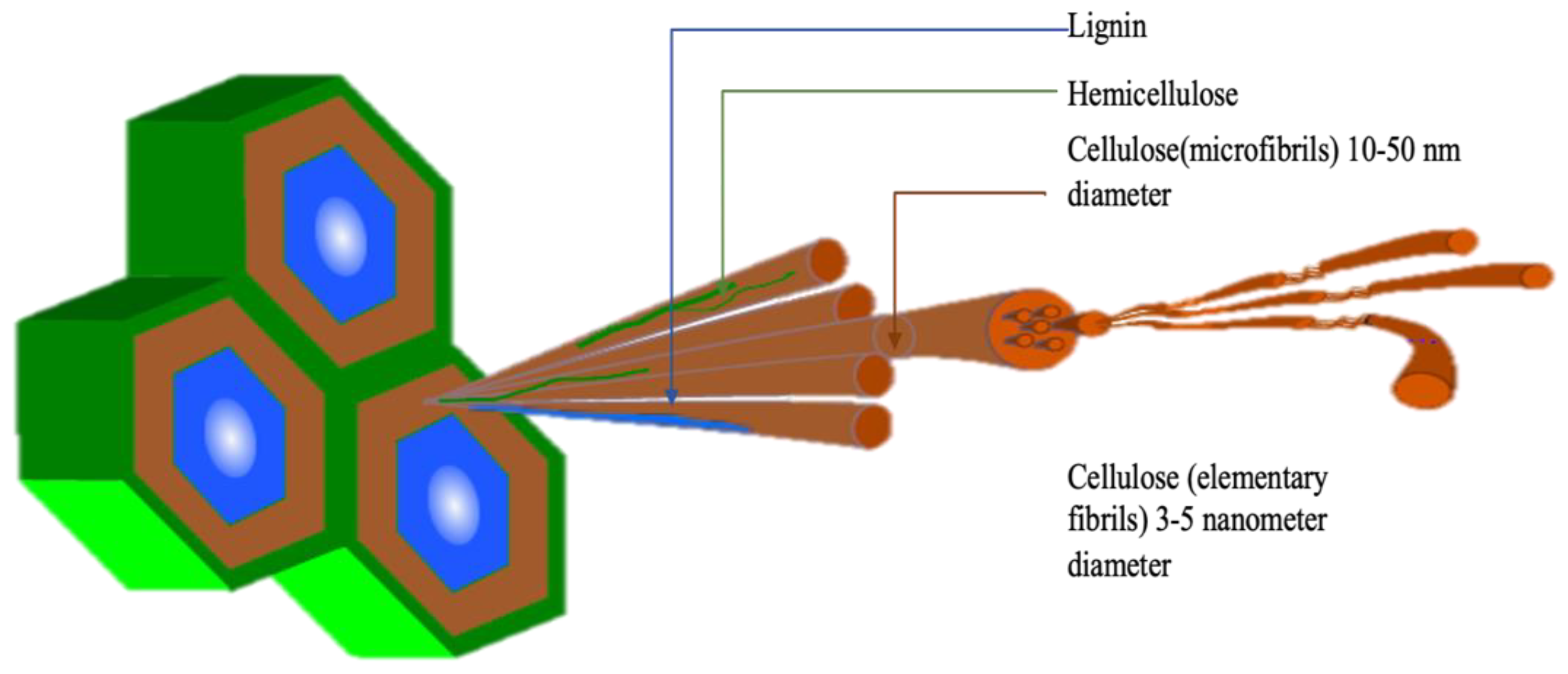
Figure 2.
Generic CNF film processing from LC and end-of-life treatments.
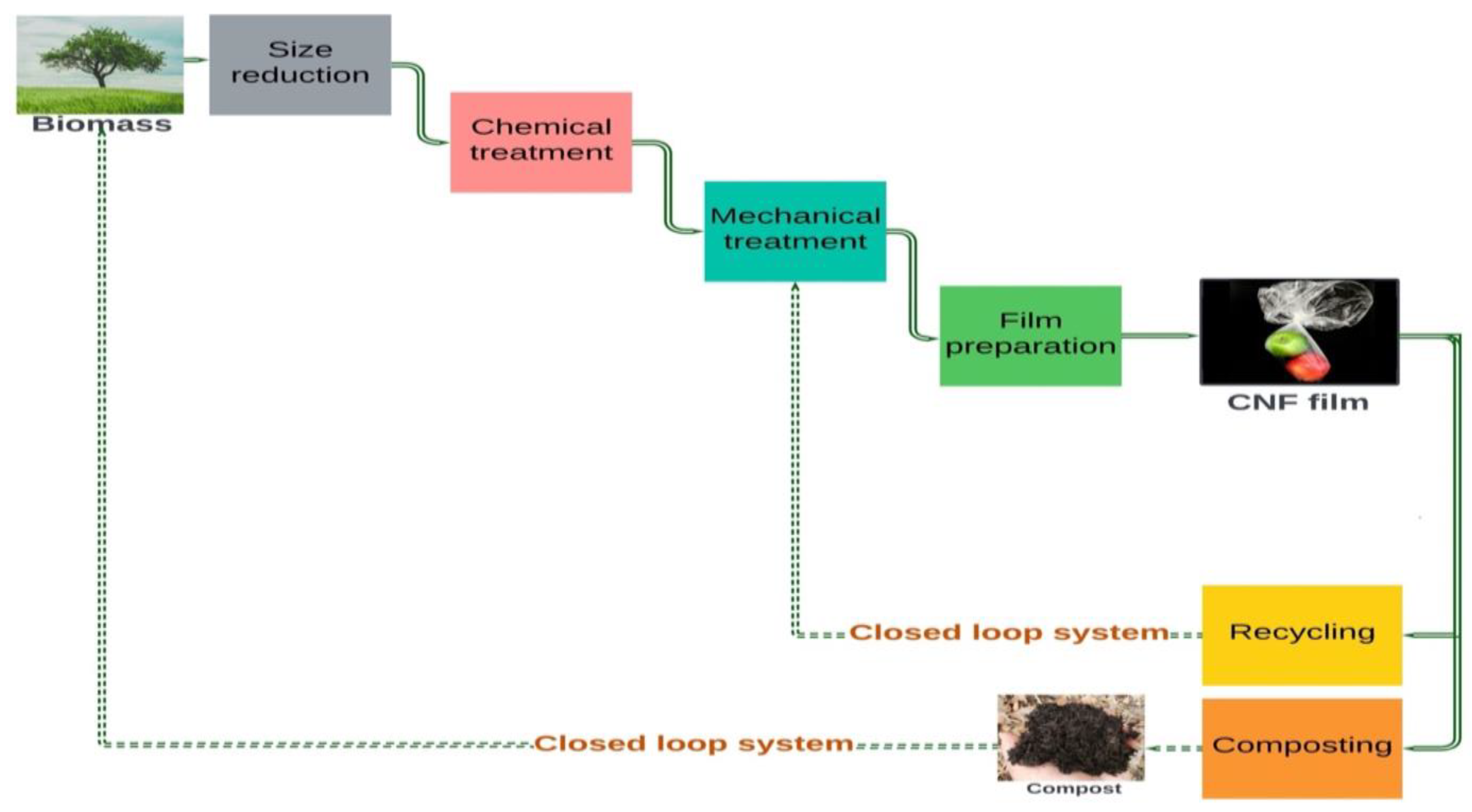
Figure 3.
Generic CNF film processing from LC and end-of-life treatments.
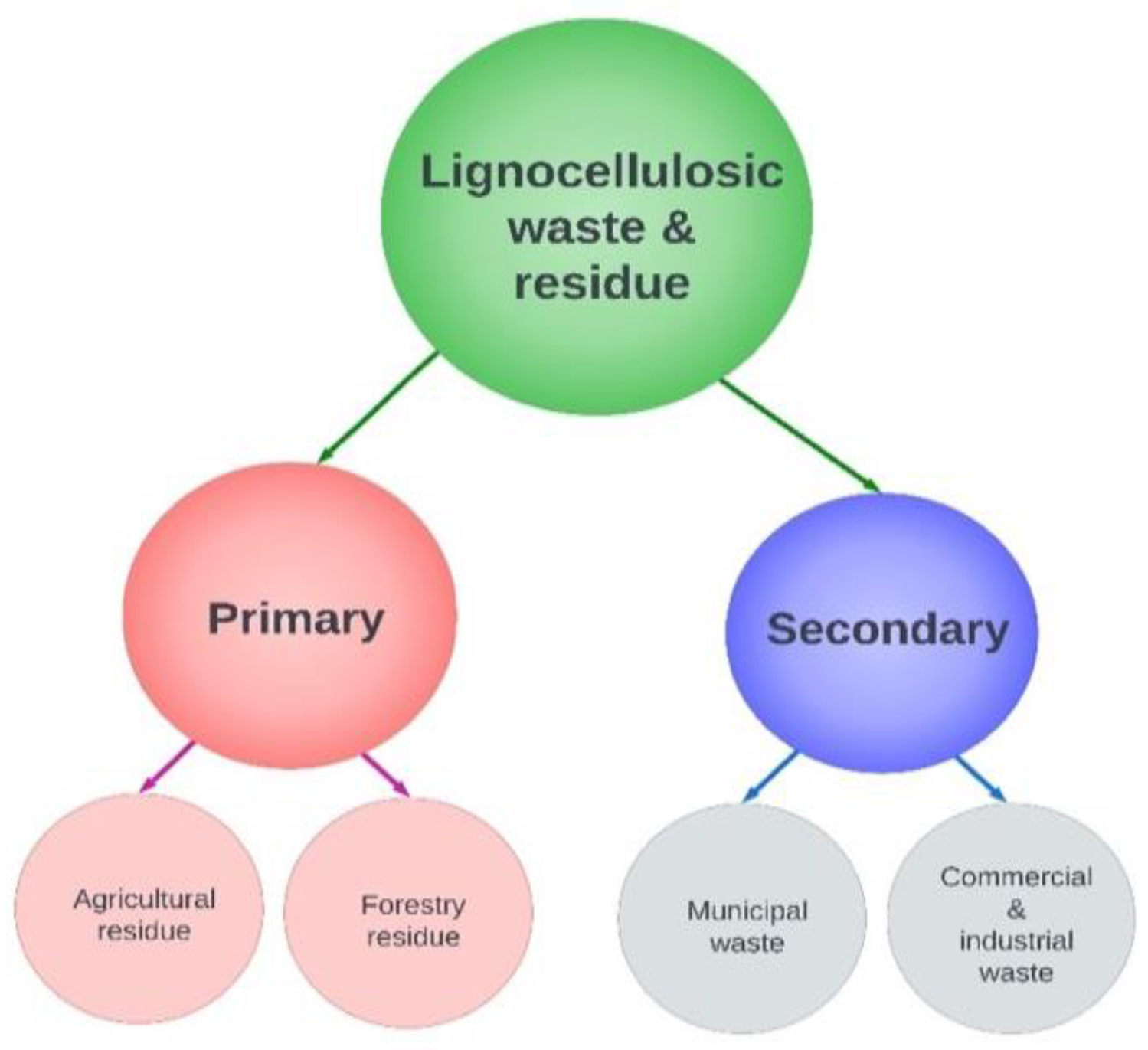
Figure 4.
The thirteen feedstock criteria with impacts under technical, economic and environmental categories used for sustainability assessment of LCW&R for CNF packaging production.
Figure 4.
The thirteen feedstock criteria with impacts under technical, economic and environmental categories used for sustainability assessment of LCW&R for CNF packaging production.
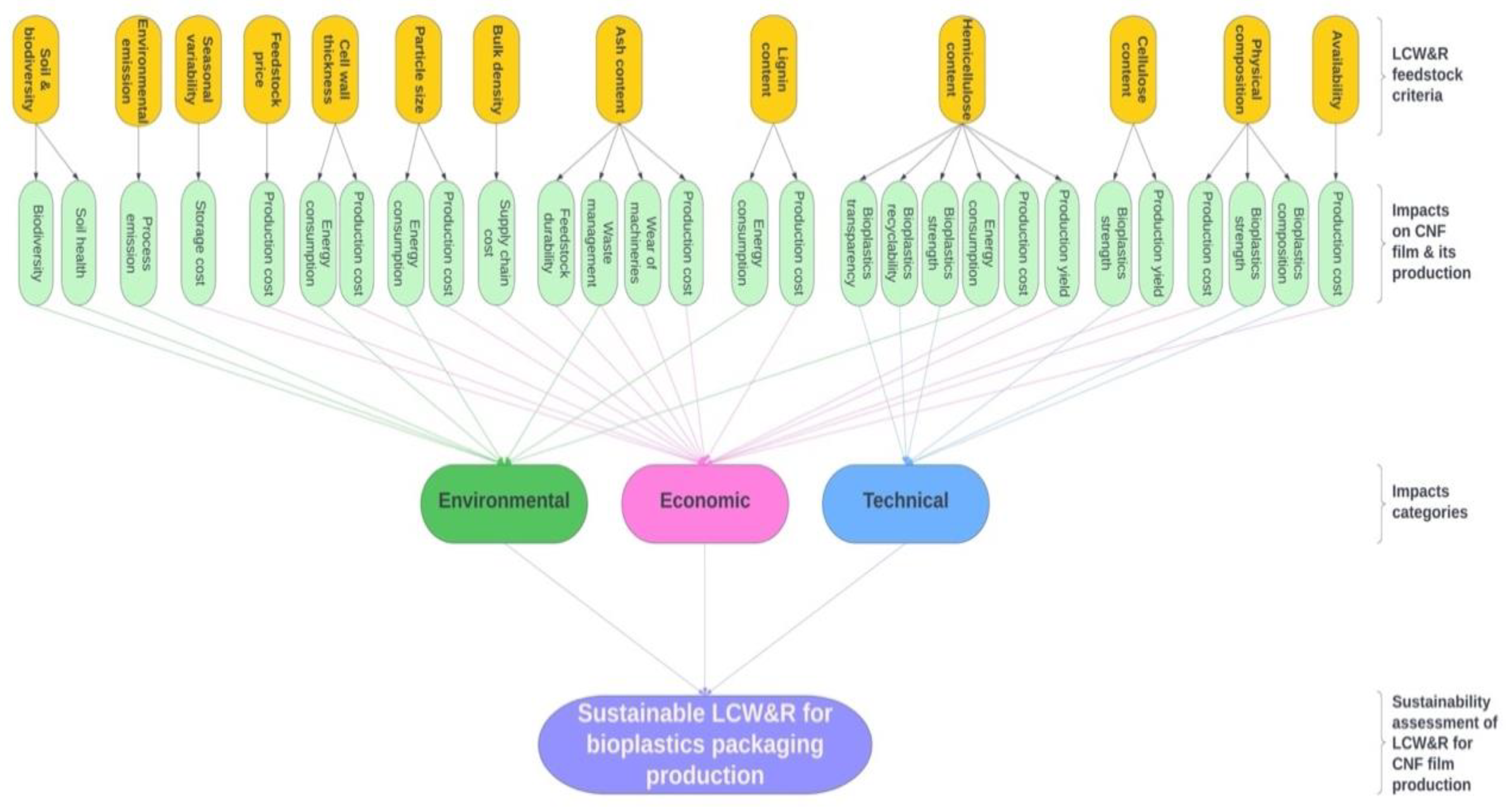
Disclaimer/Publisher’s Note: The statements, opinions and data contained in all publications are solely those of the individual author(s) and contributor(s) and not of MDPI and/or the editor(s). MDPI and/or the editor(s) disclaim responsibility for any injury to people or property resulting from any ideas, methods, instructions or products referred to in the content. |
© 2023 by the authors. Licensee MDPI, Basel, Switzerland. This article is an open access article distributed under the terms and conditions of the Creative Commons Attribution (CC BY) license (http://creativecommons.org/licenses/by/4.0/).
Copyright: This open access article is published under a Creative Commons CC BY 4.0 license, which permit the free download, distribution, and reuse, provided that the author and preprint are cited in any reuse.


