

Submitted:
21 February 2023
Posted:
24 February 2023
You are already at the latest version
Abstract
This article discusses the impact of new financial technologies, such as Non-Fungible Tokens (NFTs) on traditional industries such as art, sports, and game, while focusing on the recently formed "Metaverse" market. As a component of the overall blockchain ecosystem, the history of the establishment of NFT is analyzed. The impact of Web3 and intelligent contracts on Fintech are also investigated. This study examines the general trends in the NFTs market, including their price formation, price-influencing factors, and available patterns. Then the paper provides classifications and examples of NTFs. Besides, the technological application and primary technical path are also described. Later, the paper assesses the market's and marketplaces' accessibility. Finally, this study evaluates the management applications of NFTs and analyzes existing platforms, and demonstrates how they can be implemented effectively in various settings. The concluding portion discusses technological obstacles. The study concludes with a discussion of potential applications for the results and prospects for future research.
Keywords:
NFT
; Fintech
; Blockchain
; Finance
; Innovation
1. Introduction
The application of blockchain technology to the real world is still in its infancy, but it is already possible to assert that, like the Internet, it will be vital. Blockchain applications weave themselves into the fabric of ordinary life to the point that they are indistinguishable. (Mark Weiser,1999) Blockchain will be the next technology and will be just as essential to our daily lives. This study challenges the classification of blockchain-based non-fungible tokens (Blockchain-NFT) as an innovative paradigm capable of altering the long-standing rules of the game and regulating processes in several vital human domains1.
Since 2008, there has been an increasing likelihood that the technology and expanding the number of products it provides will become so ingrained in our lives that we will cease to be conscious of using the blockchain, as much as we are unaware that we are using TCP/IP for data transmission. As with any new technology, Blockchain has limitations, such as redundancy issues, scaling difficulties, irreversibility (Ammous, 2018), and methodological and application standardization issues. As a result of the process of progressive modernization, the legal structure in several governments is either unprepared for the use of technology or imposes artificial limitations on its adaption in specific areas. Prior research in the field elucidated problems with state recognition of programs and the conservatism of society in state-monopolized regions, such as elections and even the private sector. 2 Decentralization of projects and inadequate governance, intrinsic to newly developed technology, have also contributed to unfavorable results.
Despite these drawbacks, the business sector, and state-owned enterprises in diverse areas like management, logistics, and property registry, among others, have launched hundreds of blockchain-based initiatives in recent years. Before the “Bitcoin white paper,” a few attempts were made to deploy technology comparable to Bitcoin (2008). In 2001, BitTorrent successfully implemented a protocol for peer-to-peer file sharing (P2P) that enables users to distribute data and electronic files in a decentralized manner across the Internet (http://www.BitTorrent.com). In other words, the technology was not novel but updated. In addition to identifying the origins of NFT technology, one must also answer questions regarding the evolution of the Internet and smart contracts. The evolution of the Web has a defining impact on NFT. Web 1.0 was the Web of documents, Web 2.0 was the Web of people, and Web 3.0, which has yet to be realized, will be the Web of data (Anderson, 2007).
Since the creation of Ethereum, the second most popular cryptocurrency and the most utilized blockchain, the development of smart contracts has been propelled forward. To formalize and safeguard connections across public networks, intelligent contracts integrate protocols, user interfaces, and commitments conveyed via these interfaces (Szabo,1990). Smart contracts are digital contracts maintained on a blockchain and automatically executed when certain circumstances are satisfied 3. Among the financial uses of intelligent contracts are trading, investing, lending, and borrowing. Real-World Use Cases for Smart Contracts and dApps are in gaming, healthcare, and real estate apps; configuring entire business organizations; bonus payments contingent on fulfilling specific contract terms, and other fields. NFT is one of the one-of-a-kind tools created for a combination of reasons, including the rising need for innovative solutions, copywriting challenges, transaction security concerns, and the pervasiveness of virtual reality in everyday life.
Non-fungible tokens (NFTs) are a specific type of token that can uniquely identify something, making them non-exchangeable, unlike ERC20 tokens and other fungible cryptocurrencies. NFTs are one-of-a-kind in nature, with distinct features that allow them to be recognized from one another4. NFT refers to the so-called certificate of property rights. It is commonly utilized in the digital realm, where, since the advent of the Internet, it has been challenging to establish trust in virtually all artistic fields, from music to painting. NFT grants private ownership over music, video, photographic images, and other art forms. Tokens can also represent certificates, licenses, personal documents, keys, passes, and identities. As stated earlier, NFT is unique and cannot be split or merged. While access to the original file is unfettered, the rights of the legitimate owner, who presently possesses the NFT token, are explicitly stated. NFTs are tracked on blockchains to offer the owner proof of ownership, which is sometimes distinct from copywriting. If this requirement is included in the contract, the author can also impose royalties on each stage of a successful trade on any NFT market or peer-to-peer exchange.5
In 2013, Colored Coins was one of the earliest endeavors to associate unique qualities with a digital asset. The plan benefited from Bitcoin tokens to represent tangible assets such as stocks, bonds, commodities, and property deeds (Shermin Voshmgir, 2013). On May 3, 2014, however, the history of NFTs and Kevin McCoy, the inventor of the first NFT, began. Quantum, his non-fungible token, was created long before the NFT market became popular. Currently, this digital cube costs approximately 7 million dollars (Mendis, Dinusha, 2021)
This paper was written with the aim of a detailed description of the methods of applying blockchain and financial technologies, particularly NFT technology, and describes in detail the properties, trends, and functions of tokens in specific industries. Also, this work aims to convey in clear language the technological process of the cycle of creating tokens and NFT fiction. It also discusses the challenges and problems of application, as well as the positive properties and future promise of tokenization, both in the development of the metaverse and in the real world. In this regard, this paper is unique in covering all these different aspects and aims to account for the gap in the literature by assessing all these different dimensions in one piece.
The paper is structured as follows. The next section uncovers the technical details of the NFTs. Section 3 covers the NFT trends and provides insight into the marketplace for NFTs. Then, general trends and pricing of NFTs are discussed in Section 4. The following section is devoted to the issues and challenges in NFT implementation. Finally, the last section concludes with policy recommendations.
2. Technical path of NFT
ERC-20 defines the technical specifications for Ethereum’s standard blockchain. With the implementation of the ERC-721 standard, the company’s blockchain has become one of the pioneers of NFT. A method that enabled the symbolization and association of some (digital or physical) meaning with tokens. The evolution of the field has produced a modern model - the ERC- 1155 topstitch is a combination of characteristics - Multi Token Standard assigns a unique, adjustable token type for each token ID.6
The following standard enables the establishment of an API standard for NFTs within smart contracts. This standard provides fundamental capabilities for tracking and transferring NFTs. The ERC721 is shaped to be implemented using ERC165 during the development of smart contracts.7
Each ERC-721 contract must include both the ERC721 and ERC165 interfaces. NFT ERC721 generates a demand for the EVM (Ethereum virtual machine). Metadata exists within the NFT, given its context. The JSON representation of string data. In a minute, (the ERC721 token using the token URI) will be indexed. It includes data that signifies uniqueness, such as Name, Description, Image, and Link.8
An image is uploaded to a digital area such as IPFS or a “pinata cloud” so that the image does not alter an example of artwork in NFT. NFT gives a unique identifier and puts it on the network, making it impossible to delete the image from any server.
During the time of the NFT mint, the user is charged some amount of gas fee by the Ethereum Blockchain Network the mint period.
Gas = gwei (1 gwei = 0.000000001 ETH)
Gas refers to the unit that measures the amount of computational effort required to execute specific operations on the Ethereum network. Since each Ethereum transaction requires computational resources, each trade requires some fee. 9
As already alluded to in this section, the process of minting, sending, or buying NFTs requires Gwei tokens for EVM, for which the creator, the buyer, or the vendor of NFT must carry a stock of ETH on the wallet. The amount required depends on the traffic volume1. The high cost of the transactions is one of the central problems that are present in the Ethereum Network.10
3. NFT Trends and Marketplace
To proceed with the direct analysis of angles and trends in the research paper, it is also required to discuss the technological foundation of NFT. As previously said, not every blockchain has an ecosystem capable of minting NTFs. The following blockchains support NFT: Binance Smart Chain, Flow by Dapper Labs, Tron, Tezos, Cosmos, EOS, WAX, and Polkadot.11
This list also contains the Cardano blockchain network (Minting NFTs. Cardano.org) and a few others whose implementation processes are in progress. In this article, we will not delve further into the mechanical intricacies of blockchains. Still, it is essential to note that in some of them, the cost of a transaction or mint is either cheap or nill, while in others, the transaction speed is significantly faster. There is also a distinction in the system’s security centered around blockchain protocols. This is a separate case that requires additional research. In this part, discussing the platforms on which NFT transactions are doable is crucial. The list is rather extensive, and we will just discuss a subset of them.
An alternative to classic marketplaces is white-label solutions that allow brands to create their own stores or marketplaces using PAAS systems. This will help brands have all the necessary tools not to exhibit on third-party sites but to have everything they need in one place. Some of these solutions are platforms like Shopify in the NFT industry like Niftify or Venley.
Ten most popular NFT Marketplaces
The ten most popular NFT Marketplaces are as follows (Teymur Asgarzadeh, Natiq Ghuseynov, 2021):
- OpenSea
- Variable
- SuperRare
- Foundation
- AtomicMarket
- Myth Market
- BakerySwap
- KnownOrigin
- Enjoy Marketplace
- Portion12
Open Sea takes pride in being the first marketplace to be launched on the Ethereum blockchain in 2017. OpenSea is a peer-to-peer marketplace for crypto collectibles and non-fungible tokens. It includes collectibles, gaming items, and other virtual goods backed by a blockchain. It is the world’s largest marketplace as of now. Raible is a decentralized, P2P popular NFT marketplace that allows users to trade NFTs in a frictionless and seamless manner. The site is decentralized and will enable creators to sell their work without an intermediary. Foundation is a creative economy platform that facilitates live auctions for non-fungible tokens (NFTs)
According to the analysis, the number of platforms on which NFT activities can be conducted surpasses one hundred. On some platforms, it is possible to purchase and sell specific tokens (for example, game tokens), while others can be used for any activity with broad characteristics. Upon evaluating the market, it can be determined that, with a few exceptions, the vast majority are traded via auction. Some platforms are centralized, and a system that strives to be decentralized is only sometimes the best solution. In general, the survey of the platforms’ activities will necessitate additional future research, as the platforms’ activity period still needs longer, making it difficult to analyze them accurately.
NFT Implementation by the Field
Within the scope of this study article, a unified effort was made to classify the various sectors of NTF application based on the analytical data acquired from specialist statistical sources13. Utility tokens are assigned to a distinct area, although information about them will be stored in subcategories such as sports. Relevant facts will be utilized to characterize current industry trends. According to the available research, NFT can be applied in areas far removed from the general list, including the supply chain, patent protection and the pharma industry, and even academic research publications.14
This is not an exhaustive list of the evidence that may be used to determine how and where NFT is applied and how it can be changed for future technologies. In this study, we categorize the model according to statistical data to provide a natural interpretation of the sector and its tendencies. This study is not intended to examine all existing outcomes and projects in the sector; consequently, only two or three examples of successful or promising programs will be provided:
- Collectible
- Social Tokens
- Metaverse
- Game
- Arts
- Sports
- Utility
- DeFi15
The NFT, according to an out-of-class system, is grouped in the following format. Tracking tendencies will be given further for each area. But there are also subgroups- such as NFT of random numbers, the trend currently being tracked as part of the specified system. Probably today’s application is far from all possible ranges.16
Collectible tokens: This type of token is valuable for collectors owing to its restricted distribution. They can be utilized in various industries, including sports, games, art, and music, but their applicability is limitless. In June 2017, Crypto Punks was issued on the Ethereum network as one of the first non-fungible tokens (NFT). The number of NFTs available for the Project is restricted to 10,000 due to its terms. Crypto Punks and other early projects, such as MoonCatRescue and CryptoKitties, paved the way for the NTF craze. After then, several successful ventures, including Bored Ape Yacht Club (10.000 p.), Mutant Ape Yacht Club (15.800 p.), Mee bits (20.000 p.), and others, were released.
According to the evidence, it is abundantly evident that artificial scarcity is created to increase demand. By the conventional supply-demand model, the price of NFT rises as demand increases. Based on interviews and statements from holders of collectible tokens, it can be deduced that some of these tokens possess a social standing. Users alter their avatars and begin using the NTF avatars even in public. This strategy establishes a distinct tribalism in the metaverse. The NTFs they possess serve as identifiers (like IDs in the real world) in the crypto community, allowing them to conduct transactions by examining the transaction history associated with the NTF owner’s wallet. If the wallet owner loses their reputation due to an unjust transaction, it is possible that the value of the NFTs sent to that collector would also decline. Investigation reveals that fractionalization of NTF for shared ownership is also possible.17 Still, the social nature of the token will be rendered irrelevant, as was the case when one NTF was transferred to the DAO’s decentralized investment network, which purchased that NTF for its portfolio.
As shown in Figure 1, the average cost of the CryptoPunk has grown from a little over 100 dollars to 550,000, and unique owners reached more than 3000. The price of each NFT, as already alluded to, is different. In October, one of CryptoPunk NFT “sold” for 124,457 Ethereum -- about $532 million18. The NFT collection is the second most popular token after the Bored Ape Yacht Club. One of these tokens was sold for $2,750,000. Since the beginning of trade, its average price has climbed to $150,000, with 5735 different wallets (owners).19
As indicated previously, the collection also contains pieces of art, like “Everydays - The First 5000 Days” by Beeple, which was sold at auction for a record-breaking 69 million dollars at the time (April 2021), which can be included in both categories of NFT. Based on a study and recent sales of “CryptoPunk” for over nine times more than the Beeple’s NFT after only six months, it is likely that the current market for collectible NFTs is far from saturated.
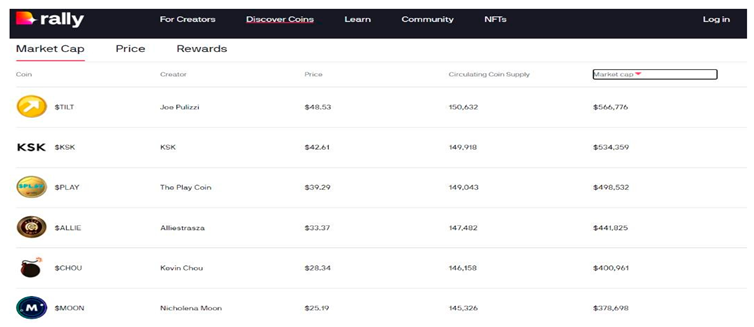
Social Tokens: Another area is creating community tokens by influencers, community leaders, or public figures. With an audience and relevant content to provide Rally is one of the platforms and the most popular in this direction in which this type of NFT can be developed.20
Rally is constructing a Creator-driven network based on open-source technology and a community-centric approach to economics, ownership, and government. With Rally, creators will be able to issue their own fully customizable, branded cryptocurrency called Creator Coins, representing their distinct digital brand, and giving supporters value and utility.
According to talks with token inventors, each utilizes the token for a unique reason. Diversifying their income, boosting the engagement of their subscribers, and, according to some content creators, reducing their reliance on centralized platforms when posting material are among the goals. It is worthwhile to examine this user interaction moment in greater detail. Based on the statistics, it can be inferred that the ownership of a token by a community member or influencer’s follower will be personally invested in the success of this NFT since as demand for the token increases, so does the well-being of all its holders. Therefore, they are motivated to promote the communities to which they belong through advertising.21
It is also important to note that tokens and the communities that they build around themselves alleviate the issue of creators and followers being dependent on centralized site censorship, rising advertising costs, and other negative aspects of sites like YouTube. This study will evaluate this issue in the subsequent section. The pricing of these tokens should also be included in this article. It conforms to the Token Bonding Curves scheme (TBC). A TBC is a pricing curve that provides a functional relationship between the current supply and price of a Coin. A TBC serves as the fundamental mechanism for an AMM (automated market maker) to facilitate buying and selling, as well as the overall link between the supply and price of a Coin. The bonding curve ensures that early purchasers can sell for a profit if additional purchasers arrive. It naturally rewards early adopters.22

Table 1.
List of most popular tokens by market cap. Source: https://coinmarketcap.com/tokens/.
Table 1.
List of most popular tokens by market cap. Source: https://coinmarketcap.com/tokens/.
Metaverse: The metaverse, coined by Neal Stephenson, is the stuff of science fiction. The word metaverse is a combination of the prefix “meta” (meaning “beyond”) and “universe”.3D virtual places linked into a perceived virtual universe. The creation of the metaverse was inevitable, given the migration of most services to the digital realm and the rising digitalization of people’s daily lives. The introduction of blockchain technology has fueled this tendency, and NFT has accelerated the expansion of the universe. According to Crypto Veterans, NFTs are the Metaverse’s Revenue Model. Imagine a virtual world where every imaginable item may be bought, sold, or traded to visualize the potential magnitude of NFT assets in the Metaverse. Like this universe, the Metaverse would not be confined by real-world limitations such as limited natural resources, supply chain risk, or the laws of physics.23
This practice got so popular that Facebook renamed itself Meta and revealed intentions to hire 10,000 individuals to build the Metaverse. Additionally, the company announced that its Metaverse would enable NTF tokens based on Ethereum. A game like “Sandbox” that has not yet been launched is an example of a future Metaverse. “Sandbox” is a virtual environment where gamers may monetize their gaming experiences using SAND, the platform’s utility coin. With non-fungible tokens (NFTs) and rewarding their engagement with SAND (Sandbox Whitepaper). Another instance is “Decentraland.” A virtual world built on the blockchain, depending on land ownership. The land is a scarce, non-fungible, and transferable digital asset kept in an Ethereum smart contract. It can be obtained by using a MANA ERC20 token. WhitePaper on Decentraland and many other initiatives are prepared for market entry.
NFT for games: According to the data, NFT Games are distinct from merely storing crypto valuables. NTF combines traditional gaming elements with innovative gameplay mechanisms to give players greater control over gaming assets24. Games within a constructed ecosystem provide the opportunity to trade or sell non-fungible tokens for profit.
For most games on the blockchain and in the web3 space for more in-depth use (where the NFT certificate can be given to almost any digital thing in the game), specific tools are created to combine standard tools with their NFT version.
SDK stands for software development kit. Also known as a devkit, the SDK is a set of software-building tools for a specific platform, including the building blocks, debuggers, and, often, a framework or group of code libraries such as a set of routines particular to an operating system (OS)(İBM).
In most situations, the designers aim to raise the player’s interest in the gameplay and prolong the playing duration. The development of blockchain-based games affords the chance to improve player engagement.25 NFT is also a new world that shifts the perception of traditional games, which do not often provide economic rewards to players, in a new direction, such as play-to-earn.
Play2Earn (play-to-earn) games relate to the gaming idea in which a platform offers players the opportunity to earn in-game assets that can be transferred to the real world as valuable resources. This, in turn, creates an entire chain of a new economy within the metaverse, as previously mentioned. The metaverse has its economy and ecosystem, which is remarkable in that it is connected to the real economy through exchange platforms and is already beginning to contribute to and alter business conditions. Axie infinity is an outstanding example of the new industry. Axie Infinity is a Vietnamese studio’s NFT-based online video game released in March 2018. Axie Infinity is a Pokémon-inspired environment where anyone can earn tokens through skillful gameplay and ecosystem contributions.26 Currently, Axie Infinity has more than 2,2 million participants, making it the most popular blockchain-based game.
Using in-game tokens, Smooth Love Potion (SLP), and Axie Infinity Shard, players can purchase land and breed Axis (AXS). These tokens are also helpful in the real world. Using data from Coinmarkets, the following graph depicts the increase in the value of the game token. Since its introduction, the price has nearly multiplied by 1,000.27 In addition, there are numerous additional projects for games such as Star Atlas, Delta Time, and many others. During the epidemic, NFT made it possible for thousands of people to work to earn a living. Monetizing players’ game experience is a paradigm utilized in e-sports for some time, but now on a larger scale. People in the Philippines, for instance, forsake “traditional low-paying jobs” in search of opportunities in the metaverse. (Dizon, Gabby, 2021) This world also generates its player guilds. Yield Guild Games (YGG) is a DAO for investing in non-fungible tokens (NFTs) in virtual worlds and blockchain games. EA and other gaming titans recognize the potential future of NFT. In the final section, we will examine the positive and negative features in greater depth.
NFT for Art: With the launch of Non-Fungible Tokens (NFTs), the art market and content creators are seeing a paradigm shift at a time when the area is attracting many artists. At the same time, many authors try to take advantage of the blockchain’s prospects and ride the buzz. One of the biggest challenges for artists in the age of electronic information was the issue of intellectual property rights. Examining the primary setting where NFT is used in this context— namely, digital art—is crucial. Since this direction’s inception, copyright has been a major worry. Piracy hurts both upcoming and experienced musicians. A particularly complex task for regulatory organizations is tracking the multiple pirate marketplace in addition to the dual use of art in public spaces. A new technology that can control data capture with extreme precision and lower transaction costs has become more in demand in a creative culture since the turn of the 20th century.
Standard blockchain currency, such as the ERC-20, could only partially satisfy the enumerated criteria of art due to their practical uses. To execute NFT and maximize profits for the product’s creator, the unique contract technology establishes additional percentage deductions for each token resale. This not only settles the ownership dispute but also results in a long-term investment for the artist. Only 12% of the $43 billion in potential money generated by the music industry in 2017 went to musicians, according to a Citi GPS analysis. The use of an intermediary and the high expense of the work transaction is the second main problem.
Markets with middlemen, such auctions, and dealers, as well as the high taxes on luxury real estate in different countries, have received a lot of attention. Previous studies have shown that art is not a conventional financial asset due to differences in returns, liquidity, and high transaction cost. It differs from traditional markets in that there is a strong attachment to the brand name, the product’s value increases over time, there are many communities that support product development (like those for crypto assets), there is a very high return on investment, which is also seen on the crypto market, and each player has a different perception of the product due to their individuality.28
As an example of transaction costs, auction houses may charge a commission of up to 25% of the hammer price for artworks selling for less than $200,000. For more expensive works of art, this price is reduced by about 12%. Since it makes it possible for artists to sell their goods directly on NFT markets, as mentioned in the section above, without the involvement of intermediaries or other interested parties. Even though the modern NFT departs from the traditional conception of copyright, the agreement is an intelligent smart contract. Hence, a distinct contract can be created for each new coin. Future counter measures against digital piracy are also conceivable.
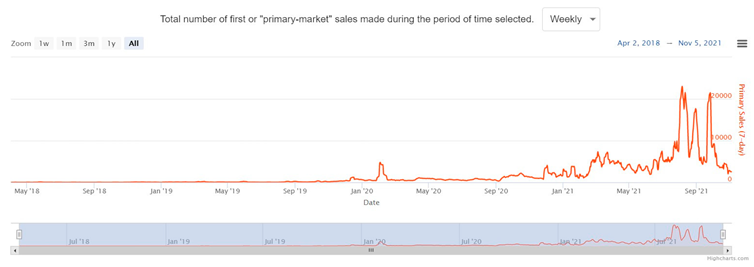
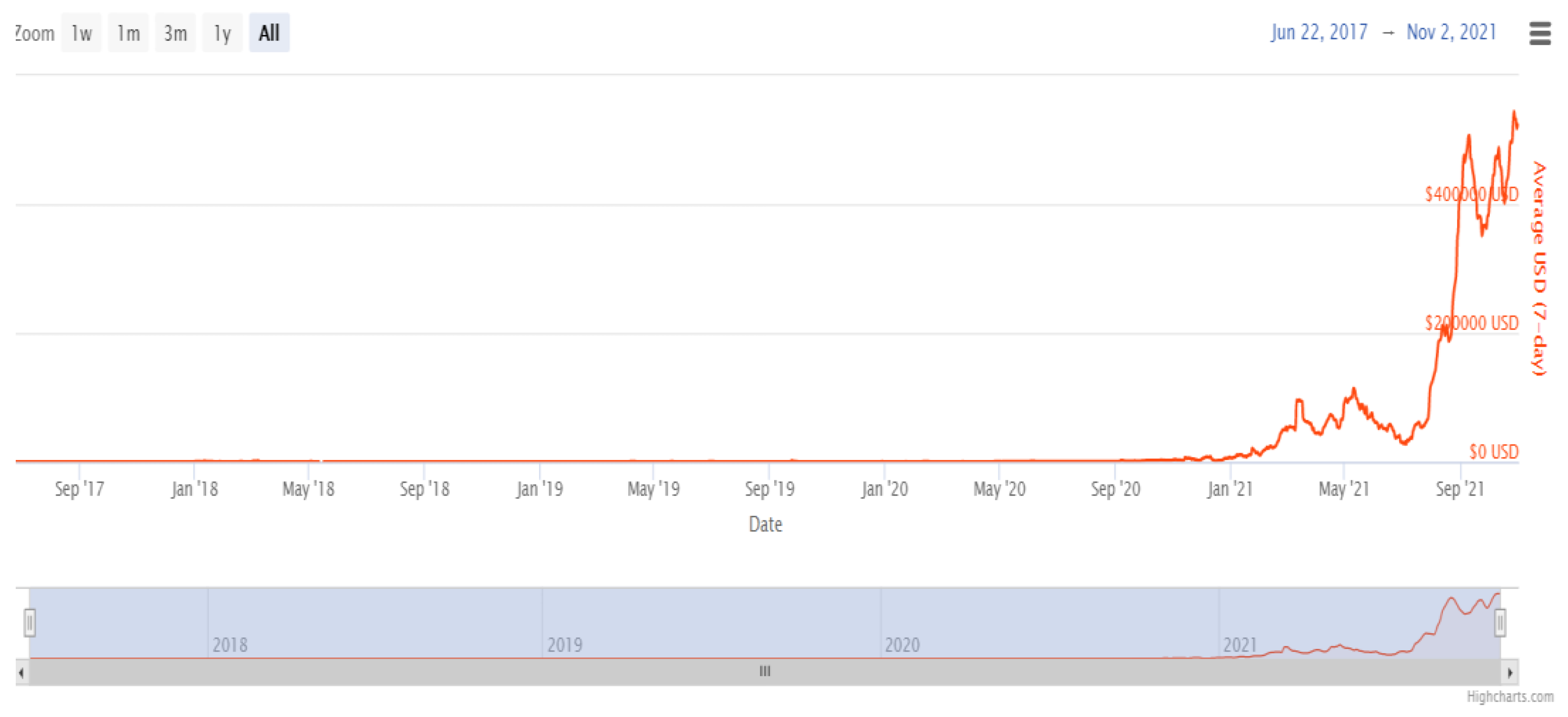
This is the new primary sales data for art in NFT. As we can see, at the time of November, sales of primary tokens fell by almost three times compared to August 2021. The reason can be, mineral the fading of the entire crypto market, but this is a topic of communication between crypto products for another study.
NFT for Sport: According to study, the sports sector adopted blockchain almost at the same time as all other economic sectors. Numerous tokens devoted to the sports industry have already been released in 2019. The following categories were used to distinguish them: markets, fan engagement, betting on sports, and funding.29
Sports and esports fans may crowd-manage their preferred teams, games, leagues, and events thanks to Chilliz, one of the most well-known projects that runs Socios.com. Fan Token(s) that may be bought using Chilliz Token, a cryptocurrency-branded utility token with the logo or name of the affiliated sports club or organization. The business uses both conventional and non-fungible tokens. The success of the initiative is demonstrated by one of its most recent partnerships. With a 100-piece limited edition NFT collection, AC Milan will be the first soccer team to introduce an NFT campaign on the fan interaction and incentives app. Digital currency known as “fan tokens” gives users access to a variety of fan-related membership privileges, including the ability to vote on club policies, incentives, item designs, and unique experiences. Because NFT-ticket solutions offer a more certain solution to this issue, clubs and organizations have reacted favorably to them. Savvy NFT Tickets are distributed as special digital assets by event planners, sports organizations, and athletes. Because of blockchain technology, they are simple to transfer and sell.
After the initial programming, the procedure for rapidly manufacturing new tickets takes less than process. Unlike conventional ticketing, the costs associated with minting and selling NFTs are minimal. Several clubs have already implemented a sales mechanism via the NFT. FC Dynamo Kyiv, the leading team in the Ukrainian Premier League, issued NFT tickets for the 2021 season (representing 25% of all tickets).
The protocol is another company that offers solutions on the market. In addition, they provide solutions for Fan Tokens, Digital Collectibles, and Loyalty & Rewards. One of the promising areas of NFT is also expected to be Loyalty Programs. Tokenization of program connections Teams can encourage “profit-building” conduct as well as increase Fan and Sponsor Engagement. There are additional venues where sports enthusiasts can purchase unique tokens, such as “So rare” for a collection of NFT football trading cards. (https://sorare.com) Formula One fan may collect NFT cars, racetracks, drivers, and tires through F1 Delta Time. This blockchain-based game will employ the Ethereum and ERC-721 and ERC-20 standards for non-fungible and fungible tokens, respectively.30
Nonfungible utility tokens: Utility tokens, sometimes known as NFTs for specialized uses, are conceptually most tokens used for a variety of functions, including gaming and metaverse NFTs. But in this chapter, we’ll look at precisely the part of the NFT that gives its holders an advantage. These NFTs give holders unique access to blockchain platform features as well as a right of access to products or services. Special opportunities, early product access, membership- only virtual events, IRLs, and dividends can all be made possible.
This is just the tip of the iceberg because the implementation process for this type of NFT has just begun. The token in this form has a variety of uses Utility tokens may be assigned for the “N project” implementation function. 8,888 NFTs of eight randomly generated numbers between 0 and 14 were used, the inventor claims.
The market capitalization of The N Project reached 10,256 ETH (about $40 million at the time). Three days after its debut, it rose to the position of sixth most well-liked NFT project (temporarily). The NFT Project With Random Numbers on Black Background Hits $40 Million, Market Cap shows that these numbers may be used to create artwork, profile pictures, animated artwork, and even a War Card Game. Various ongoing initiatives provide various bonuses, such as entry into VIP areas, discounts on travel and lodging, and more, if their NFT is held.
NFT for Defi: A public decentralized blockchain network can now access financial products thanks to a technique known as decentralized finance, or Defi. open without a middleman to everyone. With most of the functions delegated to smart contracts, the system’s architecture can establish an irreversible and highly interoperable financial system with unparalleled transparency and equitable access rights. Defi is supported by AI, Blockchain (including distributed ledger technology and smart contracts), Cloud, and Data (large and tiny). The two most common vectors in the blockchain business are decentralized finance and non- fungible tokens. NFT might be used to increase liquidity for providers and solve the curve model problem, as well as to release value from collateral for Defi. However, using NFT as collateral casts doubt on the token’s liquidity; as a result, some systems permit lenders to slash tokens they deem promising. In general, NFT can be used in various solutions for Decentralized Finance and is now just in its infancy.31
4. General Trends and Pricing of NFTs
It is necessary to talk about non-fungible assets to assess the market. On both private and public markets, most investable assets are non-fungible. Thoughts on this are divided. Like derivatives, which have a market size of about $580 trillion, art and collectibles have a market cap of about $2 trillion (Non-Fungible Tokens), which is nearly equivalent to $2 trillion (NFT). Not to mention the innately non-fungible housing market (Mieszko Mazur, IESEG School of Management).
This paper’s final portion covered price formation for social NFTs and the fact that when issued, specification tokens follow a predefined pattern called the Token Bounding Curve. It is best to consider both function value and hedonic, which in economics is further separated into value variants to properly understand the process. The concept that the price of a sold item is governed by its internal and external attributes forms the basis of the hedonic pricing model, which identifies price determinants.
A critical review of the literature on the hedonic price model by Tung-Leong CHIN and K W CHAU, as well as The Influence of the Hedonic and Utilitarian Value of Digital Games on Product Recommendation by Jan Henrik Storgrds provide estimates of the hedonic price model’s effects on the housing market and the digital gaming industry, respectively. As was mentioned in this study work, NFTs can be assessed from a functional standpoint; they include utility functions, game functions, aesthetic applications, etc. A token’s worth is not necessarily guaranteed by scarcity. So, the following categories can be used to describe digital value:
- > Value is a function of scarcity,
- > Utility,
- > Reputation,
- > and liquidity (NFTs And the Missing Layer of Utility by Samuel Huber for Forbes)
According to studies on the effectiveness of NFTs, recent NFT initiatives earn an average investment multiple of 40 (approximately 4,000 percent) over the long run, which is four times bigger than bitcoin during the same timeframe.
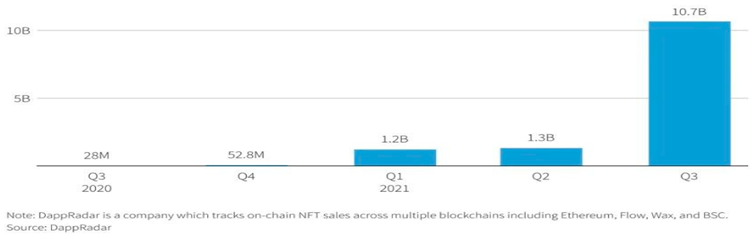
The topic of artificially produced scarcity was covered in earlier sections. subject to the author’s standing or the project’s standing in the community. In the games, NFT utilities, and the sports business sector, the term “utilities” refers to the possibility of its immediate application. These factors, as well as the market’s overall impact and the trading transaction’s length, all affect its liquidity.32 This is four times higher than combined in the first and second quarters and eleven times more than in 2020. (NFT sales surged in Q3 by Martin Boujol)
Source: By Author
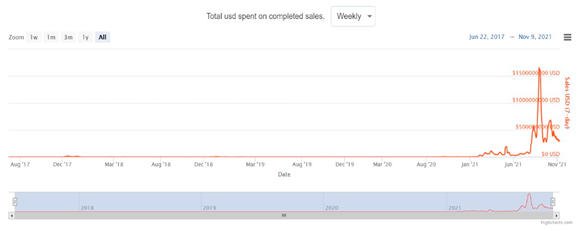
Non-fungible token (NFT) sales grew to $10.7 billion in the third quarter of 2021. The business’s revenue for the first two quarters was only $1,3 billion in Q2 and $1.2 billion in Q1, which is relatively low. Previous research argued that altcoins are affected by the volatility and fast changes in the crypto market. In terms of volatility transmission, NFT price appears distinct from cryptocurrency pricing, according to some studies (Is non-fungible token pricing driven by cryptocurrencies?).33 This graph depicts a portion of the market’s sales.
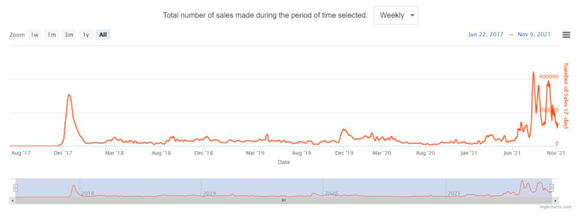
The weekly chart, out of three options (daily, weekly, and annual), was chosen to easily observe the market’s tendency. If we examine the cumulative sales of the entire NFT industry from the end of 2017 to the beginning of 2018, we observe an increase in the quantitative sales ratio. NFTs gained momentum in 2017 after the release of the crypto game CryptoKitties. The emergence of play-to-earn games, such as the previously stated Axie infinity, contributes to the rising sales of today. This graph depicts overall sales volume.
Source: By Author
It is also important to note that certain NFTs include royalties for later transactions. In general, it will not be economically advantageous for a seller to exchange tokens for less than the price at which he purchased them, plus any applicable royalties. The fundamental problem is that neither site keeps track of “off-chain” transactions, which necessitates manually adding them to their records and can result in discrepancies which are also present in the market for NFT Off-chain transactions on a cryptocurrency network are ones that transfer value away from the blockchain. because of their off-chain transactions’ nil or cheap costs.
4.1. NFT hype as a tool for adaptation in traditional sectors
The traditional community is incredibly wary of technological advancements in places where it is less common, especially if technology is being adopted later in life. Based on prior studies, even Web 2.0 technologies sparked some skepticism fifteen years ago. Additionally , over time, the extensive usage of modern products causes their efficacy to decline, which in this case, should be overlooked due to marketing hype. Web 2.0 first appeared in the year 2000; however, as of 2009, research articles from earlier studies showed that it was still in its infancy. In other words, the process continued through all stages before widespread acceptance despite the turmoil in the dot-com business.
When something is aggressively promoted and discussed in newspapers, on television, etc., to spark public interest, this is referred to as “hype.” Despite the hype surrounding NFT, the studies and the Web 2.0 example show that it often follows a certain cycle. To properly identify the cycle stage, it is necessary to look at one of the factors that determine the hype life cycle, namely the Gartner table.
The Hype Cycle uses a graph to show the relative maturity of various disciplines, IT processes, and technologies. They identify high-impact areas and predict when technologies and trends will reach maturity. The development cycle of new technology starts with over-enthusiasm, moves through a period of disillusionment, and ends with an understanding of the technology’s market significance. It is challenging to gauge where NFT is in the cycle, but non-fungible tokens are a major topic of discussion for the entire blockchain in the related chain. Since some blockchain-based goods repeat the cycle, much like Bitcoin. It goes back to the Peak of the Exaggerated Expectations stage.
According to some authors, non-fungible tokens can be used as a launching pad into the rapidly expanding sector of crypto marketing. Tokens raise issues about sharing, decentralized branding, validity, and status, among other important topics. The independent use of NFT by businesses in their line of collections, such as the development of apparel collections, started at the start of the trend and has only gotten stronger as of the time of writing. Imagine, however, that multi-brand companies with teams of hundreds of employees analyze data more quickly than conventional companies and are continuously looking for new ways to widen the sales funnel. In that circumstance, traditional industries, especially traditional ones like the market for classical art, will display appropriate mistrust for any expertise. Producers, artists, and innovators now have an additional opportunity to profit from all subsequent resales thanks to NFT. This is one of the key NFT killer features since it enables the owner to profit from subsequent resales by automatically reimbursing the creator. The proportion will be automatically transferred into the artist’s account. And the source will be profitable for all following generations.
5. Issues and Challenges in Implementation
Like every technology, NFT’s infant orientation has certain implementation challenges in its early stages. One of the main challenges is the input validation process. The processing of the submitted data is often not under the control of a third party because the information entered the blockchain is immutable and protected (occasionally troublesome due to the 51 attack), as has repeatedly been proven in earlier studies. Therefore, the right ownership and copyright procedure on them is uncertain because anyone can submit product data and claim ownership of them. These dreads have already begun distributing NFT versions of stolen pieces of art.34 Also in application issues are the complexity of the technology for the masses and the need in most cases to own cryptocurrencies to purchase NFTs, and their subsequent transactions between owners.
Another need, especially in the United States, is the passage of the KYC procedure, which is mandatory from the moment a certain amount has been passed. This case is not available when buying standard assets and is another barrier to the mass character of the product. Smart contracts that are performance-driven decide acceptance rather than conventional contracts, which are not. NFT based on a smart contract is a function for its execution rather than a single entity. The development of intelligent smart contracts in the US is still ongoing, even though, for example, in the US, an electronic signature is essentially (with slight alterations) identical in rights to the original signature (An Update on State Legislation Regarding Smart Contracts, by Christopher Adcock). For instance, the legislative process is not yet standardized in the EU. There are serious concerns about the legality of NFTs based on smart contracts because the recognition process has not yet started in several countries. Additionally, there are issues with NFT theft, which is related to inadequate security measures, and user complaints on this have already surfaced from numerous sources. More than $10,000 is being taken in NFTs, and victims have few options (Julia Gray and Ivan De Luce, 2009). Separate disputes can occasionally arise with NFT marketplace owners.35
6. Conclusion
An NFT is an identical cryptographic digital record attached to an asset, such as a work of art, music, collectible, or another object of the default value. When it comes to the new use of technology in any field, it takes some time for regulatory agencies and legislatures worldwide to catch up with the rapid adoption of technology and make legal regulations immediately. Similarly, for NFTs, no specific legal doctrine or principle of taxation has yet been determined in the world. At the time of writing this study, there is no direct regulation for NFTs.
When regulating NFTs, their legal status, as they can be traded globally and the different regulatory frameworks that they may be subject to in different countries must be considered. But more generally, we can develop ideas for how NFTs might be regulated by looking at how the law applies to cryptocurrencies, art, and collectibles. But given the unique features that distinguish these assets, it is certain that the cryptocurrencies framework cannot be fully applied to NFTs. In this study, potential tax issues related to NFT transactions need to be discussed.
| 1 | Ateşler, H. (2021, April 13). Digital artist Murat Pak has released a new token that can be bought by burning NFT. Expertcoin. https://uzmancoin.com/murat-pak-nft-burn/
|
| 2 | Beard, Briar & Rose. (2013, January 31). Fumeur V. https://beardbriarandrose.tumblr.com/image/41963857518
|
| 3 | Binance Academy. (2021, April 29). Merkle trees and Merkle roots. https://academy.binance.com/en/articles/merkle-trees-and-merkle-roots-explained
|
| 4 | Braidotti, C. & Franceschet, M. (n.d.). Enhancing art with information: The case of blockchain art. Universita'Degli Studi di Udine. https://users.dimi.uniud.it/~massimo.franceschet/publications/jocch20.pdf
|
| 5 | Aysan, Ahmet Faruk, Abdelilah Belatik, Ibrahim Musa Unal, and Rachid Ettaai. 2022. "Fintech Strategies of Islamic Banks: A Global Empirical Analysis" FinTech 1, no. 2: 206-215. https://doi.org/10.3390/fintech1020016
|
| 6 | Brennan, A. (2018, January 18). You can only use cryptocurrency to buy art at this Mayfair exhibition. Evening Standard. https://www.standard.co.uk/culture/you-can-only-use- cryptocurrency-to-buy-art-at-this-mayfair-exhibition-a3736831.html
|
| 7 | See (https://eips.ethereum.org/EIPS/eip-721) for more details |
| 8 | Charlesworth, J. J. (2021, March 17). Why the artworld loves to hate nft art? Artreview. https://artreview.com/why-the-artworld-loves-to-hate-nft-art-beeple-christies-grimes/
|
| 9 | See (https://ethereum.org/en/developers/docs/gas/) for more details. |
| 10 | Aysan, Ahmet Faruk, Abdelilah Belatik, Ibrahim Musa Unal, and Rachid Ettaai. 2022. "Fintech Strategies of Islamic Banks: A Global Empirical Analysis" FinTech 1, no. 2: 206-215. https://doi.org/10.3390/fintech1020016
|
| 11 | Davis, B. (2021, March 17). I looked through all 5,000 images in Beeple's $69 million magnum opus. What I found isn't so pretty. artnet. https://news.artnet.com/opinion/beeple- everydays-review-1951656
|
| 12 | AF Aysan, AY Polat, H Tekin, AS Tunalı - Defence and Peace Economics, 2022 |
| 13 | Ducree, J. (2020). Research – a blockchain of knowledge? Blockchain: Research and applications. 1(1-2), 1- 4. https://doi.org/10.1016/j.bcra.2020.100005
|
| 14 | AF Aysan, AY Polat, H Tekin, AS Tunalı - Defence and Peace Economics, 2022 |
| 15 | Hawkins, J. (2021, August 31). Damien Hirst's dotty 'currency' art makes as much sense as Bitcoin. The Conversation. https://theconversation.com/damien-hirsts-dotty-currency-art- makes-as-much-sense-as-bitcoin-166958
|
| 16 | ledger. (2021, May 11). The blockchain generations. https://www.ledger.com/academy/blockchain/web-3-the-three-blockchain-generations
|
| 17 | Mattei, E. S. (2021, September 28). British Museum to sell NFTs of Hokusai works, including 'The Great Wave'. artnews. https://www.artnews.com/art-news/news/british- museum-hokusai-nfts-1234604998/
|
| 18 | Hussey, M. & Phillips, D. (2021, Jan. 8). What are smart contracts and how do they work? decrypt. https://decrypt.co/resources/smart-contracts
|
| 19 | GG Akin, AF Aysan, E ÖZER, L Yildiran - The Singapore Economic Review, 2022 |
| 20 | Lastovetska, A. (2021, November 12). Blockchain architecture basics: Components, structure, benefits & creation. MLSDev. https://mlsdev.com/blog/156-how-to-build-your- own-blockchain- architecture
|
| 21 | Aysan, Ahmet Faruk, Abdelilah Belatik, Ibrahim Musa Unal, and Rachid Ettaai. 2022. "Fintech Strategies of Islamic Banks: A Global Empirical Analysis" FinTech 1, no. 2: 206-215. https://doi.org/10.3390/fintech1020016
|
| 22 | M Yaş, AF Aysan, MESM Rasid - Journal of Asset Management, 2022 |
| 23 | Bolton, S. J. & Cora, J. R. (2021). Virtual equivalents of real objects (VEROs): A type of non-fungible token (NFT) that can help fund the 3d digitization of natural history collections. Megataxa Journal 6(2), 93-95. https://doi.org/10.11646/megataxa.6.2.2
|
| 24 | Çağala, C. (2016, May 16). What is the hash value? What does the hash value do? techworm. https://www.tech-worm.com/hash-degeri-nedir-hash-degeri-ne-ise-yarar/
|
| 25 | Cummings, S. (2019, February 2). The four blockchain generations. medium. https://medium.com/the-capital/the-four-blockchain-generations-5627ef666f3b
|
| 26 | Criddle, C. (2021, March 9). Banksy art burned, destroyed and sold as token in 'money- making stunt'. bbc. https://www.bbc.com/news/technology-56335948
|
| 27 | L Gunduz, IH Genc, AF Aysan - Housing Policy Debate, 2022 |
| 28 | Fritts, M. (2021, August 9). Destroy the 'Mona Lisa' for an NFT? The Prindle Post. https://www.prindlepost.org/2021/08/destroy-the-mona-lisa-for-an-nft/
|
| 29 | Fritts, M. (2021, August 9). Destroy the 'Mona Lisa' for an NFT? The Prindle Post. https://www.prindlepost.org/2021/08/destroy-the-mona-lisa-for-an-nft/
|
| 30 | Fritts, M. (2021, August 9). Destroy the 'Mona Lisa' for an NFT? The Prindle Post. https://www.prindlepost.org/2021/08/destroy-the-mona-lisa-for-an-nft/
|
| 31 | Mattei, E. S. (2021, September 28). British Museum to sell NFTs of Hokusai works, including 'The Great Wave'. artnews. https://www.artnews.com/art-news/news/british- museum-hokusai-nfts-1234604998/
|
| 32 | ledger. (2021, May 11). The blockchain generations. https://www.ledger.com/academy/blockchain/web-3-the-three-blockchain-generations
|
| 33 | ledger. (2021, May 11). The blockchain generations. https://www.ledger.com/academy/blockchain/web-3-the-three-blockchain-generations
|
| 34 | Lastovetska, A. (2021, November 12). Blockchain architecture basics: Components, structure, benefits & creation. MLSDev. https://mlsdev.com/blog/156-how-to-build-your- own-blockchain- architecture
|
| 35 | Lastovetska, A. (2021, November 12). Blockchain architecture basics: Components, structure, benefits & creation. MLSDev. https://mlsdev.com/blog/156-how-to-build-your- own-blockchain- architecture
|
References
- Ateşler, H. (2021, April 13). Digital artist Murat Pak has released a new token that can be bought by burning NFT. Expertcoin. https://uzmancoin.com/murat-pak-nft-burn/.
- Aysan, Ahmet Faruk, Abdelilah Belatik, Ibrahim Musa Unal, and Rachid Ettaai. 2022. “Fintech Strategies of Islamic Banks: A Global Empirical Analysis” FinTech 1, no. 2: 206-215. [CrossRef]
- Beard, Briar & Rose. (2013, January 31). Fumeur V. https://beardbriarandrose.tumblr.com/image/41963857518.
- Binance Academy. (2021, April 29). Merkle trees and Merkle roots. https://academy.binance.com/en/articles/merkle-trees-and-merkle-roots-explained.
- Bitlo (n.d.). What is Bitcoin (BTC)? https://www.bitlo.com/guide/bitcoin-nedir.
- Braidotti, C. & Franceschet, M. (n.d.). Enhancing art with information: The case of blockchain art. Universita’Degli Studi di Udine. https://users.dimi.uniud.it/~massimo.franceschet/publications/jocch20.pdf.
- Brennan, A. (2018, January 18). You can only use cryptocurrency to buy art at this Mayfair exhibition. Evening Standard. https://www.standard.co.uk/culture/you-can-only-use- cryptocurrency-to-buy-art-at-this-mayfair-exhibition-a3736831.html31.
- Bolton, S. J. & Cora, J. R. (2021). Virtual equivalents of real objects (VEROs): A type of non-fungible token (NFT) that can help fund the 3d digitization of natural history collections. Megataxa Journal 6(2), 93-95. [CrossRef]
- Charlesworth, J. J. (2021, March 17). Why the artworld loves to hate nft art? Artreview. https://artreview.com/why-the-artworld-loves-to-hate-nft-art-beeple-christies-grimes/.
- COBO. (2021, March 12). Wrapping up the art world: a blazing crypto-craze, vast V&A job cuts, re-opening of museums, and more. https://www.cobosocial.com/dossiers/art- news-crypto-va-museums-reopening/.
- Coinmarketcap (n.d.). What is ERC-721? https://coinmarketcap.com/alexandria/glossary/erc-721.
- Congar, K. (2021, July 15). A first in auction history: Picasso’s painting blockchain asset will be sold in ‘tokens’. Euronews. https://tr.euronews.com/2021/07/15/ac-k-art-rma- tarihinde-bir-ilk-picasso-nun-tablosu-blokzincir-varl-g-tokenlere-sat-acak.
- Criddle, C. (2021, March 9). Banksy art burned, destroyed and sold as token in ‘money- making stunt’. bbc. https://www.bbc.com/news/technology-56335948.
- CryptoKitties. (n.d.). press. https://www.cryptokitties.co/press.
- Cummings, S. (2019, February 2). The four blockchain generations. medium. https://medium.com/the-capital/the-four-blockchain-generations-5627ef666f3b.
- Çağala, C. (2016, May 16). What is the hash value? What does the hash value do? techworm. https://www.tech-worm.com/hash-degeri-nedir-hash-degeri-ne-ise-yarar/.
- Davis, B. (2021, March 17). I looked through all 5,000 images in Beeple’s $69 million magnum opus. What I found isn’t so pretty. artnet. https://news.artnet.com/opinion/beeple- everydays-review-1951656.
- De Carlo, F. (2020). The intersection between copyright protection and blockchain technology: The case of cryptoart. [Single Cycle Master’s Degree Thesis] Luiss Guido Carli University. https://tesi.luiss.it/id/eprint/30173.
- Dickson, B. (2016, Oct. 8). How blockchain can change the music industry? TechCrunch. https://techcrunch.com/2016/10/08/how-blockchain-can-change-the-music-industry/.
- Ducree, J. (2020). Research – a blockchain of knowledge? Blockchain: Research and applications. 1(1-2), 1- 4. [CrossRef]
- Ennis, P. D. (2021, March 5). NFT art: The bizarre world where burning a Banksy can make it more valuable. The Conversation. https://theconversation.com/nft-art-the-bizarre- world-where-burning-a-banksy-can-make-it-more-valuable-156605.
- Farago, J. (2021, March 14). Beeple has won. Here’s what we’ve lost. New York Times. https://www.nytimes.com/2021/03/12/arts/design/beeple-nonfungible-nft-review.html.
- Fritts, M. (2021, August 9). Destroy the ‘Mona Lisa’ for an NFT? The Prindle Post. https://www.prindlepost.org/2021/08/destroy-the-mona-lisa-for-an-nft/.
- Hawkins, J. (2021, August 31). Damien Hirst’s dotty ‘currency’ art makes as much sense as Bitcoin. The Conversation. https://theconversation.com/damien-hirsts-dotty-currency-art- makes-as-much-sense-as-bitcoin-166958.
- Howcroft, E. (2021, January 10). ‘CryptoPunk’ NFT sells for $11.8 million at Sotheby’s. Reuters. https://www.reuters.com/technology/cryptopunk-nft-sells-118-million-sothebys- 2021-06-10/.
- Hussey, M. & Phillips, D. (2021, Jan. 8). What are smart contracts and how do they work? decrypt. https://decrypt.co/resources/smart-contractscrypt.
- Kugler, L. (2021). Non-Fungible Tokens and the future of art. Communications of the Acm 64(9), 19-20. [CrossRef]
- Lastovetska, A. (2021, November 12). Blockchain architecture basics: Components, structure, benefits & creation. MLSDev. https://mlsdev.com/blog/156-how-to-build-your- own-blockchain- architecturemlsdev.
- Ledger. (2021, May 11). The blockchain generations. https://www.ledger.com/academy/blockchain/web-3-the-three-blockchain-generations.
- Mattei, E. S. (2021, September 28). British Museum to sell NFTs of Hokusai works, including ‘The Great Wave’. artnews. https://www.artnews.com/art-news/news/british- museum-hokusai-nfts-1234604998/.
Figure 1.
CryptoPunk Price Trends. Source: https://opensea.io/collection/cryptopunks.
Figure 1.
CryptoPunk Price Trends. Source: https://opensea.io/collection/cryptopunks.
Disclaimer/Publisher’s Note: The statements, opinions and data contained in all publications are solely those of the individual author(s) and contributor(s) and not of MDPI and/or the editor(s). MDPI and/or the editor(s) disclaim responsibility for any injury to people or property resulting from any ideas, methods, instructions or products referred to in the content. |
© 2023 by the authors. Licensee MDPI, Basel, Switzerland. This article is an open access article distributed under the terms and conditions of the Creative Commons Attribution (CC BY) license (http://creativecommons.org/licenses/by/4.0/).
Copyright: This open access article is published under a Creative Commons CC BY 4.0 license, which permit the free download, distribution, and reuse, provided that the author and preprint are cited in any reuse.


