
Submitted:
13 January 2023
Posted:
16 January 2023
You are already at the latest version
Abstract
ObjectivesThe present study is aimed at characterizing and identifying the important research trends of the application of structural equation modelling (SEM) in nursing research by bibliometric analysis, and further providing reference for nursing researchers to conduct SEM research.MethodsA descriptive bibliometric analysis of publications in the application of SEM in nursing research. Literatures were retrieved from the Web of Science (WoS) core collection database On April 30, 2022. CiteSpace 6.1.R1 and VOSviewer 16 software were used for visualization and bibliometric analysis.ResultsThe annual publication indicated an increasing trend in the future. The intellectual structures of the application of SEM in nursing researches included patient safety, cross-cultural comparison, compassion fatigue, benchmarking, patient discharge, China, psychometrics, and policy. The hotpots and development trends include job satisfaction, nursing home, and nursing student.ConclusionThe hotspots and development trends related to the application of SEM in nursing research mentioned in this study may be helpful for researchers to explore new directions in this field. The intellectual structures and development trends were found in the application of SEM in nursing researches in this study. The awareness of the clusters and bursts in this field can help nursing researchers avoid overlooking some important issues when conducting SEM, and provide nurse researchers with good practice guidelines for conducting SEM.
Keywords:
Nursing research
; Structural equation modelling
; bibliometric analysis
; Visualization
1. Introduction
Structural Equation Modeling (SEM) is a statistical method that has become popular in many fields (Kline, 2016). It integrates factor analysis and path analysis, and is usually classified as a statistical method of second generation (Fornell & Larcker, 1987). SEM can examine the relationship of a set of variables (including observed variables and latent variables) simultaneously, and it also take measurement error into consideration (Hair et al., 2019; Kline, 2016). Path analysis and factor analysis are two special cases of SEM, where path analysis assumes that measurement error do not exist, and factor analysis is often applied in the development and validation of psychological measurement instrument (Kline, 2016). Nursing research refers to the process of continuously exploring, answering and solving problems in nursing field with scientific methods, and guiding nursing practice directly or indirectly, it is a systematic exploration to form reliable evidence for nursing major, including nursing practice, nursing education and nursing management (Tingen et al., 2009). In nursing research, an increasing number of researches employed psychometric scales to measure psychological characteristics regarding nursing, such as job satisfaction of nurse practitioners, occupational stress among mental health nurses, and posttraumatic growth among lung cancer patients (Lei et al., 2022; Yao et al., 2021; H. Zhang et al., 2021). Psychological characteristics cannot be directly observed and measured, which are regarded as latent variable, but can be reflected by the items in psychometric scales, which are regarded as observed variables, where measurement error often exist (Gruijters & Fleuren, 2018). In this case, SEM is an adequate choice for examining the relationship of a set of psychological variables in nursing researches. In addition, SEM is helpful in exploring or confirming the mechanism of association among variables, such as mediation and moderation effect (Hayes, 2022). Hence, the application of SEM in nursing research is expected to increase. However, few research systematically summarize the general status, hot spots, and development trend of the application of SEM in nursing research. Bibliometrics refers to a quantitative analysis method on analyzing published literatures to explore the research hotspots and development trends in a specific field. Therefore, we conducted bibliometrics analysis to explore the historical development and trends in the application of SEM in nursing research.
2. Methods
2.1. Aims
The present study is aimed at characterizing and identifying the important research trends of the application of SEM in nursing research by bibliometric analysis, and further providing reference for nursing researchers to conduct SEM research.
2.2. Design
Literatures were retrieved from the Web of Science (WoS) core collection database On April 30, 2022. The results were then analyzed by bibliometric analysis.
2.3. Sample
After removing irrelevant literatures and cross checking, a total of 4101 literatures data were obtained as research sample in the current study. The literature retrieval time is set as before December 2021.
2.4. Data Collection
In this study, the search queries are displayed in Table 1, where TS means the research theme, and * means matching any number of characters. the literature type is selected as “article”.
2.5. Ethical Consideration
Ethical review was not required for our study.
2.6. Data Analysis
The built-in function of the WoS database was used to analyze publication features, such as publication outputs, countries, institutions, authors, and journals. CiteSpace 6.1.R1 software was employed to explore the co-occurrence relationships and networks of countries, institutions, authors, and keywords, etc. (Chen, 2017). VOSviewer 16 software was used to explore the density visualization and the overlay visualization network of countries/cited countries, institutions/cited institutions, authors/cited authors, journals/cited journals, references/cited references, etc. (van Eck & Waltman, 2010, 2017). The parameter settings were as follows: (1) time span (1988-2021), one year per slice; (2) keywords and terms selected by default (3) Country, Institution, keywords, etc. selected as nodes respectively; (4) selection criteria Top N=50, suggesting that the information of the top 50 nodes in each time slice is selected for analysis; (5) look back years (LBY=5); (6) link retaining factor (LRF=3.0). (7) Pathfinder used to cut the visual network, to keep the important information of the relationship between nodes, and to improve the readability of the scientific maps. For the visualization, each node in the maps represents an element such as country, institution, author, journal, reference, and keyword, etc. Among the parameters in the upper left corner of the knowledge map obtained by running CiteSpace, N(node) represents the total number of nodes, E represents the number of links between nodes, and the value of network density reflects the correlation between nodes. These parameters can reflect the correlations of nodes. The area of annual rings of nodes reflects the frequency of nodes. Centrality generally refers to intermediary centrality, which is used to demonstrate the influence and importance of the node (Chen, 2006). Nodes with intermediary Centrality>=0.1 are generally regarded as key nodes, and they are shown by the purple outer ring (Paul et al., 2006). For the cluster maps, CiteSpace can automatically cluster the literature nodes by using algorithms. Among the parameters in the upper left corner of the cluster map, the clustering module value is the evaluation index of network modularity, which measured by Q value. Q value > 0.3 suggests a significant cluster structure. Cluster average contour value is an evaluation index of network homogeneity, and is measured by S value. S value > 0.5 suggests reasonable clustering, and when S value > 0.7, the clustering result has a high degree of confidence. In addition, CiteSpace can detect the nodes with mutation information in the data, that is, if the frequency of occurrence or citation of nodes increases sharply in a certain period, the word is regarded as the relatively important research hotspot in that period. The mutation intensity is reflected by the strength value, and higher strength value indicates stronger mutation intensity, particularly, if a node mutation time includes the latest time of the search time span (2021), the word can be considered as the research frontier.
2.7. Validity, Reliability, and Rigor
All publication data were retrieved from the WoS core collection database and were exported in TXT format with full record and cited references. Subsequently, two researchers of this study independently included and excluded the articles for further analysis. In case of any differences, researchers consulted with each other or asked a third party for arbitration.
3. Results
3.1. Annual Publication and Trends
3.2. Analysis of Countries and Regions
The co-occurrence analysis of countries and regions was conducted by CiteSpace, and the result is displayed in Figure 2A. the overlay, density, and citation visualization maps of countries and regions were created by VOSviewer (Figure 2B–D). The occurrence network comprised 104 nodes and 522 links, suggesting that researchers from 104 countries performed SEM analysis in nursing research. Where the USA (1433) had the most publications, followed by Mainland China (453), South Korea (295), Australia (268), and Canada (244), etc. The result of centrality suggest that the USA (0.31) published the most important literatures where applied SEM in nursing research, followed by England (0.20), Australia (0.19), Canada (0.18), and Spain (0.11), etc. Additionally, the USA had the highest number of citations (43850), followed by Canada (9228), Australia (4828), Mainland China (4504), and Netherlands (3798), etc. see Table 2.
3.3. Analysis of Institutions
The co-occurrence analysis of institutions was conducted by CiteSpace, and the result is displayed in Figure 3A. the overlay, density, and citation visualization maps of institutions were created by VOSviewer (Figure 3B–D). The occurrence network comprised 1474 nodes and 3222 links, suggesting that researchers from 1474 institutions worldwide performed SEM analysis in nursing research. Where Harvard University (129) had the most publications, followed by Brigham & Women’s Hospital (69), University of Michigan (61), University of Pennsylvania (48), and University of Toronto (48), etc. The result of centrality suggest that Harvard University (0.19) published the most important literatures where applied SEM in nursing research, followed by University of Toronto (0.10), University of Pennsylvania (0.09), University of Michigan (0.08), and University of Sydney (0.07), etc. Additionally, Harvard University had the highest number of citations (6436), followed by Brigham & Women’s Hospital (3477), University of Michigan (2710), University of San Francisco (2457), and University of Pennsylvania (2269), etc. see Table 3.
3.4. Analysis of Authors
The co-occurrence analysis of authors was conducted by CiteSpace, and the result is displayed in Figure 4A. the overlay, density, and citation visualization maps of institutions were created by VOSviewer (Figure 4B–D). The occurrence network comprised 11585 nodes and 36915 links, suggesting that 11585 researchers worldwide performed SEM analysis in nursing research. Where Lanschinger H (30) and Estabrooks CA (21) had the most publications, followed by Brunetto Y (19), Lee S (18), and Willett WC (17), etc. Stampfer MJ had the highest number of citations (1955), followed by Lanschinger H (1520), Spiegelman D (975), Inouye SK (974), and Hu FB (747), etc. see Table 4.
3.5. Analysis of Journals
The visualization network, overlay, density, and citation of visualization maps of journal publication were created by VOSviewer (Figure 5A–C). The co-citation analysis of journal was conducted by CiteSpace (Figure 5D). Journal of Advanced Nursing (228) was the most productive journal on the application of SEM in nursing research, followed by Journal of the American Geriatrics Society (196), Journal of Nursing Management (145), Journal of Clinical Nursing (127), and Journal of the American Medical Directors Association (118), etc. The result of centrality suggest that Age and Aging (0.40) published the most important literatures where applied SEM in nursing research, followed by American Journal of Epidemiology (0.33), Advances in Parasitology (0.20), British Journal of Psychiatry (0.19), and Archives of General Psychiatry (0.15), etc. Additionally, Journal of Advanced Nursing had the highest number of citations (3192), followed by Journal of the American Geriatrics Society (2310) and International Journal of Nursing Studies (2054), etc. see Table 5.
3.6. Analysis of References
The co-citation, cluster, and timeline visualization maps of references were created by CiteSpace (Figure 6A–C). The overlay visualization network of co-citation of references was produced by VOSviewer (Figure 6D). Figure 6B displays the clusters whose S value is above 0.5, including “patient safety”, “cross-cultural comparison”, “compassion fatigue”, “benchmarking”, “patient discharge”, “China”, “psychometrics”, and “policy” by order. The article published by Russell DW in 1996 had the highest citation counts (2175), followed by Hu FB (784), and Grodstein F (756), etc. (Grodstein et al., 2000; Hu et al., 1999; Russell, 1996). See Table 6.
3.7. Analysis of Keywords
The co-occurrence and cluster visualization map of keywords were produced by CiteSpace (Figure 7A,D). The visualization network and overlap map were created by VOSviewer (Figure 7B,C). Figure 7D displays the clusters whose S value is above 0.5, including “job satisfaction”, “risk”, “mortality”, “association”, “intensive care”, “structural equation modelling”, “severity of illness index”, “decision making”, “activities of daily living”, “quality of life”, “nursing home”, “disease management”, “experience”. The high-frequency keywords include “care”, “model”, “nurse”, “health”, “impact”, “outcome”, “quality of life”, “job satisfaction”, “quality”, and “validation”, see Table 7. The cluster timeline and bursts visualization map were produced by CiteSpace (Figure 8A,B). The burst keywords showed “work engagement”, “nursing student”, “job satisfaction”, and “burnout”, etc. had the strongest keyword bursts in the recent three years.
4. Discussion
The increasing number of published literatures on applying SEM in nursing research indicated that the methodology of SEM is gaining increasing attention in the field of nursing research. Additionally, the prediction curve suggested that the annual number of published literatures will increase quickly in the future. SEM as one of the most common used methods in many fields, has been widely employed in nursing researches in many countries (Hwang & Park, 2022; Kakemam et al., 2022; Zhou et al., 2022). Countries and regions that contributed much about the publication included the USA, Mainland China, South Korea, Australia, and Canada. Equally important, the USA, England, Australia, Canada, and Spain have kept more active cooperation with other countries and regions. The USA also has the most citations. Accordingly, considering the publications, cooperation, and citations in the current study, the USA could play a key role in this field. Moreover, England and Australia also contributed a lot in this field. However, despite a high number of publications and citations, the cooperation between China and other countries still lacks, hence, Chinese researchers could consider enhancing the cooperation with foreign researchers to deepen the researches in this fields, such as the invariance analysis regarding measurement in nursing researches under cross cultural context (Kuo et al., 2022).
The occurrence mapping of institutions identified the productive academic groups that applied SEM in nursing research. The result of the current study indicated that Harvard University had the highest number of publications, centrality, and citations, suggesting that this institution contributed much to applying SEM in nursing research (Carlile et al., 2022; Radwin et al., 2019). University of Toronto published 48 articles with a centrality of 0.10, implying that this institution also played a key role in this field (Bruno et al., 2022; Buckley et al., 2021). Additionally, the overlay visualization mapping indicated that University of Massachusetts and Kyune Hee University have also made contribution in this field in the recent years (Ayotte et al., 2022; S. M. Kim et al., 2022; Park et al., 2022; Yang et al., 2021). However, the result indicated that no institution in China ranked high regarding publication, significance, or citations, despite high publication and citations in China overall. This finding indicated that the distribution of Chinese institutions that applied SEM in nursing researches is scattered without core researching system. Hence, Chinese institutions, especially nursing high schools, could consider enhancing the support and investment on confirming or developing models in the field of nursing and pay more attention to the methodology of SEM, to form advanced research system about SEM in nursing research.
The network analysis of authors could help to identify influential researchers and collaborations between authors related applying SEM in nursing researches. Lanschinger H, Estabrooks CA, Brunetto Y, Lee S, and Willett WC were important authors of publications in applying SEM in nursing researches (Boamah et al., 2018; Brunetto et al., 2016; Lee, 2021; Tabung et al., 2016; Tate et al., 2021). Stampfer MJ, Lanschinger H, Spiegelman D, Inouye SK and Hu FB are of high citations, indicating that they also contribute a lot to this field (Grodstein et al., 2000; Hu et al., 1999; Inouye et al., 1993). However, the co-occurrence and density mapping illustrated in the current study illustrated that collaborations in this field is relatively scattered with low density, this finding suggested that researchers should consider enhancing the links between each other to improve the research breadth and depth in this field. Relative department of nursing could also consider holding international conferences regarding applying SEM in nursing researches to assemble researchers worldwide in this fields, thus improving the collaboration and further deepen the research of this field.
The analysis of journals showed that Journal of Advanced Nursing have the most publications and citations, indicating that this journal has contributed much to the publication and knowledge dissemination about applying SEM in nursing researches (Demerouti et al., 2000; G. Y. Kim et al., 2022). In addition, most journal with high publications and citations are international top journal of nursing, such as Journal of Nursing Management, Journal of Clinical Nursing, International Journal of Nursing Studies, Nurse Education Today, etc., suggesting the application of SEM has become a hotspot in the field of nursing internationally (Liu et al., 2022; Margadant et al., 2021; Santo et al., 2022; Zhu et al., 2019). Furthermore, some journals with high publications, centrality, and citations were not of the nursing field, such as Journal of the American Geriatrics Society, Journal of the American Medical Directors Association, American Journal of Epidemiology, Advances in Parasitology, British Journal of Psychiatry, Archives of General Psychiatry, and Age and Aging. This result indicated that the nursing and other disciplines have formed multidisciplinary researches based on the application of SEM, especially in the field of psychiatry and psychology (Aloisio et al., 2019; Casten et al., 1998; Tang et al., 2022; Temkin-Greener et al., 2020; Timakum et al., 2022). With the increasing burden caused by mental disorders, psychiatry and psychological health among population have raised increased concern (Liu et al., 2022). The mechanism of the relationships between psychological variables are usually complicated and difficult to explore or confirm by simple statistical methods. However, SEM is of great help to conduct multivariate analysis and can examine several effects between several variables simultaneously, which can help nurses and decision makers take effective intervention on patients with mental disorders more efficiently. Hence, the application of SEM in nursing researches is also a hotshot in the field of psychiatry and psychology.
The publication citation analysis can identify the high-quality literatures and provide references for further researches. The finding of this study indicated that the literature by Russell DW in 1996 was most cited (Russell, 1996). This literature evaluated the psychometric properties of the UCLA Loneliness Scale (Version 3) and gave a reliable and valid results for researchers to apply this instrument in college students, nurses, teachers, and the elderly. Valid and reliable psychological instruments or scales are necessary when evaluating certain psychological outcome among population, in this case, the development or confirmation of scales are common in the field of psychology, and the cross-validation of scales among different populations like nurses v.s doctors are also general due to the variance and invariance characteristics of scales. Hence, literatures of this kind are usually of high-quality and are more cited. Furthermore, the cluster analysis of reference co-citation can reveal underlying intellectual structures of a field (Chen et al., 2010). In the current study, the reference co-citation analysis formed 6 optimal clusters: “patient safety”, “cross-cultural comparison”, “compassion fatigue”, “benchmarking”, “patient discharge”, “China”, “psychometrics”, and “policy”. Indicating that the application of SEM in nursing researches are based on these intellectual structures. Due to the patient-centered property of nursing, the safety of patients, and the identification of its influencing factors are of great important in nursing researches since it can help to minimize unnecessary injuries and maintain the safety of patients during the hospital (Wade et al., 2022). However, patient safety is often affected my multiple factors like personal factors, technology, environment, management, and organization, etc., hence, SEM is usually needed to explore or confirm the complicated relationships between variables affecting patient safety (Bamberger & Bamberger, 2022). In addition to patient safety, the researches on patient discharge are also important in the field of nursing. This topic mainly focuses on the influencing factors of patient readiness for hospital discharge, where SEM is needed for validating relative instrument regarding patient readiness for hospital discharge and analyzing the multivariate influences on it (Adachi et al., 2022; Galvin et al., 2017; Mabire et al., 2019). The cluster of “cross-cultural comparison”, “benchmarking”, and “psychometrics” indicated that the application of the multi-group invariance testing is common in the nursing field. These two clusters are consistent with the literature cited most since they all emphasize the application of one instrument in different populations or culture contexts. When comparing people of different countries and sociocultural contexts on psychosocial variables using multi-item instruments, it is necessary to make sure that the items quantify the construct in the same way and degree across samples from different cultures (Beckstead et al., 2008). Cross-cultural comparison, also called “cross-cultural validation”, refers to whether the measurement instruments (usually psychological constructs) developed in a single culture are applicable and meaningful in other cultures, that is, whether measures of a single culture also equivalent in other cultures. This methodology requires the practice of confirmatory factor analysis or SEM across multiple cultures. Additionally, cross-cultural validation has been wide used in psychological researches that require to adapt a scale for use in languages other than source language (Beaton et al., 2000). This methodology provides nursing researchers with more opportunities to adapt a measurement of different culture to their own cultures, and enhanced the communication and collaboration under the globalization cross-cultural context (Beckstead et al., 2008; Resnick et al., 2021). Compassion fatigue refers to the emotional and physical burden created by the additive trauma of helping others in negative events that results in a reduced capacity and interest in being empathetic toward future suffering (Peters, 2018). Compassion fatigue may lead to physical and emotional exhaustion, and can have negative effect on job performance (Sheppard, 2015). Additionally, compassion fatigue is common among registered nurses (Alharbi et al., 2020; Jin et al., 2021). In nursing researches, compassion fatigue is often the predictor of negative events, such as turnover intention, depressive disorders, and low quality of care (Cao & Chen, 2021; Hegney et al., 2014; Labrague & de Los Santos, 2021). Otherwise, researchers also identified several variables that could influence nurse’s compassion fatigue such as psychological resilience, working environment, organizational support, and years of seniority (Alharbi et al., 2020; Maillet & Read, 2021; Oktay & Ozturk, 2021). This indicated that compassion fatigue tended to have complicated relationship with many variables and may serve as mediator or moderator, where SEM or path analysis are needed to complete these analyses.
In the current study, the hotspots and emerging trend of the application of SEM in nursing research were identified by the frequency, centrality, cluster, and burst of keywords. The results of the keyword analysis in this study indicated that “job satisfaction” appeared in cluster, high-frequency keyword, and burst keyword simultaneously, suggesting that nursing researchers have been focusing on the topic of job satisfaction of nurses worldwide. And job satisfaction can often serve as various characteristics in different nursing researchers such as predictor, outcome, mediator, or moderator (Guleryuz et al., 2008; Lin & Chang, 2015; Lopez-Ibort et al., 2021; Poghosyan et al., 2022). Job satisfaction of nurses is very important since it could impact the stability of nurses' team, patient safety and quality of life, and even the mortality of patients (Aiken et al., 2002; Brubakk et al., 2019; Murrells et al., 2008). Additionally, evidence suggested that the outbreak of the coronavirus disease 2019 (COVID-19) has had a great impact on the mental health of healthcare workers, especially for nurses since they were more likely to touch with patients and their body fluids, which could increase their risk of infection (Riedel et al., 2021; Si et al., 2020). Hence, the low work engagement, job burnout, and dissatisfaction of nurse may generate accordingly, thus leading to negative outcomes like harming patients’ health and turnover behaviors, which could cause challenges for public health and nursing (Allande-Cusso et al., 2021; Savitsky et al., 2021; L. Zhang et al., 2021). Furthermore, during the COVID-19 pandemic, intensive care units (ICUs) have undertaken the heaviest burden, indicating that nurses of ICUs may have more severe psychological outcomes, including work engagement, job burnout, and dissatisfaction (Gimenez-Espert et al., 2020; Gormez et al., 2021). Hence, the exploration of influencing factors of job satisfaction, along with their work engagement and job burnout, and further designing intervention is important to increase the wellbeing of patients and nurses, and ensure the steady development of nursing specialty. Moreover, “nursing home” is also an important theme in the application of SEM in nursing research. Nursing homes are essential facilities in that they provide a positive quality of life for the elderly who are aging or have physical and mental conditions. SEM are often applied to evaluate and validate the measurement of instruments regarding nursing homes, such as instruments of patient safety culture in nursing homes, nursing home quality, and nursing home deficiencies, etc. (Cappelen et al., 2016; Mullan & Harrington, 2001; Vrotsou et al., 2021; Zhang & Wan, 2005). Additionally, influencing factors of psychological outcomes among nurses and residents were also examined in this field using SEM (Bratt & Gautun, 2018; Wan et al., 2019). The burst of keywords indicated that in addition to work engagement, job satisfaction, and burnout, nursing student is another emerging research hotspot in the near 3 years. Nursing students often experience additional challenges related to the mandatory clinical practice and social prejudice from family and friends due to the disidentification, compared medical students of other majors, which may cause mental disorders among this population (Jenkins et al., 2019; Jing Li, 2020; Richardson et al., 2017). The COVID-19 pandemic has witnessed a severe shortage of nurses worldwide (Catton, 2021; George et al., 2013). While nursing students are the force and future of nursing profession, their attitudes and profession identity towards nursing may directly affect their willingness to choose nurse as a career after graduation (Wu et al., 2020). Hence, the complicated relationships regarding nursing students are often examined by SEM, such as mental health, professional identity, perceived social support, etc. (Black Thomas, 2022; Riley et al., 2019; Yao et al., 2021). These SEM built by researchers could well help to provide reference for improving the mental health and professional identity of nursing students, and further guaranteeing the development of nursing field.
5. Limitations
This study has certain limitations. First, we focused on quantitative analysis and no qualitative analysis is mentioned. Second, only articles recorded in WoS core collection were analyzed because it is the most commonly used database for seientometries. In this case, further analysis can focus on researches in other databases such as PubMed, Scopus, and google scholar.
6. Conclusions
In sum, this study is the first to characterize the important research trends of the application of SEM in nursing research by bibliometric analysis using CiteSpace and VOSviewer. The hotspots and development trends related to the application of SEM in nursing research mentioned in this study may be helpful for researchers to explore new directions in this field.
References
- Adachi, M.; Tamakoshi, K.; Watai, I. Hospital organizational structure factors related to discharge planning activities for alcoholics by nurses in Japan. Jpn J Nurs Sci 2022, e12473. [Google Scholar] [CrossRef] [PubMed]
- Aiken, L.H.; Clarke, S.P.; Sloane, D.M.; Sochalski, J.; Silber, J.H. Hospital nurse staffing and patient mortality, nurse burnout, and job dissatisfaction. JAMA 2002, 288, 1987–1993. [Google Scholar] [CrossRef] [PubMed]
- Alharbi, J.; Jackson, D.; Usher, K. Compassion fatigue in critical care nurses and its impact on nurse-sensitive indicators in Saudi Arabian hospitals. Aust Crit Care 2020, 33, 553–559. [Google Scholar] [CrossRef] [PubMed]
- Allande-Cusso, R.; Garcia-Iglesias, J.J.; Ruiz-Frutos, C.; Dominguez-Salas, S.; Rodriguez-Dominguez, C.; Gomez-Salgado, J. Work Engagement in Nurses during the Covid-19 Pandemic: A Cross-Sectional Study. Healthcare 2021, 9. [Google Scholar] [CrossRef] [PubMed]
- Aloisio, L.D.; Gifford, W.A.; McGilton, K.S.; Lalonde, M.; Estabrooks, C.A.; Squires, J.E. Factors Associated With Nurses' Job Satisfaction In Residential Long-term Care: The Importance of Organizational Context. J Am Med Dir Assoc 2019, 20, 1611–1616. [Google Scholar] [CrossRef] [PubMed]
- Ayotte, B.J.; Schierberl Scherr, A.E.; Kellogg, M.B. PTSD Symptoms and Functional Impairment among Nurses Treating COVID-19 Patients. SAGE Open Nurs 2022, 8, 23779608221074651. [Google Scholar] [CrossRef] [PubMed]
- Bamberger, E.; Bamberger, P. Unacceptable behaviours between healthcare workers: Just the tip of the patient safety iceberg. BMJ Qual Saf. [CrossRef]
- Beaton 2022, D.E.; Bombardier, C.; Guillemin, F.; Ferraz, M.B. Guidelines for the process of cross-cultural adaptation of self-report measures. Spine 2000, 25, 3186–3191. [Google Scholar] [CrossRef] [PubMed]
- Beckstead, J.W.; Yang, C.Y.; Lengacher, C.A. Assessing cross-cultural validity of scales: A methodological review and illustrative example. Int J Nurs Stud 2008, 45, 110–119. [Google Scholar] [CrossRef] [PubMed]
- Black Thomas, L.M. Stress and depression in undergraduate students during the COVID-19 pandemic: Nursing students compared to undergraduate students in non-nursing majors. J Prof Nurs 2022, 38, 89–96. [Google Scholar] [CrossRef]
- Boamah, S.A.; Spence Laschinger, H.K.; Wong, C.; Clarke, S. Effect of transformational leadership on job satisfaction and patient safety outcomes. Nurs Outlook 2018, 66, 180–189. [Google Scholar] [CrossRef]
- Bratt, C.; Gautun, H. Should I stay or should I go? Nurses' wishes to leave nursing homes and home nursing. JOURNAL OF NURSING MANAGEMENT 2018, 26, 1074–1082. [Google Scholar] [CrossRef] [PubMed]
- Brubakk, K.; Svendsen, M.V.; Hofoss, D.; Hansen, T.M.; Barach, P.; Tjomsland, O. Associations between work satisfaction, engagement and 7-day patient mortality: A cross-sectional survey. BMJ Open 2019, 9, e031704. [Google Scholar] [CrossRef] [PubMed]
- Brunetto, Y.; Xerri, M.; Farr-Wharton, B.; Shacklock, K.; Farr-Wharton, R.; Trinchero, E. Nurse safety outcomes: Old problem, new solution - the differentiating roles of nurses' psychological capital and managerial support. J Adv Nurs 2016, 72, 2794–2805. [Google Scholar] [CrossRef] [PubMed]
- Bruno, B.A.; Guirguis, K.; Rofaiel, D.; Yu, C.H. Is Sociodemographic Status Associated with Empathic Communication and Decision Quality in Diabetes Care? J Gen Intern Med. [CrossRef] [PubMed]
- Buckley 2022, L.; Berta, W.; Cleverley, K.; Widger, K. The Relationships Amongst Pediatric Nurses' Work Environments, Work Attitudes, and Experiences of Burnout. Front Pediatr 2021, 9, 807245. [Google Scholar] [CrossRef] [PubMed]
- Cao, X.; Chen, L. Relationships between resilience, empathy, compassion fatigue, work engagement and turnover intention in haemodialysis nurses: A cross-sectional study. J Nurs Manag 2021, 29, 1054–1063. [Google Scholar] [CrossRef]
- Cappelen, K.; Aase, K.; Storm, M.; Hetland, J.; Harris, A. Psychometric properties of the Nursing Home Survey on Patient Safety Culture in Norwegian nursing homes. BMC Health Serv Res 2016, 16, 446. [Google Scholar] [CrossRef]
- Carlile, N.; Tantillo, S.; Brown, M.; Bates, D.W.; Choudhry, N.K. A novel modality for real-time measurement of provider happiness. JAMIA Open 2022, 5, ooac009. [Google Scholar] [CrossRef]
- Casten, R.; Lawton, M.P.; Parmelee, P.A.; Kleban, M.H. Psychometric characteristics of the minimum data set I: Confirmatory factor analysis. J Am Geriatr Soc 1998, 46, 726–735. [Google Scholar] [CrossRef]
- Catton, H. COVID-19: The future of nursing will determine the fate of our health services. Int Nurs Rev 2021, 68, 9–11. [Google Scholar] [CrossRef]
- Chen, C. Science Mapping: A Systematic Review of the Literature. Journal of Data and Information Science 2017, 2, 1–40. [Google Scholar] [CrossRef]
- Chen, C.; Ibekwe-SanJuan, F.; Hou, J. The structure and dynamics of cocitation clusters: A multiple-perspective cocitation analysis. Journal of the American Society for Information Science and Technology 2010, 61, 1386–1409. [Google Scholar] [CrossRef]
- Chen, C.M. CiteSpace II: Detecting and visualizing emerging trends and transient patterns in scientific literature. Journal of the American Society for Information Science and Technology 2006, 57, 359–377. [Google Scholar] [CrossRef]
- Demerouti, E.; Bakker, A.B.; Nachreiner, F.; Schaufeli, W.B. A model of burnout and life satisfaction amongst nurses. J Adv Nurs 2000, 32, 454–464. [Google Scholar] [CrossRef]
- Fornell, C.; Larcker, D. A second generation of multivariate analysis: Classification of methods and implications for marketing research. Review of marketing 1987, 51, 407–450. [Google Scholar]
- Galvin, E.C.; Wills, T.; Coffey, A. Readiness for hospital discharge: A concept analysis. J Adv Nurs 2017, 73, 2547–2557. [Google Scholar] [CrossRef] [PubMed]
- George, A.E.; Frush, K.; Michener, J.L. Developing physicians as catalysts for change. Acad Med 2013, 88, 1603–1605. [Google Scholar] [CrossRef] [PubMed]
- Gimenez-Espert, M.D.C.; Prado-Gasco, V.; Soto-Rubio, A. Psychosocial Risks, Work Engagement, and Job Satisfaction of Nurses During COVID-19 Pandemic. Front Public Health 2020, 8, 566896. [Google Scholar] [CrossRef] [PubMed]
- Gormez, A.; Elbay, R.Y.; Cag, Y. Has COVID-19 taken a heavier toll on the mental health of ICU nurses? Intensive Crit Care Nurs 2021, 65, 103042. [Google Scholar] [CrossRef]
- Grodstein 2021, F.; Manson, J.E.; Colditz, G.A.; Willett, W.C.; Speizer, F.E.; Stampfer, M.J. A prospective, observational study of postmenopausal hormone therapy and primary prevention of cardiovascular disease. Ann Intern Med 2000, 133, 933–941. [Google Scholar] [CrossRef]
- Gruijters, S.L.K.; Fleuren, B.P.I. Measuring the Unmeasurable. Human Nature 2018, 29, 33–44. [Google Scholar] [CrossRef] [PubMed]
- Guleryuz, G.; Guney, S.; Aydin, E.M.; Asan, O. The mediating effect of job satisfaction between emotional intelligence and organisational commitment of nurses: A questionnaire survey. Int J Nurs Stud 2008, 45, 1625–1635. [Google Scholar] [CrossRef] [PubMed]
- Hair, J.F.; Black, W.C.; Babin, B.J.; Anderson, R.E. (2019). Multivariate Data Analysis (Vol. 8th Edition). Cengage Learning.
- Hayes, A.F. (2022). Introduction to Mediation, Moderation, and Conditional Process Analysis. THE GUILFORD PRESS.
- Hegney 2022, D.G.; Craigie, M.; Hemsworth, D.; Osseiran-Moisson, R.; Aoun, S.; Francis, K.; Drury, V. Compassion satisfaction, compassion fatigue, anxiety, depression and stress in registered nurses in Australia: Study 1 results. J Nurs Manag 2014, 22, 506–518. [Google Scholar] [CrossRef] [PubMed]
- Hu, F.B.; Stampfer, M.J.; Rimm, E.; Ascherio, A.; Rosner, B.A.; Spiegelman, D.; Willett, W.C. Dietary fat and coronary heart disease: A comparison of approaches for adjusting for total energy intake and modeling repeated dietary measurements. Am J Epidemiol 1999, 149, 531–540. [Google Scholar] [CrossRef] [PubMed]
- Hwang, W.J.; Park, E.H. Developing a structural equation model from Grandey's emotional regulation model to measure nurses' emotional labor, job satisfaction, and job performance. Appl Nurs Res 2022, 64, 151557. [Google Scholar] [CrossRef] [PubMed]
- Inouye, S.K.; Viscoli, C.M.; Horwitz, R.I.; Hurst, L.D.; Tinetti, M.E. A predictive model for delirium in hospitalized elderly medical patients based on admission characteristics. Ann Intern Med 1993, 119, 474–481. [Google Scholar] [CrossRef] [PubMed]
- Jenkins, E.K.; Slemon, A.; O'Flynn-Magee, K.; Mahy, J. Exploring the implications of a self-care assignment to foster undergraduate nursing student mental health: Findings from a survey research study. Nurse Educ Today 2019, 81, 13–18. [Google Scholar] [CrossRef] [PubMed]
- Jin, M.; Wang, J.; Zeng, L.; Xie, W.; Tang, P.; Yuan, Z. Prevalence and factors of compassion fatigue among nurse in China: A protocol for systematic review and meta-analysis. Medicine 2021, 100, e24289. [Google Scholar] [CrossRef] [PubMed]
- Jing Li, X.S.; Jie, M. Study on the positive psychological intervention to improve mental health of undergraduate nursing students. Journal of Bengbu Medical College 2020, 45, 8. [Google Scholar] [CrossRef]
- Kakemam, E.; Ghafari, M.; Rouzbahani, M.; Zahedi, H.; Roh, Y.S. The association of professionalism and systems thinking on patient safety competency: A structural equation model. J Nurs Manag 2022, 30, 817–826. [Google Scholar] [CrossRef]
- Kim, G.Y.; Shin, T.; Son, Y.J.; Choi, J. Psycho-behavioural factors influencing COVID-19 vaccine hesitancy among Korean adults: The moderating role of age. J Adv Nurs 2022. [Google Scholar] [CrossRef] [PubMed]
- Kim 2022, S.M.; Kim, J.H.; Kwak, J.M. Psychometric Properties of the Korean Version of the Nursing Profession Self-Efficacy Scale. J Nurs Res 2022, 30, e197. [Google Scholar] [CrossRef] [PubMed]
- Kline, R.B. Principles and Practice of Structural Equation Modeling (Vol. Fourth Edition). Guilford Press.
- Kuo 2016, S.F.; Yeh, Y.C.; Chang, C.C.; Lin, Y.F.; Wang, S.Y. Psychometrics and measurement invariance: Health Literacy Scale for Vietnamese and Indonesian married immigrants. J Adv Nurs 2022. [Google Scholar] [CrossRef] [PubMed]
- Labrague 2022, L.J.; de Los Santos, J.A.A. Resilience as a mediator between compassion fatigue, nurses' work outcomes, and quality of care during the COVID-19 pandemic. Appl Nurs Res 2021, 61, 151476. [Google Scholar] [CrossRef] [PubMed]
- Lee, S. Exploratory Factor Analysis for a Nursing Workaround Instrument in Korean and Interpretations of Statistical Decision Points. Comput Inform Nurs 2021, 39, 329–339. [Google Scholar] [CrossRef] [PubMed]
- Lei, L.P.; Lin, K.P.; Huang, S.S.; Tung, H.H.; Tsai, J.M.; Tsay, S.L. The impact of organisational commitment and leadership style on job satisfaction of nurse practitioners in acute care practices. J Nurs Manag 2022, 30, 651–659. [Google Scholar] [CrossRef]
- Lin, C.T.; Chang, C.S. Job Satisfaction of Nurses and Its Moderating Effects on the Relationship Between Organizational Commitment and Organizational Citizenship Behaviors. Res Theory Nurs Pract 2015, 29, 226–244. [Google Scholar] [CrossRef] [PubMed]
- Liu, J.; Zheng, Z.; Ge, L.; Huang, Y.; Yang, Q.; Chen, Y.; Li, X. Reliability and validity of the Mandarin version of the Trust in Nurses Scale. J Nurs Manag 2022. [Google Scholar] [CrossRef] [PubMed]
- Lopez-Ibort 2022, N.; Canete-Lairla, M.A.; Gil-Lacruz, A.I.; Gil-Lacruz, M.; Antonanzas-Lombarte, T. The Quality of the Supervisor-Nurse Relationship and Its Influence on Nurses' Job Satisfaction. Healthcare 2021, 9. [Google Scholar] [CrossRef]
- Mabire, C.; Bachnick, S.; Ausserhofer, D.; Simon, M.; Match, R.N.S.G. Patient readiness for hospital discharge and its relationship to discharge preparation and structural factors: A cross-sectional study. Int J Nurs Stud 2019, 90, 13–20. [Google Scholar] [CrossRef]
- Maillet, S.; Read, E. Work Environment Characteristics and Emotional Intelligence as Correlates of Nurses' Compassion Satisfaction and Compassion Fatigue: A Cross-Sectional Survey Study. Nurs Rep 2021, 11, 847–858. [Google Scholar] [CrossRef] [PubMed]
- Margadant, C.C.; de Keizer, N.F.; Hoogendoorn, M.E.; Bosman, R.J.; Spijkstra, J.J.; Brinkman, S. Nurse Operation Workload (NOW), a new nursing workload model for intensive care units based on time measurements: An observational study. Int J Nurs Stud 2021, 113, 103780. [Google Scholar] [CrossRef] [PubMed]
- Mullan, J.T.; Harrington, C. Nursing home deficiencies in the United States - A confirmatory factor analysis. RESEARCH ON AGING 2001, 23, 503–531. [Google Scholar] [CrossRef]
- Murrells, T.; Robinson, S.; Griffiths, P. Job satisfaction trends during nurses' early career. BMC Nurs 2008, 7, 7. [Google Scholar] [CrossRef] [PubMed]
- Oktay, D.; Ozturk, C. Compassion fatigue in nurses and influencing factors. Perspect Psychiatr Care 2021. [Google Scholar] [CrossRef] [PubMed]
- Park 2021, M.; Gu, M.; Sok, S. Path model on decision-making ability of clinical nurses. J Clin Nurs 2022. [Google Scholar] [CrossRef] [PubMed]
- Paul 2022, S.; Kokossis, A.; Gage, H.; Storey, L.; Lawrenson, R.; Trend, P.; Baker, M. A semantically enabled formalism for the knowledge management of Parkinson's disease. Medical Informatics and the Internet in Medicine 2006, 31, 101–120. [Google Scholar] [CrossRef] [PubMed]
- Peters, E. Compassion fatigue in nursing: A concept analysis. Nurs Forum 2018, 53, 466–480. [Google Scholar] [CrossRef] [PubMed]
- Poghosyan, L.; Kueakomoldej, S.; Liu, J.; Martsolf, G. Advanced practice nurse work environments and job satisfaction and intent to leave: Six-state cross sectional and observational study. J Adv Nurs 2022. [Google Scholar] [CrossRef]
- Radwin 2022, L.E.; Cabral, H.; Bokhour, B.G.; Seibert, M.N.; Stolzmann, K.; Annis, A.; Mohr, D.C. A scale to measure nurses' and providers' patient centered care in primary care settings. Patient Educ Couns 2019, 102, 2302–2309. [Google Scholar] [CrossRef]
- Resnick, B.; Van Haitsma, K.; Kolanowski, A.; Galik, E.; Boltz, M.; Ellis, J.; Eshraghi, K. Reliability and Validity of the Cornell Scale for Depression in Dementia and Invariance Between Black Versus White Residents in Nursing Homes. J Am Med Dir Assoc, 2021. [Google Scholar] [CrossRef]
- Richardson 2021, T.; Elliott, P.; Roberts, R.; Jansen, M. A Longitudinal Study of Financial Difficulties and Mental Health in a National Sample of British Undergraduate Students. Community Ment Health J 2017, 53, 344–352. [Google Scholar] [CrossRef] [PubMed]
- Riedel, B.; Horen, S.R.; Reynolds, A.; Hamidian Jahromi, A. Mental Health Disorders in Nurses During the COVID-19 Pandemic: Implications and Coping Strategies. Front Public Health 2021, 9, 707358. [Google Scholar] [CrossRef] [PubMed]
- Riley, J.M.; Collins, D.; Collins, J. Nursing students' commitment and the mediating effect of stress. Nurse Educ Today 2019, 76, 172–177. [Google Scholar] [CrossRef] [PubMed]
- Russell, D.W. UCLA Loneliness Scale (Version 3): Reliability, validity, and factor structure. J Pers Assess 1996, 66, 20–40. [Google Scholar] [CrossRef]
- Santo, L.D.; Pena-Jimenez, M.; Canzan, F.; Saiani, L.; Battistelli, A. The emotional side of the e-learning among nursing students: The role of the affective correlates on e-learning satisfaction. Nurse Educ Today 2022, 110, 105268. [Google Scholar] [CrossRef] [PubMed]
- Savitsky, B.; Radomislensky, I.; Hendel, T. Nurses' occupational satisfaction during Covid-19 pandemic. Appl Nurs Res 2021, 59, 151416. [Google Scholar] [CrossRef]
- Sheppard, K. Compassion fatigue among registered nurses: Connecting theory and research. Appl Nurs Res 2015, 28, 57–59. [Google Scholar] [CrossRef] [PubMed]
- Si, M.Y.; Su, X.Y.; Jiang, Y.; Wang, W.J.; Gu, X.F.; Ma, L.; Qiao, Y.L. Psychological impact of COVID-19 on medical care workers in China. Infect Dis Poverty 2020, 9, 113. [Google Scholar] [CrossRef]
- Tabung, F.K.; Wang, W.; Fung, T.T.; Hu, F.B.; Smith-Warner, S.A.; Chavarro, J.E.; Giovannucci, E.L. Development and validation of empirical indices to assess the insulinaemic potential of diet and lifestyle. Br J Nutr 2016, 1–12. [Google Scholar] [CrossRef]
- Tang, N.; Jia, Y.; Zhao, Q.; Liu, H.; Li, J.; Zhang, H.; Huangfu, C. Influencing Factors of Dyadic Coping Among Infertile Women: A Path Analysis. Front Psychiatry 2022, 13, 830039. [Google Scholar] [CrossRef]
- Tate, K.; Reid, R.C.; McLane, P.; Cummings, G.E.; Rowe, B.H.; Estabrooks, C.A.; Cummings, G.G. Who Doesn't Come Home? Factors Influencing Mortality Among Long-Term Care Residents Transitioning to and From Emergency Departments in Two Canadian Cities. J Appl Gerontol 2021, 40, 1215–1225. [Google Scholar] [CrossRef]
- Temkin-Greener, H.; Orth, J.; Conwell, Y.; Li, Y. Suicidal Ideation in US Nursing Homes: Association With Individual and Facility Factors. Am J Geriatr Psychiatry 2020, 28, 288–298. [Google Scholar] [CrossRef]
- Timakum, T.; Xie, Q.; Song, M. Analysis of E-mental health research: Mapping the relationship between information technology and mental healthcare. BMC Psychiatry 2022, 22, 57. [Google Scholar] [CrossRef]
- Tingen, M.S.; Burnett, A.H.; Murchison, R.B.; Zhu, H. The importance of nursing research. J Nurs Educ 2009, 48, 167–170. [Google Scholar] [CrossRef]
- van Eck, N.J.; Waltman, L. Software survey: VOSviewer, a computer program for bibliometric mapping. Scientometrics 2010, 84, 523–538. [Google Scholar] [CrossRef]
- van Eck, N.J.; Waltman, L. Citation-based clustering of publications using CitNetExplorer and VOSviewer. Scientometrics 2017, 111, 1053–1070. [Google Scholar] [CrossRef]
- Vrotsou, K.; Perez-Perez, P.; Alias, G.; Machon, M.; Mateo-Abad, M.; Vergara, I.; Silvestre, C. Nursing Home Survey on Patient Safety Culture: Cross-cultural Validation Data From Spanish Nursing Homes. J Patient Saf 2021, 17, e306–e312. [Google Scholar] [CrossRef]
- Wade, C.; Malhotra, A.M.; McGuire, P.; Vincent, C.; Fowler, A. Action on patient safety can reduce health inequalities. BMJ 2022, 376, e067090. [Google Scholar] [CrossRef]
- Wan, G.S.; Shieh, C.J.; Pu, G.P.; Huang, G. Factors in Residence Satisfaction of Elderly from Nursing Homes: Evidence from China. REVISTA DE CERCETARE SI INTERVENTIE SOCIALA 2019, 65, 26–35. [Google Scholar] [CrossRef]
- Wu, C.; Palmer, M.H.; Sha, K. Professional identity and its influencing factors of first-year post-associate degree baccalaureate nursing students: A cross-sectional study. Nurse Educ Today 2020, 84, 104227. [Google Scholar] [CrossRef] [PubMed]
- Yang, Y.; Wang, P.; Kelifa, M.O.; Wang, B.; Liu, M.; Lu, L.; Wang, W. How workplace violence correlates turnover intention among Chinese health care workers in COVID-19 context: The mediating role of perceived social support and mental health. J Nurs Manag 2021. [Google Scholar] [CrossRef]
- Yao 2021, X.; Shao, J.; Wang, L.; Zhang, J.; Zhang, C.; Lin, Y. Does workplace violence, empathy, and communication influence occupational stress among mental health nurses? Int J Ment Health Nurs 2021. [Google Scholar] [CrossRef]
- Zhang 2021, H.; Ma, W.; Wang, G.; Wang, S.; Jiang, X. Effects of psychosocial factors on posttraumatic growth among lung cancer patients: A structural equation model analysis. Eur J Cancer Care (Engl) 2021, 30, e13450. [Google Scholar] [CrossRef]
- Zhang, L.; Chai, L.; Zhao, Y.; Wang, L.; Sun, W.; Lu, L.; Zhang, J. Burnout in nurses during the COVID-19 pandemic in China: New challenges for public health. Biosci Trends 2021, 15, 129–131. [Google Scholar] [CrossRef]
- Zhang, N.J.; Wan, T.T. The measurement of nursing home quality: Multilevel confirmatory factor analysis of panel data. J Med Syst 2005, 29, 401–411. [Google Scholar] [CrossRef]
- Zhou, L.; Sukpasjaroen, K.; Wu, Y.; Gao, L.; Chankoson, T.; Cai, E. Perceived Social Support Promotes Nursing Students' Psychological Wellbeing: Explained With Self-Compassion and Professional Self-Concept. Front Psychol 2022, 13, 835134. [Google Scholar] [CrossRef]
- Zhu, Y.; Zhan, Y.C.; Zhu, J.M.; Huang, L.; Zhang, L.; Zhang, M.; Li, B.K. The development and psychometric validation of a Chinese empathy motivation scale. J Clin Nurs 2019, 28, 2599–2612. [Google Scholar] [CrossRef]
Figure 1.
(A) The annual of publications related to SEM on nursing. (B) Model fitting curves of growth trends and prediction of publications numbers in the future.
Figure 1.
(A) The annual of publications related to SEM on nursing. (B) Model fitting curves of growth trends and prediction of publications numbers in the future.
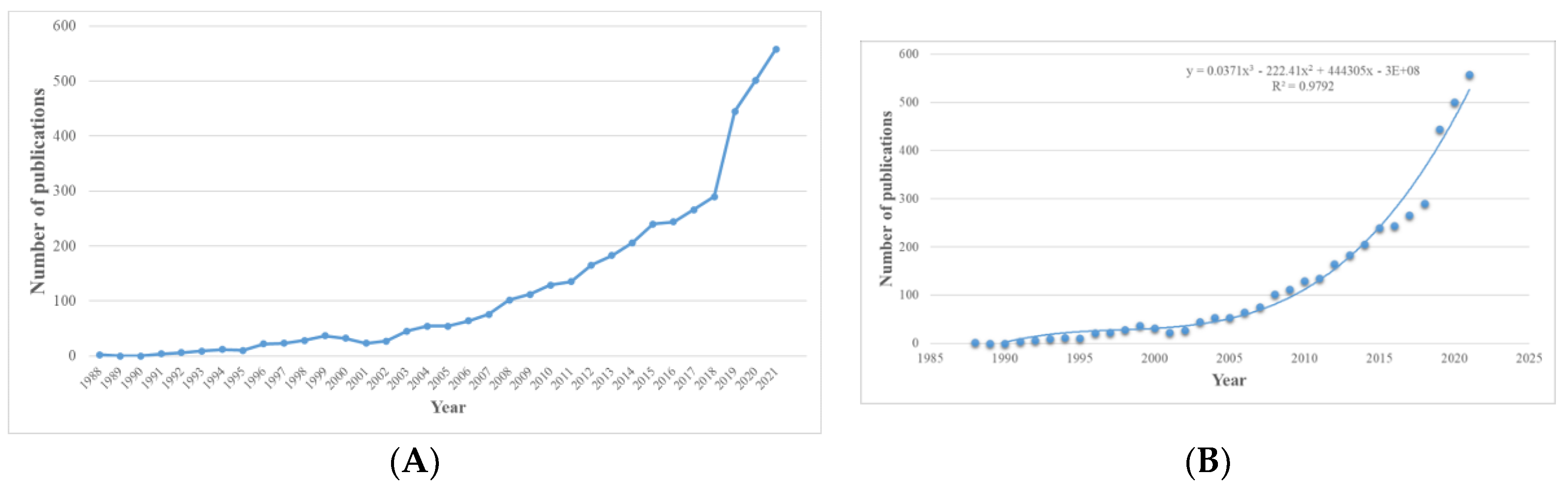
Figure 2.
(A) The collaboration network of countries researching SEM on nursing. (B) The overlay visualization network of countries related to SEM on nursing. (C) The density visualization of countries related to SEM on nursing. (D) The overlay Visualization network of cited countries related to SEM on nursing.
Figure 2.
(A) The collaboration network of countries researching SEM on nursing. (B) The overlay visualization network of countries related to SEM on nursing. (C) The density visualization of countries related to SEM on nursing. (D) The overlay Visualization network of cited countries related to SEM on nursing.
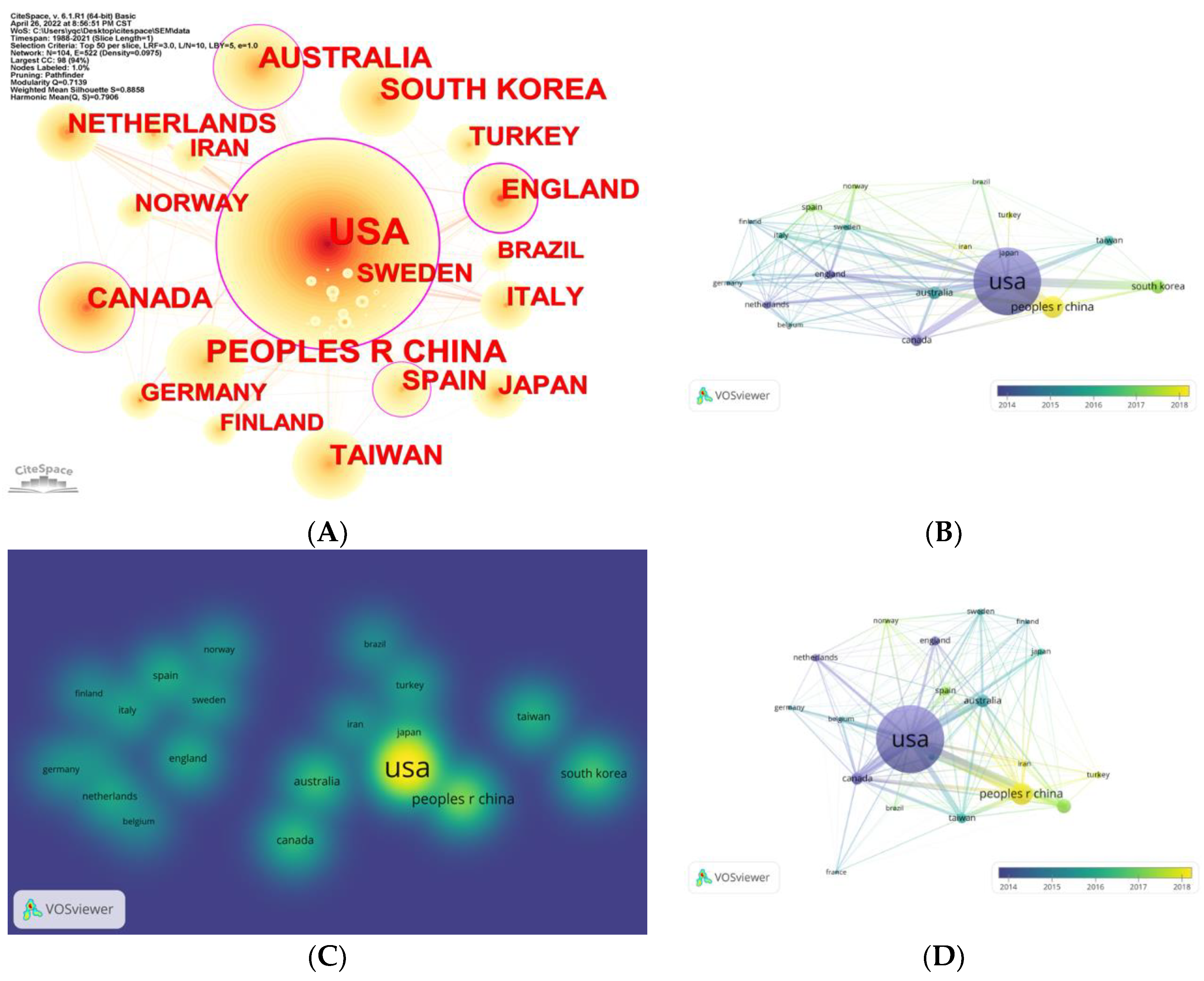
Figure 3.
(A) The collaboration network of institutions researching SEM on nursing. (B) The overlay visualization network of institutions related to SEM on nursing. (C) The density visualization of institutions related to SEM on nursing. (D) The overlay Visualization network of cited institutions related to SEM on nursing.
Figure 3.
(A) The collaboration network of institutions researching SEM on nursing. (B) The overlay visualization network of institutions related to SEM on nursing. (C) The density visualization of institutions related to SEM on nursing. (D) The overlay Visualization network of cited institutions related to SEM on nursing.
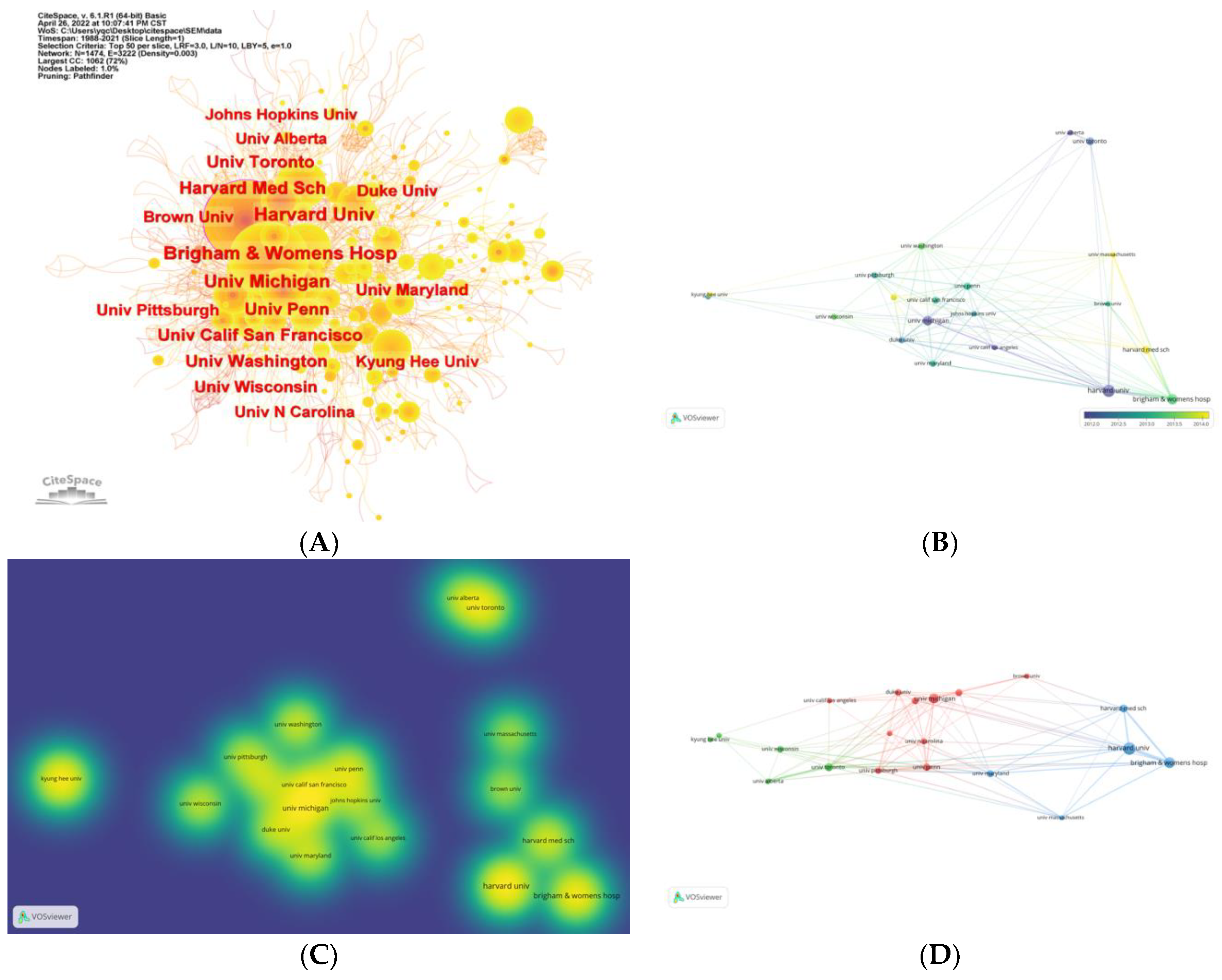
Figure 4.
(A) The collaboration network of authors related to SEM on nursing. (B) The overlay visualization network of authors related to SEM on nursing. (C) The density visualization of authors related to SEM on nursing. (D) The overlay Visualization network of co-cited authors related to SEM on nursing.
Figure 4.
(A) The collaboration network of authors related to SEM on nursing. (B) The overlay visualization network of authors related to SEM on nursing. (C) The density visualization of authors related to SEM on nursing. (D) The overlay Visualization network of co-cited authors related to SEM on nursing.
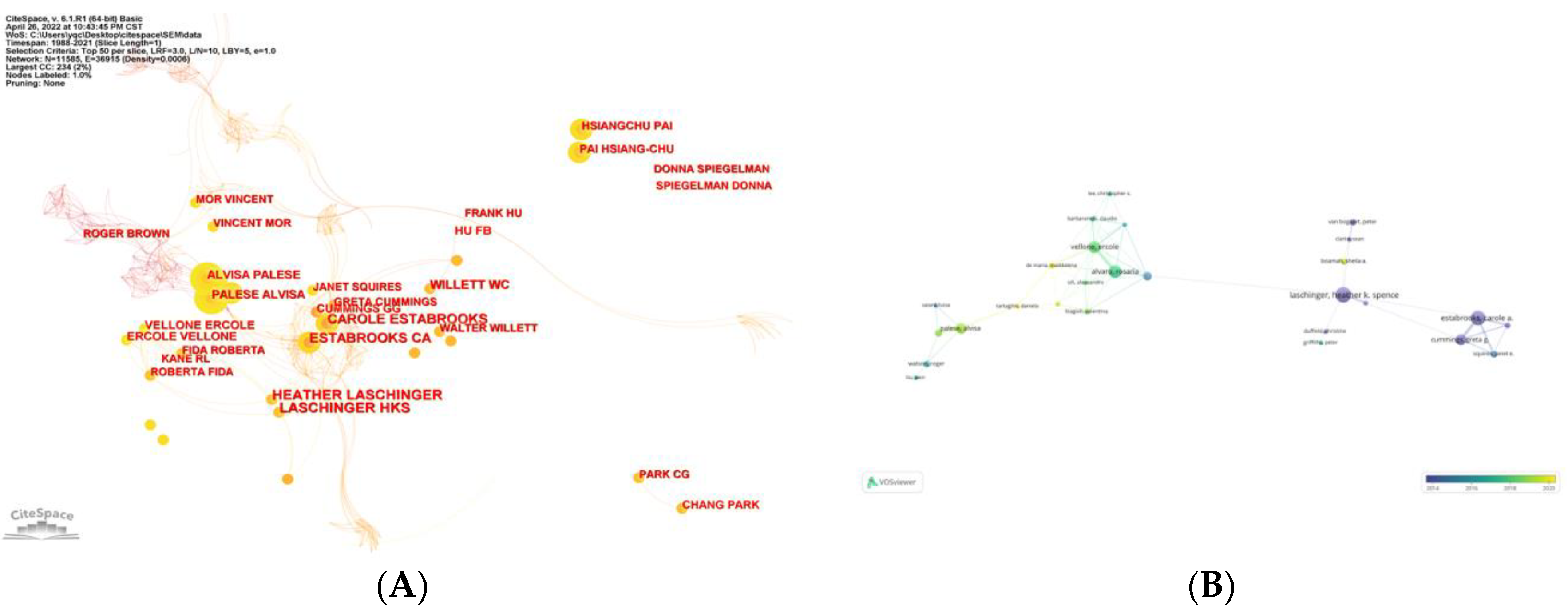
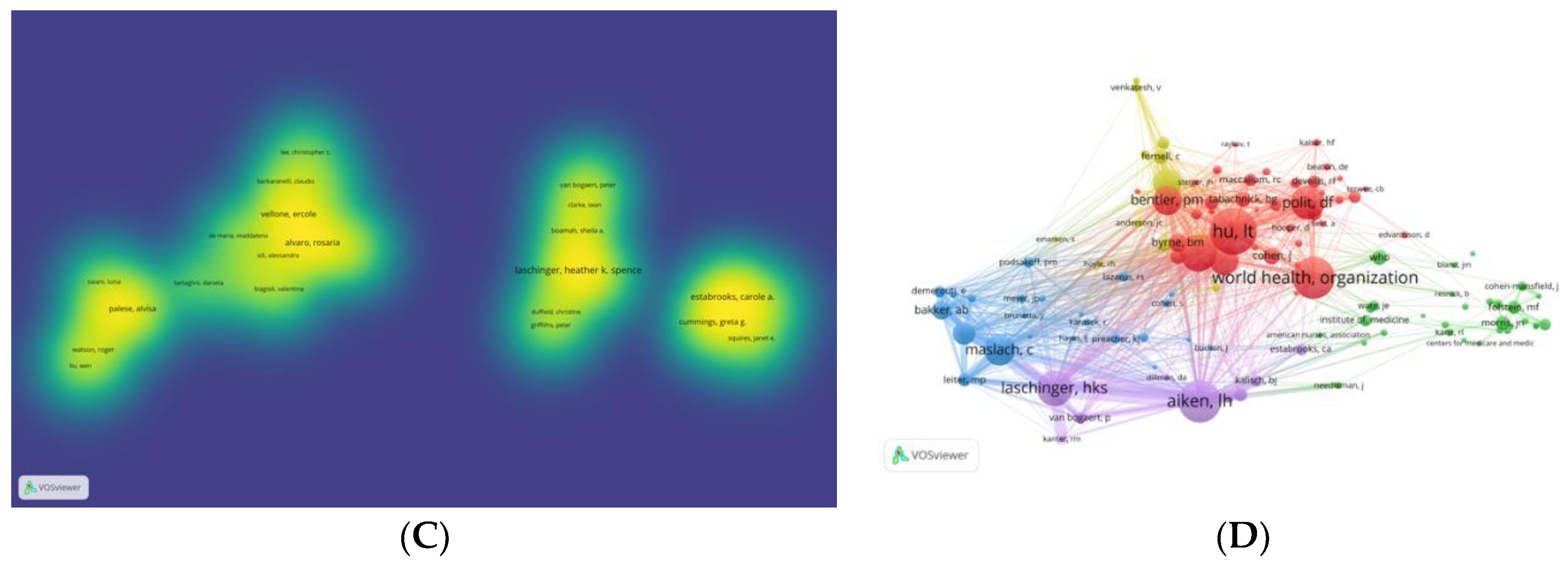
Figure 5.
(A) The visualization network of journals in SEM on nursing. (B) The overlay network of journals in SEM on nursing. (C) The visualization network of cited journals in SEM on nursing. (D) The co-citation network of journals in SEM on nursing.
Figure 5.
(A) The visualization network of journals in SEM on nursing. (B) The overlay network of journals in SEM on nursing. (C) The visualization network of cited journals in SEM on nursing. (D) The co-citation network of journals in SEM on nursing.
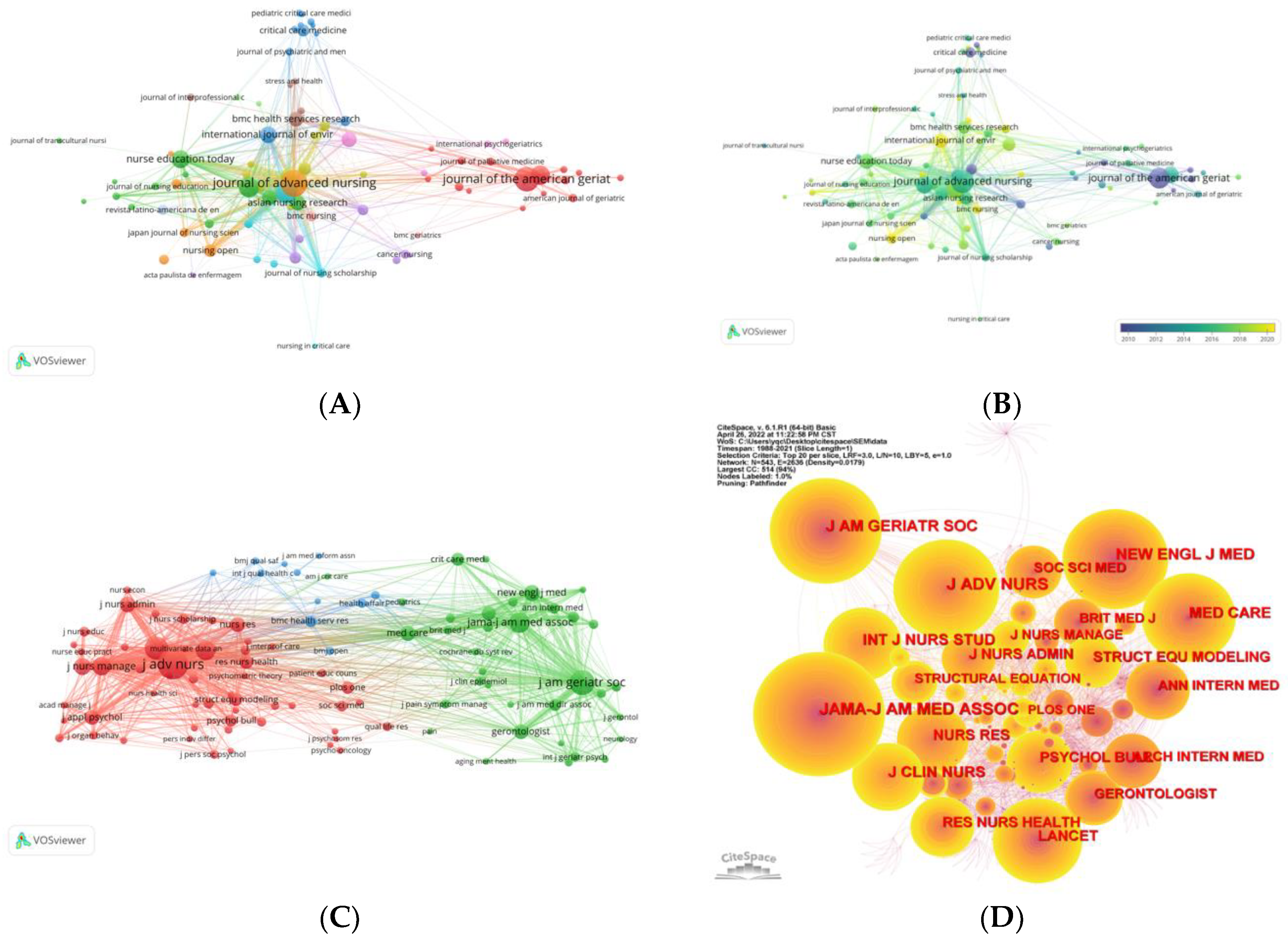
Figure 6.
(A) The network of co-cited references related to SEM on nursing. (B) The cluster network of co-cited references related to SEM on nursing. (C) The timeline view network of co-cited references related to SEM on nursing. (D) The overlay Visualization network of co-cited references related to SEM on nursing.
Figure 6.
(A) The network of co-cited references related to SEM on nursing. (B) The cluster network of co-cited references related to SEM on nursing. (C) The timeline view network of co-cited references related to SEM on nursing. (D) The overlay Visualization network of co-cited references related to SEM on nursing.
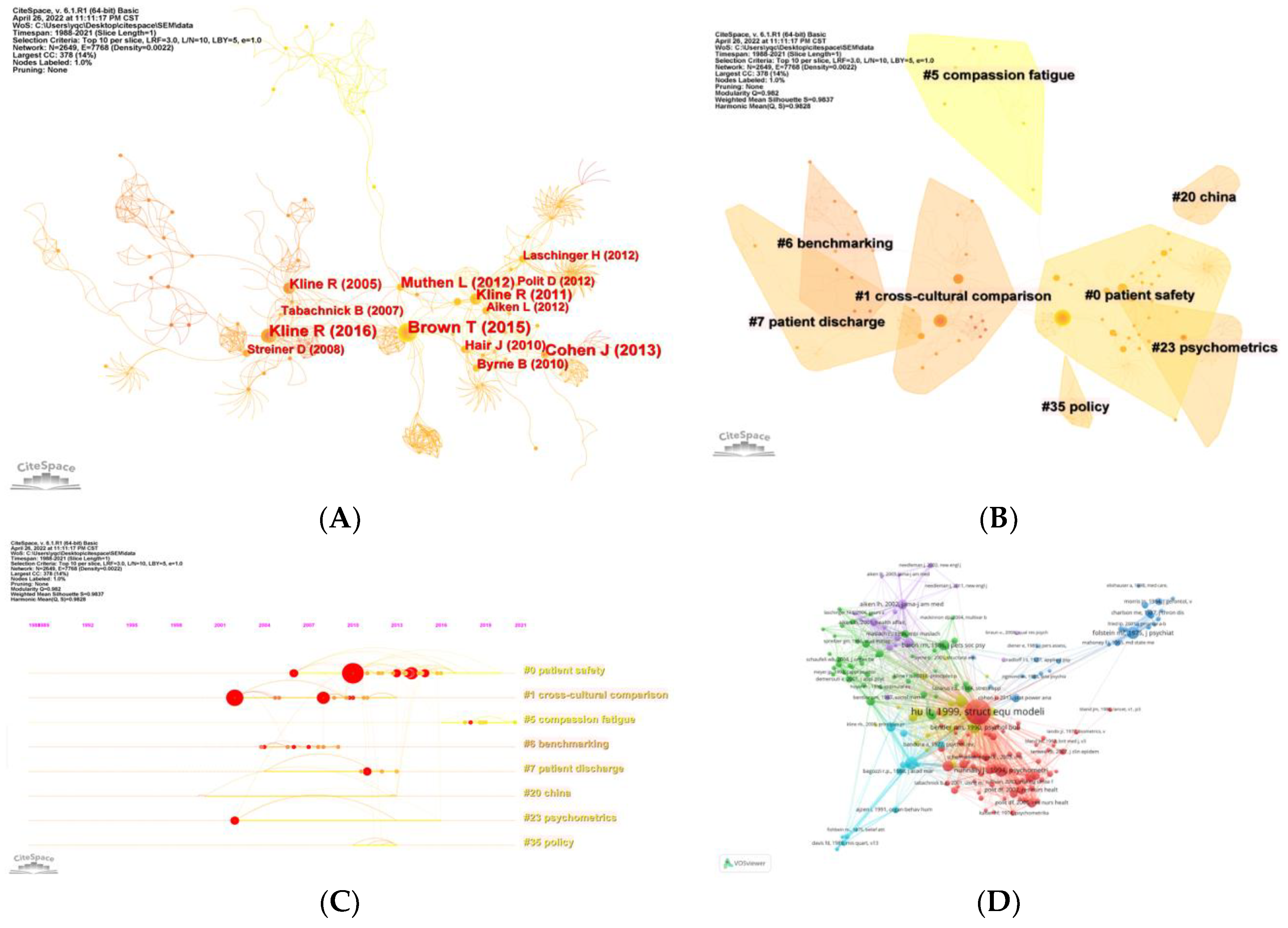
Figure 7.
(A) Analysis of keyword related to SEM on nursing. (B) The visualization network of keywords related to SEM on nursing. (C) The overlay visualization network of keywords related to SEM on nursing. (D) The cluster network of keywords related to SEM on nursing.
Figure 7.
(A) Analysis of keyword related to SEM on nursing. (B) The visualization network of keywords related to SEM on nursing. (C) The overlay visualization network of keywords related to SEM on nursing. (D) The cluster network of keywords related to SEM on nursing.
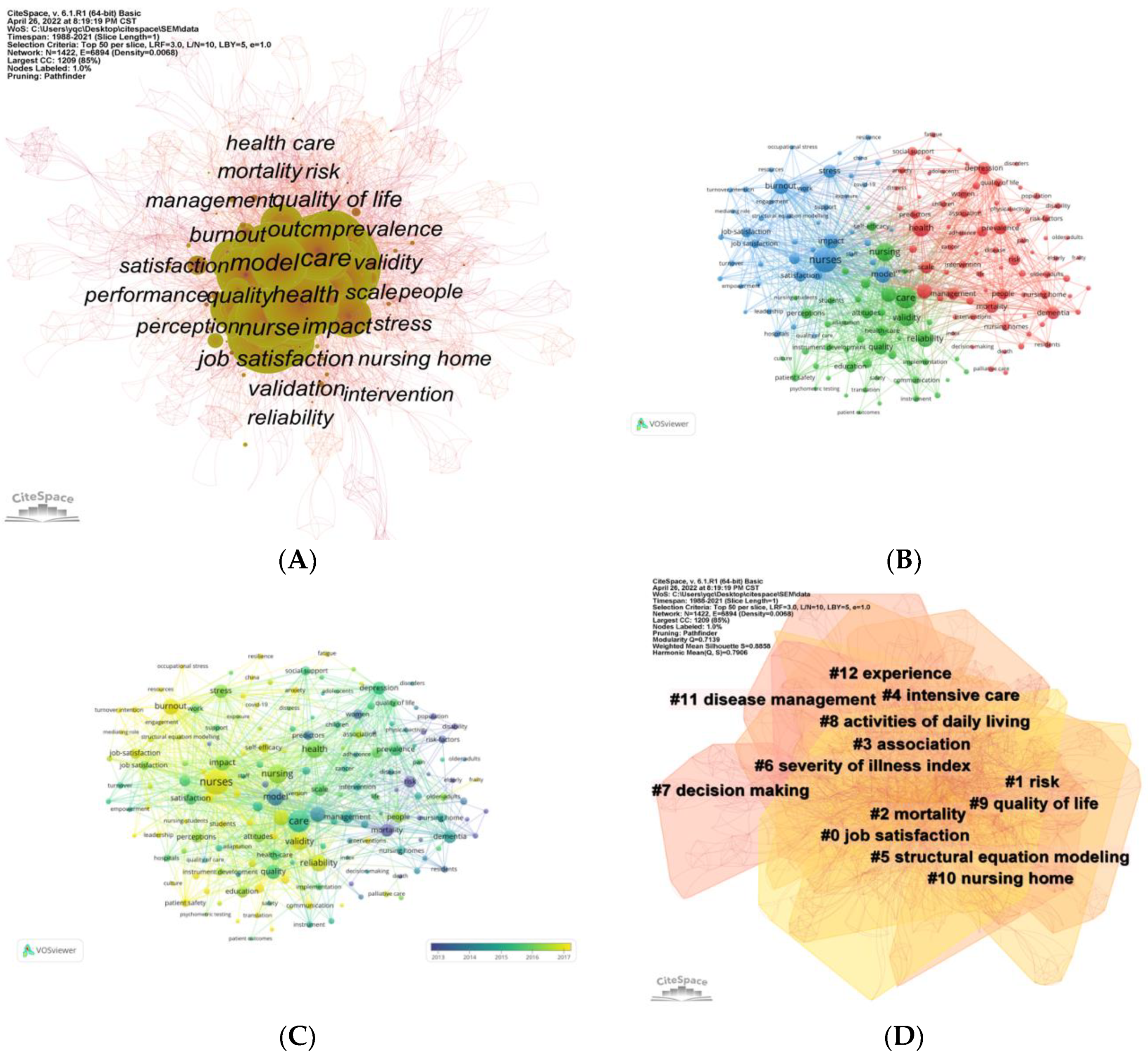
Figure 8.
(A) The cluster timeline view network of keywords related to SEM on nursing. (B) The keywords with the strongest citation bursts related to SEM on nursing. The color represents different frequent keywords (red: frequent; blue: infrequent).
Figure 8.
(A) The cluster timeline view network of keywords related to SEM on nursing. (B) The keywords with the strongest citation bursts related to SEM on nursing. The color represents different frequent keywords (red: frequent; blue: infrequent).
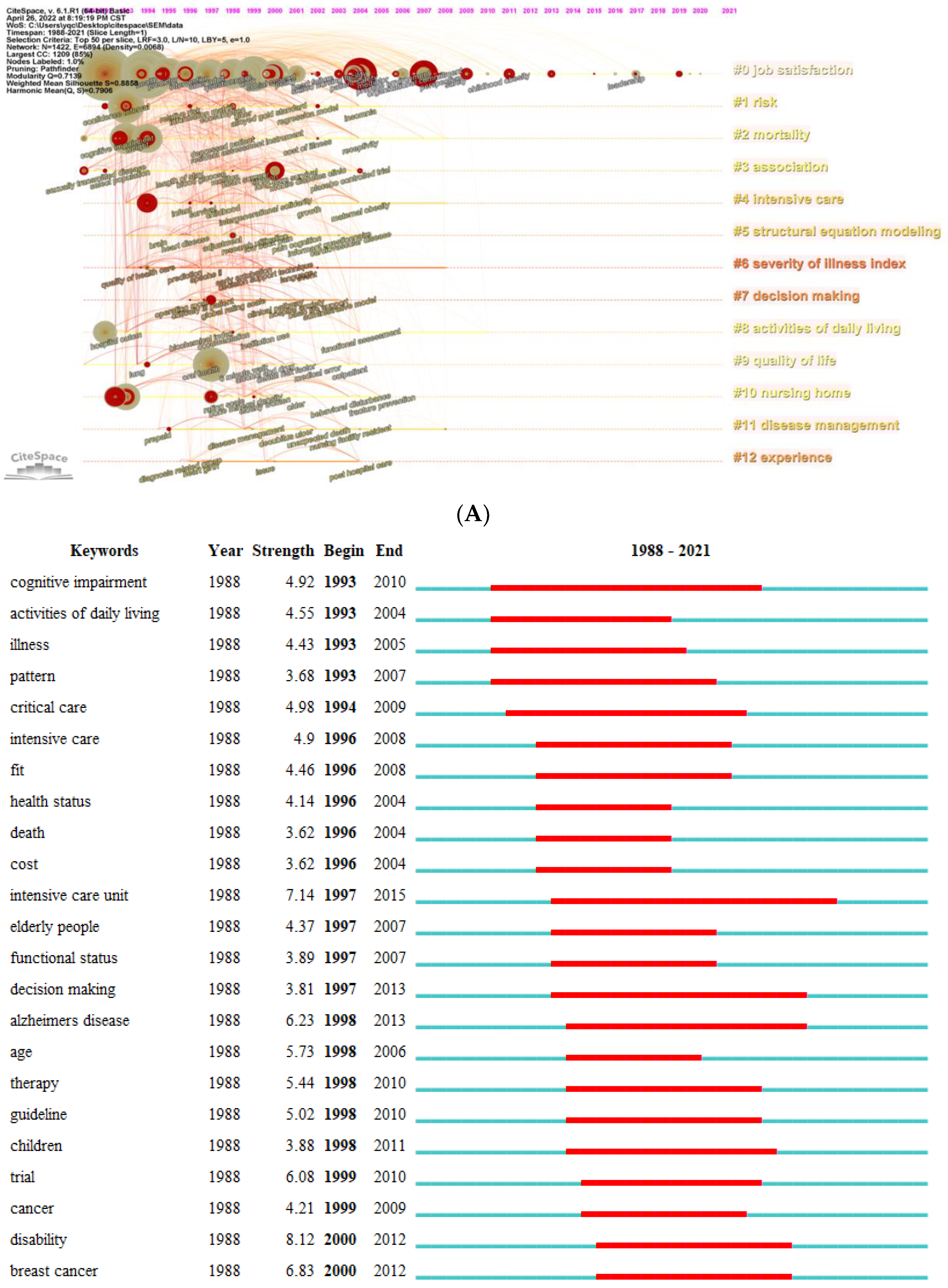
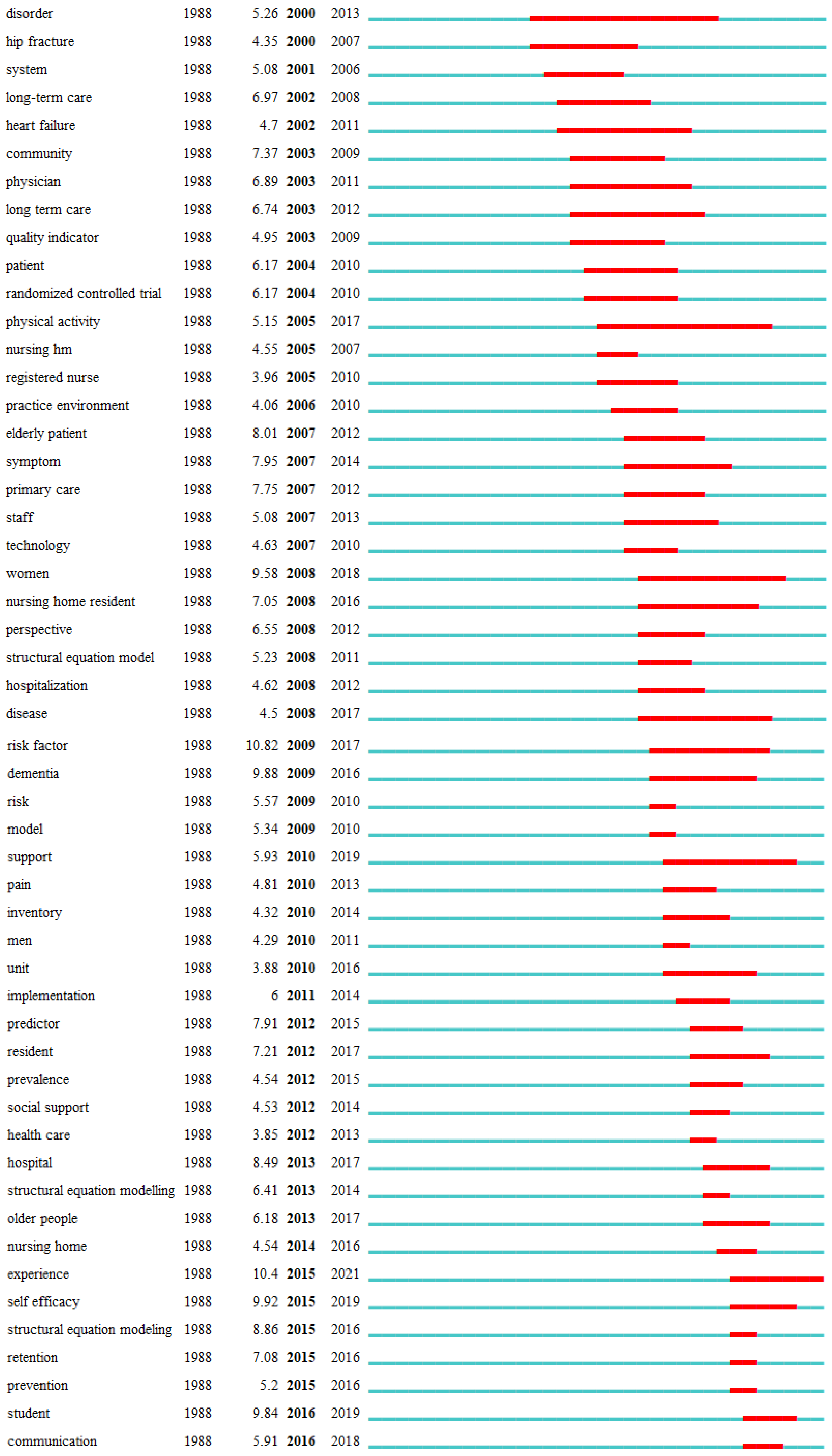
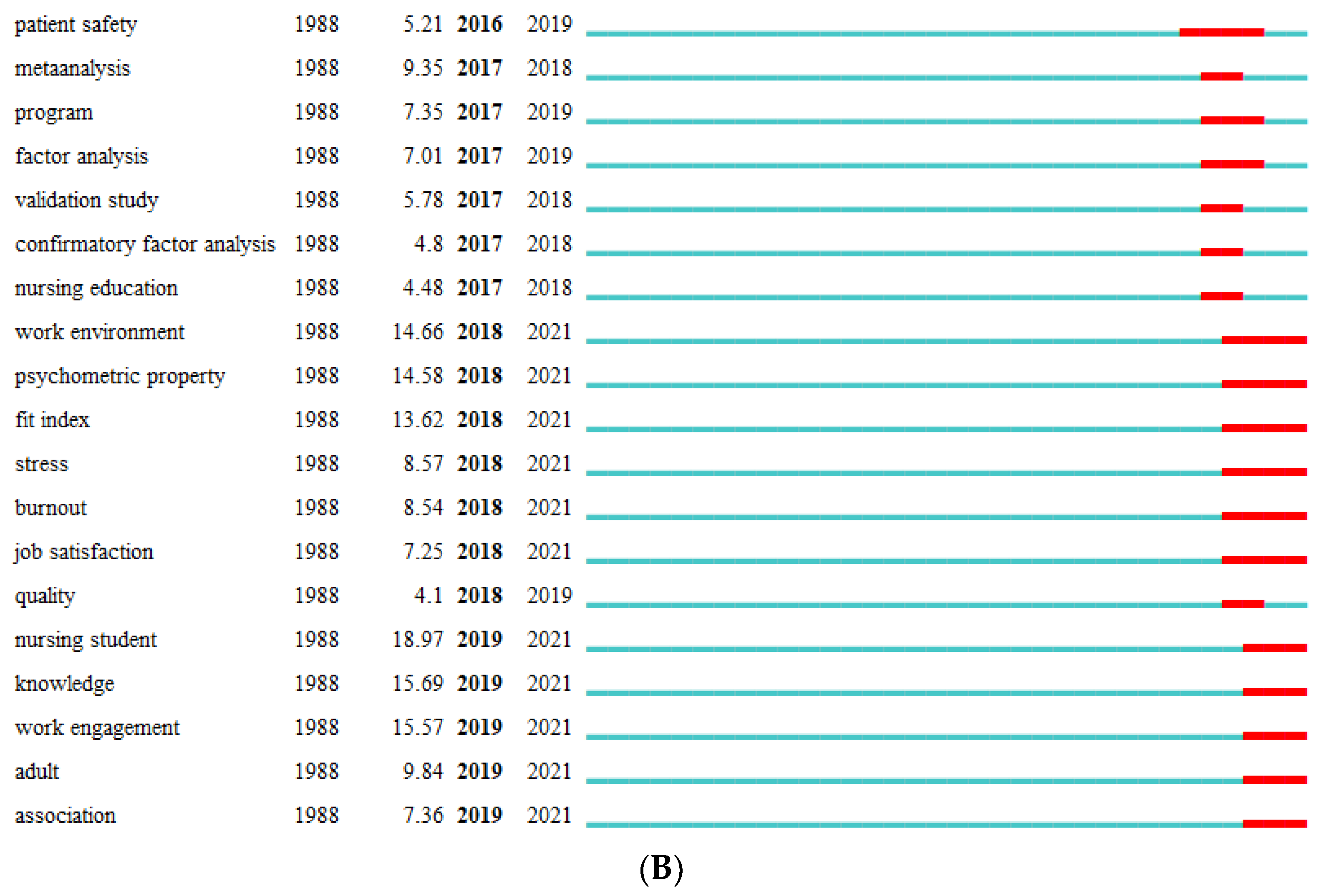

Table 1.
Search Queries.
| Set | Result | Search Query |
| #1 | 1542319 | TS=(structur* equation* model*) OR (SEM) OR (confirmat* factor analy*) OR (CFA) OR (path analy*) OR (measurement model*) OR (structure* model*) |
| #2 | 258047 | TS=nursing OR nurse |
| #3 | 5202 | #1 AND #2 |
Table 2.
Top 10 Publications, Centrality and Citations of Countries Related to SEM on Nursing.
| Rank | Publications | Country/Region | Centrality | Country/Region | Citations | Country/Region |
| 1 | 1433 | The USA | 0.31 | The USA | 43850 | The USA |
| 2 | 453 | Mainland China | 0.20 | England | 9228 | Canada |
| 3 | 295 | South Korea | 0.19 | Australia | 4828 | Australia |
| 4 | 268 | Australia | 0.18 | Canada | 4504 | Mainland China |
| 5 | 244 | Canada | 0.11 | Spain | 3798 | Netherlands |
| 6 | 205 | Taiwan | 0.10 | Sweden | 3620 | England |
| 7 | 183 | England | 0.09 | South Africa | 2823 | Taiwan |
| 8 | 182 | Spain | 0.08 | Belgium | 2420 | South Korea |
| 9 | 162 | Netherlands | 0.07 | Netherlands | 2325 | Italy |
| 10 | 142 | Italy | 0.07 | France | 2317 | Sweden |
Table 3.
Top 10 Publications, Centrality and Citations of institutions Related to SEM on Nursing.
| Rank | Publications | institutions | Centrality | institutions | Citations | institutions |
| 1 | 129 | Harvard Univ | 0.19 | Harvard Univ | 6436 | Harvard Univ |
| 2 | 69 | Brigham & Womens Hosp | 0.10 | Univ Toronto | 3477 | Brigham & Womens Hosp |
| 3 | 61 | Univ Michigan | 0.09 | Univ Penn | 2710 | Univ Michigan |
| 4 | 48 | Univ Penn | 0.08 | Univ Michigan | 2547 | Univ Calif San Francisco |
| 5 | 48 | Univ Toronto | 0.07 | Univ Sydney | 2269 | Univ Penn |
| 6 | 46 | Univ Washington | 0.06 | Duke Univ | 2260 | Univ Toronto |
| 7 | 46 | Univ Calif San Francisco | 0.06 | Brigham & Womens Hosp | 2230 | Duke Univ |
| 8 | 40 | Univ Maryland | 0.06 | Univ Washington | 1924 | Univ Western Ontario |
| 9 | 39 | Duke Univ | 0.06 | Univ Calif San Francisco | 1832 | Univ Washington |
| 10 | 39 | Wisconsin | 0.06 | Univ Wisconsin | 1800 | Univ Pittsburgh |
Table 4.
Top 10 Publications and Citations of Authors Related to SEM on Nursing.
| Rank | Publications | Author | Citations | Author |
| 1 | 30 | Lanschinger H | 1955 | Stampfer MJ |
| 2 | 21 | Estabrooks CA | 1520 | Lanschinger H |
| 3 | 19 | Brunetto Y | 975 | Spiegelman D |
| 4 | 18 | Lee S | 974 | Inouye SK |
| 5 | 17 | Willett WC | 747 | Hu FB |
| 6 | 16 | Li Y | 579 | Kane RL |
| 7 | 16 | Vellone E | 558 | Van Bogaert P |
| 8 | 15 | Alvaro R | 555 | Carole E |
| 9 | 15 | Kim H | 512 | Willett WC |
| 10 | 15 | Kim S | 458 | Curtis JR |
Table 5.
Top 10 Publications, Centrality and Citations of Journals Related to SEM on Nursing.
| Rank | Publications | Journal | Centrality | Journal | citation | Journal |
| 1 | 228 | J Adv Nurs | 0.40 | Age Ageing | 3192 | J Adv Nurs |
| 2 | 196 | J Am Geriatr Soc | 0.33 | Am J Epidemiol | 2310 | J Am Geriatr Soc |
| 3 | 145 | J Nurs Management | 0.20 | Advances Parasit | 2054 | Int J Nurs Stud |
| 4 | 127 | J Clin Nurs | 0.19 | Brit J Psychiat | 1716 | Jama-J Am Med Assoc |
| 5 | 118 | J Am Med Dir Assoc | 0.15 | Arch Gen Psychiat | 1578 | J Clin Nurs |
| 6 | 103 | Nurs Educ Today | 0.14 | J Adv Nurs | 1412 | J Nurs Management |
| 7 | 93 | Int J Env Res Pub He | 0.13 | Arch Intern Med | 1254 | Nurs Educ Today |
| 8 | 71 | Plos One | 0.13 | Immunology | 1071 | J Nurs Admin |
| 9 | 69 | Asian Nurs Res | 0.12 | Am J Clin Nutr | 1045 | Med Care |
| 10 | 69 | J Korean Acad Nurs | 0.11 | J Clin Epidemiol | 979 | J appl Psychol |
Table 6.
Top 10 Citations of References Related to SEM on Nursing.
| Rank | Author | Title | Published Year | Citations |
| 1 | Russell DW | UCLA Loneliness Scale (Version 3): Reliability, validity, and factor structure | 1996 | 2175 |
| 2 | Hu FB | Dietary fat and coronary heart disease: A comparison of approaches for adjusting for total energy intake and modelling repeated dietary measurements | 1999 | 784 |
| 3 | Grodstein F | A prospective, observational study of postmenopausal hormone therapy and primary prevention of cardiovascular disease | 2000 | 756 |
| 4 | Bycio P | Further assessments of bass (1985) conceptualization of transactional and transformation leadership | 1995 | 508 |
| 5 | Pochard F | Symptoms of anxiety and depression in family members of intensive care unit patients: Ethical hypothesis regarding decision-making capacity | 2001 | 437 |
| 6 | Laschinger H | Impact of structural and psychological empowerment on job strain in nursing work settings - Expanding Kanter's model | 2001 | 424 |
| 7 | Laschinger H | The impact of nursing work environments on patient safety outcomes - The mediating role of burnout/engagement | 2006 | 418 |
| 8 | Demerouti E | A model of burnout and life satisfaction amongst nurses | 2000 | 358 |
| 9 | Kane RA | Quality of life measures for nursing home residents | 2003 | 252 |
| 10 | Rasmussen KM | Prepregnant overweight and obesity diminish the prolactin response to suckling in the first week postpartum | 2004 | 251 |
Table 7.
Top 10 keywords Related to SEM on Nursing.
| Rank | Frequency | Keyword | Rank | Centrality | Keyword |
| 1 | 502 | Care | 1 | 0.10 | Adult |
| 2 | 376 | Model | 2 | 0.10 | Pattern |
| 3 | 373 | Nurse | 3 | 0.10 | Death |
| 4 | 345 | Health | 4 | 0.07 | Outcome |
| 5 | 274 | Impact | 5 | 0.07 | Depression |
| 6 | 269 | Outcome | 6 | 0.07 | Elderly patient |
| 7 | 258 | Quality of life | 7 | 0.06 | Quality |
| 8 | 245 | Job satisfaction | 8 | 0.06 | Risk |
| 9 | 235 | Quality | 9 | 0.05 | Care |
| 10 | 224 | validation | 10 | 0.05 | mortality |
Disclaimer/Publisher’s Note: The statements, opinions and data contained in all publications are solely those of the individual author(s) and contributor(s) and not of MDPI and/or the editor(s). MDPI and/or the editor(s) disclaim responsibility for any injury to people or property resulting from any ideas, methods, instructions or products referred to in the content. |
© 2023 by the authors. Licensee MDPI, Basel, Switzerland. This article is an open access article distributed under the terms and conditions of the Creative Commons Attribution (CC BY) license (http://creativecommons.org/licenses/by/4.0/).
Copyright: This open access article is published under a Creative Commons CC BY 4.0 license, which permit the free download, distribution, and reuse, provided that the author and preprint are cited in any reuse.