
Submitted:
31 December 2022
Posted:
03 January 2023
You are already at the latest version
Abstract
Nowadays, many Muslim-majority countries have implemented a dual banking system, namely the sharia and conventional systems. The development of Islamic banks is to fulfill the Muslims' need for the existence of halal transactions in financial institutions. However, in some countries, it turns out that conventional banks still dominate the country's economy. Because of that, it is necessary to see whether there are differences in financial risk and Earnings management between Islamic and conventional banks. The samples are conventional and Islamic banks in Southeast Asia, analyzed by the purposive sampling method from 2010-2019. The analytical tool used is the statistical difference test and economometrics analysis using generalized least square (GLS) regression with panel data (time series and cross-sectional data). These models are intended to forecasting the macroeconomics effects in applying dual banking system in one country or region. The results using non parametrics means difference test showed that the first hypothesis is accepted It means that Earnings management in conventional banks is greater than in Islamic banks. The Random Model Effect (REM) for second and third hypotheses testing on Conventional banks shows the Bankruptcy Risk and NPL do not affect the dependent variable Earnings Management (LLP). While fixed effect model testing on Islamic banks, the second and third hypothesis testing is rejected. Therefor Islamic Banks the value of Bankruptcy Risk (z-score) and the value of Non-Performing Loans (NPL) do not affect Earnings management. It also means that hypothesis 2 and 3 are rejected both in conventional as well as Islamic Banking. Sensitivity analysis for conventional as well as Islamic banking altogether using fixed effect model shows that the second and third hypotheses show that the independent variables (Bankruptcy Risk and NPL) do not affect the dependent variable Earnings Management (LLP). These results can be concluded that Islamic bank are enganged in less earnings management. Therefor in the the long run there are still more research that should conduct in comparing dual banking system in one region.
Keywords:
Financial distress
; Dual system banking
; Loan Loss Provission
; forecasting
; econometrics
Introduction
The dual banking system is popular nowadays. Usually, the Dual Banking System location is in Muslim-majority countries like Gulf Cooperative Council, MENA (Middle East and North America), and Southeast, especially Indonesia and Malaysia. Although Muslims dominate these countries, the conventional banking system is still popular in these current developments. Research Wanke et al. (2016) stated that Islamic banks are not more efficient than conventional banks. It encourages the importance of research comparing these two banking systems.
Some studies have compared the financial condition of Islamic banks with conventional ones. Research by Mohammed et al. (2015) stated that in conventional banks, the higher the market competition, the lower the banking stability of a country. On the other side, in Islamic banks, the more competitors, the more stable the market. These are in line with the research of Alam et al. (2019) that said Islamic Banks move according to the Competition Stability Theory while conventional banks are in a condition of competition vulnerability. The appearance of Islamic banks is still considered a trial. The more Islamic banks appear, the more consumers will switch and believe in this banking system, but the fewer the number, the more the market will fail.
Besides being considered a trial system, there are some concerns about the truth of the Syariah system being an interest-free system. Tlemsani (2020) test this by examining the correlation between LIBOR (London Interbank Offered Rate) as an indicator of interest rates between conventional banks and IIBR (Islamic Interbank Offered Rate) as a basic measurement of borrowing costs at Islamic banks and the result of the correlation is negative. That means the Earnings sharing of Islamic banks doesn’t depend on conventional bank interest, but Islamic bank financial instruments are a substitute for investment in conventional banking.
One important phenomenon that happens due to the impact of accounting choices in financial statements is the existence of Earnings management. Each bank has strict limits on the financial authorities of each country, even globally. However, these banks have an industry inherent risk as well as market risk and other risks that make their financial condition not as good as required by the provisions of the financial authorities. Based on this, the bank will try hard to fulfill the financial condition of the authorities, one of which is Earnings management.
There is some evidence that conventional banks do Earnings management, including Adzis et al. (2016), Ozili (2017, 2019), Vasilakopoulos et al. (2018), Abu-Serdaneh (2018), Doan et al. (2019), and Agustia et al. (2020). Pramono et al. (2018) also said in Islamic banks this behavior was found. However, according to Lassoued et al. (2017), Earnings management at Islamic banks is smaller than at conventional banks.
This study will compare Earnings management behavior between conventional and Islamic banks in five ASEAN countries. It is because this area has the potential to become the third-largest economic regional area in the world. However, there are only five countries where the capital markets and banking have been running well. The location of this study differentiates from the research of Lassoued et al. (2017) conducted in Middle Eastern and North African countries.
This study will also examine the effect of banking risk on Earnings management in Syariah and conventional banking. The banking risk will divide into bankruptcy risk following the Altman Z-Score (Altman, 1968). Besides, there will be a sensitivity test that combines a sample of conventional banking with Islamic banking.
Literature Review
Islamic and Conventional Banking
Based on Law no. 21 of 2008 regarding Islamic Banking, Islamic banks operate business activities based on sharia principles or Islamic law principles. The Islamic sharia principles mean to include the principles of justice and balance ('adl wa tawazun), benefit (maslahah), universalism (alamiyah), and not contain like gharar, maysir, usury, unjust and unlawful objects, as regulated in the fatwa of the Ulama Council Indonesia. The basis for the establishment of Islamic banks sourced from the prohibition of interest which is explained in Al Qur’an (Islamic Guidance Book) Surah Ali Imran 3: 30 that can be Translate as: “O you who believe, do not eat usury multiplied and fear Allah so that you may be successful”.
According to Indonesia Republic Law Number 10 of 1998, conventional banking is a bank that does conventional business activities and its activities providing services in traffic payment, which in principle use two methods. The first method is setting interest as a price for deposit products such as savings, time deposits, and loan products (credit) that are provided based on a specific interest rate. Second, the bank uses or applies various fees in a certain amount or percentage. This costing system is called fee-based.
Earnings Management
Earnings is the calculation of outgoing costs reducing income. Earnings information is beneficial for investors or other parties as an indicator of the efficient use of funds embedded in the company manifested in the rate of return to increase prosperity (Wirawan, 2020).
Agency theory states that Earnings management can happen because of the different importance between owners and managers. The shareholders not owned the information like the managers as the organizer.
According to Sulistyanto (2014), "Earnings management is an effort by company managers to intervene or influence the information in financial statements to trick stakeholders who want to know the performance and condition of the company".
Bankruptcy Risk
Brigham (2014: 2-3) declares that bankruptcy is a failure that happens in a company which interprets economic failure (economic distress. It means a condition where the company loses money and income can't cover its costs, meaning that the Earnings rate is less than the cost of capital or the present value of the company's cash flows is less than its liabilities. Failure happens when the actual cash flow is far below the expected cash flow. Second, financial failure (financially distressed) is a company condition where funding is difficult in terms of cash and working capital. Some liability asset management plays a very crucial role in the arrangement to prevent financial failure. Financial failure also interprets as insolvency that differentiates between cash flow basis and stock basis.
Non-Performing Loan
Banks that provide loans to customers must go through a series of analyses to minimalize and/or avoid congestion in paying installments happening. According to Ismail (2013: 224), non-performing credit is a condition where the customer is unable to pay part or all of his obligations to the bank as agreed. Furthermore, Ismail (2013: 226) states that NPL (Non-Performing Loan) is an overdue loan of more than 90 days. NPL is divided into Substandard, Doubtful, and Loss Credit.
Research Framework
In this study, there are two research frameworks to describe the hypotheses. Where the first research framework explains the first hypothesis, the second research framework explains the second and third hypotheses. The design is below in Figure 1.1 and Figure 1.2.
Research Hypotheses
Kolsi and Grassa (2017) state that Islamic banks are perceived as banks based on Corporate Governance. Conventional banks are perceived as a bank with worse management behavior than Islamic banks in the research of Louhichi and Boujelbene (2016). Lassoued et al. (2017) show that conventional banks perform greater Earnings management than Islamic banks. Based on this, the first hypothesis in this study is:
H1: Earnings management in conventional banks is greater than in Islamic banks
Research by Olson et al. (2014) states that bank risk affects Earnings management. This banking risk includes bankruptcy and non-performing loan risk (Sariri et al., 2018). Wulandari's research (2021) states that bankruptcy probability affects Earnings management.
H2: Bankruptcy risk affects earnings management
Research by Kibtiah et al. (2020) states that non-performing loans affect earnings management. Research by Permoni et al. (2018) also states that non-performing loans have a positive effect on earnings management.
H3: Non-Performing Loans affect Earnings Management
Methods of research
Research Sample Selection
Research Selection Sample
Sample 5 big ASEAN countries. In 2016 Southeast Asia announced joining the Asean Economic Community and is predicted to be the third largest regional economic power. 2019 became the turning point for the world economy because, in 2020, the world economy declined drastically due to the Covid-19 disaster, so research needs to be limited to this period. Purposive sampling took from 2010 to 2019. Conventional banks listed on the ASEAN-5 Stock Exchange (Indonesia, Malaysia, Singapore, Thailand, Philippines) publish complete data in the observation period. Islamic banks are Islamic commercial banks registered with the banking authorities of ASEAN 5 countries that publish sufficient data during the observation period. Obtained a sample of 1,920, consisting of 1,740 samples of conventional banks and 180 samples of Islamic banks.
Data Analysis Technique
Classic Assumption Test
According to Ghozali (2013), Heteroscedasticity is to finding dissimilarity of variance from the residuals in the regression model. A good regression model has homoscedasticity or doesn’t have heteroscedasticity. If the model has Heteroscedasticity, estimation is using Generalized Linear Square (GLS). However, if the variant is homoscedasticity, the test is continued to the autocorrelation test.
According to Ghozali (2013), the autocorrelation test aims to determine the correlation between the confounding error in period t and period t-1 (previous). If the residuals have autocorrelation, an estimate uses Generalized Linear Square (GLS).
Multicollinearity test, panel data regression is not the same as the linear regression model, because of that the panel data model needs to meet the requirements free from violations of basic assumptions (classical assumptions). Even so, the existence of a strong correlation between the independent variables in the formation of a model (equation) is highly discouraged, because it will affect the accuracy of parameter estimation, in this case, the regression coefficient, in estimating the true value. A strong correlation between independent variables is called multicollinearity.
The Normality Test aims to test whether the independent, dependent variables or both have a normal distribution or not. One way to see the normality of the residuals is to use the Jarque-Bera (JB) method. If the JB value is less than 2 then the data is normally distributed or if the probability is greater than 5% then the data is normally distributed.
Means Difference Test
Earnings Management measurement is by a proxy ratio of Loan Loss Provision per Total Assets. In testing the first hypothesis, the Earnings management of Islamic banks test is statistically different from the Earnings management of non-Islamic banks. The difference test is divided into Paired sample t-test and the Wilcoxon test.
According to Ghozali (2018), Paired sample t-test is a test of two pairs of samples. Paired samples are the same subject but experience different treatments. This different test model is used to analyze the pre-post research model before and after. Provisions of data are normally distributed. The criteria for the different t-tests with the level of significant α = 5% are as follows.
- If the p-value (in column sig.) < α = 0.05, then H0 is rejected and Ha is accepted. Where H0 in this study is the Earnings management of conventional banks is the same as Islamic banks, while Ha in this study is Earnings management of conventional banks is greater than Islamic banks.
- If the p-value (in column sig.) > α = 0.05 then H0 is accepted and Ha is rejected. Where H0 in this study is the Earnings management of conventional banks is the same as Islamic banks, while Ha in this study is Earnings management of conventional banks is greater than Islamic banks.
According to Ghozali (2018), the Wilcoxon Signed Ranks difference is to evaluate specific treatments in two observations, both before and after certain treatments. Used if the data is not normally distributed. The test criteria with the level of significant α = 5%, are as follows.
- If the p-value (in column sig.) < α = 0.05, then H0 is rejected and Ha is accepted.
- If the p-value (in column sig.) > α = 0.05 then H0 is accepted and Ha is rejected.
SignificantTest
In testing the second and third hypotheses, Earnings management becomes the dependent variable. There are two independent variables are bankruptcy risk Z-score and Non Performing Loan. The regression equation for the second and third hypothesis testing is:
Information:
EM = earnings management measured by Loan Loss Provision
α,β, and ε = regression coefficient
Z = 0.012 (Working Capital/Total Assets) + 0.014 (Balance Earnings/Total Assets) + 0.033 (Earnings before Interest and Tax/Total Assets) + 0.006 (Market Value of Equity/Total Book Value) + 0.999 (Sales/Total Assets)
NPL= Non Performing Loan
- 1
- Individual Parameter Significant Test (Test Statistical t)
The t-test was used to test the regression coefficients individually. The test is carried out on the population regression coefficient, is it equal to zero, which means that the independent variable has no significant effect on the dependent variable, or is not equal to zero, which means that the independent variable has a significant effect on the dependent variable.
Based on a comparison of F-Statistics with F tables
| - No effect | if the t-statistic value < t table |
| - Influence | if the t-statistic value > t table |
Based on probability
| - Has no effect | if the Prob value (t-statistic) > 0.05 |
| - It has an effect | if the Prob value (t-Statistics) < 0.05 |
- 2
- Simultaneous Significance Test (Statistical F Test)
The F-test is to know the regression coefficient (slope) hypothesis simultaneously, it is use to ensure that the selected model is feasible or not to interpret the influence of the independent variable on the dependent variable.
Based on the comparison of F-Statistics with F table
| - No effect | if the value of F-statistics < F Table |
| - Influential | if the value of F-statistics > F table |
Based on probability
| - No effect | if the Prob value (F-Statistic) > 0.05 |
| - Influential | if the value of Prob (F-Statistics) < 0.05 |
- 3
- Coefficient of Determination Test (R)
The coefficient of determination (Goodness of Fit) is denoted by R-squares which is an important measure in regression because it can inform whether or not the estimated regression model is good. The coefficient value of determination reflects how much variation is in explaining the dependent variable by the independent variable. If the Coefficient of Determination is equal to 0, the variation of the dependent variable cannot be explained by the independent variables at all. Meanwhile, if the value of the Coefficient of Determination is equal to 1, the variation in the dependent variable as a whole can be explained by the independent variables. Thus, whether a regression equation is good or bad is determined by its R-squares which have a value between zero and one.
Research Result and Discussion
The data used is in the form of Bankruptcy Risk, Non-Performing Loans, and Earnings Management variables. The objects in this study are the listed conventional and Islamic banking in ASEAN on the stock exchanges of each country in the period 2010 to 2019, meeting the applicable criteria for the application of operational variables using the purposive sampling technique required in this study.
Test the difference between conventional banking and Islamic banking
Table 1 presents descriptive statistical results of Earnings management data measured using Loss Loan Provision (LLP) between conventional banking and Islamic banking in ASEAN 5. The descriptive statistical results show that the minimum LLP value for conventional banks is 0.06 and 0.71 for Islamic banks. The maximum value for conventional banks is 51.53 and for Islamic banks is 47.73.
In this test using the Wilcoxon test because it is assumed that the data is not normally distributed. This can be seen in the table below.
Based on Table 2 above, it can be seen that the prob value <0.05. This can be concluded if the data is not normally distributed, so the different test analysis uses the Wilcoxon test.
Based on Table 3. above, it can be seen that the prob value < 0.05. So it can be concluded that there is a significant difference between conventional banks and Islamic banks in terms of Earnings management which is measured using the Loss Loan Provision (LLP) indicator.
The conclusion for testing the first hypothesis is that Ha is accepted with the condition that the p-value (0.000) < α = 0.05. Where H0 in this study is conventional bank Earnings management the same as Islamic banks, while Ha in this study is Earnings management in conventional banks is greater than Islamic banks. In this first hypothesis, it is clear that there is a significant difference in the value of Loss Loan Provision or allowance for impairment losses between conventional banks and Islamic banks, or it can be concluded that the LLP at conventional banks means 13.2065 is greater than that at Islamic banks means 10.806.
Conventional Bank Panel Data Regression Test for the second and third hypotheses
Descriptive Statistic
Based on the results of descriptive statistics in Table 4. The lowest mean value is the Non-Performing Loan (NPL) variable, while the highest mean value is the Earnings Management Variable (LLP). The lowest median value is the Non-Performing Loan (NPL) variable while the highest median value is the Earnings management variable (LLP). The lowest maximum value is Bankruptcy Risk Variable (Z-Score) while the highest maximum value is Loss Loan Provision (LLP). The lowest minimum value is the Bankruptcy Risk Variable (Z-Score), while the highest Minimum Value is the Non-Performing Loan (NPL) variable.
Research Model Selection
The research model selection for all independent variables on the dependent variable.
Chow's test compares the CEM model with FEM. The results of the chow test in Table 5 show that if the probability value of the chi-square cross-section is 0.0000 or <0.05, then H0 is rejected. Therefore, the chosen model is the fixed effect.
Based on the results of the Hausman test in Table 6, it can be seen from the random cross-section probability value of 0.5048> 0.05, this means that H0 is accepted and H1 is rejected so that the chosen model is the Random Model Effect (REM).
Based on the results of the Lagrange Multiplier test in Table 7, it can be seen from the probability value of the cross-section breush-pagan that is equal to 0.0000 <0.05, this means that H0 is rejected and accepts H1, so the model chosen is the Random Model Effect (REM). The conclusion is that the Random Effect Model (REM) was selected.
Classic assumption test
In the second and third Hypothesis Testing, the Random Effect Model (REM) was selected so that no classical assumption test was needed.
Hypothesis Testing
- 1
- F test
The probability value (F-Statistic) is 1.979857 > 0.05 so that all independent variables (Bankruptcy Risk and NPL) simultaneously do not affect the dependent variable of Earnings Management (LLP).
- 2
- Coefficient of Determination
The Adjusted R-squared value was 0.001126. it means that the variation of changes in Earnings management variables (LLP) can be explained by the Bankruptcy Risk variable (z-score), Non-Performing Loans (NPL) of only 0.1%.
- 3
-
T-test
- -
- Bankruptcy Risk (z-score) is 0.7488 > 0.05, so it has no effect
- -
- Non-Performing Loan (NPL) of 0.0486 < 0.05, so it has an effect
The conclusion is that only the Non-Performing Loan (NPL) variable has the most significant effect on Earnings management in conventional banks in ASEAN 5.
Islamic Bank Panel Data Regression Test for the second and third hypotheses
Descriptive Statistic
Based on the results of the descriptive statistics in Table 8. The lowest mean value is the Non-Performing Loan (NPL) variable, while the highest mean value is the Earnings Management Variable (LLP). The lowest median value is the Non-Performing Loan (NPL) variable while the highest median value is the Earnings management variable (LLP). The lowest maximum value is Bankruptcy Risk Variable (Z-Score) while the highest maximum value is Loss Loan Provision (LLP). The lowest minimum value is the Bankruptcy Risk Variable (Z-Score), while the Highest Minimum Value is the Loss Loan Provision (LLP) variable.
Research Model Selection
Research model selection for all independent variables on the dependent variable.
Chow's test compares the CEM model with FEM. The results of the Chow test in Table 9. show that the probability value of the chi-square cross-section is 0.0010 or <0.05, then H0 is rejected. Therefore, the chosen model is a fixed effect.
Based on the results of the Hausman test in Table 10, the random cross-section probability value of 0.4646 > 0.05 means that H0 is accepted and H1 is rejected so that the chosen model is the Random Model Effect (REM).
Based on the Lagrange Multiplier test in Table 11, the probability value of Breush-Pagan Cross-section is 0.0016 < 0.05. It means that H0 is rejected and H1 is accepted, so the model chosen is the Random Model Effect (REM). The conclusion is the Random Effect Model (REM) was selected.
Classic assumption test
In the second and third Hypothesis Testing, the Random Effect Model (REM) was selected so that no classical assumption test was needed.
Hypothesis Testing
- 1
- F Test
The probability value (F-Statistics) is 0.570394 > 0.05 so that all independent variables (Bankruptcy Risk and NPL) simultaneously do not affect the dependent variable Earnings Management (LLP).
- 2
- Coefficient Determination
The Adjusted R-squared value was 0.004823. It means that variations in changes in the ups and downs of the Earnings management variable (LLP) can be explained by the variable Bankruptcy Risk (z-score), Non-Performing Loans (NPL) of only 0.4%.
- 3
-
Test T
- Bankruptcy Risk (z-score) of 0.4084 > 0.05, so it has no effect
- Non-Performing Loan (NPL) of 0.5518 > 0.05, so it has no effect
The conclusion of the variable Non-Performing Loan (NPL) and Bankruptcy Risk (z-score) has no effect on Earnings management in Islamic banks in ASEAN 5.
Joint Sensitivity Test of Conventional Banks and Islamic Banks
Descriptive Statistic
Based on the results of descriptive statistics in Table 12. The lowest mean value is the Non-Performing Loan (NPL) variable, while the highest mean value is the Earnings Management Variable (LLP). The lowest median value is the Non-Performing Loan (NPL) variable while the highest median value is the Earnings management variable (LLP). The lowest maximum value is the variable Non-Performing Loan (NPL) while the highest maximum value is the Loss Loan Provision (LLP). The lowest minimum value is the Bankruptcy Risk Variable (Z-Score), while the Highest Minimum Value is the Non-Performing Loan (NPL) variable.
Research Model Selection
Research model selection for all independent variables on the dependent variable.
Chow's test compares the CEM model with FEM. The results of the chow test are in Table 13. show that the probability value of the chi-square cross-section is 0.0000 or <0.05, then H0 is rejected. Therefore, the chosen model is the fixed effect.
Based on the results of the Hausman test in Table 14, the random cross-section probability value is equal to 0.6376 > 0.05, which means that H0 is accepted and H1 is rejected so the chosen model is the Random Model Effect (REM).
Based on the Lagrange Multiplier test in Table 15, the probability value of the cross-section breush-pagan is equal to 0.0000 <0.05. It means that H0 is rejected and H1 is accepted, so the model chosen is the Random Model Effect (REM). The conclusion is that the Random Effect Model (REM) was selected.
Classic assumption test
In the second and third Hypothesis Testing, the Random Effect Model (REM) was selected so that no classical assumption test was needed.
Hypothesis Testing
- 1
- F Testing
The probability value (F-Statistic) > 0.05 so that all independent variables (Bankruptcy Risk and NPL) simultaneously do not affect the dependent variable Earnings Management (LLP).
- 2
- Coefficient Determination
The Adjusted R-squared value was 0.001114. It means that the variation of changes in Earnings management variables (LLP) can be explained by the Bankruptcy Risk variable (z-score), Non-Performing Loans (NPL) of only 0.1%.
- 3
-
T Test
- Bankruptcy Risk (z-score) is 0.9861 > 0.05, so it has no effect
- Non-Performing Loan (NPL) is 0.0423 < 0.05, so it affects
The conclusion is that only the Non-Performing Loan (NPL) variable has the most significant effect on Earnings management in conventional banks and Islamic banks in ASEAN 5.
Conclussions
We apply several nonparametrics and econometrics procedures to forecast the pattern of dual banking system in ASEAN-5 Countries. The non parametrics means difference test results shows that that earnings management in ASEAN-5 Conventional Banks in higher than in Islamic Banks. Therefore, after conducting econometrics analysis using GLS analysis, bankruptcy and non-performing loans do not have effect on earnings management decision in conventional and Islamic banks. Sensitivity analysis that mixed conventional as well as sharia bank econometrics analysis also shows that independent variable does not have effect on dependent variables as predicted in the hypothesis 2 and 3.
This research is using data from before Covid-19 Pandemic, further research should analysis the covid impact on dual banking system in ASEAN-5 Countries. This research also mixing sample dual banking system in muslim majority and minority countries. Further research should testing the effect on majority and minority moslem countries.
References
- Munisamy, Masum; Wanke, Saona dan. Bank efficiency in Malaysia, A Use of Malmquist Meta-Frontier Analysis. Eurasia Business and Economics Society 2016. [Google Scholar]
- Mohammed, M. O.; Dan Taib, F. Md. Developing Islamic Banking Performance Measures Based on Maqasid Al-Shari’ah Framework: Case of 24 Selected Banks. Journal of Islamic Monetary Economics and Finance 2015, 55–77. [Google Scholar] [CrossRef]
- Ozili, Peterson K. Non-Perfoming Loans In European Systemic And NonSyetematic Banks. Journal of Financial Economics Policy 2019. [Google Scholar] [CrossRef]
- Ozili, Peterson K. Non-performing loans and Financial Development: New Evidence. Journal of Risk Finance 2017, 20, 59–81. [Google Scholar] [CrossRef]
- Vasilakopoulos, K.; Tzovas, C.; Ballas, A. The impact of corporate governance mechanisms on EU banks’ income smoothing behavior. Corporate Governance: The International Journal of Business in Society 2018, 18, 5. [Google Scholar] [CrossRef]
- Alam, M.; Rahman, S. Ab; Mustafa, H.; Hossain, M. Shariah governance framework of Islamic banks in Bangladesh: practices, problems and recommendations. Asian Economic and Financial Review 2019, 9, 118–132. [Google Scholar] [CrossRef]
- Tlemsani, I.; Marir, F.; Majdalawieh, M. Screening of murabaha business process through quran and hadith: a text mining analysis. Journal of Islamic Accounting and Business Research 2020, 11, 1889–1905. [Google Scholar] [CrossRef]
- Adzis, A. A.; Bakar, J. A.; Shahar, H. K. Factors influencing young adults’ debt in Malaysia. Journal of Business and Retail Management Research 2017, 12, 76–85. [Google Scholar] [CrossRef]
- Abu-Serdaneh, J. Bank loan-loss accounts, income smoothing, capital management, signaling and procyclicality. Journal of Financial Reporting and Accounting 2018, 16, 677–693. [Google Scholar] [CrossRef]
- Doan, T.; Bui, T. How does liquidity influence bank Earningsability? A panel data approach. Accounting 2021, 7, 59–64. [Google Scholar] [CrossRef]
- Agustia, D.; Muhammad, N. P. A.; Permatasari, Y. Earnings management, business strategy, and bankruptcy risk: evidence from Indonesia. Heliyon 2020, 6, 03317. [Google Scholar] [CrossRef] [PubMed]
- Pramono, S.; Suzuki, Y. The Growth of Islamic Banking in Indonesia: Theory and Practice (Islamic Business and Finance Series, 1st ed. Routledge. 2020. [Google Scholar]
- N. Lassoued., H. Sassi.. Income diversification, bank stability and owners identity: international evidence from emerging economies. 2017.
- Altman, Edward I. Financial Ratios, Discriminant Analysis and the Prediction of Corporate Bankruptcy. In: The Journal of Finance 1968, 22, 589–609. [Google Scholar] [CrossRef]
- Undang-Undang No. 21 Tahun 2008, Tentang Perbankan Syariah, Pasal 1 butir 23.
- Tafsir QS. Ali ‘Imran (3) : 30. Oleh Kementrian Agama RI.
- Bank Indonesia. 1998. UU No.10 tahun 1998, Tentang Perubahan Terhadap UU No. 7 tahun 1992, Jakarta.
- Wirawan. Evaluasi Kinerja Sumber Daya Manusia (Teori, Aplikasi, dan Penelitian); Salemba Empat: Jakarta, 2015. [Google Scholar]
- Sulistyanto, H. Sri. Manajemen Laba. Teori Dan Metode Empiris; Grasindo: Jakarta, 2014. [Google Scholar]
- Brigham, Eugene F; Houston, Joel F. Dasar-Dasar Manajemen Keuangan, Edisi 11 Buku 1; Salemba Empat: Jakarta, 2014. [Google Scholar]
- Ismail. Manajemen Perbankan; Prenadamedia: Jakarta, 2013. [Google Scholar]
- Kolsi, Mohamed Chakib; Grassa, Rihab. Did Corporate Governance Mechanisms Affect Earnings Management? Further Evidence from GCC Islamic Banks. International Journal of Islamic and Middle Eastern Finance and Management 2017, 10, 2–23. [Google Scholar] [CrossRef]
- Louati, Salma; Louhichi, Awatef; Boujelbene, dan Younes. The Risk-CapitalEfficiency Trilogy: A Comparative Study Between Islamic and Conventional Banks. Managerial Finance 42, 1226–52. [CrossRef]
Figure 1.1.
Research Framework for H1. Source: Processed data.

Figure 1.2.
Research Framework for H2 and H3. Source: Processed data.
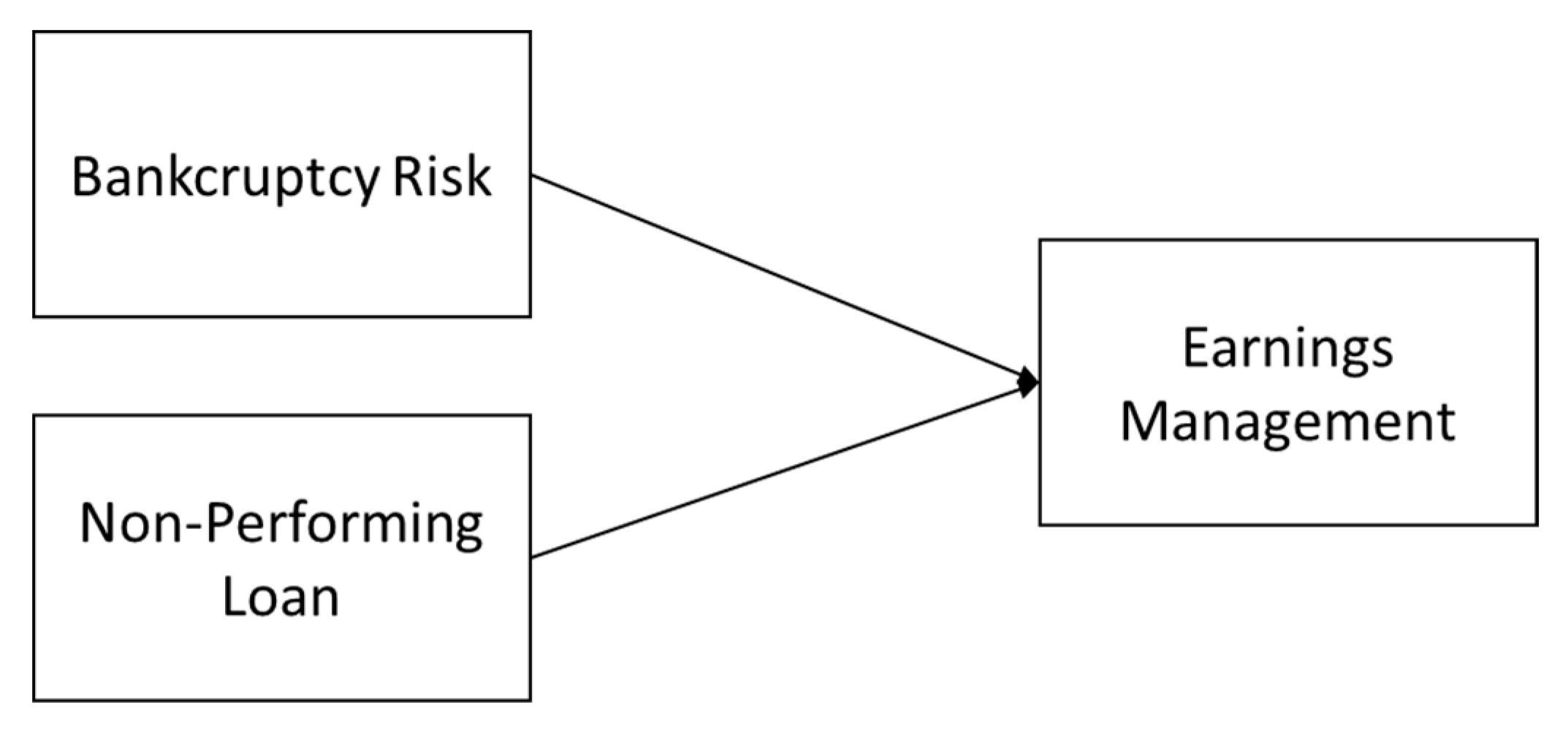

Table 1.
Descriptive Statistic.
| N | Minimum | Maximum | Mean | SD | |
| Conventional Bank | 1740 | 0.06 | 51.53 | 13.2065 | 9.0377 |
| Islamic Bank | 180 | 0.71 | 47.73 | 10.806 | 8.1161 |
Source: Processed data (2022).
Table 2.
Normality Test.
| Sig | Prob | Result |
| < 0.05 | 0.0000 | Not Normally Distributed |
Source: Processed data (2022).
Table 3.
Wilcoxon Test.
| Sig | Prob | Result |
| < 0.05 | 0.0000 | Ha is Accepted |
Source: Processed data (2022).
Table 4.
Descriptive Statistic Result.
| Z_Score | LLP | NPL | |
| Mean | 2.765605 | 13.20654 | 2.161960 |
| Median | 2.700000 | 13.12000 | 2.030000 |
| Maximum | 4.210000 | 51.53000 | 9.240000 |
| Minimum | 0.028169 | 0.060000 | 0.300000 |
| Std. Dev. | 0.534480 | 9.037782 | 1.198142 |
| Skewness | 0.086880 | 1.251367 | 1.1585597 |
| Kurtosis | 3.761597 | 5.846839 | 4.737235 |
| Jarque-Bera | 44.24117 | 1041.692 | 608.0846 |
| Probability | 0.0000 | 0.0000 | 0.00000 |
| Sum | 4812.152 | 22979.38 | 3761.810 |
| Sum Sq. Dev. | 496.7784 | 142044.1 | 2496.413 |
| Observations | 1740 | 1740 | 1740 |
Source: Processed data (2022).
Table 5.
Chow Test.
| Effects Test | Statistic | d.f. | Prob. |
| Cross-section F | 1.773495 | -173.1564 | 0.00000 |
| Cross-section Chi-Square | 311.681614 | 173 | 0.00000 |
Source: Processed data (2022).
Table 6.
Hausman Test Result.
| Test Summary | Chi-Sq. Statistic | Chi-Sq. d.f. | Prob. |
| Cross-section random | 1.367150 | 2 | 0.5048 |
Source: Processed data (2022).
Table 7.
Lagrange Multiplier Test Result.
| Cross-section | Test Hypothesis Time | Both | |
| Breusch-Pagan | 32.28985 | 0.194573 | 39.48442 |
| 0.0000 | 0.6591 | 0.0000 |
Source: Processed data (2022).
Table 8.
Descriptive Statistic Result.
| Z_Score | LLP | NPL | |
| Mean | 2.726980 | 10.80622 | 2.163000 |
| Median | 2.660000 | 11.59500 | 2.080000 |
| Maximum | 4.210000 | 47.73000 | 5.440000 |
| Minimum | 0.028169 | 0.710000 | 0.420000 |
| Std. Dev. | 0.600968 | 8.116152 | 1.100427 |
| Skewness | -0.376096 | 1.397176 | 0.904588 |
| Kurtosis | 6.597766 | 6.747275 | 3.500621 |
| Jarque-Bera | 101.3228 | 163.8785 | 26.42805 |
| Probability | 0.0000 | 0.0000 | 0.00000 |
| Sum | 490.8563 | 1945.120 | 389.3400 |
| Sum Sq. Dev. | 64.64800 | 11791.07 | 216.7582 |
| Observations | 180 | 180 | 180 |
Source: Processed data (2022).
Table 9.
Chow Test.
| Effects Test | Statistic | d.f. | Prob. |
| Cross-section F | 2.390704 | -17.160 | 0.0026 |
| Cross-section Chi-Square | 40.742678 | 17 | 0.0010 |
Source: Processed data (2022).
Table 10.
Hausman Test Result.
| Test Summary | Chi-Sq. Statistic | Chi-Sq. d.f. | Prob. |
| Cross-section random | 1.533161 | 2 | 0.4646 |
Source: Processed data (2022).
Table 11.
Lagrange Multiplier Test Result.
| Cross-section | Test Hypothesis Time | Both | |
| Breusch-Pagan | 9.936938 | 0.371751 | 10.30869 |
| 0.0016 | 0.5421 | 0.0013 |
Source: Processed data (2022).
Table 12.
Descriptive Statistic Result.
| Z_Score | LLP | NPL | |
| Mean | 2.761984 | 12.98151 | 2.162057 |
| Median | 2.700000 | 12.80000 | 2.030000 |
| Maximum | 4.210000 | 51.53000 | 9.240000 |
| Minimum | 0.028169 | 0.060000 | 0.300000 |
| Std. Dev. | 0.541007 | 8.980758 | 1.189053 |
| Skewness | 0.023341 | 1.263962 | 1.140833 |
| Kurtosis | 4.196960 | 5.905164 | 4.663614 |
| Jarque-Bera | 114.7914 | 1186.430 | 637.8885 |
| Probability | 0.0000 | 0.0000 | 0.00000 |
| Sum | 5303.009 | 24924.50 | 4151.150 |
| Sum Sq. Dev. | 561.6697 | 154775.1 | 2713.172 |
| Observations | 1920 | 1920 | 1920 |
Source: Processed data (2022).
Table 13.
Chow Test.
| Effects Test | Statistic | d.f. | Prob. |
| Cross-section F | 1.882904 | -191.1726 | 0.00000 |
| Cross-section Chi-Square | 363.391978 | 191 | 0.00000 |
Source: Processed data (2022).
Table 14.
Hausman Test Result.
| Test Summary | Chi-Sq. Statistic | Chi-Sq. d.f. | Prob. |
| Cross-section random | 0.900197 | 5 | 0.6376 |
Source: Processed data (2022).
Table 15.
Lagrange Multiplier Test Result.
| Cross-section | Test Hypothesis Time | Both | |
| Breusch-Pagan | 55.72126 | 0.759039 | 56.48030 |
| 0.0000 | 0.3836 | 0.0000 |
Source: Processed data (2022).
Disclaimer/Publisher’s Note: The statements, opinions and data contained in all publications are solely those of the individual author(s) and contributor(s) and not of MDPI and/or the editor(s). MDPI and/or the editor(s) disclaim responsibility for any injury to people or property resulting from any ideas, methods, instructions or products referred to in the content. |
© 2023 by the authors. Licensee MDPI, Basel, Switzerland. This article is an open access article distributed under the terms and conditions of the Creative Commons Attribution (CC BY) license (http://creativecommons.org/licenses/by/4.0/).
Copyright: This open access article is published under a Creative Commons CC BY 4.0 license, which permit the free download, distribution, and reuse, provided that the author and preprint are cited in any reuse.


