

Submitted:
22 November 2022
Posted:
23 November 2022
You are already at the latest version
Abstract
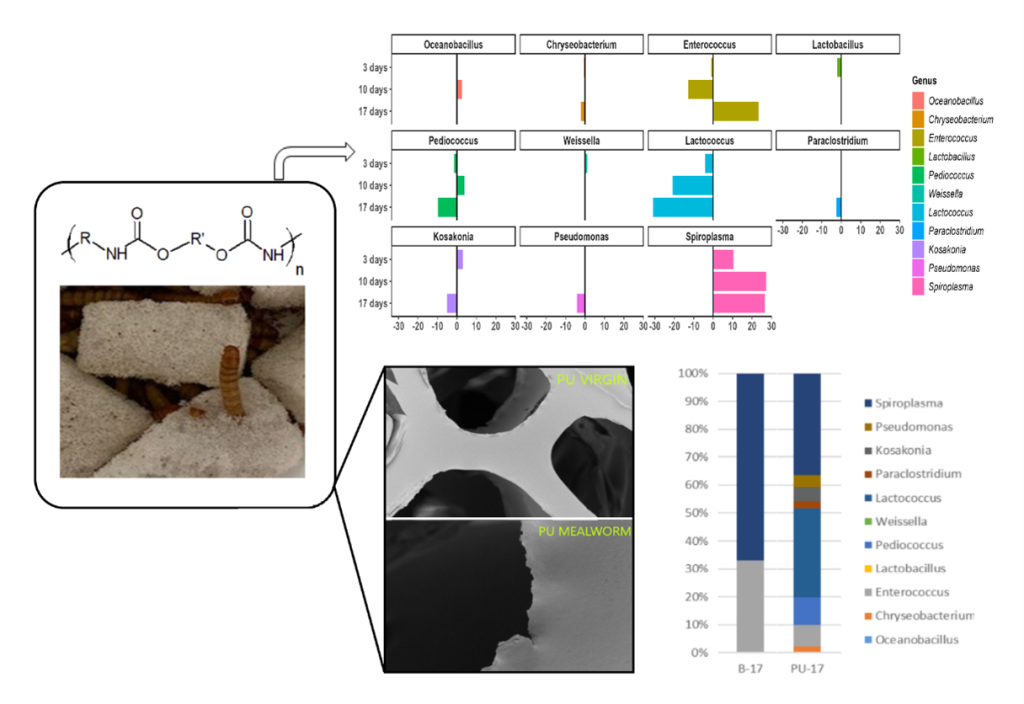
Polyurethane (PU) is a polymer widely used by humans whose recycling is highly complex due his chemical structure, being limited to incineration or accumulation in landfills. Biodegradation by enzymes and microorganisms has been studied for decades as an effective method of biological decomposition. In this study, Tenebrio molitor larvae (T. molitor) were fed with polyurethane foams, which gut enzymes and microorganisms were capable of degrading the polymer by 35% in 17 days of treatment, producing a weight loss of 14% in the mealworm. Changes in T. molitor gut bacterial community and diversity were observed, which may be due to colonization of species associated with PU degradation. Physical and structural biodegradation in PU by T. molitor compared to virgin PU, was demonstrated by Fourier Transform InfraRed spectroscopy (FTIR), Thermal Gravimetric Analysis (TGA) and Scanning Electron Microphotography (SEM).
Keywords:
plastic
; mealworms
; insect
; bacteria
; gut microbiome
Copyright: This open access article is published under a Creative Commons CC BY 4.0 license, which permit the free download, distribution, and reuse, provided that the author and preprint are cited in any reuse.


