

Submitted:
01 October 2024
Posted:
02 October 2024
Read the latest preprint version here
Abstract
In this paper, I present a possible explanation for accelerated expansion of the universe, and introduce the cosmic scale, size of the universe and cosmic time, age of the universe. The observed expansion of the universe, which relates the stretching of Shrunk space to the new theory, is derived. This model is based on the two principal long-range forces: the gravitational force and the repulsive force generated by shrunk space. They are the two most basic fundamental quantities in the universe that govern cosmic evolution. They may provide the clockwork mechanism that operates our eternal cyclic universe. This model of Space-time and its unique properties of shrinking and stretching enables us to describe a sequence of events from the Big Bang to the Big Crunch.
Keywords:
Big Bang and Big Crunch
; Cosmology
; Dark Energy
; Gravitational Force
; The Cyclic Universe
1. Introduction
Modern cosmology has rapidly evolved both experimentally and theoretically, seeking to unravel the origins, evolution, and future of the universe. Approximately a century has passed since Einstein introduced the General Theory of Relativity, and it is within this span of time that significant advancements have taken place. These advances have been driven not only by classical mechanics but also by quantum mechanics. Einstein introduced what is known as the cosmological constant into his equation, which brought about a repulsive force rather than an attractive force. This cosmological constant aimed to avoid the depiction of the universe contracting under the influence of gravity [1]. When evidence of the expansion of the universe was indicated by redshift through Edwin Hubble’s observations [2], it led to the assumption that the universe had a beginning. George Gamow and others proposed the Big Bang theory, suggesting that the early universe was in a state of high density and high temperature [3].
The recent discoveries of an accelerated expansion of the universe indicating self-repulsive dark energy [4,5,6] were not predicted and have no clear role in the standard model. Dark energy is just the name that astronomers gave to the mysterious substance "something" that is causing the universe to expand at an accelerated rate. However, dark energy is one of the important mysteries in the modern day of cosmology.
In this paper, I present a cosmological model consisting of an endless sequence of expansion and contraction of the universe that repeat indefinitely, and introduced the cosmic scale, size of the universe and cosmic time, age of the universe. This model provides a rational explanation for the expansion of the universe, and its accelerated expansion. We follow up on this approach to predict the future and the ultimate end of the cosmos. This core concept significantly influences the modern cosmological worldview.
2. Unique Nature of Shrinking and Stretching of Space-Time
In simple terms, the stretching of space literally means that the scale of the universe is increasing. The greater the distance between galaxies and clusters of galaxies distributed in the universe, the larger the universe itself becomes. The key piece of evidence is the redshift-distance relation that was first observed by Lemaître and then by Hubble [2]. This observation shows us that the redshift, which is the increase in wavelength of light reaching us, reveals how fast a star or galaxy from which the light was emitted is moving away. This information indirectly helps us decide the rate of expansion. This means that these galaxies are moving away from us; the farther they are, the faster they move.
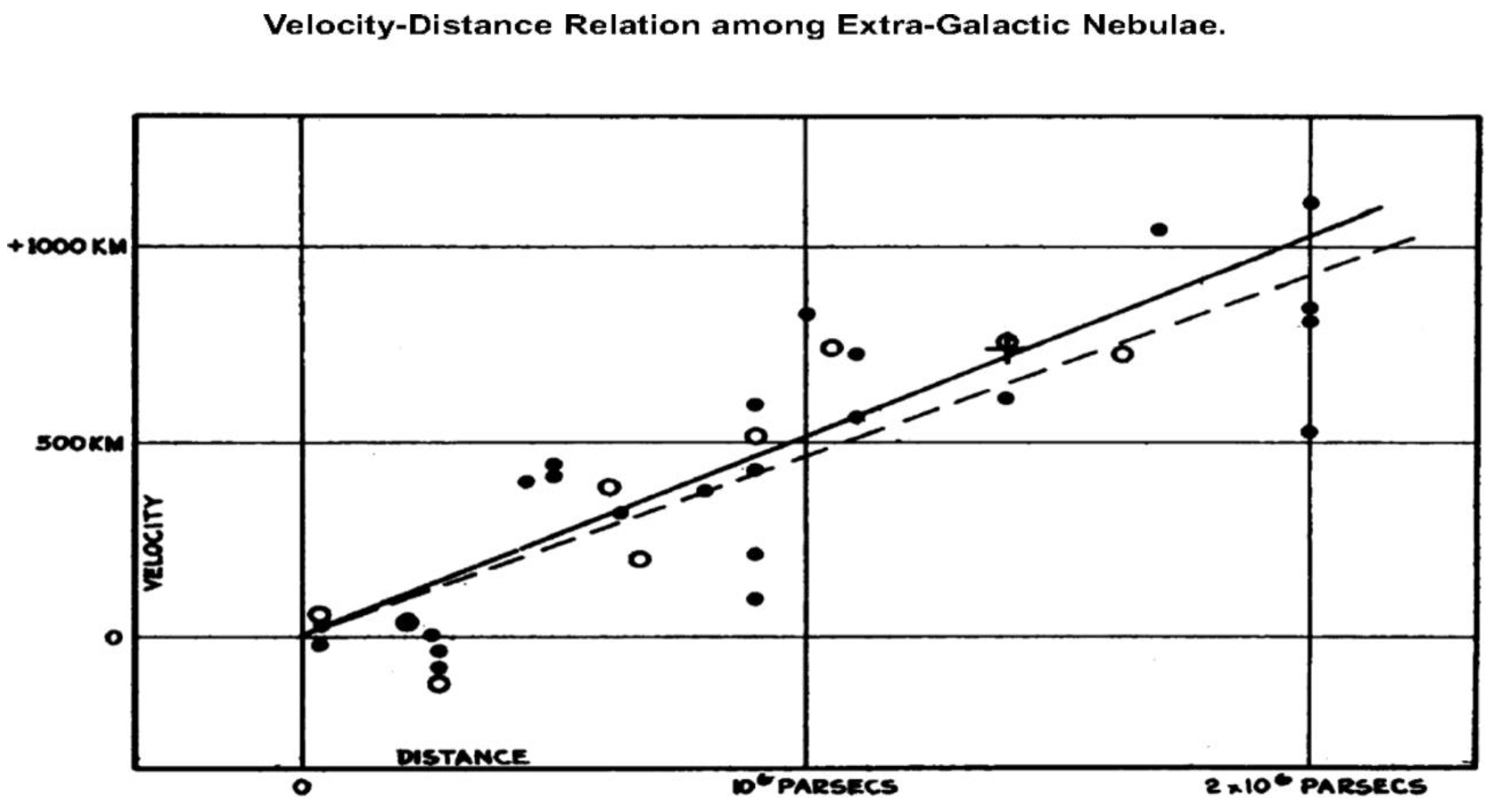
It was Edwin Hubble’s seminal 1929 PNAS paper, “A relation between distance and radial velocity among extra-galactic nebulae” [7], that led to a turning point in our understanding of the universe. In his short paper, Hubble presented the observational evidence for one of science’s greatest discoveries—the expanding universe. Hubble showed that galaxies are receding away from us with a velocity that is proportional to their distance from us: more distant galaxies recede faster than nearby galaxies. Hubble’s classic graph of the observed velocity vs. Distance for nearby galaxies is presented in Figure 1; this graph has become a scientific landmark that is regularly reproduced in astronomy textbooks. The graph reveals a linear relation between galaxy velocity (v) and its distance (d)
This relation is the well-known Hubble Law (and its graphic representation is the Hubble Diagram). It indicates a constant expansion of the cosmos where, like in an expanding raisin cake that swells in size, galaxies, like the raisins, recede from each other at a constant speed per unit distance; thus, more distant objects move faster than nearby ones. The slope of the relation, Ho, is the Hubble Constant; it represents the constant rate of cosmic expansion caused by the stretching of space-time itself.
At first, I would like to accept the expansion of the universe as an observational fact. I will focus on the notion of spacetime by introducing the unique nature of shrinking and expanding of spacetime, in which shrunk space exerts the repulsive force that force is responsible for stretching the shrunk space, or expansion of the space. Furthermore, I will focus on the notion of expansion discussed above within the context of stretching the shrunk space. This core concept significantly influences the modern cosmological worldview.
Let me elaborate this, which ultimately leads to providing an explanation for the fundamental reason behind the current expansion of the universe. In order to discuss the entire universe, we need to establish a basic fundamental model of cosmic scale, the size of entire universe and cosmic time, the age of the universe. The observed expansion of the space, which relates the stretching of shrunk space to the new theory, is derived and suggests that as the space shrinks, it exerts the repulsive force that is responsible for stretching the shrunk space, or expansion of the space. This model introducing a unique nature of shrinking and expanding of spacetime and suggests the existence of expanding space behind matter. When matter comes closer to each other, the space also shrinks between them. As space shrinks, it exerts a repulsive force, which stretches the shrunk space. The space itself is not creating, but shrunk space is stretching, which leads to the appearance of space, whereby the scale of space changes. The universe does not expand “into” anything and does not require space to exist “outside” it. This property of space causes the size of the universe to change over time, growing or shrinking. As the particles get closer to each other, the vacuum space should also consequently get closer. In a way, we can say that space shrunk, and as shrunk space expands, it allows particles to move away from each other. One way to imagine space is like a stretchy band with galaxies stuck to it. As the band stretches, the galaxies all move away from each other, and they are moving due to the stretching of the space; they are not moving through the space. The galaxies move away from each other as shrunk space stretches. The stretching of shrunk space follows the Hubble Law: the farther away a galaxy is from another, the faster its velocity. This is true from the perspective of any of the galaxies in the universe. This illustrates what is meant by saying that shrunk space is stretching and carrying objects along with it, in contrast with saying the objects are moving through space. It is not necessarily stretching space into anything. So, for example, the universe does not necessarily expand into previously existing space. The expansion is instead caused by the stretching of shrunk space everywhere, constantly.
Our space-time model suggests and demonstrates some properties of space:
1) Space-time itself is finite, and it consists of unique properties of shrinking and expanding. When space is exponentially shrunk, it exerts a repulsive force, which causes the stretching of the shrunk space.
2) The force of shrunk Space differs from gravity. Curved space exerts the inward pulling force, we call it gravitational force, and shrunk space exerts the outward pushing force. The shrink space force is repulsive; it exerts a force opposite to that gravitational force, we can say antigravity. So gravity and antigravity are not forces at all; they are the influences of vacuum space.
3) Vacuum space might be the most fundamental entity in the universe. There cannot be anything without space; without space, there is "nothing.”.
4) We might point out certain implications of our universe. It could be that our universe is cyclic and there is no beginning; there may have been big bangs before ours.
5) Finally, we also comment on the ultimate fate of the universe, as this topic is also quite controversial in the scientific community. The ultimate fate of the universe, with any level of certainty, will depend on how much space has shrunk, which essentially determines how the repulsive force of the shrunk space responds to the stretching of the shrunk space. The force of shrunk space will cease when the universe reaches its maximum volume of cosmic scale, and the expansion of the universe will eventually cease. After that, the universe will begin to contract until all the matter and energy in the universe re-collapses to a final singularity (the Big Crunch).
3. Cosmic Scale : The Maximum Size of the Universe
This model attempts to explain the expansion and contraction of the universe based on the concept of finite cosmic scale, and cosmic time of the universes. Let me elaborate on this view. As we discussed above, shrinking and expanding are the properties of spacetime itself. When matter comes closer to each other, the space also shrinks between them. As space shrinks, it exerts the repulsive force, which stretches the shrunk space. It suggests that the increasing distance between galaxies and clusters of galaxies depends on how much space had shrunk between any two points. This implies that the universe could be finite, because eventually repulsive force of shrink space would cease at a certain time, this also indicate that there must be the cosmic time, which would be the age of the universe.
As we know that Planck length is the smallest unit of length, and Planck time is the smallest unit of time in the universe. Well, there is an abolute Cosmic length and an absolute Cosmic time. It's possible that we'll never be able to measure them, but there is Cosmic Scale and cosmic time like Planck length and Planck time.
Here I introduce the largest scale, the Cosmic Scale and Cosmic Time. The cosmic scale is the maximum size of the universe, it is "large size" unit of length and a fundamental upper bound on lengths scales.
The cosmic time is the age of the universe, it is the time in which space expand to the cosmic scale and contract back into singularity.
Where,
Cosmic increasing factor is =
By putting these value,
We find,
radius of the Cosmic Scale r,
We find that the size of the entire universe d is
3.1. Cosmic Time: The Age of the Universe
The cosmic time is the age of the entire universe from the big bang to the big crunch.
By putting these value,
We find,
Divide seconds into years we get,
1 year = 31557600 seconds
We find that the total age of the universe is 19.30 Trillion Years. It is the time in which space expand to the cosmic scale and contract back into singularity. Here is interesting thing is that the cosmic scale which D is = 19.30 Trillion Light Years and the cosmic time which is equal to 19.30 Trillion Years. As we know that d = vt, so here we rewrite the equation as,
As we know that V = d/t , so rewrite as V is speed of light, and d is the Cosmic Scale, t is the Cosmic Time.
Well, now we have an equation, this could indicate us that everything follow the certain laws of nature, and it indicate us that the Cosmic time and the Cosmic Scale could be the constant in each cycle of expansion and contraction of the universe. So the expansion and contraction of the universe is fixed in a certain time, but this cycle of expansion and contraction may be infinite. So the universe is finite in each cycle, and as well as it’s cycle is infinite, that repeat indefinitely.
In below section I will explain how cosmic scale and cosmic time is interlinked with each other.
3.1.1. Interlinked of Cosmic Time & Cosmic Scale
As we know that T = D/V, If we calculate the cosmic time, we use d as Planck length, and its v is . First we calculates the V, here v will be
We find (V) Planck length
Now we use d as a 1 Planck length, so d is a 1 and V we have obtained above. So here we rewrite the equation T = d/v as,
As we know that, d = vt, if calculate the Cosmic Scale, we write this equation as We would easily find out the Cosmic Scale.
We find that, the Planck length follow the cosmic time, in his stretching and shrinking journey. It indicate us, that Planck length is interconnected with cosmic time, in the same way below we will find the Planck time is interconnected with cosmic scale. Its quite intriguing that how these connection are interlinked at Planck scale and cosmic scale. Here we use another way to finding the Cosmic Scale.
First we need to understand that, in calculating cosmic scale or cosmic time, we use a little different way. As we can say here that 1/v (Planck length) is equal to the cosmic time, so we can say that 1/ v (Planck time) would be the cosmic scale. So here we find the cosmic scale by using the equation 1/v (Planck time).
First we find the (V) Planck time, here we write it as,
We find, (v) Planck time
Now we use 1/(v) planck time, to find the Cosmic Scale,
We find the Cosmic Scale, so we can say that the cosmic scale and cosmic time is interlinked with each other. Planck time follow the Cosmic Scale and Planck length follow the Cosmic Time! Planck time and Planck length or Cosmic Scale and Cosmic Time is always be interlinked with each other.
I believe that everything follow the laws of nature, there is nothing anything which don’t follow any rules. So there should be fixed time of expansion and contraction of the universe. I don’t know how much time the universe would take to expanding and how much time it would take to contracted back in the singularity, I hope in the near future we may define it.
The size of the entire universe is fixed, but it had shrunk. So the expansion of the universe actually is stretching of shrunk space, which leads to appearance of space! Cosmic scale is only shrunk in current size of the universe. The force of the shrunk space depends on how much space has shrunk, which essentially determines how the force of the shrunk space responds to the expansion of the universe. So it’s certain that the force of shrunk space expands the universe until all the shrunk space expands at a certain large cosmic scale. Eventually expansion of the universe would cease at the certain time. And gravitational force contracted the universe until all the space shrunk and matter re-collapsed to a final singularity, restarting the cycle.
According to this model the expansion of the universe should speeding up over the time, because the decreasing repulsive force of shrunk space leads to stretching the shrunk space faster and faster, that is, although in general, decreasing of the repulsive force of shrunk space leads to accelerating the stretching of space. This is the big key to understanding the accelerated expansion of the universe. (I’ll explain it in the 3.3 section).
The two principal long-range forces, the gravitational force and the force generated by shrunk space, play an important role in the reformation of the universe. The force of shrunk space differs from gravity. Curved space exerts the inward pulling force, we call gravitational force, and shrunk space exerts the outward pushing force. The shrink space force is repulsive; it exerts a force opposite to that gravitational force, we can say it as antigravity. So gravity and antigravity are not forces at all; they are the influences of vacuum space. At the birth of the universe, around 14 billion years ago, there was an infinite repulsive force in Shrunk space. We speculate that the infinite repulsive force in Shrunk space gave rise to the Big Bang and caused the rapid growth of space. That process would appear to have moved very rapidly in the early universe and was only readily observable by detectors of high-frequency gravitational waves such as the Li-Baker [8], and [9]. It then expanded and cooled, undergoing phase transitions to radiation, fundamental particles, and matter. Matter grew into galaxies and was further consolidated by gravity into superclusters. Thus, the Big Bang was not only an explosion of matter and radiation all over space, but it may just have been a silent burst of stretching of infinite shrink space that caused the simultaneous appearance of space everywhere.
The universe may have had no beginning—the Big Bang may have been just a particular moment in the evolution of this always-existing, not a true beginning. This theory would enables us to describe a sequence of events from the Big Bang to the Big Crunch.
3.2. Accelerated Expansion of the Universe
Recent observations of supernovae reveal not only the universe’s expansion but also its accelerated expansion [10], and so an enigmatic form of energy is responsible for explaining this phenomenon. In the standard Big Bang and inflationary models, the recently discovered dark energy and cosmic acceleration [6,11] are an unexpected surprise with no clear explanation, and it has presented a challenge to its theoretical understanding.
First, Einstein aimed to maintain a static model of the universe and adjusted his equation known as the cosmological constant. When observational evidence later revealed that the universe did in fact seem to be expanding but not static, Einstein withdrew that suggestion. However, closer analysis of the expansion of the universe during the late 1990 once again led astronomers to believe that a cosmological constant should indeed be included in Einstein’s equations. It is quite intriguing that his cosmological constant still exists in cosmology as a form of dark energy, or vacuum energy. However, dark energy is one of the most important mysteries in the modern cosmology.
According to this model, the universe should keep expansion until it reached its cosmic scale, so the expansion is the most fundamental part of the universe. The force of the shrunk space depends on how much space has shrunk, which essentially determines how the force of the shrunk space responds to the expansion of the universe. The decreasing repulsive force of shrunk space leads to stretching the shrunk space faster and faster, that is, although in general, decreasing of the repulsive force of shrunk space leads to accelerating the stretching of space. This is the big key to understanding the accelerated expansion of the universe. Because, the size of the universe is fixed, it only stretches and shrunk. So extra space is not creating due to dark energy, but the shrunk space is stretching, which leads to the appearance of space, whereby the scale of space changes.
The overall scenario of this model and its implications explain the expansion of space and its accelerated expansion. At the very beginning, there was an infinite shrunk space. This infinite shrunk space produced the infinite repulsive force in the singularity, which force gave rise to the Big Bang, and shrunk space began to stretch very rapidly. Since the beginning of the universe, shrunk space has continued to expanding, but in the distant past, the density of the universe should have been greater, so the universe must have been expanding more slowly, or at a constant rate than it is today. The force of gravity is directly proportional to the repulsive force of shrunk space, and inversely proportional to the universe’s expansion. As the size of the universe increases, the density of the universe decreases, or as the size of the universe increases, the repulsive force of shrunk space decreases. Because size of the universe is increasing due to the stretching of shrunk space. There is no any space is creating, the cosmic scale is shrunk in current volume of space, so only shrunk space is stretching. The universe will not continue to expand forever; there is no need, however, for dark energy. The universe does not expand “into” anything and does not require space to exist “outside” it. Eventually, after some Billion years, the universe reached its maximum cosmic scale, and all the shrunk space stretched, the expansion stalled. After that, gravitational force contracted the universe until all the space would shrank and matter re-collapsed to a final singularity.
This model not only explains the way phenomena occur but also provides a clear worldview on the expanding space concept. The expansion of the universe is not a consequence of the space itself expanding; rather, it is caused by the stretching of shrunk space. This explanation of the universe’s expansion is straightforward and it drive us to deeper understand the universe.
4. Summary and Conclusions
This model of the universe is designed to solve some of the seemingly unsolvable problems of cosmology.“ It allows us to go beyond the Big Bang, the Eternal Cyclic Universe, and inflationary models. The new theory provides possible answers to several longstanding questions about the Big Bang model, which has dominated the field of cosmology for decades. It addresses, for example, the nagging question of what might have come before the beginning of space-time, and how did space-time come into existence? Why the expansion of the universe accelerating?
This model suggests that the entire space or (Cosmic Scale) would be shrunk at Planck length and it would expanded at a certain cosmic scale. This model deals directly with the cosmic singularity, explaining it as a transition from a contracting to an expanding phase. This model describes that the universe started with the shortest meaningful length, Planck length (the smallest measure of length because shorter than it becomes meaningless), and the shortest meaningful measure of time, Planck time.
Although inflation does not address the cosmic singularity problem directly, it does rely implicitly on the opposite assumption: that the big bang is the beginning of space and time and that the universe emerges in a rapidly expanding state [12]. In our model, the infinite force of infinite shrunk space gave rise to the big bang and caused the rapidly expanding of space. It then cooled, undergoing phase transitions to radiation, fundamental particles, and matter. The inflation theory also gets stuck at the point “before” the Big Bang because, according to it, there is nothing before it. “The fundamental philosophical problem with the Big Bang is that there’s an after, but there’s not a before.” “In a similar way, we don’t know ‘one-time only’ things that happened in history.” But this model drives us to a deeper understanding of the universe and explain the past present and future of the universe.
This could also fill some of the biggest gaps in our common understanding of the way space and time work. Spacetime and its unique nature of shrinking and expanding are the most fundamental quantities in the universe that govern cosmic evolution. Thus, it brings the universe back to its initial state, ending in a big crunch. The universe will not continue to expand forever; there is no need, however, for dark energy. This could account for the fact that the Big Bang was not the beginning of the universe; there’s always a universe before the Big Bang. The universe may have had no beginning—it has simply always existed. What we perceive as the Big Bang may have been just a particular moment in the evolution of this always-existing universe, not a true beginning.
Researchers suggest that our expanding universe is now entering a new phase of exponential expansion due to dark energy [4]. Here again, we have no idea how long this inflationary phase will last. If it continues for more than 10 times the current age of the universe, our galaxy will be left alone, surrounded by darkness with no other source of light in sight. However, dark energy is one of the most important mysteries in modern astronomy.
My explanation for dark energy is that it is a repulsive force of shrunk space, which is responsible for the stretching of shrunk space. We have elaborated on the mechanism by which force emanates from the shrink space and provides the repulsive force , which stretches the shrink space.
Above I have mathematicaly prove that the cosmic scale, the size of the entire universe is fixed, it only stretches and shrunk. So extra space is not creating due to the dark energy, but the shrunk space is stretching, which leads to the appearance of space, whereby the scale of space changes. The decreasing repulsive force of shrunk space leads to stretching the shrunk space faster and faster, that is, although in general, decreasing of the repulsive force of shrunk space leads to accelerating the stretching of space. This is caused the accelerated expansion of the universe.
This research’s major breakthrough is that it introduced the Cosmic Scale and Cosmic Time, this core concept significantly influences the modern cosmological worldview. Reviewing the overall scenario and its implications, what is most remarkable is that our model can differ so much from the standard picture in terms of the origin of space and time and the sequence of cosmic events that led to our current universe. Another advantage of this theory is that it automatically includes a prediction of the future of the universe, because it goes through definite repeating cycles lasting perhaps about 19.30 trillions of years each. The Big Bang and inflation model has no built-in prediction about the long-term future; in the same way that inflation and dark energy arose unpredictably, another effect could emerge that would alter the current course of expansion.
And in the last, I would like to suggest that. the problem of dark energy and dark matter could be fully addressed by revising the structure of spacetime and requiring further understanding of the properties of spacetime, and working on mathematicaly calculations of pushing force of shrunk space, instead of new material components that have not been found up to now. Because It appears that our universe is cyclic and has no beginning; there may have been Big Bangs before ours.
Funding
This research received no funding.
Conflicts of Interest
The authors declare that there is no any conflict of interest.
References
- Einstein, A. Kosmologische Betrachtungen zur allgemeinen Relativitatstheories. Sitzungsberichte der Königlich Preuβischen Akademie der Wissenschaften 1917, 142–152. [Google Scholar]
- Hubble, E. A relation between distance and radial velocity among extragalactic nebulae. National Academy of Sciences 1929, 15, 168–173. [Google Scholar] [CrossRef] [PubMed]
- Gamov, G. The origin of elements and the separation of galaxies. Physics Review 1948, 74, 505–506. [Google Scholar]
- Perlmutter, S.; et al. Ap. J. 517 (1999) 565.[2] A. G. Riess, et al, Astron.J. 1998, 116, 1009.
- P. M. Garnavich et al, Ap. J. 1998, 509, 74.
- N. Bahcall, J.P. Ostriker. S. Perlmutter, and P.J. Steinhardt, Science 1999, 284, 1481. [Google Scholar]
- Hubble, E. A relation between distance and radial velocity among extra-galactic nebulae. Proc Natl Acad Sci USA 1929, 15, 168–173. [Google Scholar] [CrossRef] [PubMed]
- Baker Jr., R. M.L. (2001) Peoples Republic of China Patent Number 01814223.0 Gravitational Wave Generator and Detector. Filed July 13, 2001, Granted September 19, 2007.
- Woods, C.R.; Baker, R.M.L., Jr.; Li, F.; Stephenson, G.R.; Davis, E.W.; Beckwith, A.W. A New Theoretical Technique for the Measurement of High-Frequency Relic Gravitational Waves. Journal of Modern Physics 2011, 2, 498–518. [Google Scholar] [CrossRef]
- Riess, A.G.; Filippenko, A.V.; Challis, P.; et al. Observational evidence fromsupernovae for an accelerating universe and a cosmological constant. The Astronomical Journal 1998, 116, 1009–1038. [Google Scholar] [CrossRef]
- Fujita, S. An interpretation onstructural realism to space-time used in big-bang cosmology: Is space really expanding? Journal of the Japan Association for Philosophy of Science “Kagaku Kisoron Kenkyu” in Japanese 2017, 44, 1–14. [Google Scholar]
- Guth, A.; Steinhardt, F. The inflationary universe. Scientific American 1984, 250, 116. [Google Scholar] [CrossRef]
Figure 1.
Velocity–distance relation among extragalactic nebulae (1). “Radial velocities, corrected for solar motion, are plotted against distances estimated from involved stars and mean luminosities of nebulae in a cluster. The black discs and full line represent the solution for solar motion using the nebulae individually; the circles and broken line represent the solution combining the nebulae into groups; the cross represents the mean velocity corresponding to the mean distance of 22 nebulae whose distances could not be estimated individually” (1). (Note: Velocity units should be in kilometers per second.).
Figure 1.
Velocity–distance relation among extragalactic nebulae (1). “Radial velocities, corrected for solar motion, are plotted against distances estimated from involved stars and mean luminosities of nebulae in a cluster. The black discs and full line represent the solution for solar motion using the nebulae individually; the circles and broken line represent the solution combining the nebulae into groups; the cross represents the mean velocity corresponding to the mean distance of 22 nebulae whose distances could not be estimated individually” (1). (Note: Velocity units should be in kilometers per second.).
Disclaimer/Publisher’s Note: The statements, opinions and data contained in all publications are solely those of the individual author(s) and contributor(s) and not of MDPI and/or the editor(s). MDPI and/or the editor(s) disclaim responsibility for any injury to people or property resulting from any ideas, methods, instructions or products referred to in the content. |
© 2024 by the authors. Licensee MDPI, Basel, Switzerland. This article is an open access article distributed under the terms and conditions of the Creative Commons Attribution (CC BY) license (http://creativecommons.org/licenses/by/4.0/).
Copyright: This open access article is published under a Creative Commons CC BY 4.0 license, which permit the free download, distribution, and reuse, provided that the author and preprint are cited in any reuse.


