

Submitted:
23 June 2022
Posted:
24 June 2022
You are already at the latest version
Abstract
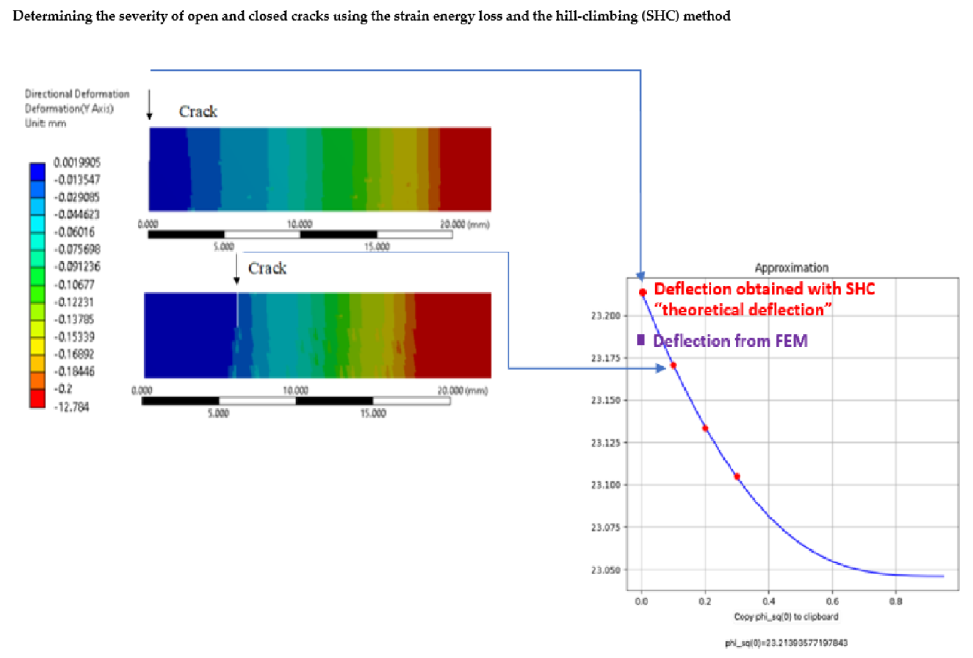
Evaluating the integrity of structures is an important issue in engineering applications. The use of vibration-based techniques has become a common approach to assessing cracks, which are the most often occurring damage in structural elements. When involving an inverse method, it is necessary to know the influence of the position and the geometry of the crack on the modal parameter changes. The geometry of the crack, both in size and shape, defines the damage severity (DS). In this study, we present a method (DS-SHC) used for estimating the DS for closed and open transverse cracks in beam-like structures by using the intact and damaged beam deflections under its weight and a Stochastic Hill Climbing (SHC) algorithm. After describing the procedure of applying DS-SHC, we calculate for a prismatic cantilever beam the severities for different crack types and depths. The results are tested by comparing the DS obtained with DS-SHC with those acquired from dynamic tests made using professional simulation software. We obtained a good fit between the severities determined in these two ways. Afterward, we performed laboratory experiments and find out that the severities obtained with the DS-SHC method can accurately predict the frequency changes due to the crack. Hence, these severities are a valuable tool for damage detection.
Keywords:
crack severity
; strain energy loss
; beam deflection
; frequency shift
; hill-climbing method
Copyright: This open access article is published under a Creative Commons CC BY 4.0 license, which permit the free download, distribution, and reuse, provided that the author and preprint are cited in any reuse.


