

Submitted:
13 June 2023
Posted:
14 June 2023
You are already at the latest version
Abstract
The battle of currents between AC and DC reignited as a result of the development in the field of power electronics. The efficiency of DC distribution systems is highly dependent on the efficiency of distribution converter, which calls for optimized schemes for efficiency enhancement of distribution converters. Modular solid-state transformers play a vital role in DC Distribution Networks and Renewable Energy systems (RES).This paper deals with efficiency-based load distribution for Solid State Transformers (SSTs) in DC distribution networks. Aim is to achieve a set of minimum inputs that are consistent with output while considering constraints and efficiency. As the main feature of modularity is associated with a three-stage structure of SSTs. This modular structure has been optimized using Ant Lion Optimizer (ALO) and validated by applying it EIA (Energy Information Agency) DC Distribution Network which contains SSTs. In the DC distribution grid, modular SSTs provide promising conversion of DC power from medium voltage to lower DC range (400V). The proposed algorithm is simulated in MATLAB and also compared with two other metaheuristic algorithms. The obtained results prove that the proposed method can significantly reduce input requirements for producing the same output while satisfying the specified constraints.
Keywords:
Solid state transformer
; Direct current
; Renewable Energy Systems
; Ant Lion Optimizer
1. Introduction
The battle of currents between AC and DC dates back in the 19th century when the pioneers of electricity battled over their medium of power, with Tesla supporting AC and Edison supporting DC [1,2,3]. The first battle concluded in favor of Tesla, and AC began its rule over DC as medium of power transfer [2,4]. The victory of AC at the first place was predominantly due to the invention of transformers, which provided AC a mean of voltage level transformation, thereby reducing losses. However, this supremacy of AC was encountered by DC once again with the advancement of power electric converters, when DC achieved its means for transformation through power electronics-based DC transformers [5,6].
DC stroke back in full swing and started taking over all parts of the power system, i.e., generation (through solar and wind, as wind can be better optimized with DC); transmission (HVDC transmission) and utilization (DC load LEDs, energy-saving DC-inverter based air-conditioners, etc.) [7,8]. The distribution sector is still under research, and several research efforts have been published so far in the relevant field. The authors of current study have presented several studies encompassing the efficiency analyses of AC and DC distribution systems on comparative grounds [9,10,11,12,13,14]. It has been concluded in the efficiency analyses of DC distribution networks as well as in the comparative analyses between AC and DC distribution networks that the efficiency of the DC distribution system highly depends on the efficiency of the DC–DC distribution converter. An approach to achieve optimized results is through the use of the modular architecture of DC–DC converters, which is the basic aim of this paper.
Over the past few decades, the distribution grid has brought benefits of low-carbon and energy savings due to the soaring adoption of distributed energy resources (DERs). This modernization also requires new concepts, topologies, and control in some basic components of the distribution grid. The transformer is an essential component of the distribution network that performs functions of controlling, transferring, and handling power [15]. In order to maintain power quality, various devices, such as STATCOMs, FACTs, and others, are required. However, the latest developments in the smart grid demand a device that is capable enough to distribute power while maintaining power quality. The device is summed up as a solid-state transformer (SST) or an intelligent transformer [16].
Considering the efficiency of the traditional low-frequency transformer (LFT), it is initiated from 97% and varies up to 98.5% for liquid-immersed LFTs. However, it is evident from the present body of knowledge that SSTs have reached an efficiency of 98.25% in LV distribution networks [3]. SSTs have significant potential to replace the LFTs, as they provide other benefits such as smaller size and advanced control features. A comparison between the size and weight of SSTs and LFTs confirms that the SST structure provides remarkable volume savings, i.e., one-third of LFTs [17,18]. In contrast to traditional setups that are manufactured from copper and iron windings, SSTs have silicon carbide (SiC) windings which is a significant factor in reducing weight [19].
Different topologies for SSTs were explored in [17,18]; SSTs possess different classifications according to the stages, power levels, and applications. The authors [18,20] provided a comparison of one-, two-, and three-step topologies. The one- and two-step topologies have limitations of poor DC link fault tolerance and do not provide modularity. Figure 1 shows the three-stage SST topology, as this setup supports modularity in structure.
Figure 2 illustrates the different compositions of solid-state transformers, such as module level, converter level, and system-level integrations. A modular SST possesses integrated power module (IPM) and provides different configurations, such as half bridge, multi-level converter and modular multi-level converters.
Modularity is an important feature that allows the same machine to be designed at a small level for multiple settings on a small scale at the same standard. The present body of knowledge proposes control strategies related to structural- and design-based optimization. The intelligence- or heuristic-based strategies for modular structure of SSTs are less explored throughout the literature. A basic control strategy was discussed for load division, which involves a simpler way to distribute load according to a specific bucket size scheme [21].
Economic load dispatch (ELD) or the optimal load distribution of generators has been explored by various researchers working in the field of power system operation and control. Many techniques, such as priority listing [22], LaGrange relaxation (LR), Linear Programming (LP), and dynamic programming (DP), have been implemented in research for ED problems [23,24,25]. However, all aforementioned techniques do not apply to non-smooth load curves. Therefore, in order to overcome this issue, metaheuristic algorithms, such as genetic algorithms (GAs), particle swarm optimization (PSO), artificial bee colony (ABC), and simulated annealing, are implemented for the solution of ED problems [26,27,28,29]. These algorithms provide fair efficiency values. Metaheuristic algorithms are optimization-based algorithms and categorized as: population-based and single point-based algorithms. Population-based algorithms prove valuable in searching several solutions at the same time [30,31,32]. The economic dispatch problem with scheduling of generators and renewable energy systems (RES) is addressed by various population-based techniques, such as ant lion optimization (ALO) [33], whale optimization (WOA) [34], grey wolf optimization (GWO), krill herd optimization [35], bat optimization algorithm (BOA) [36] and Salp swarm algorithm (SSA) [37].
In this paper, a novel technique is proposed which utilizes the efficiency parameter of SSTs along with load dispatch through the lambda iteration method. As the percentage loading capability/efficiency is an important consideration while optimizing load distribution in the DC distribution network, the proposed ALO algorithm is compared with the other two biologically inspired algorithms, which are GWO and WOA.
The rest of the paper is organized as follows. Section 2 and Section 3 elaborate the problem formulation, which consists of two sub-sections: an overview for the ALO and an efficiency-based optimal load problem. The obtained results are discussed in Section 3. In the end, Section 4 concludes the work.
2. Problem Formulation
2.1. Ant Lion Optimizer
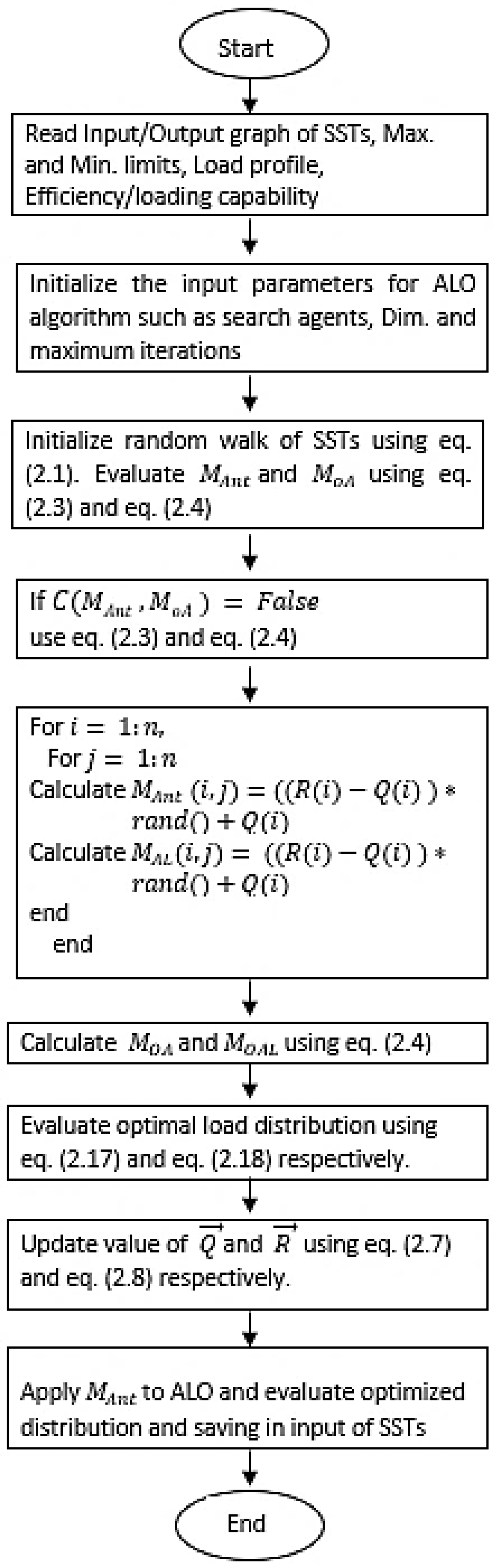
ALO is inspired by the hunting behavior of antlions. An ant lion larva moves in a circular path and digs out cone-shaped pits in the sand, consequently throwing the sand out. After digging, the larva hides underneath the cone and waits for the insects to come since the edges are sharp enough that insects easily fall to the bottom of the trap [38]. After consuming their prey, antlions prepare traps for other insects. In the next sections, this meta-heuristic behavior is modeled mathematically, and the flowchart of this algorithm given in Figure 3 explains the workings.
2.1.1. Operators for ALO
ALO algorithm is derived from the interactions between antlions and the ants in the trap. The mathematical modeling of such a behavior requires the ants to move over search space as ants move stochastically and antlions hunt them. Naturally, ants move stochastically while searching for food; therefore, a random walk is selected for ant movement, stated as
where “cumSm” calculates the cumulative sum and “n” presents the maximum number of allowed iterations. r(t) is a stochastic function and is defined as
where “t” defines the step of random walk (iteration in this study), and “rand” is a random number generated with uniform distribution in the interval of (0, 1).
Y(t) = [0, cumSm(2r((t1)−1, cumSm(2r((t1)−1)….. cumSm(2r((tn)−1)]
This matrix Mant refers to the parameters of each solution and saves the location of each ant. The ant objective function matrix is employed in the algorithm, which saves the fitness function of each candidate.
Random Walks for Ants
Random walks are based on the cumulative sum equation. During each step of optimization, antlions update their position with a random walk. Following normalization, the equation is used to keep the random walk within the search space.
In the above equation, and are the minimum and maximum number of random walks in the ith variable. and indicate the maximum and minimum ith variables in the tth iteration. Since random walks are solicited to all dimensions of ants, the above equation applies to all iterations due to limitations of search space.
Trapping in Antlion Pits
Antlion traps affect the random walk of ants, to model this system mathematically Equations (3) and (4) are proposed.
These equations provide information of random walk-in hypersphere defined by vectors Qt and Rt around antlions.
Building Traps
A roulette wheel operator is employed to the algorithm for modeling the hunting capability of antlions. In the ALO algorithm, the roulette wheel operator is utilized to select antlions on the basis of their fitness functions. This process provides a scenario of better chances for the selection of the fittest antlions [39].
Sliding Ants towards Antlion
The antlions build traps according to their fitness, whereas the ants move randomly over the search space. Antlions shoot the sand upward after sensing the presence of prey, thus trapping the ants and not letting them escape. In order to model this behavior of hunters, the radius of the ants’ random walks’ hyper-sphere is decreased adaptively. Equations (6) and (7) are defined in this regard:
Catching Prey and Rebuilding Pit
The final stage calculates the objective function of the hunt. On the basis of the objective functions, ants are selected, and their positions are updated. The updated position is a position of the latest hunted ant, thereby enhancing the chances of preying on new ants. A mathematical model is provided in the given equation:
Elitism
Evolutionary algorithms make use of elitism to maintain the best solution at each stage. In each iteration, every best antlion is saved and considered elite. A random walk around a selected antlion by a roulette wheel and elite candidate is depicted as
WAt is a random walk around the antlion selected by the roulette wheel, and WEt is the random walk around the elite at the tth iteration.
Figure 3.
ALO flow chart.
2.2. Objective Function
The objective function is formulated to optimally distribute the load on modular SSTs considering load and SST constraints. The ALO algorithm is employed to find out the minimum optimal amount of input on each SST. This objective function finds the lowest input power for modular transformer configurations. For SST, input/output curves are utilized for constructing a generalized second-order equation.
Pjn is the input of SST and Poj is the output of each SST. In the above equation, a, b and c are derived using the curve-fitting technique. These equations can be generalized as
Load balance constraints and SST minimum and maximum constraints are utilized for the formulation of the objective function. Supply and demand balance constraint is
where PD is the load demand, and the output of SST should be equal to the consumption of the load side demand in the DC distribution network.
SSTs also observe some minimum and maximum output power limitations, such as distributed generators, which can be stated as
To find out the solution of this constrained optimization, the lambda iteration method is utilized, where is used for constrained optimization
For optimal values of SST, the efficiency of SSTs is also considered an important factor and employed as
is an efficiency of SST and j is the number of SSTs.
For finding the values of , efficiency and loading capability curves are used for extracting the generalized equations for SSTs.
are coefficients for efficiency and loading graph. Loj is the loading capability of the graph at each point.
For the procedure outlined above, the objective function values are updated in each iteration with a better solution. This iterative process continue until the termination criterion is satisfied.
The primary focus is to achieve a systematic reduction of input on the modular structure of SSTs using the ALO algorithm. This will provide an optimal distribution of load demand. The application of the ALO algorithm for modular SSTs has not been explored yet, and this is motivation to implement ALO for optimal load distribution of SSTs in the DC distribution system.
3. Simulation and Results
A residential load model of a typical US building is considered as in [9,40,41]. Data from EIA and DOE (Energy Efficiency Administration and Department of Energy) are utilized. The load profile contains AC native, DC native, and independent loads (A, D, and I type). In this problem, a set of 16 SSTs is utilized to form a modular architecture instead of employing a single non-modular SST. Figure 4 represents the modular structure for SSTs installed in the DC distribution system. Out of the 16 SSTs, 6 are from the market in sets of three and the other 10 are from the literature [42,43,44,45,46]. From [21], the input/output equations and loading/efficiency curves for optimal load distribution of modular SSTs setup are utilized.
The problem is formulated in such a way that initially, the input/output equations from the graphs [21] are extracted using a curve-fitting tool in MATLAB. All these five graphs in Figure 5 provide a general quadratic equation with variable values if ().
Table 1 presents the SST equation parameters along with minimum and maximum power handling capabilities. po is the output power of a single SST and pin is the input power. The data for modular SST structure comprising 16 SSTs are tabulated in Table 1, with corresponding SST configuration parameters with upper and lower operating limits.
Efficiency and loading capability graphs are obtained from [21] and then by using MATLAB curve-fitting tools, quadratic equation constant parameters and the efficiency of each SST at every loading point are obtained. Figure 6 illustrates this efficiency vs. loading behavior at each loading condition.
A load profile from [9] is utilized for the optimal distribution of the load among SSTs in Figure 7. Moreover, a 24 h percentage loading profile is obtained by dividing each hour load by its maximum value and is presented in Figure 8. Table 2 provides the loading vs. efficiency equation constants (a, b, c), which are used to find point-to-point data. This efficiency profile will help us to prioritize the most efficient generators to fulfill the load requirements.
A test case scenario is simulated to highlight the efficiency of the proposed algorithm. ALO is implemented on modular solid-state structure with and without unit commitment. In this case, unit commitment is scheduled on basis of the efficiency of SSTs.
Scenario I: All 16 SSTs are ON and working while a load is optimally distributed using the ALO. In the test case I, all SSTs are utilized irrespective of their efficiency priorities during the simulation and optimal load distribution is executed in MATLAB. Figure 8 presents test case I, which is unscheduled SST incident and optimized with the ALO algorithm.
Scenario II: All 16 SSTs are working when 100% load is demanded, otherwise there will be SST scheduling according to the efficiency of SSTs. In this case, a unit commitment strategy is employed on the basis of the efficiency priorities of SSTs. When a load is less than maximum, only the most efficient SSTs are selected for operation. Figure 9 shows a visual illustration of the improvements achieved by using the scheduling of SSTs along with ALO, except the regions where all SSTs are ON, presenting the maximum demands in load profiles. For comparison, Scenarios I and II are utilized to investigate the scheduling effects on SSTs while using the ALO algorithm. This provides a visibly reduced amount of 1417.71539 W input, approximately 1.4 KW for the same amount of load.
Scenario III: The test cases presented above are compared with other metaheuristic techniques, such as whale optimization and grey wolf optimization which is presented in Figure 10. Moreover, the results of Scenarios I and II are compared with Scenario III, where two different metaheuristic techniques (whale optimization algorithm (WOA) and grey wolf (GWO) optimization) are employed. This comparison provides superior results produced by ALO for load distribution when scheduling is considered. As shown in Figure 11, improvement achieved by ALO is 4.21 percent and followed by WOA (i.e., 0.9 percent); lastly, GWO does not provide any significant results.
In contrast to the effectiveness, there are certain limitations to the use of these techniques. For example, ALO cannot produce fruitful results if the load profile is constant. Moreover, higher processing time is required to find a suitable search space
4. Conclusions and Future Recommendations
Various metaheuristic approaches play a paramount role in economic scheduling and dispatch. The present body of knowledge contains various approaches for improving the performance of power systems by economic load management. The trend is, however, shifting from conventional techniques to metaheuristic approaches. The ALO method is proposed to solve the optimal load distribution of modular SSTs. In this research, 16 SSTs of five different types are used in the DC distribution network. An objective function is formulated which considers the input/output behaviors of the SSTs and their minimum and maximum power handling capability. Three test cases are employed: S-I—all SSTs ON; S-II—only scheduled SSTs ON; and S-III—comparison with other metaheuristic methods. ALO provides better results for SST scheduling based on efficiency as compared to the other two methods (whale and grey wolf optimizer).
The most effective utilization of a scenario or available circumstances/resources is a stitch in time, considering the current energy situation. Many studies are presented and are under consideration dealing with the optimization of diverse scenarios, from all walks of life [47,48,49,50]. The current study may form a base for comparative efficiency analysis of AC and DC distribution systems with the DC system incorporating the suggested scheme of modular architecture. The battle of currents between AC and DC is still waiting for a definite verdict at distribution scale i–e as to whether DC is better than AC or not [51,52]. The proposed architecture possesses the tendency to lift the efficiency of DC at distribution scale as compared to AC, thereby assisting the researchers to reach a definite verdict in favor of DC. Therefore, a future study can be devised to incorporate the proposed scheme and employ it in a DC distribution network to present an efficiency comparison against AC distribution.
The escalating augmentation in the utilization of DC as medium of power transmission and distribution accompanied with sophisticated control has brought ease from the sustainability perspective and, on the other hand, complexity from the technical design perspective. The control of power coming from major renewable energy resources in smart grids demands the placement of SSTs rather than LFTs, leading to better efficiency, control and quality [53]. There is no doubt in the technical soundness of SSTs over LFTs; however, cost is the barrier hindering the path of adoption of SSTs. SSTs may not be suitable for conventional AC systems; however, SSTs do possess the tendency of providing better economics considering the efficiency analysis [54]. Passive devices installed in the SST are the major cost concern, speculations exist the mass production of SSTs may reduce the cost. Yet again, efficiency is the factor that once wiped DC out the power system in the nineteenth century and it is the same factor based on which DC is striking back. Efficiency, or, more specifically, the operational efficiencies of any device, are definitely linked to its economics in terms of payback period, lifetime and sustainability when compared against any other device [55]. The current study presents the analysis in terms of the technical efficiency and paves the way for a future cost analysis. A futuristic analysis in this regard can be a study that furnishes the comparative analyses on techno-economic grounds that presents a compromise of technology over cost and vice versa.
Author Contributions
Conceptualization, M.M. and M.S.; methodology, H.E.G.; software, A.B.; validation, M.M. and M.S. and F.S.; formal analysis, M.S.C.; investigation, K.T. and S.C.; resources, N.U.; writing—original draft preparation, M.M. and K.T.; writing—review and editing, N.U. and F.S.; supervision, H.E.G.; project administration, N.U.; funding acquisition, S.C. and K.T. All authors have read and agreed to the published version of the manuscript.
Funding
This research was supported by Prince of Songkla University from grant number ENV6502112N. This work was also funded by Geo-Informatics and Space Technology Development Agency (Public Organization): GISTDA. This work also received support from Taif University Researchers Supporting Project number (TURSP-2020/144), Taif University, Taif, Saudi Arabia.
Conflicts of Interest
The authors declare no conflict of interest.
Abbreviations
| DER | Distributed energy resources |
| LFT | Low frequency transformer |
| cumSm | Cumulative sum |
| r(t) | Stochastic function |
| t | Step of random walk |
| Rand | Random number generator |
| Mant | Parameters of each solution |
| Minimum of random walks in ith variable | |
| Maximum of random walks in ith variable | |
| Maximum ith variable in tth iteration. | |
| Minimum ith variable in tth iteration . | |
| WAt | Random walk around the antlion selected by the roulette wheel |
| WEt | Random walk around elite at the tth iteration |
| Pjn | Input of SST |
| Poj | Output of each SST |
| (a, b & c ) | Constants from Input/output quadratic equation |
| PD | Load demand |
| Minimum and maximum output power limitations | |
| Maximum output power limitations. | |
| Lagrangian constant | |
| Total input power of all SSTs | |
| Efficiency of jth SST | |
| Coefficients for efficiency and loading graph | |
| Loj | Loading capability of the graph |
| pin | Input power of SST |
| Pmin | Minimum power handling capability of SST. |
| Pmax | Maximum power handling capability of SST. |
| HFT | High frequency transformer |
| DER | Distributed energy resources |
| LFT | Low frequency transformer |
References
- McPherson (Ed). (2012)., S.S. War of the Currents: Thomas Edison vs Nikola Tesla; Twenty-First Century. U.S.A. 2012.
- Davidson, C. Thomas Edison vindicated—The resurgence of DC in MV and HV power grids. In Proceedings of the22nd European Conference on Power Electronics and Applications (EPE’20 ECCE Europe), Virtual, 7–11 September 2020.
- Tahir, H.; Lee, J.S.; Kim, R.Y. Efficiency evaluation of the microgrid for selection of common bus using copula function-based efficiency curves of the converters. Sustain. Energy Technol. Assess. 2021, 48, 101621. [CrossRef]
- Gomez-Exposito, A. The Unstoppable Changing of the Electricity Guard [Commentary]. IEEE Technol. Soc. Mag. 2017, 36, 30–33. [CrossRef]
- Zhang, G.; Zhang, B.; Li, Z. A Brief History of Power Electronics Converters. In Designing Impedance Networks Converters (Stud. Syst. Decis. Control); Springer International Publishing AG. Switzerland, 2018; pp. 1–6. [CrossRef]
- Zhang, G.; Li, Z.; Zhang, B.; Halang, W.A. Power electronics converters: Past, present and future. Renew. Sust. Energy Rev. 2018, 81, 2028–2044. [CrossRef]
- Korytowski, M. Uno Lamm: The Father of HVdc Transmission [History]. IEEE Power Energy Mag. 2017, 15, 92–102.
- Chinnathambi, N.D.; Nagappan, K.; Samuel, C.R.; Tamilarasu, K. Internet of things-based smart residential building energy management system for a grid-connected solar photovoltaic-powered DC residential building. Int. J. Energy Res. 2022, 46, 1497–1517. [CrossRef]
- Gelani, H.E.; Dastgeer, F.; Siraj, K.; Nasir, M.; Niazi, K.A.K.; Yang, Y. Efficiency Comparison of AC and DC Distribution Networks for Modern Residential Localities. Appl. Sci. 2019, 9, 582. [CrossRef]
- Gelani, H.E.; Nasir, M.; Dastgeer, F.; Hussain, H. Efficiency comparison of alternating current (AC) and direct current (DC) distribution system at residential level with load characterization and daily load variation. Proc. Pak. Acad. Sci. 2017, 54, 111–118.
- Ahmad, F.; Dastgeer, F.; Gelani, H.E.; Khan, S.; Nasir, M. Comparative analyses of residential building efficiency for AC and DC distribution networks. J. Bull. Pol. Acad. Sci. 2021, 69. [CrossRef]
- Rasheed, A.; Khan, S.; Gelani, H.E.; Dastgeer, F. AC vs. DC Home: An Efficiency Comparison. In Proceedings of the International Symposium on Recent Advances in Electrical Engineering (RAEE), Islamabad, Pakistan, 28–29 August 2019; Volume 4, pp. 1–6.
- Gerber, DL;Vossos, V; Feng, W; Marnay, C; Nordman, B; Brown, R. A simulation-based efficiency comparison of AC and DC power distribution networks in commercial buildings. Applied Energy, 210(C), 2018, 1167-1187. [CrossRef]
- Gelani, H.E.; Dastgeer, F. Efficiency Analyses of a DC Residential Power Distribution System for the Modern Home. J. Adv. Electr. Comput. Eng. 2015, 15, 135–142. [CrossRef]
- Mishra, D.K.; Ghadi, M.J.; Li, L.; Hossain, M.J.; Zhang, J.; Ray, P.K.; Mohanty, A. A review on solid-state transformer: A breakthrough technology for future smart distribution grids. Int. J. Electr. Power Ener. 2021, 133, 107255. [CrossRef]
- Hunziker, C.; Lehmann, J.; Keller, T.; Heim, T.; Schulz, N. Networks, Sustainability assessment of novel transformer technologies in distribution grid applications. J. Sust. Energy Grids Netw. 2020, 21, 100314. [CrossRef]
- Rødal, G.L.; Pushpalatha, Y.V.; Peftitsis, D. Design Evaluation of Medium-Voltage and High-Power Modularized DC/DC Converters with SiC MOSFETs. In Proceedings of the 23rd European Conference on Power Electronics and Applications (EPE’21 ECCE Europe), Ghent, Belgium, 6–10 September 2021.
- Sanchez, S.; Molinas, M. Degree of influence of system states transition on the stability of a DC microgrid. J. IEEE Trans. Smart Grid. 2014, 5, 2535–2542. [CrossRef]
- Baliga, B.J. Chapter 7—Gate Drive Circuit Design. In The IGBT Device; Baliga, B.J., Ed.; William Andrew Publishing: Amsterdam, The Netherlands, 2015; pp. 193–203.
- Shair, J.; Li, H.; Hu, J.; Xie, X. Power system stability issues, classifications and research prospects in the context of high-penetration of renewables and power electronics. J. Renew. Sust. Energy Rev. 2021, 145, 111111. [CrossRef]
- Dastgeer, F.; Gelani, H.; Ali, F.; Javed, Z. Enhancing the Energy/Power Efficiency of a DC Distribution Grid for Residential Buildings via Modular Architecture of DC/DC Solid State Transformers. J. Adv. Sci. Technol. Eng. Syst. 2018, 3, 288–297. DOI: 10.25046/aj030534.
- Tingfang, Y.; Ting, T.O. Methodological Priority List for Unit Commitment Problem. In the Proceedings of the 2008 International Conference on Computer Science and Software Engineering, Wuhan, China, 12–14 December 2008; Volume 1, pp. 176–179.
- Raj, V.M.; Chanana, S. Analysis of unit commitment problem through Lagrange relaxation and priority listing method. In Proceedings of the 6th IEEE Power India International Conference (PIICON), Delhi, India, 5–7 December 2014; pp. 1–6.
- Skolfield, J.K.; Escobedo, A.R. Operations research in optimal power flow: A guide to recent and emerging methodologies and applications. Eur. J. Oper. Res. 2022, 300, 387–404. [CrossRef]
- Travers, D.L.; Kaye, R.J. Dynamic dispatch by constructive dynamic programming. IEEE Trans. Power Syst. 1998, 13, 72–78. [CrossRef]
- Chaitanya, S.N.V.S.K.; Ashok Bakkiyaraj, R.; Venkateswara Rao, B. Technical Review on Optimal Reactive Power Dispatch with FACTS Devices and Renewable Energy Sources. In Lecture Notes in Electrical Engineering; Springer: Singapore, 2022; pp. 185–194.
- Naderi, E.; Narimani, H.; Pourakbari-Kasmaei, M.; Cerna, F.V.; Marzband, M.; Lehtonen, M. State-of-the-Art of Optimal Active and Reactive Power Flow: A Comprehensive Review from Various Standpoints. Processes 2021, 9, 1319. [CrossRef]
- Rugthaicharoencheep, N.; Boonthienthong, M.; Charlangsut, A. Optimal Reactive Power Control in Power System with Particle Swarm Optimization Technique. Appl. Mech. Mater. 2019, 891, 246–252.
- Mouassa, S.; Bouktir, T. Artificial Bee Colony Algorithm for Discrete Optimal Reactive Power Dispatch. In Proceedings of the International Conference on Industrial Engineering and Systems Management (IESM), Seville, Spain, 21–23 October 2015; pp. 654–662.
- Boussaïd, I.; Lepagnot, J.; Siarry, P. A survey on optimization metaheuristics. Inf. Sci. 2013, 237, 82–117. [CrossRef]
- Zedadra, O.; Guerrieri, A.; Jouandeau, N.; Spezzano, G.; Seridi, H.; Fortino, G. Swarm intelligence-based algorithms within IoT-based systems: A review. J. Parallel Distrib. Comput. 2018, 122, 173–187. [CrossRef]
- Dokeroglu, T.; Sevinc, E.; Kucukyilmaz, T.; Cosar, A. A survey on new generation metaheuristic algorithms. Comput. Ind. Eng. 2019, 137, 106040. [CrossRef]
- Reddy, A.V.S.; Reddy, Y.P.K.; Reddy, B.B.R. Application of ALO to Economic Load Dispatch Without Network Losses for Different Conditions. In Proceedings of the 2nd IEEE International Conference on Power Electronics, Intelligent Control and Energy Systems (ICPEICES), New Delhi, India, 22 October 2018; pp. 244–248.
- Faseela, C.K.; Vennila, H. Economic and Emission Dispatch using Whale Optimization Algorithm (WOA). Int. J. Electr. Comput. Eng. 2018, 8, 1297. [CrossRef]
- Pulluri, H.; Kumar, N.G.; Rao, U.M.; Preeti; Kumar, M.G. Krill Herd Algorithm for Solution of Economic Dispatch with Valve-Point Loading Effect; Springer: Singapore, 2019; pp. 383–392. [CrossRef]
- Karakonstantis, I.; Vlachos, A. Bat algorithm applied to continuous constrained optimization problems. J. Inf. Optim. Sci. 2021, 42, 57–75. [CrossRef]
- Kumar, A.; Singhi, R.; Das, S.; Malakar, T.; Prakash, O.; Das, P. Economic Load Dispatch Using Salp Swarm Algorithm. In Proceedings of the IEEE 9th Power India International Conference (PIICON), Sonepat, India, 28 February–1 March 2020.
- Mirjalili, S. The Ant Lion Optimizer. Adv. Eng. Softw. 2015, 83, 80–98. [CrossRef]
- Kamboj, V.; Bhadoria, A.; Bath, S.K. Solution of non-convex economic load dispatch problem for small-scale power systems using ant lion optimizer. Neural. Comput. Appl. 2017, 28, 2181–2192. [CrossRef]
- Dastgeer, F.; Gelani, H.E. A Comparative analysis of system efficiency for AC and DC residential power distribution paradigms. Energy Build. 2017, 138, 648–654. [CrossRef]
- Ryu, M.-H.; Kim, H.-S.; Baek, J.-W.; Kim, H.-G.; Jung, J.-H. Effective Test Bed of 380-V DC Distribution System Using Isolated Power Converters. IEEE Trans. Ind. Electron. 2015, 62, 4525–4536. [CrossRef]
- Sha, D.; Wang, X.; Chen, D. High Efficiency Current-Fed Dual Active Bridge DC–DC Converter with ZVS Achievement Throughout Full Range of Load Using Optimized Switching Patterns. IEEE Trans. Power Elect. 2018, 33, 1347–1357. [CrossRef]
- Powerstax Europe. Powerstax F351 Datasheet—Full Brick 350W DC/DC Converter; Powerstax Ltd UK. 22 July 2017.
- Fan, H.; Li, H. High-Frequency Transformer Isolated Bidirectional DC–DC Converter Modules with High Efficiency Over Wide Load Range for 20 kVA Solid-State Transformer. IEEE Trans. Power Elect. 2011, 26, 3599–3608. [CrossRef]
- COSEL. Cosel DBS700B28—700W DC/DC Converter. Available online: https://www.digikey.com/en/products/detail/cosel-usa-inc/DBS700B28/7046342 (accessed on 21 June 2022).
- Kim, H.-S.; Ryu, M.-H.; Baek, J.-W.; Jung, J.-H. High-Efficiency Isolated Bidirectional AC–DC Converter for a DC Distribution System. IEEE Trans. Power Electron. 2013, 28, 1642–1654. [CrossRef]
- Kelishami, M.K.; Lakzian, E. Optimization of the blowing ratio for film cooling on a flat plate. Int. J. Numer. Method H 2017, 27, 104–119. [CrossRef]
- Hosseini, R.; Lakzian, E. Optimization volumetric heating in condensing steam flow by a novel method. J. Therm. Anal. Calorim. 2020, 140, 2421–2433. [CrossRef]
- Hoseinzade, D.; Lakzian, E.; Hashemian, A. A blackbox optimization of volumetric heating rate for reducing the wetness of the steam flow through turbine blades. Energy 2021, 220, 119751. [CrossRef]
- Kiehbadroudinezhad, M.; Merabet, A.; Rajabipour, A.; Cada, M.; Kiehbadroudinezhad, S.; Khanali, M.; Hosseinzadeh-Bandbafha, H. Optimization of wind/solar energy microgrid by division algorithm considering human health and environmental impacts for power-water cogeneration. Energy Convers. Manag. 2022, 252, 115064. [CrossRef]
- Gelani, H.; Dastgeer, F.; Nasir, M.; Khan, S.; Guerrero, J. AC vs. DC Distribution Efficiency: Are We on the Right Path? Energies 2021, 14, 4039. [CrossRef]
- Dastgeer, F.; Gelani, H.E.; Anees, H.M.; Paracha, Z.J.; Kalam, A. Analyses of efficiency/energy-savings of DC power distribution systems/microgrids: Past, present and future. Int. J. Electr. Power Energy Syst. 2019, 104, 89–100. [CrossRef]
- Kadandani, N.; Dahidah, M.; Ethni, S.; Yu, J. Solid state transformer: An overview of circuit configurations and applications. In Proceedings of the 15th IET International Conference on AC and DC Power Transmission (ACDC 2019), Coventry, UK, 5–7 February 2019; p. 6. [CrossRef]
- Shadfar, H.; Pashakolaei, M.G.; Foroud A.A. Solid-state transformers: An overview of the concept, topology, and its applications in the smart grid. Int. Trans. Electr. Energy Syst. 2021, 31, e12996. [CrossRef]
- Smart Cities and Smart Spaces: Concepts, Methodologies, Tools, and Applications; Ed. Information Resources Management Association (USA), IGI Global: 2019. [CrossRef]
Figure 1.
Three-stage SST topology.
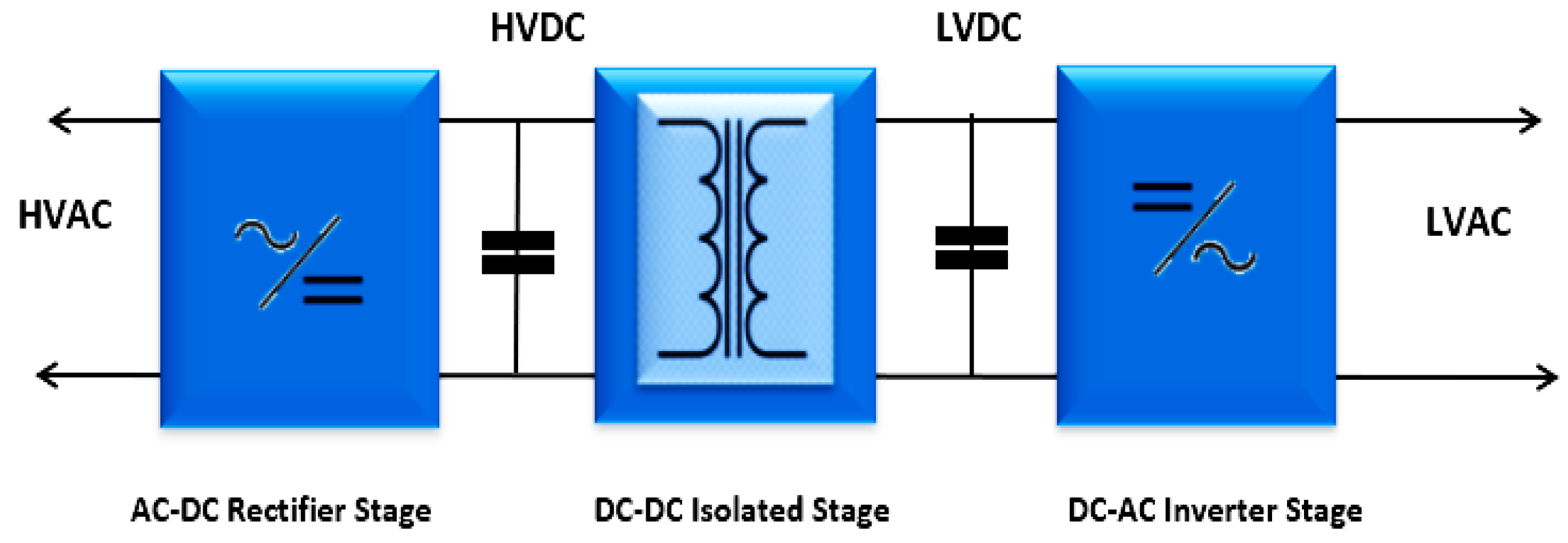
Figure 2.
SST block with different modularity levels.
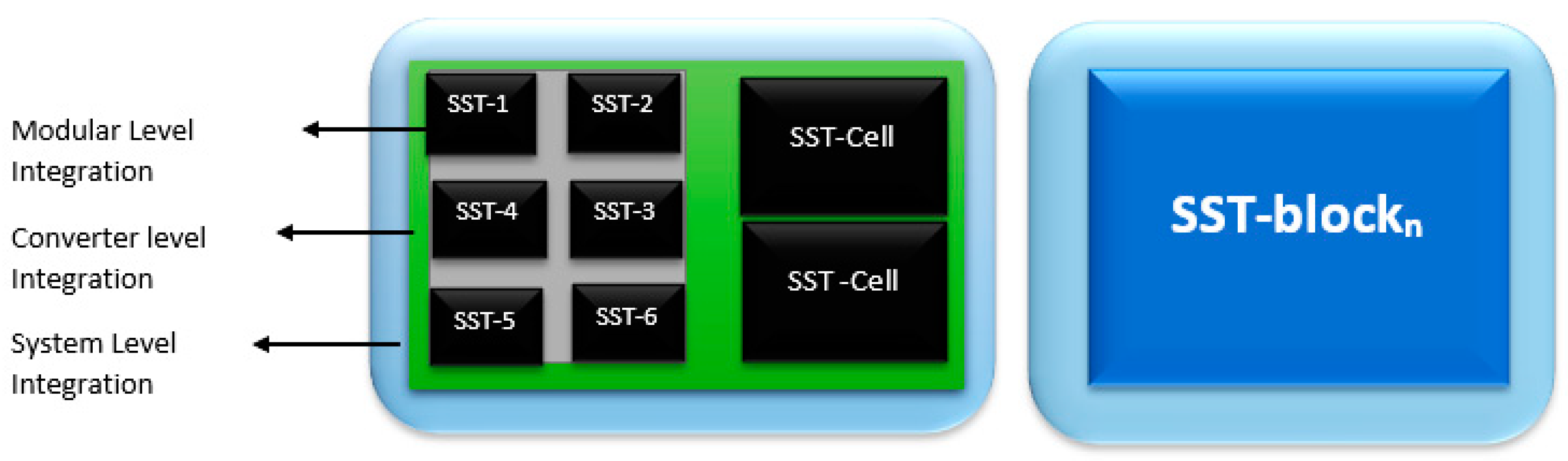
Figure 4.
DC distribution system with modular structure zoomed in.
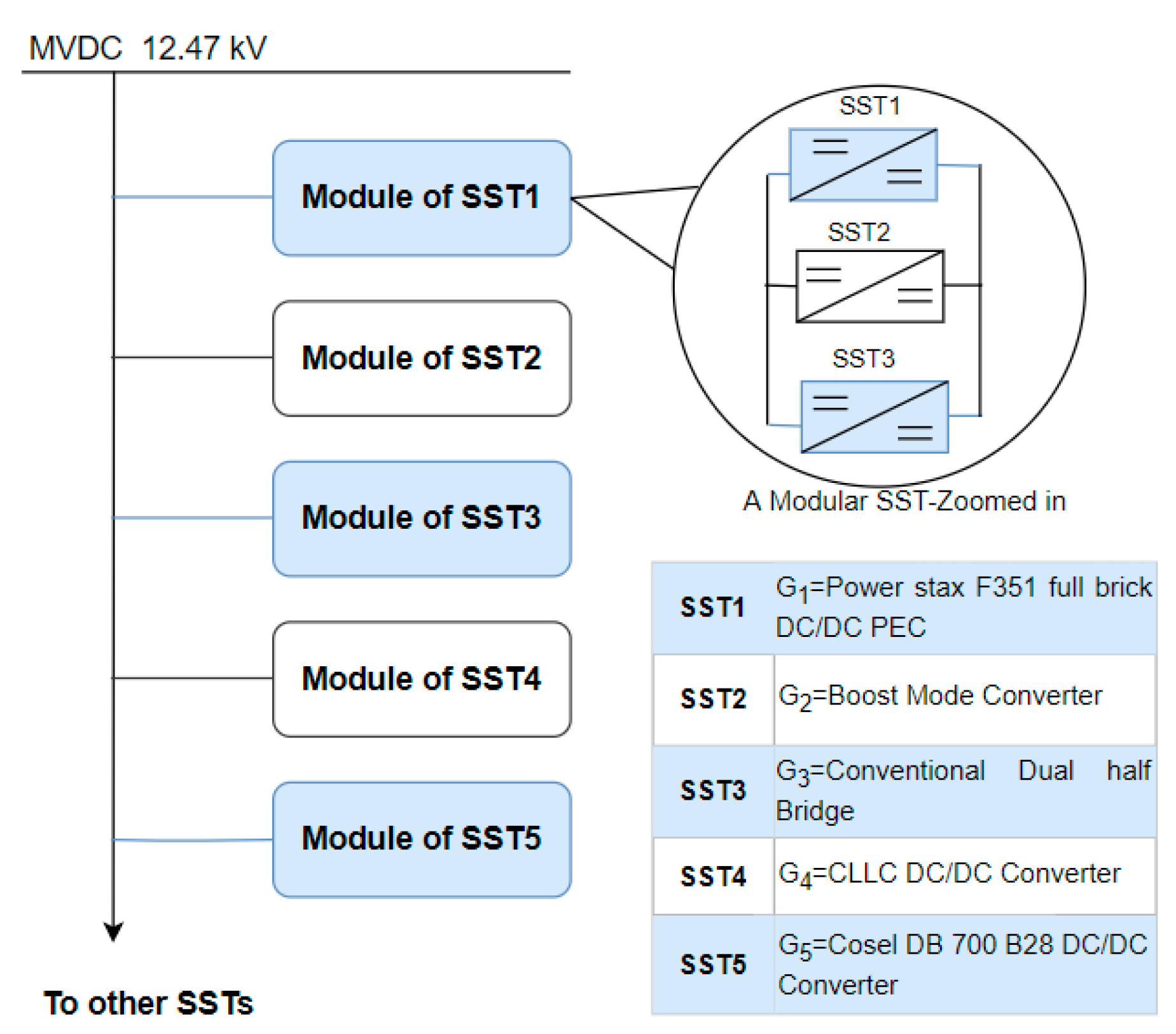
Figure 5.
Output vs. input characteristics of SSTs.
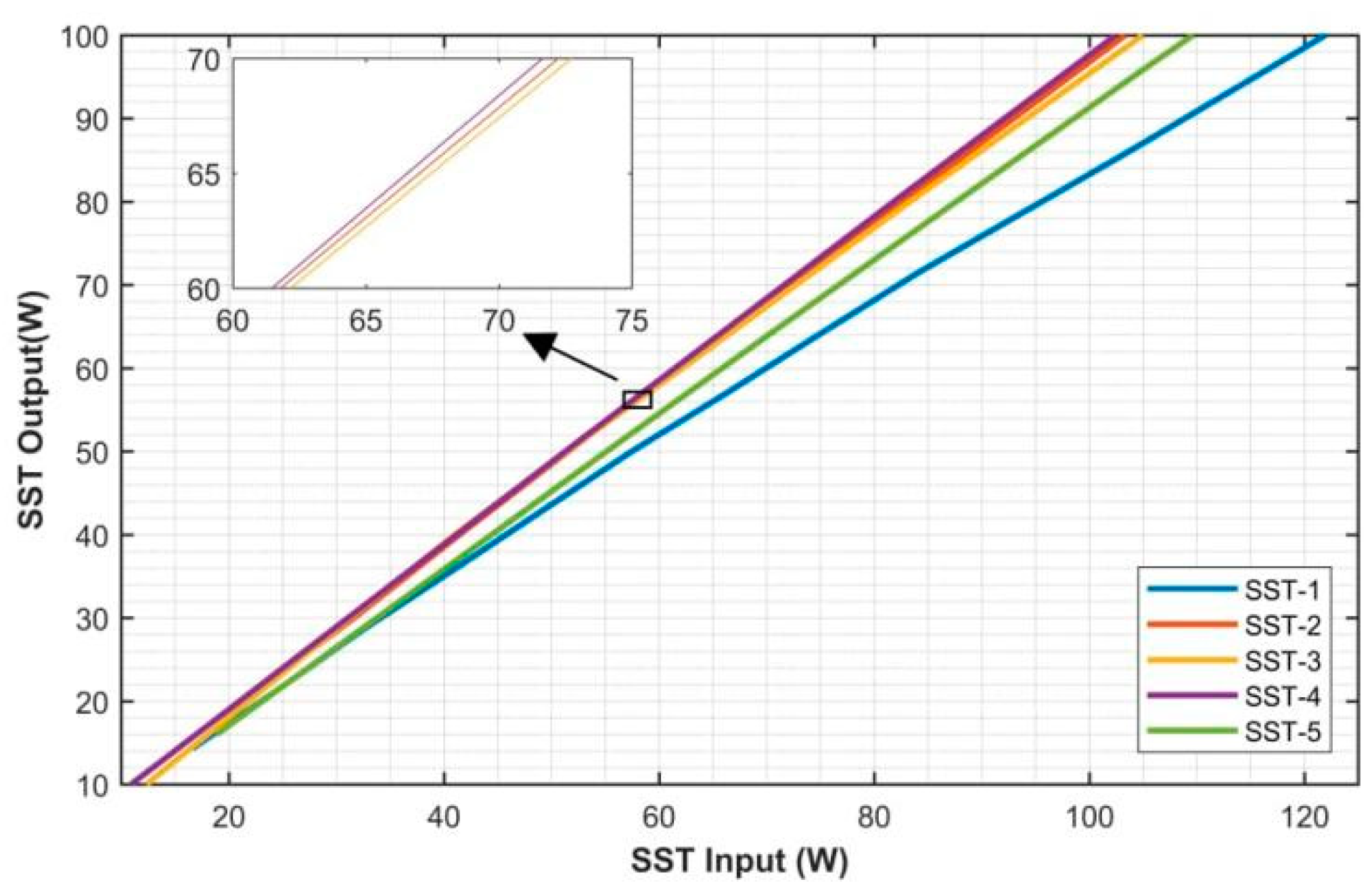
Figure 6.
Efficiency vs. loading capability characteristics of SSTs.
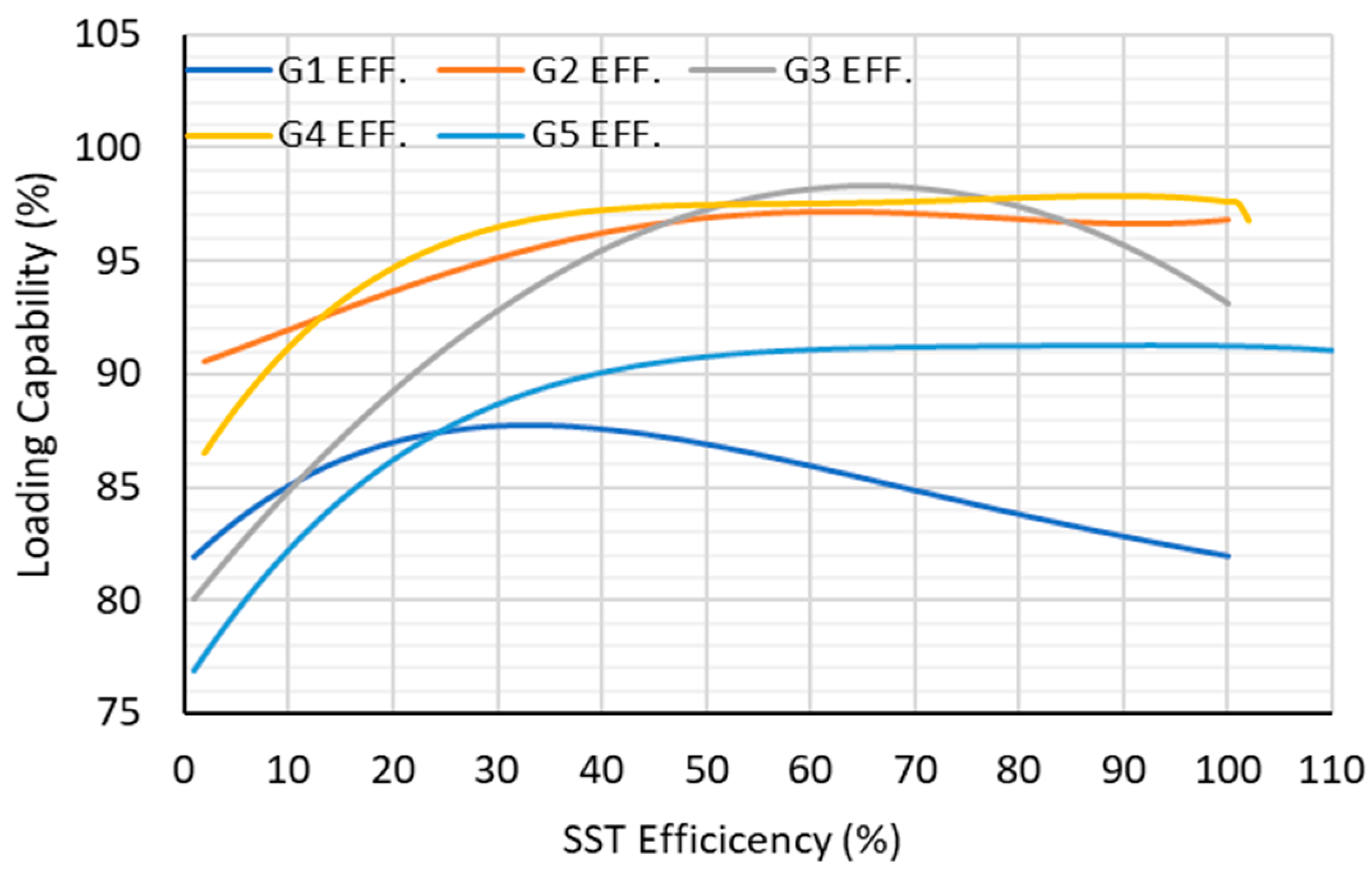
Figure 7.
Load profile of DC distribution network [9].
Figure 7.
Load profile of DC distribution network [9].
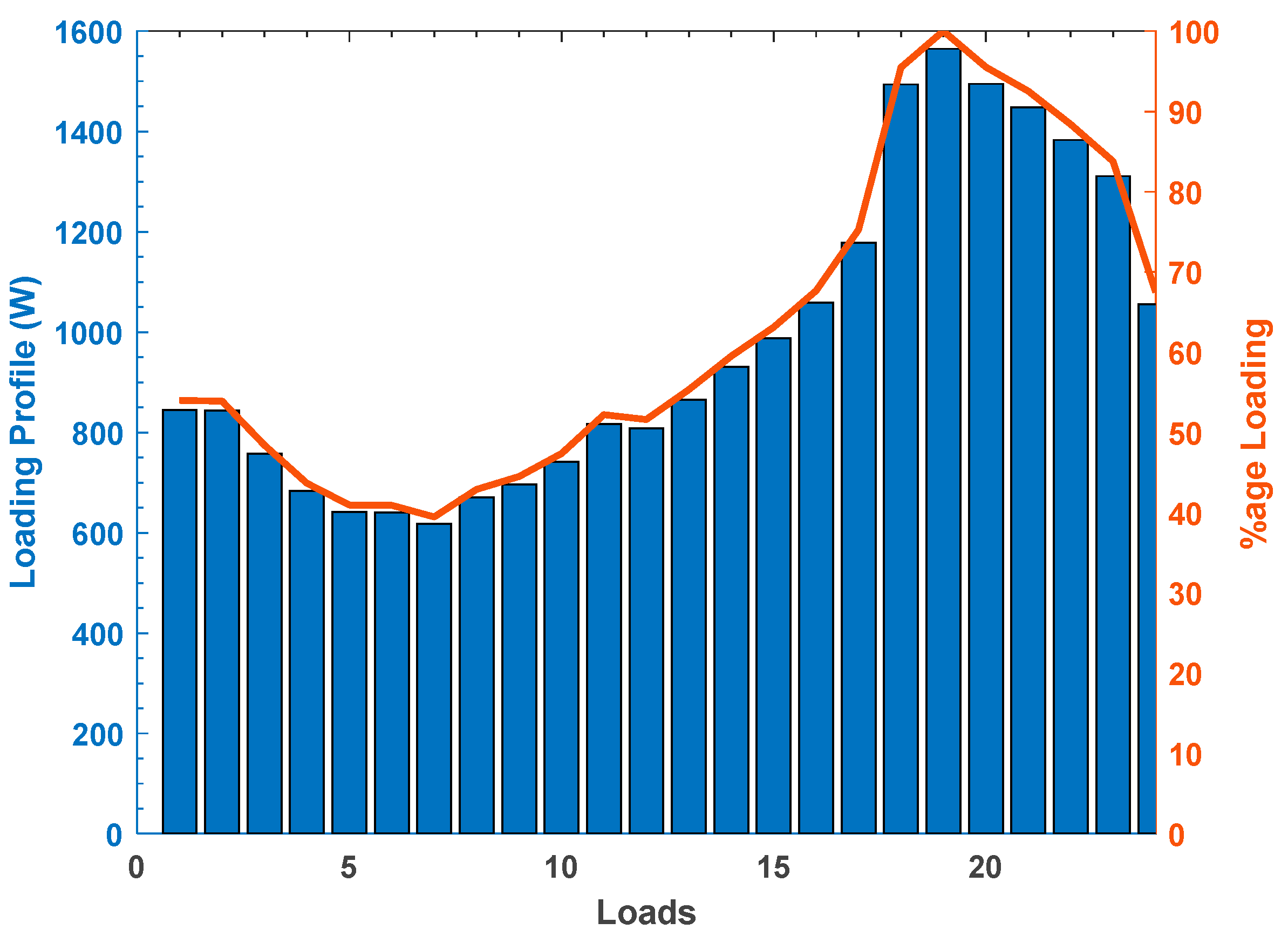
Figure 8.
Load optimization using ALO without scheduling of SSTs.
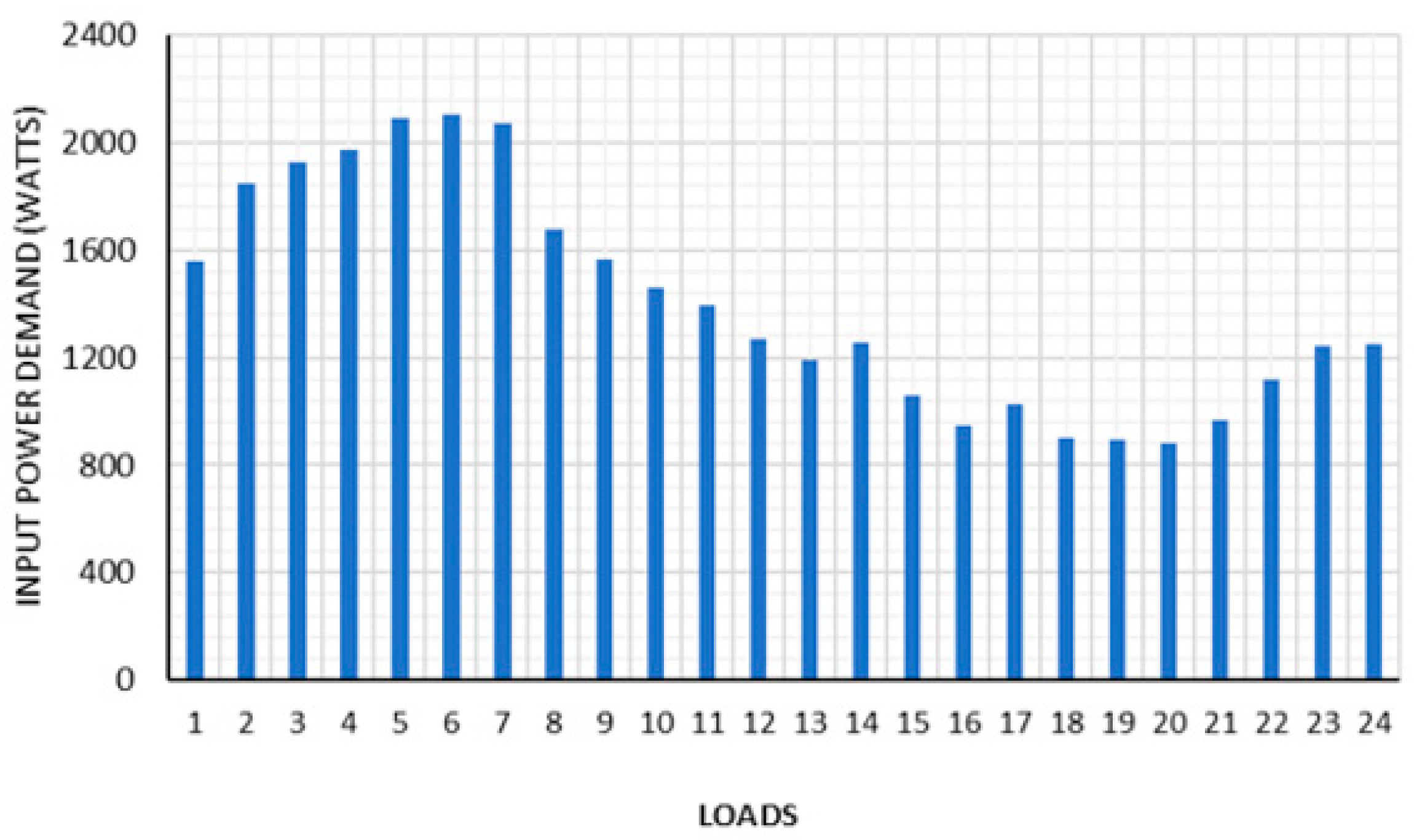
Figure 9.
Comparison of ALO for scheduled and unscheduled SST scheme.
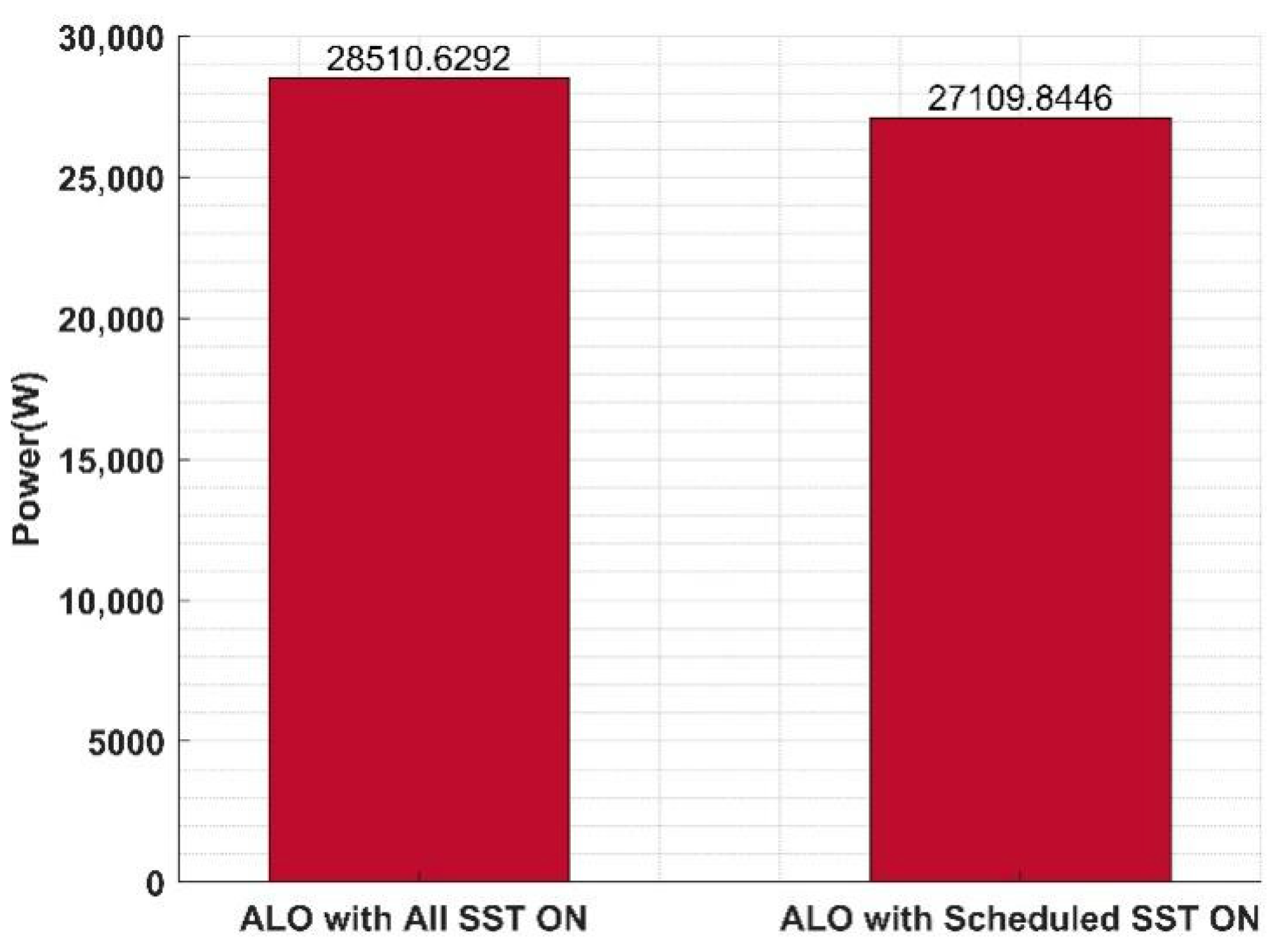
Figure 10.
Comparison of ALO, GWO, and WOA for input reduction.
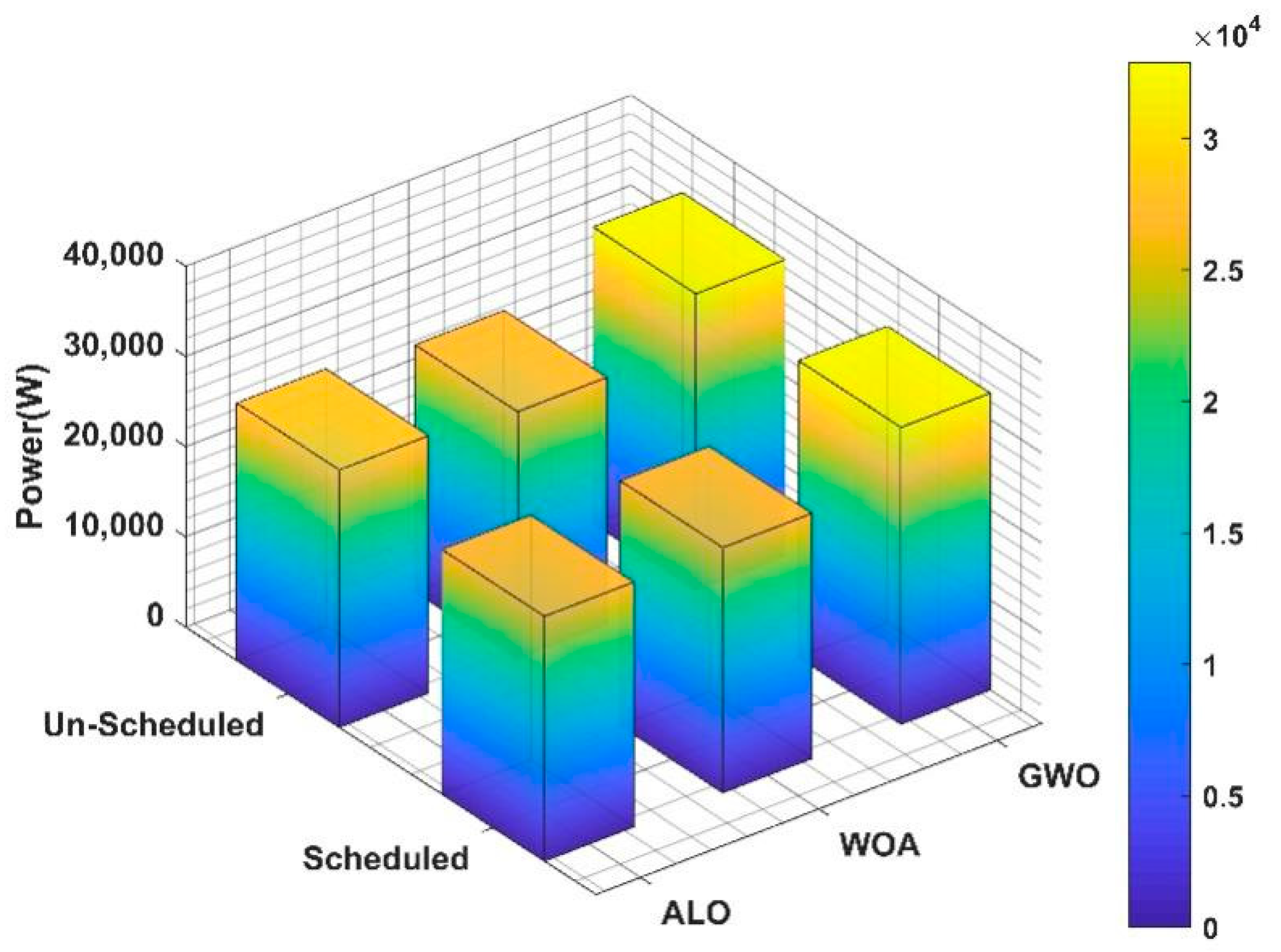
Figure 11.
Efficiency improvement of ALO, GWO, and WOA with respect to unscheduled SSTs.
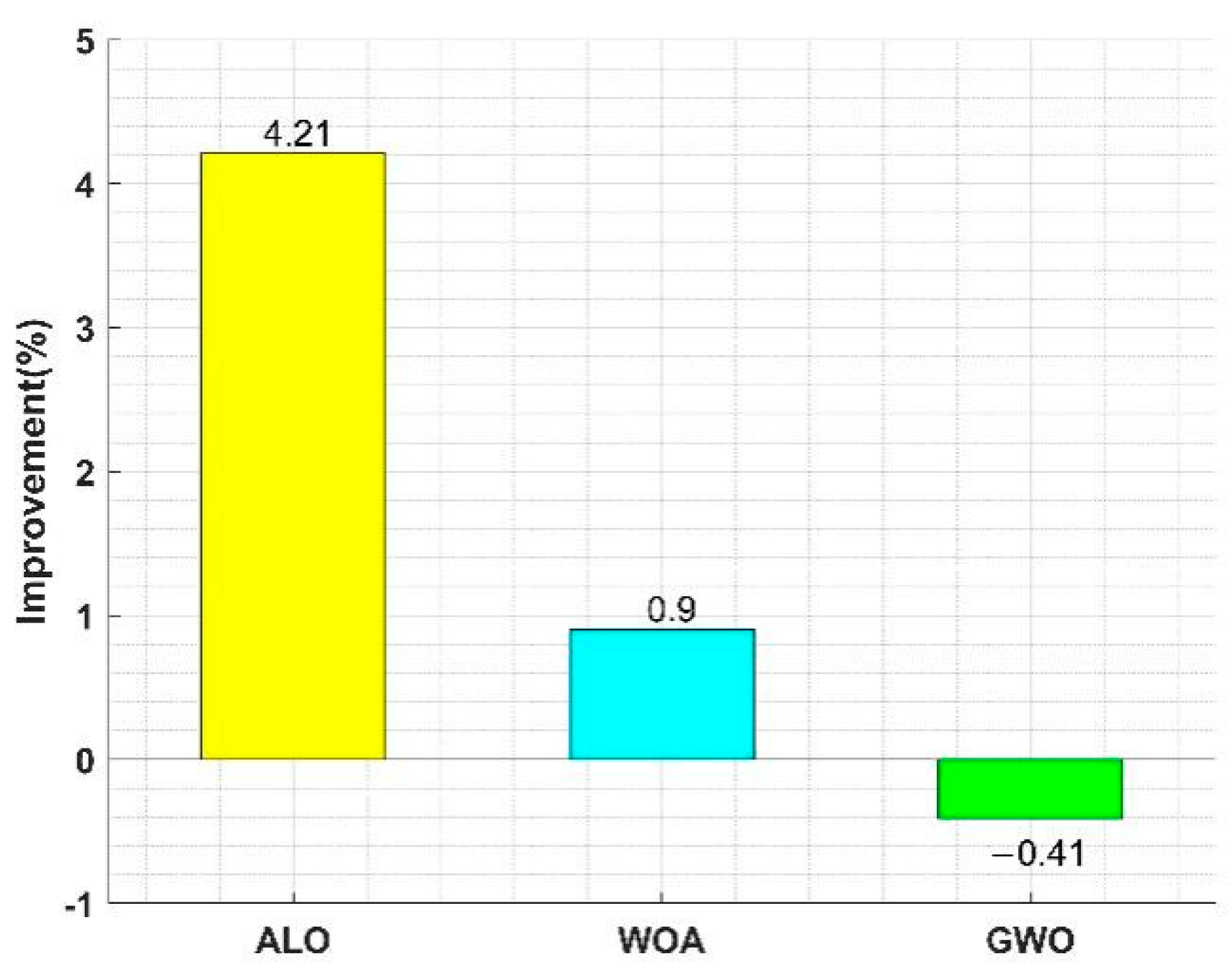

Table 1.
SST equation parameters.
| SST Configuration Input/Output | α | β | γ | Pmin | Pmax |
|---|---|---|---|---|---|
| SST1-set of 3 | 0.0017 | 1.0409 | 1.4481 | 14.28 | 100 |
| SST2-set of 3 | 0.003 | 0.9845 | 1.5944 | 20 | 100 |
| SST3-set of 3 | 0.0010 | 0.9268 | 2.8204 | 10 | 100 |
| SST4-set of 3 | 0.0002 | 0.9991 | 0.9542 | 10 | 100 |
| SST5-set of 4 | 0.003 | 1.0438 | 2.1322 | 16 | 110 |
Table 2.
Efficiency vs. loading capability equation configuration parameters.
| Loading/Efficiency | a | b | c |
|---|---|---|---|
| SST1 | −0.0012 | 0.0780 | 85.9195 |
| SST2 | −0.0015 | 0.2206 | 89.5267 |
| SST3 | −0.0044 | 0.5768 | 79.4532 |
| SST4 | −0.0015 | 0.2108 | 90.6773 |
| SST5 | −0.0015 | 0.2444 | 81.9398 |
Disclaimer/Publisher’s Note: The statements, opinions and data contained in all publications are solely those of the individual author(s) and contributor(s) and not of MDPI and/or the editor(s). MDPI and/or the editor(s) disclaim responsibility for any injury to people or property resulting from any ideas, methods, instructions or products referred to in the content. |
© 2023 by the authors. Licensee MDPI, Basel, Switzerland. This article is an open access article distributed under the terms and conditions of the Creative Commons Attribution (CC BY) license (http://creativecommons.org/licenses/by/4.0/).
Copyright: This open access article is published under a Creative Commons CC BY 4.0 license, which permit the free download, distribution, and reuse, provided that the author and preprint are cited in any reuse.


