

Submitted:
29 February 2024
Posted:
01 March 2024
You are already at the latest version
Abstract
Collatz conjecture (3x+1 problem) is a natural phenomenon in set theory that may be reconstructed using known combinatorics and order theory. Construction begins by selecting a specific order isomorphism with a bijectional order-embedding. Mapping by 3x+1 induces a unique property to only members of the mapped embedding. Under selective congruence from recursive division by two, that complex controls sequence behavior. This demonstration uses an order isomorphism consisting of two linear orders: the (1) odd positive integers and the always odd (2) Rule 50 Jacobsthal numbers, as the embedding. The argument proceeds by cardinality. When the order isomorphism is mapped under 3x+1, all Rule 50 Jacobsthal numbers are mapped to all the powers of four. This one-to-one correspondence guarantees that every odd integer is assigned to a Rule 50 Jacobsthal number, and subsequently, to a power of four. To align this construction with the conjecture, expand the set to all positive integers by showing that: (1) the powers of four embed the powers of two, in a natural way, and (2) the unique factorization of any positive even integer, not congruent to a power of two, is simply an odd integer, once the factorized power of two is divided out. In other words, if the initial choice for a positive integer is not congruent to a power of two, then recursion continues until a Rule 50 Jacobsthal number (guaranteed by cardinality) is attained. Since this value mapped by 3x+1 is always a power of four, repeated division by two will always send the sequence to one. Because this same process occurs for any choice of positive integer, Collatz conjecture is true.
Keywords:
Collatz conjecture
; order isomorphism
; embedding
; Rule 50
; Jacobsthal numbers
; congruence
1. Introduction
Collatz conjecture ( problem) is notorious for being simple to state, but impossible to prove. Starting from any positive integer, a recursive function maps odd integers to and even integers to generating a sequence [13]. The conjecture concerns the behavior of these sequences. Attributed to Lothar Collatz, who is believed to have introduced the idea in 1937, the origin of this problem is obscure. Shrouded in mystery, it was largely circulated by word-of-mouth from known associates of Collatz and likely disseminated by others even prior to that time [18]. The sequences may be referred to as hailstone sequences, or wondrous numbers, due to the wide ranging values attained. The conjecture “asserts that starting from any positive integer, repeated iteration of this function eventually produces the value 1." [13] To-date, the conjecture remains open.
2. Background
2.1. Define Collatz Conjecture
A sequence is generated by selecting a positive integer, n. Then two rules are applied using a function, f, with recursive value, , for each iteration, i. If is an even value, then that number is divided by two. If is an odd value, then that number is multiplied by 3 and one is added. These rules are applied under recursion until, as it is conjectured, the value of the sequence tends to one.
Define the function f,
and the sequence recursively.
Example calculations and sequences follow before formally stating the conjecture.
Example 1.
Example calculation for a Collatz sequence.
- Let . Three is odd, so . Ten is even, so . Five is odd and iteration continues until the following sequence is generated.
Example 2.
Examples of other Collatz sequences.
- Let , the sequence is . Let , the sequence is . Let , the sequence is .
Example 3.
The (1, 4, 2, ...) loop. There is a closed loop sequence that occurs when is equal to 1. Let , the sequence is , which is an infinite loop. Therefore, it becomes agreeable that attaining is sufficient to stop the recursive process and terminate the sequence, as indicated by the conjecture.
- Collatz conjecture statement. For any initial choice of positive integer, , iteration using f will always generate a sequence that tends to one, that is .
2.2. Prior Research and Results
Collatz conjecture is known as the simplest math problem that no one can solve . Many methods have been used over the last eighty years to show proof. According to Mueller (2021) [19], over sequences have been computed and they all go to one. But, computation isn’t a complete proof and it doesn’t prevent the existence of counter-examples. It was shown by Conway (1972) [6] that Collatz conjecture is a Turing-machine and subject to the halting problem, which is undecidable. Making it possible that a sequence could enter an infinite loop.
Beyond data and algorithms, several types of analysis have been performed for this problem. Those studies are wide and varied, and include: sequence stopping time, coefficients for least iterate, linear transformations, periodicity, residue classes, density bounds, conjugacy maps, graphs and hypergraphs. Depending on the study of interest, readers should defer to the author or mathematics professional in that particular field or sub-field. Understanding these methods are not required to realize proof. Boundedness, heuristic probability, and the most recent research related to orbits will now be discussed.
In 1976, Terras [27] showed that almost all Collatz sequences reach a point below their initial value. The same result was discovered independently by Everett (1977) [10]. From those founding papers, that bound was significantly improved upon over the next several decades. Further validity was found by Barone (1999) [2] using a heuristic probabilistic argument, where the major finding was “that iterates of the -function should decrease on average by a multiplicative factor at each step" [15]. These studies indicated that most Collatz sequences were bounded and decreasing.
More recently, Tao (2019) [26] showed the problem follows a stricter set of criteria, proving that almost all Collatz orbits will attain a bounded value. Although a wonderful result, and a testament to the power of mathematics, it was still not complete proof. And it showed that finding a counter-example would be nearly impossible.
3. Methods and Results
3.1. Methodology
Collatz conjecture (3x+1 problem) is a natural phenomenon in set theory that may be reconstructed using known combinatorics and order theory. Construction begins by selecting a specific order isomorphism with a bijectional order-embedding. Mapping by 3x+1 induces a unique property to only members of the mapped embedding. Under selective congruence from recursive division by two, the mapped set property is able to be isolated.
This demonstration uses an order isomorphism consisting of two linear orders: the (1) positive odd integers and the always odd (2) Rule 50 Jacobsthal numbers [Appendix 5.3], as the embedding. The argument proceeds by cardinality. When the order isomorphism is mapped by , all Rule 50 Jacobsthal numbers are mapped to all the powers of four. This one-to-one correspondence guarantees that every odd integer is able to be assigned to a Rule 50 Jacobsthal number, and subsequently, to a power of four. And recursive division by two is selective for congruence to powers of two.
To align this construction with the conjecture, expand the set to all positive integers by showing that: (1) the powers of four embed the powers of two, in a natural way, and (2) the unique factorization of any positive even integer, not congruent to a power of two, is simply an odd integer, once the factorized power of two is divided out. In other words, if the initial choice for a positive integer is not congruent to a power of two, then recursion continues until a Rule 50 Jacobsthal number (guaranteed by cardinality) is attained. Since this value mapped by is always a power of four, repeated division by two will always send the sequence to one.
3.2. Set and Order Theory
Sets needed for the demonstration are defined explicitly by a set rule. is taken to be the positive integers with zero. The sets are enumerated by with cardinality . Since equinumerous sets are arguably more fundamental than the principle of counting1, argument supporting theorems will be introduced. The main focus will be the Rule 50 Jacobsthal numbers that embed the odd integers. When mapped by they are each congruent to a power of four. This property may be isolated by recursive division by two, since it’s selective for congruence to powers of two. This a unique complex of a higher order.
Definition 1
Theorem 1.
Cantor’s isomorphism theorem Every two countable dense unbounded linear orders are order-isomorphic [30].
Begin by defining the two linear orders that make up the order isomorphism. The (1) odd positive integers,
and the always odd (2) Rule 50 Jacobsthal numbers [Appendix 5.3],
as the bijectional order-embedding. Please see the figure demonstrating the embedding of J in O [Figure 1].
The order isomorphism consisting of O and J is not unique. That comes after mapping by makes the Rule 50 Jacobsthal numbers congruent to powers of four. Uniqueness is derived from recursive division by two being selective for congruence to powers of two.
Now define F, the odd positive integers mapped under . This is the primary set under observation from Collatz conjecture since .
Or equivalently,
And define G, the Rule 50 Jacobsthal numbers mapped under . Set G is bijectional with and embeddable into set F.
Please see the figure demonstrating the embedding of G in F [Figure 2].
Theorem 2.
Equinumerosity theorem Equinumerosity is an equivalence relation ≈ on a family of sets[3].
Proof.
The equivalence relation ≈ is reflexive, symmetric, and transitive [Appendix 4]. □
By definition, O, J, F, and G are countably infinite sets each with a mapping equivalent to the bijection , where and .
These mappings are congruent, , and invertible, , for all and .
They are equinumerous
and cardinally equivalent.
Each set is strictly ordered, monotonic, increasing, and denumerable. For any it is always true that . For all distinct , it is always true that implies and implies . The set rule, which is enumerated by , is in one-to-one correspondence between the domain and codomain of .
The automorphism of F, which contains G, is the primary mapping under Collatz conjecture. Only odd integers may serve as escape values if the initial choice for an integer, , is not congruent to . The purpose here is to show that G is isomorphic to F by structure and order. The Cantor-Bernstein theorem will be introduced and applied. It simplifies showing the bijection between them to only demonstrating both injections, which is plain when they are equinumerous. It will be shown that G is a bijectional order-embedding of F [9].
Theorem 3.
Cantor-Bernstein theorem If each of two sets M and N can be mapped injectively into the other, and , then there exists a bijection from M to N, , such that and .
Proof.
Several proofs of this theorem exist and are attributable to Bernstein, Borel, Dedekind, Zermelo, König, and others. Some proofs rely on the axiom of choice, while others do not invoke it. The back-and-forth method (Silver, Huntington), the going-forth method (Cantor), and chain theory (i.e. chains of elements, König) can be used to show the bijection between M and N [1]. □
The injections as described by the Cantor-Bernstein theorem and set rule equinumerosity are given as,
which guarantee the bijection,
3.3. Combinatorics
The motivation now is to show the set can be can be expanded to accommodate any positive integer. Division by two is seen as a recursive device used to produce odd integers while being selective for congruence to . The order machine diagram is used to illustrate these ideas and to understand the connected graph.
Until now, division of even integers by two has been ignored; however, the purpose of mapping, , is important twofold. First, any positive even integer congruent to sends the sequence to one [Lemma 3]. Second, any even integer not congruent to , is repeatedly divided by two until it becomes an odd integer [Corollary 1]. That odd integer is mapped by to an even value [Lemma 1]. And iteration continues until an always odd Rule 50 Jacobsthal number is attained [Lemma 4]. Since mapping by yields a value congruent to a power of four, the sequence tends to one. These situations will be discussed using the order isomorphism and mapping. Some lemmas will now be reviewed.
Lemma 1.
for positive odd x is always even.
Proof.
Let x be an integer that is odd and positive. Then, must be even. Since is divisible by two, it is even. Thus, the sum of these two even numbers, , must also be even. □
Lemma 2.
Every positive even integer is either congruent to or it isn’t (dichotomy).
Proof.
By definition, is even for all , so those values may be listed. Any even number not on the list may be readily found (i.e. 6). Which must have a unique factorization (i.e. ) that is different from by the fundamental theorem of arithmetic. □
Corollary 1.
The unique factorization of any positive even integer, not congruent to , with the powers of two removed, is necessarily odd.
Lemma 3.
for all positive .
Proof.
Demonstrated using mathematical induction. Let , then is twice divisible by two. Thus, . Let , then is twice divisible by two, k-times. Thus, . Let , then and the product implies . □
Lemma 4.
J is strictly odd for all positive .
Proof.
Let for as detailed through the binomial theorem [Example 4]. It is always true that is evenly divisible by two for all [Lemma 3]. Thus, is always even, so must be odd. And the product of cannot be odd unless J is as well. □
Proof
(Proof by contradiction.). Assume J is even, then is also even. But, that implies is odd, which is impossible by equivalence to [Lemma 3]. □
Collatz conjecture may be viewed as an order isomorphic recursive machine; an order isomorphism mapped by that is under selective congruence using recursive division by two. For perspective, this shown diagrammatically [Figure 3. Order machine (OM)]. The initial selection of a positive integer, , enters the loop from the top as either even or odd. If is even, it is repeatedly divided by two, using an internal loop, until either (1) the sequence goes to one, or (2) at some iteration i, becomes an odd number. When is odd it’s mapped to , which is even, and the same process repeats. This continues until an order-embedded value from set J is found. Since is always congruent to for some , repeated division by two sends the sequence to one.
Observe, if an initial choice for a positive integer is congruent to , then the sequence tends to one. If it isn’t, then iteration continues until an odd integer, a Rule 50 Jacobsthal number, is found. No other odd integers mapped by are congruent to (uniqueness). And even numbers that aren’t congruent are used to facilitate recursion by producing more odd integers.
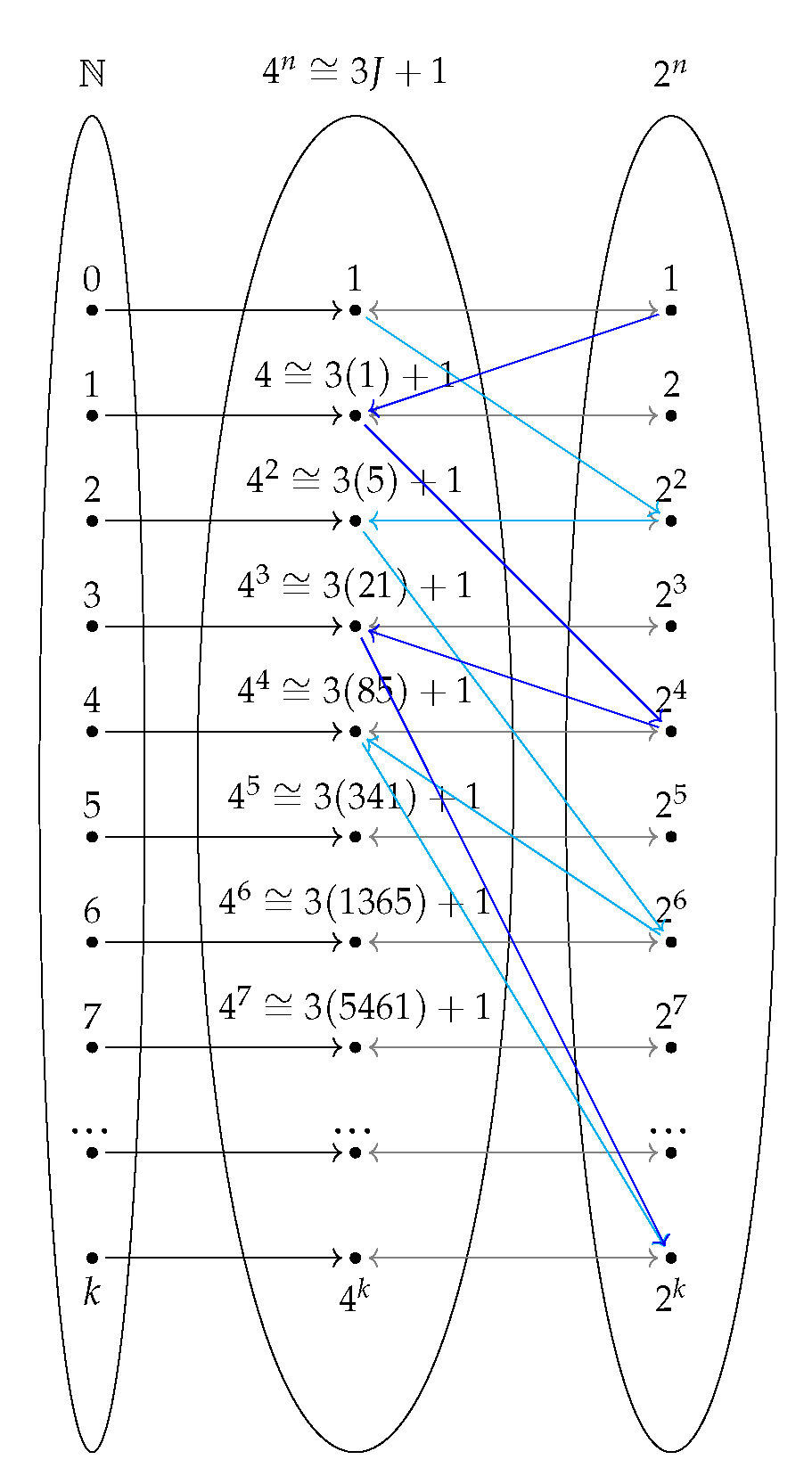
All Collatz sequences can be placed on one connected graph [Figure 5]. This occurs for a few reasons. First, conjecture recursion is selective for congruence to . As detailed, the embedded Rule 50 Jacobsthal numbers are congruent to when mapped by . Since embeds [Figure 6], this allows for all to be connected under recursive division by two. Starting from one, the only branch points off the main -tree come from set J. It further branches to for all , and then to all other positive integers.
That’s the reason a sequence can’t be known before it’s calculated. The -congruence fixes and connects all sequences, but proceeds in the direction opposite the conjecture. While any Collatz sequence is reversible, these are differing perspectives. The construction starts from one and allows for any branch pathway to be taken by applying the recursion rules in reverse, but the path to any specific integer remains unknown. The conjecture, on the other hand, allows for any positive integer to be specified, but the path back to one is unknown. Except that the sequence must attain a Rule 50 Jacobsthal number, if not initially congruent to .
4. Discussion and Conclusion
An order isomorphism with a bijectional-order embedding is not unique, and in fact, many variations in labelling could be substituted. However, Collatz conjecture is the exact opposite: it represents specificity of labelling, mapping, and selective congruence. While it is a proverbial ‘needle in a haystack’, the cardinality of the situation, as studied by Cantor, Dedekind, Zermelo, and others, is undeniable. Understanding that recursive division by two can be used as both a way (1) to make odd integers and (2) to find congruence to , greatly reduces the complexity of the situation.
It behaves as a state function. Initial, , and final, , states of the system are known, but information from the intermediate states are lost to the system. Collatz conjecture allows us to recreate the connected path, through calculation, and obtain the lost information. But as demonstrated, these are random sequences, all bounded by a forced congruence, which uses some of the most fundamental principles of mathematics. May this methodology serve as a guide for other analogously similar problems, where situational awareness can be used to provide proof, but random variation is still internally present.
5. Appendix
5.1. Set Theory Definitions
Definition 2
(Countable). Countable sets are those whose elements can be listed and indexed by the natural numbers. For example, let , then set M is countable. If a set is not countable then it is uncountable.
Definition 3
(Injection). The function f on set M is an injection (one-to-one), if for all , if that implies . That is, .
Definition 4
(Surjection). The function f on set M is a surjection (onto), if for all , there exists a unique such that . That is, .
Definition 5
(Bijection). The function f is a bijection, if each element of its codomain N is mapped to exactly one element of the domain M. A bijection is both injective and surjective. That is, .
Definition 6
(Denumerable). A set M is termed denumerable (or countably infinite) if there exists a bijection .
Definition 7
(Equinumerous). Two sets M and N are said to be equinumerous (or cardinally equivalent) provided there is a one-to-one correspondence (a bijection) from M to N. That is, . This equivalence relation is expressed as or and is sometimes termed equipollent, equipotent, or simply equivalent[8].
Theorem 4.
Equinumerosity theorem Equinumerosity is an equivalence relation ≈ on a family of sets[3].
Proof.
The equivalence relation ≈ is reflexive, symmetric, and transitive.
- Reflexive. For any set M, is a bijection .
- Symmetric. If is a bijection , then implies .
- Transitive. If and are bijections and , respectively, then implies .
□
5.2. Order Theory Definitions
Definition 8
(Trichotomy law). For any arbitrary real numbers ,exactly one of the the following relations is true.
Definition 9
(Comparability). Two elements are said to be comparable with respect to a binary relation ≤ if at least one of or is true. The elements are incomparable if they are not comparable.
Definition 10
(Partial order). A relation ≤ is a partial order on a nonempty set M if it satisfies these three properties for all :
- Reflexivity: for all .
- Antisymmetry: and implies .
- Transitivity: and implies .
A partially ordered set is also called a poset [35].
Definition 11
(Bounded). A subset M of a partially ordered set N is called bounded below if there is an element b in N such that for all m in M. The subset M is bounded above if there is an element c in N such that for all m in M.
Definition 12
(Unbounded). Let be an ordered set. A subset is unbounded in N if and only if it is not bounded.
Definition 13
(Linear order). A linear order is a partial order that is strongly connected in which any two elements are comparable.
- Reflexive, antisymmetric, and transitive for all .
- Comparability: either or is true for all .
A linearly ordered set is also called a loset [34].
Definition 14
(Dense order). A linear order ≤ on a set M is said to be dense, if for all for which , there exists an such that . That is, for any two distinct elements, one less than the other, there is another element between them.
5.3. Jacobsthal Sequence
Definition 15
From the closed-form expression, take only the even-indexed terms of , by letting for all where .
Since the powers of negative one will always be even,
the expression is able to be simplified.
Rearrangement gives the desired result,
and provides for another statement of equality,
to demonstrate another closed-form expression.
5.4. Binomial Theorem
The binomial theorem [29] describes the algebraic expansion of powers of a binomial. According to the theorem, it is possible to expand any non-negative integer power of into a sum,
where is the familiar binomial coefficient
for n choose k.
This gives the general result,
in compact summation notation. Proof may be found in standard text.
Example 4.
Application of the binomial theorem. Using the generalized binomial theorem, let and . Then, perform the necessary algebraic rearrangement.
The set rules used for the two linear orders F and G, which make up the order isomorphism mapped by , come from the previous example. may be defined for all and called F. Whereas, may be define for all and called . These sets are cardinally equivalent .
References
- M. Aigner and G.M. Ziegler (2018), Proofs from THE BOOK, sixth ed., Springer-Verlag GmbH Germany.
- E. Barone, A heuristic probabilistic argument for the Collatz sequence. (Italian), Ital. J. Pure Appl. Math. 4 (1999), 151–153.
- N. Bourbaki, Theory of Sets, Eléments de mathématiques 1, reprint ed. Springer (2004).
- G. Cantor (1883), “Ueber unendliche, lineare Punktmannichfaltigkeiten”, Mathematische Annalen 21, pp. 545–591. [CrossRef]
- K. Ciesielski, Set Theory for the Working Mathematician, London Mathematical Society Student Texts, vol. 39, Cambridge University Press, 1997, pp. 38–39.
- J. H. Conway, Unpredictable Iterations, Proc. 1972 Number Theory Conference (Univ. Colorado, Boulder, Colo., 1972), pp. 49-–52. Univ. Colorado, Boulder, Colo. 1972.
- J. H. Conway, FRACTRAN: A Simple Universal Computing Language for Arithmetic, In: Open Problems in Communication and Computation (T. M. Cover and B. Gopinath, Eds.), Springer-Verlag: New York 1987, pp. 3–27.
- F. H. Croom, Principles of Topology, reprint ed. Dover (2016).
- L. Fuchs (1963), Partially Ordered Algebraic Systems, Dover Publications, Reprint ed. March 5, 2014, pp. 2–3. 5 March.
- C. J. Everett (1977), Iteration of the number theoretic function f(2n)=n,f(2n+1)=3n+2, Advances in Math. 25 (1977), 42–45. [CrossRef]
- R. K. Guy (1983a) Don’t try to solve these problems!, Amer. Math. Monthly 90 (1983), 35–-41. [CrossRef]
- K. Hartnett, Mathematician Proves Huge Result on ’Dangerous’ Problem, Quanta Magazine, 2019.
- J. C. Lagarias, The 3x+1 problem and its generalizations, Amer. Math. Monthly 92 (1985), pp. 3–-23. [CrossRef]
- J. C. Lagarias, The set of rational cycles for the 3x + 1 problem, Acta Arithmetica 56 (1990), pp. 33–-53.
- J. C. Lagarias, The 3x+1 problem: An annotated bibliography (1963-1999), arXiv:math/0309224 Jan. 11, 2011, v13.
- J. C. Lagarias, The 3x+1 problem: An annotated bibliography, II (2000-2009), arXiv:math/0608208 Feb. 12, 2012, v6.
- The Ultimate Challenge: The 3x + 1 Problem. Edited by Jeffrey C. Lagarias. American Mathematical Society, Providence, RI, 2010, pp. 3–29.
- J. C. Lagarias, The 3x+1 Problem: An Overview. arXiv:2111.02635 Nov. 21, 2021, v1.
- D. Muller, A. Kontorovich, The simplest math problem no one can solve (short video), Veritasium, 2021.
- OEIS Foundation Inc. (2022), The Jacobsthal numbers, Entry A001045 in The On-Line Encyclopedia of Integer Sequences. http://oeis.org/A001045.
- OEIS Foundation Inc. (2022), The even-index Jacobsthal numbers, Entry A002450 in The On-Line Encyclopedia of Integer Sequences. http://oeis.org/A002450.
- OEIS Foundation Inc. (2022), Triangle read by rows giving successive states of cellular automaton generated by "Rule 50", Entry A071028 in The On-Line Encyclopedia of Integer Sequences. http://oeis.org/A071028.
- Bakuage Co., Ltd. (Japan). https://mathprize.net/posts/collatz-conjecture/index.htmlAccessed on 22 November 2021.
- N. J. A. Sloane (ed.), Sequence A001045 (Jacobsthal numbers), The On-Line Encyclopedia of Integer Sequences, OEIS Foundation.
- T. Tao, Almost all Collatz orbits attain almost bounded values, What’s new, Sept. 10, 2019. 2022. https://terrytao.wordpress.com/2019/09/10/almost-all-collatz-orbits-attain-almost-bounded-valuesAccessed 03 January 2022.
- T. Tao, Almost all orbits of the Collatz map attain almost bounded values, arXiv:1909.03562 Sept. 18, 2021, v4.
- R. Terras, A stopping time problem on the positive integers, Acta Arithmetica 30 (1976), 241–252.
- V. Thierry, Handbook of Mathematics, Norderstedt: Springer (1945), p. 23.
- Binomial theorem. (2021, July 18). Wikipedia. Wikimedia Foundation. https://en.wikipedia.org/wiki/Binomial_theoremAccessed 25 July 2021.
- Cantor isomorphism theorem. (2021, July 18). Wikipedia. Wikimedia Foundation. https://en.wikipedia.org/wiki/Cantor%27s_isomorphism_theoremAccessed 22 November 2021.
- Collatz conjecture. (2021, July 18). Wikipedia. Wikimedia Foundation. 25 July. https://en.wikipedia.org/wiki/Collatz_conjectureAccessed 25 July 2021.
- Equivalence relation. (2021, December 26). Wikipedia. Wikimedia Foundation. https://en.wikipedia.org/wiki/Equivalence_relation.
- Order isomorphism. (2021, July 18). Wikipedia. Wikimedia Foundation. https://en.wikipedia.org/wiki/Order_isomorphismAccessed 22 November 2021.
- Weisstein, Eric W. "Totally Ordered Set." From MathWorld–A Wolfram Web Resource. 05 January. https://mathworld.wolfram.com/TotallyOrderedSet.htmlAccessed 05 January 2022.
- Weisstein, Eric W. "Partial Order." From MathWorld–A Wolfram Web Resource. https://mathworld.wolfram.com/PartialOrder.htmlAccessed 05 January 2022.
- Weisstein, Eric W. "Rule 50." From MathWorld–A Wolfram Web Resource. 03 January. https://mathworld.wolfram.com/Rule50.htmlAccessed 03 January 2022.
| 1 | A child is able to show one-to-one finger correspondence long before they are able to count to five [8] |
Figure 1.
Odd x order isomorphism.
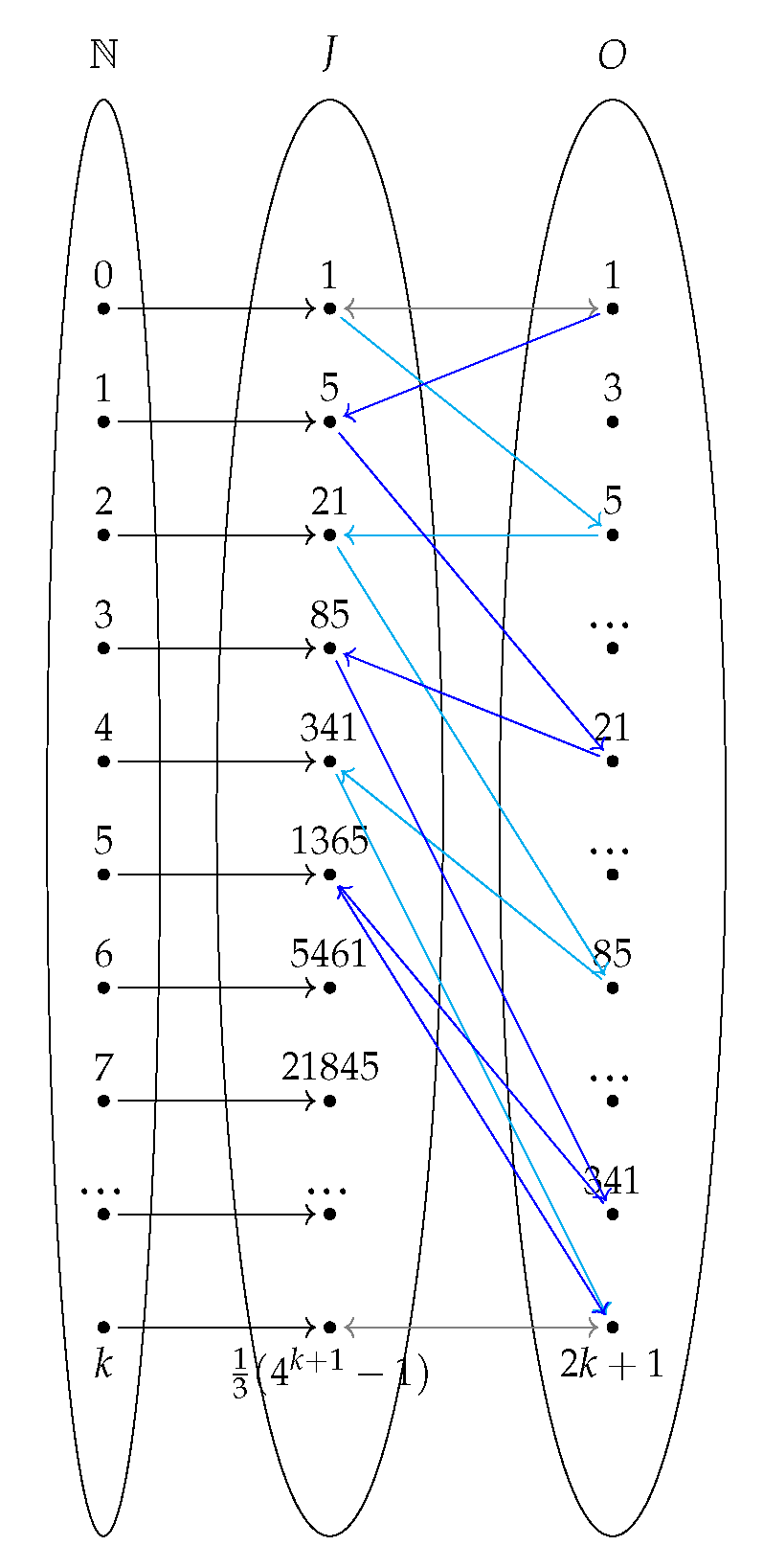
Figure 2.
Odd x order isomorphism mapped by .
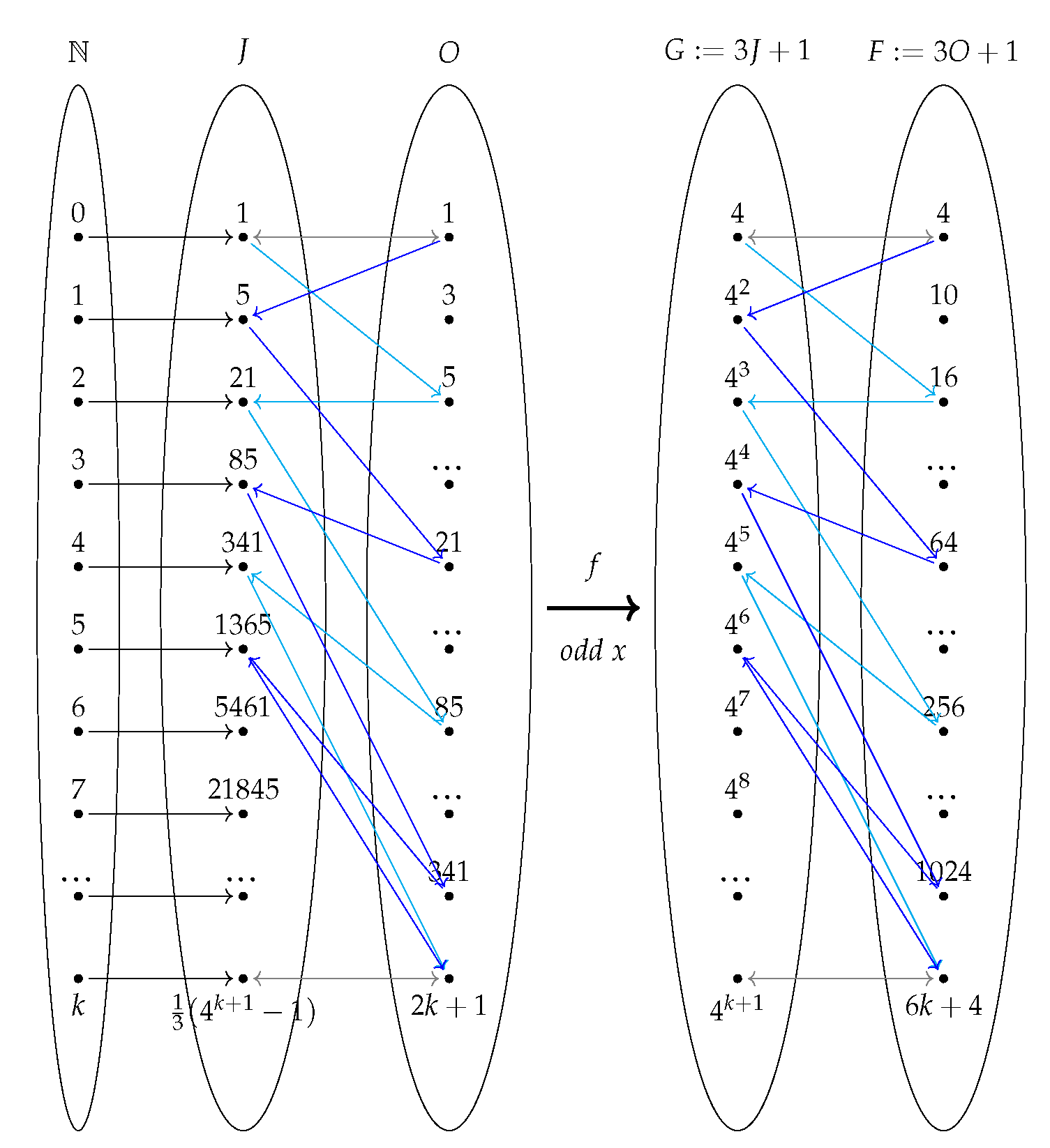
Figure 3.
Order machine (OM).
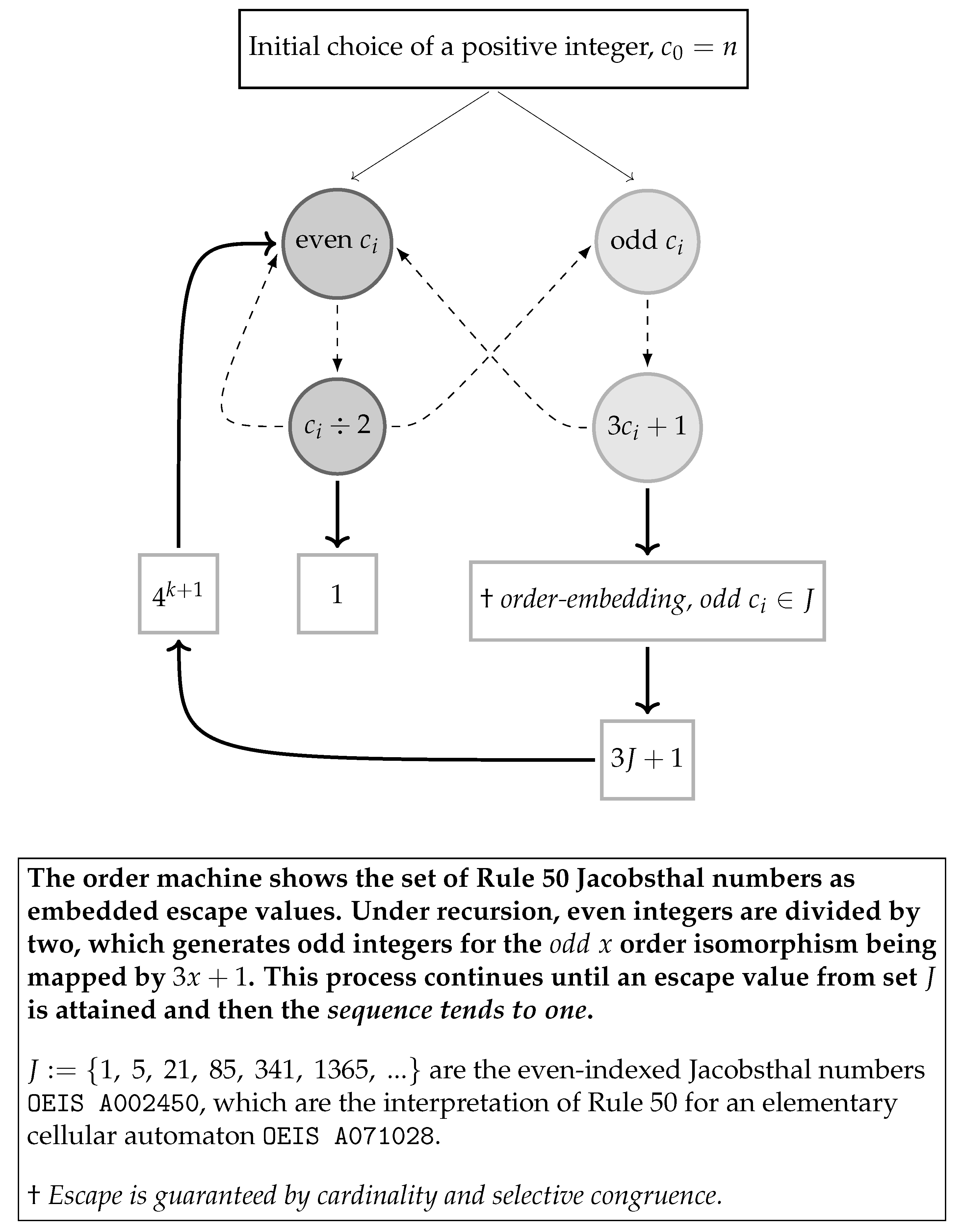
Figure 4.
Even integer order-embeddings.
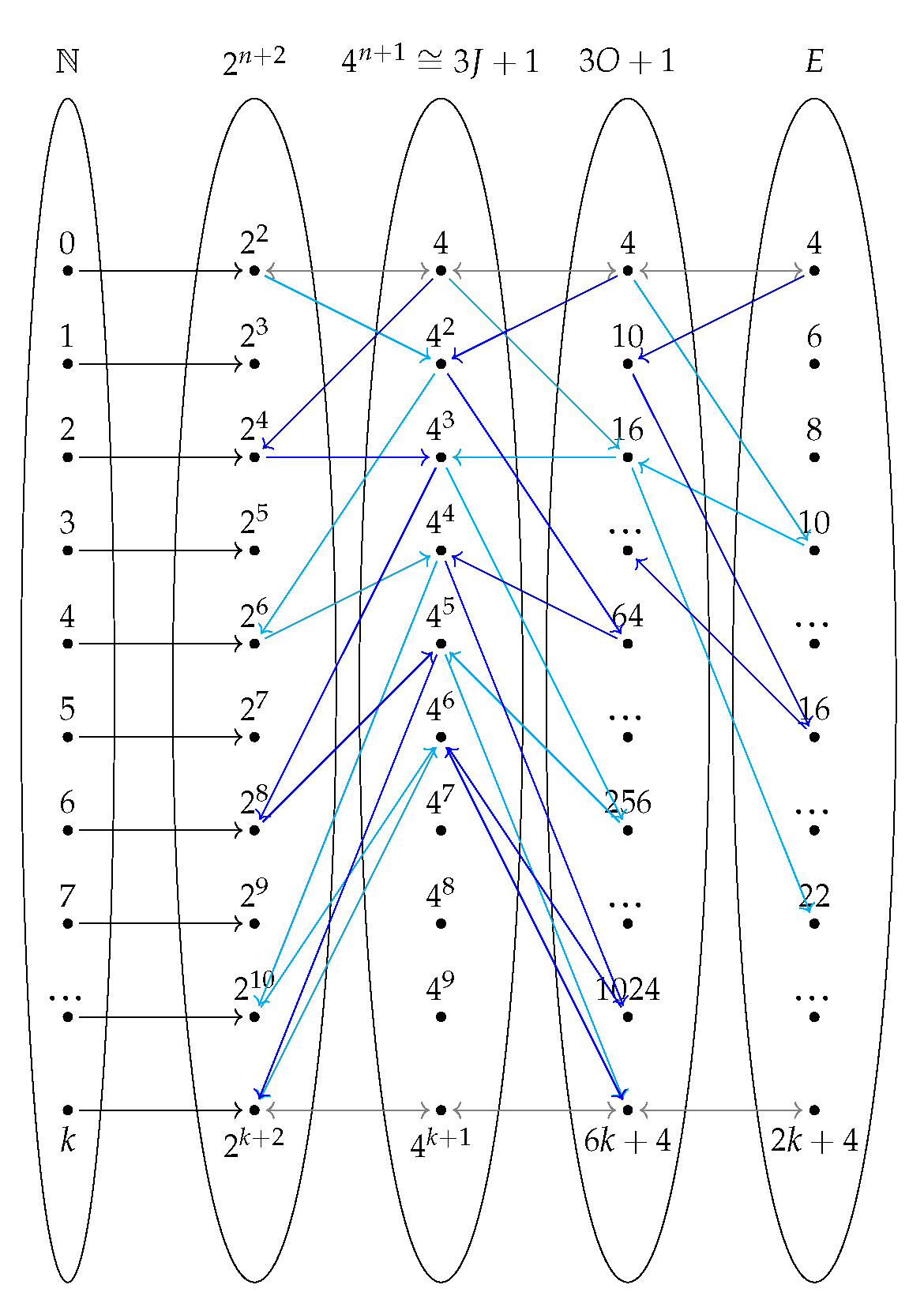
Figure 5.
Connected graph of Collatz conjecture.
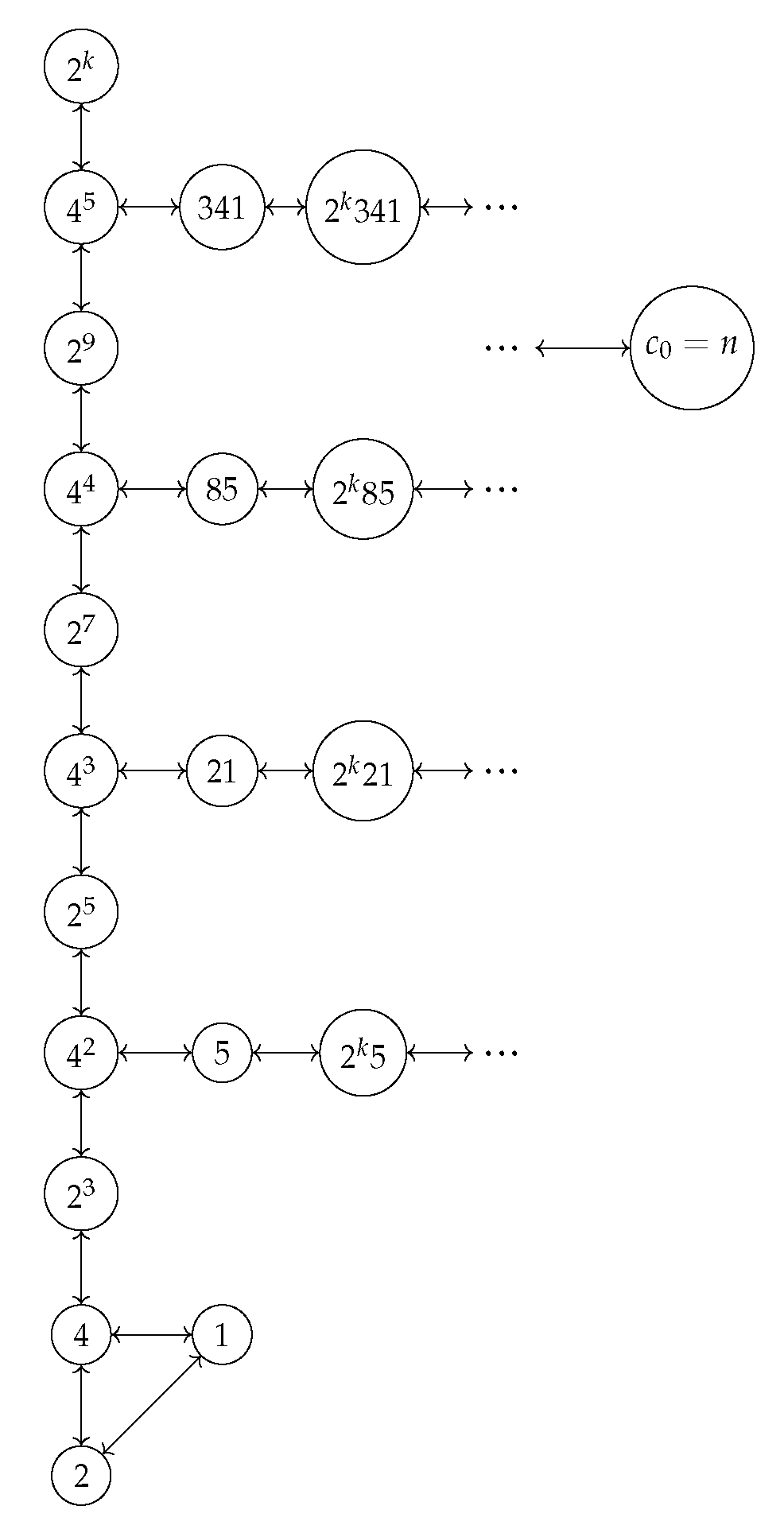
Figure 6.
Isomorphic order-embedding of in .
Disclaimer/Publisher’s Note: The statements, opinions and data contained in all publications are solely those of the individual author(s) and contributor(s) and not of MDPI and/or the editor(s). MDPI and/or the editor(s) disclaim responsibility for any injury to people or property resulting from any ideas, methods, instructions or products referred to in the content. |
© 2024 by the authors. Licensee MDPI, Basel, Switzerland. This article is an open access article distributed under the terms and conditions of the Creative Commons Attribution (CC BY) license (http://creativecommons.org/licenses/by/4.0/).
Copyright: This open access article is published under a Creative Commons CC BY 4.0 license, which permit the free download, distribution, and reuse, provided that the author and preprint are cited in any reuse.


