

Submitted:
05 March 2022
Posted:
08 March 2022
You are already at the latest version
Abstract
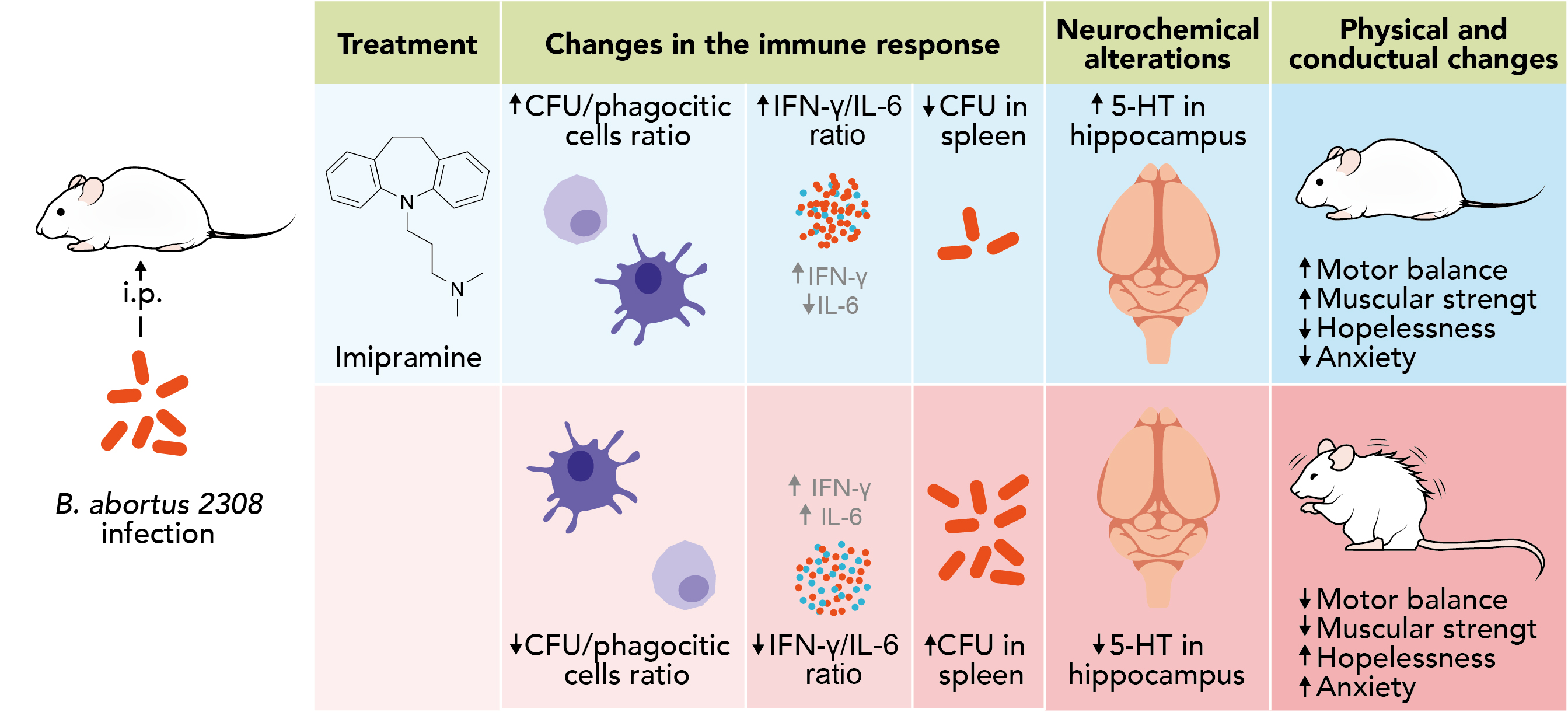
Brucellosis infection induces fever, chills, sweats, headache, myalgia, arthralgia, anorexia, fa-tigue, and mood disorders. In mice, it causes a rise in IL-6, TNF-, and IFN-; and reduces sero-tonin and dopamine levels in hippocampus. There is loss in muscle strength and equilibrium and increased anxiety and hopelessness. Imipramine (ImiP) is a tricyclic antidepressant that increases the capacity of macrophages to destroy intracellular microorganisms in vivo. The effect of ImiP was evaluated in Balb/c mice infected with Brucella abortus 2308. Serum levels were determined in IFN-, IL-6, TNF-, IL-12, MCP-1, and IL-10 by FACS; the bacterial count in the spleen, by CFU; the serotonin concentration in the hippocampus, by HPLC; and strength, equilibrium, and mood by behavioral tests. Our results showed that infected vs. control mice had a significant rise in lev-els of IFN-, IL-6, TNF-, and IL-12 with a low IFN-/IL-6 ratio, elevated bacterial-counts, alter-ations in serotonin concentration at hippocampus, and decreased muscular strength, equilibrium, and mood. Infected mice treated with ImiP vs. infected mice showed: 1) improved mood; 2) in-creased hippocampal serotonin availability, splenic dendritic cells, and macrophage phagocytic activity; and 3) upturn inflammation and reduced CFU ability. Our results support that ImiP fa-vors positive outcomes in subjects handling Brucella infections likely by improving psychoim-mune resilience.
Keywords:
Depression
; psychoimmune resilience
; tricyclic antidepressants
; serotonin
; modulation of inflammatory response
; infectious diseases
Copyright: This open access article is published under a Creative Commons CC BY 4.0 license, which permit the free download, distribution, and reuse, provided that the author and preprint are cited in any reuse.