

Submitted:
03 December 2021
Posted:
07 December 2021
Read the latest preprint version here
Abstract
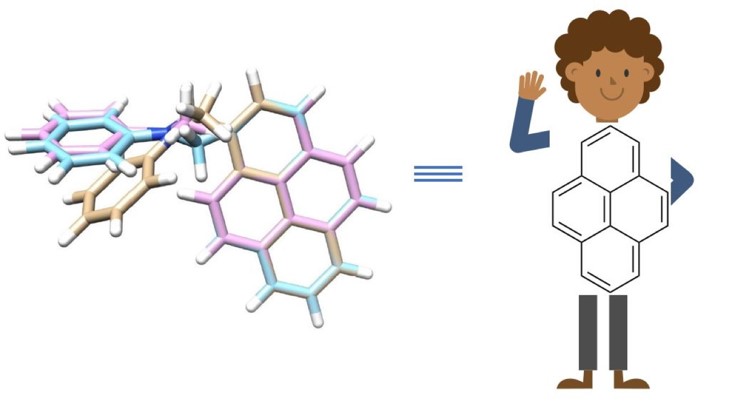
The conformational dependence of the matrix element for spin-orbit coupling and of the electronic coupling for charge separation are determined for an electron donor-acceptor system containing a pyrene acceptor and a dimethylaniline donor. Different kinetic and energetic aspects that play a role in the spin-orbit charge transfer intersystem crossing (SOCT-ISC) mechanism are discussed. This includes parameters related to initial charge separation and the charge recombination pathways using the (Semi-Classical) Marcus Theory for electron transfer. The spin-orbit coupling, which plays a significant role in charge recombination to the triplet state can be probed by (TD-)DFT, using the latter as a tool to understand and predict the SOCT-ISC mechanism. The matrix elements for spin-orbit coupling for acetone and 4-thio-thymine are used for benchmarking. (Time Dependent-) Density Functional Theory (DFT and TD-DFT) calculations are applied using the quantum chemical program Amsterdam Density Functional (ADF).
Keywords:
photoinduced electron transfer
; triplet state formation
; charge recombination
; charge separation
; intersystem crossing
; SOCT-ISC
; SOCME
; electronic coupling
Copyright: This open access article is published under a Creative Commons CC BY 4.0 license, which permit the free download, distribution, and reuse, provided that the author and preprint are cited in any reuse.