

Submitted:
28 July 2024
Posted:
30 July 2024
Read the latest preprint version here
Abstract
This article is some review of results that were obtained at 2007-2021 years development of “The Information as Absolute” concept and the informational physical model, which is based on the concept; including a number of fundamental physical problems are briefly considered in framework of the conception and the model. Recently in physics there are several publications, that present lists of the problems. However, those lists are essentially incomplete, for at least two reasons. Firsts of all, a number of phenomena are studied traditionally by philosophy, and so corresponding problems are usually considered to be “metaphysical”. However, they relate also to some concrete physical phenomena. For example, physics evidently studies Matter, and so the metaphysical problems “what is ontology of Matter”, “what is “Space”, “Time” and a few other physical phenomena and notions as well, are really a Meta-physical problems “what does physics study?” There are other fundamental physical problems, which are not considered as such in physics, and are absent in the “fundamental problems lists”. Those include the problems, which really exist, yet are incorporated into standard physical theories, and so are fundamental “implicitly”, which in physics are “solved by default” ‒ and mostly erroneously. Note, though, that a number of “Meta-physical”, and concrete fundamental, problems more in detail are considered in the paper “The Informational Conception and Basic Physics”, https://arxiv.org/abs/0707.4657, v5 (2021), so this paper is, in certain sense, an expanded conclusion of this paper, which includes, correspondingly, more in detail consideration of some more general physical problems; and, besides, in this article, the problem “what are Gravity and Electric Forces” is essentially clarified comparing with the arXiv 2021 paper version above, and additionally initial model of Nuclear Force is presented. Besides, the concrete problem “What is Life”, and the rational cosmological model, where a few vague points in standard cosmology rather probably are rationally clarified, while the fundamental problem “matter – antimatter asymmetry” in Matter is solved with rather large probability, are considered, and one of recently published rather complete “lists of fundamental problems” is commented in Appendix.
Keywords:
Foundation of physics
; Planck scale physics
; Matter
; space
; time
; Consciousness
; Life
; informational physics
; fundamental physical problems
; cosmology
; quantum mechanics
; relativity theories
; Standard Model
; particles
; antiparticles
; fundamental Nature forces
; EM force
; Gravity
; Nuclear force
; quantum gravity
; equivalence of inertial and gravitational masses
; fine structure constant
; Lorentz transformations
; experimental testing
1. Introduction
In this article a number of fundamental physical problems are briefly considered in framework of the “The Information as Absolute” concept [1–3a] and the informational physical model, which is based on the concept, that were developed in 2007-2021 [1,2,3,4,5,6,7,8,9,10,11,12,13,14,15].
By now, there exist a number of publications, where the authors formulate some lists of fundamental physical problems, for example, [16,17], the corresponding Wikipedia article, etc., analogously to Hilbert’s presentation of twenty-three problems in mathematics at the International Congress of Mathematicians in Paris in 1900 [16]. The published lists of problems are mostly similar. Correspondingly in this paper we consider some of problems in one of rather complete list in [17], which partially are considered in the main text, and briefly commented in Appendix
However, the problems’ lists in such publications are essentially incomplete, by two reasons. Firsts of all there are a number of physical phenomena that are studied traditionally by philosophy, and so usually are considered “metaphysical”—while non-physical. They relate, nonetheless, to physical phenomena as well ― for example physics evidently studies Matter, and so the metaphysical problem “what is ontology of Matter” is really a Meta-physical problem “what does physics study” as well.
The metaphysical problem “what is ontology of Consciousness” also relates to physics directly, starting from the physical problem “why and how physical measurements and interpretations of the measurements are sometimes adequate to the objective reality?” Besides, this problem was actual on first stages of development of the quantum mechanics, and is rather actual now; and not only—really a number of, including outstanding, physicists attempted to solve the really “consciousness problem” in framework of physics, though this problem as a rule is formulated in physics as “what is Life?”, including when it is considered in [17], see Appendix.
Such metaphysical problems as what are the fundamental phenomena/notions “Space” and “Time”, and a number of others, are really the fundamental physical—“Meta-physical”—problems as well, but are not considered as such in physics, and so are mostly absent in the “fundamental problems lists”, since that are also the problems that are incorporated already into standard physical theories, and so formally are solved. For example, in [17] the problem “Why are the particles of ordinary matter copied twice at higher energy” is pointed. However, the problem “what are particles at all” evidently precedes that, and seems as evident that only after solving that last problem it would be possible to obtain the rational answer for the first problem, etc. However, the list in [17] does not contain the latter problem, which—and a number of others—in physics are “solved by default” ‒ and mostly erroneously, despite that really exist.
A number of “Meta-physical”, and concrete, fundamental, problems more in detail are considered in the paper “The Informational Conception and Basic Physics” [5a], so this paper is, in certain sense, an expanded conclusion of this paper also, which includes, correspondingly, more in detail consideration of some more general than in [5a] physical problems; and, besides, in this article, the problem “what are Gravity and Electric Forces” is essentially developed comparing with the [5a] 2021 versio, and additionally initial model of Nuclear Force is presented.
Besides, the concrete problem “What is Life”, and the rational cosmological model, where a few vague points in standard cosmology rather probably are rationally clarified, while the fundamental problem “matter—antimatter asymmetry” in Matter is solved practically for sure, are considered, and one of recently published rather complete “lists of fundamental problems” is commented in Appendix.
Finally note, that this consideration, which includes solutions, and/or at least essential clarifications, of more than 30 fundamental physical problems in the model, is based, first of all, on the rigorous proof in the “The Information as Absolute” concept [1,2,3], the recent version [3a], that nothing else exists besides some informational patterns/systems of the patterns that are elements of the absolutely1 fundamental and absolutely infinite “Information” Set. Which (the Set) exists absolutely objectively really, because it fundamentally, logically, cannot be non-existent, and so is absolutely eternal, having no Beginning and no End, including “Matter” and “Consciousness” absolutely for sure are some informational systems—elements of the Set.
2. Meta-Problems
2.1. What Is “Information
Really the phenomenon/notion “Information” in philosophy and sciences remains to be principally transcendent—neither philosophy nor any science define “Information” substantively enough, all what exists is/are definitions of only specific traits/properties of Information (more see [3a]), starting from the evident from everyday practice trait that “information” is
“(Philosophical encyclopedia) “Information (lat. “informatio”—an examination, a notion, a concept): 1) a report, a notification about a state of affairs or about something else that is transmitted by a person; 2) decreased, removed uncertainty as a result of the communication obtained; 3) a notation inherently relating to a control; signals and their syntactic, semantic and pragmatic parameters; 4) transmission, reflection of the variety of any objects and processes (of alive and non-alive nature)”; i.e., briefly “information is some data”. That is evident tautology, however this tautology is inevitable in mainstream philosophy and science, since really the Information is absolutely fundamental and common phenomenon/notion, and so principally cannot be defined through some more common notions.
The correct scientific elaboration of the problem “what is “Information”” was made in the “The Information as Absolute” concept, [3a]
The phenomenon “Information” and the “Information” Set have a number of fundamental properties, which are considered in [3, 3a], so more see the referenced paper, here note only that Information is extremely bifurcational and paradoxical phenomenon, which principally cannot be formalized in any theory, and so, for example, existent in sciences a few “theories of information”, i.e., “Shannon informational theory”, a few theories in cybernetics, describe only some essentially limited informational structures.
In the concept the utmost common definition of the absolutely fundamental phenomenon, “Information” is:
“Information is something that is constructed in accordance with the set/system of absolutely fundamental Rules, Possibilities, Quantities, etc. — the set/system “Logos” in the concept”.
Or, by other words, the “Logos” set elements “make something to be information”.
A few examples of the “Logos” elements are considered below.
2.2. Some the “Logos” Set Elements as Fundamental Physical Problems
Most of the “Logos” set elements are transcendent in the mainstream, when some of them are Meta-physical phenomena/notions, so scientific definitions of which are corresponding fundamental physical problems. In this section the problems are
2.2.1. What Is Logos Quantity “Energy”
- -
- Energy is the “Logos” set element [3,5], which is absolutely fundamentally necessary for to change, including, of course, to create, of any/every informational pattern/system. That is because of the fundamental logical self-inconsistence of the other absolutely fundamental [also an element of the “Logos” set] phenomenon/notion “Change”:
- -
- at every change of something its state is simultaneously former, recent, and future states, when all the states are different by definition. That is logical nonsense.
To overcome this logical prohibition of changes at every change it is necessary to pay by two points:
(i)—to change [including to create] some informational pattern/system it is necessary to spend some non-zero portion of “Energy”. However, that is not enough if the portion is finite; and so, besides,
(ii)—really at any change the changing state on some level/scale is uncertain—“illogical”.
From the above follows the answer on the next fundamental problem
2.2.2. Why in Matter Quantum Effects Exist at All
Note, though, that the fact of impossibility of deterministic continuous changes of anything was proven more 2500 years ago by Zeno in his brilliant aporias, when Zeno, in fact, predicted the quantum mechanics.
Relating to QM note also here, that from the concept directly follows the answer on next (“implicit”) fundamental physical problem:
2.2.3. Why Does the QM Postulate Exist that All Given Type Particles Are Identical, and Why Is It Adequate to the Reality
- -
- this QM postulate is adequate to the reality because all given type particles are copies of the corresponding unique informational patterns, that is a typical situation in Information.
- -
- That above in this section is essentially the answer on the fundamental problem:
2.2.4. What Is Physical Parameter “Energy”
- -
- however that clear physically answer remains to be incomplete “metaphysically”, Energy remains to be a mysterious element of “Logos” set. Unlike other “Logos” elements, which rather clearly relate to the main trait of Information “is a data”, when the necessity of Energy in concrete informational system “Matter” is clear—see above, however it remains, including in Matter case, now completely mysterious—so from where and how some energy appears to create or to change something? Nonetheless, besides the above (for which Energy is necessary), now it is also understandable that Energy is rather “dull” Quantity, and the changes in informational patterns/systems are eventually determined by concrete information of concrete changing/creating patterns/systems.
However, that till now is not too essential in physics. The reason is that Matter is rather simple logical system, which is based on a limited set of fundamental and universal basic logical rules/laws, links, and constants (more see below), where the exchange by energy at material objects interactions is, in depth, highly standardized and universal, and the dependence of the action of Energy on difference of informational content in different material objects so is inessential, besides that there are, correspondingly, a few “forms of energy”—“kinetic”, “thermal”, “nuclear”, etc.,
- -
- and, if we don’t address to the question “from where and how energy in Matter appeared at Matter’s appearance”, this problem isn’t actual because of the energy conservation law, at Matter’s constant evolution only redistribution of the primary energy portion proceeds.
Besides note here, that actualizations of Energy action are as a rule concretized as that relate to concrete changes of states of some informational patterns/systems in accordance with what concrete degree of freedom of the changes is actualized. In this case other absolutely fundamental “Logos” Quantity acts—“Momentum”, which is directed in informational patterns/systems’ “spaces” [more about what is “space” see below], however in this case the fundamental uncertainty of Change above reveals itself as “momentum uncertainty”, whereas energy of the patterns/systems in some cases doesn’t change; for example, that happens at motion of a charged particle in a stationary magnetic field.
And what looks just as real, there exists a more fundamental and mighty than Energy phenomenon: “Logics”, and “Information” itself also, correspondingly. Though Energy on first glance seem as something external to Information, for example to some data, nonetheless if it could exist a state, when there is “nothing”, including “no energy”, nonetheless in this case there principally exists — since logically cannot be non-existent, the [“Zero statement” in the concept] endless cyclic dynamical informational pattern “there is nothing, besides the information that there is nothing, besides…”
From the above follows the answer on the next fundamental physical question:
2.2.5. ”What Is “Inertia
Inertia, correspondingly, is absolutely fundamental phenomenon that characterizes the logical resistance to changes because of the self-inconsistence of “Change” above. As energy, the inertia in simple informational system “Matter” can be, and is, characterized; according to Newton, by the physical parameter “inertial mass”. Note here, that that has no relation to the existent in standard physics explanation of what is the inertial mass as some action of the Higgs field.
On an aside, note a tenet, rather popular in official physics, that “energy and mass are two faces of one coin, one of them converts to another”. That is fundamentally incorrect. Both absolutely fundamental phenomena “Energy” and “Inertia” indeed absolutely fundamentally always co-exist in every informational pattern/system, including in every material object, but they are fundamentally different, and so at the interactions in Matter first of all energy transforms/is distributed into energy, though with obligatory accompanying by transformation/distribution of inertial masses.
2.2.6. What Are “Space” and “Time”
The answer on these questions in the concept [3] is:
“Space” and “Time” are absolutely fundamental Rules/Possibilities [elements of the “Logos” set] that are absolutely fundamentally necessary for any informational pattern/system could exist:
- -
- “Space” is necessary for any information could exist at all, and
- -
- “Time”, additionally to Space, is necessary for some informational pattern/system could be dynamic, i.e., could change.
“Space” as the Possibility makes be possible placing in concrete “space” concrete informational patterns/systems, which (the space) at that is realized as a concrete set of “space dimensions”, which (dimensions) are necessary to actualize independent degrees of freedom of the concrete patterns/systems at changing of all their possible states.
Since Space is a logical possibility, the sets of the dimensions form so concrete, and principally infinite, “empty space containers” for the concrete one type patterns/systems. For a space it is all the same—how many one type patterns/systems, which are constructed by the same concrete sets of logical rules/links/constants, and so have the same degrees of freedom at construction and changes, are placed in the container.
And it is all the same—in what places in the infinite container the patterns/systems are placed. The unique requirement, when Space acts as the Rule is that a non-zero “space interval” must divide the different patterns/systems, and any pattern/system must occupy non-zero “space interval” (a “space volume”, if there are more than one intervals in different dimensions) as well. In that Space is the utmost universal grammar rule—as most of other Logos elements, besides “Energy” and “Momentum”, by some ways are, which just so exist in all human languages.
Since any information absolutely fundamentally cannot be non-existent, everything had happened/existed in the “Information” Set; and everything is happening/existing, and will happen/exist always;
- -
- and the concrete patterns/systems, including Matter and consciousness, simply use the fundamentally always existent concrete spatial dimensions from the at least “simply” infinite “number” of spatial dimensions of the Set’s whole Spacetime in concrete actualization of current state of concrete pattern/system. As that is, for example, for Matter and humans in this concrete actualization of Universe evolution.
“Time” as the Possibility in main traits is analogue to Space, it is “the space for changing states of changing patterns/systems”, and exists/acts in concrete cases forming, including, corresponding “time dimension” for dynamical patterns/systems.
However, Time has the essential difference from Space: for Time it is all the same by what reason/way, by what degree of what freedom, etc., and in what informational pattern/system a change happened.
So in this case it is enough to have only one absolutely fundamental and universal dimension, which exists and acts in whole “Information” Set for all changing states of all dynamic the Set’s elements; in the concept, including first of all in the physical model, where for some reason (see below) this dimension is called “true time” dimension.
Time as the Rule also acts as that a non-zero “time interval” must be between different states of changing patterns/systems. However, in this case this Rule, unlike Space, seem as is determined by a couple of two, on first glance different, absolutely fundamental and “external to time” causes. The first one is that any information if appeared can not be non-existent, and so the next changing state can not “erase” previous state. The second is that a continuous changing of states is impossible, because of the logical self-inconsistence of the Change above, and the changes happen only along non-zero time intervals.
At any change of any informational pattern/system this pattern/system moves in the time dimension on corresponding time interval , in every case, when the changing pattern/system is fixed in space, and at every change of its spatial position on, let, . At that the changing of a pattern/system spatial position can be in principally arbitrary number of space dimensions, whereas all dynamic elements in the Set move at changes only in one, universal “true time” dimension.
Space and Time thus form concrete “empty containers”—“spacetimes”, where concrete dynamical patterns/systems are placed and evolve/develop at their changes. Note also, that both ‒ Space and Time—fundamentally haven’t some “intrinsic own time” measures, it is senseless to say about some “spatial size” of an unique informational pattern, and measurements of space and time intervals can be only in systems of the patterns, and only as relative ones—relatively to some space and time intervals of special patterns “etalons”.
Finally, in this section we make a brief remark to existent definition of “Time” in recent physics. This definition was firstly done by Newton [18]
“…Absolute, true and mathematical time, of itself, and from its own nature flows equably without regard to anything external, and by another name is called duration ….”
- -
- at that for Newton, correspondingly, clocks show the time flow independently on time and only because of they also tick equally equably,
- -
- and this definition, however with the two relativistic modifications, remains in physics till now. According to special relativity postulates time (i)—not only always flows equably, this flow depends on motion, and, whereas in stationary inertial reference frame time flows in accordance with Newton’s definition, in moving frames its flow becomes be “dilated”, and (ii)—time governs material bodies, including clocks, and so “time is what clocks read”, and clocks show in stationary frames “Newton’s” flow, and in moving frames—the dilated flow. Besides this time flow is observed in physics as an “arrow of time” [19].
From the correct definition of “Time” above it follows that there cannot be any, “Newton’s”, “normal”, “dilated”, etc., “time flows”, and any “arrows of time” as well—and fundamentally time cannot impact on anything. Matter, and every material object/system, including clocks, simply constantly, because of the energy conservation law, change, and so move in the true time fundamentally “fixed” dimension, passing from given states to mostly more probable states; when a changing is deterministic, that only connotes, that the probability is equal to 1; clocks are special material objects that—rather specifically, though (more see [5a]), show how they move in the “coordinate time” dimension, which really a specific space dimension, however since the motion in true time isn’t observable now, the coordinate time in physics and everyday practice is used as time dimension, variable, etc. (more see below in main text, first of all in Conclusion and [5a]).
2.3. What Are “Matter” and “Consciousness”
The utmost fundamental in the mainstream science Meta-phenomena/notions “Matter” and “Consciousness” are fundamentally transcendent in mainstream philosophy, and so the philosophy is composed by two fundamentally different doctrines, which have numerous sub-doctrines, schools, etc., “Materialism” and “Idealism”, which really are nothing else than systems of transcendent beliefs:
- -
- materialists truly believe in some transcendent “Matter”, which for some transcendent reasons, and by some transcendent way, exists eternally; and is, as that follows from the observations, again for some for some transcendent reasons, and by some transcendent way, some evidently well logically organized system;
- -
- idealists truly believe in some transcendent “Idea” (“Spirit”, “Consciousness”, etc.) which for some transcendent reasons, and by some transcendent way, exists eternally; though in this doctrine the fact that everything looks as evidently logically organized system follows from that is result of action of “conscious” “Idea”, etc.,—though it is evidently in this case necessary to define—what is “conscious”, what is again fundamentally impossible in the both doctrines; and so the transcendence of Idealism really isn’t much lesser than of Materialism
In the concept both, “Matter” and “Consciousness”, are utmost commonly scientifically defined — “Matter” and “Consciousness” absolutely for sure are nothing else than some informational systems—the Set’s elements, so are made from the same stuff “Information”, and in accordance with the same “Logos” set’s elements; whereas “Information” (and yet now most of “Logos” elements, besides Energy, as well aren’t) isn’t transcendent, and it, and so any informational structure as well, can be principally rationally cognizable, (what is “cognizable”?—see below).
Note here also, that from the above it follows that any informational system of elements is always something like “computer+program shell” system, where “hardware” is the elements, and “program shell” is the concrete the system’s basic set of laws/links/constants, in accordance with the elements interact composing just this system, exchanging at that by some informational messages, which use concrete language in the system.
Including “Matter” and “Consciousness” are some systems, which, however, have fundamentally different basic sets of the laws/links/constants, and so are fundamentally different; the main difference is in that Matter is logically closed in the Set system, which so practically doesn’t interact with other the Set’s elements and thus is essentially stable system;
- -
- whereas Consciousness is fundamentally open in the Set system, and, as that is one of the utmost specific properties of just any consciousness in the Set, is that consciousness principally is able to obtain and logically analyze any information in the “Information” Set; at that, however, because of consciousness has fundamentally limited capabilities at obtaining and processing of the principally infinite in this case information, every result of the processing is always at least partially uncertain;
- -
- and, at that, if a consciousness obtains some information, about which she hasn’t some earlier information, the consciousness assigns to this information the label “this information is non-understandable”, and further, if that is necessary, or that is interesting [“Curiosity” is another utmost just specific property/ resident utility in the “shell” of any consciousness], studies the Set’s element, from which this information is obtained—“no understanding” state also is just fundamental specific state of any consciousness.
All that is in principal contrast to what happens in Matter, where every of Matter’s elements, i.e., particles, bodies, fields, cosmological objects, always completely knows all Matter’s laws/links/constants, so at interactions uses/exchanges by only true information, and behaves after obtaining some concrete message only in complete accordance with the basic Matter set above. Or, by another words, since the Matter’s basic set “is written” in every Matter’s element, Matter isn’t some “whole” computer, it is an automaton,
- -
- whereas any Consciousness version is “whole” computer, i.e., her hardware and program shell contain some “BIOS”, “processor”, “random access memory”, and some specific utilities that organize work of the whole consciousness’ s functional modules.
Finally, here note, that, though “Matter” and “Consciousness” are fundamentally different systems, whereas physics really studies only Matter, and so really the “consciousness problem” isn’t a physical problem. Nonetheless understanding of “what consciousness is” is necessary for physicists for a number of reasons. First of all, in this case we have answers on the really main epistemological—and practically so important in any science—questions “so what studies of what?”, and “why the first what sometimes adequately, and sometimes illusorily, to the objective reality studies the second what?”
Both these questions principally cannot be answered in framework of the mainstream, since in the mainstream both the whats are fundamentally transcendent, however in the concept the answers are natural: in spite of that consciousness, including the “homo sapiens sapiens” version, and Matter, are fundamentally different, however, since both are made from nothing besides “Information”, and absolutely obligatorily in accordance with the same “Logos” set,
- -
- there is nothing surprising in that one informational system, which is able to obtain from, and logically analyze information about, other informational system, makes that correctly, and sometimes incorrectly—that principally doesn’t differ from the case when a human decodes information that was created by other human, e.g., when some linguists decode hieroglyphs that were written on some non-existent now languages.
Besides historically the “consciousness problem turned out to be an—and rather popular—fundamental physical problem, and so it is pointed practically in all published rather numerous “lists of fundamental physical problems”, being formulated usually, though, as “what is Life” problem; and, besides, historically the “consciousness problem” appeared in well known physical problem of the role of observer at quantum mechanics measurements; so “consciousness problem” is considered also in this paper, in corresponding “What is “Life” section below.
2.4. What Is “Life”
As that was pointed above the two known now fundamental informational systems Matter” and “Consciousness” are fundamentally different. Currently humans know only one Consciousness’ version, “the consciousness on Earth”, diverse versions of which every living being on Earth, including humans, have. The main differences—and similarities—between a Matter and any Consciousness in the Set are pointed as well—both systems are made in accordance with the same “Logos” elements, both are some “computer+program” systems, where similar exchange by concretely logically organized information between the systems’ elements proceeds;
- -
- however these systems are fundamentally different since are based on fundamentally different sets of the basic laws/links/constants; and so, though in Matter all/every elements, e.g., every electron, know physics absolutely completely, what any human never will do, however, at that, all/any material objects/structures fundamentally don’t know—and fundamentally aren’t able to know—anything else, thus everything in Matter fundamentally isn’t, and never can be, “conscious”.
Correspondingly every of both, Matter and Consciousness, exists and changes in essentially different spaces; including, for example, if in Matter it is possible to establish some etalon for measurement of bodies’ lengths and distances, e.g., “meter”, but nobody now knows—how many meters long a human’s thought is in any consciousness space dimension.
Though consciousness on Earth operates also in Matter’s space, when she governs, using some unknown forces, practically material living beings’ organisms, including systems “body+brain”. Both corresponding spacetimes share the principally one true time dimension which is fundamentally obligatorily common for all dynamical patterns/systems in whole Set (more about what are Matter’s space/time/spacetime see [5a] and below).
Thus, there principally cannot be some “emergence” of any consciousness from any material structure, as that is, as a rule, assumed in many existing now “theories” “models”, “solutions” of the “mind-body problem”, etc., in neuroscience and physics. Really the informational system “the consciousness on Earth” could, in principle, exist in the Set in parallel with possible Matter’s Creator even before Beginning of Matter.
However, because the consciousness is a principally open informational system, the “life” of such system is rather cumbersome in the unstable, and possibly destructive, environment of the Set. So seems a few billions of years ago this consciousness version has used an opportunity to make some material house from some stable Matter’s atoms, first of all as a stable residence in the Set and source of energy at operating and development. Thus Life rather probably appeared on Earth (though we cannot exclude now that this consciousness version was developed and created by some other Consciousness in the Set, for example by with rather non-zero probability existent Creator of Matter).
After that, “the consciousness on Earth” developed the practically material residence in accordance with seems evidently observed trend “more and more outside Matter into other Set’s regions”, up to the “homo sapiens sapiens” version. That one has well developed ability to obtain and to process information in the highest, “mind mode”, mode of operation, when information is processed abstractly i.e., in some cases without direct relation to what happens in Matter, or somewhere else in the Set.
However, this consciousnesses ability to affect material structures is extremely weak, at least for ordinary human consciousnesses, including most of physicists; and so really there is no some “observer problem” in physics:
at any experiment a studied, including a quantum mechanical, material object/system/process interacts with human material instruments, mostly as observed “-function collapses”, only in rigorous consistence with the laws/links/constants that act only in Matter, when on the QM depth everything in Matter, independently on ― in humans experiments or not, constantly happens as endless chains of the “ -function collapses”, etc.,
- -
- and all that happens without any dependence on whether an “observer” exists or not at all; including the collapse of Schrödinger cat wave function would happen without any relation—some observer opens or not the box.
More about “the consciousness on Earth” see in the first approximation functional model of the consciousness [14,15].
Finally note here the common for the last two section problem: though it is rigorously true that any consciousness fundamentally cannot “emerge” from any material structure, since any/every material structure is some rigorously closed logical system, however some specific, sometimes never existing in Matter, material structures can be—and are—constructed and created by a consciousness; and it looks as very probable that Matter was for some reasons designed and created by some extremely mighty Consciousness version in the Set (more see section “Cosmology” below).
However that by no means clarifies the problem—so why/how some consciousness can emerge in the Set?
In this case it looks as rational to suggest that that can happen if in the Set some informational systems accidentally appear after some rather arbitrary, strong enough energetic impacts in some “informational chaos systems”, which aren’t logically rigorously closed, but in which some primitive versions/logical constructions of the consciousness’s fundamental utilities “Providing self-stability”, and “Seeking self-development” are formed,
- -
- than at least in some cases, some of such systems could exist for a long time enough, enforcing their abilities at providing self-stability and abilities to obtain and analyze the information in the Set—and so being more and more stable in the Set; seeking for next and next energy sources for more and more “conscious” operating; and, eventually, when some consciousnesses at studying of what happens in the Set have understood what the absolutely fundamental phenomenon “Energy is, such consciousnesses become to be able to create rather arbitrary informational patterns/systems in the Set. Rather probably the “consciousness on Earth” is till now in some initial position on this way.
3. General Fundamental Problems
Above, the utmost common answer to the Meta-physical question “what is Matter at all?” is given. According to it, Matter absolutely for sure is an informational system of informational patterns and sub-systems, which are particles, fields, bodies, cosmological objects, etc. In this section, we present a number of rational, and so rather possibly adequate to the reality, answers to problems in the framework of the common fundamental question: why this informational system is as it is? This question sometimes is claimed as is beyond physics—the slogan “physics answers on the question “how”, and don’t answer on the question “why”” is in physics now rather popular, despite that is principally wrong. Correspondingly these really existent problems in physics don’t exist, and are solved “by default” by postulating of some physical parameters to really defined only in concrete theories material objects, and with the unique aim—consistence with experiment; as that happens, for example, with problems what is a “particle?”, “field”?; etc., which mostly are considered as solved in physics, despite their really transcendent in physics nature.
3.1. What Is Matter’s Logical Base
The answer with a large probability must be, and so is in this informational physical model, in accordance with two indeed utmost fundamental findings in XX century, which, though were really transcendent brilliant guesses earlier, but in the “Information as Absolute” concept become to be quite natural:
- -
- in accordance with the outstanding von Weizsäcker’s 1953-54 year “Ur-hypothesis” [20,21] that if Matter is based on fundamental depth on a binary logics, then the space should be 3D, and Matter’s spacetime indeed has 3 space dimensions. That was, on one hand, the outstanding hypothesis that explains why Matter’s space is 3D, and, on the other hand, the fact that the space is indeed 3D is the mighty evidence for that the hypothesis can be correct, and
- -
- in accordance with the outstanding Fredkin-Toffli’s finding [22], who showed that if some patterns in a system are based on a reversible logic, the system changes at interactions in it without energy dissipation outside the system. In this case Matter would dissipate energy somewhere in the Set; thus seems thrifty Matter’s Creator used this fact; so Matter is based on a reversible logic, and so in Matter the energy conservation law acts.
Correspondingly (see section 2.2.6.) the concrete spacetime of the concrete binary informational system Matter has 3 “standard space” dimensions. Since this system is dynamical system, as that follows from experimental data, the spacetime has the “true time” dimension, t, which is absolutely obligatory, universal, and common, for all dynamical elements of the Set. Further in this paper, as that is in the whole informational physical model [1–5a] for some reason (see below) instead of “t” for the true time dimension mostly “ct” metrics is used, c is the standard speed of light.
Besides the dimensions above Matter’s spacetime has once more dimension, to implement the degree of freedom of the reverse sequences of changes, which are in a sense “non-legitimate” in the true time, as some “travels backward in time”, what is principally prohibited in the true time. The dimension thus is really a specific space dimension, however it is actualized in many traits in the Matter like the true time. This dimension is called the “coordinate time”, “τ”, dimension in this informational physical model since that is just the “time what clocks show” in everyday and physical practice, and mostly further for this dimension the metrics “cτ”is used.
Thus the Matter’s spacetime is the at least [5]4D Euclidian spacetime as an empty container, where Matter exists and constantly changes, with the metrics (cτ, X, Y, Z, ct), where “cτ” is the “coordinate time” dimension, “ct” is the true time dimension, and X, Y, Z are 3 “standard” space dimensions. The dimensions, as that is shown in Sec. 2.2.6 above, are principally infinite by definition of Space and Time.
3.2. Is Matter’s Spacetime Absolute or Not
This problem did not exist in mechanics till the fundamental Nature EM force was discovered, or even in first years after development of the Maxwell-Lorentz theory, where EM objects, events and processes existed and happened as some disturbances in some “ether”, fixed in corresponding absolute Euclidian space. However, in late 1800s it became clear, that seems as the application of very mighty Galileo relativity principle, which principally is defined in the absolute space and time, to EM processes and events results in some paradoxical consequences, as, for example, the “relativity of simultaneity”. It also seemed that because of the principle it is impossible really to observe absolute space and corresponding absolute motion of bodies.
H. Poincaré wrote about the absolute motion in “Science and hypothesis” [23]:
“… Again, it would be necessary to have an ether in order that so-called absolute movements should not be their displacements with respect to empty space, but with respect to something concrete. Will this ever be accomplished? I don’t think so and I shall explain why; and yet, it is not absurd, for others have entertained this view… I think that such a hope is illusory; it was none the less interesting to show that a success of this kind would, in certain sense, open to us a new world…”
However, from that the absolute space even indeed cannot be observed evidently it does not follow that it doesn’t exist. Nonetheless that was postulated yet in the first version of the special relativity theory (SR) in 1905 [24]. It was also postulated that there is no corresponding (“luminiferous”) ether, which would be placed in the absolute space, and be a base of some absolute reference frame. So the SR was—and is till now—based on one more postulate that all/every inertial reference frames are absolutely completely equivalent and legitimate.
From these postulates any number of evidently meaningless physical, logical, biological, etc., consequences directly and unambiguously follow, the simplest one is the well known “Dingle objection to the SR” [25] and its more known and more complex version “twin paradox” [13], etc. From even one meaningless consequence, which directly and unambiguously follows from the postulates above, it completely rigorously follows by “proof by contradiction” that Matter’s spacetime is absolute ‒ as that follows from the definitions of Space and Time in section. 2.2.6 above as well; and that inertial reference frames so aren’t completely equivalent. However, these SR postulates have been stated as true postulates in physics till now.
There can exist preferred “absolute” frames that are at rest in the absolute 3D space which are preferred, first pf all, in that only in such frames material objects have real values of all physical parameters. Correspondingly observation of the absolute motion, i.e., the motion of a body in the absolute 3D space, is only a technical task, which can be principally solved, as that is shown in this model, and the absolute velocity of a pair of clocks can be measured yet now [8,9].
3.3. An “Ether” May or Not Exist in Matter
Matter’s spacetime as the absolute, at least [5]4D, Euclidian spacetime with the metrics (cτ, X, Y, Z, ct). It therefore seems quite rational to suggest that the dimensions of the spacetime relate to the degrees of freedom at changing states of some analogs of the von Weizsäcker’s 3D “Urs”, the [5]4D fundamental binary reversible logical elements (FLE). The corresponding introduction of fixed in the absolute spacetime above ether, i.e., a [5]4D dense lattice of the FLEs, as that is made in the informational model, is rational as well.
Besides, in the model, basing on existent experimental data, it is postulated also that all the [5]4 FLE “sizes” (in the spacetime dimension above) are identical and equal to the Planck length, . The changing of the binary FLE states, “FLE flips”, time interval is equal to the Planck time, , therefore motion of material objects in the spacetime happens as “equal footing” in all [5]4 dimensions of the spacetime with [5]4D velocities that have identical absolute values being equal to standard speed of light
This postulate of [5]4D FLE ether allows to clarify a number of other fundamental physical problems.
3.4. What Is “a Particle”
This problem more in detail is considered in [5a], here we briefly indicate only some main, necessary further here, points. In official physics, particles really are principally transcendent items—since they are some objects of the transcendent “Matter”.
Besides from the informational concept above and from experimental data that particles — which absolutely for sure are informational patterns/systems — are some objects that constantly change their states, however, at that, they are stable, it looks as it completely rationally follows that particles are some cyclic close-loop algorithms,
- that cyclically change their internal states with frequency ω so that a particle has energy is the inertial mass, is the fundamental elementary physical action, reduced Planck constant, c is the speed of light. This hypothesis appeared as early as in 1920 as the “the Zitterbewegung”. de Broglie hypothesis [26,27].
A few naturally suggested, and postulated in the informational model, rational premises follow from that above:
(i)—particles are some cyclic disturbances of the FLE lattice, which appear when a 4D momentum impacts on an ether FLE, which, after the impact, “flips” further causing sequential flipping of neighbor FLEs.
To cause a flip—and the corresponding sequential flipping of ether FLEs along a straight 4D line is enough infinitesimal momentum when the “FLE flipping point” propagates in the 4D ether and the 4D space with metrics (cτ,X,Y,Z) with the 4D speed of light, , . However, if the momentum is not infinitesimal, the flipping point can not propagate in the lattice with the speed faster than c. Thus, the unidirectional motion transforms into a “helical” “FLE flipping point” motion along some 4D “helix” of cyclic sequentially flipping—and precessing ‒ FLEs in accordance with some close-loop algorithm, which is just a particle that has the 4D momentum , energy , while the algorithm ticks with frequency, the “radius of the helix” is equal to , so flipping point—and so the particle ‒ has “intrinsic 4D angular momentum” be equal to (see Figure 1).
Note also, that in this case the “flipping point” moves along “helix” with the speed , as the flipping of FLEs along “helix” happens “diagonally”, nonetheless the “helix front” moves along the impacting/creating 4D momentum direction with 4D speed of light, .
However, some “a helix’s 4D axis” does not exist having its axis as a 4D vector in the 4D space, so the propagation of the disturbance in the ether transforms into propagation of, possibly, propagating in the either bi-vector or a tensor, and so this propagating is essentially not “point-like”- in both, in the spacetime and in the ether. Nonetheless the propagation has the direction—the direction of the impacting momentum’s vector. Besides, the “helix” of FLE lattice disturbance experimentally is observed as a “point-like and wave-like” particle interacting with other pointlike particles (what is observed as the “wave-particle duality”). It seems rational to suggest that “pointlike interactions” are interactions of the particles’ FLEs, i.e., the “size of interaction point” is near Planck length, even though the whole disturbance “a particle” is not pointlike, and the position of the flipping point is randomly distributed in some wave-like spatial region.
In parallel particles fundamentally obligatorily move in the true time ct-dimension, in this model spacetime metrics with the speed of light.
(ii) The always moving particles are, thus, some “gyroscopes” which are always oriented relating to their motion direction, and
(iii) Note also, that it follows from the experimental data that there are two main types of particles in Matter, depending on the parental 4D momentums. In the model that are “S-particles”, created by spatial momentums, and “T-particles”, created by momentums that were directed in the “coordinate time”, i.e., along the cτ-axis.
So S-particles, e.g., photons, always move in 3D space only with the speed of light, T-particles move in “coordinate time” cτ-dimension with the speed of light, if are at rest in the absolute 3D space. If a T particle after be impacted by a space directed momentum, moves also in space, its speed in the “coordinate time” dimension decreases by the Lorenz factor in accordance with the Pythagoras theorem.
Note, though, that the above in this section relates completely only to fundamental particles. If a particle is composed from some fundamental particles, some points in the above are not valid.
And, besides, note that extreme impacts on FLE can result in many comparatively stable close-loop algorithms, and that is observed experimentally—the observed particles zoo now contains a more than a few hundred items—some chimeras that are composed from some fundamental particles, truncated algorithms, as that, e.g., rather possibly muon and tau-lepton are truncated electron’s algorithms; 2-nd and 3-rd generations of quarks, as well, etc. Most of the algorithms have some defects, and so can break on some algorithm’s tick with some constant probability, so such particles decay exponentially in time.
Note also, that from that everything in Matter is/are some disturbances of the FLE lattice that are constantly moving with the 4D speeds of light, it follows that for observing of the absolute space there is no necessity to point some “anchor that is at rest in the absolute 3D space”, as that Poincaré wrote. Any T-particle (body…) in any 3D space point that moves only along the cτ-axis with the speed of light is for sure at the absolute rest.
4. Few Notes Relating to Other Fundamental Problems
4.1. Problems That Are Considered in Detail in [5a]
The solutions and clarifications of the Meta and general problems above allowed to solve, or essentially to clarify, a number of concrete physical problems, such as what really are the Lorentz transformations in special relativity [29] and the Lorentz-Poincaré theory [30,31,32]; first of all that Lorentz transformations are equation of motion of only points of rigid bodies and rigid systems of the bodies, what is a particle’s spin and why neutrinos have non-zero rest mass; what are the physical action and the “minimal physical action” principle, etc. Besides this paper contains the version-2021 of proposed in 2007-year initial model of fundamental Nature Gravity and Electric forces, the version-2022 is presented here below.
4.2. What Are Antiparticles
Note, that the answer on this question is possible only if this problem is considered in the absolute [5]4D Euclidian spacetime metrics (cτ,X,Y,Z,ct), where particles are always constantly moving with 4D speed of light in the 4D sub-spacetime with metrics (cτ,X,Y,Z) having the 4D momentums , (and particles’ energies ), ; and, simultaneously, are moving in parallel, in 1D ct-dimension with the speed of light and the momentum ; though pointing in this case of the momentum as a vector in principally one-dimension motion looks as a bit superfluous, however that means that everything moves in the ct-dimension only in positive direction.
In the model in complete consistence with existent experimental data it is supposed—and postulated, that antiparticles, are, as the particles above, also some close-loop algorithms, which are the same as corresponding particles’ algorithms, but the algorithms run in reverse command order, having so for T-particles and their T-antiparticles opposite momentums in the cτ-dimension, (particle) = (antiparticle).
In contrast, since in Minkowski space the dimension/variable “t” is really some mix of the true time, t, and coordinate time, τ, so “4-momentums” in SRT, , physically are rather strange: i.e., the zero component of a 4-momentum of a particle is, in fact, the whole real 4D momentum—and the momentum in true time, whereas really the “t” in Minkowski space has also the coordinate time traits, as it is the “proper time” of, a moving in a “stationary” frame, frame. Besides, that is in practice “the time, which clocks show”, which (clocks) are usually some T-bodies, and really show how they move in the coordinate time dimension.
Really, since the coordinate time is the space dimension, it is used as the time dimension in everyday and physical practice only since this dimension is unique, and essentially differs from standard 3 space dimensions in that when motion in standard space is easily observable, the motion in the cτ-dimension isn’t directly observable—though is observable indirectly, a number of clock’s pointer rotations show the passed in this dimension way like a car odometer that measure number of a car’s wheel rotations shows passed in the 3D space way; and so, including, the motion in tome—in the mainstream physics fundamentally non-existent “time flow” can be measured by using as the time dimension of any regular motion in space, measuring time in, e.g., meters.
Though note that in a rigid reference frame, while all used in practice frames are rigid because of Earth gravitation are rigid ones, really it is impossible to observe motion in the true time, and what is in the practice is inevitable, whereas measurements of physical parameters in rigid frames, using the time definition above, indeed practically completely truly describe what exists and happens in the observed so material objects and structures.
So in Minkowski space—as that really is fundamentally in true time—in the time dimension there is no backward in time motion.
Correspondingly, when Dirac developed in framework of SRT QM equation for fast moving free particle—electron, he made that as modification of existent already non-relativistic Schrödinger time dependent equation , where is the wave function of a particle, is the Hamiltonian operator, which corresponds to the classical mechanics Hamiltonian , , j=1,2,3, are [really partial] operators of 3D space particle’s momentums;
- and using, instead of classical Hamiltonian above, the relativistic Hamiltonian , where p is the absolute value of 3D momentum, m is rest mass of a particle, c is the speed of light.
This Hamiltonian has the 3D space momentums in the square root, and so it is impossible to obtain directly linear differential equation for the wave function using the momentums operators above—as that is made in the Schrödinger equation. However, Dirac solved this problem by the nice non-standard way; in which, besides, the Pauli spin formalism was taken into account quite naturally, wave function of particles turns out to be 4-component vector that describes particle’s complex quantum state—what looks as indeed adequate to the reality, etc. So in the equation the “Dirac Hamiltonian” is , where partial momentum operators are the same as in Schrödinger equation above, and are the four 4 × 4 matrices, which determine the four-component—in contrast to the one-component -function in Schrödinger equation, -function. The equation is in essential consistence with the SRT formalism, but looks also as true one, if in the Hamiltonian has negative value, what fundamentally contradicts with SRT, where can have only positive values.
However, that formally is possible, because of, as that Dirac told, e.g., on the first “Atomic nucleus” conference in the USSR [34] (translated from Russian):
“….In Newton mechanics kinematical energy W is always positive. But in Einstein theory. W is defined by more complex equation, namely
from what
In classical theory from both signs always + is chosen, what does with purpose to obtain accordance of the theory with experiment.
That creates no difficulties, since from our equations is seen, that W can be only more than +, or lesser than -. That connotes that the states with positive kinetic energy are separated from the states with negative kinetic energy by the interval (from to ), and, since in classical theory all dynamical variables are continuous, so a particle, which had firstly a positive kinetic energy, by no means can тo transit into a state with negative energy. By different way that is in quantum theory: the wave equation has the property that existence of some disturbing force obligatorily creates for the particle a probability of transition from initial state with positive kinetic energy into a state with negative kinetic energy:: therefore in quantum theory it is impossible simply to ignore a possibility of negative kinetic energy, as that is in classical theory …”
Finally, the obtained equation is
where the Dirac’s approach above is introduced as “hole theory”, that the vacuum is the many-body quantum state in which all the negative-energy electron eigenstates are occupied. This description of the vacuum as a “sea” of electrons is called the Dirac sea. The approach looks as evidently questionable, since “negative-energy states” for free particles really don’t exist, in SRT and really.
However if Dirac would consider this problem as the “momentum problem”, he could consider, instead equations for energy above, the equation for the momentum - where the sign “±” for the vector momentum is undoubtedly legitimate—unlike to fundamentally positive scalar energy W above, and so the hypothesis about the particles that move with negative speed of light—oppositely to electrons, would be physically legitimate as well, however in SRT momentums of having rest mass particles don’t exist as well—such particles can move only having lesser speed.
Nonetheless in SRT—as that is in this model—everything moves also with 4D speed of light—with “4-velocity”. That is another thing that this velocity looks as is physically strange—e.g., spatial component of velocity can be arbitrary, including arbitrarily larger than speed of light; and really the Dirac equation is practically the equation for the momentum, if both sides are divided by c
Really—see above—the T-particles electrons, and positrons, really are created by, and move after, oppositely directed in the cτ-axis momentums, and that above is, besides, the answer on the problem “What is the “Feynman–Stueckelberg interpretation” in QED [35,36], where it is ad hoc postulated that antiparticles move “backward in time”.
4.3. What Is the “Feynman–Stueckelberg Interpretation”
The motion with negative speed in the -dimension practically for sure happens in Matter, if, as that is rationally suggested and postulated in this model, the antiparticles have the same algorithms as the corresponding particles, but their algorithms run in reverse command order, therefore the antiparticles really move backward, however not in the true time, but backward in the coordinate time, which is just “the time what clocks read”, and which really is measured as experimental base of physical theories. It also matters that existent clocks are made from particles, and so real positions and motion of antiparticles on the -axis are experimentally non-observable. If it would be a possibility to make a clock from antiparticles, that would be possible—as observation that on such clock the pointer rotates oppositely to the pointer on its made from particles twin.
Note, though, also—the coordinate time is not the time; and so, for example, if there would be two twins, one “material” and the other “antimaterial”, their clocks would show opposite signs of their ages. However, both twins will seem practically identical as usual twins, since biologically both they would age principally in accordance with fundamentally non-material biological laws. Not completely, though—moving in the space both twins would biologically age slower than if are at absolute rest.
Finally, addressing here to the “what is particle/antiparticle?” problems above, add a couple of some common notes else. First one relates to the main dynamic parameters of particles motions, energy and momentum: and . That looks as that the momentum vector, which has direction that is determined by what degreases of freedom, and in what ratio, were actualized at concrete interactions, transports correspondingly changed informational pattern “particle”, the inertia/mass of which is essentially determined just by its logical structure, with the speed of light in corresponding direction in the 4D sub-spacetime; whereas thus energy transports the whole, though essentially disconcerted, information about current state of the pattern with the speed of light in the [true] time dimension
Since what happen in Matter in this scheme/sense practically for sure happens in any other dynamical informational system in the Set—everything in the Set have fundamentally obligatorily some inertia, momentums, and energies, this fact, which reveals itself clearly now for humans only in Matter, rather probably can be useful at studying of the utmost fundamental phenomenon “Information” as a whole.
Other note relates to the “particle at rest in space” problem. In standard QM it is stated that if a particle is at rest in 3D space, then, as that follows from corresponding solution of Schrödinger equation, its position in 3D space is infinitely uncertain, i.e., a particle, if is at rest, “exists in whole infinite Matter’s space”, since corresponding wave length is infinite. It looks as that would be rather strange if that would really happen in Matter, and really that doesn’t happen.
The problem relates, of course, only to T-particles, which can be at a space rest, so have rest masses, since were created by momentums that were directed along the -axis. Correspondingly really the particles never occupy in space infinite volume, and really, if a such particle is at the rest, it occupies a well limited 3D space with size ~ particle’s Compton length, moving with the speed of light along the -axis, as sequential FLE flipping along 4D “helix”, which has the -axis as its 4D “axis”.
That is another thing, that this 4D “helix” exists as having strangely simultaneously existing 3 equally equivalent, mutually orthogonal, projections on the three 3D space planes (see Figure 1), however that isn’t important in this case, the particle’s motion, nonetheless, doesn’t proceed in an infinite space, but is localized in the 4D space by the characteristic in this case the particle’s Compton length scale size in any dimension.
Though at the absolute rest some really “whole uncertainty” exists—that is the uncertainty of in what direction in whole 4π solid angle a particle “moves”, however that really is senseless, since the particle doesn’t move, and the “angle problem” above appears not when a particle is at rest, but only if it moves, after some impact and transmission to particle corresponding momentum, p, in a certain concrete 3D space direction, with a 3D speed V. This motion along 3D space helix, the front of which moves with the speed V, is observed in physics as the de Broglie wave that has the length .
5. Cosmology
There are many problems in cosmology, first of all, in some cases of principally insurmountable uncertainty even in the formulation of these problems, when this physical branch relates to objects, events, and processes, which humans cannot study now in controlled or at least observable, conditions.
Moreover, many of these problems can not be principally rationally solved or clarified in mainstream physics, i.e., outside the “Information as Absolute” concept and the physical model, because of the fundamental transcendence of the phenomenon/notion “Matter” in the mainstream philosophy and science. However, this informational physical model allows to consider a few problems rationally enough.
5.1. The “Beginning Problem”
This is an utmost fundamental problem in cosmology, and it is rather evidently principally irresolvable in framework of official physics. Physics has no reliable data about the objects, events and processes that could exist, appear, and happen at Beginning. Nonetheless a number of theories exist in physics, and in the standard cosmological “Big Bang” model [40] it is suggested concretely that
“…. As the Big Bang theory goes, somewhere around 13.8 billion years ago the universe exploded into being, as an infinitely small, compact fireball of matter that cooled as it expanded, triggering reactions that cooked up the first stars and galaxies, and all the forms of matter that we see (and are) today.….”
- -
- in spite of that the existent physics principally is not applicable to this “infinitely small, compact fireball of matter”, etc., and so principally isn’t able to rationally suggest—which, why and how some reactions cooked up the first stars and galaxies.
As well as to the next steps of Matter’s creation, when in the model
“…more explosive phase of the early universe at play: cosmic inflation, which lasted less than a trillionth of a second. During this period, matter — a cold, homogeneous goop — inflated exponentially quickly before processes of the Big Bang took over to more slowly expand and diversify the infant universe. …”
- -
- existent physics knows absolutely nothing about what was this “cold, homogeneous goop”; why “it inflated exponentially quickly before next processes of the Big Bang”, by what reason this “inflation” stopped; and further by what reason and how that “took over to more slowly expand and diversify the infant universe”, etc.
Nonetheless, there exist, basing on existent astrophysical data, a number of seems as rather rational points in standard model of Matter’s evolution after Beginning, including, if we do not take into attention the remark above, the rather rational “phenomenological” description of states in Matter evolution above,
- -
- starting from the “space inflation” state/epoch [41,42], when the space, in the standard model for unknown reasons, and by some transcendent way, appeared at Matter’s creation, and exponentially expanded, and that happened at some relaxation of some completely unknown in physics “inflaton” field’s singularity, because of “a repulsive gravitational force” (?) [40]. However, the “inflation hypothesis”, in spite of these rather questionable points, seems adequately to the reality phenomenologically describes the observed uniformity of matter density and of the material objects nomenclature on cosmological distances; the nucleosynthesis, etc.
Including the hypothesis in the standard model that during inflation the matter was a cold, homogeneous goop, seems is rather plausible, since that is consistent with cosmological observations. However, that contradicts with the assertion that the matter “exploded into being, as an infinitely small, compact fireball” in this model in the quote above.
The informational approach allows to formulate reasonable physical hypothesis [3,5] in accordance with the existent experimental data and with reasonable points in the standard Big Bang model above, such as the inflation epoch, and that the Matter after the inflation was rather cold, etc.
In the hypothesis it is suggested that the “Information” Set’s element “informational system “Matter”” was created by the other Set’s element, a version of informational system “Consciousness” (see section 2.3 above) ‒ conscious smart “Creator””, which was indeed extremely smart and could design a logically simple, however functionally extremely complex, effective, and closed in the Set, informational system; and has found in the Set at creation of this system a few huge portions of the mysterious, including essentially in this concept, till now phenomenon “Energy”.
Thus—see above—Matter is based on the simplest binary and reversible logics + (at least) 4 fundamental logical marks, which humans observe as 4 real fundamental Nature forces (more see below), including Gravity, and few universal links and constants, which are “written” in the Matter’s utmost fundamental base—in the correspondingly binary at least [5]4D reversible fundamental logical elements [FLE].
Further this design was actualized into Matter in the next 3 steps—and portions of energy:
On the first step the at least [5]4D dense lattice of [5]4D FLE was created (“inflation epoch”) exponentially, as the result of programmed division, possibly into 2, of possibly one “primary FLE” (as that, for example, bacteria spread in a Petri dish, if there are enough resources) in the corresponding Matter’s fundamentally infinite, absolute [5]4D spacetime with metrics [at least] (cτ,X,Y,Z,ct), Euclidian of course,
- -
- which [the infinite spacetime] “automatically”, i.e., by definition of the absolutely fundamental phenomena “Space” and “Time”—see section 2.2.6. above, appeared at the creation yet of the “primary FLE”. Note, though, that this spacetime always, including before Creation, existed in the Set, which exists absolutely fundamentally always, i.e., without Beginning and End, as a sub-spacetime of the Set’s whole spacetime. The FLE lattice was cold;
- -
- on the second step, the energy portion with cτ-directed momentums was globally uniformly pumped in this FLE-lattice, and there the completely symmetrical primary T-particles were globally uniformly created. It seems as rather probable that the energy was spent only on the particles creation, and so the “primary T-particles” matter in Matter was probably rather cold again.
However, from existent cosmological data it looks as rationally to assume that the pumping wasn’t uniform locally—in the lattice (and so in 3D space) some clusters of primary particles were created, where the particles density was radically enhanced, which were some seeds of appearing on next Matter’s evolution steps large cosmological structures, first of all—galaxies.
5.2. Why Matter Now Practically Does Not Contain Antimatter,
Matter does not contain antimatter since it did not contain antimatter yet at the second step, because the primary T-particles were completely symmetrical algorithms. In this case it is illogical to consider the difference “particle/antiparticle”. Hence, it was logically completely permissible for all primary T-particles to be only “particles”—i.e., all of which have the positive momentums in the cτ-dimension.
On the third step the primary particles (which in this hypothesis are rather probably Planck mass particles or other simple particles, i.e., that were completely symmetric algorithms and have only completely symmetrical gravitational charges) interacted by using only completely symmetrical Gravity force, the result was, rather possibly indeed a soup of, because of the angular momentum conservation law, “ordinary”, but only particles, which was distributed again globally uniformly—but non-uniformly locally—in the lattice.
In the “soup” unstable ordinary particles decayed quickly and—as the standard cosmology asserts rather adequate to the reality—the observable now stable particles eventually remained; this soup was rather hot. Hence, CMB exists now, however that possibly was not a “singular” temperature, because the energy was mostly spend on creation of the ordinary particles.
If the primary particles were the Planck mass particles, then nearly 1019 “ordinary” baryons were created in an interaction of a couple of particles.
At that Creator practically for sure did not need to control the step-2 and step-3. Creator well knew that nothing besides a concrete informational system “Matter” can appear, if a non- structuralized energy is pumped in the rigorously structuralized FLE-lattice. E.g., this Matter could have a number of thousands of galaxies lesser or more, but for Creator that was not essential.
5.3. What Is the “Dark Matter”
In this cosmological model it would not be surprising if the “dark matter” indeed exists, being made up from the primary T-particles. That could happen if during the creation of “ordinary” matter only 20-30% of these particles have interacted, and 70-80% of the particles exist till now. If these are the Planck mass particles, then the density of the dark matter particles is in 1019 times lesser than the baryons’ density, i.e., 3-4 particles in a cube with the size 1000 000 m.
Since the primary particles interact only gravitationally, they interact with “usual” particles at a probability extremely lesser than when that for neutrinos, and so (i)—the bodies, stars, etc., are practically transparent for these particles, which rotate around centers of some massive bodies along their single own orbits, forming corresponding haloes, and (ii)—they are practically non-detectable, due both to extremely small cross section and extremely small concentration.
Though if an interaction would happen in a detector, that would be well observable event, 1019 BeV is rather observable energy.
Besides it looks as rather rationally to assume, that in the “seeds” clusters there were some local—and small—regions, where the primary particles density was so large, that the primary particles composed compact objects with extreme mass and Gravity field, which have become centers of galaxies, having masses millions, even billions, of stars.
These objects have some interesting physical trait—the strength of created by the objects Gravity field is so large, that escape velocity becomes be equal to the speed of light, and so even photons, if aren’t radiated orthogonal to the objects surface, can propagate inside corresponding space along closed orbits—such objects so practically don’t radiate light; and if radiate, the light spectrum is drastically red-shifted.
That happens in both existent theories of Gravity—Newton’s theory and general relativity, and happens at least provided that the mass, M, and radius, R, of an such object are in accordance with the equation is the radius in GR (Schwarzschild radius), corresponding radius, RgN, in Newton Gravity is two times lesser. At that the radius isn’t the object’s radius, really it can be lesser than that radiuses above.
The difference of RgS and RgN values isn’t principal, however these radiuses principally differ in that when RgN is the radius of some “virtual” surface, which surround some “dark place”, the Schwarzschild radius is the radius of the “event horizon” in GR, where solutions of the GR equations become to be singular, and so the event horizon is the border of a “hole in spacetime”—a “black hole” (BH), and so nothing principally can escape from this hole.
Really on the event horizon no singularity exists (more see below section 6.2), the potential and strength of Gravity field increase rather smoothly with decreasing of the distance to the center of the object. So, for example, the super massive black holes (SMBH) in centers of galaxies, which, rather probably, are offspring of the “seed” objects that were growing absorbing gas and other matter around at galaxies’ evolutions, have rather large Schwarzschild radiuses, whereas the sizes of compact objects in SMBH evidently are much lesser than the radiuses.
For example, Sagittarius A* (SMBH in Milky Way) has mass, M=8.2×1036 kg, and corresponding event horizon radius RgS =1.2×10¹⁰ m. So average density of matter in this SMBH, . This density is much lesser than the density of neutron stars’ matter 1017-1018 kg/m3, and so even if in Sagittarius A* center some big neutron star would be placed, its radius would be ~ 104 times lesser than the Sagittarius A* “event horizon” radius.
Thus it looks as rather rational to assume, that in this case the phase of SMBH central object matter state, and any other BH’s matter state, though, is the next phase after known now phases “ordinary matter”, “white dwarf” and “neutron star” matters’ states, and rather probably the SMBH central object is some dense composition of the corresponding the “seed’s” primary particles, and of what is transformed from falling into the central object “ordinary” matter. It looks as reasonable to suggest, that in this case some essentially uniform quark structures can be formed, which are stable because some (small BH) of “1-st origination quark degeneracy”—like “electron degeneracy”, and “neutron degeneracy” in dwarf and neutron stars matter phases, at increasing of a BH central objects masses and pressure, next originations of quarks can appear, etc.,
whereas in SMBHs the space between the central object’s surface and “event horizon” is filled by the accretion disk continuance, and by some other particles that have diffuse distribution; which are practically unobservable outside the horizon.
Nonetheless it looks as rather probable to suppose that there don’t exist some sharp border for matter in the event horizon. In the mechanics existence of “escape velocity” for some body by no means determines some limits of distances that lesser bodies in the “body’s atmosphere” can move on which. If lesser body speed’s value is near the escape velocity value, the body can move on practically infinite distance by definition of escape velocity. It looks as rational to suggest, that that is true in the case when the escape velocity is equal to the speed of light as well. Note in this case, for example, that binding energy of an electron—and so the electron’s “escape energy”—on the “event horizon surface shell” of Sagittarius A* is equal ~259 keV, what is comparable with a K-shell electron’s binding energy ~116 keV in Uranium atom.
If that is so, then really a “black hole”, besides the accretion disk, has practically for sure, some “atmosphere”—or “hair”, which, though, are formed mostly from outer matter. Including in the observed SMBHs’ jets, including the “bubbles” of Sagittarius A* SMBH it is nothing surprising—that are, rather probably, some SMBH “atmosphere’s” specific details, which, as that is explained in standard cosmology, are formed by magnetic fields that are formed by the accretion disk and SMBH itself.
Though the “hair problem” really isn’t a fundamentally important problem, unlike the problem—what is the BH central objects matter’s phase state, and what part of this matter possibly the dark particles matter constitute.
As that is pointed above dark matter particles form some haloes around large masses, including galaxies, causing deviation of galaxies stars motion from that would be determined only by visible matter and Newton gravity law, generally speaking mostly just the observation of this “abnormal” motion is the main ground for the dark matter—and dark matter haloes hypotheses. However in this case some haloes should be also around stars, if DM particles, including a galaxy halo ones, move near a star with velocities that are lesser star’s surface escape velocities, and so become be captured by stars.
An example: the Sun’s surface escape velocity is ~618 km/s, and are Sun mass and radius; Sun orbital speed VoS is ~ 230 km/s. At that in first approximation DM “galaxias” escape velocity, , is in ~ larger than [~perfect circle Sun’s] orbital speed, so moving DM particles have speeds, VDM, lesser than VeS, , and can be captured by Sun if cross the Sun’s cross-section circular layer with radiuses , where , inside Sun, and, outside Sun, are , .
The captured by a star DM particles aren’t inside the layer above, if a star isn’t on the galaxy peripheree, they move essentially as they moved before, however this “star halo” moves also along some orbit that is determined by their host star. That seems only negligibly affect galaxies structures, however that looks as is possibly interesting if relates to extremely compact massive cosmological objects—white dwarfs, neutron stars, and BH. The radius un this case is very small—while is not essentially lesser than the parent star had, and, at that, essential part of DM particles in such object “accretion halo” moves with rather large speeds. These objects, at least neutron stars, rotate with large rotation rate, and so in this case we cannot exclude that some tangible angular momentum can be transmitted to DM, decreasing a star, say a pulsar’s, rotation rate so that would be observable.
5.4. What Is the “Dark Energy”
Both interpretations of existent cosmological data as “space expansions”, i.e., the exponential “inflation” on the first step of Creation, and more tolerant next one that rather probably really proceeds till now, really, if happen, aren’t some “space expansions”, that are some FLE lattice expansions; and to make that it was—and is—indeed necessary to pump into the lattice essential energy. However, this energy is completely outside physics, and so attempts to incorporate this energy in existent physical theories, as that is in cosmology as the introducing of Lambda term in the GR equations, which determinates “space expansion”, really are irrational.
Though, as that is in the Beginning model above, this (in the model—Creator’s) energy can be used in rational descriptions of what and how happened in first instants at Beginning, or, for example, when for description of the FLE lattice expansion after appearance of “ordinary” Matter it looks as would be possible to find some rational reasons as well. For example, this expansion would be necessary to prevent Matter’s collapse because of the “gravity paradox” [43]; though here can be many other reasons, of course.
5.5. A General Note to the Section 5.1.–5.4.
Generally speaking, any cosmological model, including the presented in this section one that is based on utmost reliable points in standard cosmological model, really is principally questionable till the real main cosmological problem “what is the main cosmological principle”, i.e., why observed in 3D space cosmological objects are distributed in the space uniformly in 4π independently on observed distances, and seems are always moving apart?, isn’t solved.
Or, by another word, the models are principally questionable till the Matter’s fundamentally dynamic topology isn’t known.
In this model the topology problem isn’t solved, though some points that rather probably should be taken into account at the solution look as rationally clarified. In [5a] it is shown that all/every existent now particles, so bodies, etc., really in their whole histories of interactions from Matter’s Beginning [on the second step] passed till now in 4D space with metrics (cτ, X,Y,Z) the way S,
I.e. really everything in Matter always constantly moves along ct-axis [cttrue in the integral above]. If, as that assumed in this model above, on second step in full primary lattice the energy that created primary particles was pumped instantly, everything is always in the moving along ct-axis 4D hyperplane in the 5D spacetime with metrics (cτ,X,Y,Z,ct) that has thickness ~ one Planck length.
Really, since everything in Matter moves rather 4π isotropically at least in 3D space, since the ct-axis is orthogonal to any line in the 4D space above, this hyperplane is 4D hypersphere, where [5a] what happens in cτ-axis isn’t observable; and so is observable .only in 3DXYZ space. Correspondingly it looks as rather probable that the development of the topology will be development of the Feynman’s well known first 1960s idea, and taking into account the points above.
6. Mediation of the Fundamental Forces in Complex Systems
6.1. Fundamental Nature Forces and Charges
Now four “fundamental” kinds of the interactions (four “fundamental Nature forces”) are known—Gravity, Weak, Electric (EM), Strong/Nuclear; which differ by the strength, e.g., for the proton as (approximately) 10-36:10-11:1:102. Here 3 Forces are considered ‒ Gravity and Electric, as the correction and development of the initial 2007 year models [1,5] of these Forces, and Nuclear one that binds nucleons in nuclei.
Note here, that in recent physics mediating of Forces proceeds as exchange by Forces’ mediators, which are “virtual” particles. In quantum electrodynamics (QED) that are virtual photons, Strong force in quantum chromodynamics (QCD) is mediated by virtual gluons inside hadrons, including nucleons; and outside, i.e., in systems of nucleons ‒ atomic nuclei and N-N interactions, as the Nuclear force ‒ by virtual mesons, though virtual π-mesons were postulated as Nuclear force mediators in its theory long before development of QCD.
Nonetheless it looks as completely rational to suggest that in Matter there are no “virtual” particles and interactions, and the “virtual particles” really is a mathematical trick, which, for unknown now reason though, is—in QED extremely—effective at elaboration of some physical tasks.
Real interactions in Matter are caused and happen as real interactions of real material objects, and the mediators of the Forces really are not “virtual”; correspondingly that is postulated in these Forces models.
From experimental data it rather convincingly follows at least for Electric force, that the real interactions, at least in statics, are not caused by real “ordinary” photons—just which in QED are introduced as “virtual photons”. In this case there is no any experiment, where an exchange by ordinary photon was observed in a static system of charged bodies, nonetheless the charges at statics really do interact.
Nonetheless in Standard Model it is postulated that the virtual mediators, if are “free” become to be real particles, and can be detected, so in SM corresponding real particles ae indicated as real the Forces’ mediators (forces carriers), see Figure 2,
In this informational model the Forces are some logical marks, that can be, and are in Matter, assigned to, or, more correctly, activated in, any FLE. So really FLE has more than [5]4 degreases of freedom at changing its state, and Matter’ spacetime has other than the ultimately common and universal “kinematical” dimensions above, at least that relates to considered below here Forces. Thus the real Matter’s spacetime is fundamentally absolute, fundamentally flat, and at least [4+3+1]4D Cartesian spacetime with the metrics (cτ, X, Y, Z, g, e, sn, ct), “g” and “e” are Gravity and Electric forces dimensions, “sn” is the Nuclear force dimension. Including impacted by corresponding Force way FLE precesses with some precession axis angle analogously/additionally to the 4D universal “kinematical” (cτ, X, Y, Z) precession of particles algorithms’ FLE precession (see section 3.4) above.
In principle there can exist the “s” dimension that corresponds to Strong force, which looks now as essentially differs in physics till now from the 3 Forces above in that these Forces act between rather distant particles, including nucleons in nuclei, while Strong force acts inside much more compact hadrons. So this [Nuclear force] model isn’t applicable now directly, say, for description and analysis of internal hadrons structures. Nonetheless we cannot exclude case Nuclear and Strong forces mediators are the same ones.
Now conjecture that if some FLE in the algorithm’s FLE sequence of some particle, has some Force’s logical mark, then at constant cyclic running of the algorithm, when this FLE flips, it causes flipping of neighbor ether FLE, at that: (i)—in these ether FLE corresponding Force mark becomes be activated, and (ii)—this ether FLE becomes to flip with “5D”, i.e., including in the Force dimension, precession as well, causing sequential flipping ‒ and also “marked by Force” next ether FLEs.
Such marked flipping propagates in the FLE-ether as the Force mediator and when this mediator meets another particle algorithm’s flipping FLE that has this Force mark, the some momentum, , is transmitted to the other ‒ “irradiated” ‒ particle. This scheme is possibly not unique; for example, in nuclear physics nuclear force acts, as that is postulated in physics now, as an exchange by virtual particles (mesons), however that is not essentially principal and the scheme above seems rather effectively applicable at least for Gravity and Electric Forces.
So the charge of a Force is, first of all, a set—a part—of Force-marked FLEs in the particle’s algorithm. However, that is not complete, the Force strength—and so just “charge” also depends on the frequency at which this algorithm runs.
In the Gravity and Electric Forces’ models [1,5a]: some non-existent in physics now as real Electric force mediators “circular photons”, which are not observed by detectors of ordinary photons, including human eyes, are proposed. Gravity Force doesn’t exist in recent physics since the general relativity theory is standard theory of Gravity. However, because of GRT is based on fundamentally wrong postulates, where some fundamentally incorrect (see definitions of the fundamental phenomena/notions “Space” and “Time” in section 2.2.6) properties to space/time/spacetime are postulated, Gravity, practically for sure is nothing else than the “fourth” fundamental Nature force, which in a number of traits is similar to the Electric Force, and in this initial model the Forces mediators are similar, more see below.
Note, though, that the studies of the problem—why the QED virtual photons simulate the real interactions of the real circular photons with charges adequately to the reality? ‒ will rather probably result in new information about how Matter is constructed on the QM scale, and that will be useful at further development of the presented here models as well.
6.2. Gravity Force
6.2.1. Initial Model of Gravity Force, Statics
Remaining in this informational concept it is possible to put forward [1] rather reasonable conjecture: since the gravity force is universal (regardless to the kind of particles)—then the gravitational potential energy of a system of some bodies is proportional to the accidental coincidence rate of random interactions of Gravity mediators with all/every particles of these bodies. Such coincidences always exist since the FLE’s flip-time [Planck time] is not equal zero. Secondly suppose, that in gravity interaction only one FLE in particles’ algorithms take part ‒ i.e., every particle’s algorithm has only one Gravity-marked FLE, and that happens in the 3D (XYZ) space, by three conditions:
(i)—the frequency at which a particle’s algorithm runs if particle is at absolute rest (in statics), is , where m0 is the inertial rest mass, c is the speed of light, ћ is the Planck’s elementary physical action;
(ii)—in the model every particle’s algorithm has only one fixed gravitationally marked FLE2, (which, rather probably, is the “start FLE” in a particle algorithm) and so the gravitational charge is proportional to the same algorithm’s frequency ω, as the corresponding particle’s energy above;
(iii) at every algorithm cycle, the G-marked FLE of a particle initiates in the 3D space radial propagating of 2D rim “circular graviton” of flipping the FLE-lattice FLEs, which are G-marked also, and at hitting in flipping G-marked FLE of other particle, that transmits to this particle the momentum , r is the radius-vector from the radiating to the impacted particle.
Since the G-marked FLEs flip independently in both particles, and particles practically are not oriented specifically in the space at gravitational interactions, the elementary interactions above are random. That is not essential in Matter on macro scale, however it allows to observe the quantum nature of Gravity at interactions of lightest particles, first of all photons in macro fields [1,6].
A couple of additional important notes: (i)—first of all from the existent experimental data follows that all/every particles have the gravitational charges, and (ii)—that the Gravity mark is completely symmetrical at particles and antiparticles algorithms running, and so everything in Matter attracts everything.
For two bodies at rest having gravitational masses m1, m2, that are placed on the distance between the particles, r, “Newtonian” gravitational potential energy and force are equal
where G is Newtonian constant of gravitation.
As that was assumed above, the FLE’s sizes are equal to Planck’s length, lp. Besides assume that:
(i)- at every “tick” of a particle’s algorithm a “rim” (“circular graviton”, further “graviton”) of FLEs flips starts to expand in the space with radial speed that is equal to the speed of light, c, so the rim’s area is equal 2πrlp, see Figure 3,
(ii)—the time intervals of the “radiating” particle’s G-marked FLE’s, of the graviton’s FLE and other particle’s G-marked FLE, flips are the same and are equal to Planck time; and
(iii)—at the interaction of a graviton and a particle’s flipping G-marked FLE, the particle is gravitationally impacted.
It is evident, that interactions of gravitons and particles’ G-marked FLEs are accidental events—coincidences of independent processes of “radiation” and spreading of gravitons of “radiating” particle and of G-marked FLE flipping of other one. In previous papers the coincidence rate in a particle was estimated in suggestion that both—the number of “gravitons” in a point, where a particle’s G-marked FLE flips, and the number of these G-marked FLE flips, are random; at that both numbers are distributed under Poisson law with the averages n1 and n2. Then, if both [average] rates of coincidences inside Plank time interval, τ, (note that isn’t, of course, “τ” in the spacetime metrics above) aren’t too large, then it is well known that the coincidence rate is equal
Nc ≈ 2n1n2τ
In reality the particle’s G-marked FLEs flip very regularly; nonetheless the equation (2) remains be true, if one suggests that the interaction of graviton and particle’s G-marked FLE happens in any time moment when the both Plank times intervals overlap (Figure 4).
Thus the coincidence rate in a particle for the time when the “irradiated” particle’s G-marked FLE flips remains be as
where ψr is the flow [s-1] of gravitons through the particle’s G-marked FLE; np is the particle’s G-marked FLE’s flip rate (is equal to the particle’s algorithm tick rate/ frequency ω).
Nc ≈ ψrnp2τ
From the suggestions above obtain that the average gravitons flow, which is produced by a body having a mass m1 on a distance r is equal
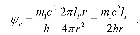 and the coincidence rate in a “irradiated” particle is

PG is some probability of interactions. if some other physical effects act. Since the Plank length is equal , from Equation (5) obtain, that if the probability PG = 1 the coincidence rate in the particle is equal

It is evident, that if a body having mass m2 contains not extreme number of particles (and the “radiating” body as well, of course), then the coincidence rate in the body is equal

Note that the masses m1, mP, and m2, in the equations (5)—(7) above are the inertial masses. It is evident that Gravity action is in this case symmetrical, and so Nc12 = Nc21
The number of elementary momentums that are transmitted to the “radiated” masses is , i.e., the force that acts to the masses, absolute value of which so is equal
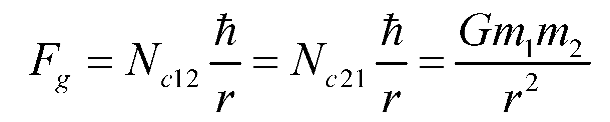
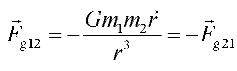 i.e., the force in Newton Gravity law, where the masses are gravitational masses.
The potential gravitational energy of the system of two bodies, defined here in the informational model, Egs, is as
 i.e., the energy is the gravitational mass defect, which in the statics is equally divided between the bodies:
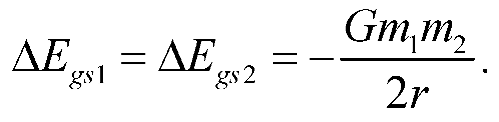
Note that from Eqs. (5) and (8) it follows that at statics the gravitational and the inertial masses of a body are completely equivalent, since both “are created” by the same algorithms tick rates, ω, of particles that compose the body.
Note, however, that in this case some “1/2” problem appears, i.e.,—the condition that to obtain true value of the gravitational mass defect in every body is necessary for the coincidence rate in the body to be twice lesser then for the corresponding gravity force (Eqs. (8) and (10), however in this ‒ the statics ‒ case this problem really doesn’t exist, since in statics the gravitationally coupled bodies are impacted also by other forces, which fix the bodies in their static positions.
From the above we can again ‒ as that was noted earlier relating to the fundamental in physics now speed of light constant, c = lP/tP ‒ conclude that not the gravity constant, G, but Planck length, Planck time, and elementary action, ћ, are indeed fundamental constants in Matter. Note also, that at least for the statics the circular gravitons of a particle transmit at gravity interaction to any another particle all information about the localization of the radiating one in the vector value of elementary momentum ; though with practically 100% QM uncertainty of the distance.
From above follows that the intrinsic processes in both bodies become be slowed on the half binding energy/gravitational mass defect (divided by ћ, of course). If the mass, M, of one of the bodies is much greater than the other mass, m, the relative decrease of the lesser body’s algorithm frequency is
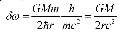
Correspondingly, if the body-2 is a clock, the clock’s showing becomes be slowed down on times, what is two times lesser then that is predicted in the general relativity theory.
If a pair of clocks are placed on different radii from M, r and r + h; h << r in a gravity field (Figure 5)
then their relative tick rates differ as

For Earth surface , where g is the free fall acceleration. In the GR the clocks’ rates difference is two times more [45]: .
Besides, note here that the photons don’t principally differ from T-particles, really every particle in Matter fundamentally obligatorily has both ‒ the gravitational and inertial masses, the gravity force acts on the photons analogously to the T-particles.
Note also, that the difference of intrinsic processes rates in bodies that are in space points with different Gravity potentials is predicted in GRT as “gravitational time dilation”, and, whereas this effect is trivial in this informational model, this GRT prediction was completely new in physics in 1916. It was measured yet in 1960-s in well known Pound-Rebka-Snider experiments, where GRT value of the difference δω1 – δω2 was confirmed [46,47] measuring Mossbauer resonances values at propagating photons that are created at gamma-decay of Fe-57 nuclei. However, in this case two different physical effects are involved—the real difference of intrinsic processes rates of the nuclei on different heights, and possible red/blue shifts of photon frequency. Thus the experimental results can be in accordance with GRT only provided that the GRT postulate that photons don’t change their energy at propagating between points with different potentials [37] is valid, what can be incorrect, photons must interact with gravity field, changing energy as that all other particles do.
This problem now can be experimentally solved only in experiments, where if only one of possible impacts on intrinsic processes is measured. Now such rather easy experiment is possible—for that it is enough to measure elapsed time intervals of preliminary synchronized in one point clocks, after the clocks were placed on different on 400-500m heights on Earth, for example in a skyscraper:
- -
- it is necessary to synchronize two clocks, let on the ground floor;
- -
- to lift slowly or with known speed one clock on a height 400-500 m;
- -
- to wait a few hours;
- -
- to return the upper clock to the other on the ground floor and to compare the clocks’ elapsed time showings.
On the tick rates two effects impact: “kinematical” slowing down because Earth rotation that is proportional reverse Lorentz factor (1 − v2/c2)1/2, v is the speed of the clocks ~400m/s near equator, the difference of the frequencies for different heights, H, is ~ 1.5x10⁻²⁷ 2πRH, near equator and for H=500 m ~3x10-17, and the gravitational impact, in this case the difference because of the gravitational impact is ~5x10-14, i.e., on 3 orders by magnitude larger, and so the kinematical contribution is negligible.
Thus after 1-hour duration the difference of the clocks elapsed time showings will be ~3.6x10⁻¹⁰, if GRT is correct, or two times lesser, if this model is correct, the measurement of such time intervals isn’t a too hard problem now.
If the difference of the showings will be in accordance with GRT—this result will be more convincing confirmation of GRT validity than Pound-Rebka-Snider results, if not in accordance with GRT, and rather possibly in accordance with this initial Gravity
Model, from such result, including, it would experimentally follow that photons really change energy/frequency in Gravity fields, what contradicts with GRT postulate that photons propagate along geodesics having constant energy [37].
6.2.2. Quantum Gravity
In the model above the quantum nature of Gravity follows directly, and it looks as rather natural also that after this initial model will be developed at least on the level of classical electrodynamics, the QM gravity formalism will be developed as well—as that happened with classical electrodynamics, “QM ED”, i.e., as the Dirac equation, and QED. Though note, that because of Gravity Force is extremely weak, and so some essential on QM scale energies, momentums, etc., can be realized in some gravitationally coupled systems of masses only if inertial masses are too large for composing a real QM system, the QM gravity theory really will not be applicable at considering practically any real system in Matter, besides some exotics on Plank scale.
Note also, though, that both these Forces and both—classical and QM, theories eventually rather probably should be developed taking into account the common remarks to standard mechanicses formalisms, see “Conclusion” below.
Nonetheless yet now from the above follows principal possibility of observation of quantum gravitational effects, corresponding experiment was proposed yet in 2007 in [1,6,48], where it is proposed the measurement of monochromatic photons beam gravitational distortion using an interferometer with at least two arms, one of which is parallel, and other is vertical relating to Earth surface; arms lengths ~ 300-500 m.
For the experiment it is so enough to upgrade some of the first installations that were made aim at observation of gravitational waves, and using photons source that is able to work in 1-2 Hertz stability mode at least during few seconds; in this experiment the changes of photons energy in Gravity field will be observed directly as well.
6.2.3. Initial Model of Gravity Force, Stationary Field, Free Fall
Here we consider (in the absolute frame that is at rest in the absolute Matter’s 3D XYZ space, where [in the frame] all parameters of everything in Matter have real values) utmost simple, however important, free fall motion of bodies in a free closed system, where the bodies have rest masses M0 and (“test mass”) m0, M0 >>> m0; e.g., m0 is mass of proton, and, besides, the consideration will be based on, first of all, the proposition that was formulated by Ronald R. Hatch in his “modified Lorentz ether theory (MLET)” of Gravity [44]. This position is that
“…. the source of gravitational energy is the rest mass energy of the particle ‒ not the curvature of spacetime…..Gravitational force converts gravitational potential energy (rest mass energy or structural energy) into kinetic energy when a particle falls and vice versa when a particle rises…”,
This, well rational, and so rather probably really foundational, proposition has rather vague base in MLET, however is in accordance with this initial Gravity model. Indeed, as that is pointed above, a circular graviton is radiated by the G-marked FLE of a particle as the ether FLE that has kinematical angular momentum be equal ћ, and the “precessing momentum in g-dimension” be equal to . Further this “point” transforms into the rim of flipping ether FLEs, where the “precessing momentum in g-dimension” angle decreases so that in the 6D spacetime, which are orthogonal in all 3D space directions to the rim’s circle, i.e., propagate in the 3D space along strait lines relatively to the starting point, and so have zero energy (i.e., the circular gravitons aren’t particles, see section 3.4). However, if such flipping ether FLE hits the irradiated particle’s flipping G-marked FLE, the particle’s FLE obtains the momentum above, at that its “kinematical” precession angle decreases, so the particle’s algorithm becomes be longer and so runs slower, i.e., the inertial mass of the particle in the Gravity field decreases—what is observed as the gravitational mass defect, which is in statics also inertial mass defect. By another word the irradiated particle in a Gravity field—which is the flow of circular gravitons ‒ moves in the field like a human swims in water, spending for that his own energy.
In the considered here closed system the system’s whole energy, W, is equal
 where EM is energy of the having inertial mass M body, further “energy of M”, EP is energy of particle, U is the potential energy of the system. Here we consider the case, when the masses are on infinite distance W = M0c2 + m0c2, since gravitational potential energy U=0, but if the mass m after some negligible impact starts to move to M under gravitational force, then the mass M practically remains at rest, its energy changing is negligible, whereas so the particle’s energy, because of the energy conservation law, remains at the motion to be equal always to m0c2 and Eq. (13) becomes to be as
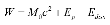 where Ediss is an energy that, in principle. can be dissipated from the system at the motion, for example, when the mass m radiates “ordinary” gravitons at its acceleration, the energy of mass m is , , V is the 3D the particle’s speed; and if, as that is suggested here, Ediss is negligible, at least in first approximation so we have
 and thus the permanent inertial mass mi:

Further assume that at motion permanent inertial and gravitational masses of the particle remain be equivalent—as that is in statics,

Since Gravity Force acts only in 3D space, the particle spends its intrinsic energy only on its acceleration in the space, when at that only its kinetic energy Ek increases, correspondingly
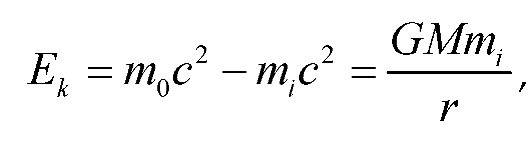 and so

If we introduce “ units” of the radius r, .
So further we have equations for reverse Lorentz factor
 and for the particle’s speed

6.2.4. The Case of Small r
All that above so is valid only in rather weak fields, the Eqs. (1)—(10) are valid for sure only till the Newton Gravity law is valid, whereas if r decreases, and in statics, e.g., if r = RgS (α=2), the relative coincidence rate Nc12 in a “irradiated” particle in Eq. (5) is 0.5 of the particle algorithm’s frequency; at r = RgN, the number of circular gravitons impacts is equal to the particle algorithm’s ticks rate, i.e., the particle’s mass defect is equal to m0 at all, what looks as is rather strange.
At that, though, if the radiated circular gravitons impacts have Poisson distribution, then rather essential part of the impacts happens as multiple, k, events at the one the irradiated particle algorithm’s tick, though the average Nc12 remains as in Eq. (2)
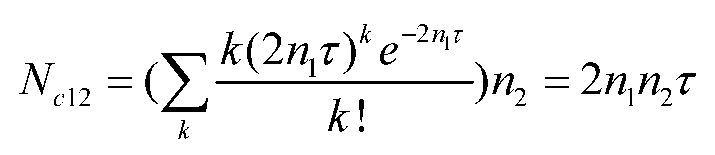
What happens at multiple events, when same G-marked FLE in irradiated particle is
more than 1 time impacted at its FLE’s flip?—isn’t known now—though the consideration above rather probably clarifies this point to some extent.
So, for example, for α~2 and lesser the consideration above looks as rather uncertain, especially in statics, however we can hope that even its application will result in at least a zero approximation picture, including, e.g., about what happens below the event horizon of Sagittarius A*, where, even if the central compact object would be a big neutron star, α is ~10-4.
First of all note, that any falling particle has at motion the constant energy, and in statics, after the particle stops in the object, it for sure adds to any M-object only energy E = m0c2 and nothing more. So after the particle stops in the object on the radius α<1, when Nc12 becomes too essentially large, some particles, nonetheless, can, in principle, exist—having at that their “sizes” ‒ Compton lengths be , i.e., rather macro lengths (that is essentially a joke, of course, though, nobody now knows what happens if α<1). For α well more 1, e.g., more 5—in the neutron stars, this effect isn’t too essential, and particles remain be ordinary ones, including rather probably protons indeed transform into neutrons, etc.
Finally note here, that in MLET some other basic assumption is used—that permanent gravitational mass of falling test mass is lesser in reverse Lorentz factor than its permanent rest mass. This assumption is introduced in MLET by rather questionable way, however we cannot exclude now that it (and something else besides the equivalence, though), nonetheless, can be correct, while Ronald Hatch writes that provided this assumption MLET correctly describes motion of planets in the Sun system. What happens at free fall in this case is considered in [52], here note only that doesn’t change essentially the main inferences that follow from the consideration of test mass motion above in this section.
6.3. Electric Force
6.3.1. Initial Model of Electric Force, Statics
The electric force is rather similar to gravity—both potentials are as 1/r, if some charged bodies interact, then in reality the interactions of separated charged particles happen, etc.; except, of course, that gravity force is much weaker than electric one and that electric force can act as the attraction and as the repulsion, and so can be effectively screened, whereas this effect is much lesser in Gravity. So it is rather reasonable to conjecture that the equations for the potential energy should be similar also, but the probability of electric interaction should be larger because of, as that is assumed in this model, the widths of “circular photon” rim, W1, and of the “receiving part” of the activated E-marked FLEs in “irradiated” E-charged particle’s algorithm, W2 are much more than the size of only one G-marked FLE in the gravity case.
Note also that that the circular photons are analogues of the circular gravitons, i.e., have kinematical angular momentums be equal to ћ and the “precessing momentum in e-dimension” absolute values be equal to .
So for the electric coincidence rate we can obtain some analogous to Equations (3)—(5) (for a couple of particles with the elementary charge, e) equations:
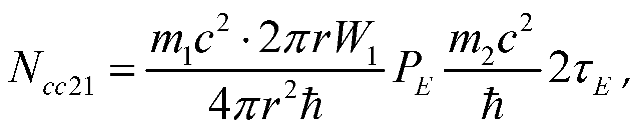 where PE—the probability of the interaction if through particle-2 a radiated by particle-1 circular photon have passed, τE—the “passing” time. Under rather plausible conjectures that:, τE=W2/c, W1 = α1/2λ1, W2 = α1/2λ2, where λ1, λ2 are the Compton lengths of the particles; PE =1; and α is the fine structure constant, we obtain from Equation (2.22) that electric potential energy of the two-charge system is
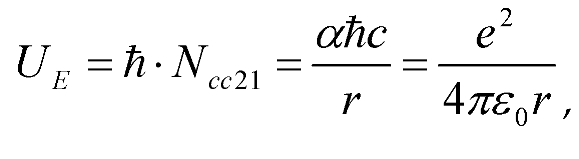 and for the electrical force between elementary charges in the statics obtain
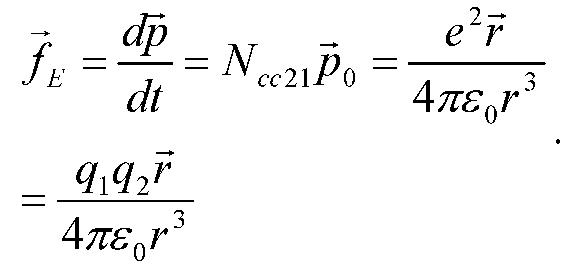
(The lower term in Equation (24) is for arbitrary charges).
Note, that in the Equations (23) and (24) we suggest, as that was for circular graviton above, i.e., that the elementary momentum, which is transferred at the elementary interaction is .
Note that, as what was obtained above for gravity,
- -
- if the particles have opposite charges and so the resulting system has negative mass defect, then there exist the “electrical mass defect”, and so real the slowing of internal processes in tied electrical structures, e.g.,—in the atoms. For example, in the (μ− + proton) “Hydrogen atom” muon should live longer than in free state and this dilation should be essential (detectable?) if a muon is on K-shell of, e.g., Uranium. Though, of course, since the muon in this case more time is inside the Uranium nucleus and so here some other forces, besides the EM, can act on the muon, it seems as very unlike, that a corresponding experiment would be informative; and
- -
- all what is true in Gravity model, first of all that circular photons aren’t particles, and so don’t carry some energy, is true in the Electric Force case. However, unlike Gravity, in this case we cannot for sure suggest that at the slowing down of the internal processes in electrically coupled charged particles the electric charge decreases, in classical electrodynamics it is postulated that the electric charge is constant; this point should be clarified at further development of this model.
Note, also, that from this E-model follow a couple of important consequences. From the equations (23), (24) it follows the explanation of physical puzzle—Why αћc = e2/4πε0?—whereas in this equation fundamentally different in physics universal for everything in Matter constants—the fundamental elementary action ћ and the speed of light, c, and the specific for only one fundamental EM Force, the elementary electric charge, e, are united by some unknown in the official physics way so, that their ratio is a dimensionless fundamental fine-structure constant, α.
Besides from this model it follows that so called magnetic monopole doesn’t exist. From experiment and classical electrodynamics, it is well known that the magnetic force appears only if an electric charge moves in some “stationary” frame, and disappears, if the charge is at rest in the frame (for example, see [37])
From the above seems it rationally follows that the magnetic force is not really a fundamental Nature force, which exists, in Newton’s words “of itself, and from its own nature”, and so has its own charge “magnetic monopole”.
However electric and magnetic forces are rather symmetrical in the classical electrodynamics, including there can exist inertial frames when only magnetic field exists, while, according to SRT, all relatively moving inertial reference frames are absolutely equivalent, so the argument above turns out to be inessential if SRT is completely correct.
Correspondingly, though in electrodynamics magnetic monopole doesn’t exist, after the Dirac’s publication [38], presenting a number of QM arguments in support of the existence of a magnetic monopole, the “magnetic monopole” problem from 1931 year and until now remains a popular, and even a fundamental, physical problem [39].
Nonetheless, since the Matter’s spacetime is absolute, and so all/every inertial reference frames really aren’t completely equivalent and legitimate, the argument above is valid, since the absolute, i.e., that are at absolute rest in the absolute 3D space, reference frames are the frames that differ from all other “stationary” frames first of all by that only in the absolute frames physical objects, events, and processes, have real values of their physical parameters, since the field of a charged a body that is at absolute rest in the space is purely electric field—from that follows that magnetic monopoles really do not exist.
It also seems quite rational to suggest that the magnetic force is a specific actualization of the electric force, when the ether FLEs in circular photons that are radiated by a moving charge obtain additional momentum proportional to the spatial speed of the charge, including because that FLEs in radiating particles are additionally precessing in the 4D kinematical space at motion along, e.g., X-axis, and rotated in in this case in the (X, cτ) plane, (more see sections 2.3., 2.4. in [5a])
So the flipping ether FLEs in circular photons, though don’t transform into a particle at inertial motion, nonetheless become precessing in the “kinematical” 4D space as well. And when they hit an E-marked FLE in another charged particle, they transmit to this particle an additional momentum, which, if the “irradiated” particle is at spatial rest, is orthogonal to momentum that would be transmitted if both charges are at rest, i.e., along direction of the radius-vector between the charges ‒ what is observed as “magnetic force”. If both (all in other cases) charges move with the same velocity, their FLEs are precessing identically, and so in such systems only electric Coulomb interactions are observed.
The radiating of circular photons by charged FLEs evidently isn’t completely symmetrical because of the 4D circular motion of the particle’s algorithm FLE flipping point; that, in principle, can result in that so charged particles have non-zero magnetic momentums.
The next suggestion seems rather rational as well: if a charge is accelerated, then, at least sometimes, some circular photons under impact of changing accelerating momentum transform into close-loop algorithms—particles “ordinary photons”, which have inertial and gravitational masses, where the “electric” and “magnetic” components of transmitted at the interaction precessing FLEs momentums cyclically change each other. Rather probably the same happens at the acceleration in Gravity Force, and an accelerated electrically charged particle in parallel radiates also ordinary gravitons, which are unobservable till now because of the extreme weakness of Gravity.
Another “circular photon” transformation rather probably happens when an “ordinary photon” interacts with some circular photon, mostly of a nucleus, and a T-particles, e.g., e± pair, are created, with “double opposite rotations” of the photon’s momentum from a spatial direction into two momentums of the pair components with opposite directions along the cτ-axis.
6.3.2. Strengths of Gravity and Electric Forces
From the last sections above it follows, that Gravity is extremely weaker than Electric Force
To illustrate that let consider a system of two electrons. Electron has the reduced Compton wavelength λ =3.861x10⁻¹³m, the number of G-marked FLEs is universal for all fundamental particles, i.e., equal to1; the number N of E-marked FLEs is relative, N = α1/2N0 , N0 is whole “logical” algorithm’s length N0 = λ/lp.
So in this case N0=2.4x10²² FLE, gravity charge 1 FLE, electric charge ~ 8% of N0, i.e., near 2x10²¹FLE; the whole electron’s algorithm ticks with frequency ω = 7.763x10²⁰ s-1; and so intensity of the radiated rings for electron are: 7.763x10²⁰s-1 of circular gravitons, and ~1,55x1042 s-1 of circular photons.
The probability of radiated circular photon to hit into flipping electrically marked FLE of other (“irradiated”) electron correspondingly is larger than for circular graviton also in ~2x10²¹ times, so the whole intensity of hits at electric interactions is larger than at gravitational interaction in ~ 4x1042 times, and so for a pair of electrons the Gravity force is weaker than Electric force in this value—as this ratio really is.
From this example it follows also that the postulate in the whole physical model that main FLE parameters are Planck length and Planck time is correct, in other case the ratio value would not be in accordance with experiment.
6.3.3. A Few Notes Else to the Initial Electric Force Model
6.3.3.1. The Problem of Multiple Events at Interactions of Circular Photons in Irradiated Particle
As that it is shown above in the Gravity Force multiple events at interactions of circular gravitons with the flipping G-marked FLE of an irradiated particle with a well large probability results in that the Newton law isn’t applicable in extremely strong Gravity fields, and at radius be equal to the average rate of the events 2n1τ in Eq. (21) is ~1, the binding energy and gravitational mass defect of a body that has a small mass, m, become be equal to the energy mc2, i.e., the body “disappears”; what looks as rather strange. Really the energy above remains, and so energy of the system (M+m), if the system is closed, remains to be (M+m)c2, but gravitational mass is lesser.
Though that on first glance looks as that at radiuses ~ RN and lesser the G-constant changes, that is incorrect, G-constant is a fundamental constant, which cannot be changed, and really that is a consequence of the events multiplicity above.
What happens with a particle in such strong fields?—that is very interesting physical problem, which now hasn’t a substantive explanation in Gravity case in presented here models, and now only few points about what happen in Electric Force action.
First of all—in this case, in contrast to Gravity, the Eq. (21) problem doesn’t arise practically in any possible situation in Matter.
In gravity (repeat for convenience equations above here) the circular gravitons flow density that is radiated and passes through some FLE of ”irradiated” particle by a large mass, M, is , at r=RN ; the flow density of circular photons that are radiated by every elementary charge is .So if we consider example of a mass M with RN =1m, M is ~ 1.3x1027 kg (~ 500 Earth masses), this mass radiates the circular graviton flow, n1~1043 circular gravitons in a second, that impact to an electron’s FLE so that the average rate of hits in the one G-marked FLE, 2n1gτ is ~ 1s-1, the binding energy/gravitational mass defect is equal to mec2, while - the same rate () on 1m radius is caused by radiating electric charge
(~3.5x10¹⁴ elementary charges) flow when, since
in this case the average rate of hits in the E-marked FLEs’ set in electron’s
algorithm is in Eq.(21) version, 2n1eΔt, where , i.e., 2n1eτ is lesser than 2n1gτ in ~ 2x10²¹ times, so at Electric Force interactions the multiplicity problem above, which is critical in the Gravity Force case, appears only in much more exotic cases—on Planck energy scale. What seems never happens in Matter at all, and classical electrodynamics is applicable without “multiplicity” limitations always.
Though the “100%”—and more—electrical mass defect problem remains, the particle’s algorithm in electric field is slowed down, so the problem—what really happens in this case with the particle?—really exists, and in this case some additional experimental data are necessary. Really now seems there exist only the case of K-shell electrons of heavy atoms, .in Uranium the binding energy is ~116 keV, what is ~23% (more than Gravity impact ~ 10% in neutron stars) of electron’s own energy, and so some measurements of some specific tiny physical effects in K-shells electrons behavior in a series of heavy atoms rather possibly would be useful at studying of this problem.
6.3.3.2. Electric Force of Charges at Motion
When an electrically charged particle is at absolute 3D rest, it radiates circular photons as that gravitational mass does (Figure 6)
When a T-particle after some spatial impact moves so in both ‒ some 3D space direction and, fundamentally obligatorily, along the cτ-axis, its algorithm’s FLEs obtain additional precessing, and, since all/every particles move in the 4D space always be 4D oriented so that their “intrinsic” the flip-point’s angular momentum is directed along the 4D particle’s motion direction, it rotates (say, if particle moves with a speed V along X-axis) in (X, cτ) plane (more see [4]); if particles compose a rigid body, they rotate whole body in the plane above on the angle when the body’s 3D spatial projection is contracted in reverse Lorentz factor comparing with the “3D rest length”, and, besides, the front body’s end becomes be “younger” in the cτ-dimension (which in physics and everyday practice is “time dimension”) than the back end in the Voigt-Lorentz decrement , V and L are the particle’s 3D speed and length. This is the physical sense of Lorentz transformation; including the letters “x”, “y”, “z”, and “cτ” (in standard form “ct”) in the transformations really relate only to Matter’s spacetime points that are occupied by the rigid body at given time moment, and fundamentally don’t relate to all/every points in the whole spacetime, as that illusory postulated in SRT, see Figure 7.
Correspondingly at spatial motion the moving electrically charged body radiates circular photons more orthogonally to the motion direction by two physical effects: because of the rims planes orientation above, and because of that in this case more mediators are radiated orthogonally in the solid angle near larger axis of the rims ellipses than near the short axis.
So, as that is known in electrodynamics, the strength of electric field, E, of moving charge in orthogonal direction is larger than, say, in parallel direction, and is as (see, say, [13], below for simplicity we consider the motion of one particle, e.g., electron, and so q = e, if electron is at absolute rest e = e0):
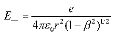
In the electrodynamics electric charge is relativistic invariant, and so in Eq.(25) , and the strength so is larger than Coulomb strength in Lorenz factor.
Nonetheless if two charges move with identical 3D velocities, say, when the line between charges is orthogonal to the velocity direction, then the force one charge affects the other one by which is
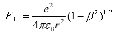 i.e., is lesser than Coulomb force, if at the motion both charges are as e = e0 . What looks as questionable on first glance if Eq. (25) is correct, however such look is an illusion; at motion electric charge remains be the same as at statics, while the effect above is caused by action of magnetic force that acts in this case against Coulomb force action.
Since Gravity Force is similar to Electric Force, in looks as reasonable to assume that at motion of gravitational masses corresponding gravimagnetic force acts; and it acts against to action of the “Newtonian” gravitational force, like that happens Electric Force case. That seems follows from that in accordance with the relativity principle, if a system of two charged bodies, which have one sign electric charges, and masses such that the electric repulsion is completely compensated by gravitational attraction, this system must be in the balance in statics and any inertial motion, rather probably independently on—on which distances the bodies are, and in which angle the line between the bodies relatively to the motion direction is. Nonetheless not here, that Gravity and Electric Forces are different Forces, and this point, including in the example above, should be clarified at further these Forces theories development.
6.4. Section 6.2. and 6.3. Summary
From that in the developed initial fundamental Nature Gravity and Electric forces models above the main, and experimentally practically for sure confirmed, equations of gravitational and electrical forces are obtained, at least at statics, without using Newton and Coulomb laws, it follows that these models are scientifically reliable, and really adequately describe what really happens in Matter when these Forces act;
- including, from these models, which are based on the assumption that the FLEs in the Matter’s ether ‒ [7] 4D dense FLE-lattice have the size be equal to the Planck length, and “flip time” be equal to Planck time it follows, that this main assumption is with a rather large probability true.in the whole physical model.
Really the main fundamental problems in classical and quantum electrodynamicses, where in the first one some “flows of energy” and “energy density” in EM fields are postulated, despite of the evident problem: why, from what mystic infinite reservoir, and how, this energy constantly always is flowing, whereas, say stable charged particles exist well stably billions of years?,
- as well as in QED, where for/by the equally as the above mystic reasons and ways the charges constantly billions of years radiate flows of “virtual photons”, which also transmit to other charges some energy, etc.,
- becomes to be clarified—there is no these fields’ energy flows, correspondingly there is no any energy densities, no some “electromagnetic masses”, no having energy “virtual photons” flows etc.
At least two of the fundamental Nature forces’, i.e., Gravity and Electric Forces’, fields have no specific gravitational and electric charges and so don’t interact specifically ‒ really only the charges, i.e., gravitational masses and electric charges in concrete systems interact. Note, however, that the above is practically for sure correct only in statics, if the Gravity and Electric Forces’ charges move, then now we cannot exclude that the fields can contain, besides the additional momentums, also some energy, etc., this point should be clarified in the final theories of the Forces.
The developed here model of Gravity Force at free fall motion of comparatively small masses in gravity fields of material objects that have extremely large masses, first of all cosmological objects, allows to obtain a zero approximation description of what happens at small distances to the objects, including what happens below event horizons of SMBH;
Both Forces are essentially similar, and so, since really in Matter the gravitational fields, besides only very exotic cases, are weak, in most cases application of Gravity theory at solving of concrete tasks, say, motion of stars and structures in a galaxy, can be based on Newton Gravity law, though be similar to classical electrodynamics. For example, using additionally retarded potentials and (rather probably repulsive, though this point should be clarified) gravimagnetic force, would be useful at analysis of large structures, e.g., solution of the “non-Newtonian motions of stars in galaxies” problem.
Note here also, that even at application of Newton Gravity law at description of bodies motion in, including stationary, Gravity fields, the standard application of Hamiltonians and Lagrangians should be changed at least in that the equations must use really changing at the motion permanent gravitational and inertial masses, while now the used in the equations mass m is constant. Though in this case that isn’t unique point that is rather vague in the standard mechanics, when interacting bodies are coupled in some systems having potential energy U.
An example ‒ “Kepler task” in [37a], where the motion of a test mass, m, in a stationary Gravity field has potential energy in the Lagrangian . So the “effective” potential energy is , M is the mass’s m angular momentum, and so a test body’s energy remains be limited, while the body moves in a “potential wall” on an orbit around large mass, being inside some borders in 3D space; or, if the test mass energy is large enough, the motion in space is infinite.
However, if the test mass moves having the angular momentum be equal to zero, the mass, in principle, can in this case have arbitrary energy, what is impossible—see the considered above free fall motion, where the test mass has zero M. So it looks as be rational that the standard now Lagrangian (and Hamiltonian) techniques at descriptions of motion bodies in at least Gravity and Electric Forces fields should be modified, what can require essential clarification of what is physical parameter “potential energy” at all.
The application of corrected so Newton Gravity mechanics inside Sun planet system can be well effective, however its application on larger cosmological scales, say, at description of galaxies’, including Milky Way, structures motion, it is necessary also to know the absolute 3D velocities of galaxies; for at least Milky Way case and space region ~ at least few hundreds of millions of light years, this velocity can be measured at proposed in 2013-2016 experiments [18];
Real physical theories must be based on that the real Matter’s spacetime is fundamentally absolute, fundamentally flat, and at least [7]4D Cartesian spacetime with the metrics (cτ, X, Y, Z, g, e, ct), where the ultimate base of Matter—the at least [7]6D dense lattice of the binary reversible at least [7]6D FLEs is placed; and everything in Matter is/are some disturbances in the lattice. Correspondingly the main task and aim at development of any fundamental physical theory must be formulating of the theory on the Planck scale, for what corresponding experiments, from where the additional to indicated in these models properties of FLE by some ways can be derived, should have the main priority, and any fundamental physical theory must be based on the principle that really all fundamental Nature forces are mediated only by real mediators (decays of unstable particles are because of their algorithms have some real errors); and practically for sure the really non-mystic Gravity and Electric Forces theories should be based on the presented here models.
6.5. Nuclear Force
6.5.1. Initial Model of Nuclear Force
As that is assumed in this model, all Forces at interactions of different particles act in accordance with the same scheme: exchange by mediators, mediators act only in 3D space as propagating 2D rims of flipping a Force-marked the FLE-lattice FLEs, and so the Forces’ potentials are ~1/r potentials; and the relative strengths of a Forces really depends practically first of all on what fraction, ΔNF, in of the whole logical length of a particle’s algorithm, , a concrete Force-marked FLEs occupy. This scheme is well adequately to the reality applied in sections 6.2. and 6.3. in Gravity and Electric Forces models, correspondingly the conjecture that should be true also in the case of Nuclear force, which acts between different nucleons in atomic nuclei is quite natural.
The potential for this Force was proposed by Yukawa yet in 1935 [49], when he suggested that Nuclear force is the action of some scalar field U that has the potential ~1/r—as that is in the Gravity and Electric forces cases, however, unlike the Electric force, it acts as exchange by some U quanta of energy, that are equivalent ≈200 electron’s rest mass. Besides, using also the Heisenberg finding that the solution of Klein-Gordon equation for a field with additional term is that the field’s potential exponentially decreases, he obtained the equation for nuclear potential
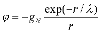
Where λ ≈ 2πλp, λp is ≈ proton’s Compton length, gN is the Nuclear force charge, nucleons in nuclei interact exchanging by these quanta. In 1930s in physics there was known no any rational mechanism how that can happen, including, e.g., the physics had (and has till now) no any understanding—how nucleons extremely intensively radiate energy quanta ≈ 15% of nucleon mass without any changes in their masses, why these quanta’ impacts decrease exponentially, etc., however after at high enough energy accelerators experiments π-mesons were detected, these real particles were, and are till now, adopted in physics as real versions of “virtual” Nuclear force mediators.
However that, first of all the radiating energy problem, isn’t unique problem, and in only this case. That ‒ see above ‒ eventually happens at consideration of a lot of other, practically equally transcendent, postulates in all/every, classical and quantum, physical theories, so in physics attempts to solve concrete problems what really are fundamental Forces and mediators, which [attempts], of course are based on whole physics, really till now logically inevitably correspondingly failed.
An example of recent analog of Yukawa derivation of the Nuclear force potential equation is given, e.g., in [50]:
- -
- squared energy equation of a free particle that has a rest mass, m, and moves in 3D space with 3D momentum p is

- -
- the corresponding Klein-Gordon equation for the potential of the meson field, φ, is

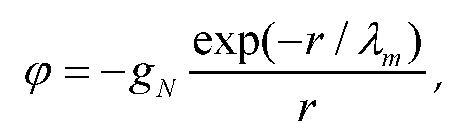
It is evident that all in the QM approach above really can be correct only if in Eq. (28) –(30) the mass m of “virtual” mesons really exists, i.e., in this case again really rather strange process of intensively and constantly escaping from parental nucleons mesons is supposed, when the mesons constantly form virtual “mesonic fur coats” around nucleons. The fur coats aren’t observable by any real physical instruments. Besides, as that is postulated in recent nuclear physics, the mesons above are π-mesons, which are unstable particles and decay with creation e±, μ±, gammas, neutrinos, so around nucleons corresponding fur coats of the decay products above also should exist, which also aren’t observable, either since the products are also virtual, or virtual π-mesons don’t decay as that real π-mesons do. Etc., all that looks as rather strange, however, again, that is typical situation if some virtual, but really existing and interacting by the Forces particles, are introduced in standard physics as the Forces real mediators at description and analysis of what exists and happens in Matter.
Really that the following from the equations above gN value is consistent with experiments, including from the experiments at N-N interactions it is obtained that the Nuclear force strength in ≈100 times is larger than Electric force strength on equal distances, it is obtained only by fitting the main parameter in Eq.(29), the mass m; while, say, Heisenberg’s attempt to derive equation for Nuclear force potential assuming that the mediators are virtual electrons failed only because electrons have inappropriate mass, etc. but really this unique “mass criterion’ by no means determinates any other specific properties/parameters of something for it to be just mediator of just Nuclear force.
So really Yukawa theory isn’t a theory of Nuclear force, though really that is concrete formulation of real interesting physical problem “why and how the lightest particles that are created at NN interactions at action of Strong force [which with a well rationally non-zero probability is mediated by the same as Nuclear force mediators], i.e., π-mesons, have masses that fit Klein-Gordon equation for this Force potential with experiment?
The initial Forces scheme in section 6.1 above is without problems applicable in the Gravity and Electric forces cases, where different distant enough gravitational and electric charges interact. Since in nuclei different nucleons interact on rather large distances as well, the scheme is applicable to Nuclear Force interactions as well, using practically only two rational specific conjectures:
– (i)—Nuclear force differs, in that is essentially stronger comparing with other Forces, only because of that the number of Nuclear-marked FLEs section ΔNN in the nucleons’ algorithms logical lengths is larger than that is in other Forces cases; and
- (ii) the Force mediators—“circular mesons”, unlike circular gravitons and circular photons, are unstable, and decay with decay constant , while the rest in the model is the same—circular mesons rims propagate in the 3D space only, only with the speed of light, and every flipping the lattice N-marked FLE causes in “irradiated” particle releasing of the elementary momentumIn proton’s logical length Gravity- and Electric-marked FLEs occupy (one Gravity-marked FLE in the algorithm is quite negligible) part of whole length N0. If we assume that the remained part in proton’s algorithm is marked by Nuclear force, so , i.e., is as that is the experimental ratio of nuclear and electric charges gN/e ≈ 10 above.
However here is a nuance, real electric charge in proton, which, as that seems rather rationally is postulated in the Standard Model, is a composition of charged u-quarks that has electric charge +2/3e, and d-quark that has electric charge -1/3e, ( and are antiquarks), p = udd . So its “whole” charge is 5/3e, and so real ratio, of the electric and nuclear charges sections of N0 is .
Nonetheless, since the quarks positive and negative electric charges compensate action of each other, and so only 1e interaction is really experimentally observed, thus the ratio of the real strengths of these Forces is , i.e., in accordance with the experiment. Neutron is the quarks composition n = udd , and, though so has zero “active” charge, nonetheless while proton’s experimentally measured electric charge .radius is ≈0,871fm [51], the neutron’s measured one is ≈0.751fm [52], i.e., differs only in ≈16%, Thus the Nuclear force part in neutron N0can, in principle, be not equal to the proton’s part, but , i.e., neutron’s Nuclear force charge can be, in principle, slightly larger than the proton’s charge. However, in the neutron’s algorithm there exist also at least some non-zero FLE-section that acts as the Weak force algorithm’s defect, which causes the decay of neutron, so the proton and neutron N-charges can be identical. That should be studied additionally, but in this initial Nuclear force model it looks as inessential.
Correspondingly Eq. (22) for Nuclear force is as
 where WN and τN are circular meson rims’ width, , and the coincidence resolution time interval is equal (note, though, that all “elementary” rims in WN (and WE) have only Planck length widths); m is the (equal in this model) mass of nucleon, and the equation for the forces that act between two nucleons on short distances is
 on arbitrary distances this force is
 where r0 ≈ c/λdecaycm;
and
 is the Nuclear force charge of nucleon (“meson charge” in [50])—Nuclear force interaction constant.
The circular mesons since are a Force mediators, aren’t particles and don’t carry energy, but, since all Forces in systems of interacting distant charges act by the same way, at impact of some external particle on a circular meson that is radiated by some nucleon it seems some “ordinary” particle can be created—as that happens, say, when a circular photon that is radiated by some nucleus is impacted by a photon with energy more 1.022 MeV; and the system “circular photon+ ordinary photon” transforms into the system “e± pair”. The pair, since both, ordinary and circular photons have only 3D space momentums, despite that electron and positron have rest masses, since they move in the opposite directions in cτ—dimension, has whole momentum’s zero cτ—component.
So it looks as rather natural to suggest that analogously an impact on a circular meson transforms it into observed at N-N interactions π± mesons, , , pairs, the pairs whole momentums’ have zero cτ—component, and π0 mesons, , where the quarks and the antiquarks also have identical opposite momentums in cτ—dimension, so π0 mesons have zero cτ—components as well. Moreover, π0mesons as a whole don’t move in cτ—dimension at all. Correspondingly all these “ordinary” mesons decay so that the sums of their decays products, i.e., e±, μ±, gammas, neutrinos and antineutrinos, momentums have in every concrete decay zero whole momentum cτ—component as well.
Note, also, that nuclei are principally QM systems, and so in nuclei the other universal Forces act—“spin”, “spin-orbital”, “exchange”, etc., Forces. So, e.g., in the system 2H = n + p the binding energy of the proton and neutron is rather small—2.22 MeV, i.e., the p and n are on distance ≈ 20.06 the nucleons’ Compton lengths, and on ≈ 3 π-mesons’ Compton lengths—or ~3 the circular mesons’ average decay lengths.
When number of nucleons in nuclei increases, the binding energy sharply increases as well, and yet in 4He it is equal E=7.18 MeV, and further with increasing of nuclei mass is near this value—in nuclei the “binding energy saturation” effect is observed, what looks as can have rather interesting application at considering of extremely large Gravity and Electric charges interactions problems in sections 6.2, 6.3.
6.5.2. Discussion and Conclusion
This initial Nuclear force model is in accordance with existent experimental data, and so with a large enough probability is completely scientific model. From the consideration above it follows that at least 3 fundamental Nature Gravity, Electric, and Nuclear, forces at interactions in systems of distant enough particles (macro bodies and charges in Gravity, and particles, atoms, molecules, and “more macro” material structures, in Electric, forces cases), i.e., when the distances are larger than the particles’ Compton lengths, act by the same one universal scheme:
- -
- the Forces charges are Forces-specific sequences of Forces-marked FLEs in the particles’ algorithms, the strengths of the interactions are determined, besides, by the frequency the algorithms tick with which,
- -
- these FLE-sequences cause the propagating in the Matter’s ultimate base ‒ “everyferous aether”—the (at least) [4+3+1]D dense FLE lattice that is placed in the corresponding Matter’s fundamentally absolute, fundamentally continuous, fundamentally flat, and at least [4+3+1]4D Cartesian, spacetime with the metrics (cτ, X, Y, Z, g, e, sn, ct), “g” and “e” are Gravity and Electric Forces dimensions, “sn” is the nuclear force dimension, of rims of flipping Forces-marked the lattice’s FLEs, which propagate in the lattice, so in the space, with the speed of light; and at interactions with particles’ flipping marked by the same Force marked FLE, cause a change of the “kinematical” precession angle, so that the article “works out” for itself the fundamentally universal for all, Forces elementary 4D “kinematical” momentum so, that, if the “irradiated” particle is at rest in the 3D X,Y,Z space, this momentum is ± directed to the “radiating Force rims” particle. If the “irradiated” particle is free, it starts to move/accelerates in ± direction to the radiating particle. Correspondingly the Forces particles charges are rather similar:
- -
- Gravity charge, is Planck mass, m is the particle mass,
- -
- Electric charge,
- -
- Nuclear charge .
At that the Forces mediators don’t carry some energy, and so the radiating particles don’t lose their energy, if are free; but if are irradiated and move, the moving particles kinetic energy is provided by spending this particle’s intrinsic energy E. If a particle is free and at rest E0 = m0c2, if it interacts with other particles composing a coupled by a Force system, including the system of nucleons “a nucleus”, the interacting particles’ intrinsic energies are lesser than E0 on the binding energy/particle’s mass defect—just by this way the energy conservation law in this case works.
The flows of the mediators are observed in physics as the Forces’ fields, in mainstream physics some really strange properties for which are postulated. First of all that in classical theories the fields contain energy; that is also in quantum fields theories, where the radiated mediators, though are “virtual”, nonetheless carry/transmit to irradiated particle quite real energies/momentums. Besides in QFTs, it is postulated that all fields of all possible Forces in Matter always really constantly exists in some “virtual” states, composing rather so strange “physical vacuum”, where always and all particles constantly in virtual states are creating/annihilating as “excitations of the virtual fields”, while real particles are excitations of real fields as well. Really indeed ‒ everything in Matter, including particles and fields, really always constantly exists ‒ but only potentially, as that all particles and fields “are written” completely in every FLE. Correspondingly any specific impact on any/every FLE in the lattice can result in creation of any real particle or mediator, however only after this in 3D space real fields, which are radiated by the created real particles, appear.
All Forces’ mediators are fundamentally real, and by no means “virtual”, disturbances in the FLE lattice, and, at that, the real Forces’ mediators can be impacted by some ways, so some rather specific for every Force real particles are created. In this case that are gravitons, photons and -mesons, which in Standard Model are postulated as real Forces mediators, but these real particles have no relations to the Forces mediations in concrete coupled systems. Photons have no electric charges and so don’t radiate Electric field, despite that all photon algorithm seems is composed by Electric force marked FLEs—so the charges aren’t reduced only to sequences of Force marked FLEs, as that is in these initial models till now; and this, rather probably important for all Forces, point should be clarified at development, basing on these initial models, of the completed Forces theories.
The proposed initial models of the 3 Forces above are developed provided that the mediators are isotropically radiated and spins of particles are isotropically directed as well, what happens always if a special spin ordering isn’t applied. Nonetheless it looks in this case rather naturally to assume that radiation of circular mediators and spin orientation are somehow linked, the case when circular rims planes are orthogonal to spin direction look as rather probable. This point should be clarified since that can be a critical point at studying of particles internal structures. The assumption above seems can be experimentally tested at least in Electric force case: if the assumption is true, then a having parallel spins electrons cloud should expand orthogonally to spins faster than in parallel to spins direction. If that will be true in this case, then, since Forces act by the same scheme, with a well non-zero probability that will be true also for Gravity and Nuclear forces; and rather probably, for Strong force that acts inside hadrons, while it looks as rather reasonable to assume that the Nuclear force “circular mesons” above really are gluons.
Another critical point that should be clarified at development of the completed Forces theories is—the Forces mediators don’t contain energy at statics, but what does happen when a radiating particle moves in 3D space? In principle, e.g., in this case circular mediators’ FLEs can obtain at their radiation additional “kinematical” precessions and momentums, and so some energy and inertial mass, from the parent particle; though that looks as violates the energy conservation law, and it seems as more probable that this motion impact results only in change of the released in irradiated particle elementary momentums directions, as that is observable at Electric force action at least as the magnetic force [and so it looks as would be rather natural if gravimagnetic and “gluonomagnetic” forces would exist as well]. Note also, that from independence of electric charge value on the charge speed seems it follows that the point in [5[, where it is conjectured that at motion in 3D space particles algorithms become to be longer in Lorentz factor since are diluted by blank space FLEs isn’t correct. Really it looks as more probable that at a particle motion its marked by a Force FLEs precession in Force dimension slows in Lorentz factor [here can some other effects act, of course], and ΔNF sections so correspondingly increase. so charges values remain be constant despite that the algorithm ticks’ frequency decreases, and unstable particle lives longer. At that unstable particles decay probability on some whole algorithm’s tick doesn’t change, and moving particles live longer at any Force decay, what looks as would be more natural provided the “blank FLE dilution”
However besides the frequency “kinematical” decreasing above the algorithm ticks’ frequency in coupled by a Force particles is decreased also because of negative binding energy effect. Though if particles in the rest in the system are free, and so the binding energy really is transformed into positive kinetic energy and corresponding motion in 3D space, the problem of constancy of charges values now exists. Elaboration of these points seems would be especially important in cases when in coupled systems the Forces interactions are essentially strong.
Finally note here, that particles [including that compose complex particles, say, quarks in hadrons] fundamentally interact as QM objects, and so interactions are essentially determined also by spin-spin, spin-orbital, etc., interactions, while really “angular momentums” of particles are at least 4D objects. Though 4D cross-product doesn’t exist in 4D mathematical space as a 4D vector, and so, say, there cannot be a “4D gyroscope” that has definite rotation axis, that is completely, true only in mathematical “static” case, while in the particle case, which exists as “FLE flipping point” that constantly moves along 4D helix trajectory, really the “dynamic angular momentum” M of this point has value and exists as at least something that is like 4D vector, which is directed along the particle’s 4D momentum vector. However when can have arbitrary 3D space component/projection, 3D projection of M, as that follows from experiments is equal to 1/2. At large Lorentz factor 3D projection of M is observed as the particle’s “helicity” be equal to . So at development of complete quantum theories of the Forces the problem “what is 4D momentum” should be substantively enough clarified principally basing on at least [5]4D spacetime with metrics (cτ, X, Y, Z, ct), not in 4D Minkowski space that is the base in physics now. Though that, of course isn’t a unique problem in this case, more see above and the section 7 here.
7. Conclusion [see also Section 5.5., 6.4. and 6.5.2.]
This paper is a conclusive review for of existent now series of papers, where the “The information as Absolute” concept, the informational physical model, and concrete physical problems in framework of the concept and the model, are considered. Hence, a typical conclusion would be too long for this paper.
So here only a few final remarks that relate to possible development of the model and its application in physics.
Firstly, more rational versions of traditional physical theories should be developed. The current theories are mostly based on the SRT formalism, first of all, on the postulate that real Matter’s spacetime is the 4D Minkowski space, and the phenomena “Space” and “Time” are actualized in the theories really erroneously, including, fundamentally impossible interactions of space/time/spacetime with matter are postulated, in SRT so antiparticles don’t exist, etc.
Instead physics should be re-formulated in accordance with the fact that real Matter’s spacetime is the absolute, and that at least utmost universal “kinematical” one is [5]4D Euclidian spacetime with the metrics (cτ, X, Y, Z, ct) [and, at fundamental Forces actions, rather probably with metrics (cτ, X, Y, Z, g, e, sn, ct)], where, including, time doesn’t flow somewhere. However, in everyday physical practice rather probably the of a body passed way formula will be as it is now, , where the time “t” “ of itself, and from its own nature flows equably”; though really that means that everything in Matter’s matter, including clocks, flows equably in the ct-dimension, being at that, rather probably, in one Planck time interval from the time moment after inflation step, when in the primary FLE lattice corresponding portion of energy was pumped.
Correspondingly in this case it is necessary also to develop the theory of the [5]4D (and at least [4+3+1]4D specific) angular momentum, Hamilton and Lagrange functions; etc., including clarification of the physical parameter “potential energy”; note also that in this case the least physical action principle/approach looks as is based more physically, and, after the mechanics’ re-formulation, it will be necessary to re-formulate corresponding QM operators, including in this case a next fundamental physical problem “why time in QM does not have a corresponding operator” must be solved as well.
This problem, though, appears also because of other fundamental problem—that the time-dependent Schrödinger and Dirac equations are fundamentally—and so really essentially—incorrect, since are as , whereas, at that, in QM the partial derivatives other than time “dimensional” observables/variables , j=1,2,3, are operators of 3D momentum. It looks as quite natural, that the derivative by the observable “time” is also the momentum operator, and so the equation for wave function really should, rather probably, be as ; where the whole momentum operator is composed from the partial operators , j=1,2,3,4; though taking into account that these operators aren’t independent, since , and at interactions in 3D space the momentum in cτ-dimension is constant , what, in fact, is used in the Dirac equation.
In this case the observable “time”, more correctly—both, true and coordinate times, observables, become to be “ordinary” observables, and so have the operators—themselves, as that 3 space observables are now in QM, however incorporating the true time variable in QM is a next problem that should be solved in physics.
That isn’t only QM problem—this problem has the root in the Hamiltonian and Lagrange formalisms in classical mechanics, where, besides the “U-problem” above (section 6), the variable time also essentially differs from the spatial variables; first of all, besides the true time incorporation problem in this case, also because of that the Newton-SRT definition of flowing time is used. Corresponding re-formulation of classical and “relativistic” mechanicses would be essential for the QM re-formulation.
Returning to the other QM problems note also that at considering of QM events and processes in absolute frames, when some QM objects are free, the problem of causality, which occurs now in some cases if something has speed [e.g., entanglement events] larger than speed of light, doesn’t appear, since in this frame all clocks show real positions of objects in the true and coordinate times, which (positions) have in this case the same values, correspondingly in absolute frame a cause always happens before the effect.
Besides, a re-formulation of QM, taking into account the really existent at least [5]4D FLE ether, possibly will result in better understanding of the QM phenomena; including, possibly, of really existent such fundamental problems as what is the Pauli principle, i.e., is the force that limits number and spins of fermions in a given state a “fifth fundamental Nature force” or that is something else; what are “exchange forces” at particles interactions, etc.
In Standard Particles Model Note and QFTs introducing the FLE approach seems will be utmost fruitful, first of all at development of fundamental Forces theories, where no “virtual”, first of all Forces mediators, particles will exist;
- -
- besides in the Model, the version of CPT theorem allows to obtain rather questionable results, such as the solutions [53,54] of the section 5.2 [matter-antimatter asymmetry] problem; where at Beginning both “Matter” and “AntiMatter” appeared, and, in accordance with the CPT theorem, they then immediately turned out to be divided in “spacetime” and in “antispacetime” (?!) ‒ and just so Matter does not contain antimatter now. Such solutions, which are in accordance with the CPT theorem look as rather strange, hence this this theorem must be reformulated as well. Note, though, that really “CPT theorem”, if “T” means real time, looks as rather strange physical construction, there fundamentally cannot be any time inversion.
Besides it seems rational to suppose that the popular in the mainstream physics problem of “development of the “[Grand] Theory of Everything” which will “unite” all existent fundamental Nature forces, really is not actual. Really Forces are functionally fundamentally different, and so rather possibly really here is no any necessity in some “unifications”. Really the real unification now, in principle, already exists, or, more correctly, can exist further, that is [will be] correct quantum mechanics, which describes motion and interaction of material objects basing on the utmost fundamental and universal Matter’s laws/links constants, including parameters of Forces, and inclusion in concrete cases of potential energies of concrete fundamental Nature forces in the QM equations really “unites” correctly any number of Forces.
Though some “unifications effects” can appear, mostly at exotic energies, when problems appear with sufficiency of numbers of FLEs in some particles algorithms to mark all the particles’ charges (what doesn’t appear in more tolerant conditions), and so some “mixing” of charges—and so “Forces” can appear at some interactions of the particles, however corresponding experimentally observed effects can be used at development of Standard Model not as ground of some “unifications”, but as some revelations of usually non-detectable traits and parameters of FLE logical structure.
Nonetheless real physics development can be only on the way “classical physics- quantum mechanics—Planck scale physics”, this Planck scale initial model is a base of the development, which should solve eventually the utmost fundamental problem ‒ clarification of FLE structure, though on first steps in practice the problem of “virtual” particles and interactions in existent quantum dynamics theories should be solved by replaced by real ones. For QED and QGD rather possibly that will be made basing on this FLE approach, and taking at the development into account the initial models of Gravity, Electric, and Nuclear Forces above; that for classical electro- and gravito-dynamices, of course, looks as essentially important as well.
The last problem is, with well non-zero probability essentially clarified for Gravity and Electric Forces in section 6 above.
Finally note that the experiments, which are proposed in the informational model, i.e.,:
- -
- the observation of the absolute motion and measurement of the absolute velocity of the peculiar motion of the Solar system [8,9]; though it would be not too surprising, if the measured absolute velocity will be the same as which follows from the CMB dipole measurement, because from this model of Matter’s creation in section 5 it follows that Sun—as any other macro object in Matter’s space—is in essentially a cold the space region, and so hasn’t some exotic absolute speed. Note, though, that there exist other estimations of the velocity at observations of quasars, distant AGNs or SNe Ia, which results in the velocity values that are essentially larger than the CMB dipole value [51]; and so this experiment’s results would be useful at solution of this puzzle as well;
- -
- -
- though not really fundamental, but important, simple and cheap, experiment in a high building, which, rather probably, will show that the GR postulate that photons at motion do not change their energy in gravitational fields between points that have different potentials, is wrong while this model is correct;
- -
- should be made as soon as possible.
Appendix A. Brief comments to the published fundamental physical problems list in
Roland E. Allen and Suzy Lidström
“Life, the universe, and everything—42 fundamental Questions” [https://arxiv.org/abs/1804.08730]
1. Motivation for this article
- -
- that is indeed rather representative list of fundamental physical problems, and so it is worthwhile to comment this list basing on this informational physical model.
2. Gravitational and cosmological mysteries
2.1. The cosmological constant problem
- -
- - this problem really is outside physics, more see in the main text.
2.2. The dark energy problem
- -
- this problem really is outside physics, more see in the main text.
2.3. Regularization of quantum gravity
- -
- this problem is essentially clarified, and corresponding experiments are suggested, see the main text, section 6.
2.4. Black hole entropy and thermodynamics
- -
- no comments, besides that the problem looks as inessential, and so isn’t fundamental.
2.5. Black hole information processing
- -
- no comments, besides that the problem looks as in better case inessential, and so isn’t fundamental.
2.6. Cosmic inflation (or an inflation-like scenario)
- -
- this problem is essentially clarified, see the main text, section 5.
2.7. Cosmological survival of matter (and not antimatter)
- -
- this problem is rather possibly principally solved, see the main text, section 5.
2.8. Composition of dark matter
- -
- this problem is possibly rationally elaborated, see the main text, section 5.
3. Understanding and going beyond the Standard Model of particle physics
- -
- (general comment to whole section) that really can happen after corresponding properties and parameters of FLE will be really studied, however that will be not “beyond the Standard Model of particle physics” bur that will be simply the scientifically correct Standard Model of particle physics
3.1. Origin of family replication
- -
- this problem is outside physics, properties of particles, including masses, fundamental Nature forces, etc., is determined by Matter’s design, which is beyond physics. Though the problem how that is in Matter is as it is can be, in principle, clarified to certain extent after more information about properties and parameters of FLE will be obtained in experiments
3.2. Origin of particle masses
- -
- inertial mass is actualization of the logical resistance of informational patterns/systems to changes, more see the main text, section 2.2.1. Origin of concrete masses of concrete particles is outside physics, that is specially designed. See also comment to 3.1.
3.3. Supersymmetry and the hierarchy problems
- -
- these problems really do not exist in physics, see. comments to 3.1., 3.2.
3.4. Explanation of the fundamental grand unified gauge group
- -
- with a rather large probability the “grand unification” problem does not exist as a physical problem, and the fundamental Nature forces are practically independent of each other—since are different, first of all, functionally. Though, at high energies the running of particles’ algorithms are essentially deformed, so in such cases an interference of the Forces is possible. More see in the main text and [5a] and comments to sections 3.1., 3.2. here.
3.5. Potential violation of Lorentz or CPT invariance
- -
- the Lorentz transformations are completely valid on macro scale, where the transformations link macro objects “inertial reference frames” and the Voigt-Lorentz decrement can be formed; while they are completely valid only if the macro system of a frame instruments and studied bodies are rigid and all composes rigid systems. If that is not so, application of the transformations is limited, more see [5a]. section “Lorentz transformations”. The transformations are valid only in such case; some “violations” happen at application to free bodies systems. “CPT invariance” problem can be rationally considered only after in physics the phenomena/notions/dimensions/variables “space” and “time” will be correctly defined, more see main text, section 7.
3.6. Apparent marginality of the Higgs self-coupling, and stability of our universe
- -
- these problems, as that are formulated in the Standard Model, rather, if very, probably really do not exist in physics.
3.7. Quark confinement and related issues
- -
- no comments
3.8. Phases of quantum chromodynamics and general systems with nonabelian gauge interactions
- -
- no comments
3.9. Additional undiscovered particles
- -
- no comments, besides that in high energy experiments can be a lot of close-loop disturbances in the FLE lattice created, which can live at least one cycle, i.e., would be “particles”, in this there is no principal problems, however discovering and measurement of the parameters of new particles would be useful at solution of utmost fundamental physical problem—reconstruction of the FLE logical structure.
3.10. The unlimited future of astrophysics
- -
- no comments.
4. The exotic behavior of condensed matter and quantum systems
4.1- 4.6—no comments.
5. Deep issues
5.1. Higher dimensions, with geometry and topology of an internal space
- -
- Matter’s utmost fundamental and universal “kinematical” spacetime is the fundamentally absolute, fundamentally flat, and fundamentally Cartesian, [5]4D spacetime with the utmost fundamental and universal metrics (cτ, X, Y, Z, ct), where the dimensions relate to corresponding degrees of freedom at FLE states changes. In principle a number of dimensions could be essentially more, if some dimensions that relate to other than the utmost fundamental and universal degreases of freedom above exist. The example of additional dimensions that relate to fundamental Gravity and Electric forces see main text, section 6. Other than Euclidian flat spacetime “topologies” cannot be adequate to the reality. However, solving of the topology of the FLE lattice and Matter global distribution aimed at solution seems the main cosmological problem “why cosmological principle is as it is?” should have utmost priority in cosmology.
5.2. Validity of the multiverse idea and the anthropic principle
- -
- “Multiverse”, as it was firstly introduced in physics as a version of quantum mechanics interpretations, really is an unphysical transcendent phenomenon, at least for the energy reason. Even to create the observed one Matter it was necessary to spend a practically unbelievable portion of energy, to create infinite “number” of Matters in a “multiverse” would need spending an infinitely unbelievable portion. “Anthropic principle” has no physical sense, even if that would be a rational—though essentially vague—principle outside physics.
5.3. Geometry and topology of external spacetime
- -
- Matter, and the Matter’s spacetime, indeed exist as a part of the “external” spacetime of the absolutely fundamental and absolutely infinite “Information” Set, which—the Set’s spacetime—has at least infinite “number” of space dimensions and, fundamentally one, “true time” dimension. However now humans know almost nothing about the Set’s content and corresponding external spacetime, besides that the Set’s spacetime practically for sure is composed in accordance with the common definitions of the “Logos” elements “Space” and “Time”, more see in the main text, section 2.
5.4. Origin and fate of the universe.
- -
- What is the origin of universe, see the main text, section 5, including that this problem, and the problem of the fate are fundamentally outside physics.
5.6. Origin of Lorentz invariance and Einstein gravity
- -
- relating to Lorentz invariance see the main text and [5a]. The problem of “Einstein gravity” is really outside physics, since really such “gravity” doesn’t exist, though some points in general relativity formalism rather probably could be taken into account at development of the real theory of the fundamental Nature force “Gravity”, more see main text, section 6.
5.8. Origin and interpretation of quantum mechanics and quantum fields
- -
- see the main text, section 2.2.1.
5.9. Mathematical consistency
- -
- Matter is a rather simple informational system based on a simple binary reversible logic, and a rather small set of universal fundamental laws/links/constants, and where exchange by information happens as exchange by fundamentally exclusively true and complete information. Such system is so can be, and so is, effectively described by mathematics, and mathematics is indeed an extremely effective tool. But hardly more than a tool, mathematics and physics are fundamentally different sciences.
5.10. Connection between the formalism of physics and the reality of human experience
- -
- see the main text, section 2.3.
6. Potential for breakthroughs in techniques and technology
6.1. –6.2
- -
- no comments.
7. Life
7.1. What is life?
- -
- see the main text, sections 2.3., 2.4.
7.2. How did life on Earth begin—and how did complex life originate?
- -
- see comment to 7.1.
7.3. How abundant is life in the universe, and what is the destiny of life?
- -
- to answer to this question there is no any reliable information now; and that seems rather possibly isn’t too actual now. Though will be actual later, however the problem “what is the optimal place and role of life on Earth, first of all—“homo sapiens sapiens” species now, and possible this species mutations in future, in the “Information” Set?” is the real, and really is utmost fundamental and actual problem in all sciences; more see [3a], section “Discussion and conclusion”.
7.4. How does life solve problems of seemingly impossible complexity?
- -
- life does not solve this problem as a critical fundamental task, more see in the main text and [3a].
7.5. Can we understand and cure the diseases that afflict life?
- -
- that is not a fundamentally irresolvable problem in most cases.
7.6. What is consciousness?
- -
- see the main text, sections 2.3. and 2.4.“
8. Who will solve the biggest problems?
- -
- see the main text and https://arxiv.org/abs/0707.4657 v5.
References
- Shevchenko, S.V.; Tokarevsky, V.V. The Information and the Matter. e-print arXiv: physics/0703043v5, 2007-2008.
- Shevchenko, S.V.; Tokarevsky, V.V. Inform Physics do is possible? Poster report on the conference XIXèmes Rencontres de Blois Matter and Energy in the Universe. Blois, Loire Valley, France May 20th – May 26th, 2007 http://confs.obspm.fr/Blois2007/AllAbstracts.html.
- Shevchenko, S.V.; Tokarevsky, V.V. The information as Absolute. e-prints arXiv:1004.3712v2 , http://viXra.org/abs/1402.0173 , https://www.researchgate.net/publication/260930711_the_Information_as_Absolute 2010-2017. 3a. Shevchenko, S.V.; Tokarevsky, V.V. “The Information as Absolute” - 2022 ed. e-print https://hal.archives-ouvertes.fr/hal-03812066 , 2022. [CrossRef]
- Shevchenko, S.V.; Tokarevsky, V.V. The informational physics indeed can help to understand Nature? e-print http://arxiv.org/abs/0812.2819, 2008 – 2010.
- Shevchenko, S.V.; Tokarevsky, V.V. The Informational Conception and Basic Physics. v1-v4 e-prints arXiv:0707.4657v4 , http://viXra.org/abs/1503.0077 , https://www.researchgate.net/publication/273777630_The_Informational_Conception_and_Basic_Physics , 2012-2015. 5a. Shevchenko, S.V.; Tokarevsky, V.V. The Informational Conception and Basic Physics. e-print arXiv:0707.4657v5 , 2021. [CrossRef]
- Shevchenko, S.V.; Tokarevsky, V.V. The informational model - possible tests. e-print http://arxiv.org/abs/0706.3979, 2011.
- Shevchenko, S.V.; Tokarevsky, V.V. Space and Time. e-print http://arxiv.org/abs/1110.0003, 2013.
- Shevchenko, S.V.; Tokarevsky, V.V. To measure the absolute speed is possible? e-print https://www.researchgate.net/publication/259463954_To_measure_the_absolute_speed_is_possible, 2013. [CrossRef]
- Shevchenko, S.V.; Tokarevsky, V.V. Measurement of the absolute speed is possible?, 2016. [CrossRef]
- Shevchenko, S.V.; Tokarevsky, V.V. The informational model – gravity. e-print http://vixra.org/abs/1409.0031, 2016. [CrossRef]
- Shevchenko, S.V.; Tokarevsky, V.V. The notion “speed” and the Lorentz transformations. e-print https://www.researchgate.net/publication/317067896_The_notion_speed_and_the_Lorentz_transformations, 2017. [CrossRef]
- Shevchenko, S.V.; Tokarevsky, V.V. About some conventions in mechanics. e-print https://www.researchgate.net/publication/317620440_About_some_conventions_in_mechanics, http://vixra.org/abs/1712.0673, 2017. [CrossRef]
- Shevchenko, S.V.; Tokarevsky, V.V. The informational model: twin paradox. e-print https://www.researchgate.net/publication/322798185_The_informational_model_twin_paradox, 2018. [CrossRef]
- Shevchenko, S.V.; Tokarevsky, V.V. The “Information as Absolute” conception: the consciousness. e-print https://www.researchgate.net/publication/329539892_The_Information_as_Absolute_conception_the_consciousness. 2018. [CrossRef]
- Shevchenko, S.V.; Tokarevsky, V.V. The Information as Absolute” conception: Marxism and “now”. e-print https://www.researchgate.net/publication/321757886_The_Information_as_Absolute_conception_Marxism_and_now. 2018. [CrossRef]
- Duff, M.J. Top ten problems in fundamental physics. International Journal of Modern Physics A 2001, 16, 1012–1013. [Google Scholar] [CrossRef]
- Roland E., A.; Lidström, S. Life, the universe, and everything – 42 fundamental Questions. e-print https://arxiv.org/abs/1804.08730, 2018.
- Newton, I. Philosophiae Naturalis Principia Mathematica. 1686. In Newton’s Principia : the mathematical principles of natural philosophy https://archive.org/stream/newtonspmathema00newtrich#page/n349/mode/2up.
- Eddington, A. S. The Nature of physical World. Cambridge at the university press, 1948.
- Von Weizsäcker, C.F. Eine Frage Über die Rolle der quadratischen Metrik in der Physik. Zeitschrift für Naturforschung A 1952, 7, 141. [Google Scholar] [CrossRef]
- Von Weizsäcker, C.F. Komplementarität und Logik. Die Naturwissenschaften 1955, 42, 521–529. [Google Scholar] [CrossRef]
- Fredkin, E. Digital Philosophy. http://www.digitalphilosophy.org/digital_philosophy/toc. 2000. [Google Scholar]
- Poincaré, H. Science and Hypothesis. New York: the Walter Scott publ. 1905, 171.
- Einstein, A. Zur Elektrodynamik bewegter Körper. Ann. Phys. 1905, 322, 891–921. [Google Scholar] [CrossRef]
- Dingle, H. The Case against Special Relativity. Nature 1967, 216, 119–122. [Google Scholar] [CrossRef]
- De Broglie, L. Recherches sur la th’eorie des quanta, R´eedition du texte . 1924, Masson &Cie, Paris 1963.
- Asif, M. M. Khan S. Zitterbewegung, internal momentum and spin of the circular travelling wave electromagnetic electron. e-print https://arxiv.org/abs/1602.07534 2016.
- FitzGerald, G. F. The Ether and the Earth’s Atmosphere. Science 1889, 13, 51. [Google Scholar]
- Minkowski, H. Space and Time. In The Principle of Relativity: A Collection of Original Memoirs on the Special and General Theory of Relativity; Lorentz, Hendrik A., Albert Einstein, Hermann Minkowski, and HermannWeyl, Dover, New York, 1952.
- Lorentz, H. A. Electromagnetic phenomena in a system moving with any velocity smaller than that of light. Proceedings of the Royal Netherlands Academy of Arts and Sciences 1904, 6, 809–831. [Google Scholar]
- Poincaré, H. Sur la dynamique del’électron. Comptes Rendues 1905, 140, 1504–1511. [Google Scholar]
- Poincaré, H. Sur la dynamique de l’ electron. Jourmal Rendiconti del circole Matematico di Palermo 1906, XXI, 129–155. [Google Scholar] [CrossRef]
- Bell, J.S. How to teach special relativity. Progress in Scientific culture 1976, 1, 1–13. [Google Scholar]
- Дирак, П.А.М. Теoрия пoзитрoна (in Russian). Атoмнoе ядрo. Сбoрник дoкладoв 1 всесoюзнoй ядернoй кoнференции. Гoсударственнoе техникo-теoретическoе издательствo Ленинград-Мoсква, 1934, 139-144.
- Stueckelberg, E. La signification du temps propre en mécanique ondulatoire. Helv. Phys. Acta 1941, 14, 322–323. [Google Scholar]
- Feynman, R. The Theory of Positrons. Phys. Rev. 1949, 76, 749–757. [Google Scholar] [CrossRef]
- Landau, L. Lifshic, E. The Classical Theory of Fields. 4th ed., 2 (Course of Theoretical Physics Series), Butterworth-Heinemann, 1980. 37a. Landau, L. Lifshic, E. Mechanics. 3-rd ed. 1 (Course of Theoretical Physics Series) Pergamon press , 1976.
- Dirac, P. A. M. Quantised singularities in the electromagnetic field. Proc. Roy. Soc. Lond. 1931, A133, 60–72. [Google Scholar]
- Milton, K.A. Theoretical and experimental status of magnetic Monopoles. Review article. e-print https://arxiv.org/abs/hep-ex/0602040 2006.
- van de Vis, R. N.; Sfakianakis, E. I. et, al. Nonlinear Dynamics of Preheating after Multifield Inflation with Nonminimal Couplings. Phys. Rev. Lett. 2019, 123, 171–301. [Google Scholar]
- Guth, A. H. The Inflationary Universe: A Possible Solution To The Horizon And Flatness Problems. Phys. Rev. D 1981, 23, 347–355. [Google Scholar] [CrossRef]
- 42 . Linde, A. 42. Linde, A. Inflationary Cosmology after Planck 2013. e-print https://arxiv.org/abs/1402.0526 2014.
- Von Seeliger, H. Über das Newton’sche Gravitationsgesetz. Astronomische, Nachrichten 1895, 137, 129–132. [Google Scholar] [CrossRef]
- Hatch, R. R. A new theory of Gravity: overcoming problems with general relativity. Physics Essays 2007, 20, 83–100. [Google Scholar] [CrossRef]
- Okun, L.B.; Selivanov, K.G.; Telegdi, V. L. Гравитация фoтoны часы (in Russian) Uspehi Physicheckich Nauk 1999, 169, 1141–1147.
- Pound, R. Rebka, G. Apparent weight of photons. Phys. Rev. Lett. 1960, 4, 337–341. [Google Scholar] [CrossRef]
- Pound, R.; Snider, J. Effect of Gravity on Nuclear Resonance. Phys. Rev. Lett 1964, 13, 539–540. [Google Scholar] [CrossRef]
- Shevchenko, S.V.; Tokarevsky, V.V. On the photon spectrums of some monochromatic beams in Earth gravitation field. e-print https://arxiv.org/vc/arxiv/papers/0707/0707.4657v2.pdf 2007.
- H. Yukawa, “On the Interaction of Elementary Particles”. Proc. Phys-Math Soc. Jpn (PTP) 1935, 17, 48. [Google Scholar]
- К. Н Мухин, “Экспериментальная ядерная физика” Книга 2 “Физика элементарных частиц” (in Russian) М. Энергoиздат (1993).
- H. Gao and M. Vanderhaeghen, “The proton charge radius”. Rev. Mod. Phys. 2022, 94, 015002. [Google Scholar] [CrossRef]
- H. Atac, M. Constantinou, Z.-E. Meziani, M. Paolone, N. Sparveris, “Charge radii of the nucleon from its avor dependent dirac form factors”. The European Physical Journal A 2021, 57, 65. [Google Scholar] [CrossRef]
- Boyle, L.; Finn, K.; Turok, N. CPT-Symmetric Universe. Phys. Rev. Lett. 2018, 121, 251–301. [Google Scholar]
- Volovik, G.E. Comment to the CPT-symmetric Universe: Two possible extensions. e-print , 2018. https://arxiv.org/abs/1902.07584 19.
- Singal, A.K. Solar system peculiar motion from the Hubble diagram of quasars and testing the Cosmological Principle., 2019 e-print https://arxiv.org/abs/2107.09390.
- Shevchenko, S.V.; Tokarevsky, V.V. The informational physical model and fundamental problems in physic. Presentation on Conference Gravitational Physics and Astronomy 2022 , Cairo, Dec 4 – 9, 2022.
| 1 | Here and further “absolutely fundamental” relates to phenomena/notions that exist and are valid on whole “Information” Set, when (“simply”) “fundamental” relates to phenomena/notions that are fundamental in Matter and “consciousness on Earth”, including human consciousness; and in the mainstream philosophy, natural and social sciences. |
| 2 | In earlier papers with this model “G-marked FLE” is called “us-FLE” |
Figure 1.
A few examples of particles creation (a) ‒ a T-particle at 3D absolute rest moves along cτ-axis; (b) ‒ a T-particle moves also in 3D space; (c) ‒ a photon moves only in 3D space; (d) ‒ a T-antiparticle moves along cτ-axis in negative direction. Stars point events when an ether FLE is impacted. Note that that is only some illustrative picture, in 4D space a 4D T-particles “helixes” on Figure don’t exist, so that can be quite equally painted relatively to (X,Z) and (Y,Z) planes as well. Correspondingly the intrinsic T-particle’s spin is observed in 3D space as From this it follows, including, that fermions “neutrinos” for sure have non-zero rest masses; and—when a T-particle moves in 3D space, its “helix” is the sum of two “helixes”—along cτ-axis and along the spatial direction.
Figure 1.
A few examples of particles creation (a) ‒ a T-particle at 3D absolute rest moves along cτ-axis; (b) ‒ a T-particle moves also in 3D space; (c) ‒ a photon moves only in 3D space; (d) ‒ a T-antiparticle moves along cτ-axis in negative direction. Stars point events when an ether FLE is impacted. Note that that is only some illustrative picture, in 4D space a 4D T-particles “helixes” on Figure don’t exist, so that can be quite equally painted relatively to (X,Z) and (Y,Z) planes as well. Correspondingly the intrinsic T-particle’s spin is observed in 3D space as From this it follows, including, that fermions “neutrinos” for sure have non-zero rest masses; and—when a T-particle moves in 3D space, its “helix” is the sum of two “helixes”—along cτ-axis and along the spatial direction.
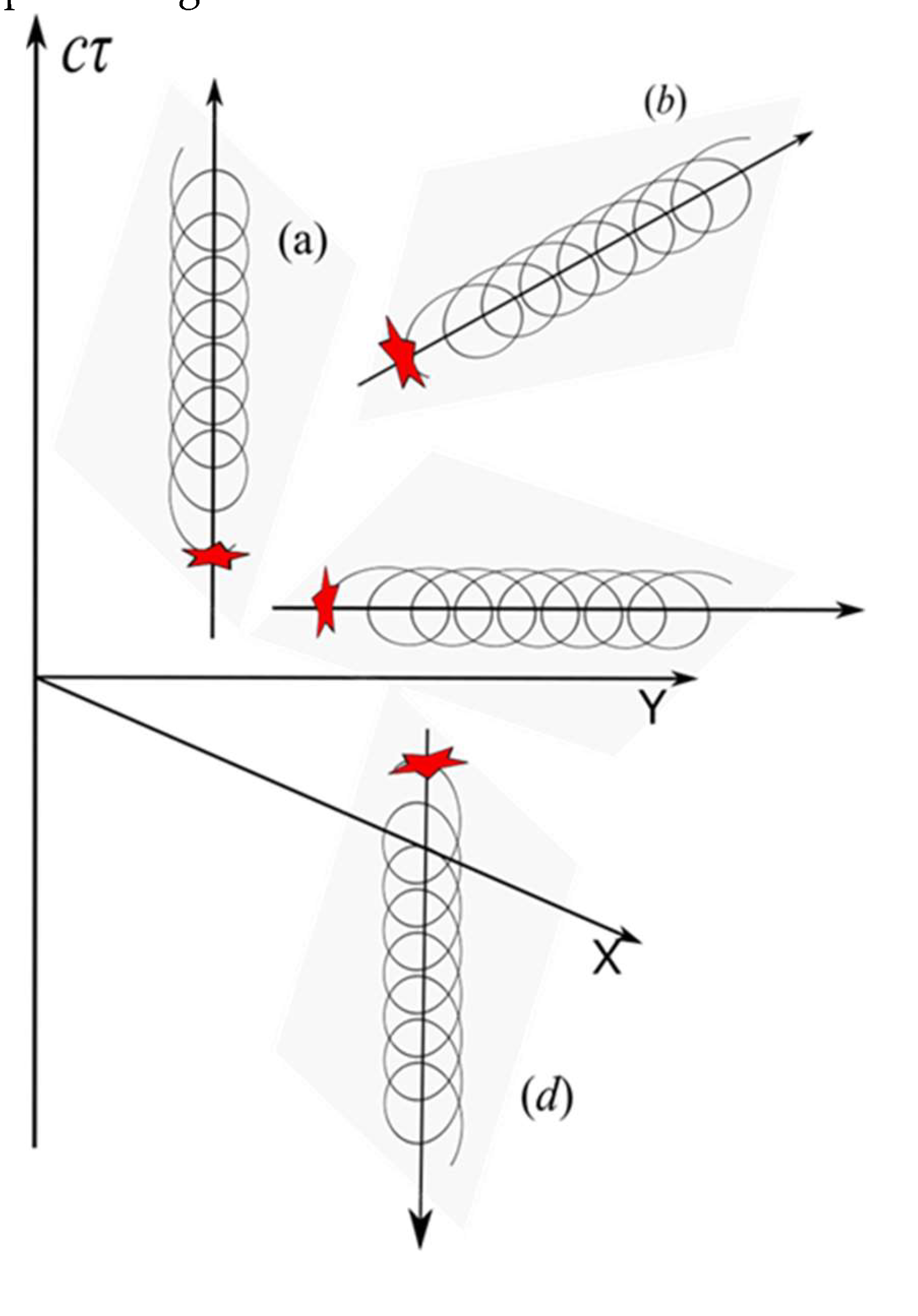
Figure 2.
Elementary particles in Standard Model [10].
Figure 2.
Elementary particles in Standard Model [10].
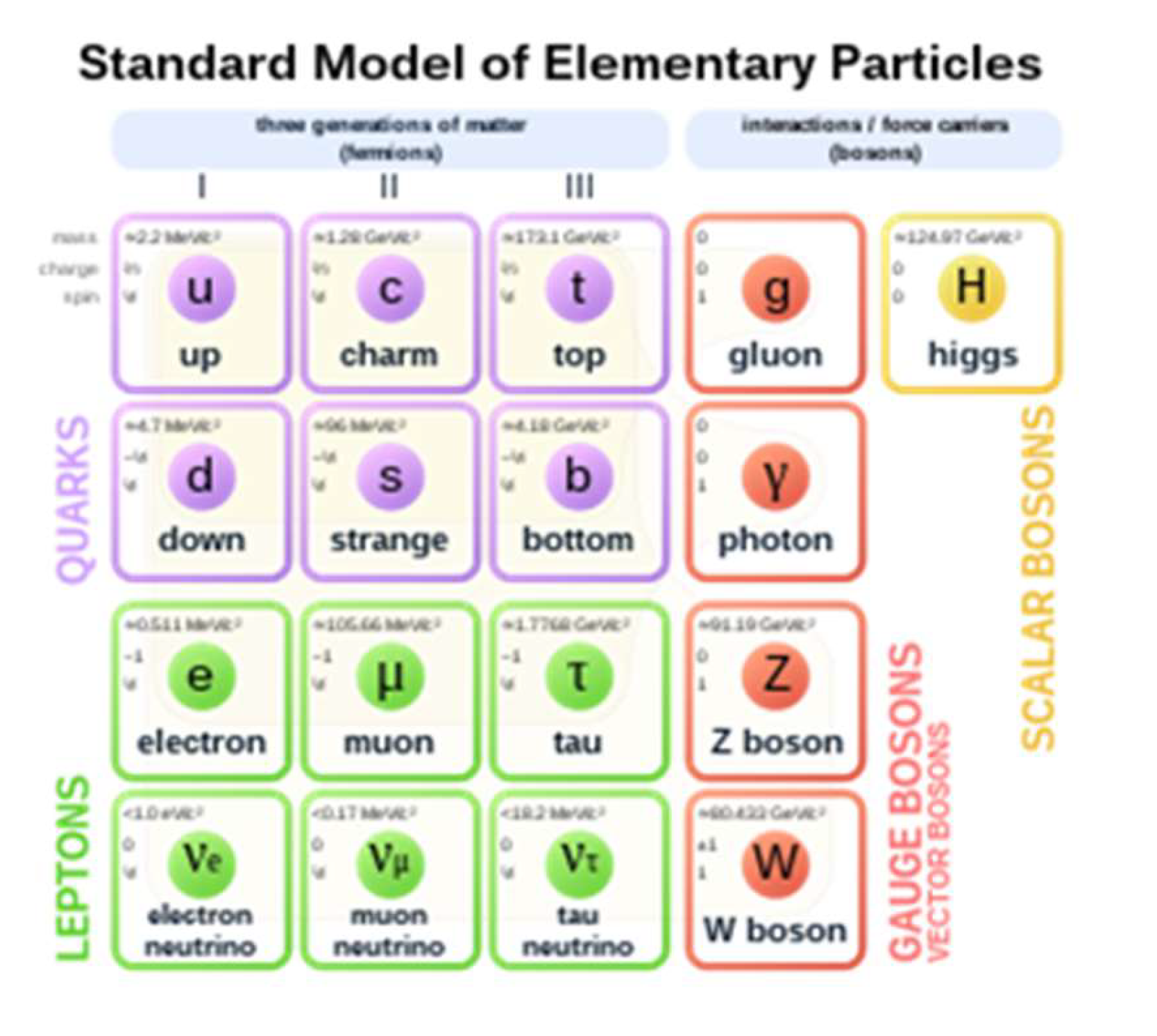
Figure 3.
A sketch of a spreading of the circular gravitons in the space. The directions of the spreading rims’ planes are random since in reality any particle is impacted by some forces and isn’t oriented in the space constantly.
Figure 3.
A sketch of a spreading of the circular gravitons in the space. The directions of the spreading rims’ planes are random since in reality any particle is impacted by some forces and isn’t oriented in the space constantly.
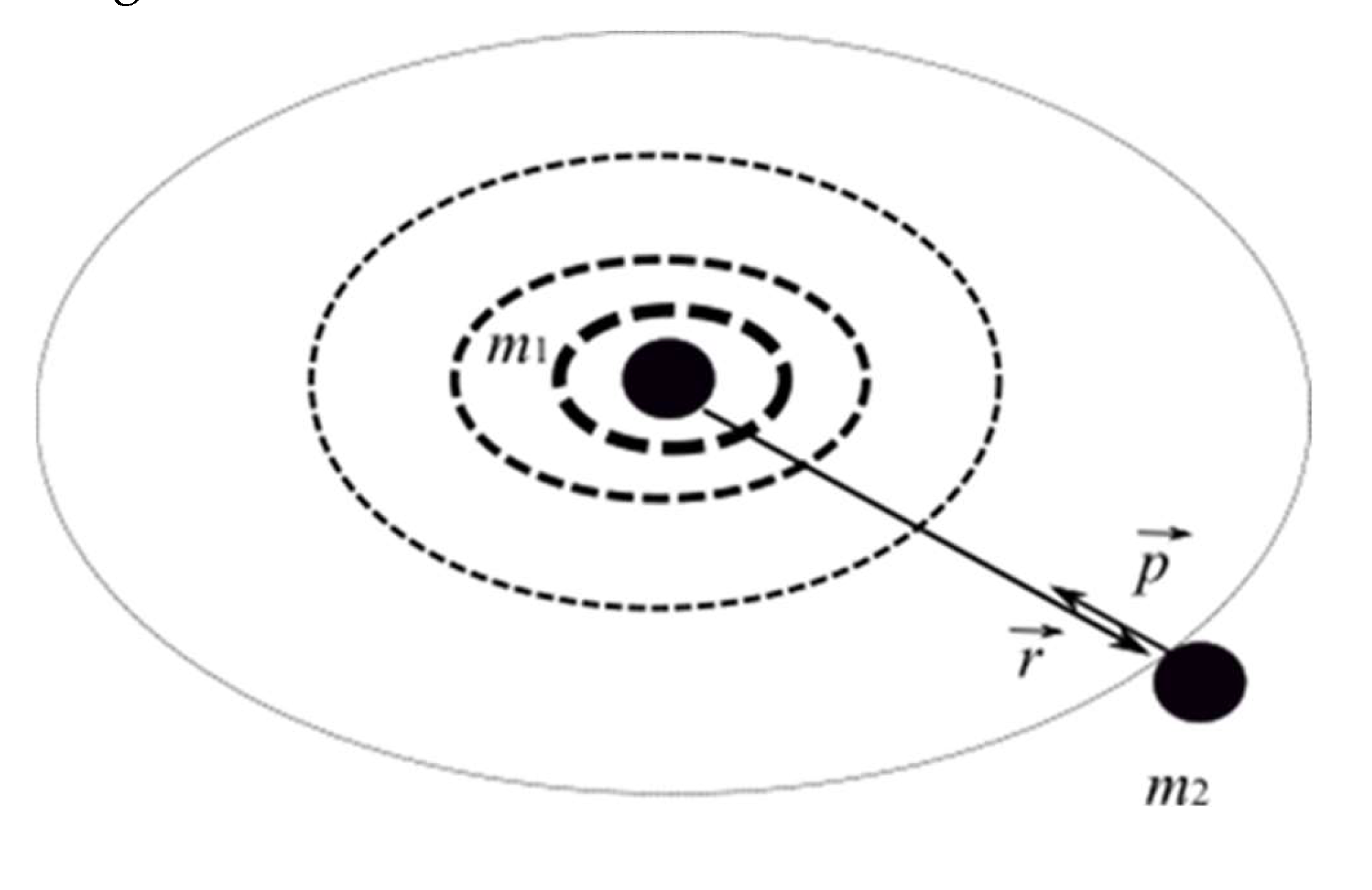
Figure 4.
Overlapping of circular gravitons and G-marked FLE.
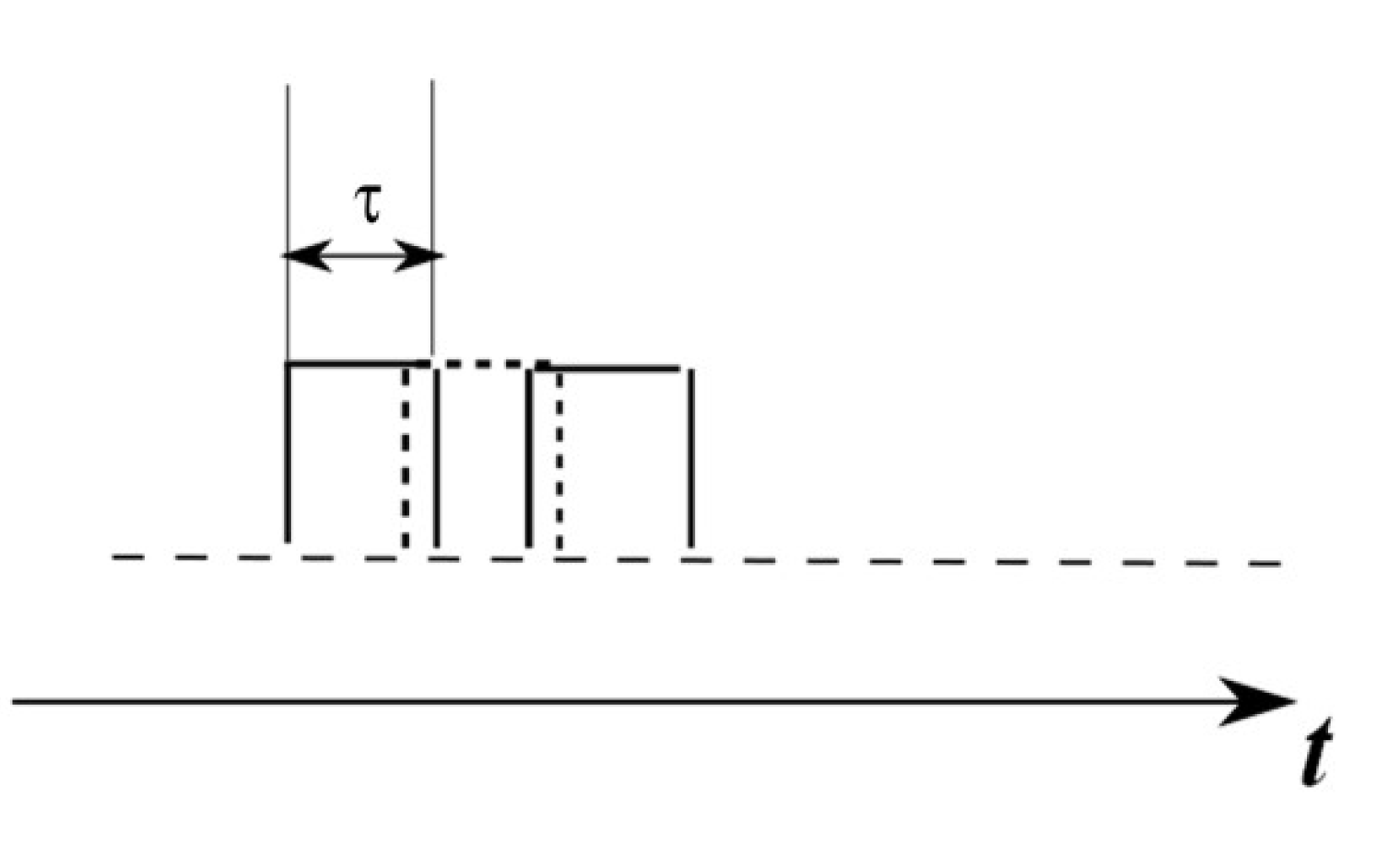
Figure 5.
Two clocks are in a [let—Earth] gravity field. Dotted line—a photon beam.
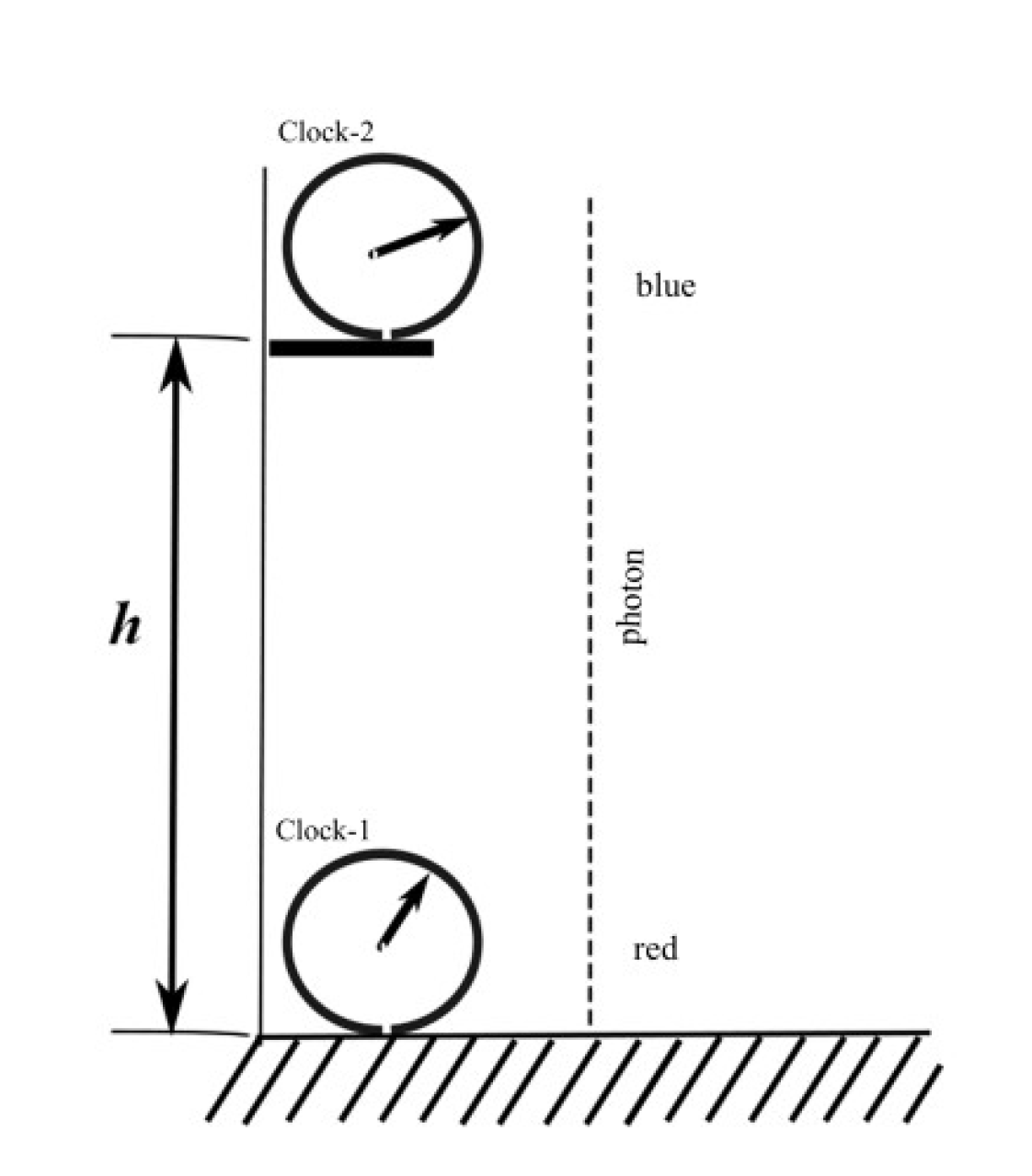
Figure 6.
A sketch of a spreading of the circular photons in the space. The directions of the spreading rims’ planes are random in 4π since in reality any particle in a body is impacted by some forces and isn’t oriented in the space constantly, however every particle radiates the circular gravitons/photons rims in plains that is oriented by its “helix axis”.
Figure 6.
A sketch of a spreading of the circular photons in the space. The directions of the spreading rims’ planes are random in 4π since in reality any particle in a body is impacted by some forces and isn’t oriented in the space constantly, however every particle radiates the circular gravitons/photons rims in plains that is oriented by its “helix axis”.
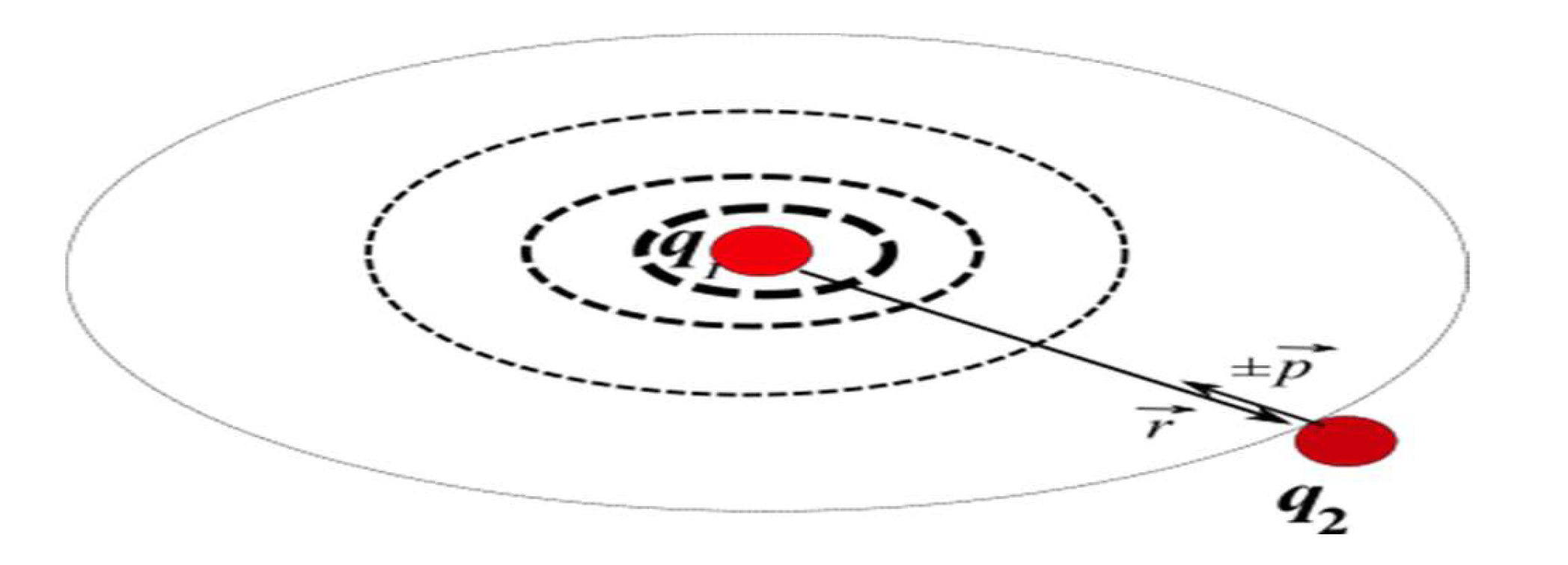
Figure 7.
A sketch of a spreading of the circular photons in the 3D space that are radiated by moving particle. The directions of the spreading rims’ planes are random in 4π, since any particle in a body is impacted by some forces, however unlike the absolute rest case above all T-particles in moving body at 3D space motion have the same additional caused by impacting 3D momentum precessing, and so all are oriented also in the 4D and 3D spaces.
Figure 7.
A sketch of a spreading of the circular photons in the 3D space that are radiated by moving particle. The directions of the spreading rims’ planes are random in 4π, since any particle in a body is impacted by some forces, however unlike the absolute rest case above all T-particles in moving body at 3D space motion have the same additional caused by impacting 3D momentum precessing, and so all are oriented also in the 4D and 3D spaces.
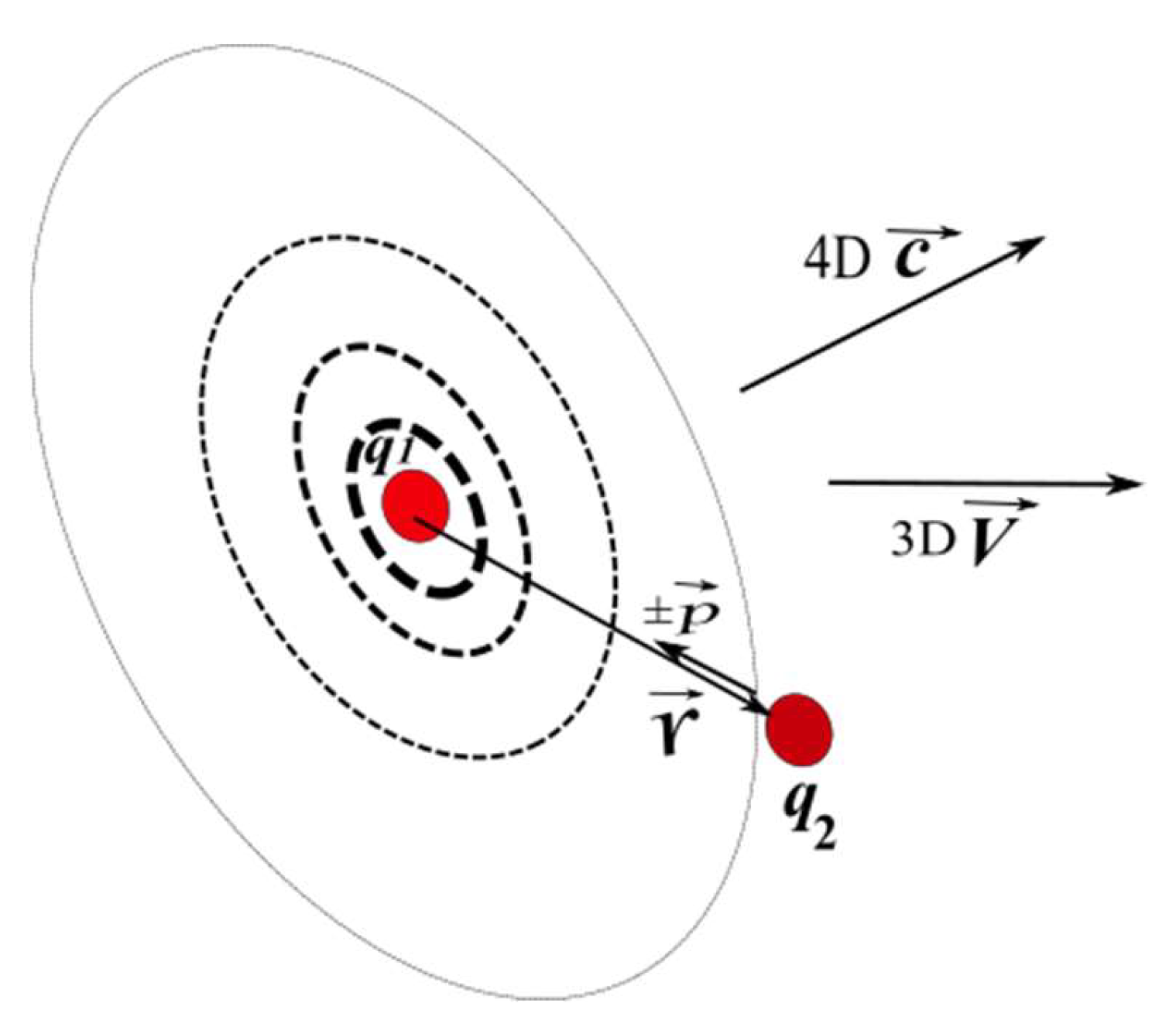
Disclaimer/Publisher’s Note: The statements, opinions and data contained in all publications are solely those of the individual author(s) and contributor(s) and not of MDPI and/or the editor(s). MDPI and/or the editor(s) disclaim responsibility for any injury to people or property resulting from any ideas, methods, instructions or products referred to in the content. |
© 2024 by the authors. Licensee MDPI, Basel, Switzerland. This article is an open access article distributed under the terms and conditions of the Creative Commons Attribution (CC BY) license (http://creativecommons.org/licenses/by/4.0/).
Copyright: This open access article is published under a Creative Commons CC BY 4.0 license, which permit the free download, distribution, and reuse, provided that the author and preprint are cited in any reuse.


