1. Introduction
The RH [
1] is one of the most important unsolved problems in mathematics. Although there are many achievements towards proving this celebrated hypothesis, it remains an open problem [
2,
3]. The Riemann zeta function is originally defined in the half-plane
by the absolutely convergent series [
2]
The connection between the above-defined Riemann zeta function and prime numbers was discovered by Euler, i.e., the famous Euler product
where
p runs over the prime numbers.
Riemann showed in his paper in 1859 how to extend the zeta function to the whole complex plane
by analytic continuation, i.e.
where
is the symbol adopted by Riemann to represent the contour integral from
to
around a domain which includes the value 0 but no other point of discontinuity of the integrand in its interior.
Or equivalently,
where
is the Jaccobi theta function,
is the Gamma function in the following Weierstrass expression
where
is the Euler-Mascheroni constant.
As shown by Riemann,
extends to
as a meromorphic function with only a simple pole at
, with residue 1, and satisfies the following functional equation
The Riemann zeta function
has zeros at the negative even integers:
,
,
,
, ⋯ and one refers to them as the
trivial zeros. The other zeros of
are the complex numbers, i.e.,
non-trivial zeros [
2].
In 1896, Hadamard [
4] and Poussin [
5] independently proved that no zeros could lie on the line
, together with the functional equation
and the fact that there are no zeros with real part greater than 1, this showed that all non-trivial zeros must lie in the interior of the
critical strip. Later on, Hardy (1914) [
6], Hardy and Littlewood (1921) [
2] showed that there are infinitely many zeros on the
critical line.
To give a summary of the related research works on the RH, we have the following results on the properties of the non-trivial zeros of
[
4,
5,
6,
7,
8,
9].
Lemma 1: Non-trivial zeroes of , noted as , have the following properties
1) The number of non-trivial zeroes is infinity;
2) ;
3) ;
4) are all non-trivial zeroes.
As further study, a completed zeta function
is proposed by equation
It is well-known that
is an entire function of order 1. This implies
is analytic, and can be expressed as infinite product of polynomial factors, in the whole complex plane
. In addition, replacing
s with
in Eq.(6), and combining Eq.(5), we obtain the following functional equation
According to the definition of
, and recalling Eq.(4), the trivial zeros of
are canceled by the poles of
. The zero of
and the pole of
cancel; the zero
and the pole of
cancel [
9,
10]. Thus, all the zeros of
are exactly the nontrivial zeros of
. Then we have the following Lemma 2.
Lemma 2: The zeros of coincide with the non-trivial zeros of .
Consequently, the following two statements are equivalent.
Statement 1: All the non-trivial zeros of have real part equal to .
Statement 2: All zeros of have real part equal to .
To prove the RH, a natural thinking is to estimate the numbers of non-trivial zeros of
inside or outside some certain areas according to Argument Principle. Along this train of thought, there are many research works. Let
denote the number of non-trivial zeros of
inside the rectangle:
, and let
denote the number of non-trivial zeros of
on the line
. Selberg proved that there exist positive constants
c and
, such that
[
11], later on, Levinson proved that
[
12], Lou and Yao proved that
[
13], Conrey proved that
[
14], Bui, Conrey and Young proved that
[
15], Feng proved that
[
16], Wu proved that
[
17].
On the other hand, many non-trivial zeros have been calculated by hand or by computer programs. Among others, Riemann found the first three non-trivial zeros [
18]. Gram found the first 15 zeros based on Euler-Maclaurin summation [
19]. Titchmarsh calculated the 138
th to 195
th zeros using the Riemann-Siegel formula [
20,
21]. Here are the first three (pairs of) non-trivial zeros:
.
The idea of this paper is originated from Euler’s work on proving the following famous equality
This interesting result is deduced by comparing the like terms of two types of infinite expressions, i.e., infinite polynomial and infinite product, as shown in the following
Then the author of this paper conjectured that
should be factored into
or something like that, which was verified by paring
and
in the Hadamard product of
, i.e.
The Hadamard product of
as shown in Eq.(10) was first proposed by Riemann, however, it was Hadamard who showed the validity of this infinite product expansion [
22].
where
,
runs over all zeros of
.
Hadamard pointed out that to ensure the absolute convergence of the infinite product expansion,
and
are paired. Later in
Section 4, we will show that
and
can also be paired to ensure the absolute convergence of the infinite product expansion.
2. Preliminary Lemmas
This section provides some preliminary knowledge to support the proof of the key lemma - Lemma 10 in next section. We need the classical results (Lemma 3 and Lemma 4) in polynomial algebra over fields, with extension to infinite product of polynomial factors (Lemma 5, Lemma 6, and Lemma 7), and properties of the multiplicity of zeros of the entire function (Lemma 8 and Lemma 9).
In the remainder of this paper, we focus on polynomials with real coefficients and infinite products of polynomial factors with real coefficients (absolutely convergent on the whole complex plane), both of which are types of entire functions.
To begin with, we introduce the ring of polynomial, denoted as
, which is defined as the set of all polynomials in
x over the field of real numbers
, i.e.
The set equipped with the operations + (addition) and · (multiplication) is the ring of polynomial in x over the field .
According to Reference [
27], the ring of polynomial is a subset of the ring of entire function, and both rings possess divisibility property.
Definition: Let , be an infinite product of polynomial factors, and let . If there exists an infinite product of polynomial factors such that: , then is said to divide , denoted as .
Remark: The above definition implicitly assumes the absolute convergence of the infinite product of polynomial factors, because is obtained through rearrangement of factors of .
Lemma 3: Let . If is irreducible (prime) and divides the product , then divides one of the polynomials .
Lemma 4: Let . If is irreducible and is any polynomial, then either divides or , (gcd: greatest common divisor).
Lemma 5: Let . If is irreducible and divides the infinite product , then divides one of the polynomials .
Lemma 6: Let . If is irreducible and divides the product , but and are relative prime, then divides .
Lemma 7: Let . If is irreducible, then either divides , or and are relative prime, i.e., .
Remark: The contents of Lemma 3 and Lemma 4 can be found in many textbooks of linear algebra, modern algebra, or abstract algebra, see for example references [
24,
25,
26]. Below we give the proofs of Lemma 5, Lemma 6, and Lemma 7.
Proof of Lemma 5: The proof is conducted by Transfinite Induction.
Let ( is an ordinal number) be the statement:
". If is irreducible and divides the product , then divides one of the polynomials ", where , with the ordering that for all natural numbers n, is the smallest limit ordinal other than 0.
Base Case: is an obvious fact according to Lemma 3 with ;
Successor Case: To prove , we have , where . Then according to Lemma 3 with , we have or . Considering : if divides , then divides one of , thus we know .
Limit Case: We need to prove
,
is any limit ordinal other than 0. For the sake of contradiction, assume that
, i.e.,
does not divide any polynomial
. Then, considering
is irreducible with the property stated in Lemma 4, we have:
which contradicts
divides one of the polynomials
. Thus, we know that the assumption
is false.
Then is true, i.e., the Limit Case is true.
That completes the proof of Lemma 5.
Proof of Lemma 6: If is irreducible and divides the product , then according to Lemma 5, divides one of the polynomials . Further, if and are relative prime, then does not divides any factor of (otherwise divides , which contradicts the condition " and are relative prime"). Thus, must divides .
That completes the proof of Lemma 6.
Proof of Lemma 7:
Since is irreducible, then by the definition of irreducible polynomial, either or . It is clear that . Thus, we conclude that either divides or , i.e., and are relative prime.
That completes the proof of Lemma 7.
Additionally, we also need the following results on properties of a zero of entire function in complex analysis for understanding the multiplicity of a zero of .
Lemma 8: Let be a non-zero entire function, and let be a zero of . Then the multiplicity of is a finite positive integer.
Proof: Let , be an entire function, which means it is holomorphic on the whole complex plane. Suppose has a zero at of multiplicity m, then , where is also an entire function and .
Assume for contradiction that m is infinite, which implies there exists an accumulation point of zeros in the neighbor of . Then, by Identity Theorem for holomorphic functions, and considering "0" is also an entire function, we have , which contradicts the given condition that . Thus, the assumption is false, i.e., m must be a finite positive integer.
That completes the proof of Lemma 8.
Remark: Statements similar to Lemma 8 can be found in Reference [
28] and other related textbooks/monographs.
Lemma 9: Let be a non-zero entire function, and let be a zero of . Then the multiplicity of is unique.
Proof: Let , be an entire function, which has a multiple zero at of multiplicity m. We can write: , where is also an entire function and .
Assume for contradiction that there exists another integer such that n is also a multiplicity of the zero . This means we can also write: , where is an entire function and .
Since both expressions for must be equal, we then obtain . Without loss of generality, consider , then we have: , which is a contradiction to . Thus, the assumption is false, i.e., the multiplicity of a zero of any non-zero entire function is unique.
That completes the proof of Lemma 9.
3. Key Lemma
In this section, we first explain the multiplicity of a quadruplets of zeros of , which is used to facilitate the identification of unreasonable subsequent multiple zeros. After that we prove the key lemma - Lemma 10, which is substantial for the proof of the RH.
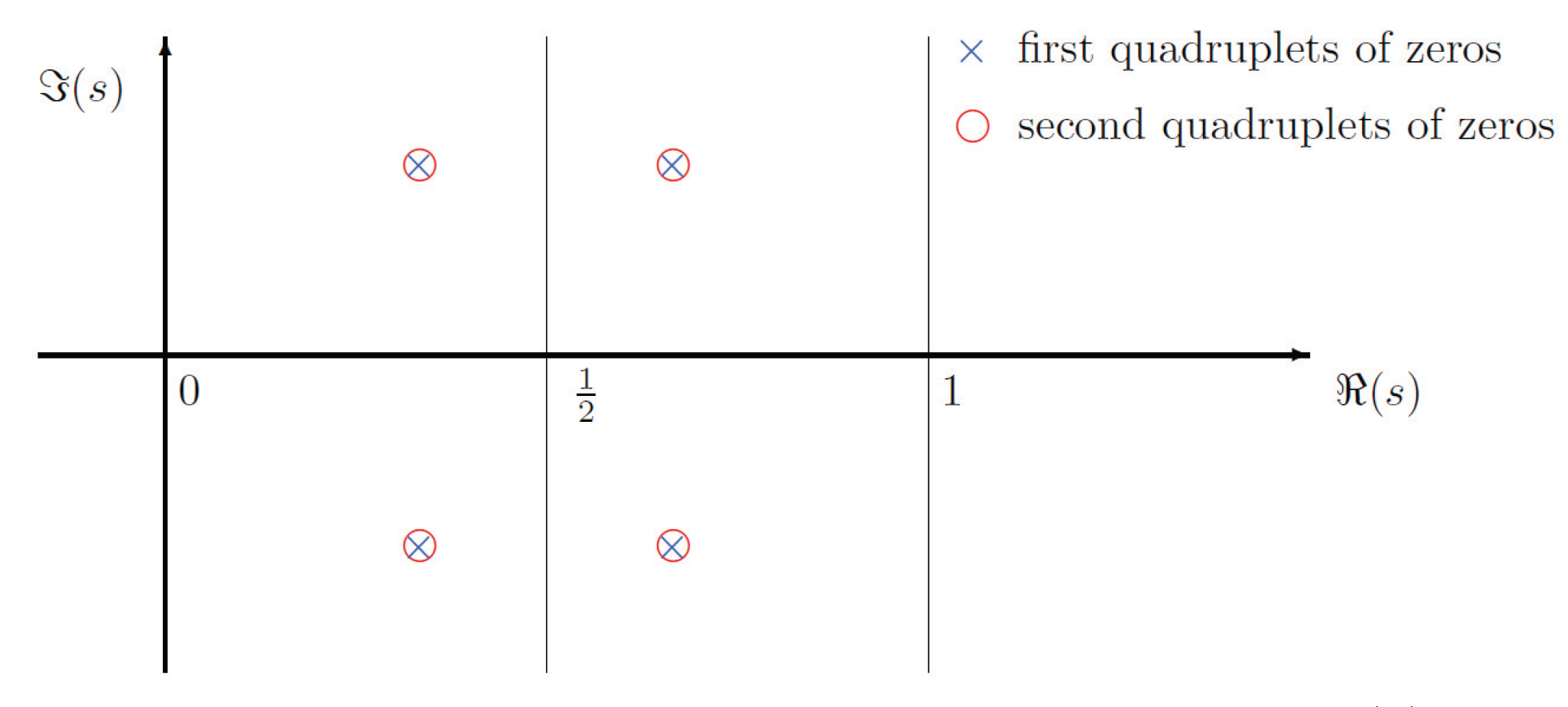
Multiple zeros of : As shown in
Figure 1, the multiple zeros of
always come in quadruplets, i.e.,
.
If without any restriction, there are two different expressions of factors of
for the multiple zeros in
Figure 1, i.e.,
, or
with
.
The latter expression with
can be excluded with the use of multiplicity of zeros in quadruplets, which is uniquely determined and then unchangeable, since
is given. In
Figure 1, the multiplicity of
is 2, i.e.,
.
Remark: For such a special entire function
, defining zero multiplicity using quadruplets
is consistent with the conventional definition of multiplicity for single zeros. This definition is just to facilitate the identification of two groups of multiple zeros that satisfy
, because the quadruplets of groups
i and
l,
and
, are indeed overlapping in the complex plane as shown in
Figure 1.
Remark: Although the multiplicity of a quadruplets of zeros of is unknown, it is an objective existence, finite, unique, and then unchangeable, for more details see Lemma 8 and Lemma 9.
Lemma 10: Given two absolutely convergent infinite products
and
where
s is a complex variable,
and
are the complex conjugate zeros of
,
and
are real numbers,
is the multiplicity of quadruplets
,
.
Then we have
where
is the equivalent sign.
Proof: First of all, we have the following fact:
where
is positive integer,
and
are real numbers.
Next, the proof is based on the divisibility of infinite products of polynomial factors. It is obvious that
where
with
, and "
l" is an arbitrary element of set
. In brief,
means that
i runs over the elements of
excluding "
l".
Then we have
where "|" is the divisible sign.
We first exclude the possibility of and in Eq.(18) with the help of the uniqueness of the multiplicity of zeros of .
Considering the factor
, with discriminant
, is irreducible over the field
, similarly,
with discriminant
is also irreducible over the field
, we know from Eq.(18) that
and
As explained in the situation of
Figure 1,
means that (
) and (
) are the same zeros in terms of quadruplets, which contradicts the uniqueness of the multiplicity of zeros of
.
Thus, in order to keep the multiplicities of zeros of
unchanged,
can not divide
,
can not divides
. In addition,
is irreducible over the field
, then by Lemma 7 we know that
and
are relative prime, similarly,
and
are relative prime. Consequently, by Lemma 6, we obtain from Eq.(18) the following result.
Let
l run over from 1 to
∞, and repeat the above process, we get
Also, based on Eq.(14), we have the following obvious fact
Further, limiting the imaginary parts
of zeros to
in order to keep the multiplicities of zeros unchanged while
, we finally get
i.e.,
That completes the proof of Lemma 10.
4. A Proof of the RH
This section presents a proof of the Riemann Hypothesis. We first prove that Statement 2 of the RH is true, and then by Lemma 2, Statement 1 of the RH is also true. To be brief, to prove the Riemann Hypothesis, it suffices to show that in the new expression of as shown in Eq.(22).
Proof of the RH: The details are delivered in three steps as follows.
Step 1:
It is well-known that zeros of
always come in complex conjugate pairs. Then by pairing
and
in the Hadamard product as shown in Eq.(10), we have
where
.
The absolute convergence of the infinite product in Eq.(22) in the form
depends on the convergence of infinite series
(since
), which is an obvious fact according to Theorem 2 in
Section 2, Chapter IV of Ref.[
23]. Thus, the infinite products as shown in Eq.(23) and Eq.(22) are absolutely convergent for
.
Further, considering the absolute convergence of
we have the following new expression of
by putting all the possible multiple factors (zeros) together:
where
is the multiplicity of
,
.
Step 2: Replacing
s with
in Eq.(25), we obtain the infinite product expression of
, i.e.,
where
is the multiplicity of
,
.
The absolute convergence of the infinite product as shown in Eq.(26) can be reduced to that of , whose absolute convergence depends also on the convergence of infinite series (since ). Then from the analysis in Step 1, the infinite product as shown in Eq.(26) is absolutely convergent for .
Step 3: According to the functional equation
, and considering Eq.(25) and Eq.(26), we have
which is equivalent to
where
is the multiplicity of quadruplets (
),
.
are in order of increasing
, i.e.,
.
To check the absolute convergence of both sides of Eq.(28), it suffices to prove the convergence of infinite series , which is an obvious fact because , then we have , that means and have the same convergence.
Then, according to Lemma 10, Eq.(28) is equivalent to
Thus, we conclude that all zeros of the completed zeta function
have real part equal to
, i.e., Statement 2 of the RH is true. According to Lemma 2, Statement 1 of the RH is also true, i.e., all the non-trivial zeros of the Riemann zeta function
have real part equal to
.
That completes the proof of the RH.