
Submitted:
29 September 2021
Posted:
30 September 2021
You are already at the latest version
Abstract
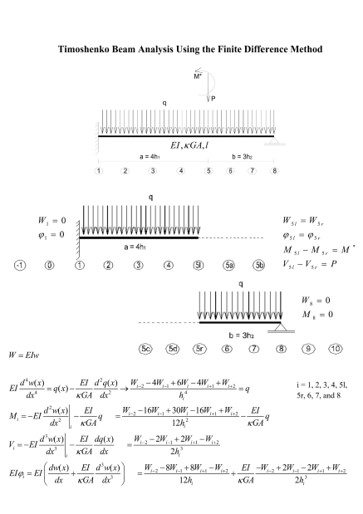
This paper presents an approach to the Timoshenko beam theory (TBT) using the finite difference method (FDM). The Timoshenko beam theory covers cases associated with small deflections based on shear deformation and rotary inertia considerations. The FDM is an approximate method for solving problems described with differential equations. It does not involve solving differential equations; equations are formulated with values at selected points of the structure. In addition, the boundary conditions and not the governing equations are applied at the beam’s ends. The model developed in this paper consisted of formulating differential equations with finite differences and introducing additional points at the beam’s ends and at positions of discontinuity (concentrated loads or moments, supports, hinges, springs, brutal change of stiffness, spring-mass system, etc.). The introduction of additional points allowed us to apply the governing equations at the beam’s ends. Moreover, grid points with variable spacing were considered, the grid being uniform within beam segments. First-order, second-order, and vibration analyses of structures were conducted with this model. Furthermore, tapered beams were analyzed (element stiffness matrix, second-order analysis, vibration analysis). Finally, a direct time integration method (DTIM) was presented; the FDM-based DTIM enabled the analysis of forced vibration of structures, with damping taken into account. The results obtained in this paper showed good agreement with those of other studies, and the accuracy was increased through a grid refinement. Especially in the first-order analysis of uniform beams, the results were exact for uniformly distributed and concentrated loads regardless of the grid.
Keywords:
Timoshenko beam
; finite difference method
; additional points
; element stiffness matrix
; tapered beam
; second-order analysis
; vibration analysis
; direct time integration method
Copyright: This open access article is published under a Creative Commons CC BY 4.0 license, which permit the free download, distribution, and reuse, provided that the author and preprint are cited in any reuse.


