

Submitted:
18 March 2021
Posted:
22 March 2021
You are already at the latest version
Abstract
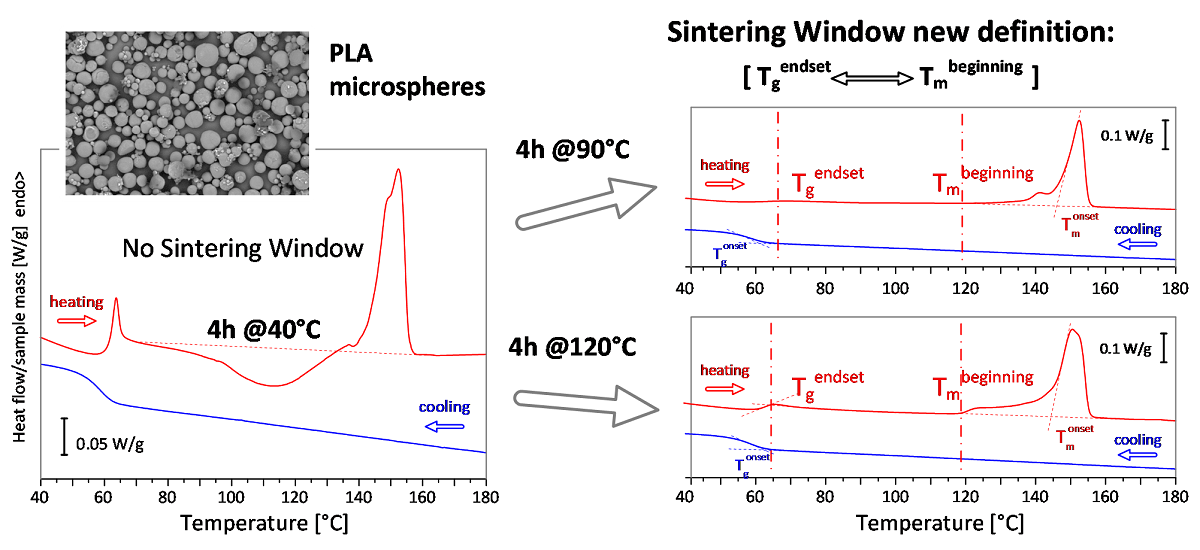
Comparison of the influence of conditioning temperature of microspheres made of medical grade poly(L-lactide) (PLLA) and polylactide with 4wt.% of D-lactide content (PLA), on its thermal and structural properties is presented. The microspheres were fabricated by solid-in-oil-in-water method for application in additive manufacturing. The microspheres were annealed below glass transition temperature (Tg), above Tg but below onset of cold crystallization, and at two temperatures selected from the range of cold crystallization corresponding to crystallization of α’ and α form of poly(L-lactide) respectively, i.e., at 40°C, 70°C, 90°C and 120°C, in order to verify the influence of conditioning temperatures on sinterability of microspheres set as sintering window (SW). Based on differential scanning calorimetry measurements SW of microspheres were evaluated with consideration of existence of cold crystallization and reorganization of crystal polymorph. The results indicate that the conditioning temperature influence on availability and range of SW that depending on the D-lactide presence. We postulate the need for an individual approach for polylactide powders in determining the SW as a temperature range free of any thermal events. Moreover, other core powder characteristic, such as residual solvent content, morphology, particle size distribution, powder flowability and thermal conductivity, as a key property for successful laser sintering, are characterized. The microspheres are close to sphere and the size of microspheres are below 100 µm. Residual solvents content decreases with the increase of annealing temperature. The thermal conductivity is 0.073 W/mK and 0.064 W/mK for PLA and PLLA microspheres, respectively, and it depends on the spherical shape of the microspheres. Furthermore, the WAXD studies prove that an increase in the conditioning temperature causes a slight increase in crystallinity degree for PLLA microspheres and clear increase in crystallization for PLA microspheres.
Keywords:
polylactide microspheres
; thermal conditioning
; sintering window
; laser sintering
; powder morphology and flowability
; crystalline structure
; additive manufacturing
Copyright: This open access article is published under a Creative Commons CC BY 4.0 license, which permit the free download, distribution, and reuse, provided that the author and preprint are cited in any reuse.


