

Submitted:
07 October 2026
Posted:
09 October 2026
You are already at the latest version
Abstract
Why simple carbon-containing small molecules can evolve stepwise into complex, diverse, and ordered living organisms and social organizations remains an unresolved core scientific question. Existing evolutionary theories each apply to only one stage—chemical, biological, or social evolution—thereby fragmenting the complete evolutionary picture. This article develops Carbon-Based Evolutionary Theory (CBET), a framework theory deduced from six scientific principles and two universal mathematical rules through an eight-step process. CBET identifies two mechanisms shared by chemical, biological, and social evolution: the dual-loop feedback mechanism, which generates changes ceaselessly, and the persistence selection mechanism, which filters changes ceaselessly and encompasses natural selection and artificial selection. CBET decouples natural selection from biological inheritance and calculates logarithmic fitness of various CBMs using the Malthusian formula. CBET accommodates major evolutionary phenomena—including niche construction, horizontal gene transfer, epigenetics, non-random mutation, coevolution, and neutral mutations—and subsumes the core viewpoints of the major theories of chemical, biological, and social evolution, yielding three derivative theories. It further proposes that human society has already entered a preliminary Global Unified Cooperative Society (GUCS). CBET also provides a systematic, positive, and balanced ethical reference that has the potential to dispel the negative ethical influence of Social Darwinism.
Keywords:
Carbon-Based Evolutionary Theory
; carbon-based materials
; dual-loop feedback mechanism
; persistence selection
; chemical evolution
; biological evolution
; social evolution
; ethics
; natural selection
1. Introduction
Why can simple carbon-based substances such as methane and carbon dioxide evolve step by step into complex, diverse, and highly ordered living organisms and social organizations? For thousands of years, this core scientific question has attracted the attention of numerous scholars, yet it has still not been fully resolved [1‒8]. This question concerns chemical, biological, and social evolution [7‒8]. For a long time, these three evolutionary stages have been studied separately [1‒8], and the resulting evolutionary theories each typically apply to only one of the stages [9‒19], thereby fragmenting the complete evolutionary picture from carbon atoms to human societies. For example, although Darwinian evolutionary theory and the modern synthesis can powerfully explain biological evolution, they cannot elucidate the intrinsic mechanisms of chemical evolution or social evolution [1‒4].
As shown in Figure 1, CBET aims to occupy precisely the hitherto vacant middle position between: (i) systems theory, cybernetics, and other theories with very broad scopes of application [20‒25], and (ii) theories specific to chemical, biological, or social evolution [9‒19]. CBET is designed as a framework theory to reveal the common mechanisms underlying chemical, biological, and social evolution—thereby unifying the complete evolutionary picture from carbon atoms to societies. CBET does not reject or replace a theory, but integrates various theories into a coherent whole.
2. Methods for Establishing CBET
CBET follows the logical-reasoning approach adopted in establishing such classic evolutionary theories as Oparin’s theory of chemical evolution, Darwinian evolutionary theory, the modern synthesis, and neo-evolutionism [1‒2,4]. Its reasoning route is shown in Figure 2 and comprises the following three aspects.
First, carbon-based materials (CBMs) are collectively selected as the theoretical protagonist. CBMs are the collective term for all matter or entities constructed, at the atomic level, with carbon atoms as the principal skeleton (SI Appendix, Text S1). As shown in Figure 3, based on the principle that “higher-level CBMs are cooperative systems formed from lower-level CBMs through physical, chemical, or more complex interactions,” CBMs are divided into eight hierarchies (HC1–HC8) (Figure 3): HC1 refers to carbon atoms, HC2 simple carbon-containing small molecules such as methane, HC3 complex carbon-containing small molecules such as amino acids, HC4 carbon-containing macromolecules such as proteins, HC5 unicellular organisms; HC6 multicellular organisms; HC7 single-level social organizations such as ant colonies and small companies; and HC8 multi-level social organizations such as armies and universities. With regard to human social organizations, this article focuses mainly on their core components—humans—rather than the associated land, roads, houses, and tools. Some CBMs lie between two hierarchies; for example, short peptides lie between HC3 and HC4, and organelles such as mitochondria and ribosomes lie between HC4 and HC5. Non-carbon-based substances, such as water, oxygen, houses, and machines, can serve as auxiliary components of higher-level CBMs. As detailed in SI Appendix, Text S2, CBMs possess several functions and potentials crucial to their evolution, including the function of serving as the skeleton of countless macromolecules, the hierarchy-elevation potential, the relative-stability potential, the structural-diversity potential, the variation potential, and the information potential [26].
Second, logical reasoning is conducted by synthesizing six principles concerning the causal relations among the key factors that are accessible and crucial in the evolution of CBMs—such as their structure, function, energy, environment, position, hierarchy, and aspect—and by generalizing established knowledge from multiple disciplines. Then, two common mechanisms underlying chemical, biological, and social evolution are derived and applied to unify various evolutionary phenomena and theories from carbon atoms to human societies.
Third, the theoretical structure and its linguistic formulation are refined through repeated cycles of testing, revision, and re-testing.
3. Eight Reasoning Steps of CBET
CBET comprises eight steps of reasoning (Figure 4).
Reasoning: Step 1
Based on multidisciplinary cross-integration, this step derives six scientific principles that synthesize the causal relationships among the 12 factors of energy, environment, structure, function, other causes, position, hierarchy, diversity, adaptability, complexity, orderliness, and cooperativeness (SI Appendix, Text S3). For example, the Environmental Influence Principle claims that environmental factors are the external cause of changes in the structure and position of matter; the Structure-Function Principle claims that the structure of matter partially determines its function; structural changes can generate new functions; complex structures and complex functions support each other; and function is the internal cause that maintains or changes structure and position; and the Energy-Change Principle claims that the transfer of energy drives changes in the structure or position of matter.
Reasoning: Step 2
Based on the above six principles, this step derives the dual-loop feedback mechanism: under the dual influence of a CBM’s own functions and environmental factors, the transfer of energy drives the CBM to undergo positional or structural changes, and both positional and structural changes of a CBM may generate a new environment or new functions; the CBM’s new environment can become the external cause of its next round of change, and the CBM’s new functions can become the internal cause of its next round of change. This process forms the two cyclic interactions [21], mediated respectively by the new environment and the new functions (Figure 4). The CBM evolutionary mechanism embodied in these two feedback-bearing cyclic interactions is herein termed the dual-loop feedback mechanism, which can ceaselessly produce changes in CBMs.
Positive examples of the dual-loop feedback mechanism are almost ubiquitous. The vast number of carbon-containing molecules, organisms, and social organizations on the Earth’s surface have been and remain subject to this mechanism: their structural or positional changes depend on energy transfer (the Energy-Change Principle), are influenced by environmental factors (the Environmental Influence Principle), and are shaped by their own functions (the Structure-Function Principle). Moreover, the result of each previous structural or positional change can, through a change in the environment or in their own functions, become the cause of the next structural or positional change—thereby corresponding to the dual-loop feedback mechanism.
Reasoning: Step 3
The dual-loop feedback mechanism performs the following four important functions (constituting the third step of CBET reasoning):
First, it can drive the hierarchical ascent of some CBMs. This is related to a suitable environment and also to the hierarchy-elevation potential possessed by CBMs (e.g., amino acids have the potential to form proteins, and ant individuals have the potential to form ant colonies) [26]. It should be noted that if the hierarchy-elevation potential were used to prove the necessity of hierarchical ascent, there would be a circular-reasoning problem of proving an “outcome” by an “outcome”; but if that potential is used to prove the possibility of hierarchical ascent, no such problem arises. Like Darwinian evolutionary theory, CBET aims to explain the mechanism by which evolution is possible, not the mechanism by which it necessarily occurs. Theoretically, non-CBMs are also governed by the dual-loop feedback mechanism, but the structures of non-CBMs (such as water, iron, and silicon) determine that their hierarchy-elevation potential is relatively weak, so that they generally cannot reach the level of complex and diverse macromolecules. They can, however, serve as auxiliary materials participating in the construction of higher-level CBMs [5‒6].
Second, it can drive an increase in the diversity of some higher-level CBMs—that is, an increase in both their quantity and variety. This is related to the hierarchy-elevation potential of CBMs (mathematically, the higher the hierarchy of CBMs, the greater the potential diversity formed through permutation and combination), and it is also related to the relative-stability potential, structural-diversity potential, and variation potential of higher-level CBMs, as well as to a suitable environment. When the environment is unfavorable, diversity may decrease [27]. In addition, the growth of diversity is subject to dual constraints from the CBMs’ own structures: the types of changes that a specific CBM can undergo in a specific environment may be limited and are not entirely random. Some CBMs can even precisely regulate the timing, location, and manner in which changes arise through complex structures (such as non-random mutation in bacteria, the immune system’s precise regulation of antibody-gene variation, and humans’ planned breeding and production of crops). The growth of diversity is also closely related to the persistence selection expounded below: environments themselves are diverse, different environments impose different requirements on the same CBM, and under selection pressures CBMs undergo different morphological changes to adapt to different environmental requirements.
Third, it can drive the descent of CBMs to lower hierarchies and a reduction in diversity. Although higher-level CBMs possess the function of relative stability, they will eventually undergo degradation under the action of factors such as energy, environment, or their own functions—including the degradation of macromolecules, the breakdown of cells, the death of organisms, and the disintegration of social organizations. Changes in the Earth’s surface environment, such as asteroid impacts, large-scale volcanic eruptions, and ecosystem collapse, can also cause the diversity of CBMs to decline sharply, sometimes leading to mass extinctions of organisms.
Fourth, it drives both the ascent and descent of CBMs across hierarchies, corresponding to repeated cycles of formation and degradation of higher-level CBMs. Newly produced higher-level CBMs often exhibit some variation compared with their precursors—this corresponds to the variation function of CBMs. This change-bearing cycle of formation and degradation includes the synthesis and decomposition of carbon-containing macromolecules, the birth and death of living organisms, and the establishment and disintegration of social organizations. It causes carbon atoms to circulate repeatedly among inorganic molecules, organic macromolecules, organisms, and social organizations—that is, the carbon cycle [27‒28].
This mechanism directly accommodates the phenomenon of niche construction [2]: CBMs can alter their environment in the course of their changes (as in the Great Oxidation Event [29]), and the altered environment in turn triggers a new round of change in CBMs. This mechanism also directly accommodates the phenomenon of horizontal gene transfer [2], because that phenomenon can be regarded as the influence of environmental factors on genetic material and a function supported by organism structures.
Reasoning: Step 4
There are two bookkeeping mathematical rules:
(1) The Existence Mathematical Rule: if the currently existing quantity of a substance is greater than zero, it exists; if it equals zero, it does not exist.
(2) The Quantity-changing Mathematical Rule: for a given substance over a given period of time, if production exceeds degradation, its quantity increases; if production is less than degradation, its quantity decreases; and if production equals degradation, its quantity remains unchanged.
According to the above two mathematical rules, within the change-bearing cycle of formation and degradation of CBMs, higher-level CBMs whose production exceeds degradation (i.e., those easy to produce and difficult to degrade) tend to accumulate, whereas higher-level CBMs whose production is less than degradation (i.e., those difficult to produce or easy to degrade) tend to be eliminated. This is the persistence selection mechanism, abbreviated sometimes as “selection” in this article. The persistence selection mechanism comprises the natural selection mechanism and the artificial selection mechanism, both of which can affect the ratio of production to degradation of CBMs. Compared with natural selection, persistence selection encompasses the influence of artificial breeding on biological evolution, as well as the influence of humanistic factors—such as social institutions, history, culture, and religion—on social evolution through artificial selection.
It should be noted that in CBET, persistence selection is no longer tied to (though it does not exclude) biological inheritance and advantage accumulation; it refers only to the various natural or artificial processes that affect the formation and degradation of CBMs. At the chemical level, natural selection can still screen molecules even without molecular replication or advantage accumulation. For example, on the early Earth, if amino acids continuously polymerized into polypeptides with random sequences, these polypeptides would also break down into amino acids through various pathways. In this long-term cycle of polypeptide synthesis and breakdown, natural selection can increase the proportion of polypeptides that are readily formed and resistant to degradation. Similarly, although restaurants do not reproduce, under long-term natural and artificial selection, hygiene-conscious restaurants make up a relatively high proportion in affluent areas, while dirty, poorly managed restaurants are more likely to be eliminated.
From the perspective of selection outcomes, the persistence selection mechanism includes positive selection (promoting change in a given direction), negative selection (suppressing change in a given direction), and stabilizing selection (promoting convergence toward an equilibrium point).
The change-bearing cycle of formation and degradation of CBMs brought about by the dual-loop feedback mechanism is one of the prerequisites for the existence of persistence selection. Therefore, the dual-loop feedback mechanism is one of the foundations of the persistence selection mechanism. It should be noted that, within CBET, the dual-loop feedback mechanism yields both random and non-random variations, and humans can even create goal-directed variations through “artificial selection”, such as purposeful reforms to corporate structures and institutions and conscious adaptation to market changes. All these variations are exposed to multiple persistence-selection pressures.
Positive examples of the persistence selection mechanism are almost ubiquitous. This is because all carbon-containing molecules, organisms, and social organizations on the Earth’s surface—past, present, and future—are subject to the persistence selection mechanism, ceaselessly undergoing the action of multiple selection pressures.
Because the change-bearing cycle of formation and degradation of CBMs occurs at such levels as carbon-containing macromolecules, cells, individual multicellular organisms, and social organizations, persistence selection occurs at multiple levels. This directly subsumes the theory of multi-level selection [30].
Based on the definition of persistence selection and its two mathematical rules, CBET calculates logarithmic fitness using the Malthusian formula:
Fitness = (1/t)·ln(NT/N0) = (1/t)·ln [1+(Γ−Λ)/N0]
This formula is a common mathematical tool for measuring compound growth rate in economics, chemistry, biology, and ecology [31]. Here, t is the duration from time point 0 to time point T, t>0; N0 is the existing quantity of a given CBM at time point 0, N0>0; NT is the existing quantity of that CBM at time point T; Γ is the total production of that CBM from time point 0 to time point T; and Λ is its total degradation during that period. A logarithmic fitness >0 means that the quantity of the CBM increased during that period, <0 means that the quantity decreased, and =0 means that the quantity remained stable. This formula decouples fitness calculation from biological reproduction and applies to all CBMs—the fitness of molecules, organisms, and social organizations can all be calculated with this formula. For example, although worker bees do not reproduce themselves, the colony produces large numbers of worker bees every year; and although a restaurant cannot reproduce, the number of restaurants with good sanitary conditions keeps increasing. These correspond to the measurement of Γ, while the death of worker bees and the closure of restaurants correspond to the measurement of Λ. This formula also takes into account the influence of generation time: if two species produce the same number of offspring per individual, the species with the shorter generation time has higher fitness over the same period.
Reasoning: Step 5
The persistence selection mechanism causes some CBMs to become more adaptable to their environments. Enhanced adaptability corresponds to certain functions of these CBMs becoming more complex. This in turn requires increased internal structural orderliness and cooperativity of these CBMs. CBMs whose internal structural orderliness and cooperativity have not increased, or have weakened, are prone to elimination in persistence selection.
Reasoning: Step 6
As stated above, the dual-loop feedback mechanism drives CBMs to higher hierarchies, while the persistence selection mechanism enhances the adaptability and orderliness of some CBMs; the joint action of the two mechanisms leads to an increase in the complexity of some CBMs. It should be noted that increasing complexity is not an absolute trend of CBM evolution; when an environmental change turns a complex structure from a selective advantage into a selective disadvantage, persistence selection may dismantle this complex structure—a situation that may be called unloading-type adaptation. For example, in dark environments, the function of “eyes” not only fails but also continuously consumes energy and carries the risk of injury; therefore, some cave-dwelling organisms, under the action of the persistence selection mechanism, have lost the complex structure of eyes.
Reasoning: Step 7
The increase in CBM complexity is itself a structural change, and thus plays a role in both the dual-loop feedback mechanism and the persistence selection mechanism: first, according to the Structure-Function Principle, growth in the structural complexity of organisms and social organizations can give rise to complex functions, thereby directly accommodating and providing a framework-level explanation for such complex functions as epigenetics, non-random mutation, developmental constraints, developmental regulation [2], and coevolution (the relevant disciplines have already elaborated in detail how complex structures give rise to these complex functions). These functions, in turn, can influence structural change. Second, because these functions confer advantages in persistence selection, they can be retained; and third, organisms with such complex structures and functions can, as environmental factors, influence the survival and reproduction of related organisms such as their predators, prey, hosts, and parasites, which is consistent with the “Red Queen hypothesis” [2,32].
Reasoning: Step 8
The eighth step is the combined action of the preceding seven steps, driving carbon-containing small molecules to evolve stepwise into complex, diverse, and ordered higher-level CBMs, including living organisms and social organizations.
CBET can be expressed by the carbon-based evolution equation ΔΩ = f(ΔE, Fd, St), which states that energy transfer (ΔE), through the joint action of the dual-loop feedback mechanism (Fd) and the persistence selection mechanism (St), leads to changes (ΔΩ) in the diversity, complexity, and orderliness of CBMs.
4. Innovations and Applications of CBET
4.1. Overall Innovations and Applications
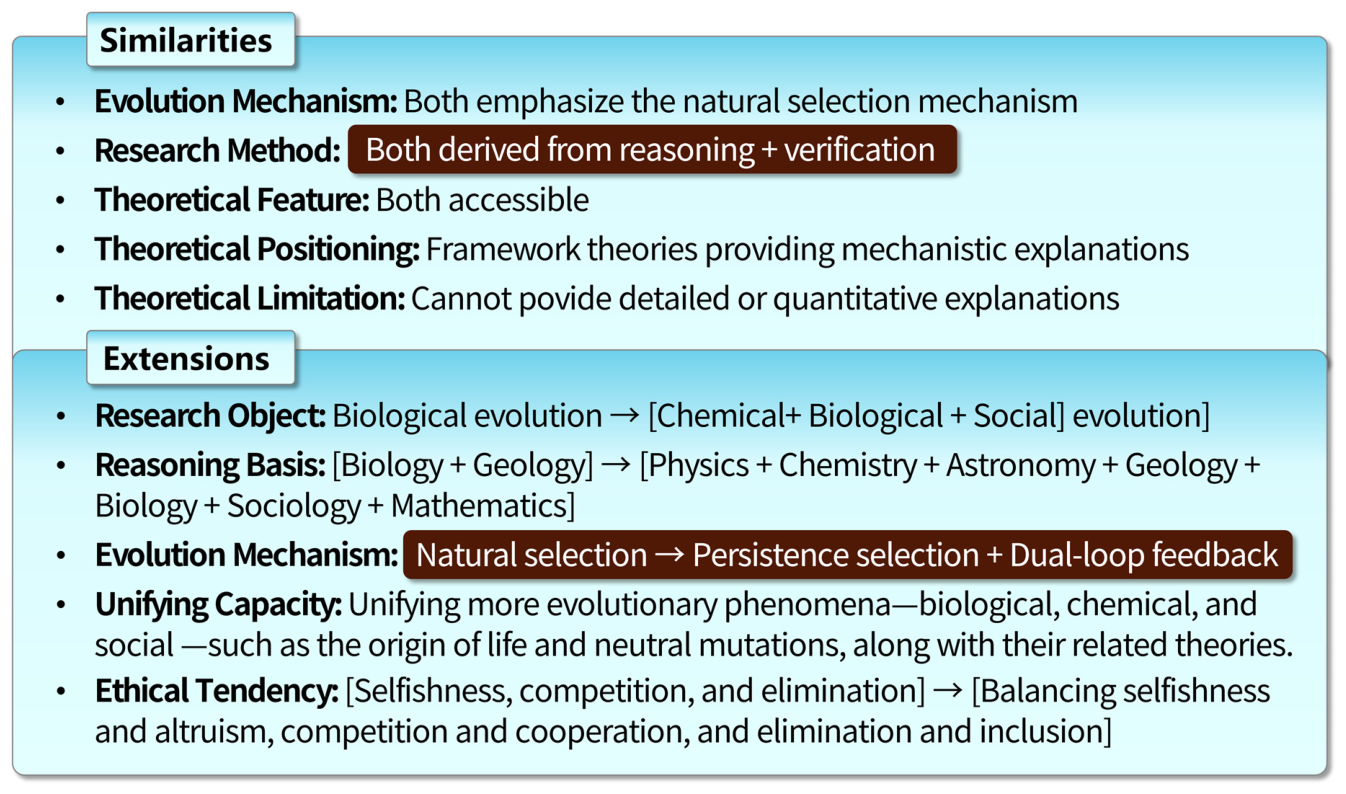
CBET is an extension of Darwinian evolutionary theory along diverse dimensions (Figure 5). These extensions constitute the innovation in the discourse system of CBET.
The first two extensions are that biological evolution is extended to chemical, biological, and social evolution of CBMs, and that natural selection tied to biological inheritance is extended to persistence selection, which includes artificial selection and natural selection independent of biological inheritance. These two extensions enable CBET to provide a unified account of the change–selection mechanism common to chemical, biological, and social evolution, much as Darwinian evolutionary theory did for biological evolution.
Third, the basis of reasoning is extended from the four facts established by geological and biological evidence (fossils from different geological periods are markedly different; organisms can undergo heritable variation; organisms generally exhibit overproduction of offspring; and environmental resources are limited [2]) to six scientific principles derived from integrating knowledge from physics, chemistry, biology, sociology, geology, astronomy, logic, and mathematics (SI Appendix, Text S3). These principles capture the complex causal relationships among energy, environment, structure, function, and various other basic factors crucial to evolution, thereby making CBET’s foundations more solid and its logic more rigorous.
Fourth, the single mechanism of natural selection for filtering changes is extended to two mechanisms: dual-loop feedback for producing changes and persistence selection for filtering changes. Consequently, CBET has greater explanatory and unifying power than Darwinian evolutionary theory, even with respect to biological issues, as will be clarified below in Section 4.3.
Because CBET uniquely employs the specific structures and functions of CBMs, it can explain chemical, biological, and social evolution more concretely than systems theory [20], cybernetics [21], universal selection theory [24‒25], generalized Darwinism [22], complex adaptive systems theory [23], although its scope of application is narrower than theirs.
4.2. Innovations and Applications in Chemical Evolution
Previous discussions of the mechanisms of the origin of life have been sparse, whereas CBET derives two mechanisms: “dual-loop feedback + persistence selection”. The former generates endless structural variation; the latter screens that variation. Once the former produces a special structure capable of reproduction, the latter can readily select it from trillions of carbon-based material structures, because this structure has a marked persistence advantage over non-reproductive structures. In addition, in suitable environments, through the long-term action of persistence selection, among complex carbon-containing small molecules (HC3), carbon-containing macromolecules (HC4), and HC4 mutual-support systems, those that are difficult to form and easy to degrade tend to be eliminated, while those that are easy to form and difficult to degrade tend to accumulate. This steers chemical evolution toward the origin of life and significantly raises its likelihood. Consequently, although the origin of life is a chance event of extremely low probability, it could have occurred in early Earth surface environments because of the enormous number of attempts and the action of the two mechanisms.
4.3. Innovations and Applications in Biological Evolution
(1) Describing Natural SelectionMore Comprehensively
CBET describes natural selection more comprehensively in the following respects.
First, early Darwinian evolutionary theory emphasized natural selection as “survival of the fittest” [1], which profoundly influenced the social sciences. The modern synthesis essentially emphasizes natural selection as “survival of the fitter” [2]. Accordingly, people have wondered why multicellular organisms, endotherms, and sexual reproduction should have advantages over unicellular organisms, ectotherms, and asexual reproduction, respectively. Based on the mathematical rules of natural selection, CBET proposes “survival of the fit enough”. For example, less competitive but “fit enough” animals, individual humans, or companies can still persist, especially in resource-rich environments. Accordingly, CBET holds that the origin and diversification of proteins, multicellular organisms, endotherms, and sexual reproduction did not require them to possess greater selective advantages than amino acids, unicellular organisms, ectotherms, and asexual reproduction, respectively.
Second, the traditional view holds that certain peculiar biological traits, such as the giraffe’s long neck, all possess natural-selection advantages, and then analyzes why these traits have such advantages [1,33]. CBET claims that natural selection screens organisms or social organizations according to their overall performance. Therefore, an individual trait may, on the whole, be advantageous, neutral, or deleterious with respect to natural selection. This allows neutral mutations (which have no significant effect on overall performance [2]) to exist widely in the biological world, and allows humans and other organisms to retain certain relatively unfavorable traits—such as the weak independent survival ability of human infants—as long as the selective disadvantages of these traits can be offset by the selective advantages of other traits.
Third, the traditional view holds that natural selection is brutally eliminative, whereas CBET, based on the mathematical rules of natural selection, claims that natural selection is both eliminative and inclusive, as the two points above show that natural selection is inclusive. Moreover, many combinations of various traits can maintain population reproduction in terms of overall performance. For example, gazelles, which are weak in combat but fast runners, and hippos, which are strong in combat but slow runners, can coexist on the African savanna.
Fourth, the traditional view holds that natural selection is brutally competitive or antagonistic, whereas CBET claims that natural selection also embodies an anti-over-involution mechanism and nonviolent competition. Take elephants as an example: if they adopted a reproductive strategy of multiple births per year, multiple offspring per birth, and high calf survival, it would rapidly overload the ecosystem and drive elephants toward destruction. Furthermore, many animals, such as bowerbirds, red deer, and fiddler crabs, employ non-violent forms of competition [2].
Fifth, the traditional view holds that natural selection is strongly selfish, and some even hold that genes are selfish [34]. CBET claims that in the evolutionary process, selfishness and altruism universally coexist. Besides ubiquitous selfishness, altruistic behavior is widespread throughout CBM evolution: at the molecular level, many molecules assist the synthesis and stabilization of other substances by providing raw materials, energy, or catalysis, exhibiting an elementary form of altruism. At the organismal level, immune cells sacrifice themselves through programmed apoptosis to protect other cells and the organism as a whole; and at the level of animal societies, eusocial organisms such as bees and ants exhibit obvious altruistic sacrificial behaviors. Most of the above altruistic behaviors are adaptive strategies shaped by long-term natural selection that benefit the stable persistence of populations. For human society, under the joint action of multiple factors such as social institutional constraints, individual moral consciousness, and emotional cognition, the motivations for altruistic behavior are more diverse: there is both reciprocal altruism and unconditional altruism that seeks no return. Moreover, with the refinement of the social division of labor and the strengthening of social cooperation, the universal interplay of selfishness and altruism—“everyone for me, and I for everyone”—is widespread in human society.
Sixth, the traditional view holds that natural selection emphasizes competition, whereas CBET claims that in the evolutionary process, competition and cooperation universally coexist. Compared with non-carbon-based substances, CBMs have achieved enormous evolutionary success, which stems from the fact that CBMs can form relatively stable cooperative systems at every structural level [35]. Furthermore, the outcome of natural selection is to enhance the internal orderliness and cooperativity of CBMs.
Seventh, the traditional view holds that natural selection acts only on heritable changes. CBET decouples natural selection from biological heredity and thus integrates various non-heritable traits—such as many animals changing their foraging behavior, habitats, migratory routes, and widespread epigenetic phenomena—that can significantly affect individual survival and population persistence. CBET further merges natural selection with artificial selection (such as vaccination, acquired education, and emergency risk avoidance) into the “persistence selection mechanism,” thereby further acknowledging the importance of acquired traits in evolution. This is consistent with universal selection theory and generalized Darwinism [22,24‒25].
(2) Integration of biological evolutionary phenomena and theories
The dual-loop feedback mechanism of CBET, through its causal relationships and feedback among structures, functions, and environments, directly integrates niche construction, in which organisms modify their environment and the modified environment feeds back on them [13]. It also integrates constructive development, in which organisms respond to environmental conditions during development and thereby alter their subsequent functions and environments [13]. Cultural and ecological inheritance [13] can also be integrated into CBET through the dual-loop feedback mechanism, because environmental factors—including cultural and ecological ones—serve as external causes of change. The joint action of the two mechanisms in CBET leads to increased CBM complexity, which can, in turn, generate complex functions, thereby subsuming the complex functions of epigenetics [11], non-random mutation [12], developmental constraints [2], developmental regulation [2], and coevolution [32], at the framework level. Additionally, CBET integrates the ubiquity of neutral mutations [2], altruism [7], and cooperation, as well as non-heritable changes and artificial selection, through its comprehensive description of natural selection, as described above.
4.4. Innovations and Applications in Social Evolution
(1) New Explanations for the Mechanisms and Direction of Social Evolution
CBET reveals that, although carbon-containing macromolecules, organisms, and social organizations belong to different hierarchies, they are all CBMs. They all exhibit dynamic cycles of formation and degradation accompanied by change (such as the establishment and dissolution of basketball teams), and they all follow the dual-loop feedback mechanism and the persistence selection mechanism. Under the joint action of these two mechanisms, the structures of certain animals tend to become more complex, enabling close cooperation among individuals, thereby forming social organizations. For instance, ants and humans possess special complex structures, such as the pheromone communication system and individual developmental regulation system of ants and the special intellectual system of humans that aid them in forming societies.
Under the joint action of the dual-loop feedback mechanism and the persistence selection mechanism, together with the unique human capacity for continuously accumulating knowledge and transmitting it across generations, human society as a whole exhibits four evolutionary trends: first, science, technology, and managerial capabilities generally continue to advance (although regression occurs in some regions and periods); and second, the potential intensity of warfare increases with technological progress, from cold weapons to hot weapons, and then to nuclear weapons, biological weapons, and artificial-intelligence weapons; third, the social division of labor continues to be refined and cooperation continues to strengthen (because both enhance the persistence selection advantages of individuals and social organizations [15,36]); and fourth, governance systems, by means of negotiation, intermarriage, competition, conflict, and war, show an overall expansion trend, from clans to tribes, tribal alliances, city-states, nations, and then to alliances of nations [14‒15].
Human governance systems tend to expand for five reasons. First, advances in science, technology, and management underpin larger governance systems, which in turn help develop and spread expertise in these fields—a positive-feedback relationship. Second, expanding governance systems enhance friendliness and cooperation among people, which in turn facilitates further expansion. Third, larger, well-managed governance systems hold a clear persistence-selection advantage: they help societies win wars and reduce their frequency (e.g., wars among allied tribes or states). Fourth, war integrates governance systems by annexing territory, while its massive destruction and killing drive humanity to seek stronger protection by forming larger governance systems. This logic remains true today, as nuclear, biological, AI, and space weapons have greatly increased war’s destructive power. Fifth, some politicians’ pursuit of larger systems, together with the public’s prevalent instinctive desires for security, peace, freedom, wealth, and respect, shapes artificial selection within the persistence-selection mechanism, thereby driving expansion.
Following the aforementioned four trends and five reasons, human society has generally evolved along the path of band → clan → tribe → chiefdom → state → regional or global governance systems [14‒15], and has already entered a preliminary Global Unified Cooperative Society (GUCS). This preliminary GUCS, which has existed since the establishment of the United Nations, has fostered countless international cooperation programs and helped prevent many international wars [37]. Whether humanity advances to higher stages of the GUCS depends not only on the trend of social evolution but also on whether natural or man-made disasters capable of destroying humanity occur in the future.
(2) Integration ofsocial evolutionary phenomena and theories
CBET can subsume the major social evolutionary theories, including classical social evolutionism [14], Marxism [38], neo-evolutionism [36,39], universal evolutionism [39], social hierarchy theory [15], multilinear evolution [36], geographic-environmental theory [16], modernization theory [40], and world-systems theory [17]. For example, Service’s social hierarchy theory can be explained directly by the joint action of the dual-loop feedback mechanism and the persistence selection mechanism driving social organizations to higher hierarchies, and these elevated social organizations can endure in the world because they possess persistence selection advantages. Steward’s multilinear evolution and Diamond’s geographic-environmental theory can both be explained using the joint action of the two mechanisms in CBET: environmental factors are the external cause of change in social organizations, and different natural geographical environments as well as different socio-cultural environments impose different persistence selection pressures on social organizations; to adapt to their respective unique living environments, social organizations develop different structures and functions, and therefore social evolution exhibits “multilinear” pathways. Wallerstein’s world-systems theory can be explained using CBET’s dual-loop feedback mechanism and persistence selection mechanism: hegemonic states, through their own powerful functions, exploit and plunder weaker states, and this exploitation and plunder compel the weaker states to resist, reform, and enhance their capabilities, causing the cost of the hegemonic states’ exploitation and plunder to rise continually, while the hegemonic states also face competition from emerging great powers. Therefore, the international competitiveness of the exploitative, plundering approach has generally weakened, while the international competitiveness of the cooperative, win-win approach has strengthened. This change conforms to the trend of human society developing toward the GUCS.
(3) Ethical References for Harmonious Social Development
CBET reveals the preciousness of human life and the importance of energy, environment, and own structure and functions. It reveals the natural balance among competition and cooperation, elimination and inclusiveness, self-interest and altruism, and individual and collective interests, thereby providing relatively comprehensive and positive ethical references for the harmonious development of human society. The ethical reference system mapped by CBET accommodates the biological facts partially stated by social Darwinism [41] (the universal existence of competition, elimination, and selfishness). Meanwhile, it corrects social Darwinism with the other facts of CBM evolution that social Darwinism leaves unstated (the equally universal existence of cooperation, inclusiveness, and altruism), thereby transcending social Darwinism [19].
5. Rationality and Scope of Application
5.1. Testing of Logical Soundness
The logical soundness of CBET is manifested in two respects: (1) its reasoning process is based on causal relationships (for example, environmental factors influence changes in the structure or position of matter) that are understandable and universal in the realm from atoms to societies; (2) each of the eight steps of CBET reasoning follows strict logical constraints, and there are neither incommensurable conceptual leaps between steps nor any reliance on unproven particular assumptions (Figure 4).
5.2. Testing by Positive Cases
All carbon-containing molecules, organisms, and social organizations are continuously and simultaneously subject to the dual-loop feedback mechanism and the persistence selection mechanism, with no counterexamples found.
5.3. Falsifiability Testing
CBET is falsifiable. If it were found that a disordered CBM directly formed a highly ordered complex structure such as an eye through the instantaneous action of a “self-organization” mechanism driven by entropy reduction, rather than through the long-term co-action of the dual-loop feedback mechanism and the persistence selection mechanism, CBET would be directly refuted. Moreover, the phenomenon of quantum entanglement serves as a counterexample to CBET’s Energy-Change Principle. CBET restricts its scope of application to CBMs, thereby circumventing this counterexample. In the process of establishing CBET, various counterexamples were found. To address them, CBET was revised substantially—for example, changing “energy input” to “energy transfer,” adding “position” and “other causes” to the reasoning path, and extending “natural selection” to “persistence selection.” Consequently, no counterexamples to the current version of CBET have been identified in the realm from atoms to societies.
5.4. Testing of Explanatory and Predictive Power
5.5. Scope of Application
CBET applies to the explanation of evolutionary phenomena of CBMs; it applies to neither the evolution of non-carbon-based substances nor non-evolutionary issues.
6. Summary and Discussion
This article has derived CBET through an eight-step reasoning process. CBET identifies two core mechanisms driving the evolution of CBMs—the dual-loop feedback mechanism that creates change and the persistence selection mechanism that ceaselessly filters change—and thereby provides a unified, framework-level explanation of the complete evolutionary picture from carbon atoms to human society. CBET does not directly reduce complex social issues to physical or chemical principles.
CBET’s innovation lies in its novel perspective and discourse system, and this innovation derives from the extension of Darwinian evolutionary theory along the dimensions of the object of study, the theoretical protagonist, the reasoning basis, the connotation of natural selection, and the evolutionary mechanisms. The innovation enables CBET to make three distinctive contributions (Figure 2): (1) it reveals more clearly and concretely than previous theories the mechanisms shared by chemical, biological, and social evolution (SI Appendix, Text S4); (2) it more tightly unifies than previous theories numerous evolutionary phenomena and theories that were originally formulated separately, thereby constructing a relatively comprehensive theoretical framework and depicting the entire evolutionary picture from carbon atoms to the human future; and (3) it provides a relatively systematic, positive, and balanced ethical reference system for global peace and the harmonious development of human society, with the potential to dispel the negative ethical influence of Social Darwinism. CBET also proposes that human society has already entered a preliminary Global Unified Cooperative Society (GUCS), and that the intermediate and advanced stages of the GUCS remain possible future directions.
Like the other theories listed in Figure 2, CBET provides neither new experimental data nor new mathematical formulas, and it offers neither detailed nor quantitative explanations for specific evolutionary processes. Furthermore, future scrutiny and empirical testing by the scientific community are necessary to determine the soundness and explanatory power of CBET.
Supplementary Materials
The following supporting information can be downloaded at the website of this paper posted on Preprints.org. It includes the eight hierarchies of CBMs, the functions of CBMs, the six principles, and CBET’s integration of various evolutionary theories.
Author Contributions
Author contributions: J.M.C. conceived, designed, and performed the study, provided financial support, and contributed approximately 92% to this article; J.W.C. performed the study, provided financial support, and contributed approximately 8% to this article; J.M.C. wrote the manuscript; both authors revised and approved the manuscript.
Acknowledgments
This study was supported by the High-Level Talent Fund of Foshan University (No. 20210036). The authors thank Feng Tang, Meng Yang, Zhen Liu, Ying Li, Hai Xiang, and many other people for their comments on this study. The authors thank Yiqing Chen who revised figures and the mathematical parts of this work.
References
- Darwin, C. On the Origin of Species by Means of Natural Selection; John Murray, 1859. [Google Scholar]
- Futuyma, D. J.; Kirkpatrick, M. Evolution; Sinauer Associates, 2023. [Google Scholar]
- Chen, J. M. A new evolutionary theory deduced mathematically from entropy amplification. Chin. Sci. Bull. 2000, 45(1), 91–96. [Google Scholar] [CrossRef]
- Xie, P. The aufhebung and breakthrough of the theories on the origin and evolution of Life; Science Press, 2014. [Google Scholar]
- Oparin, A. I. Chemistry and the origin of life. R. Inst. Chem. Rev. 1969, 2, 1–12. [Google Scholar] [CrossRef]
- Fiore, M. Prebiotic chemistry and life’s origin; Royal Society of Chemistry, 2022. [Google Scholar]
- Nowak, M. A.; Tarnita, C. E.; Wilson, E. O. The evolution of eusociality. Nature 2010, 466(7310), 1057–1062. [Google Scholar] [CrossRef] [PubMed]
- Birch, J. The philosophy of social evolution; Oxford University Press, 2017. [Google Scholar]
- Frenkel-Pinter, M.; Samanta, M.; Ashkenasy, G.; et al. Prebiotic peptides: molecular hubs in the origin of life. Chem. Rev. 2020, 120(11), 4707–4765. [Google Scholar] [CrossRef] [PubMed]
- Spitzer, J. Physicochemical origins of prokaryotic and eukaryotic organisms. J. Physiol. 2024, 602(11), 2383–2394. [Google Scholar] [CrossRef] [PubMed]
- Richards, C. L.; Pigliucci, M. How does epigenetics influence the course of evolution? Philos. Trans. R. Soc. B Biol. Sci. 2020, 376(1826), 20200111. [Google Scholar] [CrossRef] [PubMed]
- Cano, A. V.; Gitschlag, B. L.; Rozhoňová, H.; et al. Mutation bias and the predictability of evolution. Philos. Trans. R. Soc. B Biol. Sci. 2023, 378(1877), 20220055. [Google Scholar] [CrossRef] [PubMed]
- Laland, K. N.; Uller, T.; Feldman, M. W.; et al. The extended evolutionary synthesis: its structure, assumptions and predictions. Proc. R. Soc. B Biol. Sci. 2015, 282(1813), 20151019. [Google Scholar] [CrossRef] [PubMed]
- Morgan, L. H. Ancient Society; H. Holt and Company, 1877. [Google Scholar]
- Service, E. R. Primitive Social Organization, 2nd ed.; Random House, 1971. [Google Scholar]
- Diamond, J. Guns, Germs, and Steel; W.W. Norton, 1999. [Google Scholar]
- Wallerstein, I. The Modern World-System; Academic Press, 1974. [Google Scholar]
- Rudman, L. A.; Saud, L. H. Justifying social inequalities: The role of social Darwinism. Personal. Soc. Psychol. Bull. 2020, 46(7), 1139–1155. [Google Scholar] [CrossRef] [PubMed]
- Li, J. H. The Ultimate Principle of Human Relations: An Ethics of Coordination. In Social Sciences Academic Press; 2024. [Google Scholar]
- Mobus, G. E.; Kalton, M. C. Principles of Systems Science; Springer, 2015. [Google Scholar]
- Wiener, N. Cybernetics: Or Control and Communication in the Animal and the Machine, 2nd ed.; Quid Pro, LLC, 2015. [Google Scholar]
- Rosenberg, A. The Inevitability of a Generalized Darwinian Theory of Behavior, Society, and Culture. Am. Philos. Q. 2021, 58(1), 50–62. [Google Scholar] [CrossRef]
- Holland, J. H. Adaptation in Natural and Artificial Systems; MIT Press: Cambridge, MA, 1992. [Google Scholar]
- Hull, D. L. Individuality and Selection. Annu. Rev. Ecol. Syst. 1980, 11, 311–332. [Google Scholar] [CrossRef]
- Hull, D. L. Science as a Process: An Evolutionary Account of the Social and Conceptual Development of Science; University of Chicago Press: Chicago, 1988. [Google Scholar]
- Razeghi, M. The mystery of carbon: An introduction to carbon materials; IOP Publishing, 2019. [Google Scholar]
- Seager, S. Exoplanet habitability. Science 2013, 340(6132), 577–581. [Google Scholar] [CrossRef] [PubMed]
- Reichle, D. E. The Global Carbon Cycle and Climate Change, 2nd ed.; Elsevier, 2023. [Google Scholar]
- Olejarz, J.; Iwasa, Y.; Knoll, A. H.; et al. The Great Oxidation Event as a consequence of ecological dynamics modulated by planetary change. Nat. Commun. 2021, 12(1), 3985. [Google Scholar] [CrossRef] [PubMed]
- Lange, A. Extending the Evolutionary Synthesis: Darwin’s Legacy Redesigned; CRC Press: Boca Raton, FL, 2023. [Google Scholar]
- Price, G. R. Selection and covariance. Nature 1970, 227(5257), 520–521. [Google Scholar] [CrossRef] [PubMed]
- Benton, M. J. The Red Queen and the Court Jester: species diversity and the role of biotic and abiotic factors through time. Science 2009, 323(5915), 728–732. [Google Scholar] [CrossRef] [PubMed]
- Wang, S. Q.; Ye, J.; Meng, J.; et al. Sexual selection promotes giraffoid head-neck evolution and ecological adaptation. Science 2022, 376(6598), eabl8316. [Google Scholar] [CrossRef] [PubMed]
- Dawkins, R. The Selfish Gene; Oxford University Press, 1976. [Google Scholar]
- Axelrod, R.; Hamilton, W. D. The evolution of cooperation. Science 1981, 211(4489), 1390–1396. [Google Scholar] [CrossRef] [PubMed]
- Steward, J. H. Theory of Culture Change: The Methodology of Multilinear Evolution; University of Illinois Press, 1955. [Google Scholar]
- Keohane, R. O. After Hegemony: Cooperation and Discord in the World Political Economy; Princeton University Press, 1984. [Google Scholar]
- Cohen, G. A. Karl Marx’s Theory of History: A Defence; Princeton University Press, 1978. [Google Scholar]
- White, L. A. The Evolution of Culture: The Development of Civilization to the Fall of Rome; McGraw-Hill, 1959. [Google Scholar]
- Rostow, W. W. The Stages of Economic Growth: A Non-Communist Manifesto; Cambridge University Press, 1960. [Google Scholar]
- Hofstadter, R. Social Darwinism in American Thought, Revised ed.; Beacon Press, 1955. [Google Scholar]
Figure 1.
Scopes of Carbon-Based Evolutionary Theory (CBET) and related theories. CBET occupies precisely the vacant middle position—a framework theory that unifies theories of chemical, biological, and social evolution.
Figure 1.
Scopes of Carbon-Based Evolutionary Theory (CBET) and related theories. CBET occupies precisely the vacant middle position—a framework theory that unifies theories of chemical, biological, and social evolution.
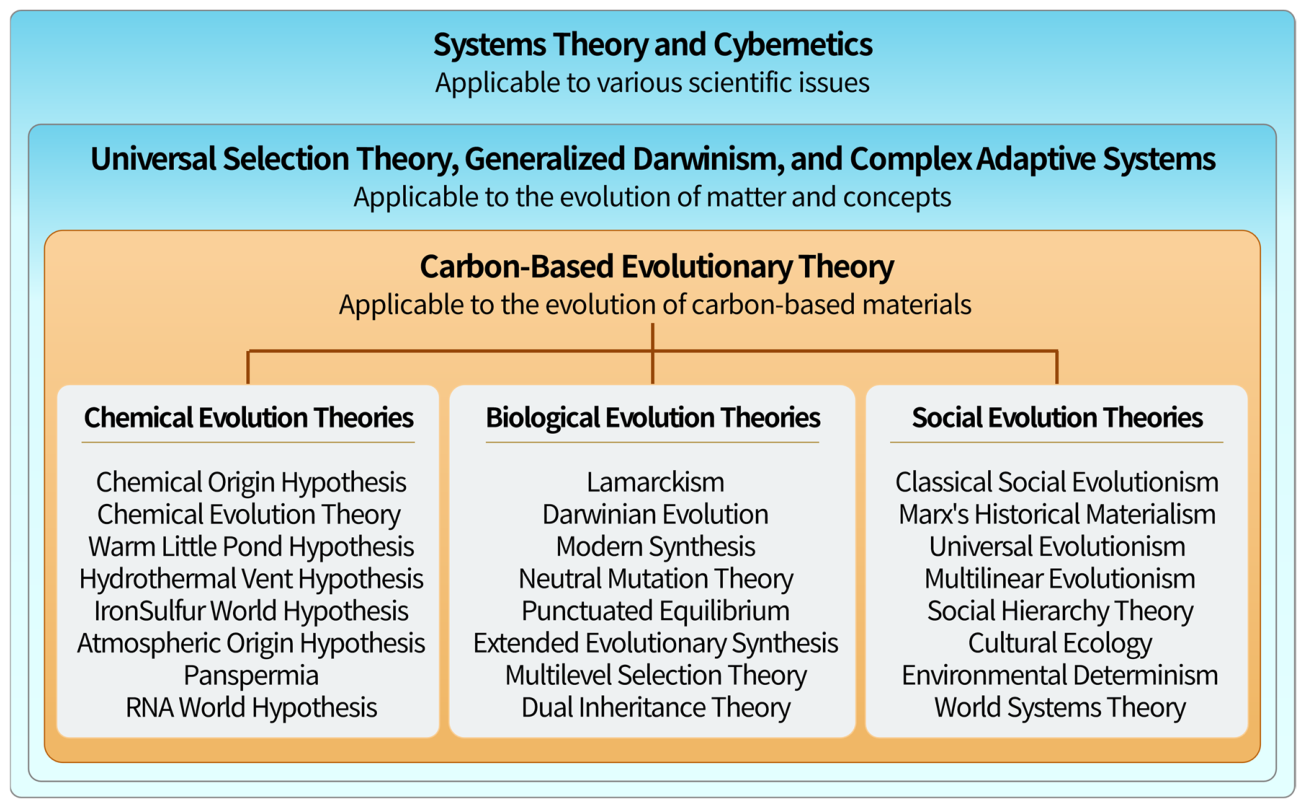
Figure 2.
The reasoning route of CBET (the brown section) and numerous evolutionary phenomena and theories that were previously articulated separately and are unified by CBET (the green section).
Figure 2.
The reasoning route of CBET (the brown section) and numerous evolutionary phenomena and theories that were previously articulated separately and are unified by CBET (the green section).
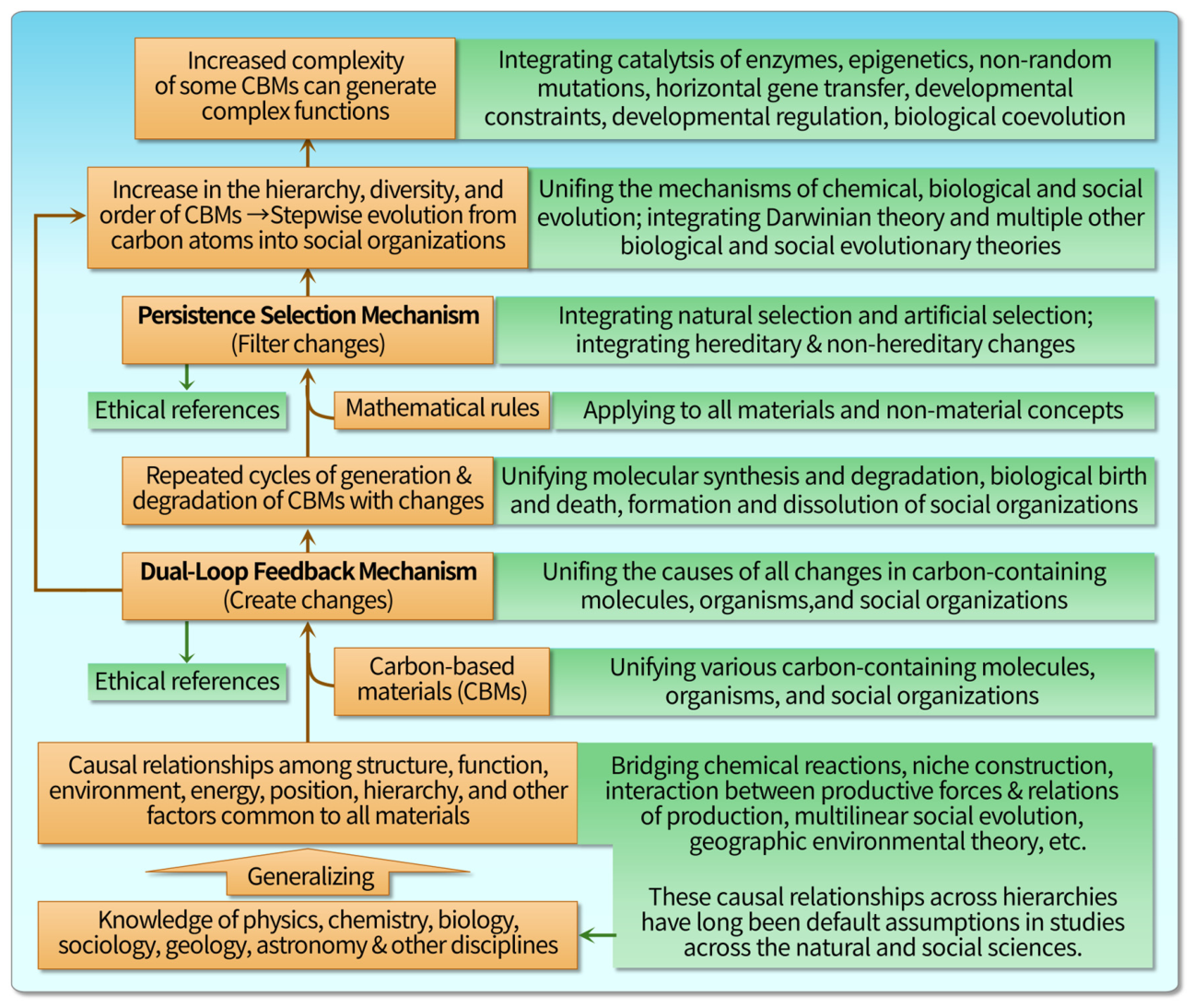
Figure 3.
Definitions of the eight hierarchies of CBMs (HC1–HC8) and their three evolutionary stages. Some CBMs lie between two hierarchies.
Figure 3.
Definitions of the eight hierarchies of CBMs (HC1–HC8) and their three evolutionary stages. Some CBMs lie between two hierarchies.
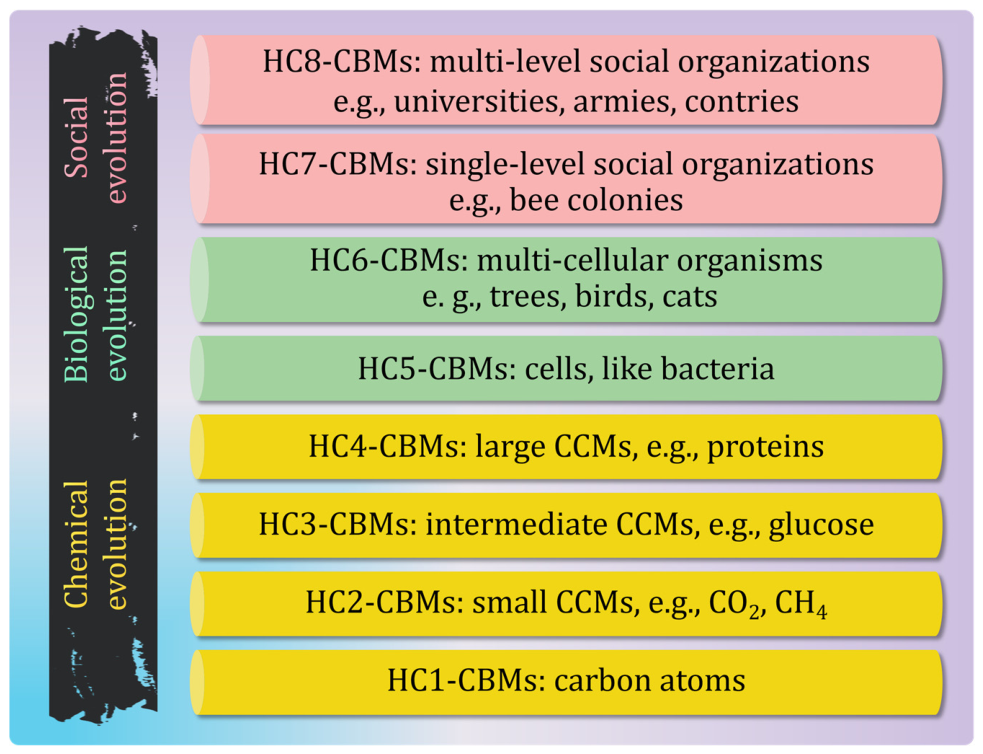
Figure 4.
Reasoning processes of Darwinian evolutionary theory (single mechanism) and Carbon-Based Evolutionary Theory (dual mechanisms).
Figure 4.
Reasoning processes of Darwinian evolutionary theory (single mechanism) and Carbon-Based Evolutionary Theory (dual mechanisms).
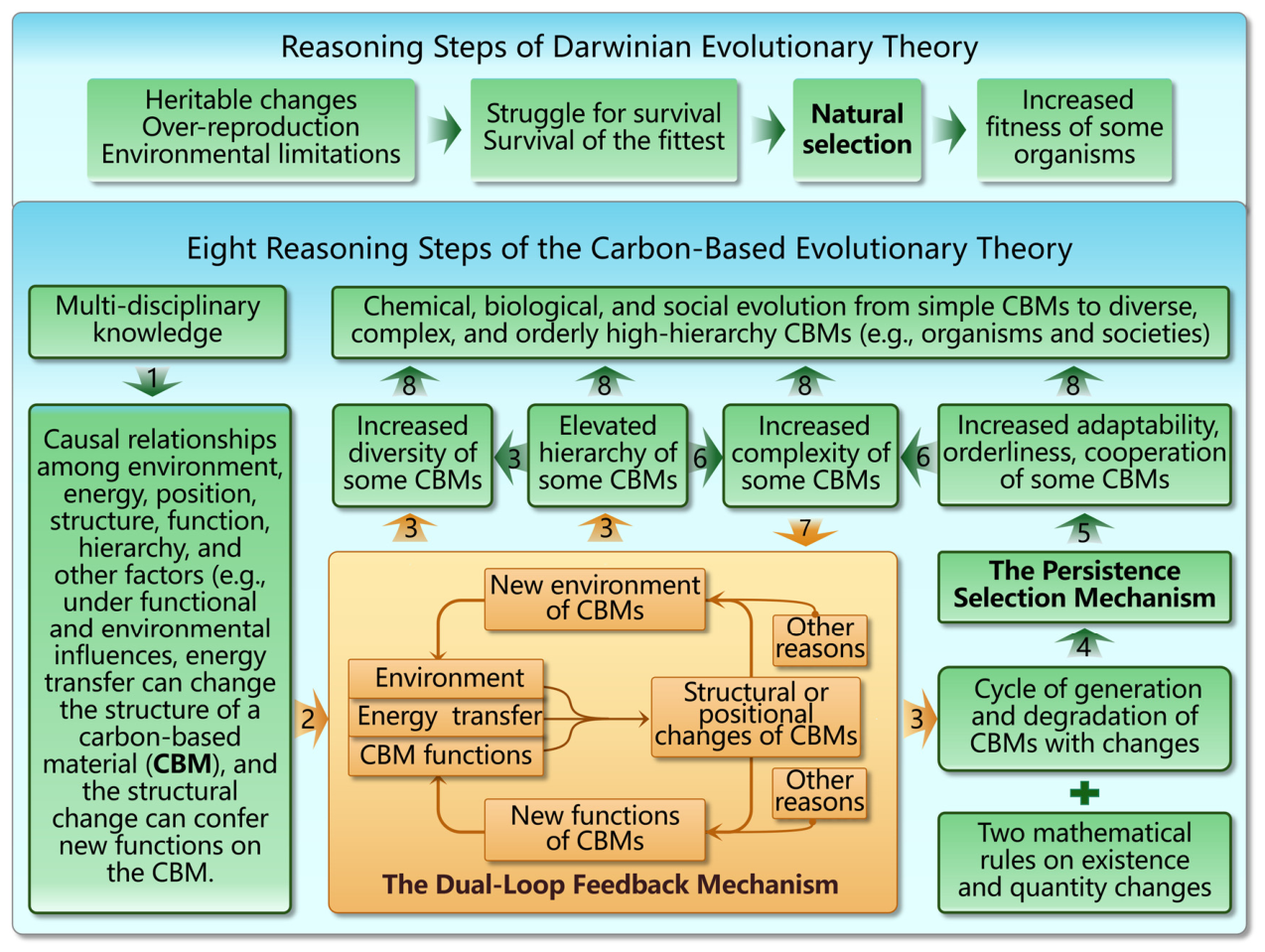
Figure 5.
Similarities and extensions between Carbon-Based Evolutionary Theory and Darwinian evolutionary theory.
Figure 5.
Similarities and extensions between Carbon-Based Evolutionary Theory and Darwinian evolutionary theory.
Disclaimer/Publisher’s Note: The statements, opinions and data contained in all publications are solely those of the individual author(s) and contributor(s) and not of MDPI and/or the editor(s). MDPI and/or the editor(s) disclaim responsibility for any injury to people or property resulting from any ideas, methods, instructions or products referred to in the content. |
© 2026 by the authors. Licensee MDPI, Basel, Switzerland. This article is an open access article distributed under the terms and conditions of the Creative Commons Attribution (CC BY) license (http://creativecommons.org/licenses/by/4.0/).
Copyright: This open access article is published under a Creative Commons CC BY 4.0 license, which permit the free download, distribution, and reuse, provided that the author and preprint are cited in any reuse.