

Submitted:
15 July 2024
Posted:
16 July 2024
You are already at the latest version
Abstract
Differences between the quantum mechanical and relativistic concepts of time observed in GPS satellites are accounted for by applying the equivalence principle to the transitioning electron of an atomic clock. This allows a differential equation of motion to be derived for the electron in the Minkowski space between electron shells. By applying Hamilton’s principle we transform the differential equation into a relativistically correct integral equation of motion, the time integral of a Lagrangian. This newly derived equation accounts for the abstract mathematics of the more familiar non-relativistic model by means of a physical interpretation. Abstract rotations in Hilbert space are replaced by real rotations of particle field geometries in Minkowki space that describe the electron transition and emission of a photon. Because the properties of energy are universal the same integral equations are able to be used to describe the time evolution of galaxies despite vast differences in lifetime. The comparison of gravitational and electromagnetic energy exchanges by means of radial and transverse fields leads to an alternative to the standard model that is based on a field model. It explains the observed properties of galaxies as a superposition of neutrinos localized within the horizon of a black hole with spins aligned. The particle properties of free neutrinos are accounted by means of a classical field geometry; specifically, a spin that is oriented in space with rotational inertia due to energy. A test of the standard model is proposed based on differing views for flavor oscillation.
Keywords:
time
; clocks
; quantum mechanics
; relativity theory
; conjugate variables
; space-time linearity
; energy
; quantum gravity
; neutrinos
1. Introduction
We do not have a theory of quantum gravity that successfully describes both quantum mechanics, governing the microscopic properties of matter; and relativity theory, its large scale behavior. It is hypothesized here that the greatest impediment to integrating these two foundational frameworks of theoretical physics is the question of time. Time is registered by clocks, devices that read out a one-dimensional sequence of increasing numbers. Currently there is no way to distinguish between clocks, a mechanism, and time, a concept. They are treated operationally as one and the same thing. On the one hand clock mechanisms are quantum oscillators consisting of electrons that transition between orbitals while registering time as a series of ticks. On the other hand, time is relativistic in nature and varies continuously according to a clock’s motion and gravitational potential. In order to calculate the passage of time on the earth’s surface corrections are applied to satellite time based on factors such as velocity and altitude relative to the earth’s surface that are unrelated to clock function. The clocks in GPS systems are corrected for relative velocity and gravitational potential, but without knowing from a quantum mechanical perspective why it is necessary. In other words, clocks register ticks absolutely in rigid succession, but time is perceived relativistically as a continuous variable. Moreover, corrections made to the orbiting clocks due to velocity and gravitational potential are applied simultaneously. If clocks are conceived of as operationally singular mechanisms that indicate time with a string of ticks caused by a transitioning electron, then it is difficult to comprehend how the electron, transitioning within the atom in a regular way, is able to process inputs from two physically distinct external sources, velocity and gravitational potential. Clocks are described quantum mechanically, but time is relativistic; and it seems contradictory to attempt to explain relativistic corrections with nonrelativistic theory. To resolve differences between the quantum mechanical and relativistic interpretations of time fundamental change will be necessary.
2. Accelerated Frames
Time is not an observable in quantum mechanics. Observables are measured by bringing a measuring device into contact with the physical system and different values of the observable are obtained depending on the state of the system. In quantum mechanics time measurements are performed without making contact with the observed physical system, a clock. So the time "measured" by clocks is not a quantum mechanical observable. It is just a numerical parameter, one of four coordinates, the same as in classical physics, and clocks are treated as simple measuring devices of absolute time. If time could actually be treated the same as spatial parameters, then a simple transformation of clock coordinates would be sufficient to make the quantum and relativity theories compatible. However, relativistic time varies continuously with respect to velocity and gravitational potential, and this contrasts sharply with quantum mechanical clocks which measure time in absolute increments of discrete amount. To understand why a fundamental difference between quantum mechanical time and relativistic time exists we must look at the origins of quantum theory.
Soon after the Bohr model of the atom was proposed in 1913 the assumption was made that the effects of gravitational field on an atom during the emission and absorption of radiation were so small that they could be neglected. At the time there were very few objections and no hard evidence to the contrary. The uncertainty principle was introduced upon further development of the quantum mechanical formalism providing “proof” that electron orbitals cannot be described with classical trajectories and it contributed to the popular belief that a nonrelativistic formulation of quantum mechanics for atomic structure in abstract space is both sufficient and complete. This caused the dynamic, classically inspired geometry of relativity theory to be set aside in favor of Hilbert space, an abstract complex linear vector space that is rigid.
Because quantum theory is limited to applications in inertial systems there was no immediate need for it to be extended to non-inertial geometries that include gravitational fields. However, in recent years new and totally unexpected experimental techniques have been developed that can link 10,000 atoms in a lattice that functions as a single quantum oscillator and atomic clock [1].This allows error due to thermal radiation to be essentially eliminated from properties of atomic structure and extremely precise measurements of time to be performed. When quantum oscillators of this type are used as clocks they are able to detect differences in the earth's gravitational potential as small as one millimeter [2]. If a different time coordinate can be associated with each point in space it means that the quantum mechanical concept of absolute time is no longer a viable concept and the inertial frames it uses are not universally valid for formulating the laws of nature. Because the tiniest of gravitational potentials cannot be ignored all physical laws should be formulated in non-inertial, or accelerated frames.
Non-relativistic quantum mechanics is formulated in inertial frames; that is, frames in uniform relative motion and in the absence of gravitational potentials. To be applied to events in accelerated frames it must first be formulated relativistically. Dirac noted that possibility in his paper on quantum electrodynamics [3], “The theory is non-relativistic only on account of the time being counted throughout as a c-number [classically], instead of being treated symmetrically with the space coordinates.” In other words, for the time variable to be relativistically correct it must be treated the same as the space coordinates with both discrete and continuous properties; that is, discrete ticks with relativistic fluctuations. A fully relativistic theory of quantum mechanics formulated with space and time coordinates that are symmetrical must hold in all frames, also accelerated frames.
3. Gravitational Perturbations
3.1. Deficiencies of the Standard Model
According to the standard model gravitons mediate exchanges of gravitational field energy at the quantum level. However, an experimental procedure to detect gravitons that could be performed in practice has never been developed. Because of their low cross section during interactions with matter it has been questioned whether the detection of gravitons is even possible [4]. An alternate method is to use the continuum space of general relativity theory and study the behavior of physical systems at the quantum level by perturbing them with a barely detectable gravitational field. A light beam that alters direction in propagation space by close proximity to a massive body, is one example. When stars are perfectly aligned the resulting gravitational lens can create the image of an “Einstein cross”. The deviation of light from rectilinear motion is observed to occur continuously without perceivable corrections of a discrete nature.
A second example is the perturbation that occurs when slight differences in gravitational potential cause an atomic clock to change its rate. The changes in rate occur continuously in response to continuous changes of velocity and gravitational potential, a result that is in complete agreement with relativity theory, but is not compatible with the foundations of quantum theory which requires changes to be discrete. In order to describe the slight changes in clock rate caused by gravitational perturbation in a way that is consistent with relativity theory an interpretation of quantum mechanics for accelerated frames is required, one that includes time in both discrete and continuous forms. In other words, we need a model of the atom that explains how the discrete ticks of a clock caused by an oscillating electron are able to change in response to the continuous perturbations of velocity and gravitational potential.
3.2. Classical Space-Time Geometry
In general relativity theory space-time geometry curves in response to the influence of matter. If it is curved significantly it would indicate that the background space-time is non-Euclidean. However, deviations by light rays from an orthogonal background are not measured in curved spacetime. The curvature at any point is determined by measuring a tiny angle of deviation with respect to Euclidean space, where Euclidean space is defined as an orthogonally configured system of rods and clocks in empty space. Although determinations of distance are approximations as a result, they are routinely performed in the astronomical sciences without making adjustments for the possibility that space-time is curved. Despite its usefulness in performing accurate measurements of the curvature of light rays, Euclidean space-time is often dismissed in practice by citing the discrete nature of quantum mechanics for events that occur at the microscopic level. Thus in theories of quantum gravity the curved space-time of general relativity becomes a quantum field at the microscopic level, and like all quantum fields it is believed to have a granular structure in the same way that photons form the structure of an electromagnetic field [5]. Although it is possible to cite the discrete nature of photons as evidence of a quantum field as in string theory and loop quantum gravity, it is also possible to use the linearity of light to construct a classical field out of photons that is linear and orthogonal. Classically defined, orthogonal fields that use photons as “measuring rods” are routinely employed in the astronomical sciences to determine the distance between points in space.
Red shifts are used to determine the distance of luminous objects, their relative age, and the rotational velocity of galaxies. The time delay of a laser beam was used to determine our distance from the moon. If even an infinitesimal non-linearity were present as, for example, tiny differences in the homogeneity of space, the speed of light, or the properties of intervening matter; the billions of years in transit time of starlight would amplify them making useless attempts to assemble and compare data obtained by different collection methods or with respect to distinct wavelengths. Although the linearity of electromagnetic radiation during propagation is used to perform astronomical measurements at accuracies far beyond our ability to determine them experimentally, it is not used at all at the microscopic level. Extrapolations to the microscopic level of matter are ignored because the methods of quantum mechanics are derived from first principles to be stochastic and non-linear. Methods of renormalization ignore linearity in their interpretation of the behavior of quantum systems as a sum over histories or path lengths, and the same is true for entanglement phenomena which dismiss linearity altogether during wave function collapse. Theories concerning the quantum properties of matter arrive at extremely different conclusions about the linearity of space than do astronomically determined observations even though both are based upon the same experimentally determined properties of light. In the next section we will show that light does not behave differently depending upon how it is used, and in fact it is possible to extend the highly successful, routinely practiced astronomical methods to the microscopic level in order to measure characteristics of atomic structure.
3.3. The Gravitational Perturbation Of Clocks
It is not possible to use a single clock to compare measurements between systems of variable gravitational potential. To compare physical systems with differing gravitational potentials we use two separate clocks, one as standard and another as a system variable. Let a laboratory clock TL that is fixed in space serve as standard and let a second movable clock TS be introduced as a system variable. The system clock TS may be subjected to different gravitational potentials and then compared with the laboratory clock TL to determine how the clock rate changes. Clocks placed in locations of higher gravitational potential speed up with respect to a stationary clock, while clocks in uniform relative motion slow down. Thus, the state of the system TS is determined by its velocity and its gravitational potential, both of which are observed and measured in continuous increments. Measurements of the time coordinate with respect to TL are performed without making physical contact, a normal procedure for time measurements in both relativity theory and classical theory, but in disagreement with quantum theory.
The same property of light that allows astronomers to measure the distance of objects at the edge of the universe (spatial linearity) and compare the period of oscillation of red shifts (temporal linearity) can now be used to extrapolate to the very small dimensions of an atomic clock to analyze space-time at the microscopic level. The linearity of the radiation allows the coordinate differences of oscillating electrons in atomic clocks to be easily measured with respect to a flat space-time. Consider a well-known test for relativity theory using cesium beam atomic clocks based on the Cs133 isotope. The clocks are flown around the world first in an eastward and then in a westward direction, and later compared to a laboratory clock fixed on the earth's surface [6]. The experiment demonstrates a slowing of clocks Δtk that is greatest in the eastward direction of flight due to the earth's rotation and a speeding up of clocks Δtg at higher altitudes due to an increased gravitational potential. They are relativistic corrections to the time of the system clock TS in the airplane which cannot be interpreted by a non-relativistic model of clocks because they are located in an accelerated system of coordinates. When Δtk and Δtg are summed at the end of the flight they will equal the time on the atomic clock TL in the laboratory.
TL=TS−Δtg+Δtk
Because the clock rate is locally determined both on the airplane and at the laboratory the frequency of the Cs atoms, 9,192,631,770 Hz, does not change during the approximately one week duration, ΔT≈ 6x10⁵ sec, of the flights. However, during that time period TS speeds up relative to TL an amount equal to approximately 2.7 x 10⁻⁷ seconds due to the combined influence of clock velocity and gravitational potential. The corrections are due to the relative velocity and altitude of the airplane, so they occur simultaneously.
The linearity of time allows the classical interval ΔT, or time of flight of the airplane, to be subdivided into a series of identically constituted clock cycles of period τ that sum linearly.
 where τm is the first clock cycle and τn is the last clock cycle. The clock periods τ correspond to single ticks of the clock, complete cycles of a transitioning electron between excited and ground states. Each of the cycles includes an infinitesimal correction with respect to the laboratory clock and their sum gives the total correction factor in 1). The correction for each clock cycle is calculated by dividing the total correction by the approximate number of oscillations during the measurement period ΔT. The linear correction factor that must be applied to the clock period τ due to gravitational field is,
 ≤ 2.7 X10⁻²³ sec
≤ 2.7 X10⁻²³ sec
This corresponds to an uncertainty in the electron’s path length for each period of oscillation of ct ≤ 8.1x10⁻¹⁵ m. It is a distance that is much smaller than the indeterminacy of an electron relative to the nucleus due to the wavelength, λ=3.26x10⁻² m. The measurement of time is not governed by the uncertainty principle because clock ticks are quantum non-demolition measurements; that is, the uncertainty of the ticks does not increase from its measured value as the system evolves [7]. In other words, measurements disturb the system in a predictable way. It is a determination of the maximum thickness of the electron shell as opposed to a determination of the electron’s position on the shell. That level of spatial precision is necessary to enable periodic electron transitions to reproduce the ticks of a clock with the observed precision. If the surfaces of the atom and its excited states were not completely uniform electron transitions would not be of uniform duration and clock ticks would be irregular.
3.4. Fractional Shifts In Wavelength
A measurement to “test the interplay of quantum mechanics and general relativity on the millimeter scale” was made between optical atomic clocks separated by a difference in height of 0.33 m [8]. After 40,000 seconds of data the authors found that the difference in gravitational potential of the clocks had caused a “fractional frequency shift” of 4.1× 10⁻¹⁷ cycles/second. This corresponds to a fractional shift in wavelength Δλ.

The fractional shift in wavelength provides an estimate of the “perceived” thickness of an electron shell that is over two magnitudes greater precision than the measurement described in the previous paragraph.
The most recent and also most accurate clock experiments use a single crystal of 100,000 strontium atoms and ultraviolet light to differentiate between the gravitational potential of the crystal’s upper and lower surfaces, a distance of one millimeter [2]. The fractional frequency instability given for that experiment, 7.6X10⁻²¹, leads to the calculation of a fractional shift in wavelength Δλ, indicating the “tolerance” of electron shells during measurements of time.
 = 5.3 X 10⁻²⁷ m
= 5.3 X 10⁻²⁷ m
Therefore each cycle of the atomic clock’s “pendulum”, an oscillating electron, is carried out between surfaces of indefinite thickness Δx ≤ 5.3 X 10⁻²⁷ m. The authors conclude, “These results suggest that there are no fundamental limitations to inter-clock comparisons reaching frequency uncertainties at the 10-21 level, offering new opportunities for tests of fundamental physics.” Apparently the measurement of gravitational potential using atomic clocks is only limited by our ability to differentiate between clocks spatially; that is, by the granularity of matter itself. Thus the interrelationship of gravity and clock time at the quantum level involves all of the fundamental properties of matter in a single experiment.
It is possible to measure clock rate change due to a gravitational potential of one millimeter. Moreover experimentalists have hypothesized that no minimum distance exists, and that clock rate changes are continuous with respect to changes in gravitational potential. To express the idea formally we describe clock function in terms of the Hamiltonian, H=T+V, where T refers to the electron’s ground state energy and V to the energy required to raise it to a higher energy level. Clock experiments show that if we increase the potential of the atomic clock by placing it in a higher gravitational potential it will cause a corresponding increase in the Hamiltonian δ that may be expressed as follows,
where δ may be made arbitrarily small because there are no “fundamental limitations” to changes in clock rate in response to continuous changes of the gravitational field. In non-relativistic quantum mechanics the Hamiltonian operator corresponds to discrete values of a system’s energy spectrum, the eigenvalues, and continuous change does not occur.
H=T+(V+δ)
In order to explain clock rate change in response to increases in gravitational potential of arbitrarily small amount, fundamental change is necessary in the way we perceive energy exchange at the quantum level. The increases in potential cause increased clock energy, as manifested not by changes in electron transition energy, an invariant, but by an increased number of ticks of the system clock relative to the laboratory clock. The additional ticks increase in number relative to the length of time of the experiment and they are due to an exchange of energy between gravitational and quantum systems. The exchanges of energy occur continuously, thereby contradicting nonrelativistic theory which proposes that exchanges of gravitational field energy are mediated discretely by gravitons. In order to account for continuous exchanges of energy relativistic equations of motion are required, a topic that will be taken up in the next section.
4. Lagrangian Quantum Mechanics
4.1. Differential Equations of Motion
The oscillating electron of an atomic clock transitions back and forth between discrete electron shells, but it moves continuously on its way from one shell to the other, and as it is moving it is being accelerated by the gravitational field. Due to the extremely short distance the electron travels, the tiny duration of its path, and infinitesimal changes produced by the gravitational potential; the curvature of space-time may be neglected. Therefore within the infinitesimally small space-time region of the atom the equivalence principle is not just an approximation it is exactly true and the motion of the electron is subject to the laws of special relativity.
We are now prepared to answer the question posed in the introduction: How is it possible for the electron in an atomic clock to transition within the atom in a regular way while processing inputs from two physically distinct external sources, velocity and gravitational potential? The electron is subject to constraints imposed in two distinct space-times. Its discrete properties are determined by the four-dimensional volume λτ between electron shells; but another infinitesimal part, due to the equivalence principle, is transmitted continuously by gravitational field acceleration. To derive local equations of motion for the electron that include both we use Minkowski space and invoke the concept of invariant spacetime intervals [9]. “Henceforth space by itself, and time by itself, are doomed to fade away into mere shadows, and only a kind of union of the two will preserve an independent reality.” Neither space nor time is assigned independent reality within the atom, rather a union of the two is preserved in the form of a spacetime interval.
The rate of an atomic clock does not speed up or slow down due to changes in the distance between electron shells. The distance between electron shells and the locally determined number of ticks per second of an atomic clock are invariant properties of matter because atomic structure is an invariant. Thus the electron in an atomic clock is subject to the invariant requirements of atomic structure due to the discrete nature of electron shells, yet at the same time it moves continuously in space-time during transitions between electron shells. For a complete determination of the equations of motion of the electron both discrete and continuous coordinates will be necessary.
From equations 1), 2), and 3) and the experimentally confirmed linearity of light we conclude that the electron of the atomic clock TS oscillates at frequency νCs with relativistic correction to each cycle  due to angular velocity relative to the center of the earth and correction to each cycle due to an acceleration of coordinates
  between ticks of the clock. An electron in free space accelerates under the influence of a gravitational field due to its mass by undergoing a change in velocity; however, an atomic electron cannot accelerate in the same way as a free electron because the spacing between electron shells is an invariant. To describe the influence of gravitational fields on the electron of an atom we use Minkowski space, hold the spatial coordinates constant, and let time vary. The use of Minkowski space has the advantage that the spacetime distance of an electron transition is invariant, so that all local frames of reference will agree on the total distance in spacetime between the ticks of a clock. The invariant properties of Minkowski space make it indispensable to a description of atomic structure. It allows the microscopic equations of motion of a transitioning electron to be assigned a differential equation for the variation of time with respect to space,
 where τ(x) is the invariant clock period of the atom in cycles per second,
  represents a continuously applied correction due to kinematical time dilation, and
  represents a continuously applied speeding up of time due to increases in gravitational potential. In ordinary space-time the motion of a particle is described by its change in position with respect to time. However, the motion of an electron in Minkowski space is given by changes in spacetime interval. Therefore perturbation experiments with atomic clocks in a gravitational field suggest that time is not determined absolutely as in Newtonian mechanics, rather its most fundamental expression is to be found in the relativistic function of clocks as determined by the equivalence principle, where the time between clock ticks is determined by the spacetime interval of an electron transition
due to angular velocity relative to the center of the earth and correction to each cycle due to an acceleration of coordinates between ticks of the clock. An electron in free space accelerates under the influence of a gravitational field due to its mass by undergoing a change in velocity; however, an atomic electron cannot accelerate in the same way as a free electron because the spacing between electron shells is an invariant. To describe the influence of gravitational fields on the electron of an atom we use Minkowski space, hold the spatial coordinates constant, and let time vary. The use of Minkowski space has the advantage that the spacetime distance of an electron transition is invariant, so that all local frames of reference will agree on the total distance in spacetime between the ticks of a clock. The invariant properties of Minkowski space make it indispensable to a description of atomic structure. It allows the microscopic equations of motion of a transitioning electron to be assigned a differential equation for the variation of time with respect to space,
represents a continuously applied correction due to kinematical time dilation, and represents a continuously applied speeding up of time due to increases in gravitational potential. In ordinary space-time the motion of a particle is described by its change in position with respect to time. However, the motion of an electron in Minkowski space is given by changes in spacetime interval. Therefore perturbation experiments with atomic clocks in a gravitational field suggest that time is not determined absolutely as in Newtonian mechanics, rather its most fundamental expression is to be found in the relativistic function of clocks as determined by the equivalence principle, where the time between clock ticks is determined by the spacetime interval of an electron transition4.2. Energy Absorption In A Conservative System
The differential equation of motion 4) describes the influence of a conservative force, gravity, on an atomic clock’s transitioning electron. Hamilton’s principle states that the differential equation of motion for a physical system can be reformulated as an equivalent integral equation, the time integral of a Lagrangian. The Lagrangian gives a complete accounting of the system’s energy with the velocity  , the coordinates
  , and the time as inputs. The true evolution of the electron in Minkowski space is a path of minimum action between two fixed energy states
  and
and  and two specified times t1 and t2.
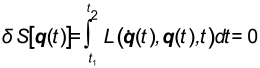
, the coordinates , and the time as inputs. The true evolution of the electron in Minkowski space is a path of minimum action between two fixed energy states and and two specified times t1 and t2.
The action is formulated in generalized coordinates so it is independent of any particular system of coordinates and it is invariant for all coordinate transformations thereby providing a description that is consistent with the formalism of general relativity theory.
4.3. Energy Absorption in A Non-Conservative System [10]
Due to the conservation of energy, absorption must occur before emission is possible. Quantization by a continuous absorption of energy is not amenable to a description by a purely field model because the fields are not bounded. Instead we use a particle model and describe the electron during continuous excitation between the states |1> and |2>. The Lagrangian for the electron is equal to the kinetic energy T minus the potential energy V, or L=T-V. The transition of an electron from the ground state to an excited state is characterized in generalized coordinates with six dimensions, three to describe its position on the electron shells R1 and R2, and three to describe its trajectory.
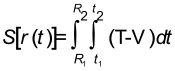
The electron initiates its motion at a point on the equipotential surface R1 of the ground state at time t1, is excited along a path r, and upon arriving at R2 after a period of time, (t2 – t1) = τ, it assumes the experimentally determined orbital angular momentum, (T-V) = 2πE. In contrast to the Bohr semiclassical model of the atom this derivation of energy absorption assigns the correct value of zero for the ground state orbital angular momentum. The action, S[r(t)], is a functional that describes the absorption process in four dimensions. It has as its argument an infinite number of functions, the possible electron trajectories r(t). It differs from 5) by introducing physically defined end-points for the path as determined by the electron shells. The energy states |1> and |2> determine the energy and corresponding period of a field cycle. When we evaluate the action integral for a quantum mechanical change of state we obtain the familiar Bohr relation describing a photon,

which is equivalent to the more familiar time-averaged relation E=hν. By treating time symmetrically with the space coordinates in four dimensions a relativistic theory describing energy absorption is obtained that accurately describes the behavior of a quantum oscillator. Electron transitions evolve continuously between the observed discrete ticks of a clock. Thus atomic structure requires two four-dimensional space-times, one discrete and one continuous, to allow implementation of the equivalence principle upon a transitioning electron and permit unification of the electromagnetic and gravitational fields in the simplest possible way, by ordinary coordinate superposition.
4.4. Energy Emission
In the previous section we described in 6) the non-conservative process of energy absorption from the environment and electron excitation. In this section we will describe its natural continuation, electron decay and the emission of a photon. The properties of energy absorption and emission for a bounded electromagnetic system, the atom, are of particular interest in our discussion for we wish to compare them with the time evolution of the absorption and emission of energy in a bounded gravitational system, the galaxy. It is not possible to make a direct comparison of gravitational and electromagnetic systems. Not only are the fields of vastly different strengths, but gravitational potentials do not share differences in polarity that are characteristic of electric charge. Despite glaring differences in their gross outward physical appearance, there are similarities that exist on a geometrical level. The kinetic flow of mass whether linear or rotational creates a transversely directed gravitational field that is analogous to the transverse magnetic field caused by current flow. The induced gravitomagnetic field, or force, is directed perpendicular to the mass flow and has been used to explain properties of relativistic jets emanating from the cores of quasars and other active galactic nuclei [11]. It is postulated that due to mass-energy equivalence transversely directed forces occur in response to mass and energy flows of all types and that they may be compared to electromagnetic flows.
In order to compare the gravitational and electromagnetic energy flows we require an interpretation of quantum mechanics that treats energy not as an observable at single points in time as in non-relativistic theory, but as a continuous time evolution [12]. Dirac described the problem simply and elegantly. “There is an alternative formulation for classical dynamics, provided by the Lagrangian. This requires one to work in terms of coordinates and velocities instead of coordinates and momenta. The two formulations are, of course closely related, but there are reasons for believing that the Lagrangian one is the more fundamental. In the first place the Lagrangian method allows one to collect together all the equations and express them as the stationary property of a certain action function. (This action function is just the time-integral of the Lagrangian.) There is no corresponding action principle in terms of the coordinates and momenta of the Hamiltonian theory. Secondly the Lagrangian method can easily be expressed relativistically, on account of the action function being a relativistic invariant; while the Hamiltonian method is essentially non-relativistic in form, since it marks out a particular time variable as the canonical conjugate of the Hamiltonian function. For these reasons it would seem desirable to take up the question of what corresponds in the quantum theory to the Lagrangian method of the classical theory.”
In Dirac’s first study, “The Lagrangian and the Action Principle”, he theorizes, “We ought to consider the classical Lagrangian not as a function of the coordinates and velocities but rather as a function of the coordinates at time t and the coordinates at time t+dt”. Rather than pick out a particular point in time as occurs with the Hamiltonian function of nonrelativistic theory, Dirac is seeking compatibility with relativity theory by calculating change in action over a space-time interval between two points in time. The results of the study proved to be accurate for they gave Feynman the idea to pursue a path integral formulation of quantum mechanics.
In the next section Dirac develops an idea complementary to the particle model with “An Application to Field Dynamics” that we wish to expand upon. He begins, “We may treat the problem of a vibrating medium in the classical theory by Lagrangian methods which form a natural generalization of those for particles. We choose as our coordinates suitable field quantities or potentials.” To obtain an equation that describes the energy emission by an atomic oscillator using field dynamics we introduce a Lagrangian density given by the fields and its first derivatives L(ϕi ,ϕi ,μ). This allows for a complete accounting of the energy interactions that occur during an electron transition, where ϕi is the current density described radially and ϕi,μ is the electromagnetic field strength described transversely. The transformation from a classical to a quantum viewpoint is realized by localizing the fields over the “region of space-time” between electron shells. Continuing with Dirac’s analysis, “We introduce at each point of space-time a Lagrangian density, which must be a function of the coordinates and their first derivatives with respect to x,y,z, and t, corresponding to the Lagrangian in particle theory being a function of coordinates and velocities. The integral of the Lagrangian density over any (four-dimensional) region of space-time must then be stationary for all small variations of the coordinates inside the region, provided the coordinates on the boundary remain invariant.”
Dirac’s field interpretation is a natural continuation of our description of absorption energy 6) and the next step in the time evolution of radiation processes. Emission initiates from the excited state R2 = (x2,y2,z2) at time t2 and it finalizes at the ground state R1 = (x1,y1,z1) at time t1. Each of the electron shells R2 and R1 determines a locus of points where the fields vanish and therefore they represent invariant field boundaries. We continue with Dirac’s arguments by requiring the integral of the Lagrangian density over the region of space-time between the excited and ground states to be “stationary for all small variations of the coordinates inside the region.” Changes in action are evaluated by integrating the Lagrangian density four-dimensionally thereby yielding a relativistic formulation of emission that is invariant, the same for all observers.
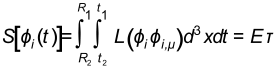
The end points of the electron’s path are located on equipotentials, space-like surfaces, and the four-dimensional localization of the fields necessarily corresponds to the result from 7), and the reduced Planck’s constant ћ. The action S[ϕi(t)] is a functional, a function of the values of coordinates on the discrete boundaries of the space-time surfaces R2 and R1 which are in turn functions of the continuous space-time variables of the fields within the surface. The boundaries of the fields are uniquely fixed four-dimensionally by the volume ∫d3x and the time interval t2-t1. The field model given by 8) describes one cycle of fields, or photon emission, as opposed to the particle model 6) which describes the excitation of an electron and one cycle of the fields. Two electron transitions, excitation and decay, equal one clock cycle and two field cycles.
Comparing 6) and 8) we see that emission and absorption are not symmetric processes since it is impossible to obtain the field distribution leading to absorption from that which resulted due to emission. Absorbed fields are unbounded whereas the emissions are bounded in space and time by the wavelength and period. Combined they represent a fully relativistic model that explains the quantization of energy as a four-dimensional localization of field in space-time, the photon. The electron shells define spatial boundaries in a way that is similar to the way the event horizon defines spatial boundaries for a black hole.
4.5. Comparison with Non-Relativistic Quantum Mechanics
The principal difference between relativistic and non-relativistic models of the quantization process is in their underlying physical assumptions. To formulate a relativistic theory we use a Lagrangian (T-V) and localize the fields £(ϕi, ϕi,μ) four-dimensionally, while in non-relativistic theory quantization is usually described with a Hamiltonian (T+V) as the potential of a point electron. To demonstrate their equivalence we will show how the two methods relate physically. In non-relativistic theory a particular type of wave function or “two-component spinor”, is used to describe energy emission. It defies explanation in ordinary space-time for it acts like an ordinary vector for infinitesimal rotations, but transforms to its negative for complete rotations and requires two complete rotations to return to its original state. Attempts to visualize spinor behavior make use of imaginary geometries such as the Möbius strip. Normally rotations and transformations of vector components and the coordinates describing them are carried out continuously. The same cannot be said for spinors. Spinors require two complete rotations to return to the original state, but they are constructed in such a way that they are sensitive to how the gradual rotation of coordinates was carried out to arrive there. In other words, they exhibit path dependence. More specifically, for any final configuration of the coordinates there are two topologically inequivalent continuous rotations of the coordinate system that result in this same configuration. It is impossible to carry out transformations between the two inequivalent rotations of coordinates even though they arrive at the same configuration. Because the spinor follows two independent paths it represents a non-conservative force.
A simpler explanation is possible by using physical arguments from the relativistic model. Rather than treat quantum mechanical energy emission as a single event carried out in two steps by a single particle, or 2-spinor, we use equations 6) and 8) to describe it with two field sources, an electron of field ϕi and a photon of field ϕi,μ , during two distinct physical processes, absorption and emission. The field ϕi of an electron has spin described by Pauli matrices oriented in three-dimensional space and the field ϕi,μ of a photon is oriented due to polarization in four-dimensional space-time by Maxwell’s equations. We interpret the 2-spinor therefore as the juxtaposition of two field geometries that cycle through the physical processes of excitation, localization, and emission. There are two paths possible, spin-up or spin-down, and two rotations are needed to complete a photon emission, where rotations are defined physically as changes in phase of the photon’s electromagnetic field during excitation and decay. Thus non-relativistic 2-spinors are rotations in abstract space and absolute time, which we interpret relativistically as the time evolution of real particle field geometries in Minkowski space.
4.6. Experimental Confirmation of Energy Localization
Relativistically correct quantization (4.3 and 4.4) occurs in two steps. Unbounded field energy is absorbed (eqn 6) and then quantized by means of a localization of fields (eqn 8). It means that a physical separation exists between the matter and energy of an excited state due to field boundaries. An electron does not receive, or absorb energy when it is excited, rather excitation causes field boundaries to be erected that localize energy within the atom and create a “bound energy state”, or photon. Localized electromagnetic fields within an atom have been observed experimentally and they are referred to as “stopped light”. The storage and retrieval of light are achieved for up to one minute in a rare earth element by converting light coherence in free space to atomic coherence in an excited state and back again [13]. The experiments provide experimental proof of field continuity between discrete energy states. Discrete field boundaries are established that localize energy, while the transverse fields contained within them vary independently and are continuous in time. Because the fields are isolated from the observer by field boundaries the phenomenon of stopped light is being developed as a form of storage for quantum computing. Therefore these experiments support the validity of equations 6) and 8), which describe the continuous absorption of energy over a time period equal to the wave period and the spontaneous transformation into a four-dimensional localization of fields.
4.7. Universal Properties Of Energy
In classical theory we treat energy as a simple physical variable or property of matter and the same unit of measurement, joules, is used to measure all of its forms. Since only quantitative comparisons are possible in the measurement of joules the universal properties of energy are under appreciated or ignored. This is understandable in the case of classical interactions since systems are not precisely defined. Nevertheless, we see the same practice in quantum mechanics where energy is described as an observable in the Schrödinger time independent wave equation. Because each of the myriad forms of energy is conceived of independently, we cannot compare them with each other in a meaningful way. Although the various forms of energy differ widely nevertheless universal properties of energy do exist. The conservation of energy has never been known to fail for either quantum or classical systems whether microscopic or macroscopic. Another well-known characteristic of energy, equipartition, is valid for all classical systems. As pointed out earlier experimental techniques have been developed that can link 10,000 atoms in a lattice that functions as a single quantum oscillator and atomic clock [1]. Because the lattice is isolated from the environment it is hypothesized that characteristics of the electromagnetic field energy of quantum oscillators can be compared with characteristics of gravitational field energy for isolated systems such as galaxies. The absorption and emission of radiation (eqns 6 and 8) is an example of a quantum system converting electromagnetic field energy into matter by means of a four-dimensional transformation, or flow. Similarly gravitational systems in the form of galaxies are centers of energy emission and absorption naturally isolated from the environment and it should therefore be possible to compare the way energy is transformed with that of a quantum system despite their vast physical differences. It is thereby postulated that the properties of energy, when described four-dimensionally with time, are independent of the material system which supports them.
5. Gravitational Field Energy
5.1. Field Transformation
We have completed our analysis of time, which we observe as discrete quantum mechanical ticks in Minkowski space with continuously applied corrections due to velocity and gravitational potential. Because our model is relativistically correct it treats time evolution as an action minimum in Minkowski space rather than as a “propagator” operating on states in Hilbert space. Diffuse forms of energy are localized four-dimensionally and then materialize as independent entities, or photons. Thus the conversion of electromagnetic fields into matter is described by means of a four-dimensional localization in Minkowski space. We wish to extend our interpretation of physical processes to study the nature of gravitational interactions as a localization of fields in the curved space-time of general relativity. This will allow energy-matter conversion processes to be compared relative to the same physical basis without causing confusion due to the wide separation of magnitudes, differences in polarity, and other observable differences that exist for electromagnetic and gravitational processes. The equipartition theorem is already routinely used in astronomical studies to determine the conditions for star formation from a molecular cloud and to estimate star temperature [14]. This and the experimentally confirmed principle of energy conservation leads to the assumption that the laws of energy in nature are valid universally for all isolated systems. For these reasons we expect that the energy-mass conversion processes for gravitational and electromagnetic systems can be compared.
Currently attempts to combine the effects of electromagnetism and gravity are of two forms; unification of the field equations, as in classical unified field theories; and unification of forces, as part of the standard model in theories of quantum gravity. The theories’ claims to legitimacy are based on attempts to derive equations that can predict the behavior of test particles with respect to the conjugate variables position and momentum. The reason these types of unification have failed to produce the desired result is due to the simple fact that the fields are already unified in the form of electrons and other particles. The electromagnetic and gravitational fields coexist harmoniously within these particles and are superposed structurally without influencing each other. If the field sources can exist in close proximity, bound together in a single particle, without noticeable effect we should not expect to detect a relationship of the fields in the far less intense setting of empty space. In fact no experiment has detected influence between the fields no matter how high the intensity. Everything we know about the fields indicates that in spite of being unified by particle structure, they are manifested and experienced independently. To attempt to unify fields by only looking at their external properties ignores this common origin. Instead we must seek a solution by taking the opposite viewpoint and asking, Why do fields that have the same physical origin interact according to completely distinct laws? To be sure a successful field theory must account for the many complexities of fields, but more importantly it must explain how this complexity can arise from simple structures. By looking at similarities in the way that gravitational and electromagnetic field energy transform into matter we compare the fields using the conjugate variables energy and time at a fundamental level.
Earlier we conceived of quantization as the absorption of electromagnetic field energy by a linear superposition of field potentials that occurs continuously over a time period equal to the wave period and transforms by means of a four-dimensional localization of fields into the photon. The energy absorption described by equation 6) may be expressed classically as a time-averaged, transverse radiation field given by the vector potential alone.
B=∇×A
The linearly superposed field potentials transform into a field source, the photon, with distinct field geometry. We are motivated to adopt the same method, as the linear superposition of potentials, for describing the time evolution of gravitational fields in free space and their transformation into matter by hypothesizing that the laws of energy apply in an equivalent way.
5.2. Relativistic Clocks
We wish to describe gravitational field energy similarly to the way electromagnetic field energy is described, as the time evolution of fields that begin in free space as linear potentials. Time evolution has different meanings as it is used in quantum mechanics and general relativity theory. The time variable is given by the ticks of a clock in the former by using atomic clocks and the linearity of light as measurement standards, while the latter gives the proper time independently of clocks. Clocks are undefined in general relativity theory because Einstein believed that “measuring rods and clocks would have to be represented as solutions of the basic equations” [15]. Although he was unable to extend the equations to incorporate clocks or measuring rods we can see how differences between theory and practice originate by looking at the Einstein equation defining the local curvature of space-time.
Gμν=κ Tμν
Time and clocks are treated in a fundamentally different way in this equation. Time is continuous on the left side in the form of proper time, with clocks and measuring rods present as test bodies. If clocks, or matter of any type is present in significant amounts it must be placed on the right side due to contributions of mass and energy. Thus, continuous time exists in free space whether or not clocks are present to measure it. Equation 9) lacks symmetry because there can be ideal clocks on either side, but real clocks are only allowable on the right.
5.3. Transformation of gravitational Field Energy Into Matter
The four-dimensional evolution of gravitational fields may be demonstrated by constructing a model for a gravitating body that has slowly changing mass-energy density. We begin with a uniform distribution of hydrogen atoms, a simple form of clock, in free space distant from each other. Both proper time and clock time are determined in Minkowski spacetime and the gravitational field intensity of the system at infinity is found by simply summing particle masses. Now let the attractive force of their mutual gravitational field cause them to slowly coalesce into a spherical body such that particle momenta remain small. Due to the equivalence of mass and energy gravitational field intensity is determined by summing particle masses and binding energy, the energy required to remove particles to infinity. The period of clocks slows and Minkowski space-time is replaced by a Riemannian metric that is described by the Einstein tensor Gμυ. An attempt to use space-time curvature to describe material structure would be unacceptable because it would place the continuous time of curvature on a more fundamental basis than the ticks of a clock, a quantum mechanical phenomenon. A background space that is continuous cannot be used to describe discrete phenomena that take place within the background space.
Accumulating atoms will cause an increasing gravitational pressure that generates heat and the emission of black body radiation, early signs of star formation. Eventually the Coulomb repulsion of the atoms is overcome by gravitational attraction in the form of a pressure gradient, protons are attracted to each other due to the strong force, and fusion initiates spontaneously in the star's core. The left side of the Einstein equation 9) interprets the star formation process as a continuous change in metric from Minkowski space to a Riemannian manifold with constant proper time. On the other hand, on the right side an accumulation of matter causes a slowing of clocks, a decreasing gravitational potential, and a corresponding dilation of proper time. Due to symmetry requirements, laws of a decreasing potential are governed by the same laws as for an increasing potential. Thus an increasing potential causes a speeding up of time and a decreasing potential causes a slowing down of time.
Laws describing the interaction of gravity and quantum mechanics in 4.1 are based on first principles; that is, on the invariance of atomic structure, the equivalence principle, and the variability of time. The equation of motion 4) that applies to matter in an increasing gravitational potential must apply in a decreasing potential as well. This will result in an increasing dilation of proper time for accumulations of matter, as expressed in Minkowski space by equations of motion with proper time as a variable and acceleration and velocity as parameters. After a time period of several billion years matter accumulates in a sufficient amount to slow proper time to zero within a gravitational field boundary, the event horizon, and a black hole forms. The event horizon is a boundary condition with proper time that slows to zero enclosing a volume of matter in Minkowski space, with properties that are analogous to those of the electron shell.
5.4. Gravitational Emission Equation
In equation 6) we described the four-dimensional localization of electromagnetic field energy due to linearly superposed field potentials and resulting photon creation. Space-like field boundaries in the form of electron shells and discrete times of transition localize fields consisting of both radial and transverse fields. The localization of gravitational field energy by means of a superposition of potentials is also characterized by the formation of a space-like field boundary, the horizon, with the passage of time Δt=0. In addition to the symmetry that exists in the above mentioned mass-energy conversion processes other symmetries are apparent when comparing field properties. The relativistic superposition of electromagnetic potentials is described by a Lagrangian density  composed of radial and transversely oriented force fields with distinct physical origins. Similarly the superposition of gravitational potentials leads to a radially oriented baryonic force field observed in the galactic bulge and a transversely oriented force field that is manifested by the tangential acceleration of matter contained in the disc and observed as rotational velocity. Symmetry arguments based on a comparison of gravitational and electromagnetic potentials support a theory that includes superposed forces of independent physical origin; a localized, radially oriented 1/r2 potential due to baryonic matter and a diffuse, transversely oriented 1/r potential which creates a tangential acceleration. Therefore a theory is favored that can explain galactic structure by means of a continuous field law in a way that is more closely aligned to the general relativistic concept of space-time than to a model based on dark matter or a modification of Newtonian laws.
composed of radial and transversely oriented force fields with distinct physical origins. Similarly the superposition of gravitational potentials leads to a radially oriented baryonic force field observed in the galactic bulge and a transversely oriented force field that is manifested by the tangential acceleration of matter contained in the disc and observed as rotational velocity. Symmetry arguments based on a comparison of gravitational and electromagnetic potentials support a theory that includes superposed forces of independent physical origin; a localized, radially oriented 1/r2 potential due to baryonic matter and a diffuse, transversely oriented 1/r potential which creates a tangential acceleration. Therefore a theory is favored that can explain galactic structure by means of a continuous field law in a way that is more closely aligned to the general relativistic concept of space-time than to a model based on dark matter or a modification of Newtonian laws. We can show a formal relationship between the energy flow of photon creation, as expressed by the action integral in 8) and black hole formation, if it is assumed that the black hole represents a field source. The field is described by a Lagrangian density L(Φi,Φi,μ), where Φi represents radial fields due to localized baryonic matter and Φi,μ represents transverse fields generated independently by a different form of matter, localized within the same black hole. It differs from a MOND type theory of acceleration which postulates a modified Newtonian law with 1/r2 acceleration within the galactic bulge that gradually transforms at large distances to a 1/r acceleration [16]. The concept of a “two component” source for black holes gives a different interpretation of the Tully-Fisher relation, which states that multiplying the luminosity of a galaxy by the period of rotation yields a constant [17]. The units of the constant, energy times time, are of action and may be compared due to symmetry arguments to the quantization of electromagnetic fields in equation 7); that is, to the equation Eτ=ћ. It is hypothesized therefore that because the laws of energy apply universally in nature there must be an analogous equation,
describing the transformation of gravitational field energy that is equivalent to the quantization of electromagnetic field, where H has the units of action and is the gravitational equivalent of the reduced Planck's constant. It means that in a spiral galaxy we expect the two sources of field Φiand Φi,μ to be present within the black hole with the same intensity, just as the electric and magnetic fields of a photon have the same intensity. It also correctly predicts that observations of increased galactic emission energy, or energy flow, are an indication of a higher rotational velocity and a lower period of rotation, as observed.
Eτ=H
It is a short step from postulating that the Tully-Fisher correlation represents solutions of an emission equation to obtaining the equation. Symmetry arguments based on equation 8) suggest that the action integral of a galaxy’s energy flow is a function of the values of the space-like coordinates on the event horizon R which are in turn a function of the continuous space-time variables of the matter within the surface, where integration is performed from zero to R and for one complete revolution of period τ.
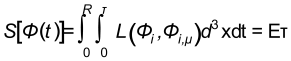
The action integral S[Φ(t)] is a functional describing the transformation of matter and energy localized within the event horizon of a black hole into the emission energy of a galaxy with rotational period τ. Because the properties of energy, when described four-dimensionally with time, are independent of the material system which supports them we can compare the the gravitational emission equation 10) with the electromagnetic emission equation 8). The existence of an emission equation governing galaxy energy flow suggests that galaxy structure is the manifestation of a field emanating from a supermassive black hole, and it consists of a radial component Φi due to baryonic matter causing gravitational attraction and a transverse component Φi,μ from a distinct source causing the tangential component of radial acceleration. The proportion of baryonic mass in a black hole contributing to radial acceleration as compared to the mass contributing to rotational acceleration determines the observed bulge to disc ratio of galaxy structure.
The photon is the most elementary form of baryonic matter Φi and it travels at speed c. It is hypothesized by analogy that the neutrino is the most elementary source of rotational acceleration Φi,μ due to its spin and that it also travels at speed c. Just as photon fields are highly complex and essential for understanding our local environment this model suggests that neutrino fields are complex and essential for understanding the cosmological environment. Continuing with our analogy, we assign the spin of the free neutrino left or right-handed helicity and an orientation in space from 0 to 2π in the same way that the photon is oriented by polarization. A high density of superposed neutrinos, localized within the black hole of a galaxy with their spins aligned, exert rotational acceleration on matter in the disc in accordance with 10) by means of a 1/r field that extends to infinity. Due to action/reaction symmetry free neutrinos surrounded by matter experience a rotational force in the opposite direction of the localized effect, where the energy of a neutrino determines its resistance to rotation due to inertia in compliance with the conservation laws. The orientation in space of a free neutrino determines whether it is able to interact with an electron, muon, or tau lepton; where the time of passage and density of surrounding matter determines the rotation of a neutrino, hence its final orientation. Neutrinos with fields of intermediate orientation are “sterile” since they do not interact with leptons. The field model differs from the standard model because it describes neutrino oscillation not as a result of a quantum mechanical superposition of neutrino eigenstates, but as the classical superposition of neutrinos with distinct field orientations acting in harmonious conjunction with the matter surrounding it. The classical neutrino model hypothesizes that flavor oscillation is dependent upon the density of the matter it traverses. This provides a means for testing the standard model which describes it as a property of flavor eigenstates.
The hypothesis from 10) that galaxy structure is determined by the localized matter and energy of a black hole is supported by experimental observations noting that every galaxy has a black hole at its center and the radial acceleration of stars in the disk is directly proportional to galaxy luminosity [18]. Because the influence of a galaxy’s localized field energy extends throughout space to infinity it governs the dynamics of galaxy clusters as well. The forces are mapped by astronomical observations on a flat background space in a reference system whose origin resides at the center of the black hole. The electromagnetic and gravitational emission equations 8) and 10) are action functionals which describe the transformation of localized energy to energy manifested externally by fields with radial and transverse components. The fact that they are derived relativistically demonstrates a formal symmetry that is absent from non-relativistic theories that use ad hoc methods to postulate the existence of unobserved forms of “dark” matter.
6. Discussion
To obtain a complete description of material behavior in a theory of quantum gravity the gravitational and electromagnetic fields must be internally consistent. This is made possible by applying the strong equivalence principle directly to electron transitions (see 4.1). The use of the strong equivalence principle means that gravity is entirely geometrical by nature and that the metric alone determines the effect of gravity ensuring that no extra fields are associated with it. It also means that gravitational fields may be reproduced identically by accelerations so that the electron is accelerated as it transitions between energy states. By successfully introducing accelerated frames within the atom we ensure that laws of motion of the quantum and relativistic theories are formulated consistently. Gravitational fields that act through the equivalence principle by continuously accelerating an electron as it transitions also ensures that the background space is continuous.
The interdependent nature of the conjugate variables should be evident in our comparison of the laws of gravity and electromagnetism. We use the conjugate variables position and momentum of test particles to map local configurations of the electric, magnetic, and gravitational fields in absolute time by using differential equations. The energy and time variables, on the other hand, use integral equations to describe material systems by means of globally determined, relativistically correct configurations in space and time; as manifested by the space-like, equipotential surfaces of electron shells, the event horizons of black holes, and the formation of galactic structure over time periods of great length. By expressing the conjugate variables four-dimensionally by means of an action integral we are able to describe electromagnetic and gravitational radiation processes relativistically in time, instead of using absolute space and time of non-relativistic theory.
References
- Hinkley, N., Sherman, J. A. et al. “An atomic clock with 10 -18 instability”, NIST (2013). arXiv:1305.5869 69.
- T. Bothwell et al. “Resolving the gravitational red shift within a millimeter atomic sample”.Nature 602, Issue 7897, 420 (2022). arXiv:2109.12238.
- Dirac, P.A,M. “The quantum theory of the emission and absorption of radiation” Proc Roy Soc A 114, 243 1927. [CrossRef]
- Rothman, T.; Boughn, S. "Can Gravitons be Detected?". Found Phys 36, 2006 (12). [CrossRef]
- Rovelli, C. “Quantum gravity” Scholarpedia 3 (5): 7117. (2008). [CrossRef]
- Hafele, J. C., Keating, R. E., “Around-the-world atomic clocks” Science 177, 1972, p. 166.
- Braginsky, V.B., Vorontsov, Y.I.., Thorne, K.S. “Quantum nondemolition measurements” Science 209 4456 (1980). [CrossRef]
- Marti, G. E., Hutson, R. B., “Imaging optical frequencies with 100 μHz precision and 1.1 μm resolution”, PRL 120, (2018), p.103201. [CrossRef]
- Minkowski, H. “Das Relativitäts Prinzip”, Ann Phys 352 (15): 927–938. 1907. [CrossRef]
- Oldani, R. "Foundations of Quantum Mechanics Revealed by the Conservation Laws" Qeios. 2024. [CrossRef]
- Williams, R.K. "Gravitomagnetic field and Penrose scattering processes". Annals of the New York Academy of Sciences 1045, 2005, p. 232. doi:10.1196/annals.1350.018. [CrossRef]
- Dirac, P.A.M., “The Lagrangian in quantum mechanics” Phys Zeit Sow 3, 1933, p.1. https://www.informationphilosopher.com/solutions/scientists/dirac/Lagrangian_1933.pdf.
- Heinze, G., Hubrich, C., and Halfmann, T., “Stopped light and image storage by electromagnetically induced transparency up to the regime of one minute”, PRL 111,2013, p. 033601. [CrossRef]
- Collins, GW. The Virial Theorem in Stellar Astrophysics. (Pachairt Press, 1978).
- Einstein in P. A. Schilpp (ed.), Albert Einstein: Philosopher-Scientist, Vol. 7, Open Court: Illinois, 1949, p. 59.
- Milgrom, M. "A modification of the Newtonian dynamics as a possible alternative to the hidden mass hypothesis". Astrophys J 270, 1983. 365. [CrossRef]
- Tully SR.B. & Fisher, J.R. “A new method of determining distances to galaxies” Astron Astrophys 54, 1977, p. 661.
- McGaugh, S., Lelli, F., Schombert, J. “The radial acceleration relation in rotationally supported galaxies” PRL 117, 201101, 2016. [CrossRef]
Disclaimer/Publisher’s Note: The statements, opinions and data contained in all publications are solely those of the individual author(s) and contributor(s) and not of MDPI and/or the editor(s). MDPI and/or the editor(s) disclaim responsibility for any injury to people or property resulting from any ideas, methods, instructions or products referred to in the content. |
© 2024 by the authors. Licensee MDPI, Basel, Switzerland. This article is an open access article distributed under the terms and conditions of the Creative Commons Attribution (CC BY) license (http://creativecommons.org/licenses/by/4.0/).
Copyright: This open access article is published under a Creative Commons CC BY 4.0 license, which permit the free download, distribution, and reuse, provided that the author and preprint are cited in any reuse.