

Submitted:
06 July 2020
Posted:
07 July 2020
You are already at the latest version
Abstract
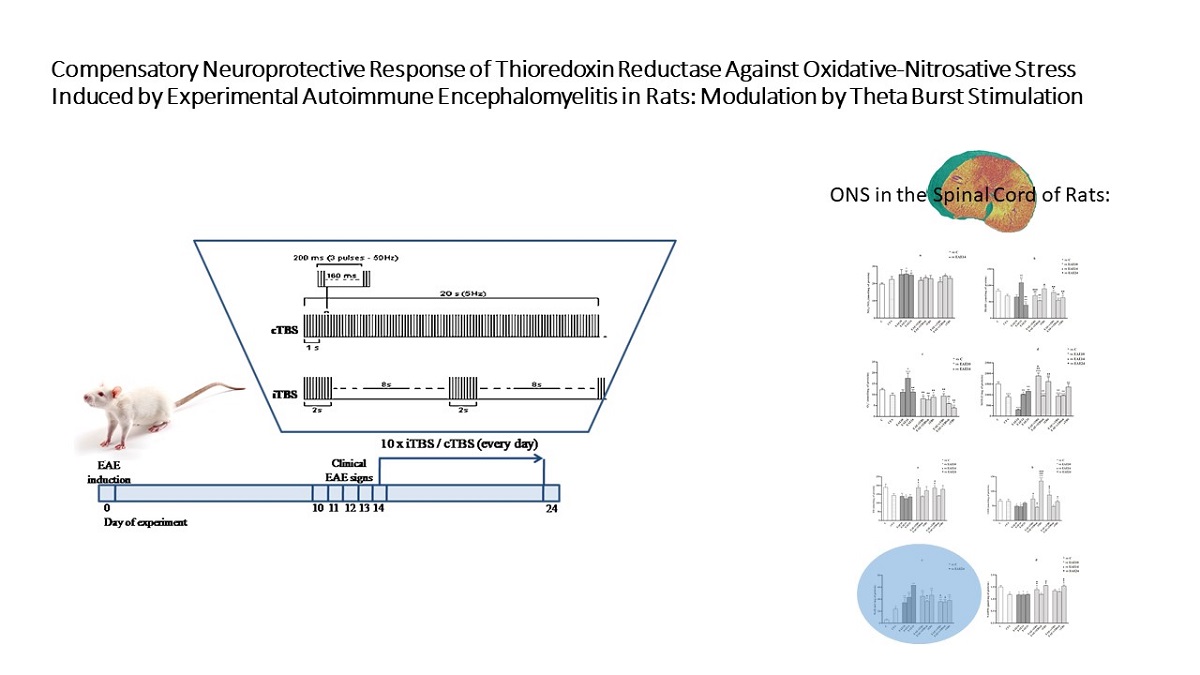
Cortical theta burst stimulation (TBS) structured as intermittent (iTBS) and continuous (cTBS) could prevent the progression of the experimental autoimmune encephalomyelitis (EAE). The interplay of brain antioxidant defense systems against overproduction of reactive oxygen, nitrogen, and thiol species induced by EAE has not been entirely investigated, just as the effect of iTBS or cTBS on oxidative-nitrogen stress (ONS) in EAE rats. Dark Agouti strain female rats were tested for the effects of EAE and TBS. The rats were randomly divided into the following groups: C - control, EAE - rats immunized for EAE, CFA - rats immunized with Complete Freund's adjuvant; iTBS and cTBS groups, and EAE+iTBS and EAE+cTBS - health and EAE rats exposed to iTBS and cTBS, respectively; EAE+iTBSsh and EAE+cTBSsh - sham stimulated EAE rats with the same noise artifacts of iTBS and cTBS, respectively. Superoxide dismutase activity, levels of superoxide anion (O2•-), lipid peroxidation, glutathione (GSH), nicotinamide adenine dinucleotide phosphate (NADPH) and thioredoxin reductase (TrxR) activity were analyzed in rat spinal cords homogenates. The severity of EAE clinical coincided with the climax of ONS, based on the increase of superoxide anion and lipid peroxidation; depletion of total thiols, GSH and NADPH; and decrease of SOD activity. The TrxR imposed the most sensitive response against the applied central nervous system (CNS) stressors to rats. We concluded that the TrxR upregulation meritoriously compensates decreased ROS sequestrating and GSH systems in EAE. Both iTBS and cTBS modulate the biochemical environment at a distance from the area of stimulation against ONS, accomplish a similar effect on TrxR activity to EAE and healthy rats, and alleviate symptoms of EAE.
Keywords:
thioredoxin reductase
; oxidative stress
; nitrosative stress
; theta burst stimulation
; experimental autoimmune encephalomyelitis
; rats
Copyright: This open access article is published under a Creative Commons CC BY 4.0 license, which permit the free download, distribution, and reuse, provided that the author and preprint are cited in any reuse.