
Submitted:
18 April 2020
Posted:
20 April 2020
You are already at the latest version
Abstract
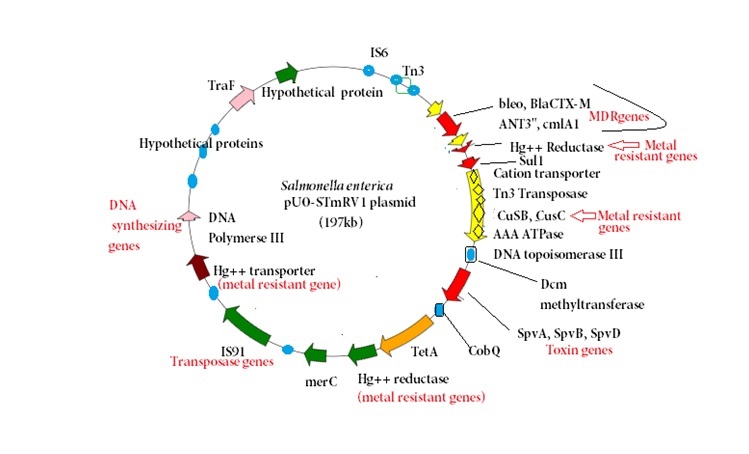
AMR and drug void have caused huge panic today with few thousand death per year. MDR Typhoid was a serious old disease and caused serious health hazard in humen and animals demanding an update on molecular biology of the status on transferable genetic elements. R-plasmids combined in F’-plasmid and the new MDR conjugative plasmids were shown abundant in Sanmonella ranging 70-440kb with similarities. BlaTEM, blaCTX-M, blaOXA, blaNDM mdr genes were abundant in >50 plasmids analyzed and metal resistant gene clusters are predominant in most large plasmids. Among the acetyltransferase all catA1, aacA1 and aac-1b-cr genes were located. Abundant streptomycin phosphotransferases (StrAB) and rarely colistin resistant Mcr-5/9 phosphoethanolamine–lipid A transferase were detected. Altered isomeric dihydropterote synthases (Sul1/2/3) were present giving sulfamethoxazole resistance and dhfr gene frequently associated giving trimethoprim resistance. Metal resistant gene clusters like SilABC (CusABC), PcoAB, RcnA, terABC, and merABCXT etc were found in many Salmonella enterica plasmids. Toxin genes like HipA and virulence genes like spvABD were located in few plasmids increasing virulence and pathogenesis. Drug efflux genes tetA or tetB and OqxB, floR, CmlA were frequent where as QepA and EamA genes were rarely seen. Thus, Salmonella metal resistant genes combined with antibiotic resistant genes has tried to overcome the both toxic antibiotics and metalions causing Typhoid AMR. Such acquisition spreads salmoniasis in the live stocks (pig, cow, chicken) where toxic soil and water dominate increasing chance of MDR typhoid in human.
Keywords:
MDR typhoid
; metal resistant genes
; water toxicity
; gut microbiome
Copyright: This open access article is published under a Creative Commons CC BY 4.0 license, which permit the free download, distribution, and reuse, provided that the author and preprint are cited in any reuse.