

Submitted:
09 October 2019
Posted:
10 October 2019
You are already at the latest version
Abstract
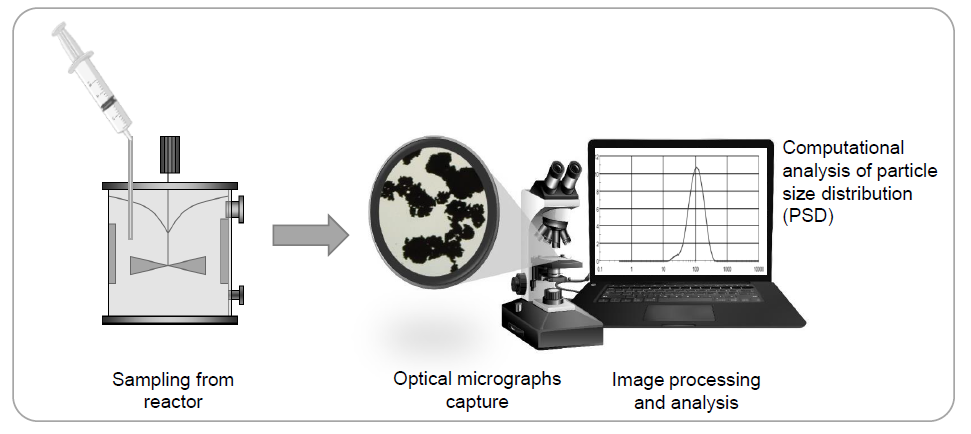
Precipitation processes are technologies commonly used in hydrometallurgical plants to recover metals or to treat wastewaters. Moreover, solid-liquid separation technologies, such as thickening or filtering, are relevant unit operations, included in the precipitation technologies. These methods are strongly dependent on the characteristics of the solid precipitates formed during the specific precipitation reaction. One of these characteristics is the particle size distribution (PSD) of the solid precipitates which are fed into a solid-liquid separation process. Therefore, PSD determination is a typical practice for the characterization of the slurries generated in a precipitation plant. Furthermore, the precipitates generated in these processes have a colloidal or aggregation behavior, depending on the operational conditions. Nevertheless, the conventional methods used to estimate PSD (e.g., laser diffraction and/or ciclosizer) have not been designed to measure particles that tend to aggregate or disaggregate, since they include external forces (e.g., centrifugal, agitation, pumping and sonication). These forces affect the true size of the aggregates formed in a unit operation, thereby losing representativity in terms of aggregates particle size. This study presents an alternative method of measuring the size distribution of particles with aggregation behavior, particularly, by using non-invasive microscopy and image processing and analysis. The samples used have been obtained from an experimental precipitation process by applying sulfidization to treat the cyanide-copper complexes contained in a cyanidation solution. This method has been validated with statistical tools and compared with a conventional analysis based on laser diffraction. Our results show significant differences between the methods analyzed, demonstrating that image processing and analysis by microscopy is an excellent and non-invasive alternative to obtaining size distribution of aggregates in precipitation processes.
Keywords:
SART process
; precipitation aggregates
; image analysis
; microscopy
; particle size distribution
Copyright: This open access article is published under a Creative Commons CC BY 4.0 license, which permit the free download, distribution, and reuse, provided that the author and preprint are cited in any reuse.


