

Submitted:
31 July 2019
Posted:
02 August 2019
You are already at the latest version
Abstract
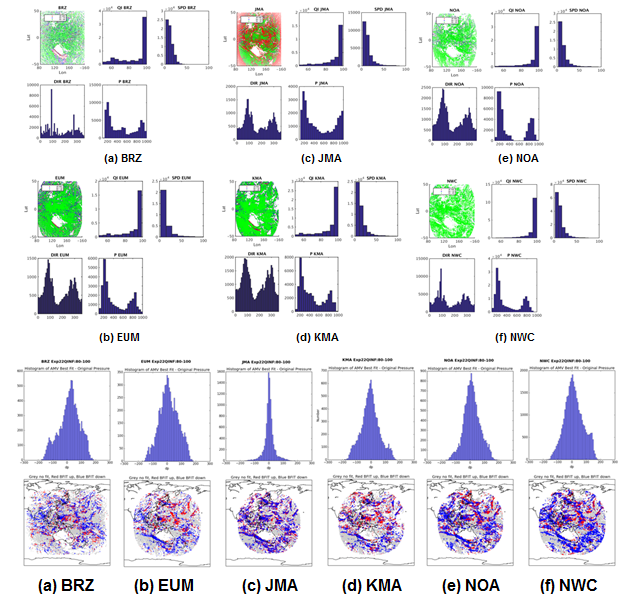
Atmospheric Motion Vectors (AMVs) calculated by six different institutions (Brazil Center for Weather Prediction and Climate Studies/CPTEC/INPE, European Organization for the Exploitation of Meteorological Satellites/EUMETSAT, Japan Meteorological Agency/JMA, Korea Meteorological Administration/KMA, Unites States National Oceanic and Atmospheric Administration/NOAA and the Satellite Application Facility on Support to Nowcasting/NWCSAF) with JMA’s Himawari-8 satellite data and other common input data are here compared. The comparison is based on two different AMV input datasets, calculated with two different image triplets for 21 July 2016, and the use of a prescribed and a specific configuration. The main results of the study are summarized as follows: (1) the differences in the AMV datasets depend very much on the “AMV height assignment” used and much less on the use of a prescribed or specific configuration; (2) the use of the “Common Quality Indicator (CQI)” has a quantified skill in filtering collocated AMVs for an improved statistical agreement between centers; (3) JMA AMV algorithm has the best overall performance considering all validation metrics, most likely due to its height assignment: “optimal estimation using observed radiance and NWP wind vertical profile”.
Keywords:
atmospheric motion vectors
; AMVs
; intercomparison
; himawari
; CPTEC/INPE
; EUMETSAT
; JMA
; KMA
; NOAA
; NWCSAF
Copyright: This open access article is published under a Creative Commons CC BY 4.0 license, which permit the free download, distribution, and reuse, provided that the author and preprint are cited in any reuse.


