
Submitted:
16 March 2018
Posted:
19 March 2018
You are already at the latest version
Abstract
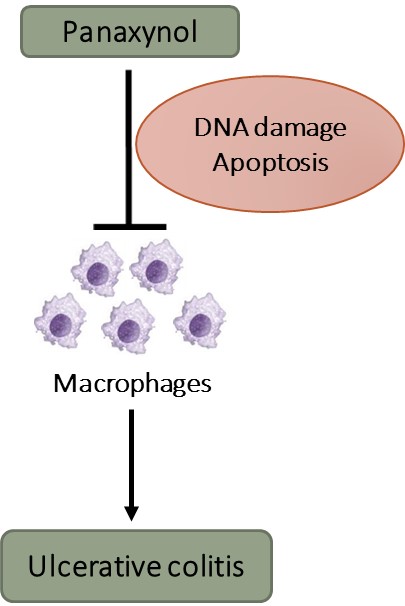
Ulcerative colitis has a significant impact on the quality of life for the patients, and can substantially increase the risk of colon cancer in patients suffering long-term. Conventional treatments provide only modest relief paired with a high risk of side effects, while complementary and alternative medicines can offer safe and effective options. Over the past decade, we have shown that American ginseng has anti-oxidant and anti-inflammatory properties that can suppress mouse colitis and prevent colitis associated colon cancer. With the goal of isolating a single active compound, we further fractionated the hexane fraction, and found the most abundant molecule in this fraction was the polyacetylene, Panaxynol. After isolating and characterizing Panaxynol, we tested the efficacy of Panaxynol in the treatment and prevention of colitis in mice and studied the mechanism of action. We demonstrate here that Panaxynol effectively treats colitis in a Dextran Sulfate Sodium mouse model by targeting macrophages for DNA damage and apoptosis. Positive outcomes from this study could take American ginseng one-step further towards becoming a conventional drug for the treatment of colitis, and possibility exploring other autoimmune diseases associated with macrophage dysfunction.
Keywords:
Inflammatory Bowel Diseases
; ulcerative colitis
; American ginseng
; Panaxynol
; macrophages
Copyright: This open access article is published under a Creative Commons CC BY 4.0 license, which permit the free download, distribution, and reuse, provided that the author and preprint are cited in any reuse.


