
Submitted:
31 October 2017
Posted:
01 November 2017
You are already at the latest version
Abstract
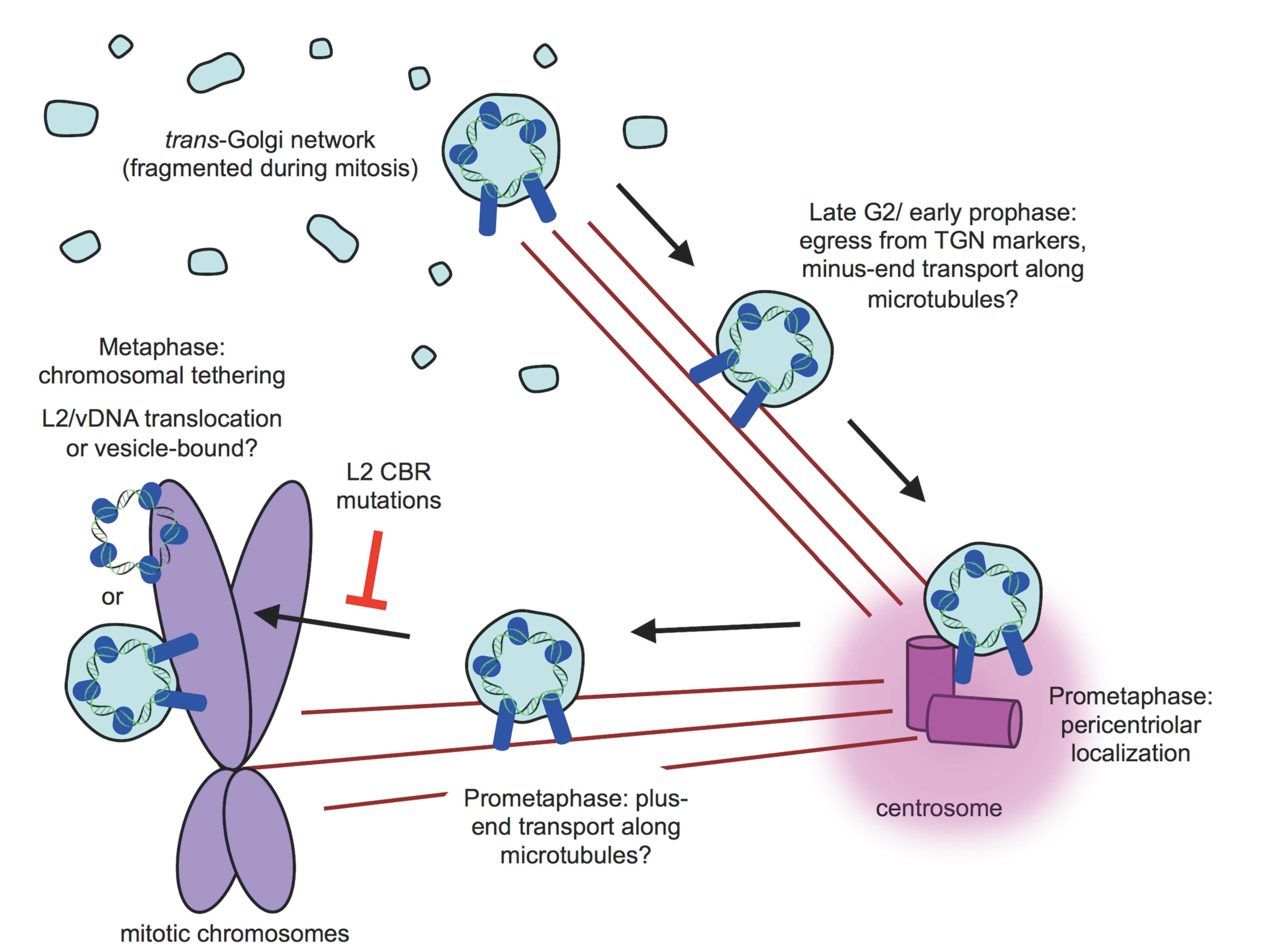
Beginning in 2012, our understanding of human papillomavirus (HPV) subcellular trafficking has undergone a drastic paradigm shift. Work from multiple laboratories has revealed that HPV has evolved a unique means to deliver its viral genome (vDNA) to the cell nucleus, relying on a myriad of host cell proteins and processes. The major breakthrough finding from these recent endeavors was the realization of L2-dependent utilization of cellular sorting factors for the retrograde transport of vDNA away from degradative endo/lysosomal compartments to the Golgi, prior to mitosis-dependent nuclear accumulation of L2/vDNA. An overview of current models of HPV entry, subcellular trafficking, and the role of L2 during initial infection is provided below, highlighting unresolved questions and gaps in knowledge.
Keywords:
human papillomavirus
; HPV16
; L2
; subcellular trafficking
; mitosis
; transmembrane domain
; translocation
; membrane penetration
; toxin
; fusion peptide
; gamma secretase
; retromer
Copyright: This open access article is published under a Creative Commons CC BY 4.0 license, which permit the free download, distribution, and reuse, provided that the author and preprint are cited in any reuse.


