
Submitted:
19 April 2017
Posted:
20 April 2017
You are already at the latest version
Abstract
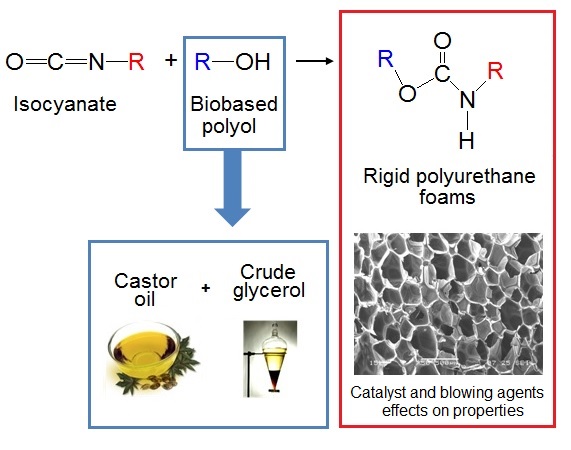
Rigid polyurethane foams were synthesized using a renewable polyol from the simple physical mixture of castor oil and crude glycerol. The effect of the catalyst and blowing agent in the foams properties was evaluated. The use of physical blowing agent (cyclopentane and n-pentane) allowed obtaining foams with smaller cells in comparison with the foams produced with a chemical blowing agent (water). The increase of water content caused a decrease of density, thermal conductivity, compressive strength and Young's modulus, which indicates that the increment of CO2 production contributes to the formation of larger cells. Higher amount of catalyst in the foam formulations caused a slight density decrease and an increase small significance of thermal conductivity, compressive strength and Young's modulus values. These green foams presented properties that indicate a great potential to be used as thermal insulation, as density (23 - 41 kg m-3), thermal conductivity (0.0128 – 0.0207 W m-1 K-1), compressive strength (45 - 188 kPa) and Young's modulus (3 - 28 kPa). These biofoams are also environmental friendly alternatives and can aggregate revenue to biodiesel industry, contributing for reduction of this fuel prices.
Keywords:
polyurethane foams
; castor oil
; crude glycerol
; biopolyols
Copyright: This open access article is published under a Creative Commons CC BY 4.0 license, which permit the free download, distribution, and reuse, provided that the author and preprint are cited in any reuse.


