

Submitted:
04 March 2026
Posted:
05 March 2026
You are already at the latest version
Abstract
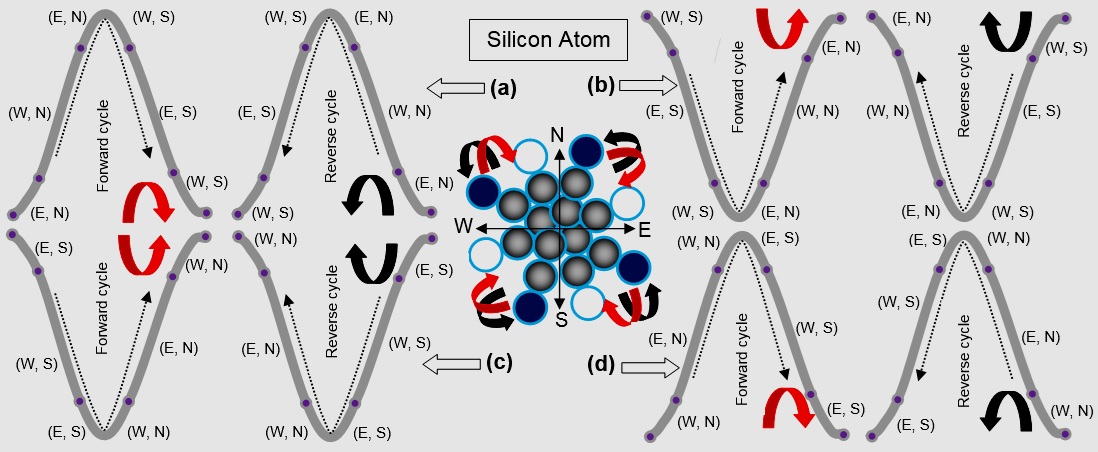
Both heat and photon energy are integral parts of scientific research. The study of the photon and the electron does not present up-to-date science in some phenomena. A misconception falls at the basic level. To eliminate the misconception, a discussion presents the electron dynamics in the silicon atom. The electron executes confined interstate dynamics for one forward or reverse cycle. As a result, the resulting shaped force-energy defines a unit photon. That unit photon has a shape similar to a Gaussian distribution with turned ends. A featured photon can interact with the side of a laterally orientated electron (of a semisolid or solid atom) to possibly convert into heat energy. When a featured photon interacts with the tip of a laterally oriented electron, that photon can convert into energy bits. The shapes of energy bits are similar to integral symbols. The reference point for the electron executing confined interstate dynamics is the center of a silicon atom. The north-south tips of the electrons align along the north-south poles. The energy shapes around the force tracing along the trajectory of electron dynamics. To execute confined interstate dynamics, forces of the two poles appear conservatively for turning the electron each time. The outer ring electron of the silicon atom reaches the ‘maximum limit point’ during the confined interstate dynamics. There is energy of one bit. In the remaining half cycle, that electron also generates energy of one bit. The electron dynamics of the silicon atom generate photons of a wave shape. Atoms of some other elements generate photons other than wave shapes. The execution of the electron dynamics is nearly at the speed of light. In addition to energy science, the study is useful in physical and chemical sciences.
Keywords:
heat energy
; photon energy
; fundamental forces
; electron dynamics
; atomic-scale phenomenon
; photon-matter interaction
Copyright: This open access article is published under a Creative Commons CC BY 4.0 license, which permit the free download, distribution, and reuse, provided that the author and preprint are cited in any reuse.


