



Preprints benefit from user comments; in fact, commenting on a preprint can have a significant impact on the quality of the research.
Leaving a comment on another author’s work (either by making an anonymous comment online or by sending the authors a private comment) allows researchers to discover and then address potential issues with their work. But, let’s take a moment to quickly go over why a preprint might benefit from user comments.
Preprints vs. peer review
Preprints do not undergo a peer-review process. While most academic work faces scrutiny from other members of the scholarly community, preprints are more easily understood as a pre-publication version of academic work. Even though both aim to promote the dissemination of knowledge, the form that they take differs slightly. In some ways, it helps to view a preprint as a “draft version” of a manuscript. In many cases, these drafts then go on to get published after the fact, yet they start as preprints.
If an article is then published in open access, it remains accessible to interested readers without a paywall. However, a manuscript published in a more traditional journal might wind up getting locked behind a subscription, making its contents inaccessible to many people. Preprints, on the other hand, are open access. As such, every updated version of any given preprint is free to read.
Having said that, science should be rigorously checked. Standard academic publishing has the peer-review process to help with that. But, what about preprints, which are shared before peer review?
One important mechanism is user comments.
The benefits of user comments
User comments are really important in many ways. First and foremost, they allow feedback to be given to the authors of a preprint. This feedback might be technical in nature or it might deal with other matters related to the research. But this pain-free method to provide feedback is very useful to help strengthen the research in a preprint. One of the benefits of a preprint is that, unlike academic publications, they can be updated.
We welcome comments and feedback from a broad range of readers. And if you want more information about them, please see our criteria for commenting.
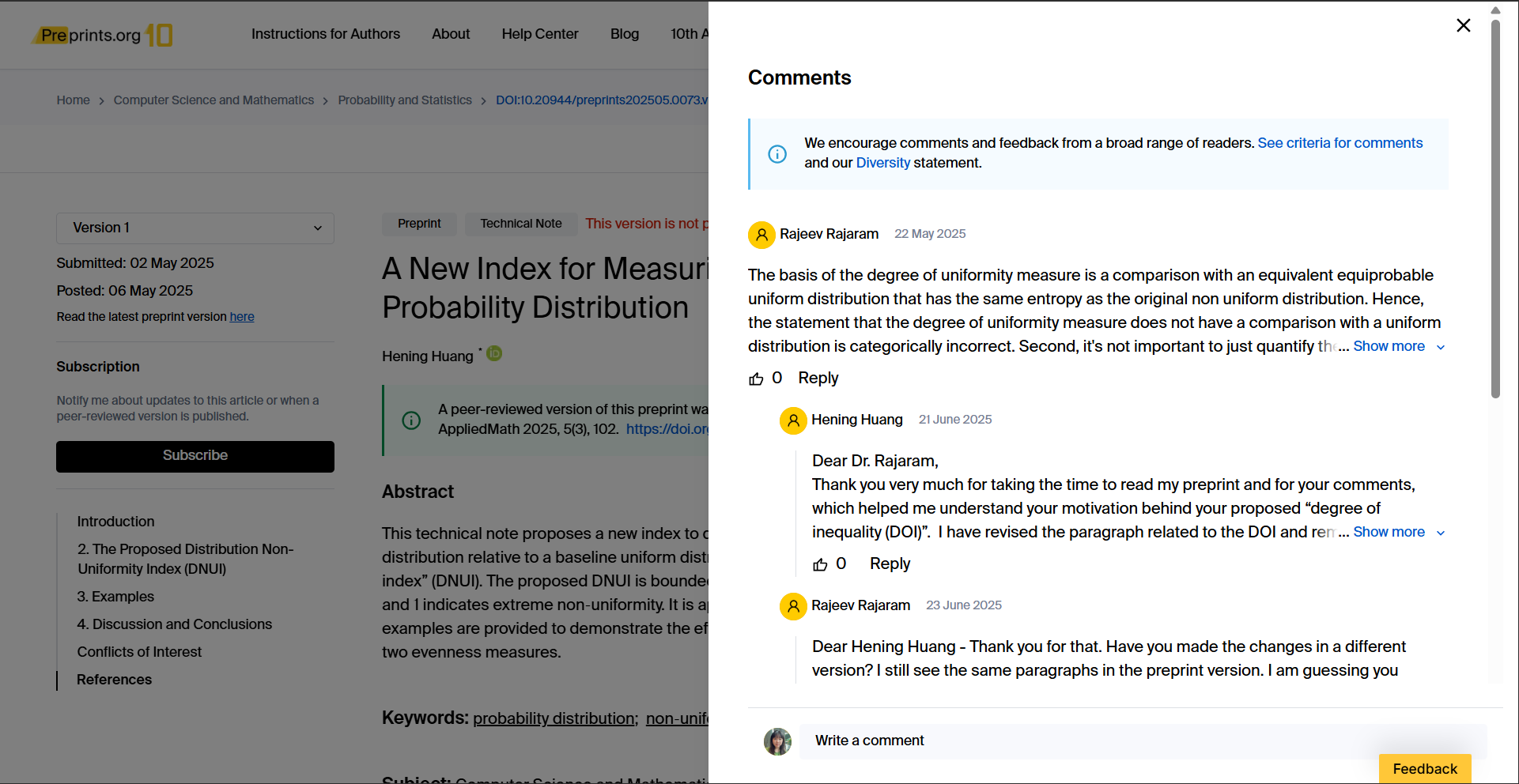
The comment function can also be used by authors to indicate information to readers (such as an update to a new version). However, the single biggest use case for the comment function on a preprint is to provide valuable feedback to help improve the research.
Considerations for commenting
The Preprints.org commenting function has a few different factors to keep in mind:
- Comments will be screened for any offensive language and off-topic discussions within 1–2 working days before they are posted. Some areas of research can be heated subjects, but it’s always best to stay professional;
- Researchers can choose to share comments publicly or privately with the authors. In either case, comments should remain professional;
- If you want to provide more substantive feedback, but do not want to do so in a public space, you can select the “Set this comments as private comments“ option, making it visible only to the authors.
- Preprints.org is also collaborating with PREreview to receive comments and feedback from the wider research community. Authors can request a PREreview feedback immediately after submission.
As you can see, comments are not just a one-sized fits all situation. We always aim to provide tools to authors and readers to improve preprints.
How to post comments
Much like peer review, no one will generally “teach” how to leave comments. If you have something you want to say, what’s the best way to do it?
From an article about commenting on preprints, the authors noted:
“Ensuring that public feedback on preprints is focused, appropriate, specific and transparent (or FAST) will help to develop a thriving culture for reviewing and commenting on preprints.”
This is excellent advice, especially if you’re leaving comments for the first time. Make sure that your feedback is focused on the issue that needs to be addressed. That feedback should be appropriate (e.g., stay professional, be clear) so that the authors do not disregard valuable advice. Being specific is also extremely valuable. Providing section headings or even exact lines from the text can be helpful to authors so that they can find where an issue might be. Being transparent does not necessarily mean to let everyone know who you are. Instead, it can also mean that you are transparent regarding biases or areas where you might not be very familiar with subject matter. Don’t pass yourself off as an expert if you aren’t one.
In addition to the points above, articles can also be rated on significance and soundness—something to keep in mind.
Why it matters
With preprints you have the opportunity to select the papers you want to review and provide feedback to authors that can improve their article prior to journal submission.
We believe that commenting on and reviewing preprints is hugely beneficial to the progress of research and it is our aim to support and facilitate it as far as possible.