




This year marks the 10th anniversary of Preprints.org, a free, non-profit, multidisciplinary preprint server supported by MDPI. During this time, we have grown into a global platform where researchers share work, exchange feedback, and advance open access research together.
This article provides an overview of Preprints.org’s continuing mission to drive the use and acceptance of preprints. A discussion of the importance and impact of preprints on academia and society more broadly is also included.
Within a framework of enhanced transparency, speed, and access, the role of preprints continues to evolve. More readers can engage with, share, and build upon scientific information, no matter their financial status. In turn, this will drive open science, interdisciplinary collaboration, and the impact of new knowledge.
Our mission
Under the umbrella of MDPI, the mission of Preprints.org is to empower researchers worldwide to share their work more quickly and widely with a broader audience. Our vision is to shape the future of scholarly communication by becoming a leading global hub for early research dissemination.
As leaders in open access research dissemination, we are dedicated to making early versions of research outputs permanently available and citable. This includes making early-stage discoveries accessible, fostering rapid knowledge exchange, and breaking down barriers across disciplines and borders.
How we started
Preprints.org has been a leader in the movement towards making scientific information universally accessible. Originally conceived by MDPI in 1998, the idea emerged as a desire to provide a global platform for scholars to post research online. It has been a long journey, but one that we’ve been happy to share with you.
There have been a number of major milestones over our 10-year journey. Each one represents a breakthrough in terms of increasing the adoption and use of preprints and initiatives to expand their research impact.
Upon launching, Preprints.org had its first preprint posted in May 2016. By August, 100 research papers had been posted by the community. This showed an immediate interest from scholars to use this kind of platform.
As we reach the 10-year mark, we can look back at these milestones and see how our platform has driven open access research and the ability to share research online.
The current state of preprints
The increased use of open access has brought preprints to the forefront of scientific research over the past decade. Open science emphasizes increased accessibility and transparency in the process of open access research. This includes open data, which can be freely used, reused, and redistributed by anyone, with proper attribution under an open license.
The COVID-19 pandemic brought an urgent need for research to be completed, shared, and citable as quickly as possible. As a result, there was a surge of scientific manuscripts related to public health. To meet this demand, open access research and preprints were used more widely in order to rapidly disseminate early-stage research. This led to increased partnerships and collaboration between scholars, publishers, and public and private institutions.
Since then, institutional mandates and recommendations for open access research have steadily expanded across the industry. These policies have requirements set by governments, funding agencies, or universities for work to be published as open access research.
Last year, the Bill & Melinda Gates Foundation and ASAPbio and Creative Commons introduced new initiatives to make preprints a required step in funded research. This kind of official recognition from funders and research organizations demonstrates a continued investment in this form of sharing scientific research.
How preprints work
If you are not familiar with preprints in research, you may have some questions.
What are preprints? Why are they important? Are preprints good for researchers to pursue?
Preprints are works in progress that represent an early version of a future publication. Once a research paper is complete, authors can post it in an online repository as open access research.
Research papers are available to readers quickly, typically within 48 hours of submission. Each manuscript is citable and registered with a unique digital object identifier (DOI).
While there is no peer review, preprints go through a screening process before acceptance. In addition, readers can leave unofficial feedback for authors, who can use this information to improve their research paper.
Though there have been some concerns about sharing unpublished scientific manuscripts, preprints are now largely accepted within academic communities. And many preprints go on to be published in peer-reviewed journals, at which point authors can link the preprint to its version of record, so readers can always access the latest.
The impact of preprints
Preprints enhance the quality of scholarly work and research impact begins before publication.
Increased access to scientific research has had significant impacts on academia and society more broadly. Institutions and governments are increasingly prioritizing preprints for multiple reasons, including: enhancing research visibility and impact; encouraging interdisciplinary collaboration; and increasing access to scientific knowledge to the public.
First, preprints allow for the sharing of research before going through the peer-review process. Readers are able to view citable scientific manuscripts sooner and with more ease than with traditional publishing models.
Preprints make scientific research easier to access and share more readily. This increases the visibility and reach of open access research and encourages collaboration.
In competitive fields in particular, establishing priority of discovery and ideas early is crucial. With preprints, authors can post their research papers with a public timestamp without waiting for the peer-review process.
Posting a scientific manuscript on an online platform provides the opportunity to receive feedback in real time from others in the field before publication. Readers can offer a kind of unofficial assessment and leave feedback directly for authors on the platform.
How we support preprints sharing
Open access research means that academic materials can be freely downloaded, distributed, and reused, with appropriate citation. This reduces some of the most common barriers that limit access to academic content, allowing for research to be viewed and used by as many people as possible.
Preprints.org continues to forward open access research by making scientific manuscripts available quickly and to a wide audience. The increased ability to post research online promotes open science, collaboration, and faster dissemination of knowledge. It also encourages a culture of academic openness.
Who is the Preprints community?
Our community of researchers has met the call to advance open access research and open science.
Within our first year of launching, over 2,000 research papers were posted. The response from our partners to post research online has continued to build momentum since that time, with consistent expansion. As of 2025, we have surpassed 100,000 research papers posted.
Successful indexing of our site has expanded the recognition and visibility of the open access research produced, furthering the reach of our authors. More recently, in 2023, we launched the Preprint Friendly Journals program, which helps authors to find relevant journals that accept preprints for publication.
Additionally, the Advisory Board has also expanded significantly, with 300+ scholars today. This has helped to strengthen the screening process and the quality of the research shared on the platform.
Get involved in our 10th anniversary
As we celebrate 10 years of growth, we are taking the time to celebrate and reflect on the strides taken in the preprint landscape. To commemorate this 10-year journey, we will host a series of anniversary events for our growing community of researchers.
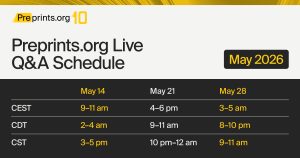
From May to July, we will host a weekly “Ask Me Anything” live Q&A series on our SciProfiles page. This is an opportunity to ask questions about preprints or provide feedback to us on your experience of posting preprints.
To help commemorate our 10th anniversary together, we are encouraging you to share your most memorable preprint with us on social media. Please use the official hashtags #MyMostMemorablePreprint #PreprintsOrg10 to join the conversation!
As we celebrate our 10th anniversary, we are reflecting on what the research community can build together. Throughout the decade, we have been a driver of some important achievements in open access research. We will continue to build upon this legacy as we begin the next chapter.