
Submitted:
26 November 2026
Posted:
27 November 2026
You are already at the latest version
Abstract
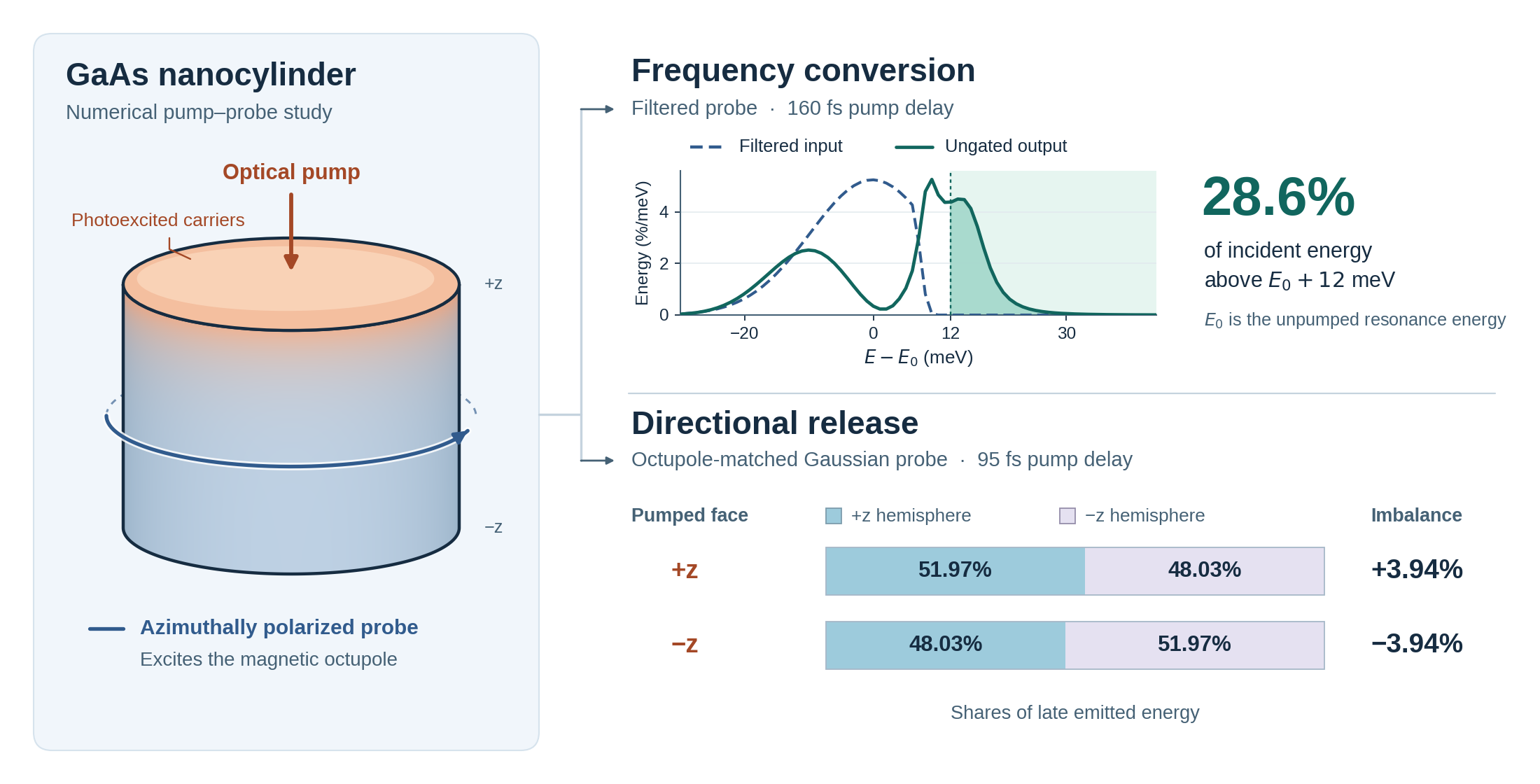
We examine whether optical pumping during the decay of a resonance in an isolated gallium arsenide nanocylinder generates frequencies absent from the probe and changes which hemisphere receives more of the late radiation. We calculate the response to an azimuthally polarized probe using a retarded volume coupled-dipole method with a causal electron–hole current and a prescribed carrier density. With a filtered probe and a pump delay of 160 fs, 28.6% of the incident energy emerges in the ungated spectrum at photon energies at least 12 meV above the unpumped resonance, beyond the input cutoff. With a Gaussian probe matched to the magnetic octupole and a pump delay of 95 fs, interference between magnetic multipoles of opposite reflection parity produces a late hemispheric energy imbalance of 3.94% whose sign reverses when the opposite face is pumped. These results suggest that a single semiconductor nanoantenna could serve as an ultrafast optical frequency converter whose far-field radiation pattern can be reconfigured by the pump.
Keywords:
time-dependent coupled-dipole method
; gallium arsenide
; frequency conversion
; quasi-bound state in the continuum
; magnetic multipoles
; free carriers
Copyright: This open access article is published under a Creative Commons CC BY 4.0 license, which permit the free download, distribution, and reuse, provided that the author and preprint are cited in any reuse.