
Submitted:
26 November 2026
Posted:
27 November 2026
You are already at the latest version
Abstract
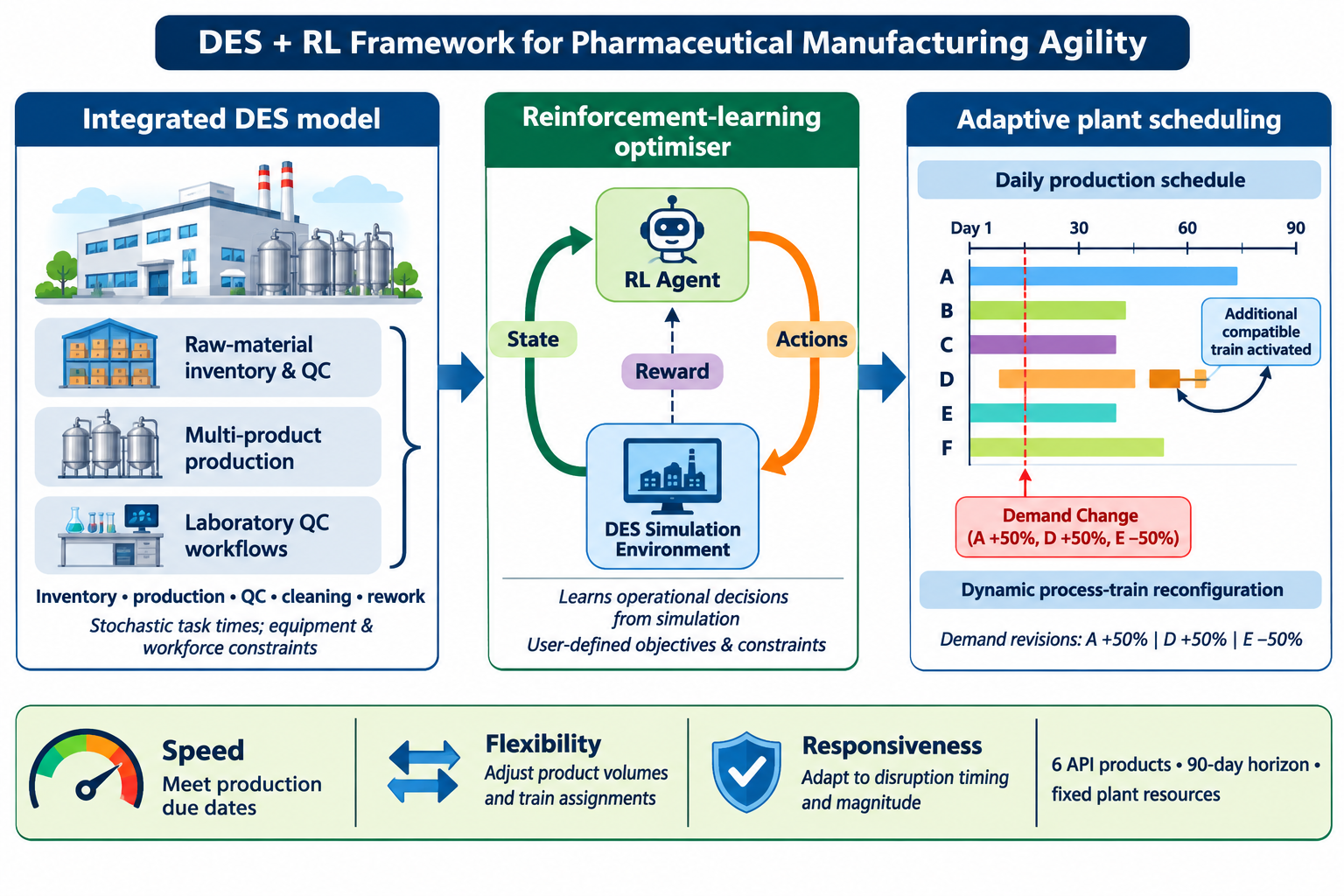
(1) Background: Pharmaceutical manufacturing agility is essential for responding to changing market demands and operational disruptions. This study aims to develop an integrated framework for enhancing manufacturing agility through discrete-event simulation (DES) and reinforcement learning (RL). (2) Methods: A DES model was developed to represent interconnected manufacturing activities, including multi-product production, raw material inventory management, and laboratory quality control workflows, with additional supporting functions incorporated as required. An RL-based optimiser was integrated to identify operational strategies under user-defined objectives and constraints. The framework was demonstrated through two plant scheduling case studies involving production due-date requirements and demand disruptions of up to 50%, requiring both daily production rescheduling and process train reconfiguration. (3) Results: The framework successfully evaluated the agility dimensions of speed, flexibility, and responsiveness. The RL optimiser generated adaptive production schedules and process train configurations in response to changing production requirements, while maintaining practical computational performance. Additional objectives, including production cost, energy consumption, and sustainability, can also be incorporated. (4) Conclusions: The proposed DES+RL framework provides a flexible and computationally practical approach to assessing pharmaceutical manufacturing agility and identifying adaptive operational strategies under dynamic operating conditions.
Keywords:
pharmaceutical
; agility
; plant scheduling
; discrete-event simulation
; reinforcement learning
Copyright: This open access article is published under a Creative Commons CC BY 4.0 license, which permit the free download, distribution, and reuse, provided that the author and preprint are cited in any reuse.