
Submitted:
25 November 2026
Posted:
27 November 2026
You are already at the latest version
Abstract
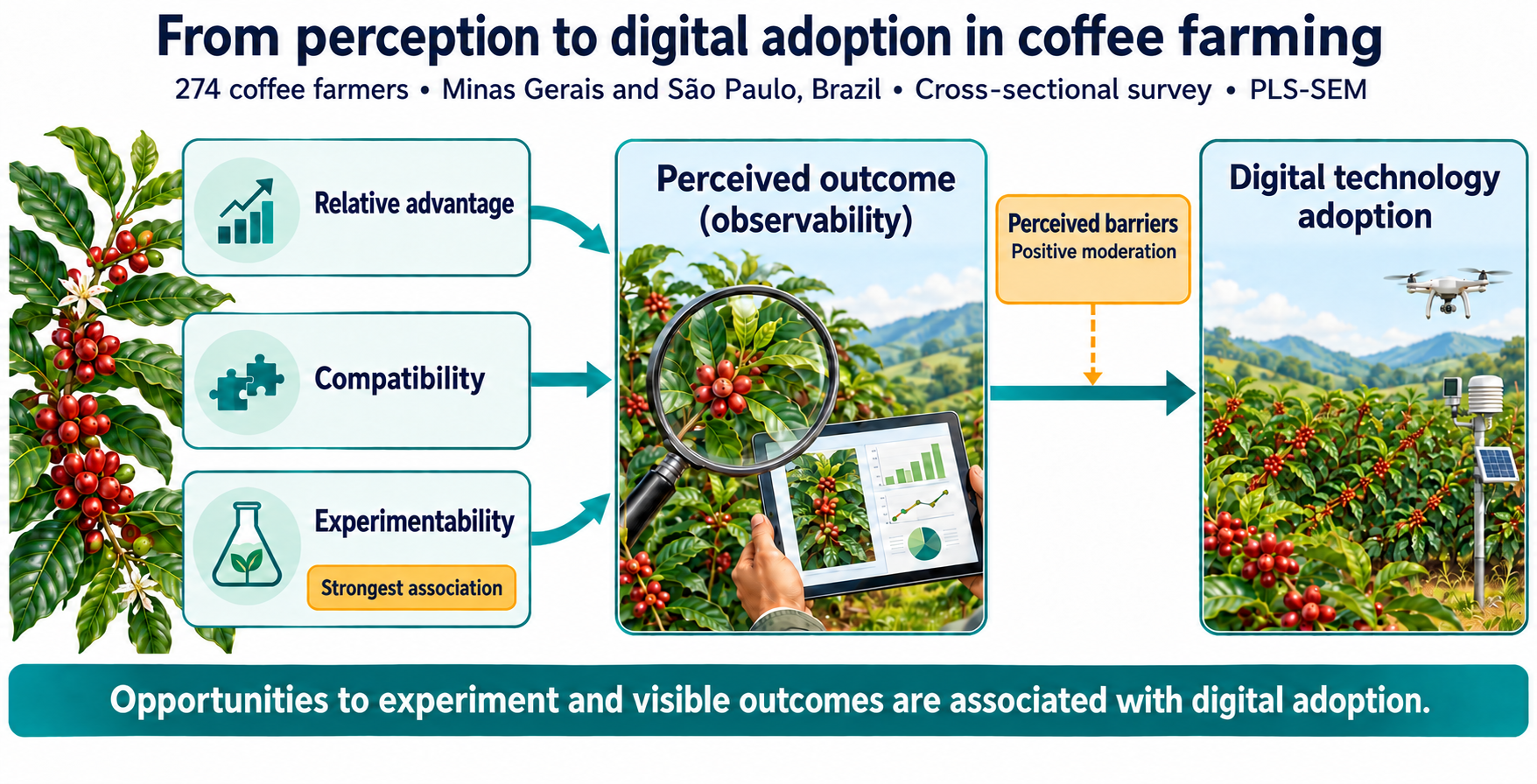
This study analysed the relationships between perceived innovation attributes (relative advantage, compatibility, and experimentability), perceived outcome observability, and the adoption of digital technologies among coffee farmers in the southern regions of Minas Gerais and São Paulo, Brazil. It also examined the moderating role of perceived barriers and the associations between socioeconomic and production-related control variables and technology adoption. Grounded in the Diffusion of Innovations Theory and the digital agriculture and Agriculture 4.0 literature, the study adopted a quantitative, descriptive, cross-sectional explanatory design. Data from an electronic questionnaire answered by 274 coffee farmers were analysed using Partial Least Squares Structural Equation Modeling (PLS-SEM) in SmartPLS 4. The results supported all five hypotheses. Relative advantage, compatibility, and experimentability were positively associated with perceived outcome observability, with experimentability showing the strongest association. Observability was positively associated with adoption, and perceived barriers moderated this relationship, strengthening it under more restrictive conditions. Among the control variables, cultivated area, financial performance, productivity in the latest harvest, and educational attainment were significantly associated with adoption. The findings support the theory's relevance for explaining digital technology adoption in coffee farming and highlight the joint importance of perceived innovation attributes and structural production conditions.
Keywords:
digital agriculture
; technology adoption
; experimentability
; observability
Copyright: This open access article is published under a Creative Commons CC BY 4.0 license, which permit the free download, distribution, and reuse, provided that the author and preprint are cited in any reuse.