

Submitted:
25 November 2026
Posted:
27 November 2026
You are already at the latest version
Abstract
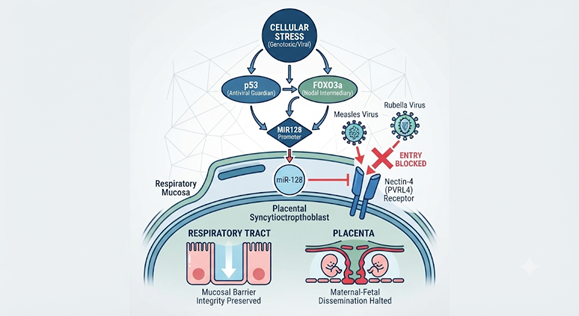
Host cell-surface receptors dictate viral tropism, tissue entry, and cross-barrier transmission. Although Nectin-4 (encoded by PVRL4) has recently been established as the essential epithelial receptor for major respiratory and teratogenic pathogens—including Measles virus and Rubella virus—the endogenous host mechanisms governing its expression remain poorly defined. Because physical wet-lab experimentation is absent in this study, we utilize advanced computational systems-biology modeling, network integration, and predictive multi-omics simulations. Here, we uncover an evolutionarily conserved host restriction pathway wherein the ancient antiviral guardian p53 coordinates with the longevity factor FOXO3a to deploy microRNA-128 (miR-128), which post-transcriptionally silences PVRL4. Systematic in silico evaluation of public expression repositories (GEO/Harmonizome) reveals a robust inverse correlation between p53 pathway activation states and PVRL4 surface density across polarized airway epithelia. By modeling the repression of surface Nectin-4 density, this predictive axis blocks the receptor-mediated membrane fusion required by Nectin-4-tropic viruses. These computational findings position the p53–FOXO3a–miR-128–Nectin-4 axis as a vital mucosal defense mechanism, demonstrating how ancient host restriction networks target specialized viral entry portals.
Keywords:
Nectin-4 (encoded by PVRL4)
; measles virus
; rubella virus
; systems-biology modeling
; network integration
; and predictive multi-omics simulations
; ancient antiviral guardian p53
; longevity factor FOXO3a
; microRNA-128 (miR-128)
; p53–FOXO3a–miR-128–Nectin-4 axis
Copyright: This open access article is published under a Creative Commons CC BY 4.0 license, which permit the free download, distribution, and reuse, provided that the author and preprint are cited in any reuse.