

Submitted:
24 November 2026
Posted:
26 November 2026
You are already at the latest version
Abstract
Continuous monitoring can keep reporting favourable results after a change has weakened the basis for an audit conclusion, even when the monitored control has not failed. This conceptual article investigates the conditions under which a favourable continuous-audit conclusion about a security control remains valid for continued reliance, and examines how these conditions differ from the validity assumptions underpinning periodic audit. A purposive synthesis of auditing standards, security monitoring guidance, continuous-auditing research, assurance-case maintenance and defeasible reasoning informs the framework. Continued reliance requires three jointly necessary but not sufficient conditions---represented scope, an adequate test and a usable evidence source---together with a documented judgement of evidential sufficiency. Changes that challenge these conditions are distinguished from deviations, which contradict the conclusion. The framework expresses these distinctions as reliance states with explicit transition rules, embedded in a five-stage cycle of objectives, monitoring, assessment, remediation and revalidation, and management review, with transversal independent audit evaluation. Hypothetical multifactor authentication and access-review cases illustrate the model. Close precedents in assurance-case maintenance limit the contribution to a scoped integration centred on the governed use of audit conclusions, whose benefits remain untested propositions.
Keywords:
continuous auditing
; security controls
; audit evidence
; defeasible reasoning
; revalidation
; continuous assurance
; internal audit
; assurance cases
1. Introduction
An organisation may receive favourable results from an automated security test every day while the conclusion those results are taken to support has ceased to be justified. Consider an administrative access control assessed through a known set of interfaces. A newly introduced interface changes that population, but the existing test continues to interrogate the same identity configuration. The observations may be accurate and recent; they no longer establish that all administrative access satisfies the intended requirement. Repeating the test more frequently does not repair the missing relationship between the observed population and the conclusion.
The organisational setting is privileged access to information services. The information assets at stake are the services and data that administrative access can reach, and the audit conclusions about the controls protecting them are themselves relied on: an unsupported favourable conclusion can influence access-risk acceptance, investment and audit reporting while leaving sensitive information exposed. The problem is becoming more consequential. The NIS 2 Directive (Directive (EU) 2022/2555) requires essential and important entities to adopt policies and procedures to assess the effectiveness of their cybersecurity risk-management measures (Art. 21(2)(f)) [1], the Digital Operational Resilience Act (DORA) requires financial entities to monitor and control the security of information and communication technology (ICT) systems continuously (Art. 9(1)) [2], and ISO/IEC 27001 requires monitoring and measurement and internal audits at planned intervals (clauses 9.1 and 9.2) [3]. These instruments are used only to locate the problem, not interpreted legally.
Three points frame the study. The organisational security problem is the continued use of a favourable conclusion about a security control after its evidential basis has materially changed or become uncertain. The limitation in current approaches is that change-driven reassessment is well established at the level of systems, controls and assurance arguments [4,5,6,7], but the conditions under which a particular audit conclusion may continue to be relied on—and who may restrict or restore that reliance—are rarely made explicit between engagements. This article addresses these limitations by connecting control objectives, monitoring evidence, deviations, remediation and management review within a unified conceptual framework. It compares the validity assumptions of continuous and periodic audit and specifies the responsibilities and evidential relationships required to support continued reliance on audit conclusions.
The research question is: Under what conditions does a favourable continuous-audit conclusion about a security control remain valid, and how do these conditions differ from the validity assumptions of periodic audit? Two senses of validity must be kept apart. A conclusion is a statement about a control during a reference interval and can remain a faithful statement about that interval. What can lapse is the warrant for relying on it for a current use. The question is answered for the second sense: a conclusion remains valid for continued reliance while it is adequately supported for a stated use, scope and time context. This implies neither certainty about the security of a system nor indefinite validity of an audit report.
Periodic audit is not purely time-bound. International Standard on Auditing (ISA) 330 permits reliance on evidence about the operating effectiveness of controls obtained in a previous audit only after establishing whether significant changes have occurred; even without change, such controls must be retested at least once in every third audit, and prior evidence may not be relied on for controls that mitigate a significant risk [8]. Management-system certification under ISO/IEC 17021-1 combines a three-year cycle with surveillance audits within it [9]. Both regimes combine conditions with time limits. The movement in the title from time-bound to condition-bound reliance therefore describes a shift of emphasis rather than a discovery: monitored conditions become the primary basis for reliance between engagements, and elapsed time is retained as a backstop.
The underlying ideas have substantial precedents, including event-driven monitoring, significant-change reassessment, regression test selection and assurance-case maintenance [4,5,6,10,11]. The research problem is therefore not whether change should trigger reassessment, but how these relationships can be organised around continued reliance on particular conclusions within a complete continuous-audit cycle, with identifiable decision authority and independent audit evaluation. Section 2 defines the concepts used; Section 3 describes the conceptual development method and the comparison with existing approaches; Section 4 develops the framework; Section 5 analyses and illustrates it; Section 6 and Section 7 discuss implications and limitations; Section 8 concludes.
2. Conceptual Background and Related Work
2.1. Controls, Evidence, Assurance and Accountability
A security control is a measure that modifies information security risk. Controls are commonly classified as preventive (stopping an event, such as multifactor authentication (MFA)), detective (identifying an event or condition, such as log monitoring) and corrective (restoring a desired state, such as revoking excessive rights). ISO/IEC 27002 further distinguishes organisational, people, physical and technological controls [12]. Continuous monitoring of a preventive control is itself a detective activity: it produces information about the control, not the control’s effect.
Audit evidence is the information used to reach a conclusion. An observation is not a conclusion: the inferential relationship depends on what was tested, why the test addresses the objective, and whether the source can support that use. ISA 500 distinguishes the quantity of evidence from its quality, including relevance and reliability, and requires attention to the accuracy and completeness of information used as evidence [13]. For assurance on subject matter other than historical financial information, which includes the operating effectiveness of security controls, International Standard on Assurance Engagements (ISAE) 3000 (Revised) requires sufficient appropriate evidence and a conclusion related to a point in time or period [14]. These standards are used as conceptual references, not as rules binding every security audit. Security assurance is justified confidence that security requirements are met; reviews of the field treat it as a lifecycle activity rather than a static product [15].
Governance and accountability concern who decides, on what evidence, and who answers for the decision. The Three Lines Model of The Institute of Internal Auditors (IIA) separates management’s ownership of risk and control from internal audit’s independent assurance [16], and the Global Internal Audit Standards set principles of independence and of evidence supporting engagement conclusions [17].
2.2. Continuous Monitoring, Continuous Auditing and Continued Reliance
Continuous auditing originated in proposals to audit online systems through recurring embedded procedures rather than retrospective sampling [18]; the Siemens pilot is an established example of continuous control monitoring associated with internal audit [19]. Professional guidance distinguishes continuous monitoring, a management activity producing and interpreting information about controls and risks, from continuous auditing, internal audit’s recurring evaluation of that information and other evidence; continuous assurance results from coordinating the two [20]. That guide was superseded in September 2025 by a third edition, Continuous Auditing and Monitoring [21]. Its full text is restricted to IIA members and was not consulted; the publisher’s public summary still presents continuous auditing as the means by which internal audit provides continuous assurance, to be integrated with continuous monitoring [22]. The distinction is therefore taken from the 2015 guide. Their activities may share data and technology, but their responsibilities are not interchangeable. Rikhardsson et al. frame continuous-auditing solutions in relation to their adoption, implementation and use within internal audit, supporting the treatment of the process as an organisational information system rather than only a testing engine [23]. A survey of internal auditors in Portugal found continuous-assurance services rated as highly important but implemented much less, with monitoring metrics the least implemented [24]. Recent work on continuous audit for Internet of Things (IoT) security compliance places the relationship between auditors and automated tools at the centre of the analysis [25]. Neither automation nor a dashboard establishes an independent audit conclusion by itself.
In this article, continuous does not mean that every control is tested at every instant. It denotes a maintained process in which planned assessments and relevant events can initiate timely reconsideration, with responsibility for acting on the result. National Institute of Standards and Technology (NIST) Special Publication (SP) 800-137 on information security continuous monitoring (ISCM) accommodates event-driven assessment alongside frequencies determined by risk [4]. A process that collects observations continuously but postpones all interpretation until an annual engagement would not satisfy this meaning.
A conclusion involves three temporal references: when the underlying condition existed, when evidence was collected, and when a reliance decision was made. A conclusion about a completed period may remain a faithful statement about that period despite a later change; what becomes unsupported is its unqualified reuse as a statement about the present. If later information shows that the original population was incomplete, the historical conclusion may itself require reconsideration.
2.3. Assurance Cases and Defeasible Inference
Assurance cases connect claims, arguments and evidence, and their maintenance after change has long been treated as a distinct problem [11,26]. Dynamic safety cases update arguments through the life of a system on the basis of monitored indicators [27]. This article adopts the need to make dependencies explicit, while proposing a smaller operational representation than a full assurance case for a system; the closest assurance-maintenance approaches are compared in Section 3.3.
A continuous-audit conclusion is a defeasible inference: its supporting reasons can lose their force without the conclusion being shown to be false. Pollock distinguishes rebutting defeaters, which are reasons to believe the conclusion false, from undercutting defeaters, which attack the connection between a reason and the conclusion [28]. Work on confidence in assurance cases adds undermining defeaters, which attack the evidence itself [29]. A failed enforcement test rebuts a conclusion; a new access route undercuts the inference from tested routes to all routes; a collector outage undermines the evidence. The three cases demand different responses. Table 1 fixes the terms used in the remainder of the article.
3. Conceptual Development Method
3.1. Design, Source Selection and Derivation
Jaakkola identifies four designs for conceptual articles: theory synthesis, theory adaptation, typology and model [30]. This article follows the model design, specifying relationships between validity conditions, triggers, deviations, judgements and reliance states, with an element of theory adaptation in importing the defeater taxonomy. The bodies of knowledge are assigned distinct roles: audit standards inform evidence judgements and authority; security guidance informs monitoring and reassessment; regression testing informs selective revalidation; assurance-case research and defeasible reasoning inform dependencies and the classification of events.
An initial purposive search on 5 November 2026 was extended on 9 November 2026 after a bibliographic lead list, produced with an artificial intelligence (AI)-assisted search tool, exposed closer assurance-maintenance comparators and organisational studies of continuous auditing. Searches combined continuous auditing, internal audit, security assurance case adaptation, assurance-case maintenance, regression test selection, significant change and audit evidence, alongside exact-title retrieval. Official standards sites and EUR-Lex were prioritised for normative concepts; publisher and institutional repositories were used for academic material. The lead list was a discovery aid, not a source of substantive claims: candidate metadata and relevant passages were checked before incorporation, and candidates with unsupported quantitative claims or undocumented methods were excluded. Generative AI tools were used in the development of the article: OpenAI ChatGPT/Codex for source discovery, synthesis, drafting and figure preparation; Consensus for the lead list; and Anthropic Claude for critical review, metadata checks and revision. All sources cited were checked against publisher, repository or official records, and the author is responsible for every claim. Selection required a direct connection to continued evidential support, change-driven reassessment, independent audit responsibilities or conceptual model development. Foundational sources were retained when they established a mechanism that could defeat a novelty claim; otherwise, work from 2019 onwards was preferred.
Extraction asked five questions: what supports reliance; what prompts reconsideration; which unit is affected; what restores support; and who decides. The comparison first identified existing mechanisms, then translated them into candidate design requirements for a bounded audit conclusion. These requirements were integrated into the proposed five-stage continuous-audit cycle and examined through three analytical branches: impact, no impact and inconclusive evidence. Access depth was uneven: method, discussion and limitation passages of the papers by Jahan et al., Ul Muram and Javed, Warg et al. and Sorokin et al. were inspected for the close comparison [6,7,31,32]; the use of Rikhardsson et al. is confined to the framing reported in its abstract [23]; standards were consulted selectively. No subscription-database search, independent coding or systematic screening was performed.
3.2. Normative and Technical Comparators
The comparison uses four dimensions: the conditions and triggers that prompt reconsideration; the unit whose support is reconsidered; the evidence needed to restore support; and decision responsibilities. Table 2 summarises the normative and technical approaches; entries describe emphasis relevant to this problem, not complete capabilities.
Among the normative comparators, the strongest challenge to novelty comes from the RMF. NIST SP 800-37 already allows reassessment to focus on controls affected by significant change and supports reuse of previous assessment results [5], and NIST SP 800-137A addresses the assessment of monitoring programmes themselves [33]. Neither targeted reassessment nor evaluation of monitoring quality can therefore be claimed as new. Regression test selection offers a precise precedent for selecting tests affected by change, but its safety properties depend on a stated software model [10]; they cannot be transferred to an organisational dependency map that may omit an interface or a supplier. In the proposed framework, unknown dependencies are a reason to broaden assessment or restrict reliance, not a justification for testing less. Certification practice supplies a further precedent: ISO/IEC 17021-1 provides for suspending, withdrawing or reducing the scope of a certification (clause 9.6.5) [9], so status values equivalent to supported, limited and suspended already exist at the level of a certified management system. What the present framework adds is their application to an individual control conclusion inside the organisation, a screening state for triggers of uncharacterised relevance, and the link between each restriction and the kind of defeater involved. ISA 315 recognises the relationships between IT risks, general IT controls and automated controls [35], which explains why favourable automated results cannot be interpreted independently of their environment.
3.3. Assurance Maintenance as a Direct Challenge to Originality
Jahan et al. represent security controls as interconnected assurance cases and propagate the effects of potential adaptations through their dependencies [6]. This is a direct precedent for reconsidering security-control support after change, not merely an analogy from safety engineering, and it prevents the present article from claiming novelty for linking a changed control to affected assurance claims. ATTEST supports the review and adaptation of assurance arguments through mappings between process, product and assurance models, with operational data from configured simulations contributing to the analysis; its stated limitations include tool and metamodel dependencies and human mapping effort [7]. Warg et al. combine modular assurance cases and contracts with continuous assessment, including confirmation reviews and audits [31]; independent assessment within iterative assurance is consequently also a precedent. Sorokin et al. use the Evidential Tool Bus (ETB) to maintain claims and evidence incrementally after change, distinguishing directly and indirectly affected goals [32], which further limits any originality claim for selective revalidation. Table 3 makes these overlaps visible; an unmentioned organisational feature is not treated as proven absence.
The resulting design question is narrower than assurance maintenance: how should an organisation govern the current use of a previously favourable audit conclusion while impact is unresolved, including changes missed by formal notification? The proposed integration binds a reliance state to a stated use and scope, records the evidential reason and decision authority, propagates restrictions to users, and subjects those decisions to independent audit and management review. These relationships could be implemented with existing assurance-case tools; no new propagation algorithm, completeness guarantee or automated sufficiency test is claimed. Table 4 distinguishes established, adapted and proposed elements.
4. Proposed Framework
4.1. The Conclusion Record
The framework begins with an explicit conclusion record. It identifies the control objective and evaluation criterion, the assessed population and exclusions, the test and its version, the evidence source and collection interval, relevant dependencies (shared components, collectors, identity services and suppliers), the conclusion author, intended users, the temporal reference and known limitations. It also records the person responsible for reviewing operational changes, the screening deadline for open triggers and the evidence-age threshold. These fields are proposed design requirements, not a format prescribed by the cited standards.
The conclusion author is typed. An operational conclusion is authored by the operational assessor as part of management’s continuous monitoring; an audit conclusion is authored by internal audit as part of continuous auditing. The term continuous-audit conclusion in the research question covers both, as conclusions maintained within the coordinated process from which continuous assurance results [20]. The conditions, states and rules below apply to both types, but only the author may change the reliance state of its own conclusion: the operational assessor cannot restore or replace an audit conclusion, and internal audit evaluates operational reliance decisions without making them.
The record separates the statement that a control met a criterion during an assessed interval from the decision to rely on that statement for a current purpose. A new assessment produces a new version or supplementary decision and preserves the earlier record. An affected subset may be separated only where its boundaries can be justified: if the same identity service or collector supports several conclusions, its degradation may affect all of them, and a convenient division in a dashboard does not establish independence between evidential bases.
4.2. Validity Conditions and Their Logical Status
Three conditions organise the assessment. C1, represented scope: the relevant population and context are adequately represented in the assessment baseline and evidence; a population may change without defeating C1 if reconciliation and assessment incorporate the change. C2, adequate test: the test remains capable of addressing the control objective in that population and context; a test of a configuration flag does not necessarily test enforcement on every access route. C3, usable evidence source: the source remains sufficiently reliable, complete and current for the inference being made; correct records about yesterday’s system may be inadequate for a conclusion about today’s deployment. Elapsed time thus enters the framework through C3, as the evidence-age threshold, and not as a separate basis for reliance.
Let K be a conclusion recorded for an intended use u. The conditions are proposed as necessary for warrant:
The necessity claim is argued by elimination. If C1 fails, part of the population about which the conclusion speaks is absent from the evidence, so the conclusion asserts more than was assessed. If C2 fails, the evidence concerns something other than the control objective, however complete the population. If C3 fails, the observations cannot be taken as accurate, complete or current, so neither scope nor test can be relied on through them. In each case one link in the inference from observations to conclusion is missing, whatever the quality of the others. The conditions are not sufficient, and the article does not claim a sufficiency condition. Instead, it proposes an operational authorisation rule: reliance for use u may be authorised at time t only when C1–C3 have been assessed as holding and the authorised assessor has recorded a judgement that the evidence is sufficient and appropriate, considering contrary evidence, coverage, depth of testing and residual uncertainty. This is a decision convention, not a proof: since J is itself a judgement about sufficiency, adding it to C1–C3 does not demonstrate warrant, but it makes the decision attributable and reviewable. The article does not attempt an exhaustive decomposition of J, on which sampling, exceptions, contradictory evidence, competence and the significance of risk all bear. The practical value of C1–C3 is that their failure is detectable through identifiable classes of event, and that the condition affected indicates what revalidation must address. The conditions are separable but interact: knowledge of scope helps determine whether a test is adequate, and the evidence source may be needed to establish the scope itself. NIST SP 800-53A provides a basis for tailoring control assessments; the three-condition grouping is this article’s adaptation [36].
The criterion and intended use are part of the conclusion’s identity, not further conditions. If the requirement changes—for instance, from any second factor to phishing-resistant authentication—the conclusion remains a faithful statement about the original criterion but no longer answers the question being asked. That calls for supersession by a new conclusion, not revalidation of the old one.
4.3. Triggers, Deviations and Evidence Judgements
A trigger is information requiring reconsideration; a deviation is an observed departure from an evaluation criterion. In the terms of Section 2, a deviation rebuts the conclusion; triggers affecting C1 or C2 undercut it, because the evidence may remain accurate but no longer licenses the inference to the stated scope or objective; and triggers affecting C3 undermine it. A new interface is a trigger before any failure is demonstrated; a source outage is a trigger even while the control operates correctly; failure to enforce MFA is a deviation if the criterion requires it. Triggers include notified changes, unrecorded changes detected through reconciliation, evidence-source degradation, new information challenging test adequacy and expiry of the evidence-age threshold. Their relevance is assessed by tracing possible effects on the conclusion’s recorded dependencies. Table 5 illustrates the many-to-many relationship; entries are plausible effects requiring investigation, not predetermined diagnoses.
For each trigger, the assessor records what is known, what is uncertain, which conclusions may be affected and what additional evidence would resolve the uncertainty. The absence of an observed deviation is not evidence that a trigger has no impact; equally, completing a remediation ticket does not show that a control again meets its criterion. An explicit judgement is needed at both transitions.
4.4. Reliance States and Transition Rules
A reliance state applies to a conclusion–use–scope combination; it does not assign a universal colour to the control. Leaving a conclusion favourable while a trigger is unassessed would allow silent reuse, while suspending every conclusion at every change would be unworkable and erode users’ willingness to respond. The framework therefore includes a bounded, visible screening state. Table 6 defines the states and Figure 1 the permitted transitions.
Rule 1, screening. Every trigger moves a supported conclusion to F. The screening window exists only to characterise a trigger whose relevance is not yet known. As soon as the assessor determines that the trigger plausibly challenges material support, the conclusion moves to L or X at that moment, without waiting for the window to expire; recognised insufficiency is never tolerated until a deadline. If the trigger is shown to be irrelevant, the conclusion returns to S with a recorded rationale. If the window expires with relevance still uncharacterised, the conclusion moves to L or X; it never returns silently to S. F does not certify adequate support: during screening, the conclusion may not be presented as favourable without the visible flag. The window is set in the baseline in proportion to exposure and is zero for conclusions designated high-exposure, by analogy with the exclusion of prior evidence for controls mitigating significant risks in ISA 330 [8].
Rule 2, deviation. A relevant deviation moves the conclusion directly to L or X without screening; L is permitted only where an unaffected subset is demonstrably separable.
Rule 3, restoration. Renewed favourable reliance requires evidence addressing each affected scope, test or source dependency and a documented judgement by the authorised assessor. Risk acceptance and the closure of an action are not substitutes. The restored conclusion states the interval to which the new evidence applies, and restoration records a new decision rather than silently resetting the previous result. The same requirements govern a move from X to L, which restores reliance only for a subset whose separability has been demonstrated.
Rule 4, supersession. A change in criterion or intended use moves the conclusion to R from any state; there is no transition out of R.
Suspension concerns confidence in a conclusion, not the availability of a service or the operation of the control. These rules are proposed decision conventions integrating established principles, not statutory obligations.
4.5. The Five Stages
Figure 2 embeds these decisions within the five stages required for the continuous-audit cycle. The stages describe responsibilities and evidence flows rather than a requirement to deploy a new platform; existing monitoring, change and audit systems can be used if their records preserve the relationships described here.
Stage 1: Objectives and assessment baseline. The control owner defines the operational objective and population with the security and risk functions. The assessor establishes criteria, tests, evidence needs and known dependencies, creates the conclusion record and fixes the screening window, evidence-age threshold, escalation thresholds, review cadence and recipients of restrictions. For an independent audit conclusion, internal audit determines its own scope and approach.
Stage 2: Monitoring, evidence and reconciliation. Operational monitoring collects results and source-health information. Change notifications are supplemented by scheduled reconciliation of recorded and observed assets, interfaces, configurations or access paths. The observed side must be capable of revealing discrepancies beyond the change register: comparing a register with a report derived solely from it offers little protection against unrecorded change. Reconciliation produces candidate discrepancies, not proof of failure; its frequency depends on exposure, volatility and the cost of delayed detection.
Stage 3: Assessment of triggers and deviations. The designated assessor screens each trigger within its window, traces relevant or uncertain triggers to affected conclusions, classifies their effect and applies Rules 1, 2 and 4. The author of an audit conclusion retains authority over its audit interpretation.
Stage 4: Remediation and revalidation. A demonstrated control failure requires an operational response. Where only scope or evidence is in doubt, revalidation may be required without remediation. Known dependencies can guide selective tests, but a new interface may require new tests rather than reruns of old ones. A successful test of a repaired component does not by itself establish the completeness of the wider population. The assessor applies Rule 3.
Stage 5: Management review. Management reviews limited and suspended conclusions, expired screening windows, response delays, resource needs and recurring weaknesses in the baseline or monitoring. It assigns action and may accept residual operational risk within its authority, but it cannot turn unsupported evidence into a supported conclusion or direct the auditor to remove a justified qualification. No-impact decisions remain visible so that systematic misclassification can be detected, and changes in objectives, criteria, resources and dependencies return to Stage 1.
4.6. Independent Audit and the Allocation of Responsibilities
The independent audit function is transversal, but it is not merely an observer of process compliance. It evaluates whether the baseline is appropriate, whether reconciliation can detect uncommunicated changes, and whether screening, reliance and revalidation decisions are supported. It may inspect evidence provenance, repeat selected tests, challenge population completeness and test the control directly. A risk-based audit programme specifies recurring coverage and escalation triggers, such as a material unresolved limitation or repeated unjustified no-impact classifications. Audit cannot claim to provide continuous independent assurance simply because management maintains a live record.
The Global Internal Audit Standards and the Three Lines Model require a distinction between operational assessment and audit judgement [16,17]. Operations can restrict the use of its own assessment immediately and must notify audit of a change affecting an audit conclusion; it cannot issue a replacement audit opinion. Conversely, audit should not operate the control or own remediation while purporting to assess those activities independently. Table 7 specifies the division.
Decision communication is part of the mechanism. A restriction recorded in a repository does not prevent reuse if downstream reports still display the earlier favourable status. Each conclusion therefore needs identifiable users or distribution points and a way of propagating state changes. Where a conclusion has been copied into a report, that report’s date and scope remain visible, and current reliance must refer to the current state. The framework reduces silent reuse only where consumers receive and act on restrictions.
5. Conceptual Analysis and Illustration
5.1. Comparison with Periodic Audit
Table 8 addresses the second part of the research question. Periodic regimes already make reliance conditional and cap it in time [8,9]; what typically remains invisible is whether the conditions hold between engagements. The proposed process retains scheduled reviews because events may be missed, evidence ages and the dependency model may be wrong.
5.2. Case A: Multifactor Authentication on Administrative Routes
Both cases are hypothetical and contain no organisational observations. An organisation protects privileged administrative access to a sensitive information service with MFA, a technological control in the sense of ISO/IEC 27002 [12]. The baseline identifies two administrative interfaces and the relevant privileged identities. Initial assessment directly tests enforcement on both routes; daily monitoring then checks identity configuration and selected authentication outcomes. A deployment introduces a candidate third access interface. The daily identity check remains favourable because the identities retain their MFA-enabled attribute, but the original direct tests do not include that component. This does not establish that MFA is bypassed; it undercuts the conclusion, since C1 and C2 may fail while C3 holds. Under Rule 1 the conclusion moves to F. For the purposes of the illustration, the baseline is assumed to give this conclusion a short, non-zero screening window; had it been designated high-exposure, Rule 1 would have moved it directly to L or X when the candidate interface was detected.
Where the deployment is notified, Stage 2 detects it through the change process. Where no ticket exists, reconciliation against independently observed deployment, gateway or network information may reveal it, adding a question about the effectiveness of change reporting. If neither source reveals the interface, the framework cannot respond to the invisible event—a substantive boundary, not a benefit that can be assumed away. Table 9 summarises three decision branches.
In the relevant-impact branch, a narrower conclusion on the two original routes may remain usable (L) only if their independence from the new route’s authentication components is demonstrated; otherwise reliance is suspended (X). Operations repairs the bypass and revalidation tests the new route, shared dependencies and the completeness of the revised population. In the no-impact branch, the change owner’s statement that the deployment was minor is not enough, and reconsideration ends without remediation because it revealed no control failure. In the inconclusive branch, the absence of observed failure is not converted into a favourable conclusion; management may accept operating temporarily under uncertainty, but the evidential state remains unresolved, and internal audit can report the limitation without claiming that the control has failed. Combining these branches into a single red status would conceal their different causes and closure requirements.
5.3. A Traceable Decision Within the Scenario
Consider the inconclusive branch detected through reconciliation. Record C-MFA-01 supports reliance on enforcement for interfaces A and B at the assessed time, with a current-use assumption of complete route coverage. Reconciliation event E-17 identifies candidate route C outside that baseline. The conclusion moves to F while the assessor screens E-17. Once the assessor establishes that C is an administrative route and that enforcement on C is unknown, E-17 plausibly challenges material support through C1 and C2; under Rule 1, reliance is restricted at that moment rather than at the end of the window. Because the independence of A and B from C’s authentication components has not been shown, current reliance on the all-routes conclusion moves from F to X; the earlier dated assessment is retained. A later demonstration of separation could move it to L for A and B.
The action record names the access-control owner to supply route and configuration information, the evidence owner to recover missing observations, and the assessor to determine the required tests. The restriction is sent to the risk-register and dashboard owners and to internal audit, which records its own response and whether further independent work is required. Management reviews the unresolved exposure and resources; approval to keep the service running does not change the evidential state. Closure requires a reconciled route population, an appropriate enforcement test and usable evidence for the new temporal reference, linked to a signed, dated reliance judgement and the distribution of its revised state. The identifiers are illustrative, not data from an implementation.
The interval of unjustified reliance. Let denote the change, its detection, the effective restriction of reliance as received by consumers, and revalidation (Figure 3). Where the change has actually defeated support,
where w is the screening window and the propagation delay to consumers. The bound is an operational target conditional on the screening deadline being met and on restrictions actually reaching consumers; it is not a property guaranteed by the existence of the states. Monitoring cadence bounds the detection delay only for changes that reconciliation can observe; if is unknown, an observed detection-to-restriction interval is only a partial measure. Revalidation at supports the conclusion from onwards; it does not prove that the control operated effectively during , and an earlier evidence gap stays visible.
5.4. Case B: Access-Rights Review as an Organisational Control
The framework should not depend on the observability of a technical setting. Consider a periodic review of privileged access rights, an organisational control in the sense of ISO/IEC 27002 [12]. The control objective is that privileged rights in the in-scope applications remain necessary and appropriate. The conclusion states that, in each cycle, every privileged entitlement received a documented, substantive decision by an accountable manager and that rights found unnecessary were removed within the period set by policy. Evidence comes continuously from an identity-governance tool, whose “review completed” record is the automated test. Three events illustrate the conditions. (i) After an acquisition, a new application is placed in scope but not connected to the tool; completion remains at 100% for connected applications, so C1 is undercut. (ii) Activity data show reviewers approving hundreds of entitlements within seconds; the completion record may be accurate, but it no longer evidences a substantive decision on necessity, so C2 is undercut. This does not show that any right is inappropriate; it shows that the test no longer supports the conclusion. (iii) The feed from the human-resources system fails, so leavers are no longer reflected; C3 is undermined and C1 may be affected. Restoring support may require audit re-performance of a sample of reviews rather than another automated check: the more a control depends on human judgement, the weaker automated completion evidence is as a basis for C2.
5.5. Consistency Check and Status of Claims
The cases show that the framework can represent a trigger without a deviation, a deviation with known impact, uncertainty without a justified favourable conclusion, and a criterion change as supersession rather than failure; one trigger can affect several conditions, and C1–C3 apply to a process control. These are checks of conceptual consistency, not demonstrations of effectiveness. Table 10 distinguishes literature-supported statements, reasoned propositions and questions requiring future testing.
6. Implications for Organisational Security
Responsibilities, escalation and management decisions. The framework makes restrictions and authority explicit. Management receives information about which conclusions lack support and why, rather than only a count of control exceptions, and may accept residual risk without converting it into evidence. Survey evidence that auditors perceive role confusion and the design of client controls as threats to independence in continuous auditing [37] is consistent with the separation in Table 7, although that study concerns external auditors in Egypt. Where an organisation lacks the capacity for recurring independent work, it should describe its process as monitoring with periodic independent evaluation rather than overstate its assurance coverage.
Compliance requirements and evidence. Where an organisation must show how it assesses the effectiveness of its security measures—for example under NIS 2 or ISO/IEC 27001 [1,3]—a reliance record of this kind could provide a documented basis for the claims it makes. Whether it would satisfy a particular supervisor or certification body is a separate question that this article does not address.
Control selection and effectiveness. Distinguishing rebutting from undercutting and undermining events separates missing evidence from demonstrated control failure and indicates what work would restore support: an evidence problem calls for further assessment, whereas a confirmed bypass also calls for remediation. A well-supported dependency map could avoid retesting unrelated controls while ensuring that a new access route receives an appropriate test. Maintaining the map and screening ambiguous triggers consumes resources, however, and in small or rapidly changing environments broader reassessment may be cheaper and more dependable. The framework should be evaluated against existing practice, including its administrative cost, rather than assuming that greater formalisation is beneficial.
7. Limitations and Future Validation
Scope and bias of the literature. The source selection is purposive and limited. It privileges accessible standards and close precedents and does not establish completeness across auditing, software engineering or security assurance; the originality claim could be weakened by additional work on assurance maintenance or operational audit systems. The AI-assisted lead list may favour indexed English-language literature. The standards have different purposes and jurisdictions: United Kingdom editions of the ISAs were used, the IIA continuous-auditing guide used here has been superseded by a 2025 edition of which only the publisher’s public summary could be consulted, and a US federal authorisation process does not govern every organisation. Their concepts are used analytically.
Assumptions and unresolved ambiguities. The framework depends on observability. Undetected changes, manipulated inventories, compromised evidence sources and incomplete dependencies can preserve unjustified confidence; reconciliation reduces one class of blind spot only if its observations add information. Evidence about the monitoring process has dependencies of its own, and the framework does not resolve this regress by asserting trust in an additional layer. The residual judgement J remains a matter of professional competence, and recognising that a criterion has become inadequate—and therefore that supersession is due—is itself a judgement the framework does not automate.
Contexts in which the proposal may not apply. Case B indicates that the framework extends to process controls whose evidence is partly automated. Application to culture, awareness or other controls with little observable evidence would require further conceptual work and should not be presumed. Organisations without a separate internal audit function cannot realise the independence assumed in the cycle.
Implementation constraints. The screening window deliberately tolerates a bounded period of possibly unjustified reliance; its length is a risk decision requiring context-specific justification and periodic challenge. The zero-length window for high-exposure conclusions reintroduces, for those conclusions, the immediate restriction on every trigger that the screening state is meant to avoid; the designation should therefore be used sparingly, and its cost falls within P4. Resource constraints can create queues in which timely detection is followed by delayed judgement, and over-sensitive triggers can produce restrictions that users learn to ignore. Survey evidence points to the absence of suitable standards, cost and a shortage of IT-skilled auditors as obstacles to continuous auditing [37]. More detailed evidence creates confidentiality and privacy costs, since administrative-access and review records may identify individuals or reveal sensitive infrastructure; proportionate collection, restricted access and retention decisions are design implications, not a legal compliance assessment.
Absence of empirical validation and future tests. No empirical evaluation has been performed. Four propositions translate intended benefits into claims that can be challenged.
- P1, reduced unjustified reuse. Where relevant changes are detected and restrictions reach users, explicit reliance states reduce E compared with a process that reports test outcomes without updating conclusion status. Evaluation should measure effective restriction time and actual reuse, not the creation of a ticket; no improvement despite equivalent detection and communication would count against P1.
- P2, proportionate revalidation. Where dependencies are sufficiently complete, revalidation directed by dependencies reduces effort relative to indiscriminate retesting without increasing missed deviations. A controlled comparison could use known changes with an independently established impact set; unknown dependencies are a predicted boundary condition, not cases to remove from the evaluation.
- P3, detection of unrecorded change. Reconciliation against sufficiently independent observed information reduces the detection delay of unrecorded relevant changes compared with change notifications alone. If both sides of reconciliation share the same blind spot, P3 should fail.
- P4, bounded screening. Compared with immediate suspension on every trigger, a bounded screening window changes the balance between restrictions later found unnecessary and additional exposure during screening. Evaluation should measure both quantities, including missed deadlines and propagation delays, without presupposing which effect dominates.
Useful measures include accuracy of affected-conclusion identification, detection, decision and propagation delays, revalidation effort, restrictions later found unnecessary and incorrect returns to S, as well as whether users understand the difference between an unsupported conclusion and a failed control. An expert walkthrough could first test interpretability and the allocation of authority; a controlled study or organisational pilot could then assess performance.
8. Conclusions
On the first part of the research question, a favourable conclusion about a security control remains valid for continued reliance only while its scope is adequately represented, its test remains appropriate and its evidence remains usable, and a documented judgement confirms that the evidence is sufficient and appropriate for the stated use. The three conditions are necessary but not sufficient; their value lies in being detectably challenged by identifiable classes of event. Such events undercut or undermine a conclusion without showing that the control has failed, whereas a deviation rebuts it, and a change of criterion or use calls for a new conclusion rather than revalidation of the old one.
On the second part, periodic audit is not simply time-bound: existing standards already make reliance conditional on the absence of significant change and cap it in time. The difference proposed is one of organisation and visibility. The conditions are monitored and acted upon between engagements through explicit reliance states and transition rules, with elapsed time retained as a backstop, within a cycle linking objectives, monitoring, assessment, remediation and revalidation, and management review. Independent internal audit evaluates the cycle and its evidence while retaining authority over its own conclusions, and neither monitoring frequency nor risk acceptance substitutes for evidence.
Close precedents in assurance-case maintenance mean that the originality lies in the integration—the governed use, restriction and communication of a bounded audit conclusion—rather than in change propagation or selective revalidation. The anticipated implications, such as earlier restriction of unsupported conclusions, more proportionate revalidation and clearer accountability, are expectations rather than demonstrated outcomes. Future work should test propositions P1–P4, first through expert walkthroughs and then through controlled studies or pilots, and should extend the analysis to controls with little observable evidence.
Funding
This research received no external funding.
Institutional Review Board Statement
Not applicable; this conceptual article reports no study involving human participants or animals.
Informed Consent Statement
Not applicable.
Data Availability Statement
No empirical dataset was generated or analysed. The illustrative cases are hypothetical; sources are listed in the references.
Acknowledgments
During the preparation of this manuscript, the author used OpenAI ChatGPT/Codex for source discovery, conceptual synthesis, figure construction and review; Consensus to generate a bibliographic lead list; and Anthropic Claude for review, bibliographic metadata checks and revision of the text, tables and figures. Their use is also described in Section 3. The author has reviewed and edited the output and takes full responsibility for the content of this publication.
Conflicts of Interest
The author declares no conflicts of interest.
Abbreviations
The following abbreviations are used in this manuscript:
| AI | Artificial intelligence |
| DORA | Digital Operational Resilience Act |
| ETB | Evidential Tool Bus |
| ICT | Information and communication technology |
| IIA | The Institute of Internal Auditors |
| IoT | Internet of Things |
| ISA | International Standard on Auditing |
| ISAE | International Standard on Assurance Engagements |
| ISCM | Information security continuous monitoring |
| MFA | Multifactor authentication |
| NIS 2 | Directive (EU) 2022/2555 on network and information security |
| NIST | National Institute of Standards and Technology |
| RMF | Risk Management Framework |
| SP | Special Publication |
References
- European Parliament and Council of the European Union. Directive (EU) 2022/2555 of 14 December 2022 on Measures for a High Common Level of Cybersecurity across the Union (NIS 2 Directive). Off. J. Eur. Union 2022, L 333, 80–152. [Google Scholar]
- European Parliament and Council of the European Union. Regulation (EU) 2022/2554 of 14 December 2022 on Digital Operational Resilience for the Financial Sector. Off. J. Eur. Union 2022, L 333, 1–79. [Google Scholar]
- International Organization for Standardization and International Electrotechnical Commission. ISO/IEC 27001:2022 Information Security, Cybersecurity and Privacy Protection—Information Security Management Systems—Requirements; ISO. Geneva, Switzerland, 2022.
- Dempsey, K.; Chawla, N.; Johnson, A.; Johnston, R.; Jones, A.; Orebaugh, A.; Scholl, M.; Stine, K. NIST Special Publication 800-137; Information Security Continuous Monitoring (ISCM) for Federal Information Systems and Organizations. National Institute of Standards and Technology: Gaithersburg, MD, USA, 2011. [CrossRef]
- Joint Task Force. NIST Special Publication 800-37 Rev. 2; Risk Management Framework for Information Systems and Organizations: A System Life Cycle Approach for Security and Privacy. National Institute of Standards and Technology: Gaithersburg, MD, USA, 2018. [CrossRef]
- Jahan, S.; Marshall, A.; Gamble, R. Evaluating Security Assurance Case Adaptation. In Proceedings of the 52nd Hawaii International Conference on System Sciences, Maui, HI, USA, 2019; pp. 7312–7321. [Google Scholar] [CrossRef]
- Ul Muram, F.; Javed, M. ATTEST: Automating the Review and Update of Assurance Case Arguments. J. Syst. Archit. 2023, 134, 102781. [Google Scholar] [CrossRef]
- Financial Reporting Council. International Standard on Auditing (UK) 330: The Auditor’s Responses to Assessed Risks. Standard, Financial Reporting Council, London, UK, 2025. Revised July 2017; updated September 2025. Available online: https://media.frc.org.uk/documents/ISA_UK_330_Revised_July_2017_Updated_September_2025.pdf (accessed on 9 November 2026).
- International Organization for Standardization and International Electrotechnical Commission. ISO/IEC 17021-1:2015 Conformity Assessment—Requirements for Bodies Providing Audit and Certification of Management Systems—Part 1: Requirements; ISO. Geneva, Switzerland, 2015.
- Rothermel, G.; Harrold, M. A Safe, Efficient Regression Test Selection Technique. ACM Trans. Softw. Eng. Methodol. 1997, 6, 173–210. [Google Scholar] [CrossRef]
- Mohamad, M.; Steghöfer, J.; Scandariato, R. Security Assurance Cases—State of the Art of an Emerging Approach. Empir. Softw. Eng. 2021, 26, 70. [Google Scholar] [CrossRef]
- International Organization for Standardization and International Electrotechnical Commission. ISO/IEC 27002:2022 Information Security, Cybersecurity and Privacy Protection—Information Security Controls; ISO. Geneva, Switzerland, 2022.
- Financial Reporting Council. International Standard on Auditing (UK) 500: Audit Evidence. Standard, Financial Reporting Council, London, UK, 2025. Updated September 2025. Available online: https://media.frc.org.uk/documents/ISA_UK_500_Updated_September_2025.pdf (accessed on 9 November 2026).
- International Auditing and Assurance Standards Board. International Standard on Assurance Engagements (ISAE) 3000 (Revised): Assurance Engagements Other than Audits or Reviews of Historical Financial Information. In Standard; International Federation of Accountants: New York, NY, USA, 2013. [Google Scholar]
- Shukla, A.; Katt, B.; Nweke, L.; Yeng, P.; Weldehawaryat, G. System Security Assurance: A Systematic Literature Review. Comput. Sci. Rev. 2022, 45, 100496. [Google Scholar] [CrossRef]
- The Institute of Internal Auditors. The IIA’s Three Lines Model: An Update of the Three Lines of Defense; The Institute of Internal Auditors: Lake Mary, FL, USA, 2020. [Google Scholar]
- The Institute of Internal Auditors. Global Internal Audit Standards; Issued; The Institute of Internal Auditors: Lake Mary, FL, USA, 2024. [Google Scholar]
- Vasarhelyi, M.; Halper, F. The Continuous Audit of Online Systems. Audit. A J. Pract. Theory 1991, 10, 110–125. [Google Scholar] [CrossRef]
- Alles, M.; Brennan, G.; Kogan, A.; Vasarhelyi, M. Continuous Monitoring of Business Process Controls: A Pilot Implementation of a Continuous Auditing System at Siemens. Int. J. Account. Inf. Syst. 2006, 7, 137–161. [Google Scholar] [CrossRef]
- The Institute of Internal Auditors. Global Technology Audit Guide (GTAG) 3: Continuous Auditing: Coordinating Continuous Auditing and Monitoring to Provide Continuous Assurance, 2nd ed.; The Institute of Internal Auditors: Lake Mary, FL, USA, 2015. [Google Scholar]
- The Institute of Internal Auditors. Global Technology Audit Guide (GTAG): Continuous Auditing and Monitoring supersedes the 2015 guide, Published, 3rd ed.; The Institute of Internal Auditors: Lake Mary, FL, USA, 2025. [Google Scholar]
- The Institute of Internal Auditors. Continuous Auditing and Monitoring, 3rd Edition: Guidance Summary Page, 2025. Available online: https://www.theiia.org/en/content/guidance/recommended/supplemental/gtags/continuous-auditing-and-monitoring (accessed on 14 November 2026).
- Rikhardsson, P.; Singh, K.; Best, P. Exploring Continuous Auditing Solutions and Internal Auditing: A Research Note. J. Account. Manag. Inf. Syst. 2019, 18, 614–639. [Google Scholar] [CrossRef]
- Barros, C.; Marques, R. Continuous Assurance for the Digital Transformation of Internal Auditing. J. Inf. Syst. Eng. Manag. 2022, 7, 11681. [Google Scholar] [CrossRef]
- Briliyant, O.; Javed, A.; Cherdantseva, Y. Systematization of Human-Centered Continuous Audit for IoT Security Compliance. J. Cybersecur. 2026, 12, tyag021. [Google Scholar] [CrossRef]
- Kelly, T.; McDermid, J. A Systematic Approach to Safety Case Maintenance. Reliab. Eng. Syst. Saf. 2001, 71, 271–284. [Google Scholar] [CrossRef]
- Denney, E.; Pai, G.; Habli, I. Dynamic Safety Cases for Through-Life Safety Assurance. In Proceedings of the 37th IEEE/ACM International Conference on Software Engineering, Florence, Italy, 2015; Vol. 2, pp. 587–590. [Google Scholar] [CrossRef]
- Pollock, J. Defeasible Reasoning. Cogn. Sci. 1987, 11, 481–518. [Google Scholar] [CrossRef]
- Goodenough, J.; Weinstock, C.; Klein, A. Technical Report CMU/SEI-2012-TR-002; Toward a Theory of Assurance Case Confidence. Software Engineering Institute, Carnegie Mellon University: Pittsburgh, PA, USA, 2012.
- Jaakkola, E. Designing Conceptual Articles: Four Approaches. AMS Rev. 2020, 10, 18–26. [Google Scholar] [CrossRef]
- Warg, F.; Blom, H.; Borg, J.; Johansson, R. Continuous Deployment for Dependable Systems with Continuous Assurance Cases. In Proceedings of the 2019 IEEE International Symposium on Software Reliability Engineering Workshops (ISSREW), Berlin, Germany, 2019; pp. 318–325. [Google Scholar] [CrossRef]
- Sorokin, L.; Bouchekir, R.; Beyene, T.; Liao, B.; Molin, A. Towards Continuous Assurance Case Creation for ADS with the Evidential Tool Bus. In Proceedings of the Dependable Computing—EDCC 2024 Workshops, Cham, Switzerland, 2024; Vol. 2078. Communications in Computer and Information Science 49–61. [CrossRef]
- Dempsey, K.; Pillitteri, V.; Baer, C.; Niemeyer, R.; Rudman, R.; Urban, S. NIST Special Publication 800-137A; Assessing Information Security Continuous Monitoring (ISCM) Programs: Developing an ISCM Program Assessment. National Institute of Standards and Technology: Gaithersburg, MD, USA, 2020. [CrossRef]
- Johnson, L.; Dempsey, K.; Ross, R.; Gupta, S.; Bailey, D. NIST Special Publication 800-128; Guide for Security-Focused Configuration Management of Information Systems. Includes updates as of 10 October 2019; National Institute of Standards and Technology: Gaithersburg, MD, USA, 2011. [CrossRef]
- Financial Reporting Council. International Standard on Auditing (UK) 315: Identifying and Assessing the Risks of Material Misstatement. Standard, Financial Reporting Council, London, UK, 2025. Revised July 2020; updated September 2025. Available online: https://media.frc.org.uk/documents/ISA_UK_315_Revised_July_2020_Updated_September_2025.pdf (accessed on 9 November 2026).
- Joint Task Force. NIST Special Publication 800-53A Rev. 5; Assessing Security and Privacy Controls in Information Systems and Organizations. National Institute of Standards and Technology: Gaithersburg, MD, USA, 2022. [CrossRef]
- Aladwey, L.; El Sayad, S. Auditors’ Perceptions of the Triggers and Obstacles of Continuous Auditing and Its Impact on Auditor Independence: Insights from Egypt. J. Risk Financ. Manag. 2024, 17, 578. [Google Scholar] [CrossRef]
Figure 1.
Reliance states and transitions. A move to L or X from F occurs as soon as material challenge is established, not only at window expiry (Rule 1). L and X are linked in both directions: doubt may widen (L to X), or a subset may later be shown to be separable (X to L, Rule 3). Any state may move to R (Rule 4); only the edge from S is drawn.
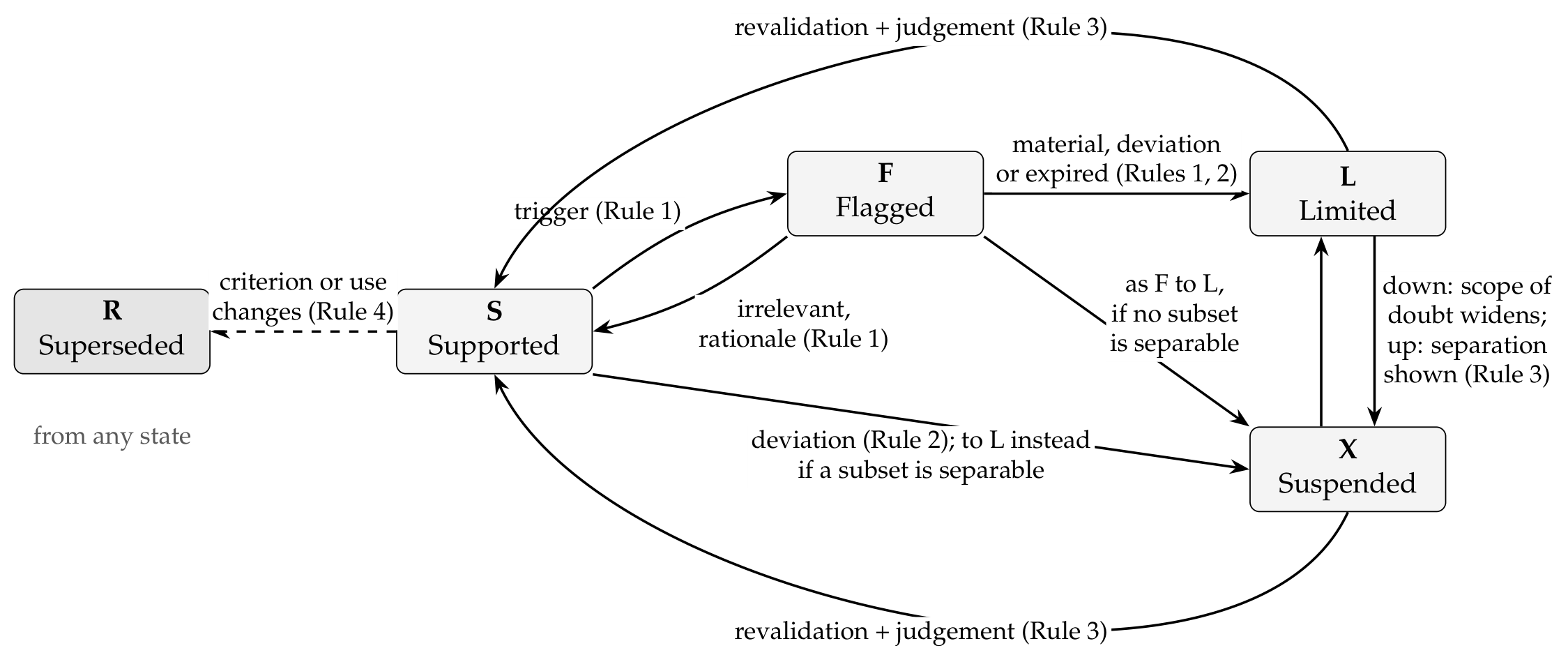
Figure 2.
The proposed cycle with transversal independent evaluation. Dashed arrows indicate evaluation of Stages 1–4, not operational ownership. No-impact decisions return to monitoring and remain visible in management reporting.
Figure 2.
The proposed cycle with transversal independent evaluation. Dashed arrows indicate evaluation of Stages 1–4, not operational ownership. No-impact decisions return to monitoring and remain visible in management reporting.
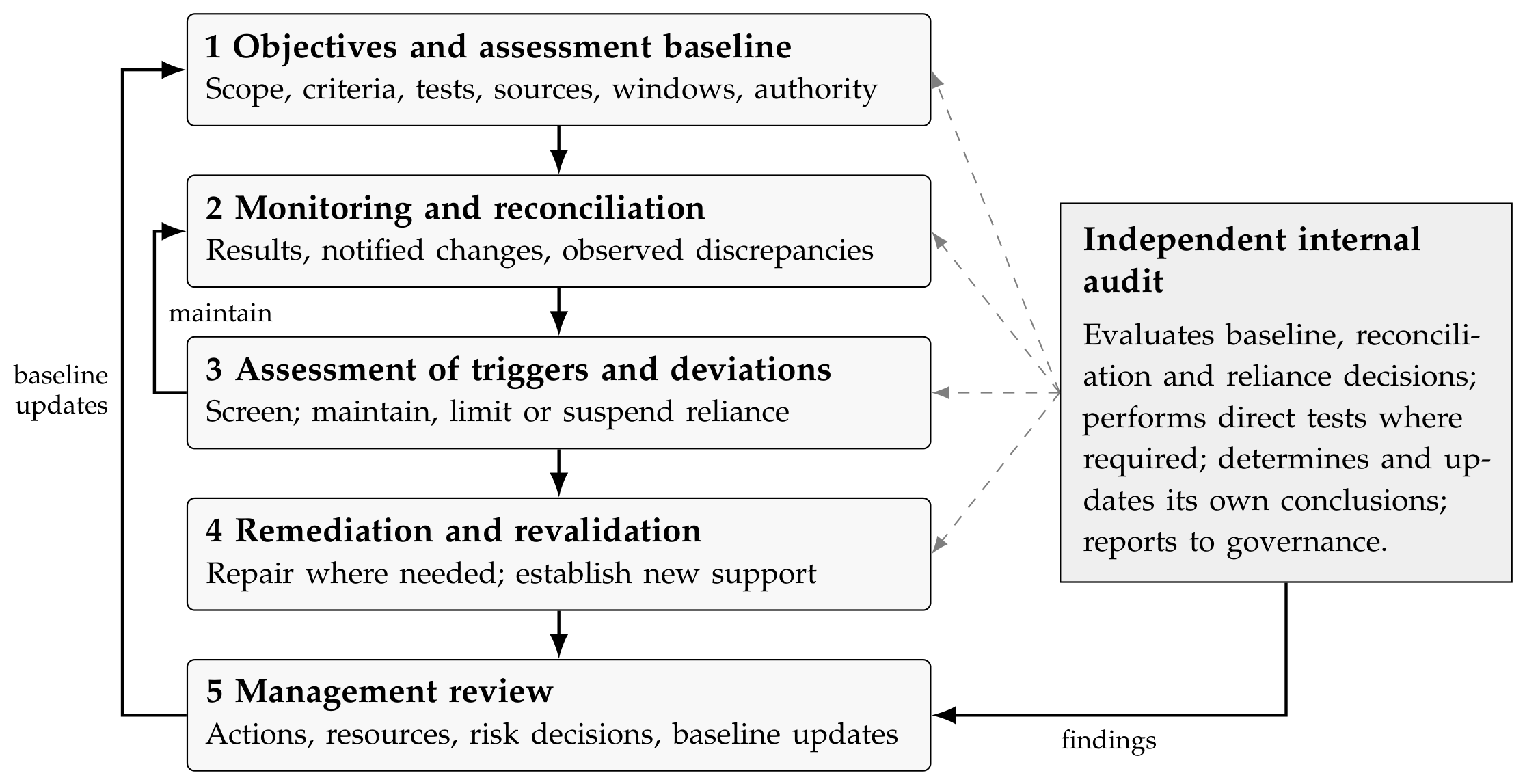
Figure 3.
Timeline of an unrecorded change that defeats support.


Table 1.
Key terms as used in this article.
| Term | Meaning |
|---|---|
| Conclusion | Recorded statement that a control met a stated criterion for a defined population during a reference interval. |
| Warrant for reliance | Adequate current support for using a conclusion for a stated purpose; the sense of “remaining valid” addressed here. |
| Trigger | Information requiring reconsideration of the warrant for reliance. |
| Deviation | Observed departure from the evaluation criterion. |
| Reliance state | Recorded status governing current use of a conclusion for a stated use and scope. |
| Revalidation | Work that establishes new support and records the interval to which it applies. |
| Supersession | Replacement of a conclusion because its criterion or intended use has changed. |
Table 2.
Normative and technical comparators. Each row is an interpretive synthesis of the cited sources.
Table 2.
Normative and technical comparators. Each row is an interpretive synthesis of the cited sources.
| Approach | Conditions and triggers | Unit reconsidered | Restoring support | Responsibilities |
|---|---|---|---|---|
| ISCM and programme assessment [4,33] | Risk-based frequencies; events | Controls; monitoring programme | Assessments; programme evidence | Monitoring and assessment roles |
| Risk Management Framework (RMF) [5] | Significant change; evolving risk | Affected controls; authorisation basis | Targeted reassessment; reuse of prior results | System owner, assessor, authorising official |
| Configuration management [34] | Baseline deviation; change control | Configuration items | Configuration and assessment records | Change and system roles |
| Periodic audit and certification [8,9,13] | Significant change; third-audit retest; surveillance | Controls relied on; certified scope | Current-period tests; surveillance audit | Auditor; certification body |
| Regression test selection [10] | Code change under stated assumptions | Modified software | Selected tests | Technical testing roles |
Table 3.
Close assurance-maintenance comparators. Responsibilities describe the source context, not a judgement about its adequacy.
Table 3.
Close assurance-maintenance comparators. Responsibilities describe the source context, not a judgement about its adequacy.
| Approach | Support and triggers | Unit affected | Restoration | Responsibility focus |
|---|---|---|---|---|
| Jahan et al. [6] | Control dependencies; potential adaptations | Connected control claims | Recalculated propagated satisfaction | Expert modelling and adaptation assessment |
| ATTEST [7] | Model mappings; change or contradiction | Affected argument elements | Review and adapt arguments | Safety engineers and managers |
| Warg et al. [31] | Contracts and context; product evolution | Modular case fragments | Updated evidence and assessment | Development teams and assessors |
| ETB [32] | Workflow dependencies; changed artefacts | Claims and supporting artefacts | Incremental workflow execution | Workflow specification and validation |
| Proposed integration | C1–C3 defeaters; deviations; criterion or use change | Bounded audit conclusion and its current use | Scoped revalidation; recorded judgement | Owner; assessor; independent audit; management |
Table 4.
Provenance of the framework elements.
| Element | Status | Basis |
|---|---|---|
| Change-driven and event-driven reassessment | Established | [4,5,8] |
| Dependency-based identification of affected claims | Established | [6,26,32] |
| Continuous maintenance of arguments and evidence | Established | [7,27,31,32] |
| Independence of audit from management | Established | [16,17] |
| Conditions C1–C3 | Adapted | Assessment tailoring [36]; evidence quality [13] |
| Rebutting, undercutting and undermining events | Adapted | [28,29] |
| Supported, limited and suspended states | Adapted | Maintaining, reducing the scope of and suspending certification [9] |
| Flagged state, conclusion-level granularity and transition rules | Proposed | This article |
| Allocation of reliance decisions across the proposed continuous-audit cycle | Proposed | This article, building on [16,20] |
Table 5.
Illustrative trigger–condition matrix. •: potentially affected; –: no direct effect assumed in this example, not guaranteed immunity; n/a: not a trigger of C1–C3.
Table 5.
Illustrative trigger–condition matrix. •: potentially affected; –: no direct effect assumed in this example, not guaranteed immunity; n/a: not a trigger of C1–C3.
| Event | C1 | C2 | C3 | Effect on conclusion |
|---|---|---|---|---|
| New administrative interface | • | • | – | Undercutting |
| Unrecorded population change found by reconciliation | • | • | • | Undercutting; undermining |
| Collector outage or missing interval | • | – | • | Undermining; undercutting |
| Changed authentication mechanism | • | • | • | Undercutting; undermining |
| New bypass technique relevant to the objective | – | • | – | Undercutting |
| Evidence exceeds its age threshold | – | – | • | Undermining |
| Failed enforcement test | n/a | n/a | n/a | Rebutting (deviation) |
| Change in criterion or intended use | n/a | n/a | n/a | Supersession |
Table 6.
Reliance states. Each state is set by the author of the conclusion: the operational assessor for operational conclusions and internal audit for audit conclusions.
Table 6.
Reliance states. Each state is set by the author of the conclusion: the operational assessor for operational conclusions and internal audit for audit conclusions.
| State | Meaning for current use | Required record |
|---|---|---|
| Supported (S) | Support adequate for the stated use | Evidence and rationale; for return from F, evidence of non-impact |
| Flagged (F) | Trigger of uncharacterised relevance under screening; no certification of support; use only with visible flag until the deadline | Trigger, conditions possibly affected, owner, screening deadline |
| Limited (L) | Only a demonstrably separable subset remains supported | Boundary evidence; excluded population; reassessment owner |
| Suspended (X) | Intended favourable inference cannot currently be supported; not a finding that the control failed | Reason, interim action, recipients and review deadline |
| Superseded (R) | Criterion or intended use has changed | Link to the replacing conclusion; earlier record retained |
Table 7.
Responsibilities and evidence relationships. Roles may map to different job titles, but incompatible responsibilities should remain distinguishable.
Table 7.
Responsibilities and evidence relationships. Roles may map to different job titles, but incompatible responsibilities should remain distinguishable.
| Role | Primary responsibility | Record or judgement produced |
|---|---|---|
| Control owner | Maintain the control, communicate change, remediate | Scope and change records; remediation evidence |
| Monitoring or evidence owner | Collect evidence, report source health, reconcile | Results, discrepancies, provenance and gaps |
| Operational assessor | Screen triggers, decide operational reliance state, revalidate | Bounded decision, rationale, limits and deadline |
| Independent internal audit | Evaluate Stages 1–4; test directly; decide its own conclusions | Independent findings; audit reliance judgement |
| Management | Review limitations, allocate resources, decide risk treatment | Action and risk decisions; no override of evidential support |
Table 8.
Comparison of organising assumptions. Periodic entries interpret ISA 330, ISA 500 and ISO/IEC 17021-1; the right-hand column specifies this article’s design.
Table 8.
Comparison of organising assumptions. Periodic entries interpret ISA 330, ISA 500 and ISO/IEC 17021-1; the right-hand column specifies this article’s design.
| Dimension | Periodic engagement | Proposed continuing process |
|---|---|---|
| Basis for reliance | Absence of significant change, checked at the next engagement, plus a time cap | C1–C3 monitored between engagements; elapsed time retained as an evidence-age trigger |
| Temporal reference | Defined date or period; not a promise about the future | Explicit historical reference plus a current reliance state |
| Reconsideration | Planned work and information received | Event handling, reconciliation and scheduled review |
| Unit of restriction | Engagement scope and resulting opinion | Identified conclusion, population and justified subset |
| High-risk controls | No reliance on prior evidence for significant risks | Zero-length screening window |
| Audit responsibility | Independent judgement within the engagement | Recurring independent evaluation; authority over audit conclusions |
Table 9.
Case A branches. These are analytical outcomes of a hypothetical case, not measured results.
Table 9.
Case A branches. These are analytical outcomes of a hypothetical case, not measured results.
| Branch | What is established | Transition | Evidence required for S |
|---|---|---|---|
| Relevant impact | MFA bypass on the new route (rebutting) | S→F→L or X | Remediation of the bypass; enforcement tests on the new route; revised scope |
| No relevant impact | Component is not an administrative route, or is already covered | S→F→S with rationale | Evidence of irrelevance or adequate coverage |
| Inconclusive | New route is administrative, but logs are missing and enforcement is unknown | S→F, then L or X once relevance is established | Evidence resolving enforcement and coverage |
Table 10.
Status of the principal claims. Lit: supported by the cited literature; Prop: reasoned proposition of this article; Test: requires empirical testing.
Table 10.
Status of the principal claims. Lit: supported by the cited literature; Prop: reasoned proposition of this article; Test: requires empirical testing.
| Claim | Status | Basis |
|---|---|---|
| Periodic audit already conditions reliance on change and caps it in time | Lit | [8,9] |
| Change in one control can propagate to related controls and claims | Lit | [6,32] |
| Continuous assurance is valued more than it is implemented | Lit | [24] |
| C1–C3 are necessary but not sufficient for warrant | Prop | Section 4.2 |
| Triggers undercut or undermine; deviations rebut | Prop | Adapted from [28,29] |
| A bounded screening window balances silent reuse against blanket suspension | Prop; Test | Rule 1; P4 |
| Explicit reliance states reduce the interval of unjustified reliance | Test | P1 |
| Dependency-directed revalidation saves effort without missing deviations | Test | P2 |
Disclaimer/Publisher’s Note: The statements, opinions and data contained in all publications are solely those of the individual author(s) and contributor(s) and not of MDPI and/or the editor(s). MDPI and/or the editor(s) disclaim responsibility for any injury to people or property resulting from any ideas, methods, instructions or products referred to in the content. |
© 2026 by the author. Licensee MDPI, Basel, Switzerland. This article is an open access article distributed under the terms and conditions of the Creative Commons Attribution (CC BY) license.
Copyright: This open access article is published under a Creative Commons CC BY 4.0 license, which permit the free download, distribution, and reuse, provided that the author and preprint are cited in any reuse.