
Submitted:
24 November 2026
Posted:
26 November 2026
You are already at the latest version
Abstract
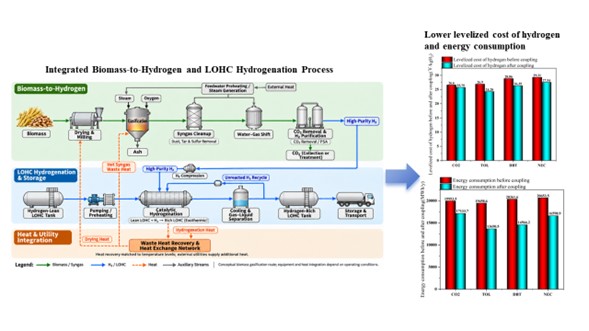
To promote the valorization of organic waste and explore routes that facilitate hydrogen storage and transportation, this study investigates the integration of biomass gasification for hydrogen production with liquid organic hydrogen carrier (LOHC) storage technology based on Aspen Plus process simulation. Four representative biomass feedstocks were first evaluated based on an annual hydrogen production capacity of 1,000 t. Comparative techno-economic analysis identified food waste as the preferred feedstock, yielding a levelized cost of hydrogen (LCOH) of CNY 22.52/kg H₂. The process models were subsequently developed for four LOHC pathways, including catalytic CO₂ hydrogenation to methanol, toluene to methylcyclohexane, dibenzyltoluene to perhydrodibenzyltoluene, and N-ethylcarbazole to perhydro-N-ethylcarbazole. The integrated processes were designed to recover the heat of hydrogenation for biomass drying, thereby reducing external heating and cooling demands. The techno-economic assessment shows that the toluene pathway achieves the best economic performance with an LCOH of CNY 24.28/kg H₂. Sensitivity analysis reveals that the costs of key hydrogen production equipment and utilities are the main drivers of the integrated systems’ economic performance. By leveraging material and energy synergies between hydrogen production and storage, this study provides a techno-economic basis for process selection and design optimization of the combination of decentralized biomass-to-hydrogen with LOHC technology.
Keywords:
biomass hydrogen production
; liquid organic hydrogen carrier (LOHC)
; process integration simulation
; techno-economic analysis
Copyright: This open access article is published under a Creative Commons CC BY 4.0 license, which permit the free download, distribution, and reuse, provided that the author and preprint are cited in any reuse.