

Submitted:
23 November 2026
Posted:
25 November 2026
You are already at the latest version
Abstract
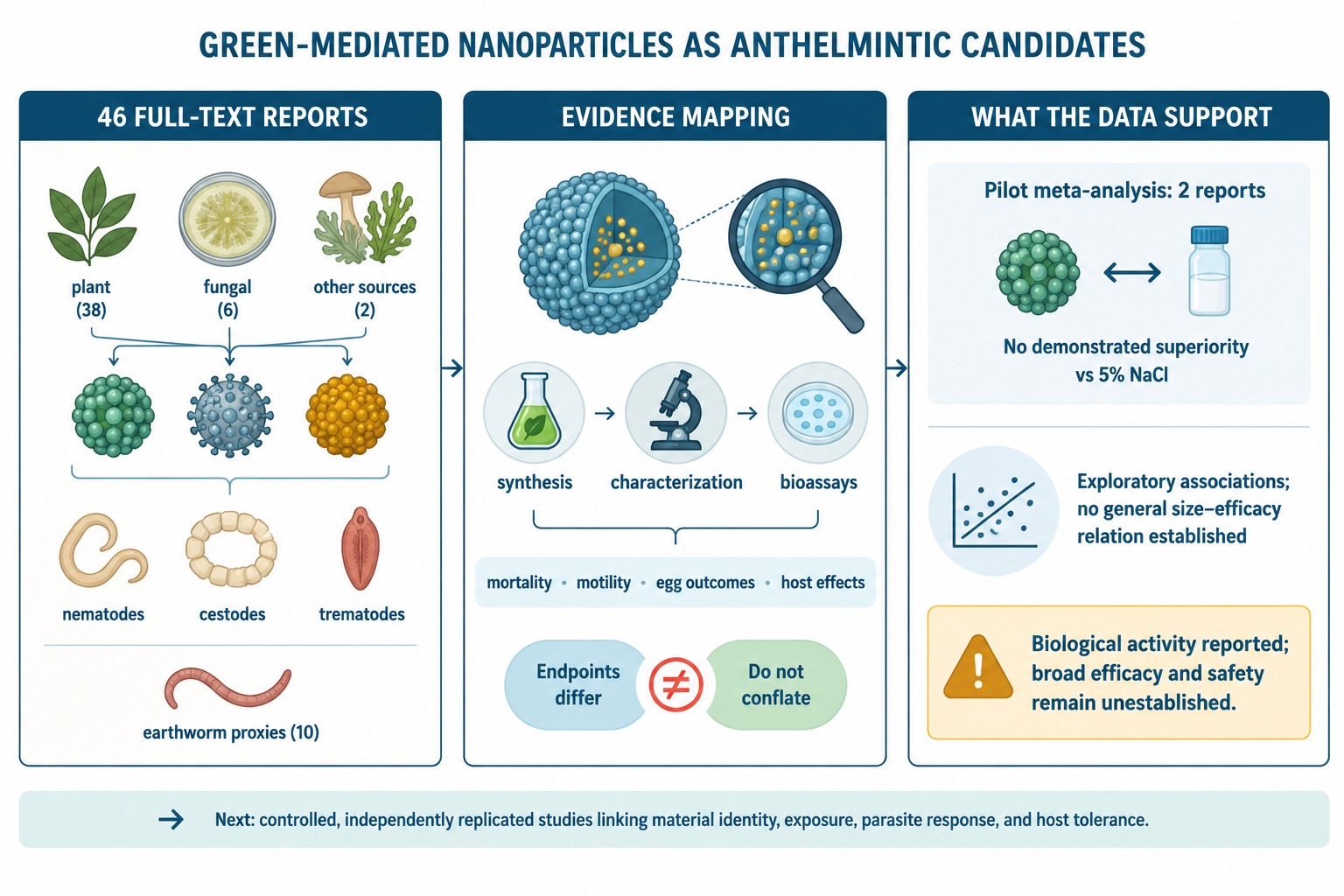
Background: Green mediated nanoparticles have been shown to have biological effects in laboratory assays with helminths. The degree of comparability between experiments, the selectivity of the effect for different parasites and the relationships between the material properties and the biological outcome are all unclear. This review has sought to map the available evidence and address these questions, without of course treating all positive assay results as being of equal value. Methods. A literature search was carried out and study selection is reported in accordance with the PRISMA flow diagram. Of the reports that were assessed in full text, 46 met the inclusion criteria and were included in the review. A pilot random-effects meta-analysis was performed on two matched experiments with E. granulosus protoscoleces exposed to 0.1 mg/mL for 120 minutes (5% NaCl as comparator). Three within-study Spearman analyses used exact permutation tests with Benjamini-Hochberg adjustment. Results: The 46 full text reports comprised 35 reports on animal or human parasitic helminths, 10 on earthworm proxy models and one on a plant nematode. 29 of the reports included silver nanoparticles and 8 reported experiments in infected hosts. 20 of the 46 first author institutional affiliations were from India. The two report pooled mortality difference was 8.36 percentage points (95% CI −39.03 to 55.75; P = 0.267; I² = 71.8%). This analysis did not demonstrate superiority over 5% NaCl. In one of the NiO studies there was a correlation between mean TEM size and paralysis time across the three formulations (ρ = 1.00; exact P = 0.333) and a weaker correlation with death time (ρ = 0.50; P = 1.000). In one of the five dose AgNP experiments there was an inverse relationship between dose and death time (ρ = −1.00; P = 0.0167; adjusted q = 0.050). These study specific analyses do not establish a general or causal relationship between nanoparticle size and efficacy. Conclusions: Across the 46 full text reports there was a wide range of reported activity for green mediated nanoparticles in the various helminth models, materials and assay conditions. The differences in study design and outcome measures make it very difficult to draw any firm conclusions and the evidence at present is insufficient to establish any broad anthelmintic efficacy or safety. The exploratory analyses do point to a number of questions that would merit further investigation rather than any general structure activity relationships. Progress will be dependent on reproducible synthesis and characterisation, comparable bioassays and independently replicated assessments of efficacy and host effects.
Keywords:
green-mediated synthesis
; anthelmintic activity
; nanoparticles
; Echinococcus granulosus protoscoleces
; systematic review
; pilot meta-analysis
; synthesis–structure–bioassay mapping
Copyright: This open access article is published under a Creative Commons CC BY 4.0 license, which permit the free download, distribution, and reuse, provided that the author and preprint are cited in any reuse.