
Submitted:
23 November 2026
Posted:
25 November 2026
You are already at the latest version
Abstract
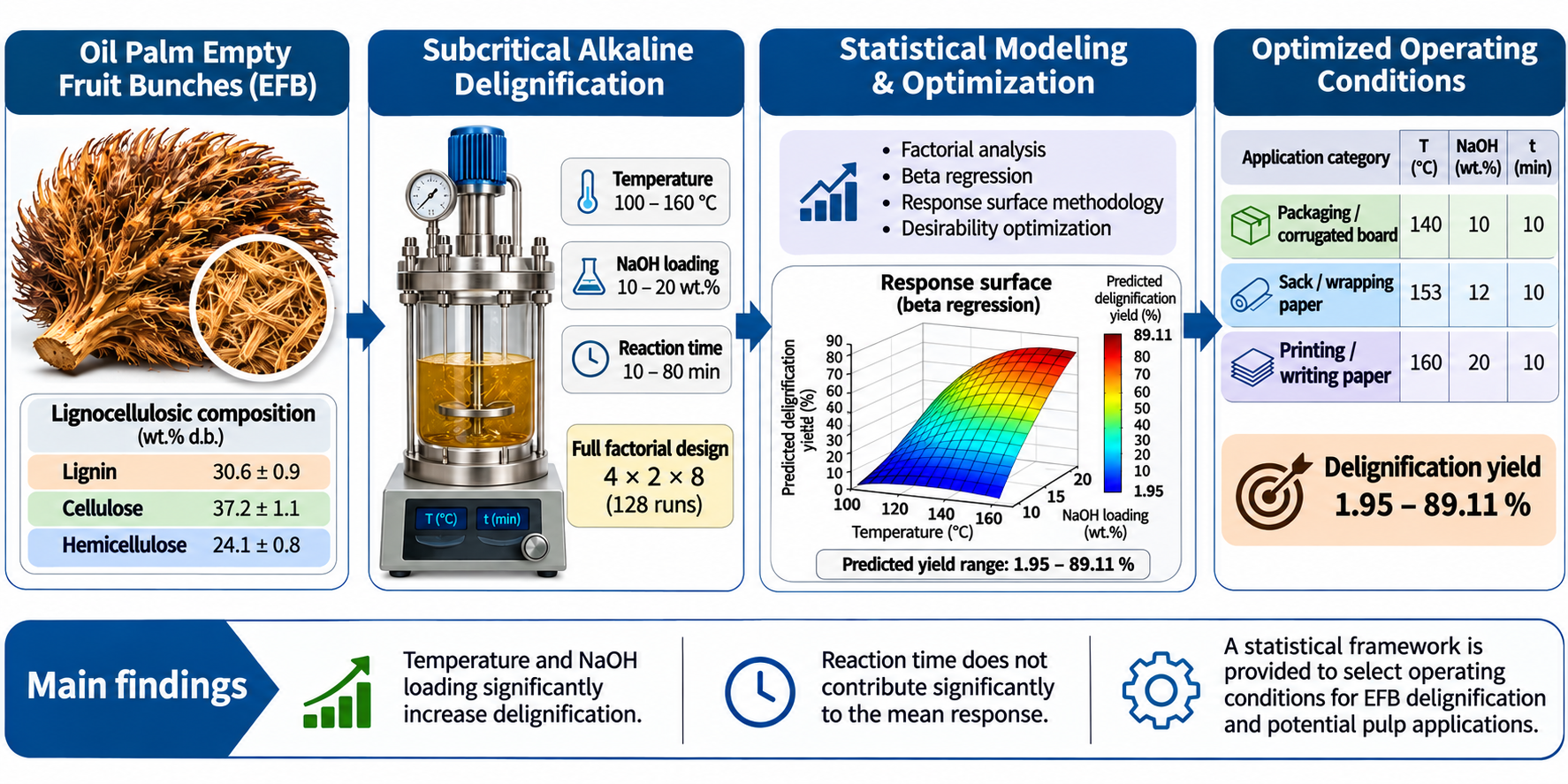
Oil palm empty fruit bunches (EFB) represent a promising lignocellulosic feedstock to produce cellulosic materials. This study investigated the subcritical alkaline delignification of EFB using sodium hydroxide (NaOH), focusing on the effects of temperature, alkali loading, and reaction time. A full factorial experimental design comprising four temperatures (100–160 °C), two NaOH loadings (10 and 20 wt.%), and eight reaction times (10–80 min) was conducted, resulting in 128 independent experimental runs. Delignification yield, defined as the fraction of initial lignin removed, ranged from 1.95% to 89.11%. Statistical analysis identified temperature and NaOH loading as significant positive contributors to delignification, with a significant interaction between these factors. Reaction time did not provide a statistically significant contribution to the mean response in the selected model. Beta regression was selected to describe the bounded delignification response and was subsequently used to generate response surfaces. A desirability-based optimization strategy was applied to identify candidate operating conditions for different pulp application categories. The results provide a statistical framework for selecting EFB delignification conditions, although further validation is required to assess carbohydrate preservation and final pulp quality.
Keywords:
oil palm empty fruit bunches
; alkaline delignification
; sodium hydroxide
; subcritical treatment
; beta regression
; response surface methodology
; desirability optimization
; lignocellulosic biomass
Copyright: This open access article is published under a Creative Commons CC BY 4.0 license, which permit the free download, distribution, and reuse, provided that the author and preprint are cited in any reuse.