
Submitted:
24 November 2026
Posted:
25 November 2026
You are already at the latest version
Abstract
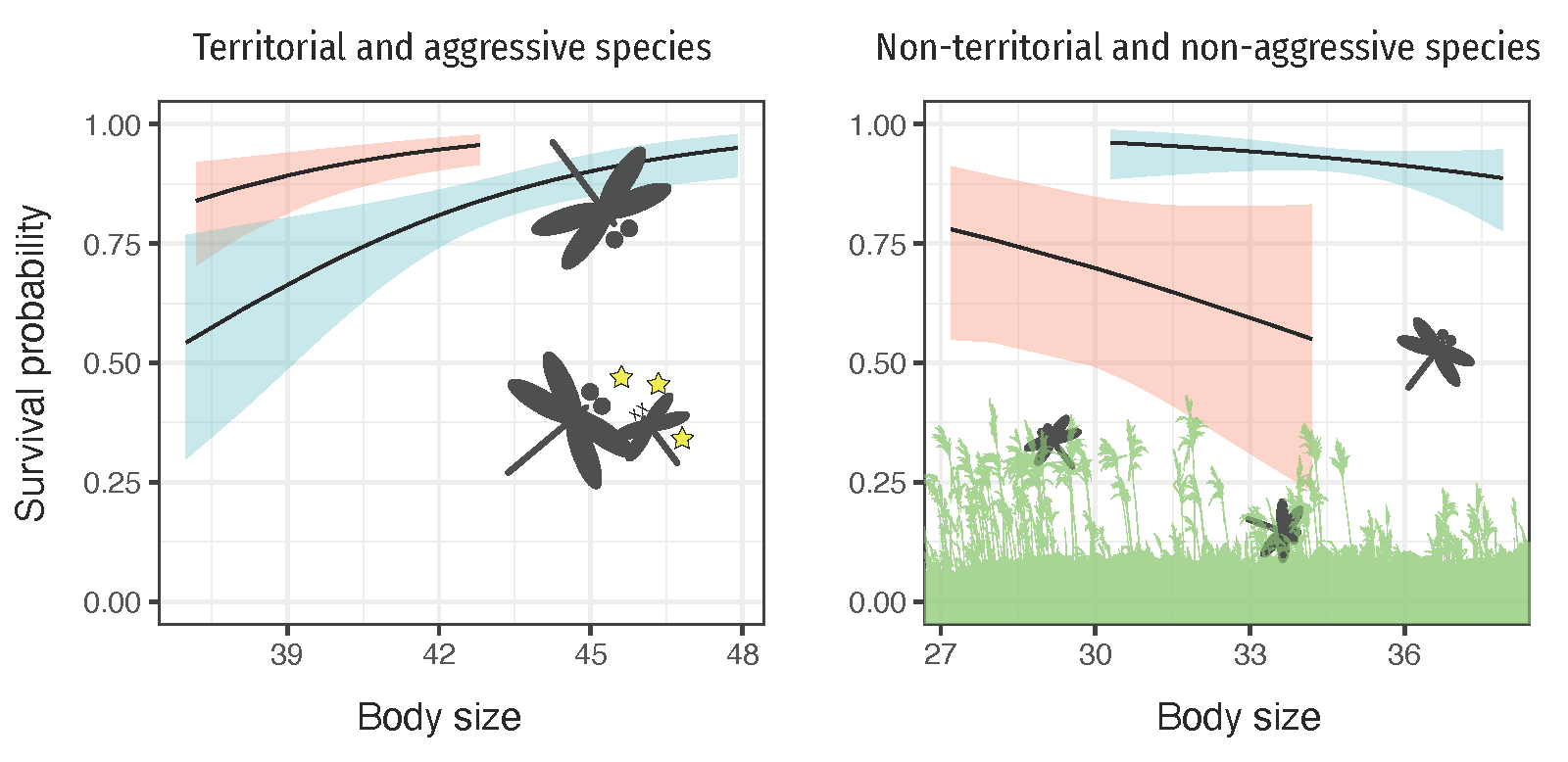
Body size is one of the main drivers of animal biology and ecology. The present study investigates the role of body size on damselfly survival probability, emphasizing its relationship with odonata behavioural traits. A meta-regression analysis was carried out on novel and previously published datasets of mark-recapture studies belonging to 22 damselfly populations of 17 species. Our results indicate that models incorporating body size as an individual covariate are similar or outperform those without it, suggesting that body size significantly influences survival rates. While large body size is advantageous in territorial and aggressive species (e.g., Polythore, Paraphlebia, Mnesarete, Calopteryx), it also positively affects survival in some non-territorial species, such as Hemiphlebia mirabilis and Coenagrion castellani. Other species, however, exhibit a small-size advantage, particularly in three-dimensional habitats requiring high manoeuvrability, as seen in some Ischnura and other species with low or absence of aggressiveness. This study highlights the heterogeneity of body size effects on survival and underscores the importance of including body size as a covariate in demographic studies of odonates to better understand survival patterns across species.
Keywords:
body length
; territoriality
; survival rate
; CMR
; odonata
; meta-analysis
Copyright: This open access article is published under a Creative Commons CC BY 4.0 license, which permit the free download, distribution, and reuse, provided that the author and preprint are cited in any reuse.