
Submitted:
24 November 2026
Posted:
25 November 2026
You are already at the latest version
Abstract
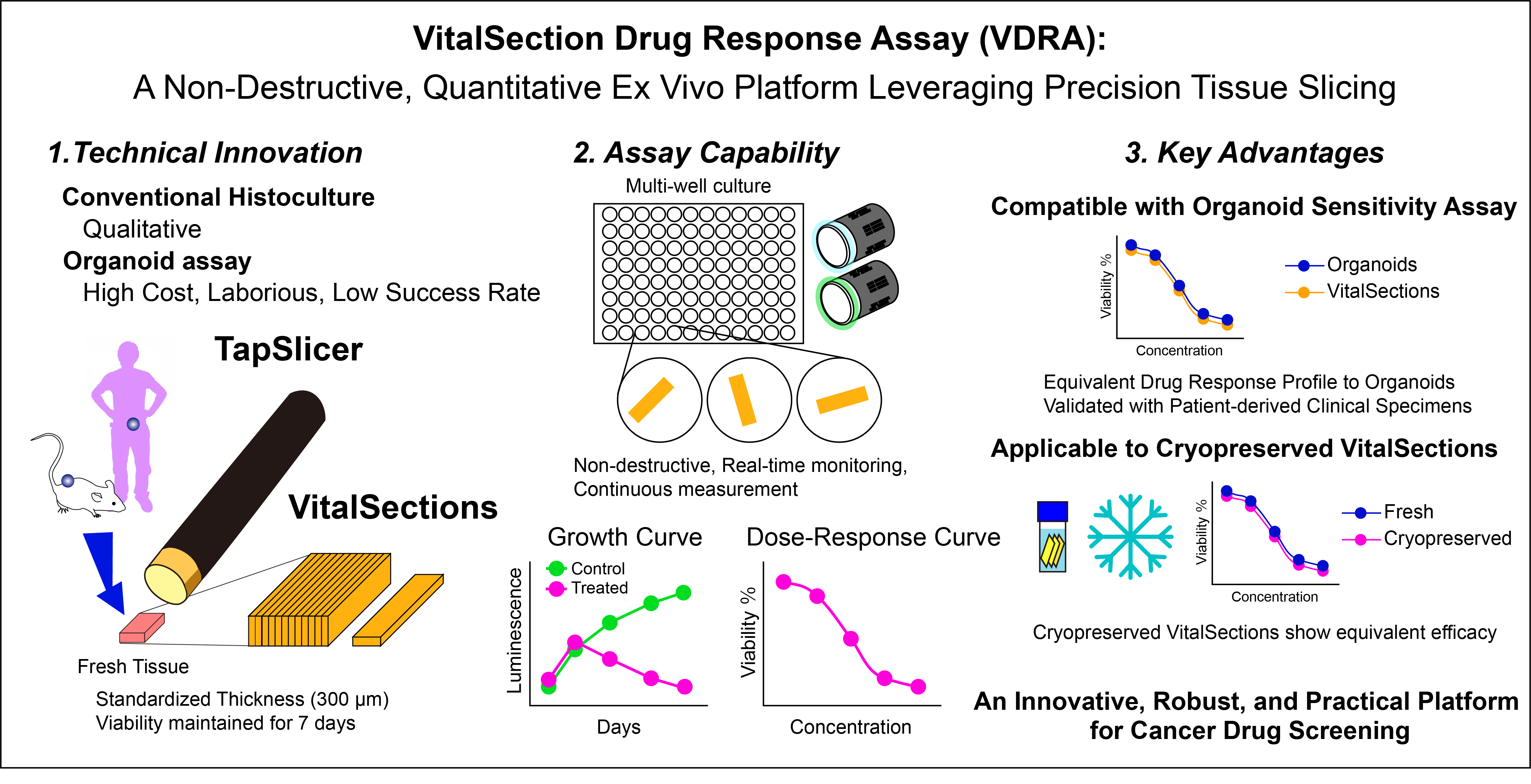
Histoculture drug response assays have long been explored for in vivo drug response evaluation; however, technical limitations have largely restricted them to qualitative analysis. Cancer organoid technology for evaluating organoid-based drug sensitivity also faces challenges in terms of cost, labor, and success rate. To overcome these technical barriers, we established the "VitalSection Drug Response Assay (VDRA)" utilizing standardized 300-µm tissue slices prepared with a novel precision tissue-slicing device (TapSlicer). TapSlicer-generated VitalSections from head and neck squamous cell carcinoma organoid-derived xenografts maintained structural integrity and cell viability for up to 7 days in culture. The optimal thickness of VitalSections enabled real-time luminescence tracking for non-destructive and quantitative monitoring of cell viability. Evaluating multiple VitalSections, we successfully constructed both dose–response and growth curves for cisplatin and paclitaxel. VDRA effectively captured drug response profiles consistent with those of corresponding organoids. Furthermore, VDRA was successfully applied to fresh patient-derived clinical specimens. In addition, cryopreserved VitalSections were successfully analyzed, yielding drug response patterns equivalent to those of fresh VitalSections. Overall, VDRA represents an innovative, non-destructive, and quantitative ex vivo platform that facilitates rapid clinical decision-making and advances precision oncology.
Keywords:
organoids
; organoid-derived xenograft
; histoculture drug response assay
; F-CAT
; head and neck cancer
Copyright: This open access article is published under a Creative Commons CC BY 4.0 license, which permit the free download, distribution, and reuse, provided that the author and preprint are cited in any reuse.