
Submitted:
24 November 2026
Posted:
25 November 2026
You are already at the latest version
Abstract
Background/Objectives: Pain is among the most prevalent and distressing symptoms in patients receiving hemodialysis, yet nursing assessment usually captures pain intensity alone. This study aimed to describe the prevalence of probable neuropathic pain, describe the sensory and affective quality of pain, and identify factors associated with neuropathic pain screening positivity and overall pain burden among adults receiving maintenance hemodialysis in Saudi Arabia. Methods: A cross-sectional study was conducted with a convenience sample of 157 adults in the inpatient and outpatient hemodialysis units of a tertiary hospital in Jeddah, Saudi Arabia, between December 2023 and February 2024. Participants completed the Arabic Short-Form McGill Pain Questionnaire (SF-MPQ) and the Arabic Neuropathic Pain Questionnaire-Short Form (NPQ-SF), using the validated cut-off of ≥0.52. Data were analyzed using non-parametric tests and multivariable logistic and linear regression. Results: Probable neuropathic pain was identified in 20.4% of participants (95% CI 14.8–27.4), increasing to 36.9% with the original cut-off. Tiring-exhausting, heavy, and cramping were the most intense pain descriptors. NPQ-positive participants had markedly higher sensory, affective, and total SF-MPQ scores and pain intensity than NPQ-negative participants (all p < 0.001; Cohen’s d 1.24–1.87). Older age was associated with lower odds of probable neuropathic pain (OR 0.97 per year; 95% CI 0.94–1.00) and, together with higher income, with lower overall pain burden. Conclusions: About one in five patients receiving hemodialysis screened positive for probable neuropathic pain, identifying a subgroup with a substantially heavier sensory and affective pain burden. Brief, validated Arabic instruments can support routine nurse-led, multidimensional pain assessment and timely interprofessional referral in dialysis units.
Keywords:
1. Introduction
2. Materials and Methods
2.1. Study Design
2.2. Setting and Participants
2.3. Instruments
2.4. Data Collection
2.5. Data Analysis
2.6. Ethical Considerations
3. Results
3.1. Participant Characteristics
3.2. Pain Intensity and Pain Quality
3.3. Prevalence of Probable Neuropathic Pain
3.4. Comparison Between NPQ-Positive and NPQ-Negative Participants
3.5. Factors Associated with Probable Neuropathic Pain and Pain Burden
4. Discussion
4.1. Implications for Nursing Practice
4.2. Strengths and Limitations
5. Conclusions
Supplementary Materials
Author Contributions
Funding
Institutional Review Board Statement
Informed Consent Statement
Data Availability Statement
Guidelines and Standards Statement
Use of Artificial Intelligence
Acknowledgments
Conflicts of Interest
Abbreviations
| CI | Confidence interval |
| CKD | Chronic kidney disease |
| DN4 | Douleur Neuropathique 4 |
| IASP | International Association for the Study of Pain |
| IQR | Interquartile range |
| KAMC | King Abdulaziz Medical City |
| LANSS | Leeds Assessment of Neuropathic Symptoms and Signs |
| NPQ-SF | Neuropathic Pain Questionnaire-Short Form |
| OR | Odds ratio |
| SAR | Saudi riyal |
| SD | Standard deviation |
| SF-MPQ | Short-Form McGill Pain Questionnaire |
| STROBE | Strengthening the Reporting of Observational Studies in Epidemiology |
| VIF | Variance inflation factor |
| WHOQOL-BREF | World Health Organization Quality of Life–BREF |
References
- GBD Chronic Kidney Disease Collaboration. Global, regional, and national burden of chronic kidney disease, 1990–2017: A systematic analysis for the Global Burden of Disease Study 2017. Lancet 2020, 395, 709–733. [Google Scholar] [CrossRef] [PubMed]
- Kovesdy, C.P. Epidemiology of chronic kidney disease: An update 2022. Kidney Int. Suppl. 2022, 12, 7–11. [Google Scholar] [CrossRef] [PubMed]
- Almutary, H.; Bonner, A.; Douglas, C. Symptom burden in chronic kidney disease: A review of recent literature. J. Ren. Care 2013, 39, 140–150. [Google Scholar] [CrossRef] [PubMed]
- Alzahrani, N.S.; Almarwani, A.M.; Alhowaymel, F.; Alharbi, H.F. The lived experience of middle-aged Saudi patients with end-stage chronic renal disease on hemodialysis treatment. J. Transcult. Nurs. 2023, 34, 263–269. [Google Scholar] [CrossRef] [PubMed]
- Lambourg, E.; Colvin, L.; Guthrie, G.; Murugan, K.; Lim, M.; Walker, H.; Boon, G.; Bell, S. The prevalence of pain among patients with chronic kidney disease using systematic review and meta-analysis. Kidney Int. 2021, 100, 636–649. [Google Scholar] [CrossRef] [PubMed]
- Davison, S.N.; Rathwell, S.; Ghosh, S.; George, C.; Pfister, T.; Dennett, L. The prevalence and severity of chronic pain in patients with chronic kidney disease: A systematic review and meta-analysis. Can. J. Kidney Health Dis. 2021, 8, 2054358121993995. [Google Scholar] [CrossRef] [PubMed]
- dos Santos, P.R.; Capote Júnior, J.R.F.G.; Cavalcante Filho, J.R.M.; Ferreira, T.P.; dos Santos Filho, P.A.B. Pain in patients with chronic kidney disease undergoing hemodialysis: A systematic review. Pain Manag. Nurs. 2021, 22, 605–615. [Google Scholar] [CrossRef] [PubMed]
- Davison, S.N.; Koncicki, H.; Brennan, F. Pain in chronic kidney disease: A scoping review. Semin. Dial. 2014, 27, 188–204. [Google Scholar] [CrossRef] [PubMed]
- Santoro, D.; Satta, E.; Messina, S.; Costantino, G.; Savica, V.; Bellinghieri, G. Pain in end-stage renal disease: A frequent and neglected clinical problem. Clin. Nephrol. 2013, 79, S2–S11. [Google Scholar] [CrossRef]
- Claxton, R.N.; Blackhall, L.; Weisbord, S.D.; Holley, J.L. Undertreatment of symptoms in patients on maintenance hemodialysis. J. Pain Symptom Manag. 2010, 39, 211–218. [Google Scholar] [CrossRef] [PubMed]
- Aatif, T.; Labioui, N.; Laasli, H.; Zajjari, Y.; Kabbaj, D.E. Uremic peripheral neuropathy in nondiabetic chronic hemodialysis patients. Ann. Indian Acad. Neurol. 2025, 28, 590–593. [Google Scholar] [CrossRef] [PubMed]
- Roy, P.J.; Weltman, M.; Dember, L.M.; Liebschutz, J.; Jhamb, M.; HOPE Consortium. Pain management in patients with chronic kidney disease and end-stage kidney disease. Curr. Opin. Nephrol. Hypertens. 2020, 29, 671–680. [Google Scholar] [CrossRef] [PubMed]
- Fleishman, T.T.; Dreiher, J.; Shvartzman, P. Pain in maintenance hemodialysis patients: A multicenter study. J. Pain Symptom Manag. 2018, 56, 178–184. [Google Scholar] [CrossRef] [PubMed]
- Sadigova, E.; Ozkurt, S.; Yalcin, A.U. Pain assessment in hemodialysis patients. Cureus 2020, 12, e6903. [Google Scholar] [CrossRef] [PubMed]
- Kitala-Tańska, K.; Kania-Zimnicka, E.; Tański, D.; Kwella, N.; Stompór, T.; Stompór, M. Prevalence and management of chronic pain, including neuropathic pain, in dialysis patients with end-stage renal disease. Med. Sci. Monit. 2024, 30, e943808. [Google Scholar] [CrossRef] [PubMed]
- Schweiger, V.; Cacciapuoti, M.; Nizzero, M.; Simari, S.; Lombardi, G.; Gottin, L.; Stefani, L.; Martini, A.; Varrassi, G.; Finco, G.; et al. Exploring chronic pain in hemodialysis patients: An observational study based on the new IASP classification for ICD-11. Pain Ther. 2025, 14, 375–385. [Google Scholar] [CrossRef] [PubMed]
- Fischer, M.J.; Hsu, J.Y.; Walsh, J.; Cavanaugh, K.L.; Charytan, D.M.; Crowley, S.T.; Cukor, D.; Dember, L.M.; Doorenbos, A.Z.; Esserman, D.; et al. Chronic pain locations, characteristics, and associations with other symptoms in adults receiving maintenance hemodialysis: Findings from the HOPE Consortium Trial. Am. J. Kidney Dis. 2026, 87, 182–198.e1. [Google Scholar] [CrossRef] [PubMed]
- Upadhyay, C.; Cameron, K.; Murphy, L.; Battistella, M. Measuring pain in patients undergoing hemodialysis: A review of pain assessment tools. Clin. Kidney J. 2014, 7, 367–372. [Google Scholar] [CrossRef] [PubMed]
- Melzack, R. The short-form McGill Pain Questionnaire. Pain 1987, 30, 191–197. [Google Scholar] [CrossRef] [PubMed]
- Backonja, M.M.; Krause, S.J. Neuropathic pain questionnaire—Short form. Clin. J. Pain 2003, 19, 315–316. [Google Scholar] [CrossRef] [PubMed]
- Terkawi, A.S.; Backonja, M.M.; Abolkhair, A.; Almaharbi, S.; Joy, J.; Foula, F.; Alswiti, M.; Terkawi, Y.S.; Al-Zhahrani, T.; Alghamdi, F.S.; et al. Development and validation of Arabic version of the Neuropathic Pain Questionnaire-Short Form. Saudi J. Anaesth. 2017, 11, S53–S62. [Google Scholar] [CrossRef] [PubMed]
- Terkawi, A.S.; Tsang, S.; Abolkhair, A.; Alsharif, M.; Alswiti, M.; Alsadoun, A.; AlZoraigi, U.S.; Aldhahri, S.F.; Al-Zhahrani, T.; Altirkawi, K.A. Development and validation of Arabic version of the Short-Form McGill Pain Questionnaire. Saudi J. Anaesth. 2017, 11, S2–S10. [Google Scholar] [CrossRef] [PubMed]
- Melzack, R.; Casey, K.L. Sensory, motivational, and central control determinants of pain: A new conceptual model. In The Skin Senses; Kenshalo, D.R., Ed.; Charles C Thomas: Springfield, IL, USA, 1968; pp. 423–443. [Google Scholar]
- Treede, R.-D.; Jensen, T.S.; Campbell, J.N.; Cruccu, G.; Dostrovsky, J.O.; Griffin, J.W.; Hansson, P.; Hughes, R.; Nurmikko, T.; Serra, J. Neuropathic pain: Redefinition and a grading system for clinical and research purposes. Neurology 2008, 70, 1630–1635. [Google Scholar] [CrossRef] [PubMed]
- Finnerup, N.B.; Haroutounian, S.; Kamerman, P.; Baron, R.; Bennett, D.L.H.; Bouhassira, D.; Cruccu, G.; Freeman, R.; Hansson, P.; Nurmikko, T.; et al. Neuropathic pain: An updated grading system for research and clinical practice. Pain 2016, 157, 1599–1606. [Google Scholar] [CrossRef] [PubMed]
- Khaled, A.; Bakhsh, D.G.; Aljimaee, H.Y.; Abudossah, N.H.A.; Alqahtani, R.S.; Albalawi, R.A.; Makki, S.; Siddiqua, A. Pain and quality of life of patients with end-stage renal disease undergoing hemodialysis in Aseer region, Saudi Arabia. J. Infect. Public Health 2024, 17, 308–314. [Google Scholar] [CrossRef] [PubMed]
- Marzouq, M.K.; Samoudi, A.F.; Samara, A.; Zyoud, S.H.; Al-Jabi, S.W. Exploring factors associated with pain in hemodialysis patients: A multicenter cross-sectional study from Palestine. BMC Nephrol. 2021, 22, 96. [Google Scholar] [CrossRef] [PubMed]
- Al Amer, H.S.; Dator, W.L.; Abunab, H.Y.; Mari, M. Cryotherapy intervention in relieving arteriovenous fistula cannulation-related pain among hemodialysis patients at the King Khalid Hospital, Tabuk, Kingdom of Saudi Arabia. Saudi J. Kidney Dis. Transpl. 2017, 28, 1050–1056. [Google Scholar] [CrossRef] [PubMed]
- Ibrahim, M.B.; Badawi, S.E.A.; Alameri, R.A. Assessment of pain and anxiety during arteriovenous fistula cannulation among hemodialysis patients: A cross-sectional study in Saudi Arabia. J. Multidiscip. Healthc. 2022, 15, 705–718. [Google Scholar] [CrossRef] [PubMed]
- Abudawood, K.A.; Albeladi, R.; Alhindi, R.; Alqarni, E.; Aljelaidy, N.; Alghamdi, R.; Alfahmi, M.; Alkathiri, R.; Almasri, N.; Alotaibi, R.; et al. Pain severity and quality of life among patients undergoing hemodialysis. PeerJ 2026, 14, e21892. [Google Scholar] [CrossRef] [PubMed]
- von Elm, E.; Altman, D.G.; Egger, M.; Pocock, S.J.; Gøtzsche, P.C.; Vandenbroucke, J.P. The Strengthening the Reporting of Observational Studies in Epidemiology (STROBE) statement: Guidelines for reporting observational studies. Lancet 2007, 370, 1453–1457. [Google Scholar] [CrossRef] [PubMed]
- Hsu, H.-J.; Yen, C.-H.; Hsu, K.-H.; Wu, I.-W.; Lee, C.-C.; Hung, M.-J.; Sun, C.-Y.; Chou, C.-C.; Chen, Y.-C.; Hsieh, M.-F.; et al. Factors associated with chronic musculoskeletal pain in patients with chronic kidney disease. BMC Nephrol. 2014, 15, 6. [Google Scholar] [CrossRef] [PubMed]
- Rambod, M.; Sharif, F.; Pourali-Mohammadi, N.; Pasyar, N.; Rafii, F. Evaluation of the effect of Benson’s relaxation technique on pain and quality of life of haemodialysis patients: A randomized controlled trial. Int. J. Nurs. Stud. 2014, 51, 964–973. [Google Scholar] [CrossRef] [PubMed]
- Raina, R.; Krishnappa, V.; Gupta, M. Management of pain in end-stage renal disease patients: Short review. Hemodial. Int. 2018, 22, 290–296. [Google Scholar] [CrossRef] [PubMed]

| Characteristic | n (%) |
| Age (years), mean ± SD | 50.04 ± 13.75 |
| Age group (years) | |
| ≤24 | 5 (3.2) |
| 25–44 | 49 (31.2) |
| 45–64 | 78 (49.7) |
| ≥65 | 25 (15.9) |
| Sex | |
| Female | 78 (49.7) |
| Male | 79 (50.3) |
| Nationality | |
| Saudi | 140 (89.2) |
| Non-Saudi | 17 (10.8) |
| Education | |
| Elementary school | 49 (31.2) |
| Secondary school | 20 (12.7) |
| High school | 48 (30.6) |
| Diploma or higher | 40 (25.5) |
| Marital status | |
| Single | 54 (34.4) |
| Married | 103 (65.6) |
| Employment | |
| Employed | 31 (19.7) |
| Unemployed | 126 (80.3) |
| Monthly income (SAR) | |
| <5000 | 100 (63.7) |
| 5000–10,000 | 33 (21.0) |
| 10,001–15,000 | 12 (7.6) |
| >15,000 | 12 (7.6) |
| Non-smoker | 135 (86.0) |
| Any comorbidity | 130 (82.8) |
| Hypertension | 110 (70.1) |
| Diabetes mellitus | 57 (36.3) |
| Heart disease | 30 (19.1) |
| Other | 31 (19.7) |
| Years since CKD diagnosis | |
| 1–6 | 90 (57.3) |
| >6 | 67 (42.7) |
| Self-reported CKD stage | |
| Stage 2 | 1 (0.6) |
| Stage 4 | 3 (1.9) |
| Stage 5 | 18 (11.5) |
| Unknown | 135 (86.0) |
| Hemodialysis frequency | |
| 3 times/week | 155 (98.7) |
| <3 times/week | 2 (1.3) |
| Measure (possible range) | Mean ± SD | Median (IQR) |
| SF-MPQ | ||
| Sensory score (0–33) | 8.29 ± 8.22 | 5.00 (2.00–14.00) |
| Affective score (0–12) | 3.29 ± 3.54 | 2.00 (0.00–5.00) |
| Total score (0–45) | 11.58 ± 11.02 | 8.00 (2.00–20.00) |
| Pain intensity rating (0–10) | 3.94 ± 3.34 | 4.00 (0.00–7.00) |
| Present pain intensity (0–5) | 1.57 ± 1.49 | 1.00 (0.00–2.00) |
| NPQ-SF | ||
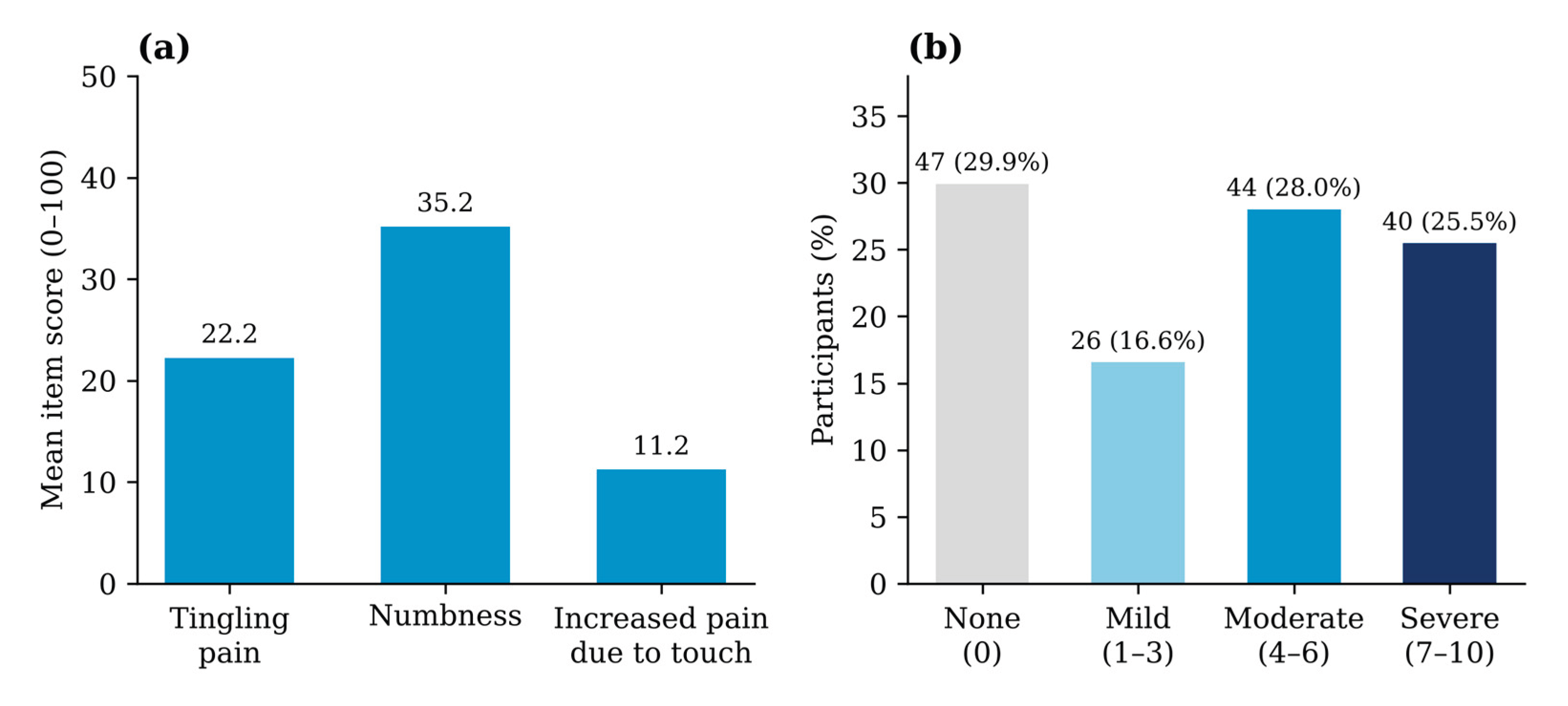
| Tingling pain (0–100) | 22.23 ± 31.02 | 0.00 (0.00–40.00) |
| Numbness (0–100) | 35.16 ± 36.37 | 30.00 (0.00–60.00) |
| Increased pain due to touch (0–100) | 11.21 ± 22.51 | 0.00 (0.00–10.00) |
| Discriminant score | −0.27 ± 1.03 | −0.55 (−1.30 to 0.41) |
| n (%) | 95% CI | |
| Probable neuropathic pain, cut-off ≥0.52 | 32 (20.4) | 14.8–27.4 |
| Probable neuropathic pain, cut-off ≥0 | 58 (36.9) | 29.8–44.7 |
| Variable | NPQ-Negative (n = 125) | NPQ-Positive (n = 32) | p | Cohen’s d |
| Continuous, mean ± SD | ||||
| Age (years) | 51.18 ± 13.92 | 45.56 ± 12.24 | 0.047 a | −0.41 |
| SF-MPQ sensory score | 5.84 ± 6.19 | 17.84 ± 8.25 | <0.001 a | 1.80 |
| SF-MPQ affective score | 2.38 ± 2.97 | 6.88 ± 3.36 | <0.001 a | 1.47 |
| SF-MPQ total score | 8.22 ± 8.51 | 24.72 ± 9.89 | <0.001 a | 1.87 |
| Pain intensity rating | 3.18 ± 3.17 | 6.91 ± 2.19 | <0.001 a | 1.24 |
| Present pain intensity | 1.22 ± 1.30 | 2.97 ± 1.38 | <0.001 a | 1.33 |
| Categorical, n (%) | ||||
| Female sex | 60 (48.0) | 18 (56.2) | 0.526 b | – |
| Saudi nationality | 112 (89.6) | 28 (87.5) | 0.752 c | – |
| Monthly income <5000 SAR | 74 (59.2) | 26 (81.2) | 0.126 d | – |
| Diabetes mellitus | 46 (36.8) | 11 (34.4) | 0.961 b | – |
| Hypertension | 87 (69.6) | 23 (71.9) | 0.973 b | – |
| Heart disease | 21 (16.8) | 9 (28.1) | 0.229 b | – |
| Variable | Probable Neuropathic Pain a | SF-MPQ Total Score b | ||
| Adjusted OR (95% CI) | p | B(SE) | p | |
| Age (per year) | 0.97 (0.94–1.00) | 0.044 | −0.16 (0.07) | 0.018 |
| Monthly income (per category) | 0.63 (0.35–1.15) | 0.132 | −2.36 (0.95) | 0.014 |
| Male sex (vs. female) | 0.83 (0.36–1.90) | 0.663 | −2.05 (1.73) | 0.239 |
| Diabetes mellitus (yes vs. no) | 1.02 (0.39–2.69) | 0.962 | 3.08 (1.92) | 0.111 |
| Heart disease (yes vs. no) | 2.42 (0.89–6.59) | 0.085 | Not entered | – |
| Constant | – | – | 23.40 (3.49) | <0.001 |
Disclaimer/Publisher’s Note: The statements, opinions and data contained in all publications are solely those of the individual author(s) and contributor(s) and not of MDPI and/or the editor(s). MDPI and/or the editor(s) disclaim responsibility for any injury to people or property resulting from any ideas, methods, instructions or products referred to in the content. |
© 2026 by the authors. Licensee MDPI, Basel, Switzerland. This article is an open access article distributed under the terms and conditions of the Creative Commons Attribution (CC BY) license (http://creativecommons.org/licenses/by/4.0/).