
Submitted:
24 November 2026
Posted:
25 November 2026
You are already at the latest version
Abstract
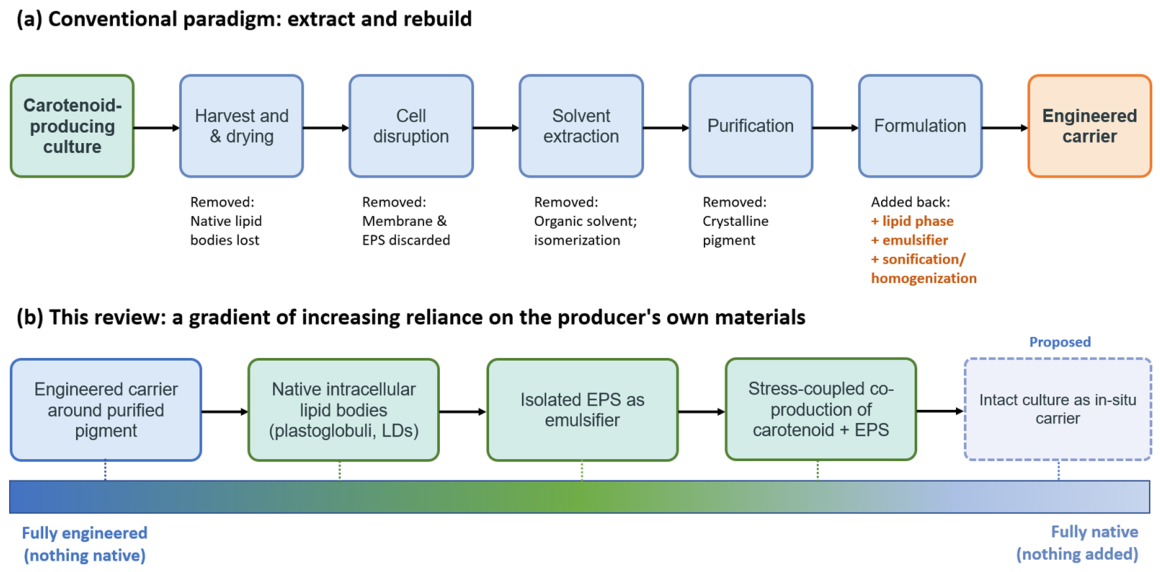
Carotenoids, such as β-carotene and astaxanthin, are high-value natural pigments, provitamin A precursors, and antioxidants. Converting this abundance into usable products is nonetheless challenging, because carotenoids are nearly insoluble in water and oil, chemically labile, and poorly bioaccessible, and because the carotenoids of many plant sources are deposited as crystals that dissolve slowly during digestion. The predominant approach has been encapsulation: the pigment is extracted from disrupted biomass, purified, and re-dispersed into an engineered lipid carrier stabilized by added emulsifiers. This raises a fundamental question: is this “disassembly-reassembly” sequence always necessary? Focusing on carotenoids from microalgae, which are their richest biological sources, this review depicts the roles of artificially engineered encapsulation, the native plastid lipid globules in which carotenogenic algae already hold their pigment dissolved in triacylglycerol, and the secreted extracellular polymeric substances (EPS) that can stabilize carotenoid emulsions without synthetic surfactants, and finally explores the little-studied prospect of the intact culture serving as the carrier itself. Although existing research has confirmed that natural lipid structures can store pigments and that isolated EPS possess emulsifying properties, there is insufficient evidence to conclude that the simply processed culture medium itself can serve as a stable delivery matrix. Addressing this knowledge gap, we restrict attention to microalgae with an established record of safe consumption (Arthrospira, Dunaliella, Haematococcus, Chlorella), survey the applications such a biogenic system would enable as a colorant, feed, and cosmetic ingredient and, more speculatively, as an aqueous extraction medium, and confront directly the tension between carrier stability and bioaccessibility. We close with the proposal that would leverage the inherent materials of culture system into a tested proposition.
Keywords:
1. Introduction
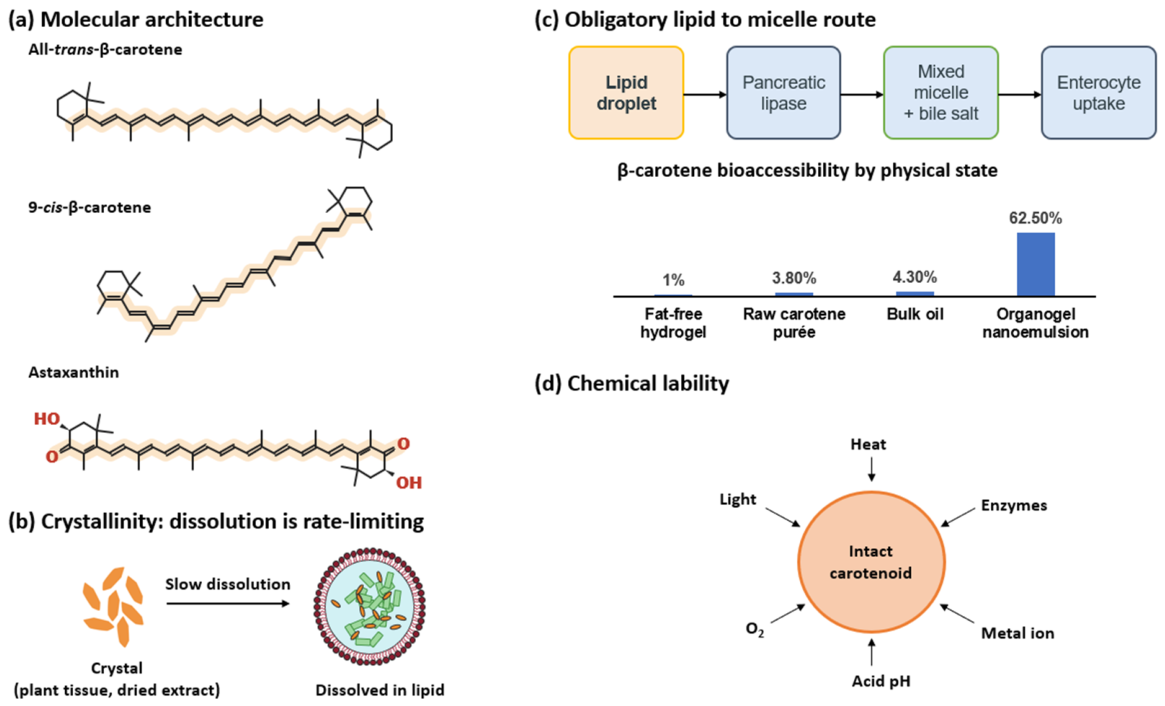
2. The Physicochemical Basis of the Limited Delivery of Carotenoids
2.1. Influence of Molecular Structure on Solubility
2.2. Limitations Imposed by Crystallinity on Dissolution and Absorption
2.3. The Obligatory Lipid–Micelle Route of Absorption
2.4. Chemical Instability and Its Consequences
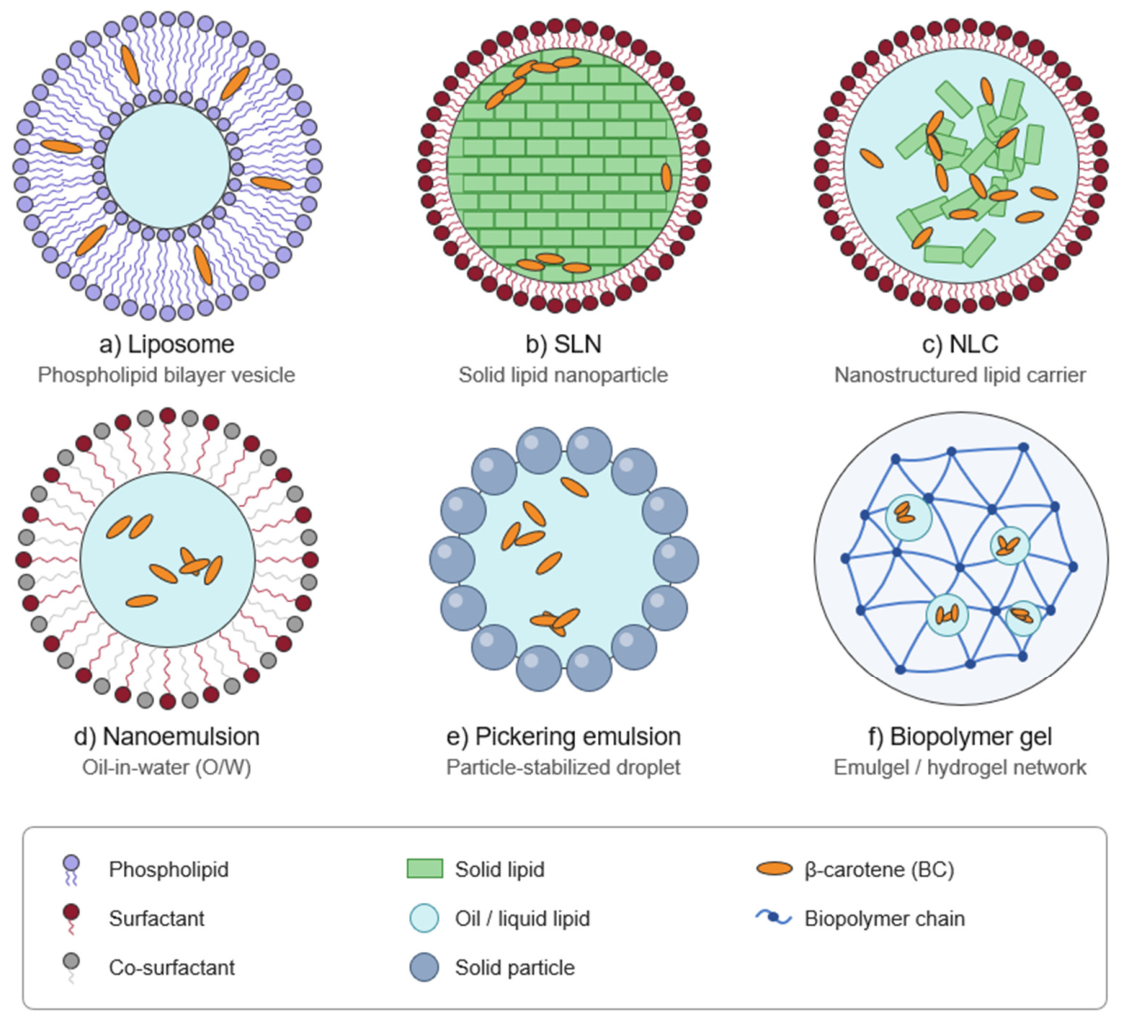
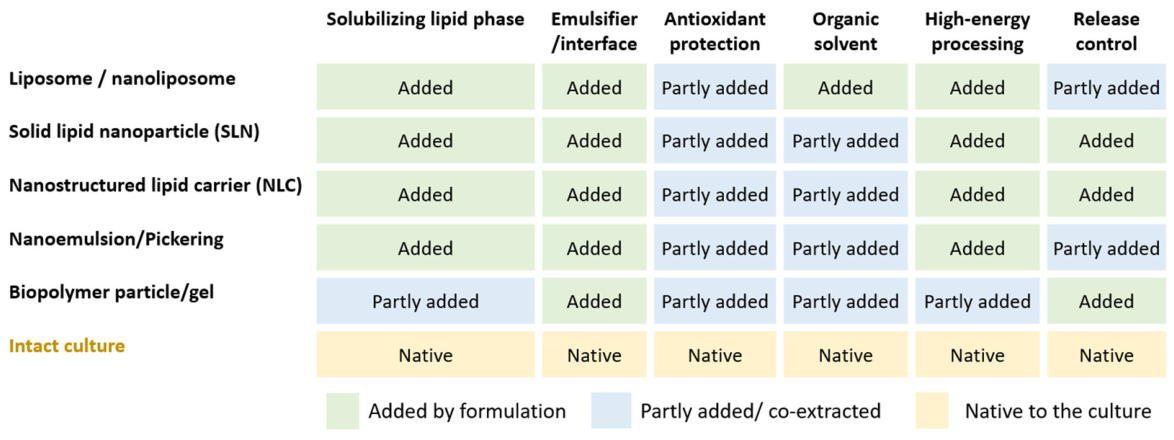
3. The Conventional Strategies: Engineered Carriers for Purified Pigments
4. Native Solubilization Structures for Pigments in Pigment-Producing Organisms
5. Secreted and Extracellular Components: From Isolated EPS to the Intact Culture Matrix
5.1. Isolated Exopolysaccharides as Carotenoid Emulsifiers
5.2. Extracellular Polymer Secretion by Carotenogenic Algae
5.3. The Intact Culture as an In Situ Carrier: An Emerging Frontier
6. Applications of Biogenic Carotenoid Systems
6.1. Applications as Colorants and Carriers in Food, Feed, and Cosmetics
6.2. Exploratory Application as an Extraction Medium
7. The Trade-off Between Stability and Bioaccessibility
8. Future Research Directions and Key Questions
Funding
Data Availability Statement
Conflicts of Interest
References
- Jalali-Jivan, M.; Rostamabadi, H.; Assadpour, E.; Tomas, M.; Capanoglu, E.; Alizadeh-Sani, M.; Kharazmi, M.S.; Jafari, S.M. Recent progresses in the delivery of β-carotene: From nano/microencapsulation to bioaccessibility. Adv. Colloid Interface Sci. 2022, 307, 102750. [Google Scholar] [CrossRef]
- Bernstein, P.S.; Li, B.; Vachali, P.P.; Gorusupudi, A.; Shyam, R.; Henriksen, B.S.; Nolan, J.M. Lutein, zeaxanthin, and meso-zeaxanthin: The basic and clinical science underlying carotenoid-based nutritional interventions against ocular disease. Prog. Retin. Eye Res. 2016, 50, 34–66. [Google Scholar] [CrossRef]
- Hamed, I.; Moradi, M.; Ezati, P.; O’Higgins, L.; Melendez-Martinez, A.J.; Matas, R.F.; Šimat, V.; McClements, D.J.; Jakobsen, A.N.; Lerfall, J. Encapsulation of microalgal-based carotenoids: Recent advances in stability and food applications. Trends Food Sci. Technol. 2023, 138, 382–398. [Google Scholar] [CrossRef]
- Ben-Amotz, A.; Katz, A.; Avron, M. Accumulation of β-carotene in halotolerant algae: purification and characterization of β-carotene-rich globules from Dunaliella bardawil (Chlorophyceae). J. Phycol. 1982, 18, 529–537. [Google Scholar] [CrossRef]
- Shah, M.M.R.; Liang, Y.; Cheng, J.J.; Daroch, M. Astaxanthin-producing green microalga Haematococcus pluvialis: from single cell to high value commercial products. Front. Plant Sci. 2016, 7, 531. [Google Scholar] [CrossRef]
- Schweiggert, R.M.; Kopec, R.E.; Villalobos-Gutierrez, M.G.; Högel, J.; Quesada, S.; Esquivel, P.; Schwartz, S.J.; Carle, R. Carotenoids are more bioavailable from papaya than from tomato and carrot in humans: a randomised cross-over study. Br. J. Nutr. 2014, 111, 490–498. [Google Scholar] [CrossRef]
- Vieira, M.V.; Pastrana, L.M.; Fuciños, P. Microalgae encapsulation systems for food, pharmaceutical and cosmetics applications. Mar. Drugs 2020, 18, 644. [Google Scholar] [CrossRef]
- de Brito, L.P.; Lins, L.F.; Bourbon, A.I.; Pastrana, L.; Cavalcanti, I.D.L.; de Britto Lira-Nogueira, M.C.; Magalhães, N.S.S.; Cavalcanti, M.T.H.; Porto, A.L.F. Microbial exopolysaccharide based nanoemulsions containing β-carotene: Stability, digestion, cytotoxicity, and uptake effects in Caco-2 cells. Int. J. Biol. Macromol. 2025, 147255. [Google Scholar] [CrossRef]
- Sousa, V.; Hijo, A.A.T.; Lüdtke, F.L.; Vicente, A.A.; Dias, O.; Geada, P. Recovery and encapsulation of Dunaliella salina β-carotene through a novel sustainable approach: Sequential application of an ionic liquid as naturally-derived solvent and emulsifier. Food Chem. 2024, 458, 140232. [Google Scholar] [CrossRef]
- García-Morales, J.; González-Vega, R.I.; Fimbres-Olivarría, D.; Bernal-Mercado, A.T.; Auobourg-Martínez, S.P.; López-Gastélum, K.A.; Burruel-Ibarra, S.E.; Silvas-García, M.I.; Grijalva-Molina, A.; Ornelas-Paz, J.d.J. Nanoencapsulated Dunaliella tertiolecta extract and β-carotene in liposomal carriers: Antioxidant and erythroprotective potential through sustained-release systems. Molecules 2025, 30, 3924. [Google Scholar] [CrossRef]
- Desmarchelier, C.; Borel, P. Overview of carotenoid bioavailability determinants: From dietary factors to host genetic variations. Trends Food Sci. Technol. 2017, 69, 270–280. [Google Scholar] [CrossRef]
- Pourkarimi, S.; Hallajisani, A.; Alizadehdakhel, A.; Nouralishahi, A.; Golzary, A. Factors affecting production of beta-carotene from Dunaliella salina microalgae. Biocatal. Agric. Biotechnol. 2020, 29, 101771. [Google Scholar] [CrossRef]
- Ben-Amotz, A.; Lers, A.; Avron, M. Stereoisomers of β-carotene and phytoene in the alga Dunaliella bardawil. Plant Physiol. 1988, 86, 1286–1291. [Google Scholar] [CrossRef]
- Yang, C.; Yan, H.; Jiang, X.; Xu, H.; Tsao, R.; Zhang, L. Preparation of 9 Z-β-carotene and 9 Z-β-carotene high-loaded nanostructured lipid carriers: Characterization and storage stability. J. Agric. Food Chem. 2020, 68, 13844–13853. [Google Scholar]
- Ben-Amotz, A.; Levy, Y. Bioavailability of a natural isomer mixture compared with synthetic all-trans beta-carotene in human serum. Am. J. Clin. Nutr. 1996, 63, 729–734. [Google Scholar] [CrossRef]
- Qian, C.; Decker, E.A.; Xiao, H.; McClements, D.J. Nanoemulsion delivery systems: Influence of carrier oil on β-carotene bioaccessibility. Food Chem. 2012, 135, 1440–1447. [Google Scholar] [CrossRef]
- Fan, Y.; Yi, J.; Zhang, Y.; Wen, Z.; Zhao, L. Physicochemical stability and in vitro bioaccessibility of β-carotene nanoemulsions stabilized with whey protein-dextran conjugates. Food Hydrocoll. 2017, 63, 256–264. [Google Scholar] [CrossRef]
- Li, Q.; Shi, J.; Du, X.; McClements, D.J.; Chen, X.; Duan, M.; Liu, L.; Li, J.; Shao, Y.; Cheng, Y. Polysaccharide conjugates from Chin brick tea (Camellia sinensis) improve the physicochemical stability and bioaccessibility of β-carotene in oil-in-water nanoemulsions. Food Chem. 2021, 357, 129714. [Google Scholar] [CrossRef]
- Zhou, H.; Dai, T.; Liu, J.; Tan, Y.; Bai, L.; Rojas, O.J.; McClements, D.J. Chitin nanocrystals reduce lipid digestion and β-carotene bioaccessibility: An in-vitro INFOGEST gastrointestinal study. Food Hydrocoll. 2021, 113, 106494. [Google Scholar] [CrossRef]
- Mun, S.; Park, S.; Kim, Y.-R.; McClements, D.J. Influence of methylcellulose on attributes of β-carotene fortified starch-based filled hydrogels: optical, rheological, structural, digestibility, and bioaccessibility properties. Food Res. Int. 2016, 87, 18–24. [Google Scholar] [CrossRef]
- Hamadou, A.H.; Huang, W.-C.; Xue, C.; Mao, X. Comparison of β-carotene loaded marine and egg phospholipids nanoliposomes. J. Food Eng. 2020, 283, 110055. [Google Scholar] [CrossRef]
- Lordan, R.; Tsoupras, A.; Zabetakis, I. Phospholipids of animal and marine origin: Structure, function, and anti-inflammatory properties. Molecules 2017, 22, 1964. [Google Scholar] [CrossRef]
- Qian, C.; Decker, E.A.; Xiao, H.; McClements, D.J. Impact of lipid nanoparticle physical state on particle aggregation and β-carotene degradation: Potential limitations of solid lipid nanoparticles. Food Res. Int. 2013, 52, 342–349. [Google Scholar] [CrossRef]
- Davidi, L.; Levin, Y.; Ben-Dor, S.; Pick, U. Proteome analysis of cytoplasmatic and plastidic β-carotene lipid droplets in Dunaliella bardawil. Plant Physiol. 2015, 167, 60–79. [Google Scholar] [CrossRef]
- Kim, M.; Kim, J.; Lee, S.; Khanh, N.; Li, Z.; Polle, J.E.; Jin, E. Deciphering the β-carotene hyperaccumulation in Dunaliella by the comprehensive analysis of Dunaliella salina and Dunaliella tertiolecta under high light conditions. Plant Cell Environ. 2024, 47, 213–229. [Google Scholar] [CrossRef]
- Sayegh, F.; Al-naghrani, M.J.; Amran, R.H.; Jamal, M.T.; Nass, N.M.; Felemban, W.F.; Jastaniah, S.D.; Satheesh, S. Extraction of beta-carotene from the microalga Dunaliella salina using bacterial lipase enzyme and organic solvent under varying stress conditions. Front. Mar. Sci. 2025, 12, 1543147. [Google Scholar] [CrossRef]
- Borowitzka, M.A.; Siva, C.J. The taxonomy of the genus Dunaliella (Chlorophyta, Dunaliellales) with emphasis on the marine and halophilic species. J. Appl. Phycol. 2007, 19, 567–590. [Google Scholar] [CrossRef]
- Morais, M.; Santos, T.; Moraes, L.; Vaz, B.; Morais, E.; Costa, J. Exopolysaccharides from microalgae: Production in a biorefinery framework and potential applications. Bioresour. Technol. Rep. 2022, 18, 101006. [Google Scholar] [CrossRef]
- He, Y.; Ji, L.; Yuan, Y.; Rui, D.; Li, J.; Cheng, P.; Sun, L.; Fan, J. Recent advances in polysaccharide-dominated extracellular polymeric substances from microalgae: A review. Int. J. Biol. Macromol. 2025, 302, 140572. [Google Scholar] [CrossRef]
- Razzak, M.A.; Kim, H.; Haque, M.A.; Jang, M.J.; Song, S.; Talari, A.; Chittepu, L.D.; Ku, S. The Prebiotic and Techno-Functional Potential of Microbial Exopolysaccharides for Human Health and Food Systems. Compr. Rev. Food Sci. Food Saf. 2026, 25, e70406. [Google Scholar] [CrossRef]
- Seveiri, R.M.; Hamidi, M.; Delattre, C.; Sedighian, H.; Pierre, G.; Rahmani, B.; Darzi, S.; Brasselet, C.; Karimitabar, F.; Razaghpoor, A. Characterization and prospective applications of the exopolysaccharides produced by Rhodosporidium babjevae. Adv. Pharm. Bull. 2020, 10, 254. [Google Scholar] [CrossRef]
- Jiang, G.; He, J.; Gan, L.; Li, X.; Xu, Z.; Yang, L.; Li, R.; Tian, Y. Exopolysaccharide produced by Pediococcus pentosaceus E8: Structure, bio-activities, and its potential application. Front. Microbiol. 2022, 13, 923522. [Google Scholar] [CrossRef]
- Wang, Y.; Li, H.; Dong, F.; Yan, F.; Cheng, M.; Li, W.; Chang, Q.; Song, T.; Liu, A.; Song, B. Therapeutic effect of calcipotriol pickering nanoemulsions prepared by exopolysaccharides produced by Bacillus halotolerans FYS strain on psoriasis. Int. J. Nanomed. 2020, 10371–10384. [Google Scholar] [CrossRef]
- Roychowdhury, R.; Srivastava, N.; Kumari, S.; Pinnaka, A.K.; Choudhury, A.R. Isolation of an exopolysaccharide from a novel marine bacterium Neorhizobium urealyticum sp. nov. and its utilization in nanoemulsion formation for encapsulation and stabilization of astaxanthin. Lwt 2021, 151, 112105. [Google Scholar] [CrossRef]
- Lv, X.; Zhang, D.; Zhu, X.; Li, D.; Zhang, C. Emulsification stability of Auricularia auricula polysaccharides and its effect on steady-state properties of β-carotene embedding. Food Innov. Adv. 2024, 3, 360. [Google Scholar] [CrossRef]
- Mishra, A.; Jha, B. Isolation and characterization of extracellular polymeric substances from micro-algae Dunaliella salina under salt stress. Bioresour. Technol. 2009, 100, 3382–3386. [Google Scholar] [CrossRef]
- Mishra, A.; Kavita, K.; Jha, B. Characterization of extracellular polymeric substances produced by micro-algae Dunaliella salina. Carbohydr. Polym. 2011, 83, 852–857. [Google Scholar] [CrossRef]
- El Arroussi, H.; Benhima, R.; Elbaouchi, A.; Sijilmassi, B.; EL Mernissi, N.; Aafsar, A.; Meftah-Kadmiri, I.; Bendaou, N.; Smouni, A. Dunaliella salina exopolysaccharides: a promising biostimulant for salt stress tolerance in tomato (Solanum lycopersicum). J. Appl. Phycol. 2018, 30, 2929–2941. [Google Scholar] [CrossRef]
- Hu, Q.; Hu, Z.; Yan, X.; Lu, J.; Wang, C. Extracellular vesicles involved in growth regulation and metabolic modulation in Haematococcus pluvialis. Biotechnol. Biofuels Bioprod. 2024, 17, 15. [Google Scholar] [CrossRef]
- Zorinc, M.L.; Demir-Yilmaz, I.; Formosa-Dague, C.; Vrana, I.; Gašparović, B.; Horvat, L.; Butorac, A.; Frkanec, R.; Denardis, N.I. Reconstructed membrane vesicles from the microalga Dunaliella as a potential drug delivery system. Bioelectrochemistry 2023, 150, 108360. [Google Scholar] [CrossRef]
- Squadrito, F.; Bitto, A.; Irrera, N.; Pizzino, G.; Pallio, G.; Minutoli, L.; Altavilla, D. Pharmacological activity and clinical use of PDRN. Front. Pharmacol. 2017, 8, 224. [Google Scholar] [CrossRef]
- Sasaki, M.; Takagi, A.; Sasaki, D.; Nakamura, A.; Asayama, M. Characteristics and function of an extracellular polysaccharide from a green alga Parachlorella. Carbohydr. Polym. 2021, 254, 117252. [Google Scholar] [CrossRef]
- Babiak, W.; Krzemińska, I. Extracellular polymeric substances (EPS) as microalgal bioproducts: a review of factors affecting EPS synthesis and application in flocculation processes. Energies 2021, 14, 4007. [Google Scholar] [CrossRef]
- You, T.; Barnett, S.M. Effect of light quality on production of extracellular polysaccharides and growth rate of Porphyridium cruentum. Biochem. Eng. J. 2004, 19, 251–258. [Google Scholar] [CrossRef]
- Barroso, C.P.M.; Weiss, M.B.; Do Amaral, S.C.; Crnkovic, C.M. Cyanobacterial products with applications in health and industry. Phytochem. Rev. 2026, 1–22. [Google Scholar] [CrossRef]
- Nunes, A.N.; Monte, J.; Rodríguez-Rojo, S.; Nogueira, I.D.; Gouveia, L.F.; Brazinha, C.; Matias, A.A. Development of a carotenoid-rich microalgae colorant by microencapsulation. Colorants 2024, 3, 39–52. [Google Scholar] [CrossRef]
- Castillo, A.; Finimundy, T.C.; Heleno, S.A.; Rodrigues, P.; Fernandes, F.A.; Pereira, S.; Lores, M.; Barros, L.; Garcia-Jares, C. The generally recognized as safe (GRAS) microalgae Haematococcus pluvialis (wet) as a multifunctional additive for coloring and improving the organoleptic and functional properties of foods. Food Funct. 2023, 14, 6023–6035. [Google Scholar] [CrossRef]
- U.S. Food and Drug Administration. 21 CFR §73.530; Listing of Color Additives Exempt from Certification: Spirulina extract. U.S. FDA: Silver Spring, MD.
- U.S. Food and Drug Administration. Listing of Color Additives Exempt from Certification: Astaxanthin. 21 CFR §73.35. U.S. FDA: Silver Spring, MD.
- U.S. Food and Drug Administration. Listing of Color Additives Exempt from Certification: Haematococcus algae meal. 21 CFR §73.185. U.S. FDA: Silver Spring, MD.
- U.S. Food and Drug Administration. GRAS Notice Inventory; generally recognized as safe (GRAS) determinations for Haematococcus pluvialis astaxanthin and for Chlorella. U.S. FDA: Silver Spring, MD.
- U.S. Food and Drug Administration. 21 CFR §73.275; Listing of Color Additives Exempt from Certification: Dried algae meal. U.S. FDA: Silver Spring, MD.
- European Parliament and Council. Regulation (EU) 2015/2283 of 25 November 2015 on novel foods. Off. J. Eur. Union 2015, L327, 1–22. [Google Scholar]
- U.S. Food and Drug Administration. Listing of Color Additives Exempt from Certification: β-Carotene. 21 CFR §73.95. U.S. FDA: Silver Spring, MD.
- Cannavacciuolo, C.; Pagliari, S.; Frigerio, J.; Giustra, C.M.; Labra, M.; Campone, L. Natural deep eutectic solvents (NADESs) combined with sustainable extraction techniques: A review of the green chemistry approach in food analysis. Foods 2022, 12, 56. [Google Scholar] [CrossRef]
- Gasa-Falcon, A.; Odriozola-Serrano, I.; Oms-Oliu, G.; Martín-Belloso, O. Influence of mandarin fiber addition on physico-chemical properties of nanoemulsions containing β-carotene under simulated gastrointestinal digestion conditions. LWT 2017, 84, 331–337. [Google Scholar] [CrossRef]
- Salvia-Trujillo, L.; McClements, D.J. Improvement of β-carotene bioaccessibility from dietary supplements using excipient nanoemulsions. J. Agric. Food Chem. 2016, 64, 4639–4647. [Google Scholar] [CrossRef]
- Gomes, G.V.; Sola, M.R.; Marostegan, L.F.; Jange, C.G.; Cazado, C.P.; Pinheiro, A.C.; Vicente, A.A.; Pinho, S.C. Physico-chemical stability and in vitro digestibility of beta-carotene-loaded lipid nanoparticles of cupuacu butter (Theobroma grandiflorum) produced by the phase inversion temperature (PIT) method. J. Food Eng. 2017, 192, 93–102. [Google Scholar] [CrossRef]
- Gotteland, M.; Riveros, K.; Gasaly, N.; Carcamo, C.; Magne, F.; Liabeuf, G.; Beattie, A.; Rosenfeld, S. The pros and cons of using algal polysaccharides as prebiotics. Front. Nutr. 2020, 7, 163. [Google Scholar] [CrossRef]
- Brodkorb, A.; Egger, L.; Alminger, M.; Alvito, P.; Assunção, R.; Ballance, S.; Bohn, T.; Bourlieu-Lacanal, C.; Boutrou, R.; Carrière, F. INFOGEST static in vitro simulation of gastrointestinal food digestion. Nat. Protoc. 2019, 14, 991–1014. [Google Scholar] [CrossRef]

| Factor / function | Effect or finding | Representative species / data |
| Regulation of EPS secretion | ||
| Growth phase | ↑ in stationary / death phase, as pH rises to ~8–9 | Most microalgae; secretion builds through late growth [29,43] |
| Nitrogen | N-limitation ↑ specific EPS but ↓ biomass | Parachlorella BX1.5: acidic EPS overproduced at zero N [42] |
| Salinity | Stress ↑ secretion; higher at low salt | D. salina: emulsifying activity 66.4% (5 M) → 85.8% (0.5 M NaCl) [36] |
| Light | ↑ to a saturation point, then ↓ | P. cruentum: 0.95 g/L at 80, 0.31 g/L at 150 µmol m−2s−1 [44] |
| Phosphorus | Low P ↑ EPS | Two-stage P-depletion ≈ 3× (Anabaena, Microcystis) [43] |
| Organic carbon | Mixotrophy ↑ EPS | C. vulgaris: 364 vs 235 mg/L (glucose vs autotrophic) [43] |
| Reported roles related to a carrier function | ||
| Emulsifying / rheology | Stabilizes oil–water interfaces; thickening | D. salina EPS; C. vulgaris 1% ≈ 0.4% xanthan gum [28,29] |
| Antioxidant | Broad radical scavenging | Rhodella (superoxide > α-tocopherol); sulfated Chlorella / Picochlorum (ABTS) [29] |
| Skin / regenerative | Collagenase, elastase, hyaluronidase inhibition; wound healing | Porphyridium cruentum; Nostoc spp. [29] |
| Biostimulant | Mitigates plant salt stress | D. salina EPS in tomato [38] |
| Antiviral | Inhibits enveloped viruses | Calcium spirulan (Arthrospira); Nostoflan (Nostoc) [45] |
| Organism | Principal pigment | Cleared article | Instrument | Not covered |
| Arthrospira platensis (Spirulina) | Phycocyanin (blue; not a carotenoid) | Filtered aqueous extract of dried biomass; dried biomass (GRAS self-determinations) | 21 CFR 73.530 [48]; microcystin-negative required | Live / whole-broth culture |
| Haematococcus pluvialis | Astaxanthin | Astaxanthin (compound); Haematococcus algae meal (salmonid feed color); astaxanthin ingredients (GRAS, defined food categories) | 21 CFR 73.35 [49]; 73.185 [50]; GRAS notices [51] | Whole-broth culture; human-food use of the whole meal |
| Dunaliella salina | β-Carotene (all-trans / 9-cis ≈ 1:1) | Mixed-carotenoid extract (oil suspension), self-affirmed GRAS; β-carotene as listed color | Self-affirmed GRAS [14]; 21 CFR 73.95 [54]; EU Novel Food [53] | Whole-broth culture |
| Chlorella spp. | Chlorophyll; carotenoids (minor) | Dried powder (GRAS notice); dried algae meal (color) | 21 CFR 73.275 [52] | Whole-broth culture |
| Open question | What would be measured | Method | Positive result means | Negative result means |
| Where does the carotenoid reside and what is the colloidal architecture? | Size, PDI, ζ-potential; morphology; co-localization of lipid, carotenoid, polysaccharide; identity of the stabilizer; plastoglobule vs EV vs coated droplet | DLS + laser diffraction; cryo-/TEM; confocal; density-gradient flotation; selective digestion (protease / polysaccharidase / lipase); ionic-strength ramp | A defined biogenic nanocarrier | Amorphous aggregate; carrier framing not supported |
| Does the isomer profile survive processing? | all-trans vs 9-cis β-carotene before/after heat; total retention | HPLC-DAD (C30) ± LC-MS | Deliverability advantage retained | Color persists but pigment degraded; restate claims |
| Is the carotenoid bioaccessible despite the polymer shell? | Lipolysis coupled to micellized carotenoid; EPS fate by phase | INFOGEST screen; dynamic model for headline; ± co-ingested LCT | Supplement use viable | Low release; supplement claim withdrawn, other uses unaffected |
| Can the emulsion extract hydrophobic compounds from external biomass? | Marker yield vs log P; compound inside stabilized phase or co-suspended | HPLC/GC-MS; benchmark vs water, ethanol, hexane, water + Tween 80; partitioning | Solvent-free extraction medium | Mere non-precipitation; claim withdrawn |
| Is it safe and what is the regulatory path? | Strain ID, axenicity; HMF/furfural; cytotoxicity; microbial quality | 18S/ITS; plating; HPLC; MTT/WST-1; mapping to Table 1 | Defined article with clear route | New dossier required before any use |
Disclaimer/Publisher’s Note: The statements, opinions and data contained in all publications are solely those of the individual author(s) and contributor(s) and not of MDPI and/or the editor(s). MDPI and/or the editor(s) disclaim responsibility for any injury to people or property resulting from any ideas, methods, instructions or products referred to in the content. |
© 2026 by the authors. Licensee MDPI, Basel, Switzerland. This article is an open access article distributed under the terms and conditions of the Creative Commons Attribution (CC BY) license.