

Submitted:
23 November 2026
Posted:
25 November 2026
You are already at the latest version
Abstract
Recent post-Newtonian (PN) calculations in Einstein–Maxwell theory (Zhang, 2026) have established the orbital frequency evolution and innermost stable circular orbit (ISCO) conditions for charged compact binaries beyond leading-order electric-dipole radiation. Building upon those analytical results, we construct non-perturbative frequency-domain gravitational-wave (GW) templates within the stationary phase approximation (SPA) that capture both Coulomb-modified conservative dynamics and next-to-leading-order (NLO) dissipative fluxes. Using the Fisher information matrix (FIM) formalism and the Cutler–Vallisneri systematic bias framework, we forecast the measurability of component charge-to-mass ratios for benchmark \(10\,M_\odot + 10\,M_\odot\) binaries observed by Advanced LIGO at a signal-to-noise ratio of \(\rho = 20\). We introduce a physically motivated Tikhonov regularization scheme to stabilize exact exchange–conjugation degeneracies in symmetric configurations. For neutral binaries, we obtain a \(1\sigma\) upper bound of \(|\kappa_1 - \kappa_2| \le 4.42 \times 10^{-2}\), while for strongly charged binaries we find that omitting NLO electromagnetic and Coulomb corrections leads to severe multi-\(\sigma\) systematic biases, demonstrating that higher-order charge-dependent terms are strictly necessary for unbiased GW parameter estimation.
Keywords:
gravitational waves
; charged compact binaries
; Einstein–Maxwell theory
; Post-Newtonian approximation
; stationary phase approximation
; Fisher information matrix
; systematic bias
; Tikhonov regularization
; advanced LIGO
1. Introduction
The detection of gravitational waves (GWs) from compact binary coalescences by the LIGO–Virgo–KAGRA network provides a direct probe of strong-field gravity and the nature of black holes [2]. Within classical general relativity (GR), isolated stationary black holes are described by the Kerr–Newman family, characterized by mass, spin, and electric charge. Although ordinary electric charges on astrophysical black holes are typically neutralized by ambient plasma and quantum discharge mechanisms, small residual charges or effective dark charges, such as those arising in hidden-sector or millicharged dark matter scenarios, can persist and leave measurable imprints on binary inspiral dynamics.
In a charged compact binary, electric charges modify the inspiral through two distinct physical channels. The first is the conservative Coulomb interaction, which rescales the effective Newtonian coupling and shifts the orbital binding energy and innermost stable circular orbit (ISCO). The second is dissipative electromagnetic (EM) radiation. Leading-order electric-dipole emission enters the GW phase at PN order relative to the dominant quadrupolar GR flux, making low-frequency inspiral signals particularly sensitive to the charge-to-mass asymmetry . Existing GW constraints have largely relied on parameterized PN phase deviations or leading-dipole approximations. However, when the charges are moderate-to-large or nearly equal (so that dipole radiation vanishes), higher-order conservative and dissipative EM corrections become essential both to break degeneracies between individual component charges and to avoid mismodeling biases.
Recently, Zhang et al. [1] derived the dissipative orbital angular frequency evolution and the 1PN ISCO stability condition for quasi-circular charged compact binaries in Einstein–Maxwell theory, incorporating 0PN and 1PN EM, gravitational, and mixed multipolar contributions. In this paper, we translate those dynamical equations into frequency-domain GW templates within the stationary phase approximation (SPA) and carry out a Fisher information matrix (FIM) analysis for ground-based detectors. Rather than expanding perturbatively in small charges, which fails when PN dipole emission dominates over quadrupolar GW emission at low frequencies, we integrate the SPA phase numerically across the full inspiral band. We further address exact degeneracies arising under simultaneous mass exchange and charge conjugation via Tikhonov regularization, and we employ the linearized Cutler–Vallisneri framework [3] to assess the systematic parameter biases incurred when NLO charge corrections are neglected.
This paper is organized as follows. In Section 2, we summarize the charged-binary PN parameters and dynamics from Ref. [1] and construct our SPA waveform model. In Section 3, we present the detector model, FIM setup, Cutler–Vallisneri bias estimator, and symmetry-adapted Tikhonov regularization. In Section 4, we report numerical forecasts for four representative charge configurations in Advanced LIGO and discuss their physical implications. We conclude in Section 5.
2. Charged-Binary Inspiral Dynamics and SPA Waveform
2.1. Post-Newtonian Inspiral Dynamics
Consider a quasi-circular compact binary with component masses and electric charges . We define the total mass , reduced mass , symmetric mass ratio , component mass fractions (), and chirp mass . Each compact object is characterized by a dimensionless charge-to-mass ratio,
which satisfies the sub-extremal Reissner–Nordström bound for black holes in Einstein–Maxwell theory.
To organize the conservative and dissipative PN corrections, it is convenient to introduce the following symmetric and antisymmetric combinations of the component charge-to-mass ratios [1]:
Here quantifies the electrostatic Coulomb interaction between the two bodies (attractive for and repulsive for ), is the effective Newtonian gravity–Coulomb coupling factor, governs the leading electric-dipole moment, is the mean charge-to-mass ratio, enters the 1PN Reissner–Nordström self-energy/curvature corrections, and enters higher-order EM and mixed multipolar fluxes (reducing to in the equal-mass limit ).
For a quasi-circular orbit with orbital angular frequency , the dominant quadrupolar GW frequency is . Defining the standard gauge-invariant PN expansion parameter [4]
the Coulomb-modified Keplerian relation derived in Ref. [1] takes the leading-order form . Combining the 1PN conservative orbital energy with the gravitational and electromagnetic radiation fluxes through NLO, Zhang et al. [1] obtained the orbital angular frequency evolution:
Here, the leading term represents PN electric-dipole radiation, while the polynomial coefficients () and () encode the 0PN and 1PN electromagnetic, Coulomb, and mixed EM–gravitational flux corrections as functions of , , , and antisymmetric charge combinations. All and vanish identically in the neutral limit , recovering the standard 1PN GR evolution; their full algebraic expressions are given explicitly in Ref. [1].
Finally, the inspiral terminates at the 1PN ISCO cutoff frequency , determined self-consistently from the circular-orbit stability condition derived in Ref. [1]:
2.2. Stationary Phase Approximation Waveform
Under the stationary phase approximation (SPA), the sky- and polarization-averaged Fourier-domain strain takes the form
where the SPA amplitude incorporates both the Coulomb-modified Keplerian scaling and the total radiation back-reaction :
Here absorbs the luminosity distance , detector antenna patterns, and binary inclination. In the Fisher analysis, we parameterize this amplitude via its natural logarithm, . Unlike the restricted PN approximation for neutral binaries where (noting ) yields , retaining the full factor in Eq. (9) captures the amplitude flattening in regimes where PN electric-dipole emission dominates over quadrupolar GW emission ().
The SPA phase is obtained by integrating up to the reference cutoff :
where and denote the coalescence time and phase defined at . For binaries with large charge-to-mass ratios (), the ratio of dipole-to-quadrupole flux exceeds unity at low frequencies, invalidating perturbative TaylorF2 expansions in small . We therefore evaluate the phase integral in Eq. (10) numerically using the complete expression for in Eq. (6). In the weak-charge limit ( and ), Eq. (10) reduces analytically to a generalized TaylorF2 phase in which electric-dipole radiation enters at PN order (), while Coulomb and NLO electromagnetic corrections enter at 0PN () and 1PN () orders.
3. Fisher Matrix Formalism, Regularization, and Systematic Bias
3.1. Detector Specifications and Fisher Information Matrix
Given a detector with one-sided noise power spectral density (PSD) , the noise-weighted inner product between two frequency-domain signals and is defined as
where we adopt and determine self-consistently from Eq. (7). To model the Advanced LIGO design sensitivity, we use the analytical zero-detuning high-power PSD fit of Ajith et al. [5]:
where is the dimensionless frequency ratio and .
The optimal signal-to-noise ratio (SNR) is . In the high-SNR limit, the posterior probability distribution of the source parameter vector around its true value is approximated by a multivariate Gaussian with covariance matrix , where the Fisher information matrix is
The marginalized statistical uncertainty on parameter is , and the normalized correlation matrix is .
3.2. Cutler–Vallisneri Systematic Bias
To quantify the importance of the NLO electromagnetic and gravitational flux terms ( and ) derived in Ref. [1] as well as the Coulomb modifications (), we compute the linearized Cutler–Vallisneri systematic parameter bias [3] incurred if data from a full charged-binary signal are analyzed with an approximate template that retains only 1PN GR plus leading-order (PN) electric-dipole emission:
where . Note that Eq. (14) represents a leading-order Taylor expansion in the phase mismatch and is strictly quantitative only in the small-dephasing regime (, or ). When , the linearized estimate signals a catastrophic breakdown of the approximate template that demands full nonlinear Bayesian inference for exact bias quantification.
3.3. Symmetries, Degeneracies, and Tikhonov Regularization
As the conservative and dissipative sectors depend on quadratic combinations of the individual charge-to-mass ratios , a naive parameterization directly in yields exact Jacobian singularities () along symmetry loci of the parameter space. We therefore adapt the charge coordinates to the physical symmetries of four representative binary configurations:
- Intrinsic GR parameters: For all configurations, the baseline parameter set comprises coalescence time , coalescence phase , log-amplitude (marginalizing over unknown luminosity distance and inclination), log-chirp mass , and log-symmetric mass ratio .
- Neutral null test [Case (a), ]: As depends quadratically on at leading order, . Parameterizing directly in the dipole strength renders non-singular.
- Asymmetric charges [Case (b), ]: Both the antisymmetric combination and the mean charge possess non-vanishing linear phase derivatives and are sampled jointly in the Fisher matrix.
- Equal same-sign charges [Case (c), ]: Electric-dipole emission vanishes identically () and is stationary to linear order in . At 0PN order, where , the leading frequency evolution scales as , inducing a near-degeneracy with the chirp mass via once is marginalized over. Consequently, is constrained primarily through 1PN phase contributions ().
- Equal-mass, opposite-sign charges [Case (d), ]: Under simultaneous particle exchange () and charge conjugation (), is invariant while . Although in the equal-mass limit is odd under this transformation, the orbital phase observables depend strictly on even powers of (e.g., ) when , making the waveform an even function of and forcing . This exact symmetry drives the unregularized Fisher matrix condition number above .
To stabilize this exact degeneracy and extract reliable covariance bounds for the remaining parameters in Case (d), we apply Tikhonov regularization by adding a diagonal Gaussian prior precision to the charge-parameter entries of . While a uniform distribution over the physical sub-extremal interval has variance (), we adopt a broader, conservative regularization width of () so that the prior exerts minimal pull on well-measured charge combinations while ensuring numerical invertibility. By construction, any direction with vanishing Fisher information (such as in Case (d)) simply saturates at the imposed prior bound , noting that this conservative Gaussian width extends beyond the sharp extremality cutoff.
4. Numerical Forecasts and Discussion
Table 1 and Figure 1 summarize our FIM forecasts for a benchmark binary at a network SNR of in Advanced LIGO. We identify several key physical features.
For neutral binary black holes [Case (a), right panel of Figure 1], the PN frequency scaling () of electric-dipole radiation separates cleanly from the 0PN chirp-mass scaling (), yielding . Restricting to the physical half-plane translates to a ( CL) upper bound on the charge-to-mass asymmetry of . Even from a single stellar-mass GW detection at moderate SNR, this bound is highly competitive with existing parameterized constraints on dipole radiation [2].
For strongly radiating asymmetric binaries [Cases (b) and (d), left panel of Figure 1], exceeds the quadrupolar GW term across the lower LIGO band. In this dipole-dominated regime, , causing and to enter primarily as a degenerate product at leading order. This produces a strong anti-correlation () and degrades the fractional chirp-mass precision by roughly an order of magnitude compared to the neutral case ( vs. ). Nevertheless, the transition toward quadrupolar GW dominance at higher frequencies breaks this degeneracy, enabling to be measured to in Case (b) ( significance for non-zero charge). In addition, shifts substantially across configurations, ranging from in Case (c) (repulsive Coulomb force, ) up to in Case (d) (attractive Coulomb force, ), and in Case (b) driven purely by the Reissner–Nordström spacetime curvature ().
In Case (c) (), the absence of electric-dipole emission () combined with marginalization over removes all PN effects. In this regime, is tightly constrained to via the breaking of the 0PN mass–charge degeneracy by higher-order 1PN phase corrections ().
The rightmost column of Table 1 illustrates the systematic chirp-mass bias incurred when omitting the Coulomb factor and the NLO radiation coefficients () while retaining only 1PN GR plus PN dipole emission. In Case (b), the bias is already comparable to the statistical uncertainty (), whereas in Cases (c) and (d) the nominal linearized bias ratios reach and , respectively. Although these large values lie well outside the linear regime of the Cutler–Vallisneri expansion (Eq. (14)), they demonstrate unambiguously that omitting higher-order PN electromagnetic and mixed EM–gravitational fluxes induces severe waveform mismatches, especially in dipole-free same-sign configurations where statistical uncertainties on remain at the sub-percent level.
5. Conclusions
We have performed a Fisher information matrix and systematic bias study of charged compact binaries using frequency-domain SPA waveforms built upon the NLO Einstein–Maxwell inspiral dynamics of Zhang et al. [1]. By evaluating the SPA phase integral numerically and retaining the full back-reaction factor in the amplitude, our templates remain valid even when PN dipole emission dominates over quadrupolar GW radiation at low frequencies.
Our forecasts for a binary in Advanced LIGO at a signal-to-noise ratio of show that a neutral-binary observation constrains charge asymmetry to ( CL). For strongly charged binaries, dipole dominance creates a strong anti-correlation between and that is broken by higher-frequency quadrupolar evolution, while same-sign configurations () allow to be constrained at the level via 1PN EM terms once exact exchange–conjugation degeneracies in symmetric cases are properly regularized. Neglecting the Coulomb coupling and the NLO flux coefficients generates severe systematic biases that invalidate neutral or leading-dipole-only templates. Future extensions of this work will incorporate black-hole spin couplings, carry out full nonlinear Bayesian Markov chain Monte Carlo analyses to quantify parameter biases beyond the linearized Cutler–Vallisneri regime, and extend forecasts to third-generation ground-based and space-borne detectors.
Data Availability Statement
The numerical integration, Fisher information matrix, and plotting scripts used to generate Table 1 and Figure 1 are publicly available at https://github.com/lyspika/lyspika.github.io/blob/main/Misc/fisher_info_matrix_analysis.py.
Conflicts of Interest
The author declares no conflicts of interest.
References
- Zhang, Z.-H.; Liu, T.; Zhang, S.; Guo, Z.-K. arXiv 2026, arXiv:2604.10654, [gr-qc].
- Berti, E. Class. Quant. Grav. 2015, 32, 243001.
- Cutler, C.; Vallisneri, M. Phys. Rev. D. 2007, 76, 104018.
- Blanchet, L. Living Rev. Rel. 2014, 17, 2.
- Ajith, P. Phys. Rev. D. 2011, 84, 084037.
Figure 1.
Left: Normalized parameter correlation matrix for a charged–neutral binary [Case (b): , , ] observed by Advanced LIGO at . Strong anti-correlation () emerges between and because PN dipole radiation dominates low-frequency phase evolution. Right: Joint ( CL) and CL () Fisher confidence ellipses in the plane for a neutral binary null test [Case (a): ]. Restricting to the physical half-plane yields at CL.
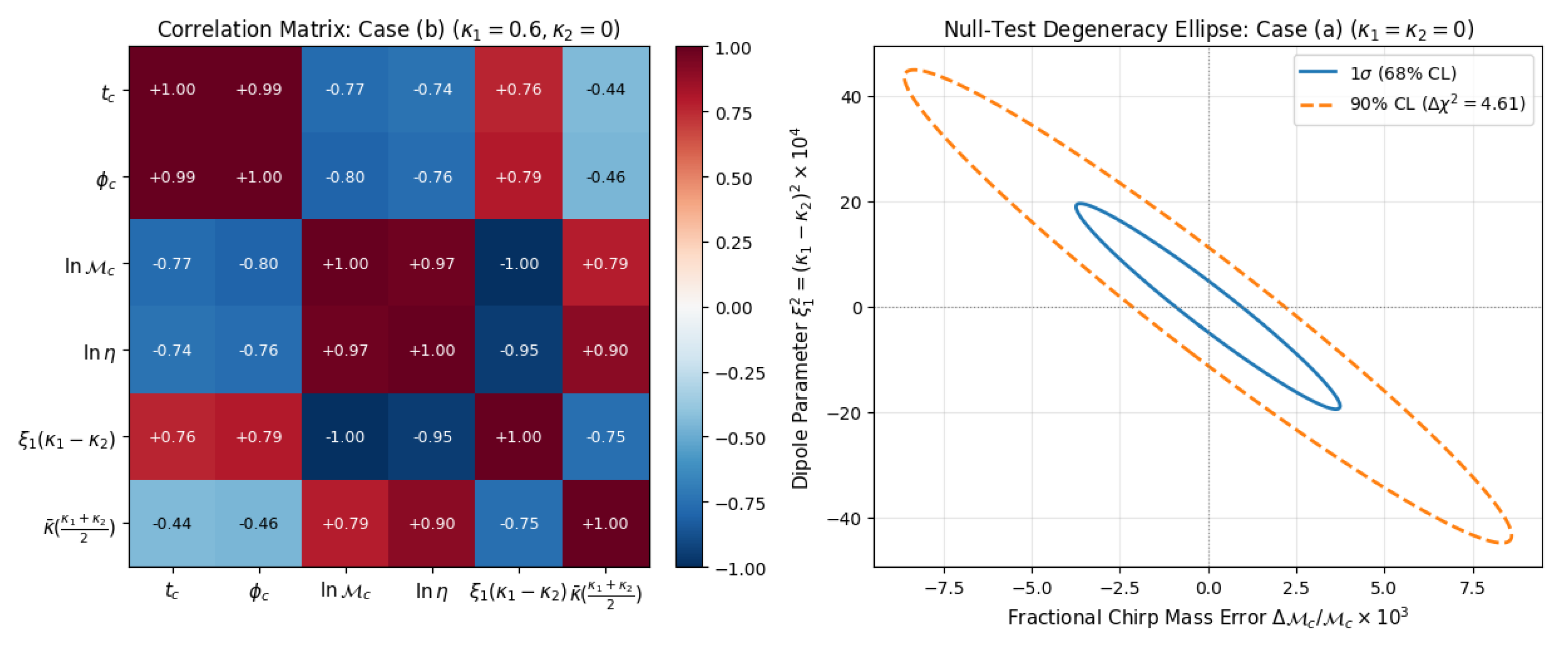

Table 1.
Marginalized statistical uncertainties and linearized systematic parameter bias ratios (incurred when omitting NLO 0PN/1PN charge corrections and ) for a benchmark binary observed by Advanced LIGO () at a network SNR of . Matrix inversions apply Tikhonov regularization () to charge parameters to stabilize exact symmetric degeneracies.
| Binary Configuration | ||||||||
| (Bias Ratio) | ||||||||
| Case (a): | — | — | ||||||
| Case (b): | — | |||||||
| Case (c): | — | () | ||||||
| Case (d): | — | |||||||
| *Unconstrained beyond the imposed regularization prior of due to vanishing linear phase derivatives in equal-mass opposite-sign configurations. | ||||||||
| †Nominal linearized Cutler–Vallisneri ratio; values lie outside the small-dephasing linear regime and indicate severe template breakdown. | ||||||||
Disclaimer/Publisher’s Note: The statements, opinions and data contained in all publications are solely those of the individual author(s) and contributor(s) and not of MDPI and/or the editor(s). MDPI and/or the editor(s) disclaim responsibility for any injury to people or property resulting from any ideas, methods, instructions or products referred to in the content. |
© 2026 by the authors. Licensee MDPI, Basel, Switzerland. This article is an open access article distributed under the terms and conditions of the Creative Commons Attribution (CC BY) license (http://creativecommons.org/licenses/by/4.0/).
Copyright: This open access article is published under a Creative Commons CC BY 4.0 license, which permit the free download, distribution, and reuse, provided that the author and preprint are cited in any reuse.