
Submitted:
24 November 2026
Posted:
25 November 2026
You are already at the latest version
Abstract
Background: Pharma 4.0 integrates Quality by Design (QbD) with digital technologies to strengthen pharmaceutical process understanding, monitoring, and control. However, the extent to which these technologies support validated, adaptive manufacturing systems remains uncertain. This review assesses their relationship with QbD elements, implementation scale, evidence maturity, and regulatory considerations. Methods: A structured narrative review of scientific literature, regulatory guidance, and standards was undertaken using a literature-identification and selection process informed by PRISMA 2020. Evidence was synthesized qualitatively across process analytical technology (PAT), the industrial Internet of Things (IIoT), artificial intelligence and machine learning (AI/ML), and digital twins. Results: Evidence maturity differed across the four domains. PAT applications were reported across pharmaceutical and biopharmaceutical operations, including pilot-scale settings. IIoT evidence primarily supported connectivity and monitoring, while end-to-end validated data-integrity architectures were less well established in the reviewed sources. AI/ML evidence ranged from laboratory modelling to a reported study evaluating ANN-derived limits using GMP exhibit batches, with bioequivalence reported. Direct evidence for digital twins supporting pharmaceutical process decisions remained limited, and many applications were conceptual or at an early stage. Conclusions: QbD 4.0 should be advanced through reliable data infrastructure, fit-for-purpose validation, lifecycle governance, cybersecurity, controlled change management, and human oversight. A staged, evidence-based approach is needed; monitoring or predictive performance alone does not establish validated process control or regulatory acceptability.
Keywords:
Quality by Design
; Pharma 4.0
; process analytical technology
; industrial internet of things
; artificial intelligence
; machine learning
; digital twins
; pharmaceutical manufacturing
1. Introduction
Pharmaceutical quality assurance has evolved from reliance on end-product testing toward approaches emphasizing process understanding, risk management, and quality built into product and process design. The US Food and Drug Administration (FDA) PAT framework established a foundation for this transition by promoting timely measurement and analysis of material and process attributes to support manufacturing control. Subsequently, ICH Q8(R2) described the principles of pharmaceutical development underpinning QbD, emphasizing predefined objectives, scientific understanding, and quality risk management [1,2,3].
Pharma 4.0™, an industry framework developed by the International Society for Pharmaceutical Engineering (ISPE), applies Industry 4.0 concepts to pharmaceutical operations through digital connectivity, data integration, and holistic process control [4]. Four technology domains are particularly relevant: PAT enables process measurement; IIoT connects equipment, sensors, and information systems; AI/ML support data-driven prediction; and digital twins provide computational representations of processes or assets for simulation and decision support. Their convergence with pharmaceutical quality principles has been discussed under quality by digital design (QbDD) [5,6,7]. However, the availability of digital technologies does not itself establish reliable quality predictions, validated process interventions, or regulatory acceptability. Their contribution depends on the evidence supporting individual components and their integration within an appropriate pharmaceutical quality system (PQS).
1.1. Challenges in Conventional QbD and the Need for Digital Integration
Conventional pharmaceutical systems often face challenges in integrating process, laboratory, and quality data across the product lifecycle. Digital technologies can improve data accessibility and process knowledge, but their effective use requires reliable data exchange, lifecycle management, and appropriate quality-system oversight [8,9,10]. These challenges motivate the integration of sensing, connectivity, predictive analytics and process modelling within a controlled quality framework.
1.1. Digital Maturity, Control Strategy, and Evidence
Digital maturity depends on validation for intended use and integration within a pharmaceutical quality system, rather than technology availability alone. The ISPE Pharma 4.0 framework emphasizes holistic control strategies and performance-based quality management, with human oversight of quality-related decisions [11,12,13]. Evidence maturity varies across technologies. PAT has been applied across pharmaceutical and biopharmaceutical operations, including pilot-scale studies. IIoT enables connected monitoring and data exchange, although validated data-integrity architectures remain insufficiently established in the reviewed evidence. AI/ML applications range from laboratory modelling to a reported GMP-scale evaluation of model-derived specification limits. Primary evidence for digital twins directly supporting pharmaceutical process decisions remains limited within the reviewed sources [14]. Therefore, integrated digital QbD maturity must be assessed across the full sequence of measurement, data transfer, prediction, process intervention and verification, rather than inferred from the performance of an individual technology.
1.3. Research Gap and Review Objectives
Existing studies have examined PAT, IIoT, AI/ML, and digital twins in pharmaceutical development and manufacturing. However, an integrated assessment of their contributions to QbD elements, implementation maturity, validation evidence, and regulatory implications remains limited [16,17,18]. This review maps the four technology domains to relevant QbD elements, evaluates evidence across laboratory, pilot, and GMP/commercial scales, and examines model credibility, data integrity, and regulatory considerations. Its objectives are to synthesise the available evidence, assess implementation and validation maturity, propose an integrated QbD 4.0 architecture, and identify key implementation barriers and research priorities. The proposed architecture is an evaluative framework for future development; it does not imply that a fully integrated, adaptive pharmaceutical manufacturing system has already been demonstrated.
2. Review Methodology
2.1. Review Design and Reporting Framework
This review presents a structured narrative synthesis of the integration of Quality by Design (QbD) with four Pharma 4.0 technology domains: process analytical technology (PAT), the industrial Internet of Things (IIoT), artificial intelligence and machine learning (AI/ML), and digital twins. It examines their applications across QbD elements, implementation scales, validation evidence, and regulatory and practical challenges in pharmaceutical and biopharmaceutical development and manufacturing. The review was informed by relevant elements of PRISMA 2020.
2.2. Information Sources and Search Strategy
The literature search covered Scopus, Web of Science Core Collection, PubMed, PubMed Central, ScienceDirect, and Europe PMC, while Google Scholar was used for supplementary searching and citation tracking. Regulatory guidance and standards were consulted from official sources, including FDA, EMA, ICH, the European Commission, WHO, PIC/S, and PMDA. Search concepts included Quality by Design (QbD), Pharma 4.0, Industry 4.0, process analytical technology (PAT), the industrial Internet of Things (IIoT), artificial intelligence and machine learning (AI/ML), digital twins, pharmaceutical manufacturing, and good manufacturing practice (GMP). The final search was completed on 9 October 2026. The database-specific search strategies and related search details are provided in Supplementary File S1.
2.3. Eligibility Criteria
Eligible sources included English-language original research articles and relevant reviews addressing at least one of the four technology domains—PAT, IIoT, AI/ML, or digital twins—in pharmaceutical or biopharmaceutical development, manufacturing, monitoring, process control, or quality assurance. Relevant official regulatory guidance and standards were included separately. Primary studies informed application and performance assessments, reviews provided contextual synthesis, and official documents supported regulatory descriptions. Duplicate records, publications lacking pharmaceutical relevance, and records with insufficient relevant information were excluded. Reports with unavailable full texts were recorded separately. Full-text exclusions were assigned specific reasons where verifiable, and findings from reviews were distinguished from primary-study evidence to avoid treating secondary reporting as independent experimental confirmation. The inclusion and exclusion criteria applied during literature selection are summarized in Table 1.
2.4. Study Selection
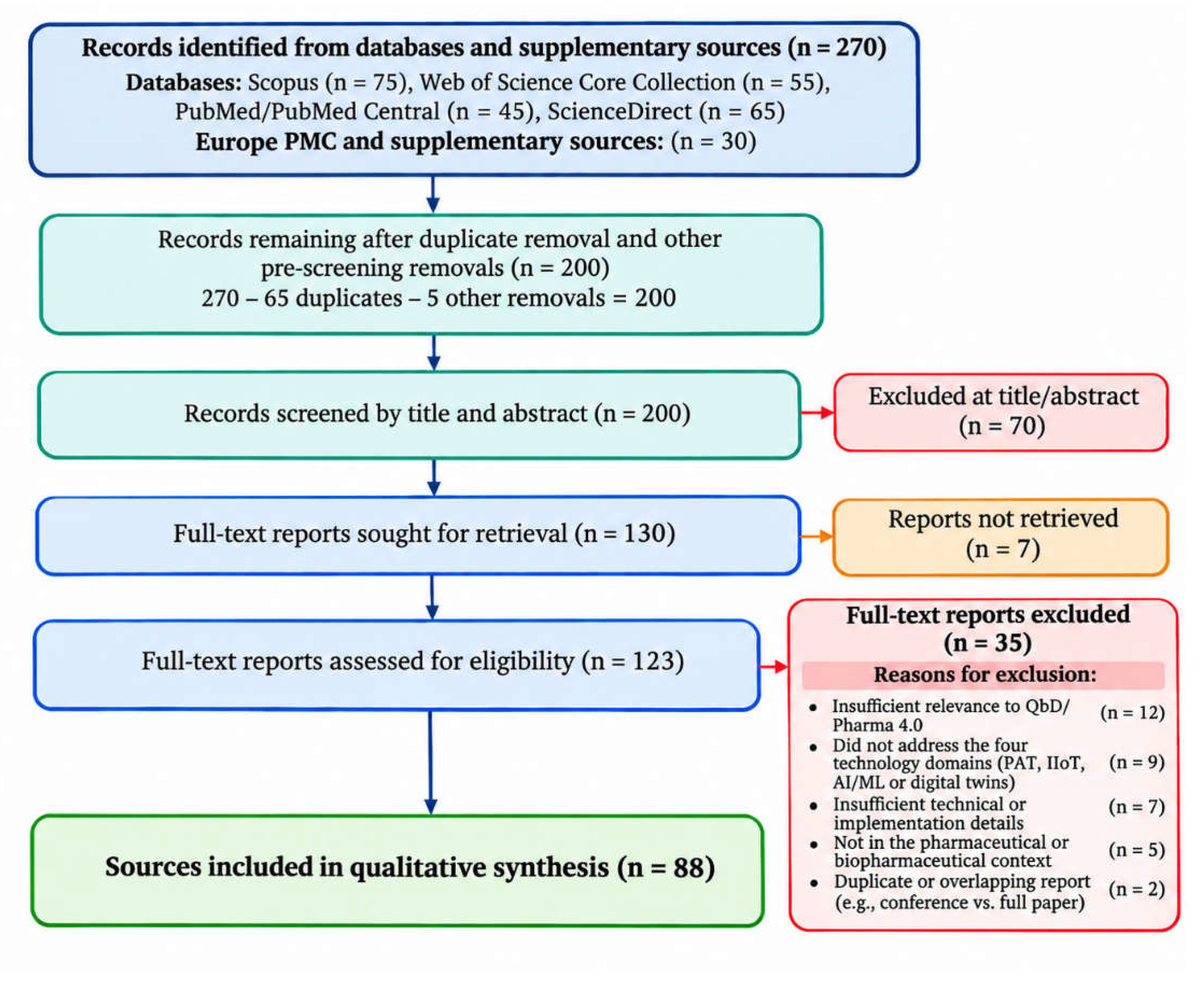
Study selection followed a staged process comprising record identification, deduplication, title and abstract screening, full-text retrieval, and eligibility assessment. A total of 270 records were identified. After removing 65 duplicate records and five additional records before screening, 200 records remained for title and abstract screening, of which 70 were excluded. Full-text reports were sought for the remaining 130 records; seven reports could not be retrieved, leaving 123 reports for full-text eligibility assessment. Of these, 35 reports were excluded, and 88 reports were included in the qualitative synthesis. The study-selection process is presented in the PRISMA flow diagram, with counts reflecting the records assessed at each stage.
Figure 1.
PRISMA-style flow diagram illustrating the study-selection process.
2.5. Data Extraction and Evidence Classification
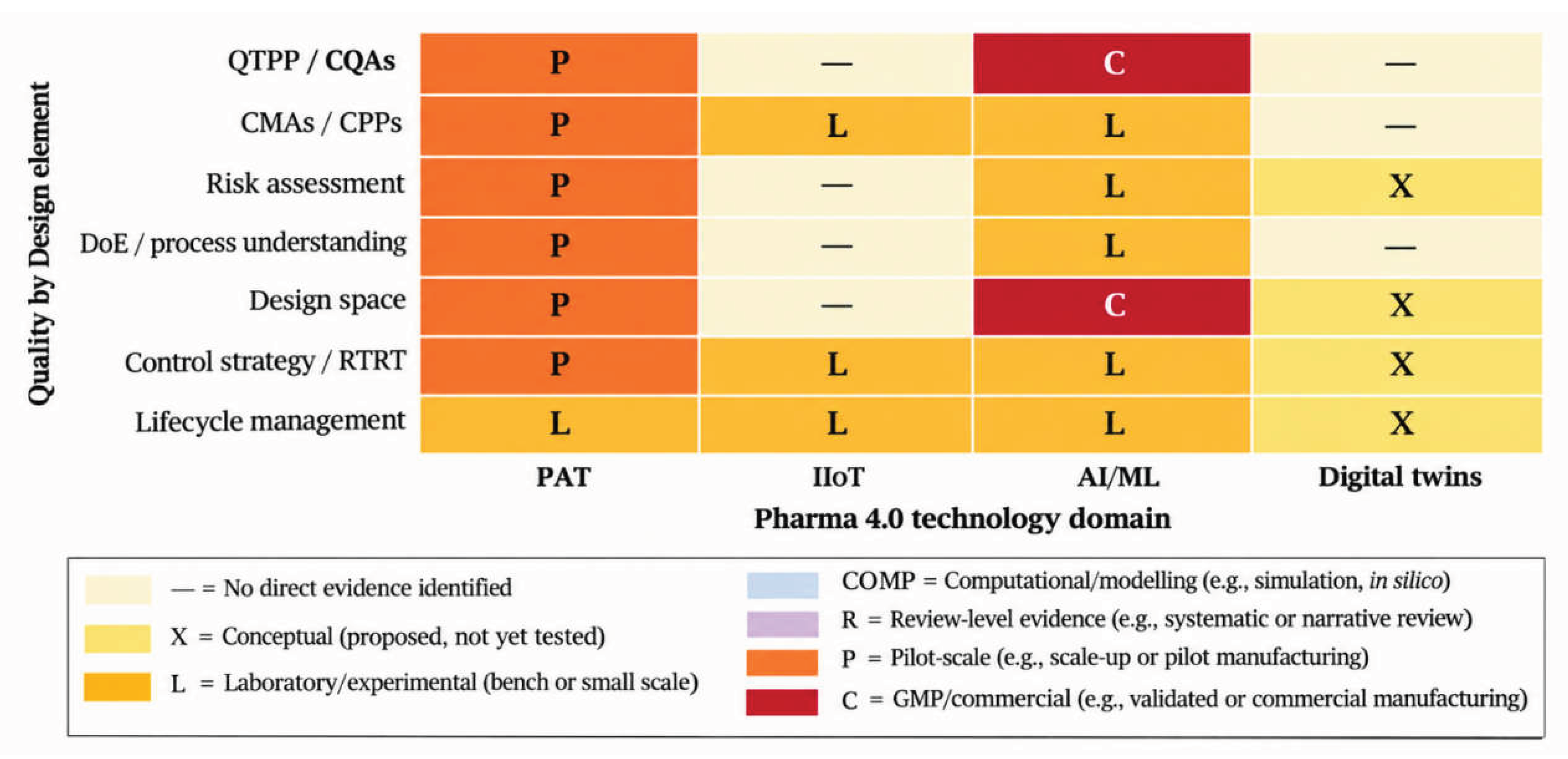
The following information was extracted from each eligible source: bibliographic details, source type, technology domain, pharmaceutical product or process, relevant QbD elements, implementation scale, validation design, reported quality or process metrics, regulatory relevance, and stated limitations. Implementation maturity was assigned according to the highest level of application directly documented in the source, not the level proposed by the authors of a conceptual framework or review. Where a source described several settings, the classification should reflect the specific result being discussed and should be explained in the relevant table or supplementary evidence matrix.
- Commercial/GMP (C): Application directly demonstrated in a commercial manufacturing setting or in a documented GMP context. GMP exhibit batches should be identified explicitly and should not automatically be described as routine commercial deployment.
- Pilot-scale (P): Application demonstrated or evaluated at pilot scale; the scale and nature of the demonstration should be specified where reported.
- Laboratory/experimental (L): Application evaluated at laboratory or small scale, without evidence of the relevant pilot or GMP implementation being claimed.
- Computational (COMP): Computational or modelling evaluation without physical implementation at the manufacturing scale relevant to the claim.
- Review-level (R): A claim supported only by secondary literature in the reviewed source set, without a directly assessed primary-study dataset for that claim.
- Conceptual (X): A proposed framework or application without reported experimental or operational demonstration.
A supplementary evidence matrix should identify, for the principal claims, study design, source type, implementation scale, validation method, key outcome, and limitations. Secondary reviews are treated as contextual sources and are not counted as independent experimental confirmation of findings reported in primary studies.
2.6. Evidence Synthesis and Comparative Analysis
A qualitative narrative synthesis was conducted to accommodate differences in study designs, technologies, manufacturing contexts, implementation scales, validation methods, and reported outcomes. Findings were compared across the four technology domains and relevant QbD elements, including critical quality attributes (CQAs), critical material attributes (CMAs), critical process parameters (CPPs), risk assessment, design space, control strategy, process monitoring, real-time release testing (RTRT), and lifecycle management. The synthesis distinguished demonstrated applications from computational evaluations and conceptual proposals. Validation strength, model transferability, data integrity, interoperability, and regulatory implications were also examined. Quantitative findings were summarized where appropriate; meta-analysis was not performed because of heterogeneity across studies.
2.7. Methodological Limitations
This structured narrative review has limitations, including potential selection bias, incomplete literature coverage, variability in source quality, and dependence on full-text availability. Overlap among databases and publisher platforms may also affect record identification and deduplication. Supplementary keyword searching and citation tracking were used to identify relevant studies that might not explicitly use the terms QbD or Pharma 4.0. Evidence classifications were assigned by the author(s) using predefined criteria and were not independently assessed by a second reviewer, which may introduce subjectivity. Differences in study design, implementation scale, validation methods, and performance metrics prevented pooled quantitative benchmarking. Accordingly, the findings should be interpreted as a qualitative synthesis rather than a quantitative comparison of technology performance.
3. Quality by Design Foundations for Pharma 4.0
3.1. Core Elements of Quality by Design
QbD is a systematic approach to pharmaceutical development that integrates scientific knowledge, predefined quality objectives, and quality risk management to establish product and process understanding. The Quality Target Product Profile (QTPP) defines intended product characteristics related to safety, efficacy, and performance. It guides the identification of critical quality attributes (CQAs), which must remain within appropriate limits to ensure product quality. Critical material attributes (CMAs) and critical process parameters (CPPs) that may affect CQAs are identified through scientific understanding and risk assessment.
The relationships established through these analyses inform the definition of the design space, which comprises the multidimensional combination and interaction of input variables and process parameters demonstrated to provide assurance of quality. The robustness of this space depends on the variables investigated, the suitability of the models used, and the supporting experimental evidence.
The resulting process understanding informs the development of a control strategy that integrates material and equipment controls, process monitoring, specifications, and release testing. PAT enables timely measurement of relevant process attributes and may support RTRT when scientifically justified and regulatorily acceptable. However, monitoring alone does not ensure process control; reliable measurements must be linked to predefined acceptance limits and appropriate corrective actions [22]. Lifecycle management sustains process understanding through continued process verification (CPV), deviation investigation, trend analysis and change control. Digital technologies can enhance these activities through improved data acquisition, connectivity, prediction and simulation, provided data quality, model validation and oversight of control-strategy changes are maintained [23,24,25].
3.2. Regulatory Framework for Quality by Design
Established regulatory guidelines provide the foundation for applying QbD to digital pharmaceutical development and manufacturing. They address product and process understanding, risk management, PQSs and lifecycle management but do not prescribe a single digital architecture [26,27,28]. ICH guidelines provide complementary principles. ICH Q8(R2) and Q11 address pharmaceutical development and drug-substance development and manufacture, respectively, while ICH Q9(R1) covers quality risk management. ICH Q10 establishes the PQS, incorporating process monitoring, corrective and preventive action, change management and continual improvement [29]. ICH Q12 supports post-approval change management through mechanisms such as post-approval change management protocols (PACMPs). These may facilitate changes to sensors, analytical models and software affecting established control strategies, but do not automatically authorize autonomous model adaptation. Changes must be evaluated for quality impact and compliance with regulatory commitments [31,32,33,34].
ICH Q13 addresses continuous manufacturing, including process monitoring, control, traceability and model-supported process understanding. ICH Q14 and Q2(R2) address analytical procedure development and validation, providing relevant principles for spectroscopic and multivariate methods. Their suitability must be demonstrated for each intended application [35]. The FDA’ PAT framework supports timely process measurement and scientific understanding. Under an appropriate control strategy, PAT measurements may support RTRT. However, these frameworks do not automatically establish the acceptability of specific AI/ML models, digital twins or automated release decisions [37]. Regulatory readiness therefore depends on intended use, scientific evidence, data integrity, model performance, change control and quality-system oversight.
3.3. Digital QbD Architecture
The proposed digital QbD framework comprises six interconnected layers: PAT-based sensing, IIoT-enabled connectivity, AI/ML analytics, digital-twin-based process modelling, process control, and the PQS. The architecture operates as a feedback loop. PAT generates process measurements, IIoT supports data transmission, AI/ML analyses patterns and predicts quality outcomes, and digital twins simulate process behaviour to support decision-making. Validated outputs may inform process actions, while the quality system oversees data integrity, model lifecycle management, change control, and knowledge management [39,40,41]. This architecture is proposed and has not been demonstrated as an end-to-end manufacturing system. Implementation requires reliable data, appropriately validated models, defined decision boundaries, and suitable human oversight. The evidence supporting individual technology layers is evaluated in the following sections.
3.4. Mapping Technologies to QbD Elements
The four Pharma 4.0 technology domains are mapped against key QbD elements in Table 2. The evidence is uneven: PAT has reported applications across several unit operations, including pilot-scale evidence, whereas AI/ML includes one reported study involving GMP exhibit batches alongside predominantly laboratory or computational applications. Direct primary evidence for digital twins supporting pharmaceutical process decisions remains limited in the reviewed source set. The table is an evidence map based on the cited sources, not proof that all technologies have been integrated and validated as one end-to-end system. Each table entry should be checked against the cited primary source and classified according to the actual study setting.
The technologies serve complementary functions. PAT provides time-resolved measurements for process understanding and monitoring; IIoT supports data connectivity and exchange; AI/ML enables prediction and pattern recognition; and digital twins offer potential for simulation and model-based decision support. These capabilities require validation appropriate to their intended use [46,47,48]. Monitoring, predictive accuracy, and closed-loop process control are distinct claims and should not be treated as equivalent without supporting evidence.
Figure 2.
Technology QbD mapping by evidence maturity.
4. PAT: The Sensing Layer
PAT forms the sensing layer of digital QbD by generating time-resolved measurements of process parameters and quality attributes. Combined with chemometric and ML models, these measurements support process understanding, monitoring, control, and potentially release decisions. The reviewed applications include oral solid dosage (OSD) manufacturing, hot-melt extrusion (HME), freeze-drying, bioprocessing, and AI-enabled QbD information management [50].
4.1. Regulatory Origins and Role in Real-Time Release Testing (RTRT)
The FDA’s 2004 PAT framework established a science- and risk-based approach to manufacturing through timely measurement and analysis of material and process attributes. By shifting emphasis from end-product testing toward process understanding, PAT can support process control, reduce avoidable waste and rework, and enable RTRT when adequate evidence and an appropriate control strategy are available [51]. Near-infrared (NIR) and Raman spectroscopy, combined with multivariate analysis (MVA), can estimate relevant quality attributes from in-process measurements. These applications depend on suitable analytical performance, process understanding, and quality-system oversight. Combining DoE with MVA can improve characterization of complex process variability that may not be adequately captured by experimental design alone. PAT measurements may also support CPV [52]. Despite the established framework, fit-for-purpose analytical methods and commercial-scale implementation remain challenges, particularly in biopharmaceutical manufacturing. PAT provides essential measurement inputs for advanced process control and potential digital-twin applications, but measurement capability alone does not establish validated closed-loop control or RTRT.
4.2. Sensor Technologies
PAT measurements may be obtained off-line, at-line, on-line, or in-line. On-line and in-line implementation requires suitable sampling arrangements or probe interfaces that do not compromise product integrity [3, 24]. Vibrational spectroscopy is widely used for pharmaceutical process monitoring. NIR models have monitored granule bulk density and ribbon density during bilayer-tablet manufacturing. In freeze-drying, NIR is more sensitive to water and ice than Raman spectroscopy, making the methods complementary; both remain at the research stage for the specific applications reviewed. Raman spectroscopy combined with a convolutional neural network (CNN) has also been applied to identify monoclonal antibody (mAb) charge variants during on-line chromatography [51, 53].
Other approaches include physical sensors for freeze-drying and slit-die rheometry for measuring melt viscosity during HME. Sensor selection should reflect the target attribute, measurement environment, response time, and demonstrated analytical performance [54].
4.3. Chemometrics and Machine Learning
Spectral data are often pre-processed using standard normal variate (SNV), multiplicative scatter correction (MSC), smoothing and derivative methods. Principal component analysis (PCA) helps identify patterns in process data, while partial least squares (PLS) predicts product properties [55,56,57]. In-line Raman and NIR models have predicted active pharmaceutical ingredient (API) content with errors of approximately 0.6–1.5%. However, models may perform poorly when operating conditions change. For example, an NIR–PLS model for a co-crystal failed at different screw speeds because temperature affected the measurements. Multivariate statistical process control (MSPC) can also detect unusual process changes, such as API accumulation and impurity formation [58].
Machine learning and deep learning (DL) can identify complex patterns in process data, but their reliability depends on representative training data and proper validation. Explainability tools, such as Shapley Additive exPlanations (SHAP) and Local Interpretable Model-agnostic Explanations (LIME), help users understand model predictions but cannot guarantee accuracy [60,61,62]. PAT models require ongoing performance monitoring, revalidation and software controls. USP General Chapter 1039 covers multivariate data analysis, while 21 CFR Part 11 addresses electronic records and signatures. Transferring models between equipment scales remains challenging: a Raman–PLS model achieved an error of 0.94–0.97% only after adjusting the optical path length. Model updates also require suitable historical data and careful evaluation [58, 63].
4.4. Applications by Unit Operation and Product Type
PAT applications and evidence maturity vary across manufacturing operations (Table 3). In a bilayer fixed-dose-combination (FDC) tablet study, FMEA, mixture and response-surface designs, and Monte Carlo simulation supported design-space development. Multivariate analysis linked granule bulk density and ribbon density with dissolution, while in-line NIR–PLS models monitored attributes during high-shear mixing and roller compaction. Scale-up from 400 to 5,000 tablets was reported, and the optimised product was bioequivalent to the reference. However, commercial deployment and closed loop correction were not established [64].
In HME, challenges include predicting final-product properties, validating models beyond calibration conditions and implementing automated ML-based control. In freeze-drying, PAT monitors product temperature, residual ice and sublimation rate, while heat-transfer coefficient (Kv) and cake resistance (Rp) support model-based optimisation. In biologics manufacturing, PAT monitors metabolites, particle characteristics and product-quality attributes, although evidence remains largely small-scale and commercial adoption is cautious [66]. Table 3 summarizes the principal tools, monitored attributes, reported outcomes, and evidence maturity across the reviewed applications.
4.5. PAT in Process Control and Quality Assurance
PAT supports process control through direct measurements, soft sensors and model-derived parameters. In freeze-drying, extended Kalman filter-based soft sensors estimate product temperature and heat-transfer coefficient, while cake resistance supports design-space calculations. In HME, predictor–corrector soft sensors estimate melt viscosity and support thermal optimisation. Raman spectroscopy enables metabolite and viable cell-density monitoring in bioprocessing [69].
For bilayer tablets, Monte Carlo simulation combined with in-line NIR monitoring supported design-space verification during scale-up but did not demonstrate closed-loop correction. Commercial-scale integration of combined feedforward and feedback PAT control remains unestablished in the reviewed sources [64, 70].
An AI-enabled framework combines edge inference, cloud-based model management, FMEA and human verification. Reported reductions of approximately 18% in out-of-specification batches and 12% in rejections derive from brief pilot or industrial summaries and require independent validation. Thus, analytical monitoring is more established than automated control and release decisions [67].
5. Industrial Internet of Things and Smart Pharmaceutical Manufacturing
The IIoT connects sensors, manufacturing equipment, control systems, and information platforms to support timely data exchange and coordinated pharmaceutical operations. Within digital QbD, IIoT provides the connectivity needed to link process measurements with analytics, control strategies, and quality-system records. Its value depends on interoperability, data integrity, cybersecurity, and appropriate system validation [71].
5.1. IIoT Architecture and Connectivity
An IIoT architecture typically includes field sensors and equipment, edge devices, industrial networks, data-management platforms, and applications for monitoring and decision support. Sensors generate process data, while gateways and industrial communication protocols transfer information between equipment and supervisory or enterprise systems. Edge computing can support local processing where latency, network reliability, or data-volume constraints make cloud-based processing unsuitable [73]. OPC UA can facilitate structured and interoperable data exchange across heterogeneous systems. However, technical connectivity alone does not ensure semantic consistency, traceability, or data integrity. Pharmaceutical implementations must establish appropriate timestamps, metadata, access controls, audit trails, and links between process data and batch records.
5.2. Smart and Digital Manufacturing
Smart manufacturing integrates connected equipment, process monitoring, modelling and automated control to improve process consistency and detect deviations. In continuous bioprocessing, inline mid-infrared measurements collected every 40 seconds showed results within 5% of offline assays, demonstrating the potential for timely process monitoring [75]. A model-based control system combining moving-horizon estimation and nonlinear model-predictive control (MHE–NMPC) operated at 1-second intervals, with a mean solver time of 0.7 seconds [76]. However, its performance declined when the process differed substantially from the model, highlighting the need for model monitoring and safe fallback strategies. Connected environmental sensors using Bluetooth Low Energy (BLE) have also transmitted temperature and humidity data and generated alerts when limits were exceeded. However, alerts alone do not ensure corrective action or pharmaceutical quality [74]. These examples demonstrate the benefits of frequent measurement, model-based control and connected monitoring, but do not establish the validation of a fully integrated smart pharmaceutical manufacturing system.
5.3. Smart Pharmaceutical Supply Chains
IIoT can improve supply-chain visibility by connecting environmental sensors, storage equipment, transport systems, and inventory platforms. Temperature and humidity monitoring can identify excursions affecting sensitive pharmaceutical products and provide time-stamped evidence for investigation. Integration with enterprise resource planning (ERP) and warehouse management systems can further connect environmental conditions with inventory and distribution records. Nevertheless, sensor availability does not guarantee complete traceability. Reliable implementation requires calibrated devices, appropriate alarm limits, secure data transfer, documented excursion handling, and clear responsibility for corrective action. Connectivity and monitoring should therefore be assessed alongside data integrity and quality-system controls.
5.4. Smart Pharmaceutical Systems
Smart pharmaceutical systems can strengthen Quality-by-Design (QbD) implementation by linking manufacturing information with operational and quality-related decisions. Their value depends not only on connectivity but also on clearly defined system functions, responsibilities, and controls appropriate to the intended use.
Within a QbD framework, these systems should support established quality objectives and documented decision-making rather than replace existing quality-system responsibilities. The extent to which they improve pharmaceutical quality must be demonstrated through appropriate validation and performance evidence.
5.5. Data Governance and Interoperability
Data governance establishes the ownership, quality, accessibility, and permitted use of manufacturing information. Pharmaceutical IIoT environments may combine data from sensors, programmable logic controllers, SCADA systems, laboratory information management systems (LIMS), and manufacturing execution systems (MES). Differences in data formats, timestamps, identifiers, and metadata can impede integration and complicate reconstruction of process history [77]. Interoperability standards can support data exchange, but integration also requires consistent definitions, controlled interfaces, traceable transformations, and links to relevant batch and quality records. Data integrity principles should apply throughout acquisition, transmission, processing, storage, and retrieval. Governance arrangements should define access rights, record retention, audit-trail review, system ownership, and responsibility for resolving data-quality issues.
5.6. Cybersecurity and System Validation
Connected pharmaceutical equipment introduces cybersecurity risks because unauthorized access, data alteration, or service disruption may affect manufacturing operations and quality decisions. Network segmentation, controlled access, secure configuration, vulnerability management, supplier oversight, and incident-response procedures are therefore important safeguards. The IEC 62443 series provide a framework for industrial automation and control-system security, including zones and conduits to separate systems according to risk. In pharmaceutical applications, these measures should be integrated with computerised-system validation and data-integrity controls. Validation should establish that the system performs as intended, maintains reliable records, and supports appropriate recovery and change management [78]. The security and validation requirements depend on intended use and potential impact on product quality. A monitoring-only device and a system able to change process set-points should not automatically be assigned the same risk classification or control requirements.
5.7. Barriers, Opportunities, and Outlook
IIoT adoption in pharmaceutical manufacturing is limited by legacy equipment, incompatible data systems, infrastructure costs, cybersecurity risks, validation requirements and skills shortages (Table 4). A staged approach can reduce implementation risks, beginning with reliable data collection and monitoring, followed by interoperable integration, validated analytics and, where justified, controlled process interventions. Each stage requires defined objectives, acceptance criteria, responsibilities and documented performance evidence [79]. IIoT provides the connectivity needed for AI/ML and digital twins, but these technologies also require reliable data, validated models, cybersecurity and lifecycle governance. Connected monitoring, predictive decision support and autonomous control should therefore be treated as distinct levels of implementation maturity.
6. AI/ML
AI and ML can complement QbD by analysing complex process data, predicting quality attributes and supporting process decisions. Their contribution depends on data quality, appropriate validation and the intended use of each model. The evidence reviewed here ranges from laboratory formulation studies to one reported GMP-scale application; these levels should not be interpreted as equivalent evidence of manufacturing readiness.
6.1. QbD-Focused Primer
DoE and multivariate statistical methods remain established approaches for relating CPPs to CQAs. ML may complement these methods when relationships are nonlinear or datasets are high-dimensional. The reviewed studies use artificial neural networks (ANNs), ML-integrated DoE, deep learning and manufacturing applications such as soft sensors, anomaly detection, process control and computer vision. Hybrid models combine data-driven predictions with mechanistic knowledge, while human oversight and explainable AI methods including SHAP and LIME can improve interpretability. Their practical value must nevertheless be evaluated for each application rather than assumed from the use of these methods alone [81,82,83].
6.2. AI Across the QbD Lifecycle
Machine learning (ML) supports critical process parameter (CPP) identification, risk assessment, formulation optimization, design-space prediction, and process monitoring. Table 5 summarizes representative applications and their reported evidence levels.
The strongest implementation evidence is the ANN-based tablet study involving GMP exhibit batches and clinical bioequivalence outcomes [84]. However, this does not establish routine commercial deployment or autonomous process control. Most other applications demonstrate laboratory-scale prediction, computational analysis, or secondary evidence. Differences in datasets, validation methods, and performance metrics limit direct comparisons and conclusions about commercial applicability.
6.3. Model Lifecycle and Credibility
AI/ML credibility depends on a defined intended use, representative data, appropriate validation, and performance under relevant operating conditions. Metrics such as R², RMSE, and prediction bias should be interpreted alongside the validation design and consequences of model error. High predictive performance alone does not establish robustness, transferability, or regulatory acceptability. Explainable AI, hybrid modelling, and human oversight can improve interpretability but do not guarantee accuracy. In one study, removing the explainable AI module left R² at approximately 0.93 but reduced interpretability and compliance alignment [67]. Lifecycle management should include data provenance, model version control, performance monitoring, drift detection, change-impact assessment, and revalidation when necessary. Quality-related applications should also have predefined decision boundaries, human oversight, and fallback procedures. Model changes must be appropriately assessed and documented within the pharmaceutical quality system.
6.4. Limitations
The available evidence remains uneven in scale and implementation maturity. Most formulation applications were evaluated at laboratory scale, while only one reviewed study assessed AI-derived limits using GMP-scale batches. Consequently, the transferability of reported findings to other products, equipment, and manufacturing sites remains uncertain. Further evidence is needed to establish whether the reported benefits persist under routine manufacturing conditions [67, 83]. Future work should prioritise prospective GMP-scale verification, transparent reporting of data and validation methods, comparisons against clearly defined baseline models, and quantitative evaluation of benefits attributable specifically to AI/ML. Promising predictive performance alone does not establish reliable process control or regulatory acceptability.
7. Digital Twins
Digital twins combine process data, computational models and process knowledge to represent specific pharmaceutical assets and support monitoring, prediction or control. Within QbD, they may help evaluate relationships among material attributes, CPPs and CQAs. However, their value depends on synchronisation with the physical process, model credibility and the consequences of the decisions they support.
7.1. Definition and Maturity
In this review, a digital twin is defined as a fit-for-purpose model of a specific asset, with a defined context of use (COU), synchronisation through state estimation, feedback appropriate to process dynamics and lifecycle-managed evidence supporting model credibility. Table 6 classifies maturity according to the decisions supported.
7.2. Digital Twins Across the QbD Lifecycle
Digital twins may support process development, scale-up and manufacturing by evaluating process behaviour and predicting potential quality deviations. For continuous manufacturing, ICH Q13 emphasises understanding model assumptions, identifying influential inputs through sensitivity analysis and experimentally confirming simulated residence time distribution (RTD) profiles. Model uncertainty should be reflected in acceptance criteria [88]. ICH Q8(R2) recognises multivariate and time-dependent design spaces, while ICH Q13 supports process modelling for quality prediction and product diversion. Model-derived design spaces nevertheless require appropriate experimental confirmation. Model-based RTRT demands particular scrutiny because batch disposition depends on the reliability of model predictions [89]. ICH Q12 provides a framework for planning specified post-approval changes through PACMPs. Where applicable, this may support controlled changes to a digital twin when updates affect an established regulatory commitment [91].
7.3. Deployment and Model Maintenance
Digital-twin deployment requires computerised-system validation, data-integrity controls and lifecycle governance. Applicable guidance, the draft Annex 11 and GAMP 5 provide relevant frameworks for risk-based validation, supplier oversight, access management and audit trails. Because a twin may transmit recommendations or set-points to physical equipment, cybersecurity controls including IEC 62443 zones and conduits should restrict communications and control actions to authorised operations [63, 72]. Lifecycle maintenance should include model version control, monitoring of predictive performance and input-space coverage, and formal change control. A digital thread should link each model-supported decision to the relevant model version, input data and batch record, enabling traceability, reproducibility and assessment of model changes.
7.4. Credibility and Regulatory Acceptance
Model credibility should be established according to its intended use and the risks associated with incorrect decisions. ASME V&V 40 and FDA guidance provide risk-based approaches to model validation, uncertainty assessment and applicability. Regulatory expectations depend on the model type and context of use. ICH Q8–Q13, relevant FDA and EMA documents, and draft Annex 22 address process modelling and AI/ML governance. Hybrid digital twins may require both mechanistic-model and AI/ML validation. The status and scope of draft guidance should be verified against current official versions before submission [92]. Digital-twin credibility involves two complementary dimensions: synchronisation credibility the ability to represent the physical process despite sensor faults, missing data, or process drift and decision credibility, which concerns the reliability of model-supported actions and the availability of safe fallback mechanisms. Continuous model updating requires controlled, validated procedures. Two proposed strategies are freeze-and-release, with formally assessed model updates, and bounded adaptation, allowing changes within predefined, validated limits under monitoring and change control. Updates affecting regulatory commitments may require an applicable PACMP or another appropriate regulatory change-control pathway [17, 34].
7.5. Limitations
Digital-twin implementation is constrained by limited calibration data, potential parameter non-identifiability and difficulties assessing model performance near design-space boundaries. Legacy equipment may also lack the instrumentation, connectivity and open interfaces required for reliable integration [94]. The evidence base identified in this review remains limited. The discussion draws substantially on regulatory documents and methodological frameworks rather than primary studies of pharmaceutical process twins; the identified primary example concerns cold-chain logistics. This finding describes the reviewed source set and should not be interpreted as proof that no other relevant studies exist.
8. Integration
Integrating four technologies into an adaptive QbD 4.0 system remains a developing goal. Although individual components have been demonstrated at different scales, the available evidence does not yet demonstrate a fully integrated, end-to-end closed-loop system. Evidence supporting simulation-informed decision-making and digital-twin-based batch release remains limited [47].
8.1. Closed-Loop Architecture
An integrated QbD 4.0 system connects sensing, data exchange, AI/ML, digital twins, process control and verification. Sensors capture CPPs and CQAs; AI/ML predicts quality, while digital twins simulate process behaviour. Approved recommendations guide process control, and verified outcomes inform updates to the design space and control strategy (Figure 3) [95]. A system is genuinely adaptive only when verified results support controlled model updates or changes to process parameters. Without this feedback, integration improves monitoring but does not complete the adaptive loop. Evidence maturity varies across functions. Pilot-scale studies demonstrate sensing and automated feedback, while one reported study applied ANN-derived limits at GMP scale. Connectivity and verification rely mainly on laboratory or framework-level evidence, and simulation-informed decisions remain conceptual in the reviewed sources. These findings do not establish a fully integrated system.
The European Medicines Agency’s 2026 Annex 22 workshop report discussed possible fallback arrangements for adaptive heating, ventilation and air-conditioning (HVAC) control and bioreactor feeding. The report also notes that some examples were pilots or theoretical frameworks rather than production systems [112].
8.2. Integrated Case Studies
Continuous manufacturing, biologics digitalisation and modular manufacturing illustrate progress in pharmaceutical digital integration, although important evidence gaps remain (Table 7) [96]. Continuous manufacturing. Commercial approvals of continuous drug-product manufacturing provide regulatory precedent, supported by the FDA Emerging Technology Program and ICH Q13. However, reported studies demonstrate individual capabilities, including PAT monitoring, automated feedback and model-based control, rather than a fully integrated digital twin with validated, adaptive control [88, 97]. Biologics digitalisation. In-line mid-infrared measurements during ultrafiltration/diafiltration were collected every 40 seconds, with results within 5% of offline assays. Raman spectroscopy and machine learning have also supported online monitoring of monoclonal antibody charge variants. Nevertheless, unified data provenance and model governance across upstream and downstream operations remain insufficiently demonstrated [75, 98].
Modular and decentralised manufacturing. Continuous-flow production, point-of-care verification and connected cold-chain monitoring demonstrate emerging capabilities. However, GMP compliance, validated records, sterility assurance and consistent quality oversight across sites remain important challenges [99]. Overall, the evidence supports the feasibility of individual digital capabilities but does not establish a fully integrated, end-to-end digital QbD system.
8.3. Dynamic Design Space and Living Control Strategies
Four concepts offer potential pathways toward adaptive QbD: dynamic design spaces, living control strategies, AI-enabled continued process verification (CPV), and model-based real-time release testing (RTRT). Their implementation requires adequate evidence, change control, and risk-based oversight.
Dynamic design space. ICH Q8(R2) supports multivariate design spaces, while ICH Q12 provides post-approval change management protocols (PACMPs). Design-space boundaries may be reassessed using accumulated data, but changes require appropriate change control. Evidence for routine data-driven reassessment remains limited [22, 91].
Living control strategy. CPV signals can trigger control-strategy reassessment. FDA’s January 2025 draft guidance discusses process models within commercial control strategies. Confirmatory testing should be retained while model reliability is established [114].
AI-enabled CPV. Initially, AI outputs can serve as alerts for human review rather than directly determining batch disposition. Although NLP-based frameworks have been reported using simulated, historical, and pilot-scale data, the regulatory risk classification of monitoring models depends on their intended role in quality decisions [17, 26].
Model-based RTRT. RTRT requires robust evidence because it directly affects batch release. Measurement-based RTRT using near-infrared or Raman spectroscopy with multivariate analysis has been demonstrated at pilot scale, whereas digital twin-based RTRT remains conceptual in the reviewed evidence [24, 90].
A cautious implementation pathway is to begin with measurement-based RTRT and confirmatory testing, introduce model predictions as advisory inputs, and use PACMPs where appropriate to establish evidence requirements for future changes. Ultimately, successful implementation depends on model governance, evidence requirements, and controlled change management not prediction accuracy alone [91].
8.4. Digital Maturity Model and Implementation Roadmap
A maturity model can help sequence investment because advanced capabilities depend on validated systems, reliable data and interoperable infrastructure. The acatech Industrie 4.0 Maturity Index provides six stages; its application to pharmaceutical QbD 4.0 in Table 8 is an author synthesis, not a validated pharmaceutical-specific maturity scale [4, 13].
In brownfield facilities, legacy equipment, limited instrumentation and closed interfaces can constrain integration. Priorities should include reliable sensing and connectivity, followed by evaluation of models in shadow mode before they influence decisions. Greenfield facilities can incorporate open interfaces, consistent data models and validation requirements during design, but these prospective advantages should not be mistaken for demonstrated economic superiority. Across both settings, progression to higher automation should depend on evidence and change control rather than maturity labels alone [73, 101].
8.5. Comparative Assessment of the Four Pillars
The four technology pillars are complementary but have different evidence and implementation needs. PAT has the strongest established role in process monitoring; industrial connectivity provides data exchange and provenance; AI/ML supports prediction and pattern recognition; and digital twins enable process simulation. Their limitations are also interdependent: unreliable measurements weaken models, poor connectivity undermines traceability, and insufficiently validated models limit the credibility of automated decisions [6, 47]. The reviewed sources provide limited technology-specific economic evidence. Reported reductions in out-of-specification batches and rejections associated with an AI-enabled framework were author-reported and should not be generalised to all AI applications. Likewise, techno-economic estimates for continuous manufacturing should not be interpreted as realised savings attributable to PAT, IIoT, AI/ML or digital twins individually. Implementation decisions should use defined baselines and use-case-specific measures, such as batch-failure rate, release-cycle time and deviation-investigation hours [67]. Overall, the evidence supports a staged implementation strategy: establish validated systems and reliable sensing, develop interoperable and traceable data infrastructure, and introduce predictive or adaptive functions only when their intended use, credibility and governance are adequately demonstrated.
9. Regulatory Framework
QbD 4.0 operates within established pharmaceutical quality requirements, supplemented by evolving expectations for AI-enabled systems and advanced manufacturing. Regulatory documents must be distinguished by status: final guidance and applicable regulations differ from draft proposals and discussion papers [26, 92].
9.1. Regional Perspectives
ICH Q8(R2), Q9(R1) and Q10 establish foundations for pharmaceutical development, quality risk management and pharmaceutical quality systems. ICH Q13 addresses continuous manufacturing, while Q14 and Q2(R2) cover analytical procedure development and validation. ICH M15 concerns model-informed drug development rather than manufacturing; its context-of-use and model-risk concepts may nevertheless inform manufacturing-model assessment [110]. In the United States, FDA's PAT framework supports process understanding and real-time quality assurance. The Emerging Technology Program and Advanced Manufacturing Technologies Designation Program provide mechanisms for regulatory engagement on novel manufacturing technologies. The reviewed sources also describe draft guidance on AI supporting regulatory decisions and process models within control strategies. An April 2026 warning letter concerning AI generated manufacturing documentation highlights the need for appropriate quality-unit oversight, but should not be interpreted as a ruling specifically on manufacturing AI models [113].
In Europe, the EMA reflection paper addresses AI across the medicinal-product lifecycle, including monitoring and change control [108]. The reviewed sources describe draft revisions to EU GMP Annex 11 and Chapter 4 and a proposed Annex 22 concerning AI in GMP activities; these proposals must not be presented as binding requirements. EMA held an Annex 22 expert workshop in June–July 2026 and published its report in October 2026 [111,112]. The joint EMA–FDA principles for good AI practice in drug development provide additional lifecycle context [109].
WHO's data-integrity guidance provides a reference for data governance and traceability. In Japan, PMDA activities have supported engagement on innovative manufacturing technologies, including continuous manufacturing. India's Revised Schedule M strengthens pharmaceutical quality-system, risk-management and validation expectations. The reviewed sources did not identify dedicated China-specific GMP guidance on AI or a WHO GMP guideline specifically dedicated to AI; these are findings of this review, not proof that no relevant guidance exists. Table 9 summarises the principal documents and their relevance to QbD 4.0 [1, 72].
9.2. Pathways for Emerging Technologies
FDA’s Emerging Technology Program supports early engagement on novel manufacturing technologies, while the Advanced Manufacturing Technologies Designation Program provides a separate pathway under section 506L of the Federal Food, Drug, and Cosmetic Act. Neither pathway guarantees product or process approval. ICH Q12 supports management of defined post-approval changes through mechanisms such as PACMPs, while PMDA provides additional examples of regulatory engagement for innovative manufacturing [1, 27, 91]. For QbD 4.0, sponsors should define each technology’s intended use, quality impact and evidence requirements. Regulatory engagement complements, but does not replace, validation and PQS oversight [25, 27].
9.3. AI-Specific Expectations
FDA draft guidance proposes a risk-based approach to assessing AI model credibility, considering context of use, influence on regulatory decisions, and consequences of incorrect predictions [107]. EMA reflection papers, draft GMP provisions, and workshop discussions should be identified by their exact title, date, and status; draft provisions and workshop discussions are not binding requirements. Before submission, verify the official status and version of every cited regulatory document. Models should have a defined context of use, appropriate independent testing, version control, documented change control, and validated fallback arrangements. The reviewed sources do not establish a universally accepted standard for pharmaceutical process digital twins.
9.4. Data Integrity
Data integrity links process measurements, model development, control decisions, and batch disposition. Applicable requirements and guidance address record completeness, traceability, audit trails, and access control. The manuscript should distinguish controls established within individual computerized systems from evidence of end-to-end data lineage across connected systems [26, 72]. FDA Computer Software Assurance guidance is directed to medical-device production and quality-management systems and should not be presented as a replacement for pharmaceutical computerized-system validation requirements. AI-enabled pharmaceutical systems also require documented model performance, suitable testing, version control, and lifecycle monitoring [28, 67, 87].
9.5. Ethical Governance and Human Oversight
AI does not transfer responsibility for pharmaceutical quality decisions from qualified personnel to technology providers. Clear accountability, quality-unit oversight and appropriate human review remain essential. The EU AI Act provides a broader legal framework, whose applicability depends on the specific use case [26, 94]. Interpretability methods such as SHAP and LIME can help explain model behaviour but do not independently establish accuracy or regulatory acceptability. Governance should also address data provenance, cybersecurity, supplier oversight and personnel competence. Fairness is particularly relevant when models represent patient populations or inform clinical decisions. Environmental benefits should not be assumed unless they are supported by quantified evidence from pharmaceutical manufacturing studies. Training should reflect the responsibilities of quality, engineering, data science and regulatory personnel [22, 60, 95]. Overall, responsible QbD 4.0 requires proportionate model assessment, reliable data, controlled change, human oversight and clear accountability within the pharmaceutical quality system.
10. Critical Assessment and Future Outlook
10.1. Barriers to Adoption and Mitigation Strategies
QbD 4.0 adoption is constrained by technical, organisational, regulatory, and economic barriers. Key challenges include calibration transfer, model drift, limited training data, scale transfer, legacy-system integration, cybersecurity, and workforce readiness. Technology-specific return on investment (ROI) and end-to-end implementation costs remain insufficiently quantified in the reviewed evidence. Table 10 distinguishes reported study findings from proposed mitigation strategies; each quantitative claim should be verified against the original source before submission.
These barriers require coordinated technical, organisational and regulatory planning. Implementation should be guided by predefined performance indicators, documented risk assessment and ongoing evaluation of technical and economic feasibility. Adoption alone does not establish improved product quality or regulatory acceptability.
10.2. Emerging Research Directions
Emerging technologies may support future pharmaceutical development, but their evidence maturity varies considerably. Table 11 summarises potential applications and key evidence gaps [105].
Future research should prioritise prospective GMP-scale validation of AI-derived design spaces, reliable calibration transfer, controlled model updates and independent assessment of digital twins used in quality decisions. Comparative studies should evaluate AI-enabled CPV against conventional statistical process control using predefined performance criteria. Further work should quantify implementation costs, cybersecurity risks and the benefits of cross-site learning while maintaining data integrity and regulatory compliance. Emerging technologies should progress towards GMP implementation only when their performance, reliability and suitability for the intended manufacturing context have been adequately demonstrated.
10.3. Limitations
This structured narrative review has limitations, including possible selection bias, incomplete literature coverage, variability in the reporting quality of included studies, and dependence on full-text availability. Evidence classifications (C, P, L, COMP, R, and X) were assigned by the authors and were not independently assessed by a second reviewer, which may introduce subjectivity despite the stated classification criteria. Differences in study design, implementation scale, validation methods, and reported performance metrics prevented pooled quantitative benchmarking. The findings should therefore be interpreted as a qualitative synthesis rather than a quantitative comparison of technology performance.
11. Conclusions
Quality by Design in the era of Pharma 4.0 offers opportunities to strengthen pharmaceutical development and manufacturing through the integration of PAT, industrial connectivity, AI/ML, and digital twins. These technologies can support process monitoring, process understanding, predictive quality assessment, and, where validated, responsive control strategies. However, implementation maturity varies, and the available evidence reviewed here does not establish a fully integrated, end-to-end adaptive QbD system validated across the pharmaceutical manufacturing lifecycle. Realising the potential benefits requires reliable data, transferable models, robust cybersecurity, interoperable systems, controlled change management, and appropriate regulatory oversight. Implementation should be guided by clearly defined intended uses, risk-based validation, controlled model updates, human oversight, and verification under relevant manufacturing conditions. Future progress depends on prospective manufacturing-scale validation, transparent performance reporting, comparison with established process-control methods, and stronger evidence of reproducibility, economic value, and measurable environmental outcomes. A staged, evidence-based approach is therefore preferable to assuming that digital integration alone improves quality or ensures regulatory acceptability.
Supplementary Materials
Supplementary File S1: Database-specific literature search strategies and supplementary search details.
Author Contributions
Conceptualization, K.Y.; methodology, K.Y. and S.K.; validation, K.Y. and S.K.; formal analysis, K.Y. and S.K.; investigation, S.K.; resources, G.V.R.R. and R.R.N.; data curation, S.K.; writing-original draft preparation, K.Y. and S.K.; writing-review and editing, K.Y., S.K., P.K.Y., S.T., G.V.R.R., A.V.S., A.V., S.P.M., P.V. and R.R.N.; visualization, K.Y.; supervision, K.Y.; project administration, K.Y. All authors have read and agreed to the published version of the manuscript.
Funding
The authors declare that no external funding was received for the research, authorship, or publication of this manuscript.
Data Availability Statement
The data and information supporting this review are available from the published literature and publicly accessible regulatory guidance documents cited in the manuscript.
Acknowledgments
The authors sincerely acknowledge the management and faculty members of Chalapathi Institute of Pharmaceutical Sciences (Autonomous), Guntur, Andhra Pradesh, India, for their encouragement, cooperation, and institutional support throughout the preparation of this manuscript.
Conflicts of Interest
The authors declare no conflicts of interest.
Abbreviations
The following abbreviations are used in this manuscript:
| Abbreviation | Full form |
| AI | Artificial Intelligence |
| AI/ML | Artificial Intelligence and Machine Learning |
| ALCOA | Attributable, Legible, Contemporaneous, Original, and Accurate |
| ANN | Artificial Neural Network |
| API | Active Pharmaceutical Ingredient |
| C | Commercial/GMP |
| CMA | Critical Material Attribute |
| CMC | Chemistry, Manufacturing, and Controls |
| COMP | Computational |
| CPP | Critical Process Parameter |
| CPV | Continued Process Verification |
| CQA | Critical Quality Attribute |
| CSV | Computerized System Validation |
| EMA | European Medicines Agency |
| FDA | U.S. Food and Drug Administration |
| GMP | Good Manufacturing Practice |
| IIoT | Industrial Internet of Things |
| ICH | International Council for Harmonisation of Technical Requirements for Pharmaceuticals for Human Use |
| IEC | International Electrotechnical Commission |
| ISPE | International Society for Pharmaceutical Engineering |
| L | Laboratory/Experimental |
| LIME | Local Interpretable Model-Agnostic Explanations |
| ML | Machine Learning |
| OPC UA | Open Platform Communications Unified Architecture |
| PAT | Process Analytical Technology |
| PIC/S | Pharmaceutical Inspection Co-operation Scheme |
| PMDA | Pharmaceuticals and Medical Devices Agency |
| PQS | Pharmaceutical Quality System |
| P | Pilot-scale |
| QbD | Quality by Design |
| QbDD | Quality by Digital Design |
| QSAR | Quantitative Structure–Activity Relationship |
| ROI | Return on Investment |
| RMSEP | Root Mean Square Error of Prediction |
| RTRT | Real-Time Release Testing |
| SHAP | SHapley Additive exPlanations |
| WHO | World Health Organization |
| X | Conceptual |
References
- Nakayama, Y.; Yamauchi, S.; Shimizume, K.; Nakanishi, A.; Masuyama, M.; Ozaki, Y.; Nakamura, K.; Fujikawa, M.; Kobayashi, M.; Kashitani, Y. Implementation of Established Conditions and Use of Quality by Design Principles during Drug Development: Status in the US, EU, and Japan. Data from a Survey Conducted by the Japan Pharmaceutical Manufacturers Association (JPMA). Ther. Innov. Regul. Sci. 2026, 60, 117–126. [Google Scholar] [CrossRef]
- Alshaer, W.; Nsairat, H.; Lafi, Z.; Hourani, O.M.; Al-Kadash, A.; Esawi, E.; Alkilany, A.M. Quality by Design Approach in Liposomal Formulations: Robust Product Development. Molecules 2022, 28, 10. [Google Scholar] [CrossRef]
- Mohammad, B.; Yetukuri, K.; Morla, S.; Nadendla, R.R. Development and Optimization of a Helianthus annuus Oil Nanoemulcream Using a Quality by Design Approach. Surf. Interfaces 2026, 98, 110363. [Google Scholar] [CrossRef]
- Nurlaela Arief, N.; Gustomo, A.; Rahman Roestan, M.; Putri, A.N.A.; Islamiaty, M. Pharma 4.0: Analysis on Core Competence and Digital Levelling Implementation in Pharmaceutical Industry in Indonesia. Heliyon 2022, 8, e10347. [Google Scholar] [CrossRef]
- Graf, T.; Naumann, L.; Bonnington, L.; Heckel, J.; Spensberger, B.; Klein, S.; Brey, C.; Nachtigall, R.; Mroz, M.; Hogg, T.V.; et al. Expediting Online Liquid Chromatography for Real-Time Monitoring of Product Attributes to Advance Process Analytical Technology in Downstream Processing of Biopharmaceuticals. J. Chromatogr. A 2024, 1729, 465013. [Google Scholar] [CrossRef]
- Kodumuru, R.; Sarkar, S.; Parepally, V.; Chandarana, J. Artificial Intelligence and Internet of Things Integration in Pharmaceutical Manufacturing: A Smart Synergy. Pharmaceutics 2025, 17, 290. [Google Scholar] [CrossRef]
- Ghosal, S.; Panda, N.; Jena, B.R.; Maity, M.; Bose, S.; Parhi, R. Integration of Quality by Design with Artificial Intelligence/Machine Learning Technologies in Pharmaceutical Manufacturing: A Comprehensive Review: Review Paper. ADMET DMPK 2026, 14, 3565. [Google Scholar] [CrossRef]
- Bak, Y.W.; Woo, M.R.; Cho, H.J.; Kwon, T.K.; Im, H.T.; Cho, J.H.; Choi, H.-G. Advanced QbD-Based Process Optimization of Clopidogrel Tablets with Insights into Industrial Manufacturing Design. Pharmaceutics 2025, 17, 659. [Google Scholar] [CrossRef]
- Destro, F.; Barolo, M.; Nagy, Z.K. Quality-by-control of Intensified Continuous Filtration-drying of Active Pharmaceutical Ingredients. AIChE J. 2023, 69, e17926. [Google Scholar] [CrossRef]
- Mohseni-Motlagh, S.F.; Dolatabadi, R.; Baniassadi, M.; Baghani, M. Application of the Quality by Design Concept (QbD) in the Development of Hydrogel-Based Drug Delivery Systems. Polymers 2023, 15, 4407. [Google Scholar] [CrossRef]
- Liebes-Peer, Y.; Czeisler, S.; Broderick, R.; Vecsler, M.; Heller, Y.; Linhart, C.; Mossel, J.; Lennerz, J.K. Regulatory Science for AI-Based Software as a Medical Device in Computational Pathology and Biomarker-Driven Drug Development. J. Pathol. Inform. 2026, 22, 100681. [Google Scholar] [CrossRef]
- Srai, J.S.; Margolles, A.C.; Guo, D. Digital Transformation of Electronic Patient Information Leaflets (ePIL): The Case of Multinational Pharmaceutical Manufacturers. Int. J. Prod. Res. 2025, 63, 4887–4907. [Google Scholar] [CrossRef]
- Rafiei, R.; Williams, C.; Jiang, J.; Aungst, T.D.; Durrer, M.; Tran, D.; Howald, R. Digital Health Integration Assessment and Maturity of the United States Biopharmaceutical Industry: Forces Driving the Next Generation of Connected Autoinjectable Devices. JMIR MHealth UHealth 2021, 9, e25406. [Google Scholar] [CrossRef]
- Graf, A.; Lemke, J.; Schulze, M.; Soeldner, R.; Rebner, K.; Hoehse, M.; Matuszczyk, J. A Novel Approach for Non-Invasive Continuous In-Line Control of Perfusion Cell Cultivations by Raman Spectroscopy. Front. Bioeng. Biotechnol. 2022, 10, 719614. [Google Scholar] [CrossRef]
- Liu, Q.; Wu, C.; Liu, H.; Wang, M.; Zhao, C.; Zhang, F. Real-Time Monitoring of Multistep Batch and Flow Synthesis Processes of a Key Intermediate of Lifitegrast by a Combined Spectrometer System with Both Near-Infrared and Raman Spectroscopies Coupled to Partial Least-Squares. ACS Omega 2024, 9, 20214–20222. [Google Scholar] [CrossRef]
- Khuat, T.T.; Bassett, R.; Otte, E.; Grevis-James, A.; Gabrys, B. Applications of Machine Learning in Antibody Discovery, Process Development, Manufacturing and Formulation: Current Trends, Challenges, and Opportunities. Comput. Chem. Eng. 2024, 182, 108585. [Google Scholar] [CrossRef]
- Gasset, A.; Van Wijngaarden, J.; Mirabent, F.; Sales-Vallverdú, A.; Garcia-Ortega, X.; Montesinos-Seguí, J.L.; Manzano, T.; Valero, F. Continuous Process Verification 4.0 Application in Upstream: Adaptiveness Implementation Managed by AI in the Hypoxic Bioprocess of the Pichia Pastoris Cell Factory. Front. Bioeng. Biotechnol. 2024, 12, 1439638. [Google Scholar] [CrossRef]
- Atre, P.; Rizvi, S.A.A. Advancements in Pharmaceutical Lyophilization: Integrating QbD, AI, and Novel Formulation Strategies for Next-Generation Biopharmaceuticals. Biologics 2025, 5, 35. [Google Scholar] [CrossRef]
- Ter Horst, J.P.; Turimella, S.L.; Metsers, F.; Zwiers, A. Implementation of Quality by Design (QbD) Principles in Regulatory Dossiers of Medicinal Products in the European Union (EU) Between 2014 and 2019. Ther. Innov. Regul. Sci. 2021, 55, 583–590. [Google Scholar] [CrossRef]
- Mire-Sluis, A.; Dobbins, J.; Moore, C.M.V.; Pepper, T.; Rellahan, B.; Riker, K.; Roberts, M.; Schultz, T. Patient-Centric Quality Standards. J. Pharm. Sci. 2024, 113, 837–855. [Google Scholar] [CrossRef]
- Limpikirati, P.K.; Mongkoltipparat, S.; Denchaipradit, T.; Siwasophonpong, N.; Pornnopparat, W.; Ramanandana, P.; Pianpaktr, P.; Tongchusak, S.; Tian, M.T.; Pisitkun, T. Basic Regulatory Science behind Drug Substance and Drug Product Specifications of Monoclonal Antibodies and Other Protein Therapeutics. J. Pharm. Anal. 2024, 14, 100916. [Google Scholar] [CrossRef]
- Buya, A.B.; Mahlangu, P.; Witika, B.A. From Lab to Industrial Development of Lipid Nanocarriers Using Quality by Design Approach. Int. J. Pharm. X 2024, 8, 100266. [Google Scholar] [CrossRef]
- Yang, S.; Hu, X.; Zhu, J.; Zheng, B.; Bi, W.; Wang, X.; Wu, J.; Mi, Z.; Wu, Y. Aspects and Implementation of Pharmaceutical Quality by Design from Conceptual Frameworks to Industrial Applications. Pharmaceutics 2025, 17, 623. [Google Scholar] [CrossRef]
- Kim, E.J.; Kim, J.H.; Kim, M.-S.; Jeong, S.H.; Choi, D.H. Process Analytical Technology Tools for Monitoring Pharmaceutical Unit Operations: A Control Strategy for Continuous Process Verification. Pharmaceutics 2021, 13, 919. [Google Scholar] [CrossRef]
- VanDuyse, S.A.; Fulford, M.J.; Bartlett, M.G. ICH Q10 Pharmaceutical Quality System Guidance: Understanding Its Impact on Pharmaceutical Quality. AAPS J. 2021, 23, 117. [Google Scholar] [CrossRef]
- Niazi, S.K. Regulatory Perspectives for AI/ML Implementation in Pharmaceutical GMP Environments. Pharmaceuticals 2025, 18, 901. [Google Scholar] [CrossRef]
- Tran, R.; Fraser, G.; Fisher, A.C.; Lee, S.L.; Boam, A.; Tsinontides, S.; Maguire, J.; Yu, L.X.; Rosencrance, S.; Kozlowski, S.; et al. A Network of Regulatory Innovations to Improve FDA Quality Assessments of Human Drug Applications. Int. J. Pharm. X 2024, 7, 100239. [Google Scholar] [CrossRef]
- O’Connor, T.F.; Chatterjee, S.; Lam, J.; De La Ossa, D.H.P.; Martinez-Peyrat, L.; Hoefnagel, M.H.N.; Fisher, A.C. An Examination of Process Models and Model Risk Frameworks for Pharmaceutical Manufacturing. Int. J. Pharm. X 2024, 8, 100274. [Google Scholar] [CrossRef]
- Duarte, J.G.; Duarte, M.G.; Piedade, A.P.; Mascarenhas-Melo, F. Rethinking Pharmaceutical Industry with Quality by Design: Application in Research, Development, Manufacturing, and Quality Assurance. AAPS J. 2025, 27, 96. [Google Scholar] [CrossRef]
- Sipos, B.; Katona, G.; Csóka, I. A Systematic, Knowledge Space-Based Proposal on Quality by Design-Driven Polymeric Micelle Development. Pharmaceutics 2021, 13, 702. [Google Scholar] [CrossRef]
- Deavin, A.; Hossain, A.; Colmagne-Poulard, I.; Wong, K.C.; Perea-Vélez, M.; Cappellini, S.; Ausborn, S.; Meillerais, S.; Bourguignon, C. A Global Industry Survey on Post-Approval Change Management and Use of Reliance. Ther. Innov. Regul. Sci. 2024, 58, 1094–1107. [Google Scholar] [CrossRef]
- Kirkpatrick, D.; Gupta, N.; Gopalaswamy, R.; Kolhatkar, R.; Hudson-Davis, M.; Keire, D. The Role of Enhanced Analytical Procedure Development in Facilitating Post-Approval Changes Via Established Conditions. AAPS J. 2025, 27, 61. [Google Scholar] [CrossRef]
- Rodriguez, H.; De Lucia, M.L. A Proposal of a Combined Convergence Regulatory Strategy Applied to Post-Approval Changes by Latin American Countries, Reducing Workload and Allowing Continuous Improvement to Guarantee the Quality, Safety, and Efficacy of Medicines. Front. Med. 2021, 8, 768376. [Google Scholar] [CrossRef]
- Vinther, A.; Ramnarine, E.; Gastineau, T.; O’Brien, L.; Brehm, O.; Fryrear, D. Approaches to Design an Efficient, Predictable Global Post-Approval Change Management System That Facilitates Continual Improvement and Drug Product Availability. Ther. Innov. Regul. Sci. 2024, 58, 433–442. [Google Scholar] [CrossRef]
- Verch, T.; Campa, C.; Chéry, C.C.; Frenkel, R.; Graul, T.; Jaya, N.; Nakhle, B.; Springall, J.; Starkey, J.; Wypych, J.; et al. Analytical Quality by Design, Life Cycle Management, and Method Control. AAPS J. 2022, 24, 34. [Google Scholar] [CrossRef]
- Hurley, S.; Tantuccio, A.; Escotet-Espinoza, M.S.; Flamm, M.; Metzger, M. Development and Use of a Residence Time Distribution (RTD) Model Control Strategy for a Continuous Manufacturing Drug Product Pharmaceutical Process. Pharmaceutics 2022, 14, 355. [Google Scholar] [CrossRef]
- Wang, J.; Chen, J.; Studts, J.; Wang, G. In-Line Product Quality Monitoring during Biopharmaceutical Manufacturing Using Computational Raman Spectroscopy. mAbs 2023, 15, 2220149. [Google Scholar] [CrossRef]
- Casian, T.; Nagy, B.; Kovács, B.; Galata, D.L.; Hirsch, E.; Farkas, A. Challenges and Opportunities of Implementing Data Fusion in Process Analytical Technology—A Review. Molecules 2022, 27, 4846. [Google Scholar] [CrossRef]
- Spyrou, O.; Verdouw, C.; Hurst, W. A Digital Twin Reference Architecture for Pharmaceutical Cannabis Production. Int. J. Comput. Integr. Manuf. 2024, 37, 726–746. [Google Scholar] [CrossRef]
- Sagmeister, P.; Lebl, R.; Castillo, I.; Rehrl, J.; Kruisz, J.; Sipek, M.; Horn, M.; Sacher, S.; Cantillo, D.; Williams, J.D.; et al. Advanced Real-Time Process Analytics for Multistep Synthesis in Continuous Flow**. Angew. Chem. Int. Ed. 2021, 60, 8139–8148. [Google Scholar] [CrossRef]
- Ladegourdie, M.; Kua, J. Performance Analysis of OPC UA for Industrial Interoperability towards Industry 4.0. IoT 2022, 3, 507–525. [Google Scholar] [CrossRef]
- Kim, S.H.; Han, S.H.; Seo, D.-W.; Kang, M.J. Evaluation of Prediction Models for the Capping and Breaking Force of Tablets Using Machine Learning Tools in Wet Granulation Commercial-Scale Pharmaceutical Manufacturing. Pharmaceuticals 2024, 18, 23. [Google Scholar] [CrossRef]
- Jovic, O.; O’Mahony, M.; Solomon, S.; Egan, D.; O’Callaghan, C.; McCormack, C.; Jones, I.; Cronin, P.; Walker, G.M.; Mouras, R. Merging Real-Time NIR and Process Parameter Measurements in a Fluidized Bed Granulation Process to Predict Particle Size. Pharmaceutics 2025, 17, 720. [Google Scholar] [CrossRef]
- Sohail Arshad, M.; Zafar, S.; Yousef, B.; Alyassin, Y.; Ali, R.; AlAsiri, A.; Chang, M.-W.; Ahmad, Z.; Ali Elkordy, A.; Faheem, A.; et al. A Review of Emerging Technologies Enabling Improved Solid Oral Dosage Form Manufacturing and Processing. Adv. Drug Deliv. Rev. 2021, 178, 113840. [Google Scholar] [CrossRef]
- Mäki-Lohiluoma, E.; Säkkinen, N.; Palomäki, M.; Winberg, O.; Ta, H.X.; Heikkinen, T.; Kiljunen, E.; Kauppinen, A. Use of Machine Learning in Prediction of Granule Particle Size Distribution and Tablet Tensile Strength in Commercial Pharmaceutical Manufacturing. Int. J. Pharm. 2021, 609, 121146. [Google Scholar] [CrossRef]
- Glader, C.; Jeitler, R.; Wang, Y.; Van Tuijn, R.; Grau-Carbonell, A.; Tetyczka, C.; Mesite, S.; Caisse, P.; Khinast, J.; Roblegg, E. Process Analytical Strategies for Size Monitoring: Offline, At-Line, Online, and Inline Methods in a Top-Down Nano-Manufacturing Line. Pharmaceutics 2025, 17, 684. [Google Scholar] [CrossRef]
- Maharjan, R.; Kim, N.A.; Kim, K.H.; Jeong, S.H. Transformative Roles of Digital Twins from Drug Discovery to Continuous Manufacturing: Pharmaceutical and Biopharmaceutical Perspectives. Int. J. Pharm. X 2025, 10, 100409. [Google Scholar] [CrossRef]
- Pietrasik, M.; Wilbik, A.; Grefen, P. The Enabling Technologies for Digitalization in the Chemical Process Industry. Digit. Chem. Eng. 2024, 12, 100161. [Google Scholar] [CrossRef]
- Wu, W.; Shen, L.; Zhao, Z.; Harish, A.R.; Zhong, R.Y.; Huang, G.Q. Internet of Everything and Digital Twin Enabled Service Platform for Cold Chain Logistics. J. Ind. Inf. Integr. 2023, 33, 100443. [Google Scholar] [CrossRef]
- Nagy, B.; Galata, D.L.; Farkas, A.; Nagy, Z.K. Application of Artificial Neural Networks in the Process Analytical Technology of Pharmaceutical Manufacturing—a Review. AAPS J. 2022, 24, 74. [Google Scholar] [CrossRef]
- Sathiyapriyan, P.; Mukherjee, S.; Vogel, T.; Essen, L.; Boerema, D.; Vey, M.; Kalina, U. Current PAT Landscape in the Downstream Processing of Biopharmaceuticals. Anal. Sci. Adv. 2025, 6, e70013. [Google Scholar] [CrossRef]
- Zhao, X.; Hou, B.; Huang, Z.; Qiu, N.; Li, F.; Xia, J. Near-Infrared Spectroscopy Coupled with Chemometrics for Rapid Determination of pH, Moisture and Lycopene Content in Lycopene Liquid Beverages. Foods 2026, 15, 2676. [Google Scholar] [CrossRef]
- Villanueva-López, V.; Pacheco-Londoño, L.C.; Villarreal-González, R.; Castro-Suarez, J.R.; Román-Ospino, A.; Ortiz-Rivera, W.; Galán-Freyle, N.J.; Hernandez-Rivera, S.P. API Content and Blend Uniformity Using Quantum Cascade Laser Spectroscopy Coupled with Multivariate Analysis. Pharmaceutics 2021, 13, 985. [Google Scholar] [CrossRef]
- Vallan, A.; Fissore, D.; Pisano, R.; Barresi, A.A. On the Use of Temperature Measurements as a Process Analytical Technology (PAT) for the Monitoring of a Pharmaceutical Freeze-Drying Process. Pharmaceutics 2023, 15, 861. [Google Scholar] [CrossRef]
- Yan, C. A Review on Spectral Data Preprocessing Techniques for Machine Learning and Quantitative Analysis. iScience 2025, 28, 112759. [Google Scholar] [CrossRef]
- Malavi, D.; Raes, K.; Van Haute, S. Integrating Near-Infrared Hyperspectral Imaging with Machine Learning and Feature Selection: Detecting Adulteration of Extra-Virgin Olive Oil with Lower-Grade Olive Oils and Hazelnut Oil. Curr. Res. Food Sci. 2024, 9, 100913. [Google Scholar] [CrossRef]
- Yu, Y.; Qiao, Y.; Fan, C.; Dong, M.; Cao, K. Machine Learning and Near-Infrared Fusion-Driven Quantitative Characterization and Detection of Protein Content in Maize Kernels. Front. Nutr. 2025, 12, 1719661. [Google Scholar] [CrossRef]
- Munir, N.; Nugent, M.; Whitaker, D.; McAfee, M. Machine Learning for Process Monitoring and Control of Hot-Melt Extrusion: Current State of the Art and Future Directions. Pharmaceutics 2021, 13, 1432. [Google Scholar] [CrossRef]
- Karimi-Jafari, M.; Soto, R.; Albadarin, A.B.; Croker, D.; Walker, G. In-Line Raman Spectroscopy and Chemometrics for Monitoring Cocrystallisation Using Hot Melt Extrusion. Int. J. Pharm. 2021, 601, 120555. [Google Scholar] [CrossRef]
- Salih, A.M.; Raisi-Estabragh, Z.; Galazzo, I.B.; Radeva, P.; Petersen, S.E.; Lekadir, K.; Menegaz, G. A Perspective on Explainable Artificial Intelligence Methods: SHAP and LIME. Adv. Intell. Syst. 2025, 7, 2400304. [Google Scholar] [CrossRef]
- Ahmed, A.; Del Rio-Chanona, E.A.; Mercangöz, M. Comparative Study of Machine Learning and System Identification for Process Systems Engineering Dynamics. Ind. Eng. Chem. Res. 2025, 64, 4450–4478. [Google Scholar] [CrossRef]
- Shahin, M.; Chen, F.F.; Hosseinzadeh, A.; Zand, N. Using Machine Learning and Deep Learning Algorithms for Downtime Minimization in Manufacturing Systems: An Early Failure Detection Diagnostic Service. Int. J. Adv. Manuf. Technol. 2023, 128, 3857–3883. [Google Scholar] [CrossRef]
- Schoot, M.; Kapper, C.; Van Kessel, G.; Postma, G.; Buydens, L.Mc.; Jansen, J.J. Cost-Benefit Analysis of Calibration Model Maintenance Strategies for Process Monitoring. Anal. Chim. Acta 2021, 1180, 338890. [Google Scholar] [CrossRef]
- Chun, M.-H.; Kim, J.Y.; Park, E.-S.; Choi, D.H. Development of a Robust Control Strategy for Fixed-Dose Combination Bilayer Tablets with Integrated Quality by Design, Statistical, and Process Analytical Technology Approach. Pharmaceutics 2021, 13, 1443. [Google Scholar] [CrossRef]
- Matsunami, K.; Miura, T.; Yaginuma, K.; Tanabe, S.; Badr, S.; Sugiyama, H. Surrogate Modeling of Dissolution Behavior toward Efficient Design of Tablet Manufacturing Processes. Comput. Chem. Eng. 2023, 171, 108141. [Google Scholar] [CrossRef]
- Patil, H.; Vemula, S.K.; Narala, S.; Lakkala, P.; Munnangi, S.R.; Narala, N.; Jara, M.O.; Williams, R.O.; Terefe, H.; Repka, M.A. Hot-Melt Extrusion: From Theory to Application in Pharmaceutical Formulation—Where Are We Now? AAPS PharmSciTech 2024, 25, 37. [Google Scholar] [CrossRef]
- Zhu, Z. Intelligent Information Management Enables Quality-by-Design in Pharmaceutical Production. Sci. Rep. 2025, 15, 44201. [Google Scholar] [CrossRef]
- Walsh, I.; Myint, M.; Nguyen-Khuong, T.; Ho, Y.S.; Ng, S.K.; Lakshmanan, M. Harnessing the Potential of Machine Learning for Advancing “Quality by Design” in Biomanufacturing. mAbs 2022, 14, 2013593. [Google Scholar] [CrossRef]
- Gottschalk, T.; Özbay, C.; Feuerbach, T.; Thommes, M. Predicting Throughput and Melt Temperature in Pharmaceutical Hot Melt Extrusion. Pharmaceutics 2022, 14, 1757. [Google Scholar] [CrossRef]
- Simão, J.; Chaudhary, S.A.; Ribeiro, A.J. Implementation of Quality by Design (QbD) for Development of Bilayer Tablets. Eur. J. Pharm. Sci. 2023, 184, 106412. [Google Scholar] [CrossRef]
- Sun, D.; Hu, J.; Wu, H.; Wu, J.; Yang, J.; Sheng, Q.Z.; Dustdar, S. A Comprehensive Survey on Collaborative Data-Access Enablers in the IIoT. ACM Comput. Surv. 2024, 56, 1–37. [Google Scholar] [CrossRef]
- Leal, F.; Chis, A.E.; Caton, S.; González–Vélez, H.; García–Gómez, J.M.; Durá, M.; Sánchez–García, A.; Sáez, C.; Karageorgos, A.; Gerogiannis, V.C.; et al. Smart Pharmaceutical Manufacturing: Ensuring End-to-End Traceability and Data Integrity in Medicine Production. Big Data Res. 2021, 24, 100172. [Google Scholar] [CrossRef]
- Mirani, A.A.; Velasco-Hernandez, G.; Awasthi, A.; Walsh, J. Key Challenges and Emerging Technologies in Industrial IoT Architectures: A Review. Sensors 2022, 22, 5836. [Google Scholar] [CrossRef]
- Behnke, I.; Austad, H. Real-Time Performance of Industrial IoT Communication Technologies: A Review. IEEE Internet Things J. 2024, 11, 7399–7410. [Google Scholar] [CrossRef]
- Wasalathanthri, D.P.; Feroz, H.; Puri, N.; Hung, J.; Lane, G.; Holstein, M.; Chemmalil, L.; Both, D.; Ghose, S.; Ding, J.; et al. Real-time Monitoring of Quality Attributes by In-line Fourier Transform Infrared Spectroscopic Sensors at Ultrafiltration and Diafiltration of Bioprocess. Biotechnol. Bioeng. 2020, 117, 3766–3774. [Google Scholar] [CrossRef]
- Huang, Y.-S.; Sheriff, M.Z.; Bachawala, S.; Gonzalez, M.; Nagy, Z.K.; Reklaitis, G.V. Evaluation of a Combined MHE-NMPC Approach to Handle Plant-Model Mismatch in a Rotary Tablet Press. Processes 2021, 9, 1612. [Google Scholar] [CrossRef]
- Žagar, J.; Mihelič, J. Big Data Collection in Pharmaceutical Manufacturing and Its Use for Product Quality Predictions. Sci. Data 2022, 9, 99. [Google Scholar] [CrossRef]
- Jaatun, M.G.; Lundteigen, M.A.; Thieme, C.; Flå, L.H.; Bernsmed, K.; Lygre, R.; Gratte, F. Security Aspects of Zones and Conduits in IEC 62443. J. Cybersecur. Priv. 2026, 6, 52. [Google Scholar] [CrossRef]
- Hole, G.; Hole, A.S.; McFalone-Shaw, I. Digitalization in Pharmaceutical Industry: What to Focus on under the Digital Implementation Process? Int. J. Pharm. X 2021, 3, 100095. [Google Scholar] [CrossRef]
- Forbes, T.P.; Gillen, J.G.; Feeney, W.; Ho, J. Quality by Design Considerations for Drop-on-Demand Point-of-Care Pharmaceutical Manufacturing of Precision Medicine. Mol. Pharm. 2024, 21, 3268–3280. [Google Scholar] [CrossRef]
- Rathore, A.S.; Nikita, S.; Thakur, G.; Mishra, S. Artificial Intelligence and Machine Learning Applications in Biopharmaceutical Manufacturing. Trends Biotechnol. 2023, 41, 497–510. [Google Scholar] [CrossRef]
- Suriyaamporn, P.; Kansom, T.; Pamornpathomkul, B.; Ngawhirunpat, T.; Opanasopit, P.; Ramjan, S. Predictive Modeling Approach Using Machine Learning-Integrated Design of Experiments in Quality by Design for Optimizing Resveratrol-Loaded Polymeric Nanoparticle Formulation. Int. J. Pharm. 2025, 683, 126080. [Google Scholar] [CrossRef]
- Duarte, L.S.; Molano, L.; Jiménez, R.A.; Guevara-Pulido, J. Artificial Neural Network as a Strategy to Predict Rheological Properties in Emulgel Formulations. Sci. Rep. 2026, 16, 5025. [Google Scholar] [CrossRef]
- Simões, M.F.; Silva, G.; Pinto, A.C.; Fonseca, M.; Silva, N.E.; Pinto, R.M.A.; Simões, S. Artificial Neural Networks Applied to Quality-by-Design: From Formulation Development to Clinical Outcome. Eur. J. Pharm. Biopharm. 2020, 152, 282–295. [Google Scholar] [CrossRef]
- Nallamuthu, M.; Umadevi, S.; Anandan, R. Artificial Intelligence Powered Design of Experiments: Optimizing Abiraterone Acetate-Loaded Gelatin Nanoparticles for Enhanced Oral Bioavailability of Abiraterone Acetate. Int. J. Appl. Pharm. 2025, 17, 483–496. [Google Scholar] [CrossRef]
- Dawoud, M.H.S.; Mannaa, I.S.; Abdel-Daim, A.; Sweed, N.M. Integrating Artificial Intelligence with Quality by Design in the Formulation of Lecithin/Chitosan Nanoparticles of a Poorly Water-Soluble Drug. AAPS PharmSciTech 2023, 24, 169. [Google Scholar] [CrossRef]
- Nakka, G.; Gupta, S.; Reddy, K.K. Artificial Intelligence in Pharmaceutical Manufacturing: Applications, Case Studies, and GxP Implementation Considerations. J. Pharm. Sci. 2026, 115, 104240. [Google Scholar] [CrossRef]
- Domokos, A.; Pusztai, É.; Madarász, L.; Nagy, B.; Gyürkés, M.; Farkas, A.; Fülöp, G.; Casian, T.; Szilágyi, B.; Nagy, Z.K. Combination of PAT and Mechanistic Modeling Tools in a Fully Continuous Powder to Granule Line: Rapid and Deep Process Understanding. Powder Technol. 2021, 388, 70–81. [Google Scholar] [CrossRef]
- Kasemiire, A.; Avohou, H.T.; De Bleye, C.; Sacre, P.-Y.; Dumont, E.; Hubert, P.; Ziemons, E. Design of Experiments and Design Space Approaches in the Pharmaceutical Bioprocess Optimization. Eur. J. Pharm. Biopharm. 2021, 166, 144–154. [Google Scholar] [CrossRef]
- Panzitta, M.; Calamassi, N.; Sabatini, C.; Grassi, M.; Spagnoli, C.; Vizzini, V.; Ricchiuto, E.; Venturini, A.; Brogi, A.; Brassier Font, J.; et al. Spectrophotometry and Pharmaceutical PAT/RTRT: Practical Challenges and Regulatory Landscape from Development to Product Lifecycle. Int. J. Pharm. 2021, 601, 120551. [Google Scholar] [CrossRef]
- Deavin, A.; Adam, S.; Ausborn, S.; Nielsen, A.S.B.; Cappellini, S.; Colmagne-Poulard, I.; Gastineau, T.; Gonzalez-Martinez, A.; Meillerais, S.; Mortazavi, C. Path Forward to Optimise Post-Approval Change Management and Facilitate Continuous Supply of Medicines and Vaccines of High Quality Worldwide: Joint Position from EFPIA, IFPMA and Vaccines Europe. Ther. Innov. Regul. Sci. 2023, 57, 7–11. [Google Scholar] [CrossRef]
- Cook, G.; Houson, I.; Mustoe, C.; Maloney, A.G.P.; Schlindwein, W.; Markl, D. Digital and AI-Enabled Models in Pharmaceutical Development and Manufacturing: A Regulatory-Focused Industry Survey. Int. J. Pharm. 2026, 701, 127177. [Google Scholar] [CrossRef]
- Wang, R.-Z.; Liao, Y.-X.; Wang, T.-L.; Jing, X.-Y.; Yang, G.; Wang, H.; Xiao, F.; Zong, Y.; Yang, Y.; Yuan, Y.; et al. Hybrid AI/ML-Mechanistic Framework Enables Intelligent Optimization of Commercial Biopharmaceutical Downstream Processing. mAbs 2026, 18, 2644662. [Google Scholar] [CrossRef]
- Shahab, M.A.; Destro, F.; Braatz, R.D. Digital Twins in Biopharmaceutical Manufacturing: Review and Perspective on Human–Machine Collaborative Intelligence. Engineering. 2026, p. S2095809926004595. [CrossRef]
- Abdulhussain, R.; Muhamad, H.; Fiza, T.; Dereiah, S.; Mawla, N.; Patel, K.; Adebisi, A.; Asare-Addo, K. The Integration of Artificial Intelligence through Quality by Digital Design for Sustainable Pharmaceutical Manufacturing. Int. J. Pharm. 2026, 693, 126682. [Google Scholar] [CrossRef]
- Isoko, K.; Cordiner, J.L.; Kis, Z.; Moghadam, P.Z. Bioprocessing 4.0: A Pragmatic Review and Future Perspectives. Digit. Discov. 2024, 3, 1662–1681. [Google Scholar] [CrossRef]
- Bouckaert, L.; De Man, A.; De Souter, L.; Starsich, F.; Meir, B.; Sowinski, S.; Vervaet, C.; De Beer, T.; Vanhoorne, V. In-Line NIR Spectroscopy for Comprehensive Process Understanding of Semi-Continuous Blending in Continuous Production of Low-Dose Formulations. Int. J. Pharm. 2025, 681, 125622. [Google Scholar] [CrossRef]
- Chen, J.; Wang, J.; Hess, R.; Wang, G.; Studts, J.; Franzreb, M. Application of Raman Spectroscopy during Pharmaceutical Process Development for Determination of Critical Quality Attributes in Protein A Chromatography. J. Chromatogr. A 2024, 1718, 464721. [Google Scholar] [CrossRef]
- Turac, I.-R.; Casian, T.; Iurian, S.; Porfire, A.; Iovanov, R.; Popa, D.E.; Tomuță, I. Quality by Design and Process Analytical Technology for On-Demand Drug Manufacturing Through 3D Printing. Pharmaceutics 2026, 18, 935. [Google Scholar] [CrossRef]
- Rathore, A.S.; Nikita, S.; Jesubalan, N.G. Digitization in Bioprocessing: The Role of Soft Sensors in Monitoring and Control of Downstream Processing for Production of Biotherapeutic Products. Biosens. Bioelectron. X 2022, 12, 100263. [Google Scholar] [CrossRef]
- Rodriguez-Chavez, I.R.; Ibrahim, A.; Ersezer, B.; Radcliffe, A.; Gamerman, V.; Hartog, B.; Iversen, L.F.; Schindler, M. Priorities and Implementation Barriers in End-to-End Digital Transformation in the Pharmaceutical Industry: Sequential Mixed Methods Analysis. J. Med. Internet Res. 2026, 28, e91531–e91531. [Google Scholar] [CrossRef]
- Kovács, B.; Péterfi, O.; Kovács-Deák, B.; Székely-Szentmiklósi, I.; Fülöp, I.; Bába, L.-I.; Boda, F. Quality-by-Design in Pharmaceutical Development: From Current Perspectives to Practical Applications. Acta Pharm. 2021, 71, 497–526. [Google Scholar] [CrossRef]
- Cassidy, B.; Bloomingdale, T.; Carmody, J. Navigating ICH Q2(R2) Compliance in Analytical Method Validation: A Gap Analysis Toolkit to Streamline Risk Assessment and Change Management. J. Pharm. Sci. 2025, 114, 103749. [Google Scholar] [CrossRef]
- Kubik, C.; Hofmann, J.; Molitor, D.A.; Becker, M.; Groche, P. Reliable Machine Learning Models for Manufacturing Processes. Int. J. Adv. Manuf. Technol. 2025, 138, 5913–5927. [Google Scholar] [CrossRef]
- Luo, K.; Yang, Y.; Chachar, S.; Zhong, C.; Chen, M.; Xiong, J.; He, L.; Liu, D.; Baloch, S.K.; Elshoura, I.; et al. AI-Driven Pilot Platforms and Computational Pharmaceutics: Accelerating Innovation in Small Molecule Drug Development under Industry 4.0 and 5.0 Paradigms. Front. Pharmacol. 2026, 17, 1681040. [Google Scholar] [CrossRef]
- Suksaeree, J. A Review of Artificial Intelligence (AI)-Driven Smart and Sustainable Drug Delivery Systems: A Dual-Framework Roadmap for the Next Pharmaceutical Paradigm. Sci 2025, 7, 179. [Google Scholar] [CrossRef]
- FDA. Considerations for the Use of Artificial Intelligence to Support Regulatory Decision-Making for Drug and Biological Products: Draft Guidance for Industry and Other Interested Parties . January 2025. Available online: https://www.fda.gov/regulatory-information/search-fda-guidance-documents/considerations-use-artificial-intelligence-support-regulatory-decision-making-drug-and-biological (accessed on 23 November 2026).
Figure 3.
Integration of Pharma 4.0 Technologies with QbD Elements.
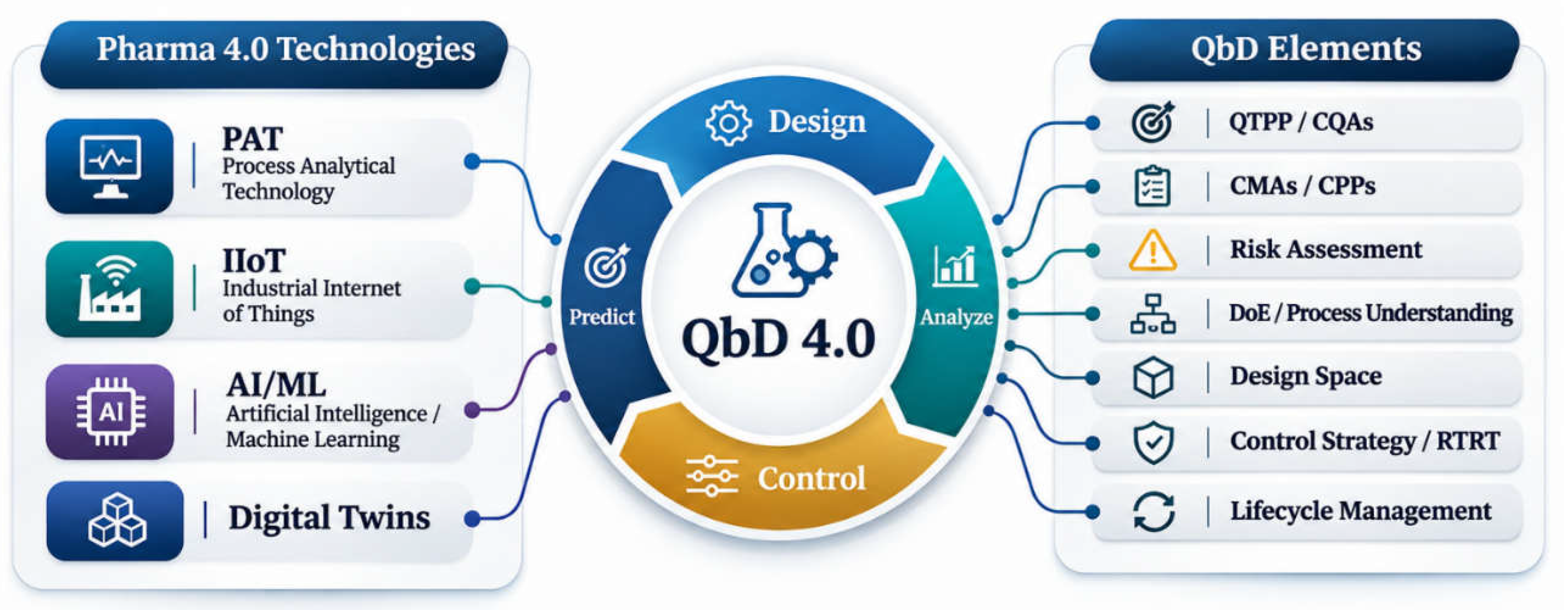

Table 1.
Eligibility criteria for the selection of literature relevant to QbD and Pharma 4.0 technologies.
Table 1.
Eligibility criteria for the selection of literature relevant to QbD and Pharma 4.0 technologies.
| Criterion | Inclusion | Exclusion |
|---|---|---|
| Publication type | Original research, relevant reviews, official regulatory guidance and standards | Duplicate records and irrelevant publication types |
| Application | Pharmaceutical or biopharmaceutical development, manufacturing, monitoring, control, or quality assurance | Applications without meaningful pharmaceutical relevance |
| Technology | PAT, IIoT, AI/ML, digital twins, or combinations of these | No relevant technology connection |
| Quality relevance | QbD, pharmaceutical quality, validation, or regulatory implications relevant to the review objectives | No meaningful connection to the review objectives |
| Language | English | Non-English publications |
| Full-text assessment | Sufficient information to assess eligibility and extract relevant evidence | Retrieved reports excluded when they fail the eligibility criteria |
Table 2.
Mapping of QbD elements to Pharma 4.0 technologies.
| QbD element | Conventional QbD | PAT | IIoT | AI/ML | Digital twins |
|---|---|---|---|---|---|
| QTPP/CQAs | Defined CQAs; offline testing | In-line CQA monitoring (P) | No direct evidence | ANN limits linked to bioequivalence (C) | No direct evidence |
| CMAs/CPPs | Development ranges; periodic monitoring | In-line viscosity and temperature (P) | Sensor connectivity (L) | CPP identification (L) | No direct evidence |
| Risk assessment | FMEA; expert judgement | Risk-based monitoring (P) | No direct evidence | CPP ranking; explainability (L) | Conceptual sensitivity analysis (X) |
| DoE/process understanding | Factorial/RSM DoE | DoE with multivariate analysis (P) | No direct evidence | ANN/ML-DoE outperformed regression in one study (L) | No direct evidence |
| Design space | Development-defined ranges | NIR-supported scale-up (P) | No direct evidence | ANN-derived limits assessed using GMP batches (C) | Proposed; experimental confirmation needed (X) |
| Control strategy/RTRT | Set-points; end-product testing | NIR/Raman; limited closed-loop evidence (P) | Laboratory predictive control (L) | Predictive control and anomaly detection (L) | Proposed real-time prediction (X) |
| Lifecycle management | Periodic review; change control | CPV; drift/transfer oversight (L) | Data-integrity systems; limited validation (L) | NLP-supported document linkage (L) | Proposed model governance (X) |
| Overall evidence | Established practice | Mainly pilot-scale; freeze-drying at production scale | Mainly laboratory/pilot | One reported GMP-scale study; mostly early-stage evidence | Mainly conceptual; one supply-chain study [49] |
Evidence level: C, commercial/GMP; P, pilot-scale; L, laboratory/experimental; COMP, computational; R, review-level; X, conceptual. Evidence levels indicate the strongest implementation maturity reported and should be interpreted separately from validation strength. Abbreviations are defined in the table and main text.
Table 3.
PAT applications across pharmaceutical processes and product types.
| Application area | PAT tools and monitored attributes | Reported outcome and evidence maturity | Ref. |
|---|---|---|---|
| OSD: bilayer FDC tablets | In-line NIR–PLS; granule bulk density and ribbon density; DoE and MVA | Scale-up to 5,000 tablets; bioequivalence reported. Commercial deployment not reported. | [64] |
| HME | NIR, Raman, UV–Vis, rheometry; PCA, PLS, ML and SPC; API content, solid state and melt properties | API prediction RMSEP approximately 0.6–1.5%; mainly laboratory and pilot evidence. | [58] |
| Freeze-drying | Temperature sensors, PRT/MTM/DPE, TDLAS, Pirani/Baratron, QMS, NIR and Raman; temperature, sublimation, endpoint and moisture | Batch-level tools used at production scale; single-vial and spectroscopic tools mainly at research stage. | [54, 66] |
| Vaccines and biologics: upstream and formulation | NIR, MIR, Raman, NMR, DLS/MALS and FBRM/PVM; metabolites, adsorption and particle size | Closed-loop metabolite control demonstrated; evidence predominantly small-scale. | [14] |
| Biologics: downstream processing | Raman, NIR, MIR, UV, LSPR, HPLC/MS and CNN–Raman; protein concentration, aggregates, charge variants and breakthrough | Increasing in-line evidence, but commercial-scale adoption remains cautious. | [51] |
| AI-integrated QbD | ML/DL, NLP, SHAP/LIME and edge–cloud systems; hardness, dissolution deviations and sterility-related factors | Source-reported reductions of approximately 18% in out-of-specification batches and 12% in rejections; evidence based on brief pilot/industrial case summaries. | [67] |
Table 4.
IIoT-Specific Implementation Challenges Identified in the Reviewed Studies.
| Barrier | Evidence from the reviewed studies | Ref. |
|---|---|---|
| Latency and computational demands | A reported control system achieved a mean solution time of 0.7 s within a 1 s sampling interval, while the UF/DF analytics cycle was 40 s. These values illustrate the timing requirements of different connected applications. | [75] |
| Cost and portability | Point-of-care manufacturing sites may lack dedicated quality-control laboratories, complicating decentralised quality verification. | [80] |
| Workforce and regulatory readiness | The reviewed work identifies needs for workforce training, harmonised terminology, additional PAT tools and clearer regulatory guidance. | [22] |
| Technology maturity and integration | The ledger-based traceability pilot remained pending, modules were not interconnected, and GMP requirements for point-of-care sites remained unresolved. | [80] |
Table 5.
AI/ML applications across the QbD lifecycle and reported evidence levels.
| Application | AI/ML approach and validation | Key reported findings | Evidence level |
|---|---|---|---|
| Tablet specifications and design space (BCS class IV drug) | ANN; 33% holdback; three GMP exhibit batches | R² > 0.94; approximately 5% dissolution prediction bias; bioequivalence achieved | C: GMP exhibit-batch evidence [84] |
| Gelatin and lecithin/chitosan nanoparticles | ANN with DoE; cross-validation reported for gelatin nanoparticles | R² close to 1 for gelatin nanoparticles; drug-release prediction | L: Laboratory [85] |
| Polymeric nanoparticles for transdermal delivery | ML-integrated DoE compared with regression | Lower RMSE and higher validation R² | L: Laboratory [82] |
| Carbopol emulsions | ANN with training, validation, and test sets | Strong predicted–experimental correlation | L: Laboratory [83] |
| Tablet under development | Human-in-the-loop ML | Improved performance and quality reported | P: Development stage; scale unreported |
| Continuous/biopharmaceutical manufacturing and sterile-product inspection | Soft sensors, MSPC, MPC, computer vision, and reinforcement learning | Multiple applications; quantitative benchmarks unavailable in secondary sources | R: Review-level [81, 87] |
| CQA prediction and regulatory information management | Deep learning, NLP, SHAP and LIME | R² ≈ 0.93 versus 0.81 for factorial DoE and 0.84 for regression; p < 0.01 reported | COMP: Computational analysis using simulated, historical, and pilot-scale data [67] |
Table 6.
Digital twin maturity levels classified by decision-making function.
| Maturity level | Function | Human role | Key credibility requirements |
|---|---|---|---|
| Descriptive | Reconstruct the current state through soft sensing, monitoring and process-verification support | Human interprets results and acts | Input-data quality and estimator accuracy |
| Predictive | Forecast CQAs and potential design-space excursions; inform assessment of readiness for RTRT | Human makes decisions based on predictions | Independent validation and prediction uncertainty |
| Prescriptive | Optimize set-points, respond to disturbances and support diversion decisions | Human reviews and approves recommendations | Model-form sensitivity and consequences of decisions |
| Autonomous | Execute closed-loop control within a verified design space | Oversight by exception | Highest level of risk assessment, fail-safe mechanisms and change control |
Table 7.
Integration case studies and remaining evidence gaps.
| Application | Demonstrated capabilities | Key evidence gaps |
|---|---|---|
| Continuous manufacturing | PAT, automated feedback and model-based control | Integrated digital twins and validated adaptive control |
| Biologics [100] | In-line spectroscopy, soft sensors and analytics | Unified data provenance and model governance |
| Modular manufacturing | Continuous-flow production, point-of-care verification and connected monitoring | GMP compliance, sterility and multi-site oversight |
Table 8.
Digital maturity ladder for QbD 4.0.
| Stage | QbD 4.0 capability | Evidence status | Gate before progression |
|---|---|---|---|
| 1. Computerisation | Validated systems and electronic batch and laboratory records | Established practice | Data integrity and validated state |
| 2. Connectivity | Interoperable systems, historians and traceable records | L–P | Reliable interfaces and data provenance |
| 3. Visibility | Time-resolved PAT data, soft sensors and digital representations of CPPs/CQAs | P | Calibration transfer and drift management |
| 4. Transparency | Multivariate analysis, explainable ML and risk-based parameter assessment | L; C | Independent test data and documented interpretability |
| 5. Predictive capacity | CQA forecasting, design-space excursion prediction and advisory RTRT | X–L | Defined context of use, model-risk assessment and confirmatory testing |
| 6. Adaptability | Governed closed-loop control within a verified design space | X | Validated fallback, qualified oversight and appropriate change control |
Note: C, commercial/GMP-scale evidence; P, pilot-scale evidence; L, laboratory/experimental evidence; X, conceptual or proposed capability. Combined labels (e.g., L–P and X–L) indicate evidence spanning the respective categories. Evidence categories indicate implementation maturity rather than overall study quality.
Table 9.
Key regulatory frameworks relevant to QbD 4.0.
| Framework or document | Status or scope reported in the manuscript | Relevance to QbD 4.0 |
|---|---|---|
| ICH Q8(R2), Q9(R1), Q10 | Final guidelines | Pharmaceutical development, risk management and quality systems |
| ICH Q12 | Final guideline | Post-approval change management and PACMPs |
| ICH Q13 | Final guideline | Continuous manufacturing and process models |
| ICH Q14 and Q2(R2) | Final guidelines | Analytical procedure development and validation |
| ICH M15 [110] | Final ICH Harmonised Guideline (Step 4, adopted 29 January 2026); FDA final guidance published June 2026 [110] | General principles for planning, evaluating, and documenting model-informed drug development evidence; not specific to manufacturing process control |
| FDA PAT framework | Final framework | Process understanding and real-time quality assurance |
| FDA Emerging Technology Program and Advanced Manufacturing Technologies Designation Program | Regulatory engagement and designation pathways | Support for eligible innovative manufacturing technologies |
| FDA AI regulatory-decision guidance [107] | Draft Level 1 guidance, January 2025; non-binding and not for implementation [107] | Risk-based credibility assessment for AI models used to support regulatory decisions on drug/biological product safety, effectiveness, or quality |
| EMA AI reflection paper [108] | Final reflection paper adopted September 2024 [108] | AI/ML considerations across the medicinal-product lifecycle; read alongside applicable law and product-specific requirements |
| Joint EMA–FDA Good AI Practice principles [109] | Published January 2026; non-binding principles [109] | Human-centric design, risk-based assessment, data governance, model lifecycle management, and oversight across drug development |
| EU GMP Chapter 4, Annex 11 and proposed Annex 22 [111,112] | Draft revisions/new annex published for consultation in July 2025; EMA held an expert workshop in June–July 2026 and published its report in October 2026. This is not evidence that the annex is final [111,112] | Proposed controls for documentation, computerized systems, data integrity, cybersecurity, and AI/ML lifecycle management |
| WHO data-integrity guidance | Final; 2021 | Data integrity and traceability |
| India Revised Schedule M | Notified in 2023; applicable deadlines vary | Quality systems, risk management and validation |
| PMDA innovative manufacturing activities | Activities reported for 2016–2024 | Regulatory engagement on emerging manufacturing technologies |
Table 10.
Major barriers to QbD 4.0 implementation and proposed mitigation strategies.
| Barrier | Evidence and mitigation |
|---|---|
| Model reliability and transfer | Raman–PLS calibration transfer achieved an RMSEP of 0.94–0.97% for ketoprofen and clotrimazole in hot-melt extrusion model validation [58]. Monitor drift, define transfer limits and independently verify models at GMP scale [67]. |
| Data and scalability | One reported study verified AI-derived limits at GMP scale; deep learning improvement was demonstrated using approximately 15,000 data pairs [67]. Use representative datasets, hybrid models where justified and prospective validation. |
| System integration | Proprietary platforms and inadequate instrumentation complicate connectivity [100]. Use interoperable interfaces, such as OPC UA, and evaluate retrofits in shadow mode [49]. |
| Cybersecurity | Risks associated with connected control systems remain insufficiently quantified in the reviewed evidence. Apply network segmentation, IEC 62443 principles and system-specific security testing. |
| Workforce and governance | Data silos, unclear responsibilities and skills gaps hinder adoption [22]. Establish data governance, role-specific training and clear accountability. |
| Regulatory uncertainty | Evolving AI expectations and the absence of an identified dedicated pharmaceutical digital-twin standard complicate implementation [23]. Engage regulators early, maintain version control and apply risk-based model assessment and change management. |
| Economic feasibility | Evidence on end-to-end implementation costs and ROI is limited. Evaluate costs and measurable benefits against documented baselines before scaling deployment. |
Table 11.
Emerging directions and evidence gap in QbD 4.0.
| Direction | Potential application | Current evidence and research priority |
|---|---|---|
| Generative and agentic AI | Support knowledge retrieval, experimental planning and selected development tasks. | Exploratory evidence; establish human oversight and controlled evaluation. |
| Foundation models for process data | Integrate heterogeneous process, analytical and historical datasets. | Limited primary manufacturing evidence in the reviewed source set; assess transferability and reliability. |
| Federated learning | Develop models across sites without centralising raw data. | Demonstrated in other pharmaceutical research contexts, including quantitative structure–activity relationship (QSAR) modelling, but not established here as a manufacturing solution. |
| Edge AI | Enable low-latency monitoring near manufacturing equipment [67]. | Requires verification, cybersecurity controls and lifecycle management. |
| Sustainable manufacturing | Optimise energy use, material consumption and waste. | Quantified benefits were not established in the reviewed evidence; use measured environmental endpoints. |
| Personalised and point-of-care manufacturing | Support decentralised production and smaller, tailored batches [80]. | Feasibility has been explored, but robust decentralised quality systems remain a challenge. |
Disclaimer/Publisher’s Note: The statements, opinions and data contained in all publications are solely those of the individual author(s) and contributor(s) and not of MDPI and/or the editor(s). MDPI and/or the editor(s) disclaim responsibility for any injury to people or property resulting from any ideas, methods, instructions or products referred to in the content. |
© 2026 by the authors. Licensee MDPI, Basel, Switzerland. This article is an open access article distributed under the terms and conditions of the Creative Commons Attribution (CC BY) license (http://creativecommons.org/licenses/by/4.0/).
Copyright: This open access article is published under a Creative Commons CC BY 4.0 license, which permit the free download, distribution, and reuse, provided that the author and preprint are cited in any reuse.